Showing posts with label Anne Hathaway. Show all posts

Monday, November 17, 2014

Interstellar (2014)

It’s been a good month for science – we landed on a comet, Big Hero 6 brought scientific imagination to the Disney crowd, and the Internet was able to withstand the gravitational pull of Kim Kardashian’s bottom.  But leave it to Christopher Nolan to outdo all of the above by treating us to what a true filmmaker can do with his own material and his own vision.

Matthew McConaughey stars as Cooper, a top pilot turned farmer in the midst of a total collapse of the earth’s ecosystem.  Without giving away too much of the plot, Cooper is torn between his loyalty to his daughter Murph (Mackenzie Foy) and the initiative spearheaded by Professor Brand (Michael Caine) and his daughter Amelia (Anne Hathaway), which promises hope for humanity among the stars.

Interstellar is, to be quite blunt about it, Inception meets 2001: A Space Odyssey, combining Kubrick’s science-fictional aesthetics with Nolan’s knack for tight and highly personal storytelling.  Where 2001 lacked humanity amid god-babies and monoliths, and where Inception delved deep into an individual’s dreamspace, Interstellar opens the scope considerably, beyond galaxies, while never forgetting the heart of the story is Cooper’s love for his family.  This, I think, will be the crux of Nolan’s oeuvre – high concept anchored by a deeply personal love story (especially, more recently, the love of a father for his children).

It’s been six years since Christopher Nolan’s last wholly original film – with 2012’s The Dark Knight Rises in between, concluding his take on the mythic DC Comics character – and as much as I loved his Batman films I couldn’t be more excited that Nolan is doing his own work again.  By way of disclaimer, I do feel a bit like a devout churchgoer when I attend a Nolan film, seated quietly as the lights dim and expecting to receive some enlightenment or at least feel the touch of the divine.  Nolan hasn’t disappointed me yet, and I appreciate his emphasis on the cerebral.  Nolan is, for my money, one of only a handful of “directors to watch,” whose output has been consistently strong and who deliver a stable brand of films.

Interstellar is through and through a Christopher Nolan product, which is to say that it continues to develop his major themes, continues to push the envelope in terms of practical effects, and does so in a very smart way that resists the puzzle-box style of Inception while preserving that film’s investment in dense scientific concepts.  That is to say, Interstellar isn’t a rigorous intellectual workout like Inception, but it isn’t any less clever for being more temporally straightforward; Nolan is still interested in the relative experience of time, but it’s grounded more in Einstein than in Freud.  It is the high science-fiction followup to Inception that I wanted from Transcendence, but Wally Pfister – Nolan’s frequent cinematographer – gave us more an impression of than a exercise in Nolan’s brainy auteurism.  Interstellar doesn’t just look like a Nolan film (as Transcendence did); it thinks like one, and it even feels more deeply than Nolan films usually do.

The heart of the film – and indeed, it has one – comes from McConaughey’s love for his daughter, and The New Yorker couldn’t have been more right when they dubbed this stage of his career “The McConaissance.”  There’s a moment in the film where I thought to myself, “This is the same guy from How to Lose a Guy in 10 Days?”  I wouldn’t be averse to seeing McConaughey join the troupe of Nolan staples, as Michael Caine has (and, to a lesser extent, Hathaway).  Nobody in the film is bad – Jessica Chastain continues to be reliably compelling in everything from Zero Dark Thirty to Mama, and John Lithgow does crotchety-old-man quite well.  McConaughey, though, is the emotional center of the film, perhaps a step in the evolution of a filmmaker who’s been accused of being a sort of cinematic Tin Man.

Interstellar is Nolan at his biggest and most expansive, his longest film to date but also his most emotional, leading to a few misty-eyed moments.  I don’t think it’s his best – Inception is still a masterpiece, and The Dark Knight is just consummate filmmaking – and it is a little bit long, though I struggle to see what could have been cut from a movie as tightly crafted as this one.  What it undeniably is, though, is another strong creation from a big-budget auteur with an unmistakable vision and a profound understanding of the value of cinematic spectacle.  Your eyes may mist, but they’ll be wide in astonishment.

Interstellar is rated PG-13 for “some intense perilous action and brief strong language.”  Like most Nolan movies, Interstellar is entirely bloodless; there are a few explosions, fistfights, and tidal waves, including one very successful jump moment.  Two F-bombs are heard, and there is a pervading sense of just how dangerous space travel is.

Thursday, January 10, 2013

Les Misérables (2012)

I’m of two minds regarding Tom Hooper’s Les Misérables, the Oscar-bait adaptation of the long-running musical.  There are good things to say about the film, but the delivery of the movie’s technical aspects is so distracting that I came away feeling a bit disappointed.

You know the story, adapted from Victor Hugo’s sprawling epic about French justice and revolution:  Former convict Jean Valjean (Hugh Jackman) is doggedly pursued by Inspector Javert (Russell Crowe) for breaking parole after serving 19 years for stealing a loaf of bread.  After experiencing God’s mercy, Valjean builds a new life for himself, raising the daughter of his late employee Fantine (Anne Hathaway).  The film reaches its third act when the daughter, Cosette (Amanda Seyfried), falls in love with brave young revolutionary Marius (Eddie Redmayne), embroiling Valjean and Javert in a conflict larger than themselves.

Preliminary disclaimer:  I’d never seen the musical version before, though I’ve read the novel and seen the mostly successful Liam Neeson/Geoffrey Rush film version.  I’m aware that the following “Why is there so much singing in a musical?” is a bit like bemoaning a Superman film for too much flying.

But the singing in the film doesn’t always work.  It’s been my custom to review musicals by musical number, of which there are two kinds in this sung-through musical:  full and distinct pieces, and interludes where the dialogue is sung.  Consequently, a movie where nearly every word is sung is difficult to break down in paragraph form.  There are some standout pieces, to be fair; Hathaway is heart-breaking with “I Dreamed a Dream,” a despairing ode that would drive even the stone-hearted Pharaoh to tears and will likely garner her an Oscar nod – if not a win – come February.

In the scene-stealer category, we have a surprisingly delightful “Master of the House,” featuring Sacha Baron Cohen and Helena Bonham Carter as crooked innkeepers.  As the Thénardiers, Cohen and Carter recur throughout the film (always unexpectedly, always agreeably) but take center stage in this giddy revelry in corruption, reminiscent of their deliciously evil turns in Sweeney Todd.  Their enchanting abilities were never truly in question, but the unanticipated levity their presence brings helps to alleviate some of the grim and unsuccessful elements of the film.

The film’s bleakness isn’t inherently a fault; truth be told, Hugo’s novel is a depressing one.  Les Mis conveys that quite well; in spite of the distracting talk-singing, Jackman and Crowe are both quite good in their roles as tortured and torturer, conveying a wide range of subtle emotions and conveying characterization past the singing that would tell rather than show.  Indeed, the greatest success of the film is that Jackman and Crowe manage to emote past their distracting tendency to sing every word; it’s almost as though there’s a better movie in here somewhere, if only the singing were reined in or at least less operatic.  I wonder, for example, why you cast someone like Russell Crowe, who plainly can’t sing, opposite Hugh Jackman, whose musical theater pedigree is significant and self-evident.

What the film doesn’t do well is provide the counter to the tragedy; though Hooper isn’t wallowing in sadness, the purported ray of sunshine falls flat.  Yes, the Thénardiers are a delight each time they appear, but the film offers as its source of optimism the uncompelling relationship of Cosette and Marius.  Seyfried is squandered as Cosette, reduced to nothing more than a pretty face on which Marius pins his hopes – hopes which he quickly abandons in favor of his duty.  Marius, too, gives voice to the meaninglessness of his comrades’ deaths (a moment when less singing would have meant more emotional weight), but the saccharine wedding scene that follows feels forced and unconvincing.  Redmayne clearly has love in his eyes when he looks at Cosette – leading me to wonder when this actor’s “moment” will come – but Cosette doesn’t requite it as well as I’d like.

Which gets me back to the central problem of Les Mis – the sense of imbalance.  Hooper’s direction is quite distracting in moments, as when he rapidly zooms in on a soloist like the end of the line on a roller coaster.  These disorienting moments felt more at home in the grand guignol surrealism of Sweeney Todd but never quite fit in this mostly realistic piece.  In short, the movie is too theatrical, too operatic, to work within the confines of a film.  Like Danny Boyle with Frankenstein, perhaps Hooper would have been better served by moving his production to the stage.

I don’t like being the guy who pulls apart a multimillion-dollar movie from behind a hundred-dollar laptop, but there are things that work in this film and there are things that don’t.  Perhaps this film is not made for someone like me (buzz indicates it’s certain to clean up at the Oscars), but for my money the film does not succeed in the same way that Sweeney Todd did.

Les Misérables is rated PG-13 “for suggestive and sexual material, violence and thematic elements.”  Prostitution is implied during the story, and we see one exchange with no nudity.  The June Rebellion is depicted with several deaths by gunfire, some with bloody sprays (though nothing on the order of Django Unchained).  I have yet to know what “thematic elements” are.

Friday, August 31, 2012

The Dark Knight Rises - EPIC Review

Enough time has passed, I believe, that a more extensive and more specific look may be taken at Christopher Nolan’s The Dark Knight Rises.  In the tradition of 2008’s “Epic Review” of The Dark Knight, I’ll be discussing more in depth what I enjoyed about the film, which will inevitably entail spoilers of both general plotlines and specific dialogue which I’ll invoke.  The goal is, I hope, to provide a more detailed assessment of the film beyond my earlier review which gushed over the technical aspects of the film but could only allude to the story and its effect on me.  For safety’s sake, the bulk of the review can be found after the jump; those reading this review from anywhere other than the front page will be advised that spoilers begin below the first image in this review.

I cannot stress this enough:  if you have not seen The Dark Knight Rises yet, do not read any further.  The success of the film depends wholly on allowing it to develop at its own pace; any spoilers therein would detract from the overall experience.

Friday, July 20, 2012

The Dark Knight Rises (2012) -- Spoiler Free

I mused yesterday about whether or not Christopher Nolan could create a successful and fully realized trilogy – something no superhero director, for one reason or another, has been able to do.  After attending a midnight showing of The Dark Knight Rises, the verdict is in.

He has.

In many ways, I would have been able to write the bulk of this review without ever having seen the film.  I was expecting to gush.  I was anticipating that feeling of being blown away.  I had few (if any) doubts in the back of my mind.  And ordinarily a film which fulfills expectations might ultimately be a disappointment.  But when expectations are this high, merely meeting them is worth the price of admission.

And The Dark Knight Rises, impossible as it may seem, even exceeds expectations.  One might even say it “rises” to the challenge.

I’ll forego the usual plot summary in deference to the cloud of secrecy and spoiler embargoes necessitated by our digital age (even our late night talk shows were thought to be dangerous).  Suffice it to say that The Dark Knight Rises joins Gotham eight years after the death of Harvey Dent, eight years after Batman entered a self-imposed exile, and just as new foes are rising to threaten the very foundations of Gotham City and its new era of peace.

Of the performances, I can only quote the words of Stan Lee – “Excelsior!”  Bale bears the bulk of the film – no surprise here, since he’s playing the eponymous Knight; as has been the case with the past two films in “The Dark Knight Trilogy,” the focus is as much (if not more so) on Bruce Wayne as on Batman.  His character evolves without ever feeling forced to do so, his quest both understandable and relatable, and his return to the Batsuit a welcome and applause-worthy moment.

Bale’s backed by a cast that doesn’t disappoint.  The old favorites – Michael Caine as Alfred, Morgan Freeman as Lucius Fox, and Gary Oldman as Jim Gordon – continue to turn in solid performances.  Bonus credit to Caine, who manages to do create (particularly in two specific scenes) a real and accessible version of the trusty butler that hasn’t been reached in the character’s seventy-year history.  More than just the snarky chauffeur or stolid voice of reason, Caine’s Alfred is a friend first, as much a father as Thomas Wayne was, and we feel his agony when he sees what Bruce has allowed himself to become.

As for the new faces, they’re welcome additions to the cast.  I see now why we needed so many new faces, and I’m glad especially that Joseph Gordon-Levitt was among them.  His John Blake is easily the most interesting new protagonist (more on the villains later), embodying many of the film’s – and trilogy’s – main themes without ever feeling shoehorned into an already full film.  I’ve said it once and I’ll say it again:  JGL is bound for stardom (if he’s not there already), and The Dark Knight Rises is another fantastic line on the résumé.

But after Heath Ledger’s unforgettable turn as The Joker, can the film’s villains surpass the decade’s most iconic force of evil?  Honestly, probably not, but Tom Hardy’s Bane and Anne Hathaway’s Selina Kyle (note that the name “Catwoman” is surprisingly never invoked) aren’t trying to outdo their predecessor.  Rather, they create entirely new – and gratefully fresh – versions of significant members of the Batman mythos.  More surprising than Hardy’s Bane is what Anne Hathaway manages to do with Selina; it’s a performance I didn’t quite know she had in her, managing to distinguish herself from the Catwomen before her with breathy intonations and evident internal conflict.  Bane, however, is head-to-toe conviction; though he’s given the unenviable task of emoting with much of his face obscured, Hardy manages to convey through his body language the smug self-satisfaction and confident physical dexterity for which his character is known.  (A fuller take on his voice remains to be seen; though it has been lampooned ad infinitum, I suspect my theater’s audio system wasn’t equipped for the booming bass of the film, and so I’ll have more thoughts on that later.)

But what’s most remarkable about The Dark Knight Rises is not the able work delivered by qualified thespians.  The greatest compliment I can pay the film is to repeat what I’ve already said time and time again – Christopher Nolan is a master storyteller who wastes not a frame of film in delivering his definitive statement on the character and what he means.  As before, The Dark Knight Rises is filled with moments that tie together and layer new meaning on important scenes; conversely, perhaps the worst thing I can say about the film is that it doesn’t stand on its own as well as The Dark Knight did.  Indeed, The Dark Knight Rises is very closely related to Batman Begins, revisiting moments and referencing plot beats in a way that echoes without plagiarizing.  But as the final installment in the trilogy (and not just a sequel, as The Dark Knight was initially envisioned), Nolan rewards his viewers just as Lucius Fox was rewarded in The Dark Knight for his faith in Batman’s mission.

If Batman Begins could be distilled to a meditation on overcoming fear, and if The Dark Knight can be said to be a film about defeating the forces of chaos and conquering fear which has escalated into weaponized terror, The Dark Knight Rises is about precisely that – about rising, about overcoming once more.  But here Nolan makes explicit what’s been suggested all along:  the greatest heroism in the world is born through hope, both the hope that an individual can make a difference and that that difference will be a positive one.  And though I’m much more attached to films which engage me on a cerebral level – which this film does, unequivocally – The Dark Knight Rises also makes me feel, deep inside of me, that there is always hope.  It’s a film that made me shed a few tears for a variety of reasons – finality, sorrow, ecstasy, unrestrained jubilation – and it’s a credit to Christopher Nolan that I do not begrudge him a single salty drop.  He has earned it.
The Dark Knight Rises is rated PG-13 “for intense sequences of violence and action, some sensuality and language.”  Violence and all-out action sequences are prevalent as before but are almost entirely bloodless, though Bane’s methods and physicality are more brutal than we’ve seen in the trilogy thus far.  There is one clearly implied sexual encounter, with no more than bare shoulders, while another character is implied to be a prostitute; Selina is extremely sultry and uses that to her advantage, without transgressing beyond an astonishingly tight suit.  Language is mostly tame and is probably PG-quality taken on its own.

Rest assured, loyal readers, I haven’t said my last words on The Dark Knight Rises.  I saw The Dark Knight eight times in theaters, and I am certain repeat viewings of this film will come in the days to follow.  And once the statute of limitations on spoilers has been lifted, I’ll give more in-depth comments on specific moments in the film and the thematic importance of the trilogy as a whole.  Stay tuned, loyal readers – we return on Monday with our regularly-scheduled “Monday at the Movies” post!

Saturday, March 6, 2010

Alice in Wonderland (2010)

I should begin by saying there isn't anything wrong with Tim Burton's Alice in Wonderland. But.
That's admittedly a strange way to begin a review, but Burton's version of the Lewis Carroll stories (equal parts remake and sequel) is admittedly a strange movie.

In this version, Alice (fresh face Mia Wasikowska) is 19, facing a less-than-exciting engagement and befuddled by recurring dreams of Wonderland in all its smiling-cat glory. After ditching her would-be fiance for a white rabbit (Michael Sheen, famous as David Frost in Frost/Nixon) in a waistcoat, Alice falls down the rabbit hole, and the classic hijinks ensue - tense confrontations with the decapitation-prone Red Queen (Helena Bonham Carter, replete with a digitally enhanced cranium), a zany tea party with The Mad Hatter (Johnny Depp), and a duel with the monstrous Jabberwocky (voiced with gusto by Christopher Lee).

I began the review as I did because I want to make it clear that the movie is as fun and enjoyable as most anything with Tim Burton's name on it. I also wanted to make clear that my disappointment with the movie doesn't hinder its capacity to be enjoyed by filmgoers. Okay, that's complicated - how can a movie's main flaw not be a flaw at all? Let's unpack that.

Beginning with the good news - the cast is vivacious and delightful as always. Johnny Depp gets his name before the title of the movie, likely because of his star power; his quirky eccentricities and a heavy dose of pathos in his backstory contribute to a fresh spin on the character, distancing him from the stereotypical nutjob as fully as Depp inhabits the character (which, like all his roles, is a complete immersion). HBC jokes that she plays in all of Burton's films because she's his wife, but the incontrovertible truth is that she's at her best when she's playing a completely disjointed person like the Red Queen; her first scene (in which she interrogates several frogs-in-waiting about her missing cranberry tarts) sets the stage for a mentally unhinged portrait, and her repeated cries of "Off with his/her/their head!" will make any filmgoer giggle with glee. As the White Queen (Red's sister), Anne Hathaway is - in Alice's parlance - "curiouser and curiouser," because I'm still not sure what to make of her; Hathaway bounds about the screen with the angelic grace of a waltz for one, but there seems to be a bit of madness ready to slip out at inopportune moments. Certainly this is an all-star cast (yes, that's Alan Rickman as the Caterpillar, here named Absolem), but keep your eyes on scene-stealer Matt Lucas, who ably juggles the dual role of eggbodied twins Tweedledum & Tweedledee (or is it the other way around?).

Screenwriter Linda Woolverton does a clever job of weaving a new through-line into the classic story; it's not spoiling anything to say that Alice is called upon to battle the Jabberwocky and dethrone the Red Queen, but there's a slyness at play that puts a new relevance on familiar occurrences. The Cheshire Cat matters more in this version; no longer is he just a grinning feline evaporating in the trees, but he's now a turncoat seeking redemption at every turn; similarly, the Mad Hatter's not mad per se, but he's getting there. Hats off (pardon the pun) to Woolverton, who also turned Hamlet into The Lion King.

So there's nothing really wrong with the movie, but here comes the bad news. The bad news is that Burton could have done much better. Again, that isn't to say that the movie's bad or missteps in any places, but there's a certain feel to the movie that doesn't quite match the Tim Burton style (wildly imaginative and visually disorienting in a Rembrandt kind of way). Maybe it's his fidelity to the source material; though the film has a smart new story arc, I have the same complaint about this one that I did about Charlie and the Chocolate Factory. That is, there are certain story beats that any adaptation simply must hit, and there's a fine line there between pulling it off and feeling unimaginative; Alice has its moments, but it often feels like we're moving from room to room on a predestined chocolate factory tour.

Similarly, I felt like Depp was holding back in a lot of places; his Mad Hatter could have been so much more. What we get isn't bad - the decision to speak in a Scottish accent whenever provoked to anger is new and different - but perhaps I've come to expect too much. It's classic Depp, but perhaps "classic Depp" is last year's style. The film is "Classic Burton," too, but it never quite pushes the limit of what I've come to expect from the director. I've always considered 2007's Sweeney Todd to be the movie Tim Burton had been gearing up for his entire life, so it's a tough act to follow in that respect.

I can't say that anyone did any wrong here. Perhaps Depp and Burton's creative juices are on hold after Sweeney Todd (which, no matter what one feels about the movie as a musical, has to be awarded a medal for ambition and enthusiastic execution). Perhaps Disney held the reins too tightly on Burton and Co. (a slapdash nod to the 1951 animated version feels like the kind of overt nod that Burton's usually more subtle about). Whatever the case, I remain pleased but disappointed (if one can feel those two emotions at once) with Alice in Wonderland and look forward to Burton's next pairing with Depp - an adaptation of the campy vampire soap Dark Shadows.

Alice in Wonderland has one of the strangest ratings of all time - "PG for fantasy action/violence involving scary images and situations, and for a smoking caterpillar." I mean, I guess that makes sense.

Saturday, June 21, 2008

Get Smart (2008)

Would you believe "best movie of the year"? No. Would you believe "funniest movie of the year"? No. Would you believe "so-so espionage farce with a few good chuckles"?

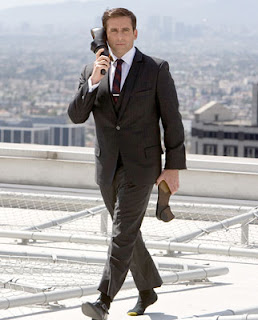
That's approximately my assessment of Get Smart, a movie that unfortunately let all of the good parts out of the bag with its marketing campaign. A sequel/update of the classic television series of the same name, Get Smart is a spy farce in the tradition of Austin Powers with Steve Carrell as the imperfect Maxwell Smart, Agent 86 in CONTROL.

When Smart is promoted by The Chief (Alan Arkin, perhaps the funniest actor in the movie), he teams up with sexy superspy Agent 99 (an incredibly gorgeous Anne Hathaway) and the suave Agent 23 (Dwayne Johnson, who is still "The Rock" even if he drops the nickname from his credits) to fight the forces of KAOS and its pseudo-leader Siegfried (Terence Stamp, who's again as out of place here as he was in Elektra). Obligatory references to the original TV show, half-hearted laughs, and spectacular explosions ensue.

Something tells me this movie would have been funnier if I hadn't seen the trailers, although call that the "Cinema King Paradox" - too-good trailers ruin a movie, but I wouldn't see a movie if I didn't like the trailers. Go figure. The problem here is that all the funny moments, punchlines, and slapstick choreography have been spoiled by the trailers, which contain the best parts of the film. One notable exception - Alan Arkin delivers a line near the end of the film that made me about fall out of my chair. Oh, yeah, that and crunchy pudding. And a hysterical cameo by Patrick Warburton (Puddy) as... well, I won't ruin it. Best casting since Heath Ledger as The Joker, though.

(Speaking of The Joker, I was inordinately thrilled by the presentation of the "Happy Trails" trailer for The Dark Knight which appeared before my screening of Get Smart. Available at http://whysoserious.com/happytrails for those poor folks who haven't seen it yet.)

Perhaps part of the problem is that Get Smart tries to be a serious espionage story with injections of comedy. What's then disorienting about that is that the film falls into all the spy tropes - feuding partners who fall in love, a surprise double agent (whose identity I predicted even before the story introduced the threat of a double agent), the villain's henchman who develops a conscience, &c - without adequately poking fun at these cliches --- something the Austin Powers scene did brilliantly. [I still crack up at the scene where Dr. Evil's son asks him of Austin Powers, "Why don't you just shoot him?!"]

There aren't as many laughs as the trailer would lead you to believe, and if you've seen the trailer, you've already seen the best parts of the movie. But there's something to be said for a movie that contains a ton of explosions, something a filmgoer such as myself can always appreciate. It's just that I was looking for something a little more substantial in a movie this weekend. Of course, it was between this and The Love Guru, so I think my choice was fairly obvious.

Oh, well. Missed it by that much.

Wednesday, May 28, 2008

Brokeback Mountain (2005)

I'm still not quite sure what to make of Ang Lee's critically lauded Brokeback Mountain. At the insistence of a few friends and the confidence in Heath Ledger's acting ability that I acquired like a booster shot thanks to the trailers for The Dark Knight (in which Ledger plays the best damn Joker, period), I finally gave the movie a try.

And the jury's still out on the movie for me.

In his essay "In Critical Condition," David Bordwell draws a distinction between "an excellent film" and a film that is "to your liking." (I direct you to the entire article, a fascinating look at how movies are reviewed and analyzed: http://www.davidbordwell.net/blog/?p=2315. Thanks, Karl.) This is the distinction I've been trying to sort out with this, the story of a complex love that begins between two sheepherders (Ledger and Jake Gyllenhaal, as Ennis del Mar and Jack Twist) in the 60s. Most everyone in the critical circle saw it as an excellent film, yet I'm not sure if I can dislike an excellent film. I'm not even sure if I dislike Brokeback Mountain.

Let me air my laundry about this one and hope that I'll come to some conclusion about the movie by the end. First the good news. The movie is consistently paced, lending a pastoral fairytale atmosphere to the whole work. If this was Lee's goal, he succeeded; if not, then the film dodges "boring" by a few feet. Acting in here is for the most part sterling (see the bad news for the notable exception), with a powerhouse performance by Heath Ledger that made me want to melt in my seat. Why he didn't win the Oscar I'm not quite sure - Hoffman's Capote was so-so but falls flat when compared with Toby Jones's a year later in Infamous. The two wives, Anne Hathaway and Michelle Williams, are suitably layered, but it's Ledger's performance that you'll take away for a while.

I've commended Lee for his ability to keep the flow of the film moving while maintaining a slow and deliberate pace. Yet I have to mention one scene in particular as a stand-out visual, the one I'll probably keep with me for a while. Ennis takes his wife (Williams) and daughters to a picnic/firework show, only to be met by foul-mouthed truckers who won't keep their language at a family-friendly level. When Ennis attacks the truckers, fireworks go off behind him while the camera rests at a Citizen Kane-like ground-up angle. The result is stunning.

Now the bad news. The crux of the film is obviously the relationship between Ennis and Jack. So it hurts the movie greatly that Jake Gyllenhaal is not a terrific actor and seems out of place against the vastly more genuine Ledger. Gyllenhaal seems like a child playacting in his father's cowboy uniform, and it seems that his only character development comes by growing a porn star mustache. Although I have to give him some applause for the "I wish I knew how to quit you" scene, Gyllenhaal is overall disappointing in here. (Randy Quaid, too, is lackluster, but his part is so small that he's barely noticeable.)

The other key flaw in the film is that it asks the viewer to be accepting of a relationship that betrays two marriages. I'm sorry, but I draw the line there. Had Ennis and Jack divorced their wives to be together (or at least not married until false pretense), I would have been more positive about their relationship. But the heartwrenching performance by Michelle Williams, especially when she realizes that her husband is in love with another man, makes it difficult for me to enjoy the film when I know that this relationship is making people so unhappy. Call me old-fashioned, but I disapprove of marital dishonesty and find it hurts my enjoyment of a work.

In the end, I think I have to concede that the film wasn't quite to my liking, mostly because of the flaws that - in my analysis - prevent Brokeback Mountain from being an excellent film. That said, I didn't want to stop watching at any point once I realized that the slow pace seemed intentional. I suppose I'd have to recommend it, if for nothing else than to see what all the hoopla is about.

Just don't expect an excellent film. Be content with a "pretty good, but could have been great" movie that will stick with you for a long time.

You'll wish you knew how to quit it.