Haunted Mansion is rated PG-13 for “some thematic elements and scary action.” Directed by Justin Simien. Written by Katie Dippold. Starring LaKeith Stanfield, Tiffany Haddish, Owen Wilson, Danny DeVito, Rosario Dawson, Jamie Lee Curtis, and Jared Leto.
Monday, August 7, 2023
Haunted Mansion (2023)
Haunted Mansion is rated PG-13 for “some thematic elements and scary action.” Directed by Justin Simien. Written by Katie Dippold. Starring LaKeith Stanfield, Tiffany Haddish, Owen Wilson, Danny DeVito, Rosario Dawson, Jamie Lee Curtis, and Jared Leto.
Monday, April 17, 2023
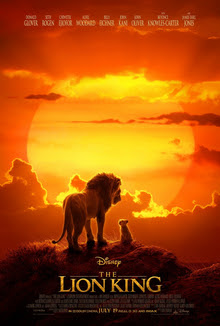
The Lion King (2019)
The Lion King is rated PG for “sequences of violence and peril, and some thematic elements.” Directed by Jon Favreau. Written by Jeff Nathanson. Starring Donald Glover, Seth Rogen, Chiwetel Ejiofor, Alfre Woodard, Billy Eichner, John Kani, John Oliver, Beyoncé Knowles-Carter, and James Earl Jones.
Monday, January 17, 2022
Jungle Cruise (2021)
If you were to take a blend of things that I specifically enjoy – Humphrey Bogart, movies based on theme park rides, The Mummy, dad jokes, Pirates of the Caribbean – you might end up with a movie like Jungle Cruise. However, in this case, the sum of the parts is so much more than the whole, with a film that ends up feeling noted to death and assembled by committee. Jungle Cruise is never quite terrible, but it docks somewhere south of watchable.
In search of a mythical flower that will end human suffering, Dr. Lily Houghton (Emily Blunt) defies contemporary skepticism and commissions the sardonic skipper Frank Wolff (Dwayne Johnson) to ferry her and her brother (Jack Whitehall) up the Amazon River. Along the way, the trio is pursued by a cursed Spanish conquistador (Édgar Ramirez), a maniacal German prince (Jesse Plemons), and a harbormaster (Paul Giamatti) to whom Frank is deeply in debt.
At some point in Jungle Cruise – and this moment will vary for moviegoers – you’ll be reminded of a better movie that you’d rather be watching. Perhaps it’s early on, when the film’s opening flashback sequence and initial historical setting remind you of the structure of Stephen Sommers’s masterful Mummy. Perhaps you’ll pick up on the Bogart-esque performance of Dwayne “The Rock” Johnson (which is actually somewhat decent, inflected as it is by, above all, The African Queen). Or perhaps it’s the film’s second half, with cursed zombie conquistadors who seem airlifted from the Pirates of the Caribbean franchise. Or maybe, just maybe, you’ll find yourself recognizing some of Frank Wolff’s deliberately bad jokes and wish that you were on the Jungle Cruise ride proper. At any rate, it is impossible to watch Jungle Cruise and think this is the best version of any of its disparate parts.
Despite drawing on such a wealth of source material and creative influences, Jungle Cruise all too often feels like it’s pulling its punches. The key, for example, to why the corny jokes work so well on the ride is because the skippers believe in the punchline and deliver it with a knowing wink. Here, Johnson seems to want to remain above the jokes, delivering them deadpan but almost begrudgingly, knowing yet not really caring that some true believers want to hear about “the backside of water.” Ditto the winks to Albert Falls and Trader Sam, legendary figures in Disney Parks lore but almost inconsequential easter eggs here. Where Johnson cuts a passable Bogart for about half the film, Emily Blunt is a disappointing remix of Rachel Weisz’s Evelyn Carnahan from The Mummy, lacking the charm and wit in favor of a corporately cynical “girlboss” attitude. And as seriously as the film takes itself, it’s continually deflated by the fact that no one can pronounce the Spanish word “lágrimas” correctly. (It’s got an accent mark for a reason.)
While the first half of the film is essentially a theme park remake of The African Queen, peppered with enough inside references to keep fans from walking out, the second half is a disappointing retread of the Pirates movies. Édgar Ramirez and his crew of conquistadors seem airlifted from the disparate ghost zombie crews of Hector Barbossa, Davy Jones, and Armando Salazar. Some of these phantasms are merged with plant life, others with insects or snakes, to the point where they may as well be leftover CGI creations that weren’t used in the final cuts of the Pirates films. I don’t know quite how you make a narrative film out of a plotless ride like Jungle Cruise – perhaps focusing more on the Jungle Navigation Co. or on Albert Awol (if you know, you know) – but I don’t think that cribbing the successful Pirates formula is the most satisfying way to go.
If the plot feels like it’s grafted together from impressions of its predecessors, the cast certainly all feel like they’re starring in different movies. Johnson is somewhat slick but never quite breaks free of his own star persona; if he’d committed to the Bogart of it all, or embraced the hammy humor, it could have been a breakout franchise performer like Johnny Depp’s impossibly popular Captain Jack Sparrow. Blunt too seems bored by most of the film, trying not to overdo the stuffy bluster but never quite landing anywhere. Then there are the three strangest performances in the film – Jack Whitehall as Lily’s brother, Jesse Plemons as Prince Joachim of Prussia (a real person, mind you), and Paul Giamatti as a dock owner who seems to have wandered in from a Saturday Night Live skit. Whitehall plays MacGregor extremely broadly, accessing a Forrest Gump level of caricature, even as the film only winks and nods in the direction of his sexuality. Plemons is clearly having arch fun as a Germanic villain, but he’s so transcendently unreal that one loses focus on the film every time he appears. (This performance was but an appetizer for the sheer historical stupidity on display later that year in The King’s Man.)
Then there’s Paul Giamatti, who seems to understand how silly the film is and so brings the right level of ham to his performance. Yet no one else in the film is operating at his level, which makes him look more like a cartoon character than the computer-generated jaguar that prowls around the film. Particularly as a gifted character performer in the vein of, say, the Universal monster films, Giamatti shines a light on just how incongruous Jungle Cruise manages to be, a collection of parts and bits from five different writers who never seem to be on the same page. Indeed, just about the only thing in the movie that works is a mid-film twist that I genuinely did not see coming, yet this shift in the plot ends up veering the film into another strange and unexpected direction. Perhaps Jungle Cruise is like the Amazon River itself, swirling and winding in unpredictable ways, with too many voices arguing over how best to navigate it.
Jungle Cruise is rated PG-13 for “sequences of adventure violence.” Directed by Jaume Collet-Serra. Written by Michael Green, Glenn Ficarra, John Requa, John Norville, and Josh Goldstein. Starring Dwayne Johnson, Emily Blunt, Édgar Ramirez, Jack Whitehall, Jesse Plemons, and Paul Giamatti.
Tuesday, November 6, 2018
Take Two Tuesday: Tomorrowland (2015) ...or, Put a Pin in It
2015 does not sound like that long ago, but three years feels like an eternity. I have distinct memories of seeing Tomorrowland in the theaters, and objectively it feels like only yesterday, even though the calendar tells me it was more than 1,200 days. Time flies, it seems, whether you’re having fun or whether you’re hurtling toward dystopia. The world seems like a grimmer place than it did three years ago, which is really saying something because I think we all recognize that the sky has been falling for some time now.I’ve had a lot going on in my life of late, spending a lot of unpleasant time in my own head, and it feels like I hit a crisis point a few weeks ago. It was perhaps, then, appropriate that I came back to Tomorrowland at exactly the moment I needed it. When I reviewed it in 2015, you’ll recall that I was of two minds about it. “Tomorrowland is an important film,” I wrote, “playing to some of my political/aesthetic predispositions, but it’s not as good as it ought to be.” I was cynical about the film’s attempt to kickstart an imaginative revolution, frustrated that the film hadn’t delivered on its utopian promise. I wanted to goto Tomorrowland, and I expected the film to take me there.
Reader, I missed the point. Put another way, I had spent far too long asking, “Wasn’t the future wonderful?” without realizing that I should have been asking, “Won’t the future be wonderful?” (Light spoilers follow.)
In a way, Tomorrowland has never really left me. As a lifelong visitor to Walt Disney World, it’s around every corner of my memory, a direct right turn off Main Street in the Magic Kingdom. I’ve listened to the Michael Giacchino score more times than I can count; iTunes tells me I’ve listened to one track, “Pin-Ultimate Experience,” a whopping 113 times (which makes it #59 on my Top 100 Most Played list), and it’s almost certainly my favorite Giacchino score. A few months back, I finally read the tie-in prequel novel, largely because it includes a comic book, and I’ve continued to study Brad Bird’s career with great interest, most recently with Incredibles 2. And I bought the Blu-Ray about six months ago, knowing that I’d never fully dislodged the film, and noodled around the special features until finally plunking down a few hours last week to rewatch the film.
There is a great
Tomorrowland is an intervention film, no doubt about it, but I think critics mistook Bird’s frustration for mere crankiness, and I share his frustration. Our world seems paradoxically broken, with one crowd shouting that the world’s problems don’t exist, and the other insisting that the problems aren’t fixable. Then there’s Casey Newton (Britt Robertson) in the middle, amazed that no one has thought to ask how to save the future. There’s something endearing about Casey’s deadpan naiveté, about her complete disbelief that no one has considered pursuing a solution. Bird has stacked the deck, no question; you get to do that when you’re writing an allegory. But there is something so inspiring when Casey’s relentless optimism forestalls the apocalypse, if only for a few seconds – a jarring moment of hope for fallen cynic Frank Walker (George Clooney). The way the film stops on this beat is downright chilling, and it’s a credit to Bird that the film doesn’t need to overexplain what’s just happened; a pause on a ticking clock is enough for a thinking audience to understand that Casey is, quite literally, our last hope. And yes, I am a sucker for films that talk about how to save humanity from its fallen state (cf. Batman v Superman).
The film remains a little bit clunky, with an occasional exposition dump like the ones co-writer Damon Lindelof employed on Lost, but there is here a simultaneous charm to them. “Now I finally answer your question, you’re gonna interrupt me?” Walker interjects, at which time I realized that the mythology of the film was all just window dressing for Bird’s real message – that there is no time to waste, that the future is now, and that someone has to step up and build it. It’s as if Brad Bird is shaking the collective audience by the shoulders and imploring us, “Get off your ass and build Tomorrowland!”There’s a wonderful line in another Bird film – Ratatouille, one of my all-time favorites – in which a critic discards his pessimism upon realizing, “Not everyone can become a great artist, but a great artist can come from anywhere.” It’s this message that infects the film’s final moments, in which the next generation of prime movers is recruited. Many of them come from humble beginnings, yes, but if Casey believes in them, we’re in good hands. I realized only now that the film’s framing device, narrated by Walker and Casey, isn’t a screenwriting cheat. It’s a fully integrated part of the story because the entire film is the advertisement on the pin. When Casey touches the pin in what is undoubtedly the film’s best, most breathtaking sequence, she sees the promise of Tomorrowland; the next set of pins, then, will essentially show the film Tomorrowland and take its beholders to that promised land. In this way, the film teaches us how to read it; we are, all of us, the next Casey Newtons.
It’s a scary position, but it’s a promising one. It’s a hopeful one, and heavens, do we need it. I no longer think the film is a failure – I think its success will be measured by what we do with it. As a piece of fiction, the film is a bit unwieldy, as the ambition of its ideas perhaps surpasses what you can reasonably accomplish in a two-hour Disney movie, but I’ll always take a movie of ideas over a movie of mere spectacle. Bird has denied that his work is influenced by Ayn Rand (the director doth protest too much, methinks), but both are creators whose stories are life-support machines for philosophies; Bird is more optimistic than Rand, but he shares her notion that the creators of the world cannot be shackled by conventional wisdom, that they must be allowed to save the world. “I was designed to find dreamers,” the animatronic Athena (an underrated Raffey Cassidy) declares, and I think Bird senses a kinship with her. Athena oddly becomes the heart of the film – oddly, because she has no heart – but then that’s the way of most science fiction. She’s the one who dispenses the pins, and she points the way for the dreamers, but she can’t take us to Tomorrowland without our help.
On second watch, I think I’m ready to go so far as to say that Tomorrowland is a Personal Canon film. Remember that the idea of the Personal Canon was always that these were movies that helped explain me to the world, and I think so much of what I believe about politics and art is in Tomorrowland. It’s the reason why I sought out an orange T pin (the Chevrolet giveaway, not the unreasonable facsimile) even after having a lukewarm reaction to the film; it’s the reason I can’t stop listening to the Giacchino score. I wanted to possess the film’s ideas in some tangible remnant. Maybe I couldn’t have exactly the film I expected, but I could distill that ideal into a few symbols – a circular enamel promise of tomorrow and a majestic swooping score that flies as lofty as our aspirations.
Tomorrowland is a film that looks at me and asks me to get out of my rut and help save the world by doing the things I am uniquely qualified to do. It’s a film that makes me laugh and makes me cry; it’s a film that has high philosophical debates and spectacular explosions. It’s got nods to Star Wars and Disney World and the promise of a bright future. It’s a movie that needs to be seen because it’s an idea that needs to be heard. I’m so glad to have given the film another chance, because Tomorrowland asks me to give myself a second chance, too.
Monday, May 29, 2017
Pirates of the Caribbean: Dead Men Tell No Tales (2017)
Here’s the thing about Pirates
of the Caribbean: Dead Men Tell No Tales: for all that critics have
contorted themselves to work the film’s subtitle into some kind of indictment
of whether this particular tale should have been told, it is for all intents and
purposes Pirates of the Caribbean 5,
resurrecting plotlines from past films and trotting them out again for more
high-seas adventure. So if you’re already weary of Captain Jack Sparrow and his
ilk, this one won’t win you over. For those of us dyed-in-the-wool landlubbers,
though, it’s more of the same good fun.Captain Jack Sparrow (Johnny Depp) is down on his luck when he learns that the ghostly pirate Captain Salazar (Javier Bardem) is coming for him and the rest of the pirates on the seas, including the lucre-laden Hector Barbossa (Geoffrey Rush). Meanwhile, Henry Turner (Brenton Thwaites) needs Jack’s help to seek out the Trident of Poseidon to free his father Will Turner (Orlando Bloom) from the curse of the Flying Dutchman, while horologist Carina Smyth (Kaya Scodelario) knows how to read the map to find it.
I was struck by how many parts of Dead Men felt familiar, almost like clues along a treasure map that loyal fans know how to read. I first caught it when I noticed that the romantic theme from At World’s End was repurposed for an action cue involving Henry Turner; I chalked it up to new composer Geoff Zanelli slyly remastering Hans Zimmer’s superlative earlier score, but then the similarities really started manifesting. There’s a curse, and Jack’s responsible; there’s a mystical artifact buried on an island to which the compass points; there’s a witch and a crew of inhuman pirates with a decaying ship; we’ve got a chase through cobblestone streets and an execution sequence that doesn’t quite go as planned; and there’s a well-intentioned pretty boy paired off with an unconventional woman. I would go so far as to hazard a guess that every scene in Dead Men involves a callback to another moment in the franchise.
What I can’t determine, doubtless because I am too uncritical a critic in my appreciation for a film series that’s been a favorite for nearly half my life, is whether this is for better or worse. Put another way, I’m not sure if the franchise has run out of ideas or if the crew of Dead Men, like Roald Dahl on You Only Live Twice (itself a fifth film in a franchise), have taken stock of the preceding films and attempted to canonize the rules and tropes that govern such a movie, for there does seem to be a sense that Dead Men is going back to square one for a kind of velvety-soft reboot and revivification. I did not, however, feel that On Stranger Tides strayed too far from the Pirates brand and indeed appreciated the new corner it carved out in the universe. Dead Men does, then, feel a bit like playing it safe, not unlike the ship at the film’s climax which risks falling into an immense cavern (though I never perceived that metaphorical cavern).
What Dead Men does contribute is a deeper sense of the mythology of the universe, just ahead of what might be an extension of the franchise (and yes, the post-credits scene is, as ever in these movies, pivotal). We’ve got flashbacks and “secret origins” and retroactive continuity vis-à-vis the curse of the Dutchman, as well as an expanded family tree that Geoffrey Rush has compared (spoilers in the link) to a Dickens novel, an assessment with which I’d have to agree; Dead Men feels very much like “the next chapter,” perhaps more than On Stranger Tides did.
But for all the critical hemming and hawing over whether this is a fresh or stale “next chapter,” I have to say that it’s a fun one, and I think one’s overall take on this Pirates film has very much to do with the degree to which one has ever enjoyed a Pirates film. As before, you’ve got spooky villains with quirky gimmicks, which are animated with grisly compelling detail, and you’ve got the trademark Pirates brand of humor on display, from an uproarious bank heist that goes awry in the strangest way to hilarious confusion over the precise meaning of the word “horologist.” But there are no false notes, no moments where one might tweet out #NotMyPirates. There’s continuity here, not unlike the devoted patience one affords the Marvel Cinematic Universe, which is thrice as long.
In short, dead men tell no tales, but franchise newcomers Joachim Rønning and Espen Sandberg have directed a safe yet entertaining one that makes me equally, not less, enthusiastic about the prospect of a sixth Pirates film. (Remember, Penelope Cruz’s Angelica is still out there somewhere...) Dead Men is a useful primer on what the Pirates franchise has done, and here’s hoping that a sixth will demonstrate what it can do.
Pirates of the Caribbean: Dead Men Tell No Tales is rated PG-13 for “sequences of adventure violence, and some suggestive content.” Directed by Joachim Rønning and Espen Sandberg. Written by Jeff Nathanson and Terry Rossio. Starring Johnny Depp, Javier Bardem, Geoffrey Rush, Brenton Thwaites, and Kaya Scodelario.
Monday, April 10, 2017
Beauty and the Beast (2017)
It’s a tale as old as time, and it’s certainly one we’ve
seen before. But for the first time in Disney’s ongoing project of remaking its
animated classics into live-action big budget fairy tales (with or without a
healthy dose of revisionism), Beauty and
the Beast both makes the case for another retelling of the story and
manages to be a compelling and potent riff on the original. If you’re like me, you probably have vast swathes of the 1991 animated film committed to (or seared into) memory, and you’ll likely be singing along in your head to the musical numbers, which get a few bonus verses here and there but are otherwise largely unchanged. So too is the plot translated fairly directly to live-action: bookish villager Belle (Emma Watson) finds herself imprisoned in the castle of the Beast (Dan Stevens), a prince turned monstrous by a curse, in order to save her doddering father Maurice (Kevin Kline). While local ape-man Gaston (Luke Evans) pines for her, to the consternation of his compatriot LeFou (Josh Gad), the castle’s lusty candlestick Lumiere (Ewan McGregor), fussy clock Cogsworth (Ian McKellen), and maternal teapot Mrs. Potts (Emma Thompson) conspire to bring beauty and the beast together to lift the spell.
In the case of Disney’s continued remake renaissance, I wouldn’t say there’s been a complete win. Maleficent was at once too distant from its source material while simultaneously pulling its punches on that difference. Meanwhile, Cinderella and The Jungle Book were visually stunning but ultimately more of the same as far as the originals were concerned. With Beauty and the Beast, however, I recall thinking several times during the film, “Oh, so that’s why they remade this!” Between its new characters and its patched-up plot holes, elucidated backstories and added lyrics, this Beauty and the Beast is a lot like a new brand of your favorite flavor of ice cream. There’s a lot that’s recognizable and reminds you what you love about it, but there are added nuances that gives this incarnation a life all its own. (It’s like the time I discovered they made cookie dough ice cream out of monster cookies and M&Ms.)
Perhaps the greatest strength of the film is its cast, which is positively bang-on from the word “go.” Watson and Stevens are well cast as the star-crossed lovers, in a romantic plotline that doesn’t feel obligatory and includes a few very well-crafted turns of character that give believability to the courtship plot. (That one such moment revolves around a library is perhaps preaching to this bibliophile’s choir, but I’d fall in love with a beast too if he had a library of his own to make Alexandria blush.) That McGregor, McKellen, and Thompson are note-perfect is right up there with “Water Wet” in terms of headlines, nor should one be surprised by the frankly stunning special effects work. What’s genuinely surprising is that Evans and Gad create something really quite special in Gaston and LeFou. Though it’s by no means sympathy for the devil, the script gives Gaston a refreshing amount of psychological depth, and Gad plays LeFou with an understated tenderness that gives LeFou a few legitimate reasons to hang around a specimen as deplorable as Gaston.
Indeed, what Beauty and the Beast does quite well is clarify a few of the nagging details and polish up the bits that work in order to present a fresh version of the story to an audience who is a little older, a little wiser, and a bit more sophisticated. This is hardly an “adult” version of the story, but it does feel a bit more grown-up, more willing to go to places the original didn’t – the question of Belle’s mother, for one, and the aforementioned update to Gaston: neither of which changes the characters or the plot but brings them into sharper focus.
Perhaps most importantly for this moviegoer, Beauty and the Beast never forgets to embrace with exuberance the playful weirdness of a film that includes a talking wardrobe, a barking footstool, and a boisterously romantic candlestick who turns a dinner invitation into something out of Busby Berkeley. It is the kind of film that touches the heart in the right places but isn’t embarrassed to leave you with a big dumb grin on your face as a talking clockface excretes gears in alarm. It’s a film that has more emotional range than we have any right to expect from a remake of an animated fairy tale.
But it’s also a film that, as the song goes, may have something there that wasn’t there before. I’m reticent to call it a brain or a heart or something so reductive, nor do I want to chalk it up to je ne sais quoi, though one character actually does. But unlike some of Disney’s more recent live-action updates, it has an unflappable demand to exist and ends up a worthy successor to the original.
Beauty and the Beast is rated PG for “some action violence, peril, and frightening images.” Directed by Bill Condon. Written by Stephen Chbosky and Evan Spiliotopoulos. Starring Emma Watson, Dan Stevens, Luke Evans, Josh Gad, Kevin Kline, Ewan McGregor, Ian McKellen, and Emma Thompson.
Monday, December 5, 2016
Moana (2016)
While Disney is remaking and reinscribing their classic
animated fare with varying degrees of success (from Maleficent to The Jungle Book,
the results have been a mixed bag), they’re simultaneously churning out what
can best be described as revisionist fairy tales in which Disney can be seen to
rewrite its gender politics vis-à-vis the “happily-ever-after through true
love” narrative. (Zootopia might even
fit in here, though from here Big Hero 6
seems to fit better with the Marvel movies.) Moana certainly fits in the latter camp beside Tangled and Frozen, and
while I wasn’t as bowled over by Moana
as I was by Frozen, Moana is still a fine offering.Fueled by a longing to take to the seas, young Moana (newcomer Aul’i Cravalho) bristles against her father’s insistence that she stick to her island roots and prepare to lead her people as their chief. But with the gentle encouragement of her grandmother, Moana discovers another destiny, one that leads her to the exiled demigod Maui (Dwayne “The Rock” Johnson) and his own begrudging quest for restitution.
Your mileage, as ever, may vary, but perhaps because the bar has been set so high of late by Disney, Moana did not knock me out. Last month I returned from a few days in Walt Disney World, so maybe it’s the fact that I’d very recently mainlined the magic of the mouse, or perhaps it was the burden of expectation (always a dangerous thing to carry into a movie theater) based on precedent and extant reviews. Heck, maybe I’d been jaded by the dispiriting array of trailers on tap before Moana. Or maybe it’s just that Moana is good but not great. Maybe, in the words of Captain McCluskey, “I’m getting too old for my job... too grouchy.”
I did like it, but the superlatives aren’t there for me to purge like so much ipecac. I enjoyed the soundtrack in the moment, though I didn’t leave the theater humming any of the tunes; I laughed at the jokes, but I can’t say that I could repeat any of them for you. What did impress me mostly began with the letter C – Cravalho, coconuts, the chicken, and a crustacean. And the tattoos.
Time will tell whether Cravalho becomes a major star or not (remember, the voice of Mulan now has a regular spot on Marvel’s Agents of SHIELD), but she acquits herself well in her debut feature in a part that feels written to play to her strengths – her determination, her singing prowess, and her ability to keep pace with the more seasoned voices in the cast. While I never fully dissociated Maui from the man I knew to be voicing him, Cravalho inhabits Moana with aplomb and breathes life into her.
The plot of the film can be loosely described as a Polynesian Odyssey, with a series of episodic adventures along a sea voyage on a mission from the gods. In these adventures, we meet a seafaring band of pirate coconuts (or is that coconut pirates?) who are equal parts adorable and terrifying, a fine feat of visual design and wordless storytelling. Then there’s the mad chicken Heihei (voiced, surprisingly, by the dulcet clucks of Alan Tudyk), who almost steals the show with his dimwitted struts and well-timed mishaps. Rounding out a kind of trinity of fascinating creatures (or, put another way, “fantastic beasts”), we have Jemaine Clement as the klepto crab Tamatoa, who gets a fun musical number in which to express his offbeat sensibility while serving as a kind of Joseph Campbell’s gatekeeper for a literal sword-in-the-stone moment.
Lastly, if I wasn’t knocked out by Maui himself, his tattoos are quite impressive, hand-animated amid the computer cartoonery that is the film’s milieu. Indeed, it’s little surprise that the film’s directors have had a hand in many of Disney’s last twenty years of animated films, especially because Maui’s tattoos recall the Grecian aesthetics of Hercules back in 1997, a film I remember fondly. These semi-sentient tattoos continue the coconuts’ good work of silent storytelling, drawing on the bulging biceps and swirling linework of Hercules to great effect. Maui seems irritated by their rebellious approach to his own self-mythmaking, but it’s an audience delight to see a hole poked in the demigod’s bluster
I have nothing bad to say about Moana, except to say that I have nothing tremendous to say about Moana, which feels a bit like the movie review equivalent of a “first world problem.” Moana is the very model of reliable entertainment, steady on course for Disney, even if the effect is more that of a pleasant dream – left with a good feeling but without the lasting memory that would accompany something a little more substantive.
Moana is rated PG for “peril, some scary images and brief thematic elements.” Directed by Ron Clements and John Musker. Written by Jared Bush, Ron Clements, John Musker, Chris Williams, Don Hall, Pamela Ribon, and Aaron & Jordan Kandell. Songs by Lin-Manuel Miranda and Opetaia Foa’i. Starring Auli’i Cravalho and Dwayne Johnson.
Bonus review! Moana is preceded by the short film “Inner Workings,” which is very much the half-remembered dream equivalent of the immaculate Inside Out. Here, a man’s internal organs react to the drudgery of office work, the temptations of the beach, and the overwhelming urge to micturate. It’s clever but ephemeral, perhaps hampered by the protagonist’s uncanny resemblance to Carl Fredrickson from Up, and it never arrives at the depth of concept or feeling that Inside Out did. But it’s cute and doesn’t overstay its welcome.
Monday, April 25, 2016
The Jungle Book (2016)
Why Disney is remaking their animated features as
live-action films is, quite honestly, beyond me. Last year I had a “Why does
this exist?” reaction to Kenneth Branagh’s Cinderella,
finding that it didn’t distinguish itself enough from the original. Now it’s
Jon Favreau’s turn to adapt an animated film, The Jungle Book, and I have to say that the end result is much more
successful for the tightrope act it performs between fidelity and innovation,
to say nothing of the frankly fabulous special effects.The Jungle Book introduces Neel Sethi as man-cub Mowgli, banished from his adopted wolf pack after his life is threatened by tiger Shere Khan (Idris Elba). With panther Bagheera (Ben Kingsley) at his side, Mowgli travels through the jungle in search of man’s village, encountering a menacing snake (Scarlett Johansson), gigantopithecus King Louie (Christopher Walken), and omnivorous bear Baloo (Bill Murray).
One of the real delights of Cinderella was getting to see Cate Blanchett chew the scenery as the wicked stepmother Lady Tremaine, and it’s as if Favreau decided to turn up the volume to eleven by selecting an all-star voice cast for his remake. The voiceover work is arguably the most compelling aspect of this Jungle Book; Elba is perfectly menacing as the mean-spirited tiger, and there’s something uncanny about recasting Kaa’s slithery speech for Johansson’s husky notes. And as much as I’ll always love Louis Prima and Phil Harris, in their respective roles Walken is sublime and Murray is freshly definitive.
Wisely, and strikingly, the film preserves many of the original songs from the 1967 cartoon, in a way that feels organic to the film. “The Bare Necessities” comes on the heels of Bill Murray’s recent Netflix Christmas special, which allowed the comic actor to flex his crooning muscles, and Murray’s natural charisma comes through clearly, even behind the CGI fur of Baloo. And let’s just say that there will be few moments of pure cinematic ecstasy this year to rival Walken’s recitation of “Ooby-doo, I wanna be like you-oo-oo.”
King Louie himself is a real treat, reimagined from a hepcat orangutan into a colossal ape straight out of Conrad’s Heart of Darkness (like Kipling, wrestling with the legacy of imperialism in India). Behind the computer effects we can discern some of Walken’s own distinctive tics, facial gestures and hand movements as well as his non-pareil intonations. And here’s where Jungle Book really mesmerizes me – like Kaa’s hypnotic eyes, I’m captivated by the fact that all the animals are animated by computers, not by motion capture or animating only the mouths. This is really remarkable stuff that the Disney animators have managed to cook up, and the fact that it never looks phony is perhaps justification enough for updating the 1967 animated film into live action.
Quietly, Favreau has become one to watch, demonstrating an incredible versatility between this, Iron Man, and Chef (and, though it wasn’t as well received, Cowboys & Aliens). Jungle Book proves my hypothesis that Chef was good for Favreau in the sense that it gave him time to find his own voice again after working on blockbuster corporate products for several years in a row. There is something of the same personal vision from Chef balanced by the unabashed wonder that ought to belong to a Disney picture.
News spread like man’s red flower that Jungle Book 2 had already been greenlit. I can only imagine where the narrative will go – unlike the original film, this Jungle Book doesn’t end with a coquettish water girl at man’s village – but more like this will be a welcome addition to the Disney canon.
The Jungle Book is rated PG for “some sequences of scary action and peril.” There are growly animals that chase and menace our protagonists, and scenes in which fire ravages the jungle might intimidate younger viewers.
Heads up, True Believers – we’ll continue to Make Yours Marvel this Wednesday with another installment in “The Grand Marvel Rewatch,” so check back then for 2015’s Ant-Man. Or subscribe above, and receive those missives right in your inbox. Nuff said!
Monday, March 7, 2016
Zootopia (2016)
For as much of a Disney shill as I constantly profess to be,
I don’t know why I’m continually surprised by how good their recent output is.
Case in point: Zootopia. What is
there to say? I loved it. My greatest disappointment was that there wasn’t an
animated short to play before the film.Officer Judy Hopps (Ginnifer Goodwin) dreams of being the first bunny cop in Zootopia, a city populated by a mélange of animals. Her first assignment, parking meter duty, isn’t as glamorous as she had hoped, but it brings her into contact with streetwise fox Nick Wilde (Jason Bateman), who proves to be an unlikely lead in a string of missing animals, which – in the vein of all good cop stories – Judy only has 48 hours to solve.
Zootopia is directed by Byron Howard and Rich Moore, who previously directed Tangled and Wreck-It Ralph, respectively, and I think you can, in a way, situate Zootopia roughly between those two. That situation isn’t on a spectrum of good-to-bad, because I really enjoyed both films in rather different circumstances. Zootopia blends the narrative strengths and compelling female protagonist of Tangled with the sweeping world-building and dry wit of Wreck-It Ralph in order to give us this uproariously funny fish-out-of-water action comedy.
There’s been much made in the press around the film about the decision made late in production to place the focus on Judy instead of Nick. And honestly, even if we weren’t living in a world where we still don’t have a female-led solo Avengers film, even if 2016 weren’t the first time in seventy-five years that Wonder Woman was appearing in a live-action film, it still would have been the right decision. Watching the film, it’s difficult to imagine how the story might have worked with Nick at the helm; there’s something much more successful about meeting Zootopia through Judy’s naïve eyes, allowing Nick to take us and Judy by the floppy ears and show us around. Making him the lead protagonist might have stripped him of some of his charm; we don’t know him as well as Judy, which gives Bateman free rein to do the fast-talking snark he’s perfected.
The other real delight in Zootopia is the way it works on two levels. There’s the classic Disney level, with solid storytelling that the kids will love. But then there’s the valence of Zootopia that appeals to the adults in the audience who can appreciate the extended reference to The Godfather, the thick metaphors about difference at play in the film, or the fact that the entire film is basically Chinatown with funny animals. This is the way that “kids’ films” ought to behave, not talking down to the kids or shouting up at the adults. Once again, Disney knocks it out of the park.
Then again, I’d have given Zootopia an all-star rating if it had just been two hours of the sloths working at the DMV. That never gets old.
Zootopia is rated PG for “some thematic elements, rude humor and action.” A scene where we see unclothed animals described as “naturists” is played for laughs, given that all the other animals are fully dressed. Several moments in which animals go savage may frighten younger viewers.
Heads up, True Believers – we’ll continue to Make Yours Marvel this Wednesday with another installment in “The Grand Marvel Rewatch,” so check back then for 2011’s Captain America: The First Avenger. Or subscribe above, and receive those missives right in your inbox. Nuff said!
Monday, December 21, 2015
Star Wars: The Force Awakens (2015)
First of all, if you haven’t seen The Force Awakens just yet, read on without fear of being spoiled
(although really, what else did you have to do this weekend?). I’m very
sensitive to the fact that this is a film with a heavy curtain of secrecy
around it. The spoilers are out there if you really want them, but I’d advise
anyone to go into The Force Awakens
with a clean palate because this is a film that works best when it washes over
you and introduces itself to you on its own terms. It’s a remarkable achievement,
breathing new life into a franchise that needed it, setting a fantastic tone
for the forthcoming Disney era.Again, no spoilers here, so I’ll refrain from the usual plot synopsis, only to say that the film’s opening title crawl is immensely captivating stuff, clicking into place a lot of the rumors and official releases such that you have an instant sense of the state of that galaxy far, far away these thirty years after Return of the Jedi. In addition to the familiar faces of Han Solo (Harrison Ford), Luke Skywalker (Mark Hamill), and Leia Organa (Carrie Fisher) – listed in the order they’re credited on the film – The Force Awakens introduces us to a new trio: stormtrooper Finn (John Boyega), scavenger Rey (Daisy Ridley), and hotshot Poe Dameron (Oscar Isaac). And menacing the galaxy is one more black-clad acolyte of the dark side, Kylo Ren (Adam Driver), and the First Order’s plan to unseat the Republic.
I found myself thinking immediately of the words of Obi-Wan Kenobi from Return of the Jedi: “You cannot escape your destiny.” And while I’m on record as being one of those moviegoers who ordinarily detests the deus ex machina of destiny, it’s undeniably woven into the fabric of the Star Wars universe, and director JJ Abrams does some very intriguing work with it. Throughout The Force Awakens, we have characters who are either running from their destiny or sprinting headlong toward it, and all of them end up pretty much exactly where they are meant to be – from the stormtroopers in the opening scene to the folks present in the final shot of the film (and what a gorgeous, sweeping final shot it is). Heck, even Greg Grunberg, a childhood friend of Abrams, fulfills his destiny by appearing here as an X-wing pilot.
JJ Abrams had the unenviable task of being the only person to direct a Star Wars film without George Lucas's hand on his shoulder (including, of course, The Clone Wars and that horrible thing I watched last Friday). While I’ve never been a full Abrams disciple, there’s no question that he more than lives up to the legacy of the original trilogy. (As for the prequels, they’re largely set aside, save for one passing reference.) As a director, Abrams keeps the pace of the film at an even clip, sprinkling in enough humor to make this possibly the funniest Star Wars film in the saga without compromising the film’s overall tone. More apparent is the film’s reverential and referential attitude toward the original trilogy; nearly every sequence in the film has some callback to a previous moment, giving lie to George Lucas’s oft-quoted refrain about the poetry of the saga. But what’s remarkable here is that the aggregate effect isn’t one of plagiarism; there’s a deference, to be sure, to what came before, but it advances the saga forward and cues up more than enough for Episodes VIII and IX to continue to explore.
Bizarrely, and actually gratefully, I’m more interested in the new characters than in the returning faces. Yes, there’s a wonderful reintroduction moment for every returning character (even the ones you weren’t expecting to be applause-worthy), but the Finn-Rey-Poe trio could easily be the new Luke-Leia-Han for this generation, and not necessarily in that order. This is great news for the franchise as a whole, because it shows that Star Wars is capable of sustaining itself beyond the inevitable first flash of nostalgia that The Force Awakens was always destined (there’s that word again) to invoke. And say what you want about the prequels, but they always pointed to A New Hope, never sufficiently building their own world (save for those long and tedious political conversations). The Force Awakens propels the narrative forward, to say nothing of the introduction of an equally compelling trio (or quartet, depending on how you do the math) of antagonists. Let’s just say this – Kylo Ren is everything we wanted from Hayden Christensen’s Anakin Skywalker.
I’ll have to see the film again to give a more detailed assessment – I know there are folks chomping at the bit to talk about some of the more spoileriffic details – and I’d like to revisit the film with more of the John Williams score under my belt. I was just too overwhelmed by the film to drink it all in at once. And that’s such a good thing. I felt myself smiling like a child again once those blue words “A long time ago...” appeared on the screen, felt my jaw fall as the title crawl clued me into the story. I smiled, I laughed, I gasped, and I very nearly cried in a few moments, and not only out of sadness when the film went for the emotional tug. My eyes were misty because I felt, finally, I’d come home. Chills up my arms, chokes in my throat (not the kind induced by the dark side, mind you), and a permanent grin across my face: these were the feelings The Force Awakens conjured up in me. Like some magical incantation, cast out across the void of decades, Star Wars is back.
Star Wars: The Force Awakens is rated PG-13 for “sci-fi action violence.” This film is slightly bloodier than previous Star Wars films, but the level of violence and action is about the same.
Monday, May 25, 2015
Tomorrowland (2015)
Tomorrowland, by
Brad Bird (with some script assistance from Damon Lindelof), is sitting
somewhere around 49% on Rotten Tomatoes, while his other films are solidly in
the 90th percentile. What happened here? I’m not, as you might suspect, about
to place Tomorrowland on a pedestal
opposite its detractors, nor do I find myself agreeing wholly with the film’s
detractors. Instead, the answer lies somewhere in the middle; Tomorrowland is an important film,
playing to some of my political/aesthetic predispositions, but it’s not as good
as it ought to be, making a few disappointing narrative mistakes on the way to
its underwhelming third act.
Wasn’t the future wonderful? Tomorrowland asks why our visions of the future bend toward dystopia when our dreams used to be so optimistic. On the eve of the demolition of a NASA launch site, Casey Newton (Britt Robertson) finds a pin that promises a great big beautiful tomorrow where they’re saving a seat for her. Her quest to find Tomorrowland brings her to Frank Walker (George Clooney), a child prodigy turned jaded recluse with a long-standing link to Tomorrowland.
Here’s the thing about Tomorrowland: I cannot tell whether its most distinguishing feature is a narrative failure or precisely the point of the film. I’ll get right to the point; the entire film is predicated on the grandeur of Tomorrowland, on the gleaming promise of the future. The fable-like quality of the film relies on the wondrous spectacle of Tomorrowland, yet Tomorrowland takes entirely too long to get there, and when we do, it really fails to live up to expectations. To be fair, there’s a perfectly valid plot-related reason for this, but on the larger scale of narrative it’d be a bit like The Wizard of Oz revealing that the city of Oz is in a state of mild disrepair.
Put another way, Tomorrowland spends entirely too long getting there, dwelling in the imperfect world of the present without sufficiently jarring us out of the familiar. We sympathize with Casey (played quite well by Robertson), and after the initial glimpse of Tomorrowland we want to be there too. Ultimately, though, the promise of Tomorrowland is deferred – not, I think, to the sequel which it seems box office receipts won’t justify, but rather to the viewer’s own imagination of what Tomorrowland ought to be.
And I can’t say whether it’s a complete mistake or exactly the message of the film. That is, I can’t tell if Bird has dropped the ball entirely or if he wants us to imagine Tomorrowland for ourselves and kickstart the imaginative revolution the film is meant to provoke. Either way, I think it’s a shortcoming of the film; either it ought to fail spectacularly or soar triumphantly, but Tomorrowland simply falls short and doesn’t quite reach its target. I wanted to like the film more than I ended up doing. I never felt bored during it, thanks to the puzzle-box storytelling Lindelof seems to have perfected, but by the end of the film I was left very much with the feeling of, “Oh, that’s it?”
How then can a film which ends up being mildly disappointing simultaneously be an “important” film? We usually reserve that label for cinematic game-changers like Citizen Kane or Star Wars. But I think – I hope – that Tomorrowland might be seen as a paradigm shift in the current cultural fascination with dystopian futures. Part of the reason I love superhero movies so much is because at the end of the day they promise that everything is going to be all right. The present is often a dismal affair, and I’d much rather the entertainment I consume not amplify that feeling of dread. I’ve not read/seen Divergent or The Maze Runner in large part because I’ve already seen The Hunger Games, and there is only so much gifted-child-in-dystopia I can take. I am becoming bored of this, and in that sense Bird is preaching to a choir of one with this filmic plea for brighter imaginations.
I’m not sure why exactly Tomorrowland flopped. The opening shot, in which Clooney narrates directly to the audience about the difficulty of narration, is a solid indicator of the kind of clumsy storytelling not befitting this story, and I do wonder what Bird (who flew solo on scripts for The Incredibles and Ratatouille) could have done entirely on his own without tethering his vision to someone else. (And no, Mr. Lindelof, I haven’t forgiven you for Prometheus.) At the same time, there is a vocal group who run screaming at the merest whiff of an Ayn Rand reference, and there is what could be a strong Atlas Shrugged allusion in the midst of all this. At the end of the day, though, I think most of us wanted the film to earn its place at the innovative science-fiction table next to Inception, and it just didn’t. But if Tomorrowland can make us dream again the way Inception did (well, not quite the same brand of dreaming), its importance will outweigh its reviews. Here’s to tomorrow, and a once-more wonderful future.
Tomorrowland is rated PG for “sequences of sci-fi action violence and peril, thematic elements, and language.” There’s a really quite stunning sequence in which robots chase our heroes through their home – honestly worth the price of admission – and a few other scenes in which robots meet melty ends and people are zapped by disintegrator rays. Discussion of the fate of the world might unsettle milder viewers.
Monday, March 30, 2015
Monday at the Movies - March 30, 2015
Sky High (2005) –
I don’t know how this movie slipped under my radar for an entire decade, given
that it’s in some aspects Disney’s live-action follow-up to The Incredibles. But where the 2004 Pixar film was an instant
classic, subverting genre tropes while simultaneously reveling in them, Sky High carries itself a little too
cutely, with only the self-referential winks keeping this one from being just
another angsty coming-of-age flick.
Michael Angarano plays Will Stronghold, the powerless son of The
Commander and Jetstream (Kurt Russell and Kelly Preston, respectively) who’s
deposited in sidekick school until his abilities manifest. As I said, there’s none of the intelligence
of The Incredibles here, other than
the high-concept of a superhero high school (which, honestly, we’ve seen
before). Instead, there’s an
uncomfortable dissonance between the vibrant colors of the costumes and the
frankly cheap special effects that look much less than their $35 million
budget; the cast are giving it their all, especially Russell’s gung-ho
performance as the exuberantly enthusiastic father of a super-to-be, but I’m
inclined to say that Sky High
ultimately falls flat. That said,
however, there is nothing in Sky High
that is patently bad, for it never offends with ineptitude. It is, rather, less successful than it wants
to be, less intelligent than it needs to be, but there is the somewhat irresistible
charm of a movie which is unapologetic about its own “dumb fun” ethos, a movie
which is by and large predictable but has no pretensions about its own
intelligence. There is little that
separates Sky High from a
direct-to-television film, but there is a sizable gap between this and a movie
that worsens its audience for having seen it.That does it for this week’s edition of “Monday at the Movies.” We’ll see you here next week!
Monday, March 16, 2015
Cinderella (2015)
With Maleficent
(mercifully) behind us and a live-action Beauty
and the Beast yet to come, we’re in the midst of a live-action reinvention
over at the House of Mouse. While I do
have some reservation regarding the overall necessity of the move, I do think
that Cinderella acquits itself better
than Maleficent thanks to its
narrative fidelity and its frankly stunning production value.In what is essentially a remake of the 1950 animated Disney film, Lily James stars as Cinderella, left after her father’s passing in the care of her evil stepmother Lady Tremaine (Cate Blanchett). After a chance encounter with her Prince Charming (Richard Madden), Cinderella makes every effort to go to the ball, with a little magical assist from her Fairy Godmother (Helena Bonham Carter).
The most striking thing about Cinderella is, surprisingly, the clothing. I cannot recall ever being as impressed with costume design as I was with Sandy Powell’s work on this film. (Fun fact: she’s also the costume designer for my all-time favorite film, The Departed.) Perhaps some credit is due to the cinematography, but the colors in the film really pop in a way that dominates my overall impression of the film – Cinderella looks spectacular. The dresses of Lady Tremaine and her daughters very plainly communicate their interior ugliness, doing so with a flair that Powell has described as nineteenth century by way of the 1940s. Cinderella’s dresses, too, are incredibly vibrant, matching well the Prince’s royal finery.
The film overall has a very polished look which I credit to the very pristine direction of Kenneth Branagh, who does fairy tales with the same elegance he brings to Shakespeare and superheroes. There are a few nods to both – from Hamlet, both Derek Jacobi and fencing, and from Thor, Stellan Skarsgard – but more importantly, Branagh brings his trademark earnestness to Cinderella. It’s honestly a little jarring to go from the delightfully revisionist Into the Woods, in which Cinderella’s indecisiveness clashed with Prince Charming’s insincerity, to a film which wholly believes in the happily-ever-after genre tropes.
Despite the well-crafted nature of the film and the strong performances all around, there is still the lingering question of whether there is a need for another treatment of Cinderella which doesn’t really distinguish itself too strongly from the versions that preceded it. This is, of course, the question asked of every remake at one time or another, and my chief complaint about Maleficent was, you’ll recall, that its contributions to the revisionist project were so uneven that the best scene was the one that took the fewest liberties, so clearly there’s a threshold of acceptable innovation/transgression. Cinderella succeeds, I think, on the grounds that it steers a very straight course through the familiar elements of the plot in an even and engaging way, but as content as I felt during the end credits there was still the sensation that I hadn’t actually seen anything new.
Now, to be fair, Cinderella goes 180-degrees from Into the Woods by making the Prince more, not less, compelling; where Sondheim’s Prince “was raised to be charming, not sincere,” Cinderella gives us a prince bristling at his royal obligations, more interested in marrying for love than for obligation (subtext that I don’t recall being quite so present in the animated film). It also recognizes that Cate Blanchett is phenomenally gifted, so Lady Tremaine’s wickedness is played up as well as explored near the end of the film as she monologues about her motivations.
Ultimately, then, I’m in an unusual place with Cinderella. The creative team responsible have created something that amounts to a very good cover band version of a classic with a few neat solos in the middle there, but there’s a curmudgeonly bit of me that wants to cling to the original because the new isn’t different enough. Then again, I think of all the children in the theater with me that afternoon, and I realize that for them this film likely is the definitive Cinderella, and I don’t think that’s such a bad thing. Maybe the better metaphor is that of translation, the act of going from one language (animation) to another (live-action), and it is on those grounds that Branagh’s Cinderella succeeds.
Cinderella is rated PG for “mild thematic elements.” I suppose that’s due to the passing of Cinderella’s parents and the verbal abuse she endures at the hands of her wicked stepmother, but this is very nearly G-rated material.
Bonus review! Cinderella is preceded by a seven-minute short, Frozen Fever – a sequel to (you guessed it), Disney’s wildly profitable Frozen from two Christmases ago. The short finds Elsa (Idina Menzel) prepping the kingdom for the birthday of her sister Anna (Kristen Bell). Only two things stand in the way – the snowman Olaf (Josh Gad) is trying to eat the cake, and Elsa has a head cold. The cynic in me thinks that Frozen Fever is a long advertisement for plush toys of the snow-babies created whenever Elsa sneezes, but aren’t they cute? By nature of being so short, Frozen Fever isn’t long on substance, but it does continue the film’s emphasis on the sisters’ relationship over a romantic one between Anna and Kristoff in a way that is more refreshing than treacle. The main song “Making Today a Perfect Day” is about as catchy as “For the First Time in Forever” from the main film, though it won’t, I predict, have the staying power of “Let It Go” (either in eternity or in your head). All told, I’m a bigger fan of Disney’s original shorts like Paperman and Feast, though Frozen Fever is as pleasant as the “Toy Story Toons” we’d been getting for a while there, a fun pit stop with some familiar faces.