Showing posts with label Margot Robbie. Show all posts

Monday, July 31, 2023

Barbie (2023)

Apparently it’s been Barbie’s world all along, folks; we just live and dream in it. In this topsy-turvy summer where the pink day-glo sparkle of Barbie can open on the same day as the portentous and sobered Oppenheimer – and both can make a boatload of money – Barbie ends up being an excellent reminder that we can have both. If Barbie can have it all, so can we, and we don’t need to take ourselves too seriously in the process.
 
Things are great in Barbieland, a paradise populated only with Barbies and Kens (and Allan, played by Michael Cera). It’s all good until Barbie (Margot Robbie) begins to experience flat feet, anxiety, and cellulite. At the insistence of Weird Barbie (Kate McKinnon), Barbie ventures out into the real world with Ken (Ryan Gosling) to find out why her worldview has gotten so grim – much to the consternation of the president of Mattel (Will Ferrell).
 
From its earliest trailers and first-looks, it was quite clear that Barbie’s secret weapon was going to be self-awareness. An early trailer cast Barbie in a send-off of Kubrick’s 2001: A Space Odyssey, with children gleefully smashing baby dolls, and the hard cuts to the pristine plastic of Barbieland reassured us that director Greta Gerwig knew exactly what we might expect from a corporate Barbie film – and she was steadfastly opposed to creating a two-hour toy commercial. Instead, we get The Lego Movie by way of Enchanted, a film that shouldn’t be this delightful for a movie based on a narrative-less toy. (The antithesis, I suppose, is something like Transformers, a joyless toy commercial mired in its own monastic mythos.)
 
Margot Robbie is perfectly cast as “stereotypical” Barbie, the ur-doll from which all other Barbies (even President Barbie) draw their inspiration. Indeed, so immaculate is Robbie in this role that even the narrator (Helen Mirren) cannot help but comment on the utter absurdity of her lament that she’s not pretty; “Note to filmmakers,” she opines in one of the film’s many terrific jokes, “Margot Robbie is not the actress to get this point across.” Meanwhile, Ryan Gosling is, if it can be imagined, even doofier as Ken than Michael Keaton was in Toy Story 3. Gosling’s Ken is a true buffoon, a self-described accessory and self-insistent “ten” whose job is “beach” despite an apparent inability to perform CPR or even swim to shore on his own. Together, the two have some of the funniest chemistry imaginable, particularly because of the perennial lack of clarity about the precise nature of their relationship.
 
Gerwig and co-writer Noah Baumbach are delightfully cavalier about most of the rules that govern Barbieland. Some of this is due to the logic that governs a child’s play, but more of it is in an embrace of fantasy and dreams at large. In two sequences, Rhea Perlman appears (particularly jarring for someone who, like myself, has binged nearly all of Cheers in about four months), and there’s an explanation provided in a hand-wavey kind of way that rolls over the audience like a wave. In another scene, someone ponders the possible differences between Barbieland and the real world, and in asking which difference is key, he receives a unanimous answer, “Yes.” Whether Barbieland is just down the block, like Toontown in Who Framed Roger Rabbit?, or whether it is a creation of a child’s fictional dreamscape, is the kind of question that only an adult reviewer would begin to ask – and Gerwig’s response is, “Don’t worry about it.”
 
The film is bracingly unselfconscious, with no one afraid to embarrass themselves or lean into the broad absurdism of playing a plastic doll come to life. Simu Liu is wickedly fun as a Ken consumed with himself (as they all are), a walking/talking competitive vanity incarnate. Similarly, Gerwig is undaunted by the prospect of directing cardboard montages, placing a corporate boardroom on the world’s longest tandem bicycle. It’s peppy and poppy, a little subversive and a little heavy on the ‘message,’ but if anyone’s upset by the film, they’re taking it – or themselves – a little too seriously. It’s a film where Gosling’s Ken is both perplexed and disappointed about the number of horses involved in a “patriarchy,” where Weird Barbie is unapologetic about smelling like a basement. The little nine-year-old boy next to me was as enchanted as his younger sister a few seats over. Their mother, on the other hand, didn’t seem to be enjoying herself, but then again she didn’t seem like a person who enjoyed much of anything. Perhaps she needed a Barbie of her own to inspire her, to remind her that it’s okay to feel joy. 
 
That message is Barbie’s greatest gift – that it’s tough out there, but it’s okay to laugh, to dream, to blaze your own path forward on tippy-toes, wearing so much more pink than any one retina can handle – just as long as you’re you while you’re doing it.
 

Barbie
 is rated PG-13 for “suggestive references and brief language.” Directed by Greta Gerwig. Written by Greta Gerwig and Noah Baumbach. Based on the Barbie dolls by Mattel. Starring Margot Robbie, Ryan Gosling, America Ferrera, Kate McKinnon, Michael Cera, Issa Rae, Rhea Perlman, and Will Ferrell.

Monday, December 26, 2022

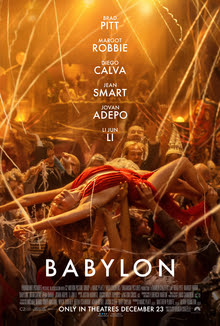
Babylon (2022)

I became a fan of Damien Chazelle almost overnight. I rented Whiplash, one of the only films ever to leave me physically shaking, shortly before seeing La La Land in theaters (twice) and breaking down in full sobs. First Man was an odd follow-up, a spaceman biopic after a big Hollywood musical, but Babylon feels a bit more a return to form. Again (and still), Chazelle is looking at what makes successful people tick, what pushes them to succeed beyond their comfort zones, and what price fame exacts on their souls. 

Babylon is bigger and it is more boisterous, a three-hour version of Hail, Caesar! by way of Quentin Tarantino, which begins with a pachyderm’s diarrhea and concludes with a long montage that serves as – unsurprisingly, given his past work – Chazelle’s big love letter to the movies. For my money, it’s a grand success until that finale, which overinflates the point made by La La Land in a movie that is already perilously extravagant.


Babylon is a sprawling film epic in the tradition of, say, Once Upon a Time in Hollywood, featuring a bevy of characters bumping into each other on the way up the showbiz ladder: aspirant and ingenue Nellie LaRoy (Margot Robbie), whose dreams of stardom occlude the perils along her way; silent star Jack Conrad (Brad Pitt), who speaks bad Italian while proposing marriage to a different woman every other scene; accidental stagehand Manny Torres (Diego Calva); jazz trumpeter Sidney Palmer (Jovan Adepo); and gossip columnist Elinor St. John (Jean Smart), who sees all and writes even more.


I knew just from the runtime that the decadence of Babylon was going to be the point, that its sheer exorbitance would likely be a comment in itself. La La Land was a tight two hours, but it seems that three-hour runtimes are becoming the way of the future; James Cameron needed the full three to give us the next Avatar film, while Wakanda Forever landed only twenty minutes shy. After the aforementioned elephant sequence, Chazelle stages an exorbitant party sequence that would make Baz Luhrmann blush with envy. It’s The Great Gatsby times a million, and how our protagonists react to and inhabit it will set the course for the next two hours and change.


Chazelle is a confident filmmaker, and the vast majority of the film is leisurely world-building, episodic sequences that explore the consequences of Hollywood’s meteoric rise. In some such episodes, our protagonists are asked to make moral sacrifices in exchange for fortune and glory; in others, they voluntarily sacrifice their dignity or their physical well-being for a shot at the big time. To sustain this episodic structure, a storyteller must be supremely confident and adept in ferrying the audience along, and Chazelle is certainly that, but he’s helped ably by a terrific cast.


As Nellie LaRoy, Robbie is electrifying. I’m not sure if her performance is sufficiently different from, say, her Harley Quinn to land her an Oscar, though the idea is being bandied about; she’s certainly manic and magnetic, like a dark Judy Holliday. Her chemistry with Diego Calva’s Manny is supposed to be star-crossed, but I sense that only Manny feels that way, and that’s precisely the point. This is a far cry from Mia and Sebastian of La La Land, perhaps because Babylon is largely more cynical. Meanwhile, Pitt’s terrific, as he always is, though one may be wondering why Jean Smart was given a role as toothless as Elinor until the third act, when Smart – in her role as scribe, prophet, and gatekeeper – gets an incisive monologue that could very well crop up in an awards season sizzle reel. Indeed, Elinor’s big speech makes a better summation of the film than Chazelle’s ending proper, which leads me to my conflicted feelings about the film’s ending.


I was deliberately not looking at my watch throughout the film but felt it must surely be on its way toward denouement when Chazelle began to stage his final episode before the film’s coda. Nothing I had seen so far prepared me for a terrifying performance from Tobey Maguire as mobster James McKay. In the film’s final act, Chazelle ratchets up the tension until the film descends into its own version of Dante’s Inferno – itself a perfect inversion of Babylon’s opener – with the ghastly Maguire as Virgil, our sunken-eyed guide into the underbelly of Los Angeles. From there, the film wraps up by telling us who will and won’t change, just in time for an epilogue that puts a button on the story. 


It’s almost as though Chazelle is in a rush to conclude the movie in time for his final sequence, which feels less like a satisfying and integrated climax and more like the final moments of Walt Disney World’s The Great Movie Ride. Without spoiling, Chazelle’s grand point had always been clear, and the extended conclusion feels like a less successful version of La La Land’s ending – which worked precisely because it was rooted in the characters. Here, though, Chazelle is making a broader point about the filmmaking industry, and when he acknowledges, for example, Singin’ in the Rain, he tips his hand, gilding the lily and unfortunately suggesting that Babylon has just been an R-rated remake of the 1952 classic.


Babylon isn’t Singin’ in the Rain, but nor is it La La Land, which I maintain is still Chazelle’s best. If there’s an issue with Babylon, it isn’t that it lacks restraint or focus – its madcap meandering is precisely the point – but if it’s a shaggy dog story, the punchline needs to be a little more substantive and personal than where Chazelle leaves it. I still don’t know if La La Land ends on a happy, sad, or wistful note, but Babylon closes with one foot firmly in treacle, which is a sentiment the movie never fully earns. If the film had ended ten minutes earlier, this might have been a different review, but Babylon trips over its own feet right at the finish line – but what a race up until that point.


Babylon
 is rated R for “strong and crude sexual content, graphic nudity, bloody violence, drug use, and pervasive language.” Written and directed by Damien Chazelle. Starring Brad Pitt, Margot Robbie, Diego Calva, Jean Smart, Jovan Adepo, Li Jun Li, Eric Roberts, Jeff Garlin, and Tobey Maguire.

Monday, August 9, 2021

The Suicide Squad (2021)

Superhero movies are like ice cream. I like ice cream. I like most kinds of ice cream. I have favorite flavors, but there are also certain flavors or toppings of ice cream on which I’m not terribly keen. I don’t like chocolate in my ice cream, for example, and too much of it ruins dessert. 

I think James Gunn is chocolate ice cream. I enjoyed Guardians of the Galaxy well enough but found Vol. 2 to be overly laden with Gunn’s trademark gross-out schoolboy humor, a fascination with bodily functions and jeering insults. Vol. 2still had the Marvel heart, but The Suicide Squad has boasted that it is Gunn’s unvarnished foray into the DC (Extended) Universe. If this is Gunn undisguised, it is crude, and it is cruel, and it is certainly not my favorite flavor of ice cream.


In The Suicide Squad (not to be mistaken with its predecessor, Suicide Squad), Amanda Waller (Viola Davis) has assembled another crew of miscreants to undertake a top-secret mission with clandestine ill intent. She sends the assassin Bloodsport (Idris Elba), the fanatical Peacemaker (John Cena), the depressive Polka-Dot Man (David Dastmalchian), young Ratcatcher 2 (Daniela Melchior) and King Shark (voiced by Sylvester Stallone) into the island nation of Corto Maltese to find mad scientist The Thinker (Peter Capaldi) before his Project Starfish is exposed. Meanwhile, Harley Quinn (Margot Robbie) and Squad leader Rick Flag (Joel Kinnaman) are stranded on Corto Maltese, with Harley doing her Harley thing while Flag tries to get control of the increasingly manic situation.


From its opening scenes, The Suicide Squad is aiming for a fun and zany tone, but instead it lands somewhere just south of virulently misanthropic. If audiences complained that Zack Snyder’s comic book movies boasted too high a body count, wait until they get a load of The Suicide Squad, in which human life does not matter while the film regards each death as a punchline, an opportunity to convince the audience that Gunn’s sick, bloody nihilism is something to be cheered. As a comic book fan, I was over the moon at the cast list, scraping the bottom of the barrel for characters like Mongal and Savant, The Thinker and King Shark (never mind that the latter two had already been on the CW show The Flash). After all, Gunn had successfully introduced audiences to Z-list Marvel characters like Groot and Yondu, and we fell in love with them.


Not so here. At every turn, each time a character debuts, someone else on screen verbally assaults them, calling them names and mocking them. Only Idris Elba’s Bloodsport is spared this unpleasant introduction, likely because it would beggar believability to think that anyone might get the drop on Idris Elba. There is nothing redemptive like the “We are Groot” moment and nothing heartfelt like Yondu’s remark, “He wasn’t your daddy”; the only thing that comes close is the clear and predictable relationship that forms between Bloodsport and his proxy daughter Ratcatcher 2, who is herself carrying her father’s complicated and tragic mantle.


When the film is not actively ridiculing its protagonists or treating them like mere cannon fodder, The Suicide Squadcontinues that Gunn tradition of kneecapping its emotional moments with lowest-common-denominator humor; worse yet, just when the characters get a moment in the sun, they’re often exterminated in brutal, abrupt fashion – and these moments are, again, so predictable, lacking only the subtlety of a bright neon sign to announce a character’s imminent mortality. It is hard to imagine any of these faces becoming breakout characters because the film doesn’t often seem to care if they live or die. In a sense, Gunn might seem to have the most in common with Amanda Waller, who sees her Squad draftees as expendable grist for her own manipulative mill, yet Gunn appears to have some degree of loathing for Waller too, especially given how the film treats her in its third act.


But I didn’t hate The Suicide Squad. There is so much in the movie that works. Elba is a gem, and Daniela Melchior is the closest thing the film has to a real protagonist, even wading her way with aplomb through a film school student monologue about her origin story. King Shark is the closest to the film’s Groot, though Gunn makes the curious decision to write the character, the comic book son of a sea god, like a brain-damaged toddler deserving of his colleagues’ derision. Capaldi is perfectly cast as The Thinker, even though the film never gives him an opportunity to flex his augmented brain. And of course, Margot Robbie continues to be a light in the darkness as Harley Quinn, a spot-on interpretation of an unapologetic if errant feminist. It’s only too bad that the film never quite knows whether it wants to be a true Suicide Squad movie or another Harley Quinn movie (in the vein of the delightful and underappreciated Birds of Prey).


But as much as I wanted to like the film, and as much good material as there is somewhere in The Suicide Squad, there is a core ugliness at the center of the film, an underlying contempt for its source material and its characters. There should be zaniness and joy, especially with a cast of misfits like this. The Suicide Squad was an opportunity to tell the schoolyard bullies that they were wrong, that Polka-Dot Man isn’t proof positive that comics are inherently stupid. “This is dumb,” the film says, “and you’re an idiot for liking this.” There is nothing redemptive about The Suicide Squad, nothing but condescending spite and scorn until an emotional climax that is never really earned.


And yes, I am aware of the delicious grim dark irony of complaining that a movie like The Suicide Squad is mean-spirited. If you put a crew of supervillains on a helicopter together, they probably wouldn’t get along; they’d cuss and sneer and betray each other. But as much of a mess as David Ayer’s Suicide Squad was, studio interference or no, there was always a sense that Ayer liked these characters and wanted us to like them too. Gunn’s Suicide Squad is like a serving of ice cream at the Abuse Café, and it is not for everyone.


The Suicide Squad is rated R for “strong violence and gore, language throughout, some sexual references, drug use, and brief graphic nudity.” Written and directed by James Gunn. Based on the DC Comics. Starring Margot Robbie, Idris Elba, John Cena, Joel Kinnaman, Sylvester Stallone, David Dastmalchian, Daniela Melchior, Peter Capaldi, and Viola Davis.

Monday, January 9, 2017

Suicide Squad [Extended Cut] (2016)

2016 was a curious year for superhero films and their afterlives. Marvel and DC released two each, but only DC took its home video releases as opportunities for longer versions of its film slate. Batman v Superman: Dawn of Justice got an Ultimate Edition, half an hour longer and a little clearer in its execution. Suicide Squad, meanwhile, found itself the heir of an “Extended Cut,” gaining only ten minutes in the offing.

In a way, the nomenclature says it all. Suicide Squad isn’t a movie that was intended to be seen in a longer version like BvS, cut down by studio heads balking at three hours of Bat-sturm und Super-drang. Instead, director David Ayer presents an “extended cut,” more of the same that doesn’t shed much new light on the film, doesn’t clarify it in any meaningful way, but does provide more opportunity for the film to showcase its greatest strength – quirky personalities, well-casted, bouncing off of other strange rangers of whom I do hope we see much, much more.

Comparing an extended version naturally requires me to throw up a SPOILER WARNING, although it’s not exclusively the sort of spoiler that gives away the ending. (I do, however, discuss the film’s final scene at the end of this paragraph.) This is just an “extended” take on the story we’ve already seen, and it’s not substantially different from the film we got back in August. But discussing the differences naturally involves spoiling what they are, and the first (and perhaps most recognizable) difference is probably the film’s most appealing. We have a whole new flashback in which Dr. Harleen Quinzel (Margot Robbie, still the film’s shining star) chases down The Joker (Jared Leto) and demands that he make her his clown queen. It’s a smart move that adds agency to Dr. Quinzel’s fall into the identity of Harley Quinn, and it helps distance the film from the abusive relationship from the source material. Subsequently, it sheds more light on Harley’s dive into the vat of acids at Axis Chemicals; we have more context, and we know she’s chosen to go down this path. (Remember, in the theatrical cut, we move from Joker’s electroshock treatment right to Axis.) Harley’s less of a victim here, even if she’s still a dangerous psychopath, and it makes the film’s final frames – in which The Joker rescues Harley from prison – a little more palatable, a little more – dare I say it? – darkly romantic.

In the wake of Suicide Squad, a lot of buzz was devoted to Jared Leto’s Joker, and in this version he’s changed not at all. Even his modified involvement in Harley’s origin remains of a piece with his characterization in this film; he’s exasperated by her desire to join his criminal empire, but he goes along with it, because... well, why not? But while news emerged that much of Leto’s performance had been cut from the film (reported both by Leto and by eagle-eyed trailer viewers who detected something missing), rumors swirled that we’d see it all back in the Extended Cut. Not so, true believers, and so Joker exists unchanged in the Extended Cut. I’m still of the philosophical opinion that this is #NotMyJoker though he serves this film as well as he’s expected to be.

Margot Robbie continues to benefit most from the Extended Cut in two fun extended group scenes, which deepen the character dynamics while giving the performers a chance to get more comfortable in their clown paint, yakuza mysticism, and reptilian skin. It’s apparent why these scenes we’re cut – they’re far from cinematic, with long takes of characters walking and talking on their way to the next big special effects bonanza – but it’s a real loss for those who wanted Suicide Squad to be more of a character piece than it was. In one scene, Harley puts her psychotherapist skills (emphasis on the “psycho”) to work in diagnosing Killer Croc and Katana. The off-beat dynamic among these Gotham-centric characters in particular makes me hope that we’ll see them all together again in Ayer’s follow-up Gotham City Sirens (which nominally ought to include Catwoman and Poison Ivy alongside Harley Quinn).

In another scene, which ends up comprising an entire deleted subplot, we see that the Squad is plotting against Rick Flag (Joel Kinnaman), a plan later abandoned when they realize how dangerous Midway City has become. It’s this kind of fun scheming that restores a sense of danger to these characters, a kind of inevitable unpredictability that reminds us that “Task Force X” is actually kind of a bad idea, and it’s something only a royal badass like Amanda Waller (Viola Davis, in pure “hell hath no fury” mode) could pull off.

I don’t know that I’ve heard anyone compare Suicide Squad to Watchmen, the seminal mid-1980s comic that redefined (and/or reminded) what the medium could accomplish using its own bag of tricks. So allow me to be the first in saying that Suicide Squad’s extended cut reminds me a great deal of Watchmen – but Zack Snyder’s Watchmen and the way its visual tricks aped the comic’s scene transitions. It’s not a major change at all, and it might even be that I’m misremembering the theatrical version, but it did jump out at me in this cut. For example, Harley Quinn looks down a flight of stairs, reminding her of the long fall at Axis Chemicals, or she sees a motorcycle that takes her mind back to chasing The Joker. It’s a small touch, but it aligns the film a little closer with the Snyder aesthetic by way of a non-DCEU comic book film, a little insider information much appreciated for those of us in the know, and it makes the film just a little bit more of a comic-book.

There’s a very funny Photoshop going around in which the only difference between two Suicide Squad posters is that a wound on Harley Quinn’s forehead is only slightly longer – hence, an extended cut. And it’s quite an apt metaphor in this case: the Extended Cut features Harley Quinn front and center, but the differences are more or less otherwise cosmetic. A little deeper and a little bit more fun, the Suicide Squad Extended Cut is more of the same for fans but less substantial than the much-improved Batman v Superman Ultimate Edition.

Suicide Squad is still rated PG-13 for “sequences of violence and action throughout, disturbing behavior, suggestive content and language.” Written and directed by David Ayer. Starring Will Smith, Jared Leto, Margot Robbie, Joel Kinnaman, Viola Davis, and Cara Delavingne.

Monday, August 8, 2016

Suicide Squad (2016)

Suicide Squad is a very difficult film for me to review, because I genuinely believe that casual comics fans are going to encounter a somewhat different film than the one I saw this weekend. We hear this description “for the fans” being bandied about, usually when a comic book movie doesn’t perform well critically, but I think Suicide Squad is made more for the fans who are already on board with these characters, and it’s with that base that the film will be more successful.

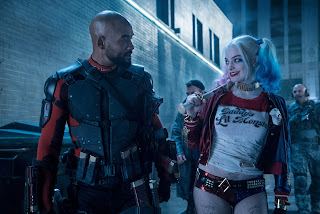
In the wake of the events of Batman v Superman: Dawn of Justice, Amanda Waller (Viola Davis) believes that a metahuman war is coming, so she convinces the US Government to create a black ops team of psychopathic criminals to do Waller’s dirty work. Headlined by hitman-for-hire Deadshot (Will Smith) and manic pixie clown girl Harley Quinn (Margot Robbie), Task Force X – dubbed a “suicide squad” in an on-the-nose moment from Deadshot – is dispatched to Midway City for a rescue mission when a magical threat menaces the entire globe. Meanwhile, Harley Quinn is being pursued by her “Mistah J,” the Joker (Jared Leto), who wants his girl back.

I usually pride myself on my ability to look at a thing objectively, to set aside my enthusiasm for the source material and see how a fresh eye would look at things. (I hear some of you scoffing already.) But for a diehard DC Comics devotee, Suicide Squad is a real challenge because it nails some of the comics material from the starting gate, though I’m not sure Johnny Popcorn will have the same enthusiasm for it.

Case in point: Amanda Waller. Viola Davis absolutely nails the role from the comic books. If Amanda Waller could step off the page and onto the screen, we’ve got Davis as living proof. For comics fans, you couldn’t do better. But for the casual film fan, the character is well-developed and compelling, but without the lens of comics accuracy the character is probably somewhat unremarkable (aside from a midcredits scene that intimates a surprise depth to Waller’s influence).

Ditto for The Joker. And I’ll say this for Suicide Squad – it is pretty bold for the film to include Batman (Ben Affleck) and the Joker in largely supporting roles, the former in what amounts to a cameo performance. I just want to point out that we’re living in a world where Captain Boomerang has more screentime in Suicide Squad than Batman. (And boy, is the film aware of how ludicrous Captain Boomerang is.) But back to the Joker – as with Waller, I’m fully aware that I’m bringing decades of investment in the character into the theater with me, and so I can rationalize this wildly divergent interpretation of the character as emblematic of the Joker’s “super sanity,” in which he constantly reinvents his own personality to cope with the madness of modern life. But even then, and I imagine the effect is compounded for viewers who don’t care about the Joker like I do, there’s something puzzling about why the Joker looks like something out of a gangster rap music video. Is he satirizing the gangs he seeks to replace? Or is this just our post-Ledger edgier Joker (cribbing Ledger’s voice, to boot)? Either way, there’s a “not my Joker” reflex from this fan, and I suspect a sort of bemused perplexity from others.

The good news is that the casting of the leads in the DC Extended Universe continues to be successful. Will Smith, despite my misgivings that he only ever plays Will Smith, does a fine job with Deadshot, giving the character sufficient nuance and a clear psychiatric profile. But far and away, Suicide Squad is Margot Robbie’s movie. For a relatively new character to the Batman mythos, Harley Quinn is one of its most beloved, and Robbie more than does the character justice. Granted, this is still early-days Harley, before she realizes just how abusive her relationship with the Joker really is, and I’m sure that future films will get to that part in due time. For now, though, Robbie revels in the harlequinade of madness, layering the character with shades of performance and insanity, leaving us to wonder just which is which. Above all, it’s clear that Robbie is having a blast with Harley Quinn, and that infectious enthusiasm transfers over to the audience’s side of things.

Suicide Squad is not Guardians of the Galaxy, though it seems to try very hard to be, nor is it quite Deadpool, which its detractors have accused it of aping. Fortunately, it’s also not Fant4stic, the dun standard for comic book movies. But it is, however, more than a little strangely crafted, from its opening montage to its Ghostbusters-esque climax. Almost aware of the fact that the general audience won’t know who Katana, Enchantress, and Killer Croc are, the film delivers this information in the bluntest exposition imaginable, replete with stylized on-screen rap sheet text. It’s aesthetically cringe-worthy and decidedly uncinematic, but in a way it’s understandable. The film’s use of the Suicide Squad against a mystical force who wants to destroy the earth for unknown reasons, using a big shining light in the sky to do it, is less sensible. The Squad is a pretty down-to-earth group with no discernible “super” skills, so they seem grossly outmatched and perhaps even in the wrong movie when juxtaposed with an otherworldly force. Put another way, it’s not the best narrative structure to allow the team to shine. If there’s to be a Suicide Squad 2, which box office receipts seem to indicate in the affirmative, I’d like to see the Squad stay closer to their home turf, against a villain that doesn’t require more expository mumbo-jumbo.

Suicide Squad is not a total disaster, a backhanded Trumpean compliment if ever there were one, but it’s not an unqualified success, either. It’s a strange film, off-putting in some ways but fantastically enjoyable in others, fun enough to get a thumbs-up from this reviewer but not quiet the triumph I wanted.

Suicide Squad is rated PG-13 for “sequences of violence and action throughout, disturbing behavior, suggestive content and language.” Written and directed by David Ayer. Starring Will Smith, Jared Leto, Margot Robbie, Joel Kinnaman, Viola Davis, and Cara Delavingne.

Monday, December 30, 2013

The Wolf of Wall Street (2013)

Any reader who isn’t a stranger around these parts knows that I’m an enormous Martin Scorsese fan, and I’m of the opinion that Leonardo DiCaprio is one of our finest actors.  So believe me when I say that The Wolf of Wall Street, the pair’s fifth collaboration in more than a decade, is undoubtedly their best work since 2006’s The Departed (and maybe even since Goodfellas – your mileage may vary).

DiCaprio stars as the titular Wolf, Jordan Belfort, who uses his Wall Street savvy to start up his own barely legal brokerage.  Amid the debauchery and depravity of the excesses at Stratton Oakmont, Belfort attracts the attention of the FBI while juggling the demands of his second wife Naomi (newcomer Margot Robbie) and his partner Donnie (Jonah Hill).

With Wolf of Wall Street, Scorsese returns to the true-crime biopic genre he perfected with Goodfellas and Casino; indeed, Wolf could be seen as the third in a thematic trilogy of rise-and-fall narratives ripped from the headlines, and it certainly deserves that place of prominence in Scorsese’s repertoire.  Wolf is compelling and engaging, a prime example of a filmmaker not content to rest on his laurels; instead, he reminds us just how good he can be.  And for a film that never feels like it’s three hours long, never elicits so much as a bathroom break or a glance at a watch, Wolf is one of the most engrossing films I’ve seen all year.

As far as engrossing goes, let’s hope that this is the year that finally nets DiCaprio his Best Actor trophy at the Oscars (though he’ll have some steep competition from Christian Bale in American Hustle).  DiCaprio’s been turning in consistent work for the better part of a decade, and it’s high-time the Academy stops treating him like a bridesmaid and recognizes the total immersion DiCaprio undergoes into this character.  Aside from the verisimilitude of DiCaprio’s impression of Belfort’s physicality and mannerisms, he proves himself deft with a range of behaviors, from slapstick humor to deadpan disgust, from swaggering braggadocio to a whole range of addictions.  Belfort is such a multilayered character, and the film offers DiCaprio so many different opportunities to flesh out facets of this fascinating figure.

Yet with so many tonal oscillations, The Wolf of Wall Street never feels confused or inconsistent.  While some reviewers are bemoaning the film’s indulgent excesses, I have to think that’s part of the point; Scorsese is so effective at recreating Belfort’s world that he manages to trick us into thinking he’s not on our side.  And just like in Goodfellas, we’d be remiss if we didn’t think there was at least something seductive about Belfort’s lifestyle.  Whether it’s the money, the sex, or the feeling of invincibility, we’re meant to understand in some way – and perhaps even empathize with – Belfort’s decisions.

And Wolf of Wall Street plays with so many of the great Scorsese themes that it deserves high marks as another fascinating iteration of a great director’s most significant statements – the perils of venality, the inevitability of self-destruction, the coincidental slip-up.  In fact, one might even lump Wolf of Wall Street in with the greatest of Greek tragedy – we have our protagonist cursed with a fatal flaw (as with most Scorsese characters, it’s ambition) that becomes the instrument of his own implosion.  But if that’s too highfalutin a comparison for you, just remember Henry Hill’s closing monologue from Goodfellas about how the road through your dreams ends in being a schnook, eating egg noodles with ketchup.

In an era where one-percenters are the popular scapegoat, it’s refreshing to see a film that addresses the issue without heavy-handed moralizing about the evils of capitalism.  Instead, Scorsese presents the subject on its own terms, with an invigorating honesty that asks the audience to draw its own inescapable conclusions.  It’s a master class in respect and rewards for the audience, anchored by one of the year’s best performances.

The Wolf of Wall Street is rated R “for sequences of strong sexual content, graphic nudity, drug use and language throughout, and for some violence.”  Man, is this movie wildly inappropriate.  We’ve got a bevy of naked men and women on parade (sometimes literally), more drug abuse than you know what to do with, an estimated 500 F-bombs, and a few mild fisticuffs.