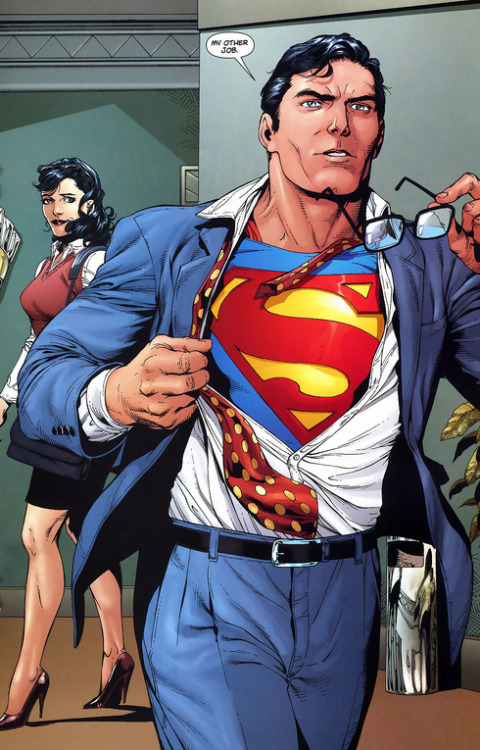
The vote is in: I like Richard Donner's version better.
In several important ways, this will be less review and more analysis, comparative in a way that most every review on this blog is not. The film under inspection is
Superman II,
originally released in 1980 as directed by Richard Lester but re-released in 2006 as directed by Richard Donner. Having been fired from
Superman II, Donner had already filmed most of his rendition of
Superman II, initially intending both the first and the second films be shot simultaneously; after the studios vetoed this idea, Donner - with 75% or so of the sequel in the can already - halted his
Superman II until 2006, when he finally edited his cut together.
Superman II: The Richard Donner Cut is, in broad strokes, very similar to Lester's
Superman II. The overall plot is the same: Superman (Christopher Reeve) fends off a Kryptonian criminal invasion led by General Zod (Terence Stamp) in alliance with Lex Luthor (Gene Hackman) while dodging the suspicions of Lois Lane (Margot Kidder) that Clark Kent and Superman are one and the same. It's in the details that the two versions differ, and as the saying goes, the devil is in the details. I'm most pleased to say that all the things to which I objected in the Lester version are excised from Donner's cut, although Donner's version isn't entirely polished, leading to some distracting problems with the ending (which, inevitably, I'll have to spoil).
My aim here isn't to simply compare and contrast, to pick apart what's new and different between versions. Better reviewers than myself have had four years to do just that; for one, see DVD Verdict, who did
a pretty good comparison job. Instead, my aim here is to look at the (in my eyes) most significant changes and whether or not they enrich the film. For starters, my favorite line - "Superman, thank God" - is untouched (and indeed plays out funnier, for reasons to be discussed below), so score one for Donner.
The Donner cut opens with Jor-El (Marlon Brando) sentencing Zod, Ursa, and Non to the Phantom Zone. This scene was added into the DVD version of
Superman: The Movie, so it's nothing new in this reviewer's eyes; indeed, it's even a little distracting to see the same scene replayed again. But I fully understand and appreciate the Donner cut's aims in reinstating this scene: it clearly and finely restores Jor-El to the plot of
Superman II, making more apparent the "son becomes the father" parallel I noted in the Lester cut. It also underscores a larger role for Jor-El to play, a role fulfilled by Superman's mother Lara (Susannah York) in the Lester cut in order to avoid paying Brando the exorbitant fees he commanded; bringing Jor-El back into the story creates a deeper connection with the first film and introduces a more compelling dynamic than the one with Lara. Donner leading Lester, 2-0.
I praised Lester's treatment of the growing dynamic between Clark and Lois, but Donner takes the advantage here for doing a better job with it. Donner's cut more subtly highlights Lois's growing suspicions, replacing the Parisian terrorist scene with a more successful scene at the Daily Planet, which introduces both Lois's cause for suspicion and the honeymoon racket expose; instead of throwing herself into Niagara Falls, Lois instead leaps from the Daily Planet offices. And instead of Clark clumsily tripping into the fireplace, Lois takes a more proactive approach, which would be criminal to spoil since it's undoubtedly the best "new" scene in the Donner cut. 3-0 now.
Donner's cut explains a lot of problematic plot holes in Lester's rendition, chief among them the connection between Lex Luthor and the Kryptonians, as well as the restoration of Superman's powers (which I thought was more a problem of audience members not interpreting correctly, but oh well). Here, when Lex breaks into the Fortress of Solitude with Miss Teschmacher, he's treated to a crystal projection of Jor-El explaining his role in Zod's imprisonment. By explaining the plot to Lex and by Hackman's perfect portrayal, it's apparent why Luthor feels he can reason with Zod & Co.; more importantly, this new scene explains how Lex knows that Superman
is Kal-El, a fact that's not apparent in the Lester cut. Later, the restoration of Superman's powers is accomplished through a great scene between Brando and Reeve, who play off each other very well. It's a scene that cements Jor-El's compassion for his son, and the sad resignation on Brando's face is evidence enough for why Brando was considered one of the best actors of his generation. Donner's 4-love, for those playing the home game.
The greatest thing Richard Donner did for
Superman II, however, is his judicious exorcism of all things slapstick from Lester's version of the story. Gone are the silly wind jokes during the battle for Metropolis; left by the wayside is the silly characterization of Non as an inept dullard with no grasp of his powers. Consequently the villains are entirely - finally - threatening, surrounded by only menace and dread, not the lurking suspicion that a gag is just around the corner. In Lester's cut, I got the idea that Zod was exasperated with the fact that he was the only particularly daunting figure in the trio, but in Donner's version I now feel - as Superman must - that all three Kryptonians present a viable threat. That isn't to say that Donner's cut is entirely humorless; rather, the laughs come from all the right places: Luthor's sly attitude, the Clark/Lois relationship, and Reeve's easygoing personality. 5-0 now.
But in the last quarter, Lester scores a point for a better ending. "Hang on," you say, "this is the guy who used cellophane super-shields and multiple Supermen to end his movie?" Well, yeah, and thank God those are gone. Donner's Fortress scenes are overall cleaner and truer to the spirit of Superman, but the actual ending of
Superman II: The Richard Donner Cut is unpolished in very distracting ways. This newer version leaves entirely unanswered the fate of Lex Luthor, stranding him in the Fortress of Solitude - which, seconds later, is destroyed by Superman. Huh? And while Donner earns high marks for better handling Lois's conflicted feelings about knowing Clark's secret identity, he loses points for unoriginality. As much as I hated the amnesia kiss, I was even more let down by the way in which the Donner cut handles the problem of Lois knowing: reversing the rotation of the earth and going back in time. This ending worked in the first movie, but here it just feels like Donner ran out of ideas. For a film that feels so much fresher in the new cut, the ending doesn't do the rest of the film justice; as an added detriment, this time-traveling ending problematizes the last scene of the Donner cut, in which Clark returns to a diner to even the score with a burly trucker - which, if time had been undone, shouldn't need to be done if it didn't happen. So in that regard, Lester has the advantage, especially for his patriotic ending in which Superman restores the American flag to the White House. For a man who allegedly didn't understand the character, he sure hit the nail on the head with that one. Final score? 5-1.
So while the Donner cut isn't perfect, it's still leaps and bounds (over a tall building, most likely) better than the more pronounced-ly flawed Lester version. Some are complaining about the rough cut nature of the film; some effects shots are unfinished, and other scenes are drawn from screen tests plagued with continuity issues. But this is an iconic character whose very nature is based on the power of imagination. In the words of DC Comics marketing, "Just imagine." This is the version in which a man truly flies, the version I'll be watching again and again.
 Superman II: The Richard Donner Cut
 is rated PG "for sequences of action violence, some language and brief mild sensuality." In terms of objectionable content, it's exactly identical to the original film, although the removal of comic relief may make the violence seem a little more unrelenting - which isn't a bad thing in my opinion. I doubt that Kryptonian criminals hot out of exile would stop to arm-wrestle a few yokels.
 Blue Jasmine (2013)
– Woody Allen is nothing if not prolific, but the sheer volume of his work
often means that every film can’t be a success.
Blue Jasmine – Allen’s
post-recession take on A Streetcar Named
Desire – is, however, a triumph; in fact, it’s probably his best in at
least a decade. In a powerhouse
performance, Cate Blanchett stars as the eponymous Jasmine, at wit’s end after
the imprisonment and death of her too-big-to-fail husband (Alec Baldwin). To cope with her fall from grace, Jasmine
lives part-time in a fantasy world while moving in with her sister Ginger
(Sally Hawkins) and her boyfriend Chili (Bobby Cannavale). As this iteration’s Blanche Dubois, Blanchett
puts the “pathos” back into “pathetic” and more than earns her Oscar; her
Jasmine is scattered and schizophrenic, slipping between realities while never
failing to tell the audience which version of the world she’s actually experiencing
– her own or the real one. The
supporting cast, too, is very potent in this one; Louis CK turns up for a
bumbling note of levity, Baldwin as Jasmine’s husband is more important to the
story than Blanche’s ever was, and the decision to split the Stanley figure in
two – Cannavale’s Chili and Andrew Dice Clay’s Augie. This gives us a fuller sense of Ginger,
liberated from a reductionist “Stanley bad” approach that might be encouraged
by Brando’s thuggish performance. For
those who think the filmmaker has lost his touch, this is a fine example of
Allen’s late style, contemplative and sobered.
Blue Jasmine (2013)
– Woody Allen is nothing if not prolific, but the sheer volume of his work
often means that every film can’t be a success.
Blue Jasmine – Allen’s
post-recession take on A Streetcar Named
Desire – is, however, a triumph; in fact, it’s probably his best in at
least a decade. In a powerhouse
performance, Cate Blanchett stars as the eponymous Jasmine, at wit’s end after
the imprisonment and death of her too-big-to-fail husband (Alec Baldwin). To cope with her fall from grace, Jasmine
lives part-time in a fantasy world while moving in with her sister Ginger
(Sally Hawkins) and her boyfriend Chili (Bobby Cannavale). As this iteration’s Blanche Dubois, Blanchett
puts the “pathos” back into “pathetic” and more than earns her Oscar; her
Jasmine is scattered and schizophrenic, slipping between realities while never
failing to tell the audience which version of the world she’s actually experiencing
– her own or the real one. The
supporting cast, too, is very potent in this one; Louis CK turns up for a
bumbling note of levity, Baldwin as Jasmine’s husband is more important to the
story than Blanche’s ever was, and the decision to split the Stanley figure in
two – Cannavale’s Chili and Andrew Dice Clay’s Augie. This gives us a fuller sense of Ginger,
liberated from a reductionist “Stanley bad” approach that might be encouraged
by Brando’s thuggish performance. For
those who think the filmmaker has lost his touch, this is a fine example of
Allen’s late style, contemplative and sobered. A Streetcar Named
Desire (1951) – Look, every now and again, I review a movie where all I can
do is point to the decades of preexisting critical consensus and add little
more to the discussion than to say, “Yeah, what they said.” Case in point: Elia Kazan’s adaptation of the Tennessee
Williams play is nothing short of iconic.
While watching this tour de force rendition of the fall of Blanche
Dubois (Vivien Leigh) in the home of her sister Stella (Kim Hunter) and
Stella’s husband Stanley Kowalski (Marlon Brando), one feels distinctly that
one is in the presence of a greatness which more than lives up to its
reputation. Every note-perfect beat in
the film strikes a resonant chord with the audience, be it Leigh’s fragile
beauty or the frankly inspired decision to film in black-and-white. And when it comes to Brando’s mumbling hulk
Stanley, you’re talking nothing short of definitive; he performs as though
Williams’s pen had literally given birth to Stanley, fully formed like Athena
from the foamy scalp of Zeus. Readers of
the playscript will be forgiven for thinking this is anyone’s show but
Stanley’s, for he is everything you could want from a Stanley. Kazan’s direction cements the place of the
film in cinema history; his directorial sensibility lends a tragic
inevitability to the proceedings, such that Stanley’s line “We’ve had this date
with each other from the beginning” becomes the distressing centerpiece to the
play. But the film, subject to the Hays
Code, contains a slightly tweaked ending, a nuanced gesture toward a moral
universe, which makes the film a distinctly unique experience when compared to
the play. It’s not Williams’s ending,
that’s for sure – but it does make the film, in the final analysis, a
masterpiece by Kazan.
A Streetcar Named
Desire (1951) – Look, every now and again, I review a movie where all I can
do is point to the decades of preexisting critical consensus and add little
more to the discussion than to say, “Yeah, what they said.” Case in point: Elia Kazan’s adaptation of the Tennessee
Williams play is nothing short of iconic.
While watching this tour de force rendition of the fall of Blanche
Dubois (Vivien Leigh) in the home of her sister Stella (Kim Hunter) and
Stella’s husband Stanley Kowalski (Marlon Brando), one feels distinctly that
one is in the presence of a greatness which more than lives up to its
reputation. Every note-perfect beat in
the film strikes a resonant chord with the audience, be it Leigh’s fragile
beauty or the frankly inspired decision to film in black-and-white. And when it comes to Brando’s mumbling hulk
Stanley, you’re talking nothing short of definitive; he performs as though
Williams’s pen had literally given birth to Stanley, fully formed like Athena
from the foamy scalp of Zeus. Readers of
the playscript will be forgiven for thinking this is anyone’s show but
Stanley’s, for he is everything you could want from a Stanley. Kazan’s direction cements the place of the
film in cinema history; his directorial sensibility lends a tragic
inevitability to the proceedings, such that Stanley’s line “We’ve had this date
with each other from the beginning” becomes the distressing centerpiece to the
play. But the film, subject to the Hays
Code, contains a slightly tweaked ending, a nuanced gesture toward a moral
universe, which makes the film a distinctly unique experience when compared to
the play. It’s not Williams’s ending,
that’s for sure – but it does make the film, in the final analysis, a
masterpiece by Kazan.