Showing posts with label Mark Rufffalo. Show all posts

Monday, November 6, 2017

Thor: Ragnarok (2017)

A staggering seventeen films into the Marvel Cinematic Universe, audiences are still prompted to ask, “Is this the best Marvel movie yet?” It’s a question that reminds me that I haven’t updated my Marvel ranking since doing a Top 10 since 2014, but it’s amazing that we’re still given occasion to ask that question, that we haven’t tired of the Marvel method just yet because the films keep finding new angles on these classic characters. Thor: Ragnarok continues the Marvel tradition of pushing its characters out of their comfort zones, both narratively and tonally, with a film that exudes so much style and fun without losing sight of emotional substance.

After recovering a dangerous artifact during his quest for the Infinity Stones, Thor (Chris Hemsworth) returns home to Asgard to find that his father Odin (Anthony Hopkins) has been supplanted by Loki (Tom Hiddleston). In claiming the throne for himself, however, Loki has upset the delicate balance of the Nine Realms, exposing Asgard to threats like Hela, goddess of death (Cate Blanchett). Cleaning up his brother’s mistakes will take Thor to the gladiatorial arena of The Grandmaster (Jeff Goldblum) in combat with an old friend, the Hulk (Mark Ruffalo).

I’m not going to make proclamations about whether or not this is the best Marvel movie or even whether it’s the best Thor movie (I’m still quite attached to the stodgy Shakespearian Thor from Kenneth Branagh), because the premise of the question overlooks the bounty of riches we have gotten from Marvel over the last decade. After all, I’m old enough to remember when a single Batman movie was a treat years in the making; in 2017 alone we’ve seen four Marvel movies, three DC movies, scads of animated direct-to-videos, and more superhero television than a human can watch. What I will say, however, is that Thor: Ragnarok is more crowd-pleasingly fun than I can recall having at a Thor movie, but strikingly it’s funny in a way that isn’t overpowering; unlike in Guardians, Vol. 2, where I felt worn down by the deflating humor, Ragnarok knows which moments to punctuate with a gag and which to let linger (a somber sequence on a cliffside, for one). It is the funniest of the Thor films, with Chris Hemsworth displaying a potent comedic sensibility; the film is virtually stolen by Goldblum’s hedonistic Grandmaster, all finger lilts and self-congratulation, though even Anthony Hopkins gets in a good laugh as Loki-Odin (his reaction to Thor’s arrival, subtle and perfect, might be a new favorite Odin moment).

While the Thor movies have always felt a little bit perfunctory, neither advancing the overarching narrative nor developing an arc for Thor beyond being an action hero, Thor: Ragnarok does attempt to tie the previous two films together into an impromptu arc for the god of thunder, collecting little bits from the previous Thor and Avengers films and uniting them into a story about warring brothers, imposing fathers, and those who cannot help but lead. It’s a real treat to hear composer Mark Mothersbaugh take the same approach to the film’s score, weaving in bits from Patrick Doyle and Brian Tyler before him (as well as a conspicuous harpsichord, to match a small cameo). Ragnarok does, then, finally tie Thor into the larger Marvel world and his own narrative arc, which both provides a satisfying rush to those of us who’ve been here from the beginning and lends a sense of cosmic importance to the film’s proceedings.

There’s much in Thor: Ragnarok I would have liked to see more, which is usually the mark of a good film, that it leaves you wanting more. Tessa Thompson’s Valkyrie, a kind of mirror-universe Lady Sif, is a fine answer to Thor, a hard-drinking survivalist who’d fit just as well on the deck of the Millennium Falcon. Hela and Skurge (Karl Urban) are compelling villains, particularly in light of Marvel’s notorious difficulty at crafting distinctive antagonists (though that does seem to be changing of late); the film does an astonishingly deft job at quickly characterizing them. I predict Korg (voiced by Taika Waititi) will become a Groot-level fan favorite, and the great thing about a shared universe like this is that we’ll surely see him crop up again soon. Then there’s the small cameos that could easily flesh out a film all their own, to say nothing of the surprising buddy chemistry between Thor and Hulk, which seems surprisingly obvious in hindsight; one wishes, though, that Bruce Banner had gotten as much screen time, because Ruffalo is really quite adept at Banner’s quick subvocal quips and perpetual disorientation.

Thor: Ragnarok might be the best Thor movie yet (and Waititi’s hints that he might be down for a Thor 4 are great news indeed), but its balance of bust-out humor and emotional weight stand as an example for Marvel going forward. Its score, too, distinctive in a way Marvel hasn’t approached since the “Awesome Mix” of Guardians of the Galaxy, reminds us how cinematically potent these adventures can be when they’re crafted carefully and thoughtfully. The film does a very good job breaking its characters down, taking them places they aren’t fully at home – Banner in space, Thor sans his hammer – to see what the characters really are. This one is worthy, and I’m quite excited to see it again.

Thor: Ragnarok is rated “PG-13 for intense sequences of sci-fi violence and action, and brief suggestive material.” Directed by Taika Waititi. Written by Eric Pearson, Craig Kyle, and Christopher L. Yost. Starring Chris Hemsworth, Tom Hiddleston, Cate Blanchett, Tessa Thompson, Jeff Goldblum, Mark Ruffalo, and Anthony Hopkins.

Monday, December 14, 2015

Spotlight (2015)

After the credits rolled on Spotlight, I turned to my moviegoing companion and murmured, “That is what I wanted Truth to be.” A few weeks back I took the Cate Blanchett/Robert Redford movie to task for “all the self-congratulation of an Aaron Sorkin screenplay but less of the snappy prose,” and I stand by those words because Spotlight shows us how it’s done, emblematic of everything a journalism film ought to be – taut, gripping, honest, and well-performed.

Spotlight is the horrifyingly true story of a team of Boston Globe reporters (among them Michael Keaton, Mark Ruffalo, and Rachel McAdams) and their editor (Liev Schreiber) who uncover mounting evidence of widespread child abuse in the Catholic Church. I invoke “horror” because of the dispiriting spiral of abuse the team uncovers, learning quickly that the story they’re working on encompasses as many as 87 priests and systemic attempts to cover up the scandal, which only begins to see light when a beleaguered attorney (Stanley Tucci) organizes a class-action suit against the Church.

The very first thing one notes about Spotlight – and indeed my principal motivation for seeing the film – is the impressive ensemble cast who are bound to be competing against each other when the Oscar nominations are announced next month. There’s not a face on the screen who doesn’t already carry a tremendous amount of screen presence from their previous work, and the only unfamiliar face – Brian d’Arcy James – pulls double-time to make up for the fact that he’s not immediately recognizable. The lot of them are doing award-caliber work with characters that are apparently quite close to their real-life counterparts. Keaton and Ruffalo are immensely compelling, particularly when the two butt heads on the story. The screen crackles when Keaton and McAdams go on interviews together, and it is as ever a delight to see Stanley Tucci in another idiosyncratic supporting role as the self-described only Armenian in Boston.

I had a critique formulating at about the midpoint in the film where I felt the characters weren’t clearly delineated enough, that their narrative places could be interchanged without much compromise to the narrative – that, in short, Spotlight was more about the telling of the story than the tellers. Which, to be fair, in a very real sense it is, but it’s also indicative of the slow-burn approach to the characters taken by director Tom McCarthy (he of Station Agent and an acting turn in Good Night and Good Luck, which feels of a piece with Spotlight). Rather than frontload the characterization, we find out more about the reporters’ motivations as the film unfolds. By the end of the film, and I confess this is a clever move, we’re left to reflect on the degree to which what we learn about the reporters influenced the way they pursued the story.

What surprised me about Spotlight was that there really was no “untold story” that the film exposes. It proceeds about how you’d expect – an investigation begins, details are uncovered, the story is published. (There’s one somewhat surprising historical curveball thrown into the mix, one that contextualizes the investigation in a very profound way, one that reminds you just how long ago all this happened.) What is remarkable is just how compelling this manages to be. And I’m returning to the Truth comparison because Spotlight manages its moral outrage without a sense of preachiness and without ever feeling baggy under the weight of its self-righteousness. Instead, its taut simplicity is its greatest strength, and its exemplary filmmaking ought be seen before the screenings fill up with post-Oscar bandwagoners.

Spotlight is rated R for “some language including sexual references.” The film contains in the neighborhood of 10 F-bombs and about twice as many scatological expletives. Though no abuse is ever depicted on screen, we do see survivors speaking frankly about the incidents and the emotional trauma thereafter.

Monday, May 4, 2015

Avengers: Age of Ultron (2015)

The world is a darker place in the wake of the news that Joss Whedon won’t be helming the two-part Avengers: Infinity War (due out in 2018 and 2019). To wit, Avengers: Age of Ultron is a darker, moodier installment in the Marvel Cinematic Universe than its predecessor. But if this truly is Whedon’s swan song in the world of The Avengers, it’s a damned good note on which to end, better than the original and a close contender for the MCU’s finest hour.

After a knockout opening sequence that doesn’t waste any time getting to the action, all your favorite Avengers have assembled. When Tony Stark (Robert Downey Jr.) and Bruce Banner (Mark Ruffalo) develop an artificial intelligence project that goes awry, the other Avengers – Captain America (Chris Evans), Black Widow (Scarlett Johansson), Thor (Chris Hemsworth), and Hawkeye (Jeremy Renner) – face the threat of annihilation when the AI builds itself a body and becomes Ultron (James Spader). Along the way, the Avengers are threatened by superpowered twins (Elizabeth Olsen and Aaron Taylor-Johnson) left in the wake of the fall of Hydra.

It seems clunky to type with all those parentheticals, but the Joss Whedon trademark has always been gracefulness when it comes to large ensemble casts. As in the first film, there is an organicity to the assembling of these Avengers, but where The Avengers spent the better part of its first half in assembly-mode (a really lovely first half, actually, perhaps stronger than the action-heavy climax), Age of Ultron throws the group into a cauldron already boiling with tension and camaraderie. The script is well-crafted as ever, with distinct arcs for its characters (which ought to be the norm but, sadly, isn’t) and a tight narrative focus that finds a way to expand the universe without dithering and losing focus.

I don’t want to say more about expanding the universe for fear of spoiling the film, so on the occasion of May the Fourth – Star Wars Day – I’d like to comment on Age of Ultron being ostensibly the franchise’s “Empire Strikes Back” moment, the middle and darkest entry in a trilogy. The mood in Age of Ultron is considerably grimmer than in The Avengers, though it’s by no means unbearable; in fact, what’s surprising about the film is just how much humor it includes among all the foreboding. The Avengers was funny, but Age of Ultron seems to have imported the raucous tempo of Guardians of the Galaxy’s punchlines. “Keep ’em laughing” seems to be the word of the day here, to the point where I began to wonder, amid all the franchise’s one-liners and character resurrections (Nick Fury, Phil Coulson, Pepper Potts, Bucky Barnes, et al), whether Age of Ultron would actually pull the emotional trigger and give us something truly tragic. Suffice it to say, Age of Ultron does go there, and in a way that works better than it actually ought to.

I could lather up the performers, as I usually do, but you’ve seen it all before. The cast continues to do that at which they are best while also successfully navigating through their respective character evolutions. Ruffalo, for one, is still doing the exposed-nerve timidity, but the romantic wrinkles given to his character equally compelling and don’t feel the least bit out of Bruce Banner’s rhythm. Renner gets the closest thing to the film’s center stage (an apology, perhaps, for spending much of The Avengers under Loki’s mind-control) with a development so surprisingly unanticipated that a pin drop would have deafened the audience on opening night.

The true surprises are in the incoming cast, who distinguish themselves quite nicely while also integrating into the ensemble without that feeling of intrusion. Spader in particular stands out as one of the MCU’s better villains, very well-developed and extremely menacing in a creepy sort of way – in other words, exactly the kind of character you’d expect from James Spader. The twins, Scarlet Witch and Quicksilver, work very well in the context of the film, and they’re the sort of people you’d like to see more of in future films.

One final note must be made of the way that Age of Ultron very consciously engages with the superhero film genre overall. We all have this sense that the bubble is going to burst at some point (with four superhero movies coming out in July 2018 – one a week!), but Age of Ultron never feels overfull or weary. Instead, there’s an interesting way that the film comments on the trend of superhero movies toward ungrounded violence, by which I don’t mean the odd tendency of Marvel films to end with airborne combat and explosions galore. No, there seems to be a very clear commentary on Man of Steel’s ignorance (willful or otherwise) of civilian casualties. At many points in Age of Ultron, The Avengers take great pains to guarantee the safety of the innocent, at the point of risking their own lives to save the citizenry. While I’m one of the few who maintains that Man of Steel’s carnage will actually be a motivating factor for Superman in the sequels, Age of Ultron tackles the issue head-on to demonstrate that the sanctity of life ought to be the hero’s first prerogative.

Is Age of Ultron a bid for a kinder, gentler superhero film? I’m not sure that’s the message, but it is certainly a bid for a more thoughtful one. And while I’m not ready to say it’s dethroned The Winter Soldier at the top of my MCU power rankings, I will say that Whedon had made an indelible stamp on the superhero genre, and the future would do well to take its cues from him – particularly the well-crafted yet innovative juggling act of Age of Ultron.

Avengers: Age of Ultron is rated PG-13 for “intense sequences of sci-fi action, violence and destruction, and for some suggestive comments.” The action scenes are standard superhero fare, with all the punching, explosions, and gunfire you’d expect. Most of it is bloodless, as you’d expect from fights with robots, but some of the more personal action beats include blood. The film also includes the standard amount of innuendo and a few scenes of flirting.

By the way, today is May the Fourth – Star Wars Day! – so flashback to 2014 and take a look at my reviews of the Star Wars saga!

Thursday, June 13, 2013

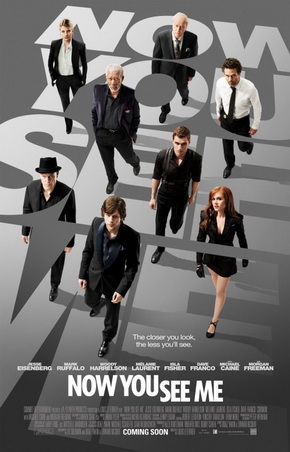
Now You See Me (2013)

The movies are a magical experience, and movies about magic can double up the fun by drawing attention to the innocuous deception of a theatrical illusion.  Unfortunately, Now You See Me spends so much time swaggering that it never really enchants. Now You See Me is ostensibly the story of four semi-professional magicians (Jesse Eisenberg, Woody Harrelson, Isla Fisher, and Dave Franco) who pull off a series of elaborate magic tricks as The Four Horsemen.  But when their illusions begin to look like theft by way of social justice, FBI agent Dylan Rhodes (Mark Ruffalo) and professional debunker Thaddeus Bradley (Morgan Freeman) begin to realize the magicians are, of course, not what they seem.

The key to any successful slight of hand is that the audience has to be so distracted by the flair that they miss the real trick.  Take Christopher Nolan’s The Prestige, a clever (perhaps brilliant) case study of competitive magicians; you’ll be so fascinated by the rivalry between Christian Bale and Hugh Jackman that you’ll miss the clues dropped by the filmmakers.  It’s possibly unfair but entirely unexpected that I’d make this comparison, but Now You See Me doesn’t let the audience play along.  Instead, we’re practically kidnapped, tied down by a film that continually insists on its own brilliance, reminding us at every turn that they’re smarter than we are.

Sure, I can be smarter than you if I don’t tell you what’s going on.  Then, the film gloats by showing you what really happened, though these scenarios are couched in so many maybes and perhapses that it’s never wholly clear what’s going on.  And when your focal character is an investigator, it’s a bit empty to have him never really understand anything.  Ruffalo’s solid as the not-smartest man in the room, and his charisma is enough to hold your attention, but it seems like a less successful riff on his character from The Brothers Bloom, which is saying something.

As for the rest of the cast, you’re looking at the disappointment of the summer.  The four leads have all done good work in the past, but the screenplay is incredibly thin, failing to distinguish any of the four characters beyond physical appearance.  You could rotate the actors in the cast, and it really wouldn’t matter; the characters are so boilerplate and so frustratingly identical that you’ll struggle to connect with them.  Perhaps the film’s worst offense?  Morgan Freeman and Michael Caine never share the frame; their scenes together crackle like a master class in acting, but we never get to see them side-by-side, which gives it a phoned-in feel.

Having said that, there’s a bit of fun to be had in some of the film’s stagier moments.  When The Four Horseman are performing, it’s an opportunity to chew some scenery, and the four leads do well there.  You might even want to see a full show by them at some point, since they convey a sense of infectious enthusiasm for their work.  And, naturally, once you’re told you’re about to be tricked, it’s engaging to watch and try to figure out where the trick is.

As Michael Caine said in The Prestige, “You want to be fooled.”  It’s a good thing, too, since Now You See Me never gives you an opportunity to figure out how the trick is done.  Nor is the ultimate explanation a fulfilling payoff; a last-minute twist is so clichéd that you’ll have already dismissed it as “too obvious.”  Now You See Me is superficial and a bit irksome, continually reminding you of its own cleverness without ever earning the moniker of “smart.”  Sad news for a strong cast, but the real trick is on the audience.

Or, in other words, now I saw it, now you don’t.

Now You See Me is rated PG-13 for “language, some action, and sexual content.”  There’s an F-bomb, playful banter, and some shouting; action consists of a car chase, a few explosions, and some shouting.  And there’s an aborted make-out scene thrown in to earn the “13.”

Monday, November 12, 2012

Monday at the Movies - November 12, 2012

Welcome to Week Forty-One of “Monday at the Movies.”  
 
The Brothers Bloom (2008) – From Rian Johnson, the mind that brought you Looper?  There are connections, to be sure, but for the most part this feels like a completely different film.  To be honest, that difference isn’t always a positive thing for Brothers Bloom.  Unfortunately, this is one of those con-man movies that is too cute by half, trying to out-indie Wes Anderson by couching unsubtle foreshadowing within overbroad characterization.  Adrien Brody and Mark Ruffalo star as the eponymous brothers; the depressive Brody wants out of the life, even though Ruffalo’s cons are as intricate and successful as a Dostoevsky novel.  One last con, blah blah blah, Rachel Weisz as the Manic Pixie Dream Girl mark.  You can call this one from the concession stand; where Looper reinterpreted its own dialogue to add meaning to the twist ending, Brothers Bloom quotes itself at the ending as if to say, “What, you didn’t see this coming?”  In praise of the film, Ruffalo’s performance is quite good; from the man who’s done the best Bruce Banner in a decade, I wouldn’t expect less, but it’s a disappointment that the film focuses more on sad sack Brody than on his more compelling brother. As Penelope, Weisz straddles the line between ascetic shut-in and sexually precocious, but the two halves never coalesce into a realistic character worthy of the affection Brody displays for her; her American accent, though, is nonpareil (something we saw in The Bourne Legacy, as well), and there’s a fun turn by Rinko Kikuchi as the mostly-silent Bang Bang.  But The Brothers Bloom ultimately fails to enchant despite its enthusiastic attempts to do so.

That does it for this week’s edition of “Monday at the Movies.” We’ll see you here next week!

Monday, May 7, 2012

The Avengers (2012)

If you had any question about when the summer movie season begins, seeing most of your favorite summer movie icons assembled in one film should assuage your confusion.

We’ve been waiting since 2008 for The Avengers to assemble, and under the direction (and script) of fan favorite Joss Whedon, they’ve done just that.  Iron Man (Robert Downey, Jr.), The Hulk (Mark Ruffalo), Thor (Chris Hemsworth), Captain America (Chris Evans), Nick Fury (Samuel L. Jackson), Black Widow (Scarlett Johansson), and Hawkeye (Jeremy Renner) – the gang’s all here.  (Even Clark Gregg, who manages to make Agent Coulson even more likeable, as he has with each successive appearance of this great character.)

And when The Avengers assemble... it’s amazing.

Taking little threads from each of the existing Marvel Cinematic Universe films, The Avengers finds the team gathering for the first time after Thor’s brother Loki (Tom Hiddleston) steals a weapon of unimaginable power from S.H.I.E.L.D. headquarters.

That’s it.  That’s the premise.  But without spoiling any of the film’s delightful surprises, it’s a deceptively simple plot which allows plenty of room for character interactions.  So while the story won’t surprise anyone, the relationships will; we’ve been fantasizing about a time when Iron Man and Thor would meet Captain America, and here we get to put them all in the same room and see what’s shaking.

Joss Whedon’s greatest strength here is in balancing an enormous cast of characters, something he does far better here than he ever did on the abbreviated Firefly.  Pulling double duty on scripting and directing, Whedon never loses focus on any of the heroes – even the unpowered Black Widow and Hawkeye, who highlight how out of their league they are in a key emotional scene.  Rather, each gets a moment to shine, a line or action that’ll elicit applause or hooted cheers from an audience which is already glad to be there.

Even better, these are the same characters we’ve already met in other films – excepting, of course, Ruffalo’s Hulk, a vast improvement over lackluster predecessors.  By “same,” I mean that Whedon has kept their voices intact; Iron Man still possesses the same narcissistic wit, Thor seems to have walked straight off a Shakespearean stage, and Captain America hasn’t lost any of his 1940s flair despite being more than 70 years out of his time (better yet, we’re not asked to laugh at him for it).

What makes The Avengers a hit is that it’s a successful whole built on successful parts.  Marvel has made a string of delightful films in the lead-up to The Avengers, and if even one of those had fallen flat, this whole enterprise would have been fruitless.  If Thor had floundered or if Iron Man had missed the mark, we’d be stuck with a dud in a team of winners.  Instead, what we have is grade-A comic book movie.

And I say “comic book movie” with no derision in my voice.  Where The Dark Knight took comics and applied filmic realism to spectacular effect, The Avengers translates perfectly to film the experience of reading a comic book.  Flashy colors, exorbitant explosions, clever angles, and costumes that ought to look out of place but don’t (I’m looking at you, Loki) – these are what we’d expect on the newsstands, not in a post-Nolan world.  But it works here.

It works because the movie is so infectiously fun that it quickly sweeps the audience into its world and recruits us into the superteam.  The Avengers isn’t a team of demigods like the Justice League (an updated Greek pantheon in Grant Morrison’s 1997-2000 comics run), it’s a cluster of (mostly) human characters with human foibles.  Tony Stark’s attempts to provoke Bruce Banner into changing into the Hulk isn’t something you’d ever see Batman doing to Superman, but here it’s perfectly in line with what a group of misfits do when they’re assembled in a tight space.

It’s also extremely entertaining to watch.  Whedon singles out each character’s defining traits and pits them against each other; take Downey’s playful lack of sincerity and Ruffalo’s tortured repression, and you’ve got sparks.  Blast Nick Fury’s dedication to the task against Thor’s sense of cosmic perspective, and you’ll be chuckling right alongside Thor. 

Honestly, I can’t sell short just how fun this movie is.  See it with a full house, if you can.  But see it.  It’s the kind of film that makes my cheeks numb from smiling all the time.  Well, not all the time.  There’s a moment – true believers will know it – when the film hits a surprisingly heartfelt beat, but it sweetens, not sours, the film.  I’m already eagerly awaiting the DVD – and a second showing before that.
The Avengers is rated PG-13 for “intense sequences of sci-fi violence and action throughout, and a mild drug reference.”  It’s more of the same comic book violence we’ve come to expect from Marvel’s stable, often not bloody (with one notable exception) but dominated by explosions.  I think the aforementioned drug reference is Tony Stark’s continued abuse of alcohol, which would have been a disappointing omission.
 
Welcome back to the summer of full reviews, true believers – we’ll see you next week!

Monday, June 21, 2010

Eternal Sunshine of the Spotless Mind (2004)

I finally sat down to watch Eternal Sunshine of the Spotless Mind for three reasons: I'd run out of "must-see" movies, I personally know people who love this movie, and it's landing at the top of many "Best of 2000-2009" lists. And after seeing the movie, I can't fathom why people are saying this is the best film of the last decade.

I'm not being sarcastic. I'm not being glib. I'm not deliberately trying to be antagonistic by penning a negative review of one of the most critically-acclaimed movies of my lifetime. I wanted to like Eternal Sunshine. I really did, and I tried my darndest to do so. But in the final analysis, I switched off my television, took the DVD out of the player, and shrugged, "Meh."

Eternal Sunshine of the Spotless Mind represents the latest in an unintentional series of "boy-meets-girl" movies here at The Cinema King. Here, the boy is Joel (Jim Carrey), and the girl is Clementine (Kate Winslet with a "you won't believe she's British" voice). Following a nasty break-up, the two separately elect to undergo a memory erasure procedure pioneered by Dr. Howard Mierzwiak (an underused Tom Wilkinson). Though Clementine accepts the ignorance-is-bliss philosophy offered by Mierzwiak and his team (which includes Mark Ruffalo, Kirsten Dunst, and Elijah Wood), Joel begins to regret his decision midway through the procedure as he struggles to remember his time, however bitter, with Clementine.

Aside from the imaginative premise of memory erasure and the inventive ways that director Michel Gondry devises to depict the practice, the film is disappointingly formulaic but without any effort put into making the formula believable. I didn't detect very much chemistry between Joel and Clementine; indeed, it seems as though all they do is goof around before making each other miserable. Consequently, the film's basic throughline - Joel's quest not to forget Clementine - is shallow and uninspiring. Simply put, the only reason to root for these characters is because we're told to. Clementine is mildly endearing - thank the always-divine Winslet for that - though she barely develops beyond the "manic pixie dream girl" trope. Carrey develops even less; he mopes lethargically through the movie without the convincing ennui that JGL employed in (500) Days of Summer. The supporting cast is decent, though they float through the movie with little to do beyond advance the plot; Wood's character shows creepy promise, but it's as though Kaufman & Co. didn't quite know what to do with him. Disappointment ensues.

The other major grievance I have against Eternal Sunshine is that it's brutally slow-paced, and when all your characters are extremely depressed without providing any reason for us to sympathize with them this can be a painful experience. Combine this with the predictability quotient exhibited by this movie, and the only reason I finished the movie was because I'm just that kind of a guy.

But I guess I can see why so many people love this movie. It's innocuous, and it's uncomplicated; it's got neat visual effects, a narrative spine (albeit a misued one), and a hopeful ending that affirms an optimism in the human condition. But for a #1 movie of the last ten years, I need a little more than marshmallow fluff. I need something incisive and at least slightly subversive, a movie that either tells me something I didn't know or tells me something that feels like the truth - not a Hollywood version of the truth. (An uncompromised ending apparently suggested that patients of the memory-loss program were bound to repeat their mistakes and need the procedure several times; this might have been more intriguing and would have at least made the film feel inventive and not just lethargically and slavishly optimistic.) So for some this may be a divine movie, but for me it's just plain disappointing. But that's the point of reviews; I'm leaning toward The Departed being the best movie of the last ten years, but maybe Eternal Sunshine fans find it deplorable. Fine.

Let me conclude by clarifying that I don't think that Eternal Sunshine of the Spotless Mind is a terrible movie. It's not; it's certainly no Next. It may not be great, but moreover it's just not "to my liking," nor can I explain why so many people are saying it was the best film of the last ten years. Now I almost have to write my own list.
The MPAA rated Eternal Sunshine of the Spotless Mind R "for language, some drug and sexual content." F-bombs get dropped, there's some mild nuzzling/cuddling, all the girls end up in their underwear at some point in the movie, and a few characters smoke mariijuana. Language aside, this probably could have been a hard PG-13 if the filmmakers had aimed for it.

Saturday, May 29, 2010

Zodiac (2007)

I've had problems lately with movies which either weren't what I thought they'd be or which somehow transmuted themselves into something different around the second act. Zodiac marks another in that popular "gotcha" genre, in that it proposes to be a true crime mystery story but ends up telling more about the kinds of people who solve mysteries. And since it's David Fincher (Fight Club, Se7en, and The Game, as well as Benjamin Button) at the helm, it's a success.

Zodiac is the true story of the serial killings that terrorized California during the late 60s and early 70s, but it's more concerned with three of the main "investigators" on the case - cartoonist and amateur sleuth Robert Graysmith (Jake Gyllenhaal), world-weary detective David Toschi (Mark Ruffalo), and driven yet tortured journalist Paul Avery (Robert Downey, Jr.). As the Zodiac steps up his offensive and mounts a disturbing letter-writing campaign, the investigators step up their defensive, sacrificing personal and professional committments in pursuit of the killer.

I hadn't realized before watching Zodiac just how many David Fincher movies I've seen - six out of seven, and all of them quite good (though I've made no bones about Fight Club's notorious twist being extremely predictable due to ample evidence in the film's early minutes) - but I recognized an unconscious lure each of his movies possesses. They're all very dark cerebral thrillers with driven protagonists facing unseen evils. (Well, except for Benjamin Button.) In this regard, Zodiac is more of the same, but it's a good more. Where Se7en drives its protagonists to ultimate madness and psychological collapse, Zodiac is much more plausible and therefore inherently more palatable and artistically deft; our characters here don't all lose everything, though they come very close.

The characters are all very fully realized in Zodiac, a credit to the actors filling the shoes. Though I've admitted that Gyllenhaal is not a spectacularly gifted actor, Fincher seems to do for him what Sidney Lumet did for Vin Diesel in Find Me Guilty - that is, elicit a good performance from someone who shouldn't have had it in them. As Graysmith, Gyllenhaal is a fine Everyman, with whom the audience can thoroughly relate, though it takes some getting used to as the character perennially "looms" (RDJ's word) on the periphery of the action for the first third of the movie. Ruffalo is solid as the only real law enforcement represented beginning to end; his story arc falls just short of tragic, which separates him from the third name on our list - RDJ. RDJ seems to be making a career of playing well-meaning but tragically flawed characters with substance abuse problems, and I'd have a problem with it if he weren't fantastically consistent (and, as his turn in Tropic Thunder indicates, versatile beyond this character type). Paul Avery is the most compelling, the most personable, and the most fascinating character in the film, since the quest for Zodiac takes its most drastic and most personal toll on him. It's a shame that his critical character change comes behind a "X Years Later" title card, since RDJ could have worked wonders with that.

Zodiac is filled with other great character actors in supporting roles, who must be enumerated briefly. Brian Cox is celebrity attorney Melvin Belli, who's called in when Zodiac phones into a morning talk show to speak with him; this character is underused in the film, especially in light of what a fantastic actor Cox is, but I suppose that's a casualty of adhering to the historical facts of the case. Anthony Edwards of ER fame appears as Toschi's partner Bill Armstrong, a man whom I was apparently alone in suspecting to be the killer back when I thought the movie was about that sort of thing. Chloe Sevigny is Graysmith's put-out wife, and Sevigny does her usual good job of flitting in and out of the film when needed; Philip Baker Hall ("Joe Bookman" on Seinfeld) plays a handwriting expert whose credentials become suspect, and if anyone's perfected the surly professional type, it's Hall. John Carroll Lynch almost steals the show (but doesn't - remember, that's RDJ's job) as prime suspect Arthur Leigh Allen, straddling a line that makes even the most damning evidence seem uncertain, such that perhaps not every audience member will be as convinced of his guilt as some characters in this highly ambiguous movie.

The ambiguity may sound off-putting, but it is in fact one of Zodiac's best traits. The Zodiac killer inspired Scorpio in Dirty Harry (a fact alluded to in the film), but the real-life case didn't have such a clear ID on its perp. Consequently, the film never actually reveals who the killer was; there's strong circumstantial evidence, but with none of it beyond a reasonable doubt and with overtures to an arrest preceded by the could-be killer's fatal heart attack, it's up to the viewer to decide. But Fincher directs a few great scenes which overcome and indeed exploit the ambiguity of the film. The most memorable scene in the film comes when Graysmith realizes he may have stumbled upon the Zodiac killer's identity; the suspect claims a positive handwriting sample as his own, advances a strong theory for what the killer's signature logo means, and reveals that he owns a basement (a rare feature in California homes) - something the killer admitted to, as well. The slow burn of this epiphany, the gloomy lighting and ambient noises, and a taut performance by Gyllenhaal all make this a powerfully engaging moment in the film, a key example of why Fincher's such a well-regarded (and rightfully so) director.

Zodiac landed on a lot of "Best of 2007" lists, and while I'm not quite sure if it's THAT good, I'm ready to say it was a fabulous ride.
Finally, Zodiac is rated R "for some strong killings, language, drug material and brief sexual images." As a movie about a serial killer, the murder scenes are quite graphic. F-bombs litter the dialogue, and alcohol and some stronger drugs make negligible appearances, as do unrevealing covers to pornographic magazines.