Showing posts with label Rated PG. Show all posts

Monday, June 5, 2023

Spider-Man: Across the Spider-Verse (2023)

Five years and one Oscar later, Into the Spider-Verse just happens to be my favorite Spider-Man film. Apologies to Spider-Man 2 and Far From Home, which are the best that live-action Spidey has to offer, but Into the Spider-Verse is such a diamond absolute of a movie, so entertaining in an effortless way that belies its complex juggling act. It was a joy to queue it up the night before seeing its sequel, Across the Spider-Verse, which might have been a bad idea: Across is fantastic, but its predecessor was perfect. 

Sixteen months after becoming his world’s Spider-Man, Miles Morales (Shameik Moore) is still juggling his responsibilities to his school, his family, and his city. But a surprise visit from his not-so-secret crush Gwen “Spider-Woman” Stacy (Hailee Steinfeld) forces Miles to reckon with his place in the Spider-Verse, an interconnected multiversal web of superheroes under attack from the villainous Spot (Jason Schwartzman). Miles finds himself teaming with old friends like recent dad Peter B. Parker (Jake Johnson) and new allies like Spider-Man India (Karan Soni) and Spider-Punk (Daniel Kaluuya) – all led by the humorless Miguel O’Hara (Oscar Isaac), who understands Miles’s great responsibility better than anyone.


Across the Spider-Verse goes big. It’s purportedly the longest animated film in American cinematic history, and it’s packed to the gills with more spider-people than most comic books can accommodate. Across begins with an extended sequence set on Earth-65, home of Spider-Gwen, and it’s such an engaging bit of table-setting that one fairly wishes the whole movie had been Gwen’s; the scene looks like something out of a Robbi Rodriguez comic, and the film might very well have been Gwen’s wholesale had the second act kept her front and center. (Fear not, true believers, Sony has already promised Gwen will be leading a spin-off film and, we can reasonably assume, next year’s Beyond the Spider-Verse.)


Indeed, my second-biggest gripe with Across – albeit far from a dealbreaker – is that the film struggles to be a two-hander between Gwen and Miles. It reminds one of middle chapters like The Empire Strikes Back and Infinity War, both of which interposed their antagonists as protagonists while splitting up the good guys on parallel narrative tracks. The first and third acts of Across belong to Gwen, but the middle act is solidly Miles, still plucky and earnest with his tongue firmly in his cheek. In the first film, he managed to turn the theory of relativity into a cheesy pick-up line, and here he’s fully inherited the uniquely Spider-Man brand of goofball sarcasm. Across never quite balances them the way that Empire so gracefully did – we lose Gwen’s plot when we see her through Miles’s eyes – but if Gwen is this film’s Leia, Miles is still squarely its Luke. 


Like Luke Skywalker, Miles enters into a much bigger world in Across, serving also as the audience’s gateway into the larger realm of the Spider-Verse. These sequences on the densely-populated Earth-928 are going to be ripe for a home video audience to freeze-frame and analyze, loaded with cameos and references from the last sixty years of Spider-Man content. But amid all these homages and single-frame appearances, the creative team have not forgotten to anchor it all to compelling story arcs for the primary characters – their longing to belong, their fears of commitment, and their rebellious wonderings whether they’re able to write their own stories. This, after all, is what made Into the Spider-Verse such a roaring success – that we managed to meet no fewer than five new Spiders and parallel versions of villains like Doctor Octopus, all in under two hours without shortchanging any of them.


The makers of Across have more time to play, but paradoxically it seems they didn’t have enough time, because the film speeds along for two hours and twenty minutes before slamming on the brakes. To be fair, ending a story with “to be continued” is one of the oldest and noblest traditions in comic book history, and it does solidify the film in conversation with Empire Strikes Back and Infinity War. Yet while I’m a little rankled that the film stops rather than ends, I think my principal complaint is actually the fact that I don’t have more of this film already being injected directly into my eyeballs. The principal story arcs have mostly concluded, and the characters have made choices that show how far they’ve grown, but there is still something shamelessly corporate about mandating my attendance at Beyond the Spider-Verse by withholding the end of the story until March 2024. (Don’t worry, guys, I was already planning on it!)


I never check my watch during a movie, and so I had thought the third act was just ramping up when Across flashed those three cliffhanger words across our screen. And so, if that’s actually the beginning of a brand-new first act, I’m legitimately excited to see what happens next. I’m equally thrilled to see how the creators deepen the world one more time; the introductions of Spider-Man India and Spider-Punk are so compelling that we forget that we haven’t seen Spider-Man Noir, Spider-Ham, or Peni Parker this time around. Which other spiders are waiting for us just beyond Beyond? If the third installment in the trilogy is as breakneck and beautiful as the second, we might have to rethink whether we let other franchises get away with the cliffhanger ending.


Spider-Man: Across the Spider-Verse is rated PG for “sequences of animated action violence, some language, and thematic elements.” Directed by Joaquim Dos Santos, Kemp Powers, and Justin K. Thompson. Written by Phil Lord, Christopher Miller, and David Callaham. Based on the Marvel Comics. Starring Shameik Moore, Hailee Steinfeld, Bryan Tyree Henry, Luna Lauren Vélez, Jake Johnson, Jason Schwartzman, Karan Soni, Daniel Kaluuya, and Oscar Isaac.

Monday, April 17, 2023

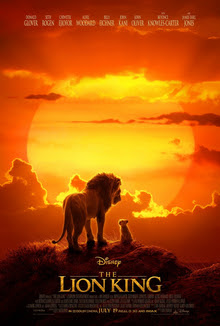
The Lion King (2019)

Most movies would be improved, I think, by imagining that you are watching them with Jeff Goldblum. And as I was watching The Lion King, Jon Favreau’s 2019 remake of the 1994 animated classic, I had the acute feeling that Goldblum’s Dr. Ian Malcolm (from Jurassic Park) was sitting next to me. I could almost hear him say, “Your animators were so preoccupied with whether they could, they didn’t stop to think if they should.”
 
By the time the end credits rolled on The Lion King, I found myself asking the same question I ask of nearly all of Disney’s live-action remakes: “Why?” Why does this film exist? Why was the remake almost identical to the original? And why was I surprised that, yet again, Disney pulled the wool over my eyes in convincing me that I hadn’t already seen this story?
 
From its opening frames, The Lion King is an exercise in déjà vu. The sun rises on an African plain, and the same Zulu opening vocals from Lebo M. ring out. If it’s not precisely shot-for-shot, it’s close enough, as Mufasa (James Earl Jones) and Sarabi (Alfre Woodard) present their son Simba (JD McCrary, then Donald Glover) to the kingdom he will one day rule. All of this has happened before, and the “Circle of Life” might as well be the creative bankruptcy that leads to a rinse-and-repeat mode of content creation.
 
To be fair, that sequence is the very model of ‘iconic’; it was, after all, packaged as a teaser trailer for the 1994 film, and it’s an absolute banger of an opener. Don’t fix what isn’t broken, they say, so I’ll give director Jon Favreau a pass on the first five minutes. When you’re a cover band, you play the hits, no matter how many times you’ve heard “Hey Jude” or “Free Bird” in your life. As the film unfolded, I thought we were heading into fairly interesting territory. This 2019 version begins to deepen the psychological profile for its villain Scar (Chiwetel Ejiofor) and his cackle of hyenas, who rebel against Mufasa for largely different reasons this time around. An explanation for his eponymous scar, and a few line changes to his solo number “Be Prepared,” feel like early forays into giving us a reason to run through the paces once more.
 
Perhaps ironically poignant, the first time that I noticed a major content change was in a sequence that revolves around, of all things, a dung beetle and his bespoke fecal boulder. Every creature in the savannah plays some small part in accidentally delivering to Rafiki (John Kani) a snarl of Simba’s mane, proving to the mandrill shaman that the lion king is still alive. It’s a fascinating rebuttal to Timon (Billy Eichner) and Pumbaa (Seth Rogen), who had just prior rebuked the idea of a “circle of life,” and it’s a slightly more credible way for Rafiki to learn of Simba’s exile. But in the end, it is an extended sequence about ossified manure, perhaps more suited to Planet Earth than a Disney feature.
 
In fact, the whole thing comes off as more of a thought experiment than a movie proper. What if, The Lion King asks, we could remove all abstraction from the original and render it as lifelike as possible so that we become not spectators but voyeurs in the animal kingdom, watching a wildlife documentary? Why include a bird who can smile or roll his eyes when we can give audiences a Zazu (John Oliver) whose physical features are limited by how an actual hornbill can move? Indeed, why make the film in such a way that the only expressions on the characters’ faces are provided by the Kuleshov effect? 
 
The answer, it seems, is behind the scenes. As far back as his Jungle Book, Jon Favreau has been experimenting with what technology can allow him to do, and the making-of featurettes for both movies show Favreau exploring his imaginary world through the use of VR technology. (A similar technical invention allows Favreau to shoot much of The Mandalorian in an immense soundstage called “The Volume,” so perhaps all’s fair in love and Star Wars.) If Favreau’s directorial outings are more about pushing the envelope of special effects, reskinning classic films just to see if he can, then The Lion King is a roaring success. But one can’t even call this a live-action adaptation – it is, rather, just differently animated, an identical remake only slightly less inessential than Gus Van Sant’s Psycho.
 
It’s not that The Lion King is badly made. The effects are good, even to the point that one might assume these were actual animals filmed on genuine African landscapes, and some of the voice casts are decent upgrades; Ejiofor in particular is a more Shakespearean Scar, while Eichner and Rogen are the surprise best-in-show (excluding, naturally, James Earl Jones’s return as Mufasa). Despite being slightly longer than the original, all of it feels overly familiar. “I know, I know,” I found myself thinking, “You’ve told me this one already.” There is a long gap between 1994’s Lion King and the Hamletthat inspired it; the difference between 1994 and 2019’s Lion Kings, however, is merely one of overlaying an Instagram filter.
 

The Lion King
 is rated PG for “sequences of violence and peril, and some thematic elements.” Directed by Jon Favreau. Written by Jeff Nathanson. Starring Donald Glover, Seth Rogen, Chiwetel Ejiofor, Alfre Woodard, Billy Eichner, John Kani, John Oliver, Beyoncé Knowles-Carter, and James Earl Jones.

Monday, February 27, 2023

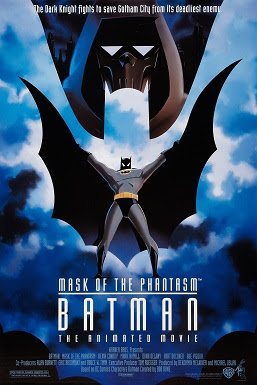
Batman: Mask of the Phantasm (1993)

“I need it to be different now. I know I made a promise, but I didn’t see this coming. I didn’t count on being happy.”
 
When I reviewed Batman: Mask of the Phantasm back in 2012, I said that it was “impossible” to compare it to The Dark Knight, finding Phantasm to be “quintessential.” Four years later, in my first expansion of my Personal Canon, Mask of the Phantasm made the cut – and yet I had said it was “imperfect... the resolution doesn’t quite hold up after repeat viewings.”
 
Reader, I was wrong. This review could have been so many things – an edition of “Take Two Tuesdays,” a continuation of my 2017-2019 reviews of Batman: The Animated Series, or part of my heretofore undeclared attempt to review every movie on the Personal Canon. Even before rereading my original review, I wanted to revisit Mask of the Phantasm because it deserved so much more than just 250 words in that “Monday at the Movies” format – especially on the occasion of its 30th anniversary this year. Whatever I was thinking in 2012, Phantasm has never truly let me down.
 
The Batman (Kevin Conroy) is a wanted man, wrongly accused of the murders of some of Gotham’s most notorious mobsters. Batman is hot on the trail of the real killer, The Phantasm (Stacy Keach), when an old flame returns to town – Andrea Beaumont (Dana Delany), whose past relationship with Bruce Wayne is explored in heartbreaking flashbacks, even as the plot marches inexorably toward a final confrontation with The Joker (Mark Hamill).
 
I always forget that Phantasm is as brief as it is. In the neighborhood of 75 minutes, it’s hard to find a film that hits all the bases like this one does: suspense, romance, comedy, heartbreak. Between dynamite action sequences and deeply human character work, Mask of the Phantasm includes no fewer than three origin stories across two timelines, telling an indelible and original story about Batman. It’s a tale that has cast its own shadow over Batman in the past thirty years, with fans constantly asking, “When will the Phantasm show up?” (The Phantasm appeared in Batman Beyond comics circa 2015 and in 2020’s Batman/Catwoman; over on film, we got a name-only tease in Batman v Superman, while the Phantasm is frequently name-checked in wishlists for the inevitable sequel to The Batman.)
 
Yet the reason I’ve never quite sounded the call for more Phantasm stories is because this one is perfect. The comics did a semi-sequel to the film in Batman & Robin Adventures, in an issue that could only be called “Shadow of the Phantasm.” While it’s a fun romp, it’s not indispensable, and it essentially leaves the characters in the same place where the film did: separated, exiled, and presumed dead. I’m being cagey about spoilers, even though the film is thirty years old and the action figure infamously unmasked the Phantasm just in time to disappoint kids on Christmas. My spoiler-phobia is largely due to my quasi-religious devotion to stories and the art of storytelling, but it’s also because the mystery isn’t entirely the point; if you know how tragedies work, you’ll plot this one out in short order.
 
Because the key to Phantasm isn’t that it’s a mystery; it’s a film noir about brooding avengers and the dark shadowy antiheroes who love them. It’s a tragedy about what happens when people let their pasts define them, but it’s also about the inescapability of the past, of chickens coming home to roost when it’s least convenient. Indeed, the past looms as large as the heavy tombstone on which the WAYNE family name is inscribed, and the real pain of the film is Bruce Wayne’s inability to escape that destiny he pledged for himself. “The way I see it,” Andrea snipes in one incisive moment, “the only one in this room controlled by his parents is you.”
 
Phantasm is somewhat unique for a Batman origin story in that we never see the murder of the Waynes, that random act of devastating violence that set Bruce Wayne on a course of dark vengeance. Instead, the film takes their loss as a given and sets the real origin story as a choice – Bruce Wayne chooses his vow over his own selfhood, and when he dons the cape and cowl for the first time, it’s not a moment of triumph. Alfred intones, “My God!” and recoils. The music swells, but even that refrain is sobered and pained. From that moment on, Bruce Wayne is the performance, a careless playboy charade who has to hide himself away from others lest they see through his façade.
 
The Phantasm, too, is a performance, reciting the ominous refrain, “Your angel of death awaits,” like some grim prophecy that explains everything. Outfitted with a theatrical costume and an insistence on dramatic violence, the Phantasm is wrestling with demons that have nothing to do with framing Batman for murder. Meanwhile, the mobsters – most notably Sal Valestra, voiced by Abe Vigoda – are stuck in their roles, playing out cheap imitations of The Godfather while their past catches up to them. The casting of Vigoda is inspired, mired in the genre’s past while playing on the arrested timelessness of Vigoda’s permanent old age.
 
Paradoxically, only The Joker is perfectly liberated. If you didn’t know he was in the movie, his first appearance reads like something out of a nightmare; the film takes a hard pivot and bends around his manic gravity. At first, the mobsters try to recruit Joker to protect them from Batman, but the incorrigible Joker can’t help but take over the plot for his own purposes, bumping off as many gangsters as The Phantasm does. He even seems to grasp the cruel irony of the film’s finale, laughing with gleeful abandon as he, Batman, and The Phantasm stare down certain death. Indeed, throughout Joker plays the Shakespearean fool, commenting on the coincidences of the plot, calling out red herrings about Phantasm’s identity, and cracking wise with a sense of humor best suited to the gallows of Gotham.
 
I haven’t said anything about the voice cast because the scripting is so impressive, but suffice it to say that Kevin Conroy remains the definitive Batman, giving us no fewer than three takes on the character (costumed vigilante, fresh-faced bachelor, and jaded philanthropist). He can plumb the depths of grief or crack a wry one-liner, and he’s the voice I’ll always hear in my head for any comic book. Ditto for Mark Hamill, whose Joker is so good that you forget he was ever a farmboy from Tatooine. Hamill has a knack for uncomfortable punchlines like “That’s what I want to see, a nice big smile.” Then there’s Dana Delany, who has to be the emotional heart of the story while keeping her own feelings clenched beneath a cool exterior. She can keep pace with both Bruce Wayne and Batman, and using nothing but her voice, she convinces us that she’s Bruce’s true star-crossed lover.
 
Ultimately, the reason people want more Phantasm isn’t because there’s more to say. It’s because this film is so good, so perfect, that 75 minutes feels criminally brief. We want to hear Conroy and Hamill riffing on each other until the end of time. We want to chase happiness just like Bruce Wayne does, and we want to revel in the bittersweet fatefulness that finds Bruce pursuing a darker calling. Or maybe we just want to live in that glorious art deco Gotham, painted on black with red skies, with a breathtaking Shirley Walker score to make sense of it all. (I know I do.) It’s an agonizingly human story, heightened by the presence of elaborate costumes and a certain Clown Prince, and as in the best films no one wants to see it end.
 
I don’t know what I meant in 2012 by “doesn’t quite hold up,” because Phantasm is a movie that has held up – and it has held me up when I’ve felt down about storytelling, disappointed by my favorite genre, or just grim about life itself. It’s almost like a calculated distillation of a superhero narrative, sweeping from start to finish, from origin story to never-ending battle. It’s not a movie that necessarily makes one feel good about humanity, but it does make one feel good about being alive. What life is worth living if you don’t have Conroy and Hamill narrating it?
 

Batman: Mask of the Phantasm
 is rated PG for “animated violence.” Directed by Eric Radomski and Bruce Timm. Written by Alan Burnett, Paul Dini, Martin Pasko, and Michael Reaves. Based on the DC Comics. Starring Kevin Conroy, Dana Delaney, Hart Bochner, Stacy Keach, Abe Vigoda, Efrem Zimbalist Jr., and Mark Hamill.

Tuesday, October 19, 2021

Monster March II: Frankenweenie (2012)

Frankenweenie is not quite the movie I was expecting. Certainly I got more than my fair share of Tim Burton hijinks, all angular bodies and the subtle terrors of the suburbs. What I wasn’t expecting was how much of a faithful and loving adaptation Frankenweenie would prove to be of the original James Whale Frankenstein – and what a fitting inclusion for Monster March II. (Remakes and mash-ups and sequels, oh my.)

Young Victor Frankenstein (Charlie Tahan) loses his beloved dog Sparky (Frank Welker) in an unfortunate accident, but the words of his eccentric science teacher (Martin Landau) inspire Victor to undertake his own experiment. Sparky lives! Yet as Victor struggles to keep his science project secret, his classmates begin to realize that his experiment has the potential to change their town.


From the beginning of Frankenweenie, it seems that Tim Burton has set out to make a film about his own childhood. The story begins with Victor screening his latest short film for his parents. Like Burton, Victor clearly has an appreciation for low-budget horror with all its gimmicks and movie magic, even equipping his parents with 3-D glasses for the living room premiere. It’s the sort of peculiar precise detail that suggests Burton actually lived this moment. Already the film was defying my expectations, and I do wish Burton had spent more time on this hobby of Victor’s; I’m not sure how it would fit into the Frankenstein allegory he’s telling, but it’s certainly unique and clearly a passion for Burton.


As Victor attempts to discover a world beyond his love for his dog, the film veers into a riff on Edward Scissorhands, which was itself a kind of Franken-fable (with Johnny Depp as a kinder, gentler creature who nonetheless became feared for his unnatural appearance). Here Burton’s obsession with the simulacrum of the suburbs is on full display; though the streets and houses all look normal, the people that occupy them are anything but – especially the children, who are cartoonish and borderline monstrous, even before their fierce competitive spirit drives them to burglarize his attic laboratory. Kids can be real creeps, Burton says here, and having had a childhood myself I would have to agree.


Yet if the film starts out in the vein of Edward Scissorhands, it well and truly reminds us by the end of the story that it’s from the same odd mind that brought us The Nightmare Before Christmas. Victor’s relationship with the reanimated Sparky is both bizarre and sweet, a comfortable niche for Burton, but the creature horror of the film’s third act puts one in mind of the vampire bat toy that Jack Skellington’s minions set loose on Christmas Eve. As the children of New Holland reanimate their pets, only some of whom have joined the choir invisible, one can almost hear Burton gleefully rubbing his hands together from behind the camera as he intones, “I will show you fear in a handful of sea monkeys!” 


Frankenweenie is plenty enjoyable, even when it feels a bit like a Tim Burton cover band, but it’s of particular interest this month for being a spot-on adaptation of the Frankenstein legend, especially as remediated through the lens of horror films like the Karloff classic. (Indeed, one neighborhood boy, voiced by Martin Short, may as well be Karloff.) Colin Clive’s ecstatic “It’s alive!” is replaced by Victor’s more jubilant “I did it!” And of course, no modern Frankenstein would be complete without Elsa Lanchester’s iconic hairdo from Bride of Frankenstein, though it would be criminal to spoil who gets to wear it. (Perhaps surprisingly, it’s not the neighbor girl Elsa Van Helsing, voiced by Winona Ryder.) This is a madcap Frankenstein, a mishmosh of all the iconography Burton loved as a child, run through his instantly recognizable stop-motion filter. It is perhaps exactly the movie you’d anticipate coming from Burton, but by the same token it’s never quite the movie you expect. After two hundred years, this old story still has a little spark to it.


Frankenweenie is rated PG for “thematic elements, scary images, and action.” Directed by Tim Burton. Written by John August and Tim Burton. Starring Charlie Tahan, Martin Short, Catherine O’Hara, Martin Landau, Winona Ryder, and Frank Welker.

Friday, August 13, 2021

August Archaeology: Indiana Jones and the Temple of Doom (1984)

With the 40th anniversary of Raiders of the Lost Ark this year, the release of the 4K box set (finally!), and the franchise’s omnipresence on Showtime the past few weeks, The Cinema King has come down with a bad case of Indy Fever. Having already reviewed the films some time ago, let’s try something a little different this month. In the tradition of the “Grand Marvel Rewatch,” let’s dig around the Indiana Jones franchise and see what comes up.


This week, from 1984, it’s Indiana Jones and the Temple of Doom. After dodging gangsters in Shanghai, Indiana Jones (Harrison Ford) drops into northern India with his pint-sized sidekick Short Round (Jonathan Ke Quan) and chanteuse Willie Scott (Kate Capshaw). The theft of a sacred stone leads Indy to Pankot Palace, where an ancient evil has taken root, and our favorite archaeologist may find much worse than fortune and glory in the caverns beneath the palace. 

  1. PG or not PG? The old urban legend draws a straight line between Temple of Doom and the creation of the PG-13 rating later that year, and there’s a grain of truth to that. It’s easy to forget how downright scary Temple of Doom can be, especially in its back half; even to an adult, there’s something terrifying about the human sacrifices and death cults that pervade the caves beneath Pankot. It’s all shot in fiery reds, and John Williams takes the music in an unearthly direction, with the result sounding more like a horror film than an adventure flick. Raiders felt tame by comparison, thrilling but never quite as perilous.
  2. Hats off to Mola Ram. While the Nazis are still the perfect foil for Indy’s gee-whiz brand of adventuring, let’s not forget what an excellent villain Mola Ram makes for Temple of Doom. He’s scary, with nothing redeeming about him, and his subterranean search for the lost Sankara Stones makes him a surprisingly apt antagonist for our archaeologist hero. Amrish Puri is expertly cast, with an intimidating presence even before he bulges his eyes and gives a mad leering smile. And speaking of “hats,” my compliments to the person who gave Mola Ram the sacrilegious cow skull for a headdress, melding Indian beliefs with Satanic imagery by way of Georgia O’Keeffe.
  3. The biggest trouble with her is the noise. Fairly or not, so much of the film’s critical reputation falls on Kate Capshaw’s shoulders. On this latest rewatch, Capshaw is doing exactly what the script wants, playing this big-spirited nightclub singer dragged against her will into a series of nightmares. She screams more than 70 times in the film, which is profoundly irritating, but the problem belongs more properly to the script, which puts this fish so far out of water that everyone protests. She doesn’t grow, she doesn’t change, but neither does her environment change around her. Instead, we get a character who never wants to be here; it is, incidentally, the same complaint I have with most movies about The Hulk. If you don’t want to be a superhero, don’t be in a superhero movie.
  4. A reactive protagonist. While some lament that Indy doesn’t govern the action in Raiders, I’m surprised the same complaint isn’t often leveled at Temple of Doom. Unlike the other films, where Indy is off looking for an artifact, Temple of Doom gives him minimal agency in his quest. The Shanghai opener is out of his control, he quite literally stumbles into the main plot, and once he gets to Pankot he’s only reacting to things that happen. Now I’m not saying this is necessarily a bad thing, and perhaps it’s even clever given that this prequel is Indy’s “first” adventure, but it’s somewhat less than engaging to watch a protagonist who’s never quite in command of his narrative destiny.
  5. Do I like this movie? Raiders and Last Crusade are Personal Canon material for me, no doubt about it, and I’m sure I don’t love Temple of Doom as much as those two. In fact, I’m usually sure that Temple of Doom is my least favorite Indy movie. But does that mean I don’t like it? I’ve never raced to see it – and indeed wondered if I could get away with August Archaeology without rewatching – but each time I watch it, I’m glad I did. The opener is a real banger, and the finale is terrific (both the mine car chase and the bridge sequence), though I’ll concede that the middle is a bit dull, stuck on gross-out sequences like the exotic banquet and the creepy-crawlie chamber. We’ll revisit the question in two weeks, but isn’t some Indy better than no Indy at all? 

You tell me: is Temple of Doom the worst Indiana Jones film, or is it quietly the best? Sound off in the comments, and tell me your favorite part of Indiana Jones and the Temple of Doom. We’ll be back next week to ponder whether the franchise’s best is actually Indiana Jones and the Last Crusade. 

Friday, August 6, 2021

August Archaeology: Raiders of the Lost Ark (1981)

With the 40th anniversary of Raiders of the Lost Ark this year, the release of the 4K box set (finally!), and the franchise’s omnipresence on Showtime the past few weeks, The Cinema King has come down with a bad case of Indy Fever. Having already reviewed the films some time ago, let’s try something a little different this month. In the tradition of the “Grand Marvel Rewatch,” let’s dig around the Indiana Jones franchise and see what comes up.


First up, from 1981, it’s Raiders of the Lost Ark. Indiana Jones (Harrison Ford) is tasked with finding the fabled Ark of the Covenant, a biblical artifact of unspeakable power, before the Nazis unearth it. Indy enlists the help of former flame Marion Ravenwood (Karen Allen), and the race is on across continents as old rival René Belloq (Paul Freeman) dogs Indy’s every move.

  1. The music. You don’t need me to tell you that John Williams is the greatest film composer of all time. Just listen to the iconic and unforgettable “Raiders March,” thrill to the spectral and mystic “Miracle of the Ark,” and swoon to “Marion’s Theme.” Williams famously drafted two separate themes for Indiana Jones, uniting them both at the suggestion of director Steven Spielberg. Yet the two themes gel so well together, melding the triumphant march with a sense of the hard work it takes to get there. Each musical motif swirls into the film as though Williams is speaking a language all his own, commenting on the plot and driving us furiously into the action.
  2. Speaking of the action… I can’t count how many times I’ve seen Raiders, but it’s tremendously exciting every time. From the pulse-pounding opener, which puts one very much in mind of a James Bond pre-credits sequence, through the climactic desert chase, Raiders gets the blood pumping. The best part about the action is how often it’s used to develop and humanize the characters, as when a tired Indy laconically guns down an overeager swordsman. Ditto for the small beats where Indy catches himself enjoying the violence, only to wince and remember that he’s been shot in the arm. Raiders practically reinvented blockbuster movie pacing, and it’s not hard to tell why.
  3. What a world! The world-building in Raiders makes writing look easy; I should only hope to write a story this good. The film effortlessly introduces Indiana Jones as a superheroic archaeologist and a world-renowned scholar, and it gives him such a richly textured background filled with fascinating characters who have their own complicated history with Dr. Jones. When we meet Marion or Belloq or Sallah (John Rhys-Davies), we can tell immediately how they know Indy, what each thinks of the other, and what might happen next time they’re in a room together. Moreover, Spielberg deftly introduces the Ark into the film’s world through sophisticated lighting tricks and audio cues (like soft winds or, yes, Williams’s score). It’s an overall unified narrative where no piece is wasted – smart filmmaking at its smartest.
  4. Is this the best supporting cast of all time? Harrison Ford rightly takes up a lot of oxygen when we talk about great performances in Raiders, but everyone else nails their roles. Karen Allen is superb in all the moments where she refuses to be the damsel in distress, and it’s only too bad that she wasn’t in more Indy films (or, put another way, that there weren’t more Indy films for her to join). Meanwhile, Paul Freeman dials up the smug smarm of the enemy archaeologist Belloq, a walking moral compromise; he sells the competitive rivalry with Indy almost immediately. Then there’s the stalwart John Rhys-Davies and Denholm Elliott, about whom I’ll say more in two weeks. (So to answer my question, I’m sure I’m forgetting another movie, but Raiders has to be in the conversation somewhere.)
  5. The formative years. My dad brought home a copy of Raiders on VHS back during a McDonald’s promo circa 1991, and the more I think about it, the more I’m convinced that Raiders was a seminal moment in my moviegoing career. For my money, it’s everything a movie should be – a brisk adventure that puts well-crafted characters in impossible situations with nothing less than the fate of the universe at stake. It’s also a period piece, which helps explain my obsession with movies like The Rocketeer and The Mummy. It’s unlikely I saw this before Star Wars, but it’s possible; either way, it set a high bar for every subsequent movie to come. You don’t get on the Personal Canon any other way.

What more can one say about one of the greatest movies ever made? Sound off in the comments, and tell me your favorite part of Raiders of the Lost Ark. We’ll be back next week – back in time, that is – with the prequel Indiana Jones and the Temple of Doom. 

Monday, May 3, 2021

Bat-May: Batman: The Movie (1966)

Once upon a time, the most divisive fault line in fandom was whether or not you loved Adam West’s Batman. (It was a simpler time.) Chances are that you held him in higher regard if you grew up with him, but if Tim Burton or Frank Miller got to you at a young age, you might not have had the patience for a groovier, campier Batman. By the time Adam West passed in 2017 – and indeed long before that – the tides seemed to have turned in Bat-fandom: even if Batman ’66 (as it came to be dubbed) wasn’t your Batman, it was at least a Batman with its own redeeming qualities. 

Within that neon outpost in the Dark Knight’s long and storied history, amid the pow-biff-bam of the television series, Batman: The Movie finds the Caped Crusader (Adam West) and his sidekick Robin (Burt Ward) facing the unfathomable – all their greatest villains have teamed up, with global domination in their sights. The Joker (Cesar Romero), The Penguin (Burgess Meredith), and The Riddler (Frank Gorshin) have joined forces with Catwoman (Lee Meriwether), who is posing as the Russian journalist Miss Kitka, in a fiendish plot to rule the world.


Batman: The Movie is not quite a movie because it feels like three or four episodes of the television series strung together. You can even mark the narrative intervals with each time it seems Batman and Robin have been blown to smithereens; just supply the Bill Dozier “same bat‑time, same bat-channel” narration yourself. While this pacing can be fun on television, even if you string a two-parter together, it becomes a bit interminable as a feature film with an episodic quality. Perhaps Batman: The Movie is better understood as an artifact, a kind of analogue to comic book crossovers. Where the episodes of the television show usually only featured one high-profile villain (often played by a major celebrity guest star), the selling point here is that the show’s four biggest villains are sharing the screen. (Scrapped plans for a second film, with Batgirl in tow, suggest this pattern would have continued on the big screen.)


Like the television show, the film is more enamored of its villains than of the Dynamic Duo. Adam West and Burt Ward play their parts in staid and stalwart fashion, their straight faces serving an essential role in the high camp atmosphere, but there’s no question the film only truly comes alive when it has its antagonists on screen. Of the foursome, Burgess Meredith’s Penguin takes the lead; it’s his submarine and his henchmen that run the plot, with the other villains deferring to his leadership. (Maybe it’s the monocle.) As the Penguin, Meredith is almost a Jack Burnley drawing come to life, all squawks and waddles, but what really stands out about his performance is just how hard he’s selling it.


Indeed, all the players are acting their parts with the gusto of a toddler at playtime, hammy in all the right places but never compromising the internal integrity of the thing with so much as a wink to the camera. Each villainous performer finds his or her lane and sticks with it. Frank Gorshin’s Riddler is giddy and over-the-top, but it’s dialed into what this incarnation of the Riddler should be (and a clear template for Jim Carrey’s Riddler in Batman Forever). Cesar Romero’s Joker, once you get past the painted-over mustache, puts the “clown” in “Clown Prince of Crime,” whooping and clapping at his own mischief. Meanwhile, Lee Meriwether (herself subbing in for television’s Julie Newmar) plays Catwoman/Kitka with all the purring puns a single screenplay can handle.


Kitka’s romance with Bruce Wayne is compelling enough, with Adam West suitably smitten with the passingly dismissive Soviet. In these moments, it’s a little disappointing that Bruce never sees through the disguise until the very end of the film – particularly since his Batman is marked with over-preparation for literally any other scenario he encounters. He’s got shark repellent in his helicopter, a torpedo deflector in his belt, and even a computer that can sort dust particles by color; it’s just too bad he doesn’t have a working set of eyes and ears to know when he’s being duped. Perhaps, however, that’s the point – this Bruce Wayne is a lover, not a fighter. (Though his seduction skills could use some work – quoting Edgar Allan Poe isn’t the first recourse for most casanovas.) 


For a Batman film, both Batman and Robin are woefully underdeveloped, static figures of justice and good manners – which is, again, the point. The camp of Batman ’66 requires heroes who are unchanging and unflinching; nothing flummoxes them, and nothing finds them ill-prepared to save the day. These do-gooders need only do good, despite the less-than-stimulating viewing pleasure such heroics provide. There’s never any doubt that good will prevail, with the only surprises being which unlikely gadget our heroes will pull from their bottomless utility belts. Like their villains, though, West and Ward commit wholeheartedly to their act, with West’s deliberately dramatic delivery matching Ward’s gee-whiz enthusiasm.


Batman: The Movie was originally intended to be the series debut, launching the television program in big-screen style. Released after the first season, however, it becomes instead a celebration of everything that Batman ’66 was – flashy, vibrant, and campy. It’s a feature-length distillation of the show’s successes and failings, its mod mentality dialed up to 11. If you loved the show, you’ll love the movie, but if West has never been your Batman, this film won’t change your mind. As for me, I like the show just fine, in small doses, and Batman: The Movie proves to be a bit too big a dose for one sitting. For a generation, this was Batman, so kudos to the crew for keeping the flame alive.


Batman: The Movie is rated PG. Directed by Leslie H. Martinson. Written by Lorenzo Semple Jr. Based on the DC Comics, and on the ABC television series. Starring Adam West, Burt Ward, Lee Meriwether, Cesar Romero, Burgess Meredith, and Frank Gorshin.

For more Bat-May action, the good folks at Collected Editions posted my review of Batman: The Movies, the comic book adaptation of the Batman Quadrilogy. Give them a click - no one reviews comics like Collected Editions!

Friday, April 23, 2021

April of the Apes: Conquest of the Planet of the Apes (1972)

When it comes to Conquest of the Planet of the Apes – the fourth installment in the simian time-travel franchise – I can’t quite say whether I would have preferred the title to be Panic on the Planet of the Apes or Riot for the Planet of the Apes. (The conquest, you see, happens largely off-screen, after this movie ends.) It’s certainly the most violent of the Apes films, particularly in the unrated version that found its way onto Blu-Ray, and at times it seems as though the violence is merely an end in itself. But for all its low-budget sturm und brutish allegorical drang, Conquest is a compelling installment in a perennially strange series.

Twenty years after his parents arrived on earth, the talking chimpanzee Caesar (Roddy McDowall) has been hiding from the government under the protection of circus owner Armando (Ricardo Montalbán). While the rest of the world domesticates apes to replace the dogs and cats that perished in a global pandemic, Caesar becomes the unlikely hero of a revolution after his secret is uncovered by the forces of the sinister Governor Breck (Don Murray).


Conquest is somewhat unique among the Apes films in that it exists in two different versions: there’s the 1972 theatrical release and the more recent (and, as far as I can tell, fan-preferred) unrated version that debuted on Blu-Ray circa 2009. While the differences are largely negligible, with the unrated version featuring more graphic and startling shots of blood and violence, the ending is bracingly different. I’ll throw up a spoiler warning, although I wonder whether it’s possible to spoil a closed-loop time travel story: in the theatrical release, Caesar heeds his better angels and talks his fellow apes out of violence, while in the unrated version, Caesar embraces the use of force and encourages the gorillas to execute Governor Breck.


When I first saw Conquest ages ago, it was the theatrical version, but having watched the unrated cut for “April of the Apes,” I can’t imagine going back. The darker, more fatalistic ending gives Roddy McDowall the centerpiece he deserves; in a dramatic monologue that is equal parts Shylock and Richard III, McDowall mouths a somber and grim portrait of humanity, invoking the darkest chapters of American history while positing himself as a Darwinian emperor ape. In this closing soliloquy, dark and chilling enough to elevate the entire film, McDowall’s Caesar reminded me very much of another science-fiction fable of revolt – HBO’s Westworld. And like the violent delights of the android theme park, the precarious peace of Conquest’s earth, Caesar insists, would have violent and inevitable ends. (One also cannot ignore the unanticipated lasting potency of the film’s civil rights metaphor, all the more heated in 2021, when Caesar’s essential thesis revolves around which lives matter.)


While McDowall is doing simian Shakespeare, the rest of the film is bogged down by cheap effects and on-the-nose metaphors. The first two Apes films featured an incredible prosthetics technique by John Chambers, but by the time we get to Conquest, we’re lucky if more than two apes at once are sporting that innovative makeup effect; instead, the bulk of the cast is sadly restricted to low-budget pullover masks, at once inexpressive and unconvincing. It’s a plus for Caesar, who stands out all the more, but it is overall to the film’s detriment, especially since the film does not invest much time in ape characters like Natalie Trundy’s Lisa (who, in the theatrical version, masters the power of speech in time to soften Caesar’s hardened heart).


Similarly, the villains of the film are thoroughly undercooked, evil for the sake of being evil without much in the way of motivation or character development. Doubtless the makers of the Andy Serkis mo-cap trilogy took note, as this was something the Serkis films greatly improved upon, particularly with Woody Harrelson’s unsettling Colonel in War for the Planet of the Apes. In Conquest, though, the antagonists are little more than Nazi stormtroopers, callously engaging in barbaric modes of torture without the self-awareness to realize that their shiny black boots and crisp black clothing telegraph their inherent villainy to the world. There’s a shining moment of insight when MacDonald (Hari Rhodes) chooses a side and turns against the other humans, but the film bludgeons the point home when MacDonald and Caesar repeatedly call attention to the fact that the black MacDonald is “a descendant of slaves.”


So much of Conquest of the Planet of the Apes isn’t subtle, though perhaps that’s asking too much of a franchise that involved Rod Serling only once. Still, like Escape from the Planet of the Apes, there is something of The Twilight Zone in Conquest, particularly in the darker unrated cut. There is a tragic sense of inevitability as the series winds down; in attempting to avert the planet of the apes, the human slavers end up creating it. There can be no peace through subjugation, the film warns, yet it is a lesson that Caesar seems not to have learned. Like Ben Affleck’s Batman, Caesar is blinded by his rage and his pain – yet the film is stronger and more chilling without the theatrical cut’s moralizing (and ultimately inert) denouement. While it’s very short and subsumes substance for spectacle, one can’t help but be won over by Conquest’s potent go-for-the-jugular approach – but none of it would work if it weren’t for Roddy McDowall treating this sci-fi hokum like Elizabethan tragedy.


Put another way, this might not be how we imagined the birth of the planet of the apes (nor does it quite align with the versions we heard from Cornelius or Dr. Zaius), but in the moments when it stays out of its own way Conquest is very nearly better than a fourth film with no budget has any right to be.


Conquest of the Planet of the Apes is rated PG. Directed by J. Lee Thompson. Written by Paul Dehn. Starring Roddy McDowall, Don Murray, Natalie Trundy, Severn Darden, Hari Rhodes, and Ricardo Montalbán.

Monday, January 7, 2019

Spider-Man: Into the Spider-Verse (2018)

We like to say that “the geeks have won.” It’s a victory that’s been called more often than Barbara Stanwyck’s bedside telephone in Sorry, Wrong Number, but each time it feels like geekdom has achieved the unthinkable – be it the smash debut of The Avengers or introducing comics-accurate oddballs like King Shark and Professor Pyg on primetime. In 2018, the geeks won by having a banner year, with three animated superhero films alongside major showings by their live-action counterparts. However you slice it, we can have a productive argument about whether the cartoon with a Spider-Pig was actually the best one – a true win for the geeks.

Spider-Man: Into the Spider-Verse (finally) introduces Miles Morales (Shameik Moore) to the big screen as Brooklyn’s new friendly neighborhood Spider-Man after a spider bite puts him in a league with his universe’s Peter Parker (Chris Pine). I say “his” universe, for Brooklyn becomes host to a coterie of spider-people after The Kingpin (Liev Schreiber) tears a hole in the fabric of space-time with a particle accelerator experiment. Joining Miles are a shlubbier Spidey (Jake Johnson), Spider-Woman (Hailee Steinfeld), the black-and-white Spider-Man Noir (Nicolas Cage), and Peter Porker, the Spectacular Spider-Ham (John Mulaney) – all in search of a way home.

I’ve said in the past that Batman is the greatest fictional character because of his chameleonic ability to accommodate whatever his audience needs – he can be the paragon of camp, the apex gargoyle, a space-age dark knight, or a kid-friendly crusader. When I say that, however, I’m usually not thinking of Spider-Man, for whose comparable metamorphoses Spider-Verse makes a compelling argument. Spider-Verse posits a veritable spider-prism (kids next door, rocker chicks, tough-guy gangsters, wise-cracking pigs, and more), each of whom accesses the central truth of Spider-Man – that with great power, there must also come great responsibility. You can’t run away, you can’t turn your back; your family and your friendly neighborhood are counting on you. For all his myriad forms, it’s hard to imagine Batman in a film like this one, teamwork having never been his strong suit. (Singular dislocation suits Batman better than prismatic conjunction; cf. Batman Ninja, Batman Beyond, etc.)

It’s equally hard to imagine that Spider-Verse works as well as it does. Its irreverent approach to storytelling, layering origin stories in a gag that never loses its comedic punch, helps the viewer navigate fifty years of convoluted chronology with deft precision. (Its comics counterpart, 2014’s Spider-Verse crossover, is comparably impenetrable.) Make no mistake, though; for all its spider-people, Spider-Verse is well and truly Miles’s film, a full origin story for the newest Spider-Man (who debuted in 2011). Here Miles is quite a character, engaging and relatable because of his eminent humanity; he’s shy but gifted, funny and earnest. What’s more, there comes a moment in the film where you’d almost rather he not become Spider-Man because of how well we like Miles and the unique story being told with him; it almost seems a shame to put him in a costume and give him a fairly recognizable super-action narrative. But the exceedingly clever script finds a way to weave that hero’s journey into the story already in progress (including a few, ahem, touching callbacks).

Of course, so much of the film’s success owes to its lanky animation style, delicately exaggerated in the best Tex Avery tradition. The slightly jerky movements and modest design tweaks help divorce Spider-Verse from strict representation and move it into a realm where it feels like anything can happen, where any abstract incursion fits right in (cf. Spider-Ham). Animation naturally unfetters a filmmaker’s aspirations in the way that a comic book page renders all things possible beyond constraints of budget. That’s not to say that Spider-Verse is cheap (its budget has been reported at $90 million), but it’s hard to imagine a live-action film capturing all the peculiar quirks of this world, to say nothing of its technicolor climax or the characters that almost need to belong to an animated world (again, Spider-Ham, but also the monochromatic Spider-Man Noir). I knew I was in for a visual treat even from the trailers, but nothing can really prepare a moviegoer for the first appearance of the massive Kingpin – whose sheer mass cannot be understated. Even this, though, is essential character work; Kingpin’s colossal bulk distorts gravity around him, in the way that his particle accelerator tampers with the laws of physics in order to pull in the objects of his plot (no spoilers, but the script is smart to make Kingpin three-dimensional, giving him a full and possibly legitimate reason for risking the fate of the universe).

As dark as the film can be, wading into heavy subplots about betrayal, disappointment, and loss, Spider-Verse is exuberantly, boundlessly fun. I can’t, for example, point at someone or touch their shoulder without thinking of particular jokes in the film and guffawing my webs off. But the film also tickles my specific devotion to superheroes for its relentless optimism. Yes, the situation is dire, with cataclysmic consequences, but here’s a kid from Brooklyn who stands at the center of this massive web with the power to save everyone, and all he needs to do is figure himself out. What’s more, he has a loving family and a network of friends to help him through difficult times; no matter how isolated he feels, Miles Morales is never alone. Reducing him to “the black Spider-Man” doesn’t do justice to the depth of this character or the ways he advances and perpetuates the legend of Spider-Man without the guilt or baggage of Peter Parker.

I’m not ready to wade into the battlefields of “who did it better?” just yet. (As I get older, I’m losing patience with these pithy ‘hot takes’ that end more conversations than they start.) The geeks have well and truly won when we can have Black Panther and Spider-Verse, when we get a long-overdue Incredibles 2 alongside them and Avengers: Infinity War, to say nothing of Aquaman, Venom, Deadpool 2, and Ant-Man and the Wasp. (Phew!) It’s an embarrassment of riches, not unlike the spider-cornucopia presented in Spider-Verse, with something for everyone and everything adding up to a romping good time. Best of all, Spider-Verse got me to dust off my Marvel Unlimited subscription and queue up a slate of spider-comics to read. That’s how the geeks win.

Spider-Man: Into the Spider-Verse is rated PG for “frenetic sequences of animated action violence, thematic elements, and mild language.” Directed by Bob Persichetti, Peter Ramsey, and Rodney Rothman. Written by Phil Lord and Rodney Rothman. Based on the Marvel Comics by Stan Lee, Steve Ditko, Brian Michael Bendis, Sara Pichelli, and Dan Slott. Starring Shameik Moore, Jake Johnson, Hailee Steinfeld, Mahershala Ali, John Mulaney, Nicolas Cage, Kathryn Hahn, Liev Schreiber, and Chris Pine.

Tuesday, November 6, 2018

Take Two Tuesday: Tomorrowland (2015) ...or, Put a Pin in It

2015 does not sound like that long ago, but three years feels like an eternity. I have distinct memories of seeing Tomorrowland in the theaters, and objectively it feels like only yesterday, even though the calendar tells me it was more than 1,200 days. Time flies, it seems, whether you’re having fun or whether you’re hurtling toward dystopia. The world seems like a grimmer place than it did three years ago, which is really saying something because I think we all recognize that the sky has been falling for some time now.

I’ve had a lot going on in my life of late, spending a lot of unpleasant time in my own head, and it feels like I hit a crisis point a few weeks ago. It was perhaps, then, appropriate that I came back to Tomorrowland at exactly the moment I needed it. When I reviewed it in 2015, you’ll recall that I was of two minds about it. “Tomorrowland is an important film,” I wrote, “playing to some of my political/aesthetic predispositions, but it’s not as good as it ought to be.” I was cynical about the film’s attempt to kickstart an imaginative revolution, frustrated that the film hadn’t delivered on its utopian promise. I wanted to goto Tomorrowland, and I expected the film to take me there.

Reader, I missed the point. Put another way, I had spent far too long asking, “Wasn’t the future wonderful?” without realizing that I should have been asking, “Won’t the future be wonderful?” (Light spoilers follow.)

In a way, Tomorrowland has never really left me. As a lifelong visitor to Walt Disney World, it’s around every corner of my memory, a direct right turn off Main Street in the Magic Kingdom. I’ve listened to the Michael Giacchino score more times than I can count; iTunes tells me I’ve listened to one track, “Pin-Ultimate Experience,” a whopping 113 times (which makes it #59 on my Top 100 Most Played list), and it’s almost certainly my favorite Giacchino score. A few months back, I finally read the tie-in prequel novel, largely because it includes a comic book, and I’ve continued to study Brad Bird’s career with great interest, most recently with Incredibles 2. And I bought the Blu-Ray about six months ago, knowing that I’d never fully dislodged the film, and noodled around the special features until finally plunking down a few hours last week to rewatch the film.

There is a great big beautiful tomorrow animated short on the Blu-Ray, “The Origins of Plus Ultra,” that was originally intended to be the film’s opener. I understand it was cut for reasons of pacing and because it reveals some of the film’s mythology a little too early (Clooney covers some of it at the top of the third act, in Paris). But it does queue up the film such that I find it difficult to imagine the film without it, because the short prepares the audience for the central question of the film – “What happened to human endeavor? Aren’t we better than this?”

Tomorrowland is an intervention film, no doubt about it, but I think critics mistook Bird’s frustration for mere crankiness, and I share his frustration. Our world seems paradoxically broken, with one crowd shouting that the world’s problems don’t exist, and the other insisting that the problems aren’t fixable. Then there’s Casey Newton (Britt Robertson) in the middle, amazed that no one has thought to ask how to save the future. There’s something endearing about Casey’s deadpan naiveté, about her complete disbelief that no one has considered pursuing a solution. Bird has stacked the deck, no question; you get to do that when you’re writing an allegory. But there is something so inspiring when Casey’s relentless optimism forestalls the apocalypse, if only for a few seconds – a jarring moment of hope for fallen cynic Frank Walker (George Clooney). The way the film stops on this beat is downright chilling, and it’s a credit to Bird that the film doesn’t need to overexplain what’s just happened; a pause on a ticking clock is enough for a thinking audience to understand that Casey is, quite literally, our last hope. And yes, I am a sucker for films that talk about how to save humanity from its fallen state (cf. Batman v Superman).

The film remains a little bit clunky, with an occasional exposition dump like the ones co-writer Damon Lindelof employed on Lost, but there is here a simultaneous charm to them. “Now I finally answer your question, you’re gonna interrupt me?” Walker interjects, at which time I realized that the mythology of the film was all just window dressing for Bird’s real message – that there is no time to waste, that the future is now, and that someone has to step up and build it. It’s as if Brad Bird is shaking the collective audience by the shoulders and imploring us, “Get off your ass and build Tomorrowland!”

There’s a wonderful line in another Bird film – Ratatouille, one of my all-time favorites – in which a critic discards his pessimism upon realizing, “Not everyone can become a great artist, but a great artist can come from anywhere.” It’s this message that infects the film’s final moments, in which the next generation of prime movers is recruited. Many of them come from humble beginnings, yes, but if Casey believes in them, we’re in good hands. I realized only now that the film’s framing device, narrated by Walker and Casey, isn’t a screenwriting cheat. It’s a fully integrated part of the story because the entire film is the advertisement on the pin. When Casey touches the pin in what is undoubtedly the film’s best, most breathtaking sequence, she sees the promise of Tomorrowland; the next set of pins, then, will essentially show the film Tomorrowland and take its beholders to that promised land. In this way, the film teaches us how to read it; we are, all of us, the next Casey Newtons.

It’s a scary position, but it’s a promising one. It’s a hopeful one, and heavens, do we need it. I no longer think the film is a failure – I think its success will be measured by what we do with it. As a piece of fiction, the film is a bit unwieldy, as the ambition of its ideas perhaps surpasses what you can reasonably accomplish in a two-hour Disney movie, but I’ll always take a movie of ideas over a movie of mere spectacle. Bird has denied that his work is influenced by Ayn Rand (the director doth protest too much, methinks), but both are creators whose stories are life-support machines for philosophies; Bird is more optimistic than Rand, but he shares her notion that the creators of the world cannot be shackled by conventional wisdom, that they must be allowed to save the world. “I was designed to find dreamers,” the animatronic Athena (an underrated Raffey Cassidy) declares, and I think Bird senses a kinship with her. Athena oddly becomes the heart of the film – oddly, because she has no heart – but then that’s the way of most science fiction. She’s the one who dispenses the pins, and she points the way for the dreamers, but she can’t take us to Tomorrowland without our help.

On second watch, I think I’m ready to go so far as to say that Tomorrowland is a Personal Canon film. Remember that the idea of the Personal Canon was always that these were movies that helped explain me to the world, and I think so much of what I believe about politics and art is in Tomorrowland. It’s the reason why I sought out an orange T pin (the Chevrolet giveaway, not the unreasonable facsimile) even after having a lukewarm reaction to the film; it’s the reason I can’t stop listening to the Giacchino score. I wanted to possess the film’s ideas in some tangible remnant. Maybe I couldn’t have exactly the film I expected, but I could distill that ideal into a few symbols – a circular enamel promise of tomorrow and a majestic swooping score that flies as lofty as our aspirations. 

Tomorrowland is a film that looks at me and asks me to get out of my rut and help save the world by doing the things I am uniquely qualified to do. It’s a film that makes me laugh and makes me cry; it’s a film that has high philosophical debates and spectacular explosions. It’s got nods to Star Wars and Disney World and the promise of a bright future. It’s a movie that needs to be seen because it’s an idea that needs to be heard. I’m so glad to have given the film another chance, because Tomorrowland asks me to give myself a second chance, too.

Monday, June 18, 2018

Incredibles 2 (2018)

Fourteen years is not the longest we’ve had to wait for sequels – Indiana Jones waited eighteen years to find the Kingdom of the Crystal Skull, while Blade Runner 2049 incorporated its 35-year gap into the narrative – but it’s certainly the longest for Pixar, who have expanded four of their films into franchises while The Incredibles stood alone. Because The Incredibles has had (but did not need) fourteen years to become one of my all-time favorite films, it’s hard for me to say whether Incredibles 2 is better, but it’s certainly a worthy successor to what was, for a good long while, possibly the greatest superhero movie ever made.

Incredibles 2 follows up immediately on the original, as the arrival of the Underminer once more calls the Parr family out of hiding. But patriarch Mr. Incredible (Craig T. Nelson) is stunned to learn that the media-savvy Winston Deaver (Bob Odenkirk) and his sister Evelyn (Catherine Keener) believe Elasti-Girl (Holly Hunter) is the key to winning over public perception of re-legalizing superheroes. While Elasti-Girl pursues the case of the villainous Screen-Slaver, Mr. Incredible faces his greatest challenge yet – embracing his role as a stay-at-home dad to adolescent Violet (Sarah Vowell), mathematically-challenged Dash (Huck Milner), and the unpredictably-powered infant Jack-Jack.

As the director of my two favorite Pixar films – The Incredibles, naturally, and Ratatouille – Brad Bird earns a lot of goodwill from me. Despite Tomorrowland being a bit of a flop, there’s been something about it that hasn’t left my mind since I saw it (not counting, of course, Michael Giacchino’s masterful score), which means it’ll make a great “Take Two Tuesday” one of these days. Point being, even when Bird is off his game, he’s still capable of turning in unforgettable work with something to say. For Father’s Day weekend, Incredibles 2  provides a nice reminder that the act of raising a family can indeed be a superheroic feat, that gender roles are just what we make of them, and that the gifted cannot help but seek out their unique purpose in life. Bird’s appreciation for the extraordinary is on full display in Incredibles 2, though he wisely flips the script to show Elasti-Girl’s taste for superheroics; where the first film saw Mr. Incredible revel in his clandestine activities, here we get to see Elasti-Girl have her day in the sun, and the ways she and her husband find peace and fulfillment in their new roles is frankly inspiring for anyone of my generation, staring down the barrel of starting families.

Incredibles 2 does not, however, do much in the way of genre deconstruction after the fashion of the first film. For example, there is a moment when a villain launches into exposition, and in the first film that would have followed up on a winking joke about “monologuing.” Here, though, the superheroics are fairly straight-faced, largely because Bird is less interested in the superhero genre this time and more interested in a story about a family that happens to wear spandex. Put another way, Incredibles 2 is less about reckoning with the past and more about preparing for the future. (Whether that augurs well for a possible Incredibles 3 is anyone’s guess, but I’d wager that the box office receipts will find Bird receiving no shortage of blank checks for a threequel.)

Indeed, the restraint on display is artfully done, refreshing for a sequel that’s been more highly demanded than any other in recent memory. In a production with less integrity, it’s easy to imagine vast subplots dedicated to Edna Mode or even Honey Best, but here they’re part of the narrative world and fit into the story without pandering to an audience that craves so much more of them. Bird also introduces a number of new characters, too many to enumerate, but again they fit into the aesthetic and the world of The Incredibles with that essential hunger to see more. Doors are, of course, left open for further adventures in this world, be they on film, on television, or in comic books, but one is reassured that the film took so long to arrive because its creators are acutely aware of how special the final product needs to be. 

Incredibles 2 feels very special, but it also feels good. At a time when everything seems divisive, when no one can agree on anything from politics to Star Wars, it’s refreshing to go to a film that embodies the purest form of escapism – not escapism from something but escapism to a place where the good guys are unreservedly good, where they have an irrepressible need to help and a visually amazing way of doing so. The film includes a number of sequences that are breathtaking, even as far as a mesmerizing animation of a motel swimming pool, hypnotic in all its simulated eddying glory. Incredibles 2 looks beautiful; its inimitable style is an enviable treat, effortlessly cool yet painstakingly rendered. We want to live there. We want to be these people; at least, I do, because Incredibles 2 reminds us that there is a hero inside of all of us, just waiting for an opportunity to answer the call to do something amazing, even if it’s just changing poopy diapers. From start to finish, Incredibles 2 is a joyride, with heavy emphasis on “joy.”

Incredibles 2 is rated PG for “action sequences and some brief mild language.” Written and directed by Brad Bird. Starring Craig T. Nelson, Holly Hunter, Sarah Vowell, Huck Milner, Bob Odenkirk, Catherine Keener, and Samuel L. Jackson.

Bonus review! Incredibles 2 is preceded by Bao, a short film from Domee Shi in which a dumpling comes to life and brightens the life of his ostensible mother. In the best Pixar tradition, the short is bracingly original, emotionally potent, and dialogue-free, allowing the power of the images to speak volumes. After last year’s “Olaf’s Frozen Adventure” overstayed its welcome, Bao is refreshingly brisk, condensed in a way that shows the tight economy of the narrative. I didn’t know quite what to expect from Bao, beyond seeing still images of its adorable protagonist, but I found myself touched by its sincere sentimentality. Bao is a fine return to form for a studio who has done some of its best work in its pre-feature shorts.