Showing posts with label magic. Show all posts

Monday, October 12, 2015

Harry Potter and the Half-Blood Prince (2009)

After something akin to an allergic reaction to Harry Potter and the Order of the Phoenix, I very nearly gave up on this review series. Equal parts uneven and uninteresting, Order seemed decidedly disorderly – a pun I wish I’d thought up last month. Instead, I forged on; I’ve consumed a lot of lackluster media solely in the name of completionism, but fortunately returning director David Yates seems to have learned his lesson with Half-Blood Prince, which is on the whole much more engaging and unified than its predecessor.

Now in his sixth year at Hogwarts, Harry Potter (Daniel Radcliffe) becomes a closer confidante to his headmaster Albus Dumbledore (Michael Gambon), who brings Harry along when incoming Potions professor Horace Slughorn (Jim Broadbent) is hired. Harry soon learns, though, that Slughorn has been hired because he knows valuable information about the dark lord Voldemort. While Harry’s friends Ron (Rupert Grint) and Hermione (Emma Watson) wrestle with their feelings for each other, Harry and Dumbledore pursue the last bit of hidden knowledge needed to defeat Voldemort.

Right off the bat, Yates demonstrates a much stronger command of the visual language of film, establishing in the film’s opening shot the central theme – Dumbledore, having seen firsthand the consequences of keeping Harry in the dark, elects to trust his star pupil. After much of the confusion of Order, wondering what the central throughline was, there’s a pleasant “Aha!” at the beginning of Prince. And indeed, throughout we see Yates communicating silently with his audience, allowing us to glean from the visual that which we need to know. We have very few ponderous monologues or, at the other end of the spectrum, moments of ungraspable speculation; the film tells us what we need to know in a way natural to the medium.

It helps that you have wonderfully expressive yet subtle performances, first by the teenage cast who have really come into their own. Last time I reviewed this film, as a younger man I bemoaned the “angsty teenage romance” that pervades the film. Now that I’m older, wiser, and fresher on the franchise, I see what’s actually happening here is that the actors are (perhaps for the first time) allowed to humanize their characters and give them a few emotions besides stock tropes of “stoic,” “goofy,” and “brainy” (respectively). Furthermore, it’s a treat to see Alan Rickman as Snape and Broadbent’s Slughorn given stretching room for those fine thespians to vivify their characters.

It’s Michael Gambon, surprisingly, who ends up being something of a scene-stealer. Though I’ve never been sold on Gambon as a replacement for the late Richard Harris (I’ve always wondered what Peter O’Toole could have done with the part), he does pretty impressive work with Dumbledore, who’s nowhere near as stern and shouty as he’s been. Instead, we get a pretty close approximation of the Dumbledore from the books, much more contemplative and compassionate, which Gambon layers on as a natural role-reversal from his earlier interpretation of the character. This is the Dumbledore I wish we’d gotten all along, but in light of the way this film ends (I’m being cautiously vague, even though I’m sure this “spoiler” is right up there with Rosebud in terms of a statute of limitations) it’s a much more sobered and thoughtful performance than we might have been led to expect.

The film is overall more focused than the last one, and even though the book split its attention between flashbacks and present-day movement toward the seventh book, the film finds a much more confident identity in its present, giving Harry something very tangible for which to fight while deepening the mythology of the universe. Even the last-minute cliffhanger of sorts, which teases the narrative center of the final film(s), ties into the main theme of friendship and trust (which, actually, links up with the major twist of this film as well). What you have, then, is a much better organized Harry Potter film in which each element is deeply integrated into the main storyline and theme. It is, in short, a much more successful penultimate feature film than I’d presumed possible from Yates. Half-Blood Prince is a full-blood success.

Harry Potter and the Half-Blood Prince is rated PG for “scary images, some violence, language and mild sensuality.” Spells and their occasionally bloody after-effects, as well as a few creepy creatures and a looming sense of peril at every turn (including one spectacular jump moment near the film's climax), could be objectionable as far as "scary images [and] some violence" are concerned. The snogging in this film ("mild sensuality") isn't much to write home about, though it dominates a lot of the main characters' focus.

Monday, June 8, 2015

Harry Potter and the Prisoner of Azkaban (2004)

Harry Potter and the Prisoner of Azkaban, the third of eight films in the Harry Potter series, represents in a lot of ways a changing of the guard:  Alfonso Cuarón takes the directorial reins from Chris Columbus, Michael Gambon assumes the role of Albus Dumbledore, and a general mood of darkness falls over the franchise.  And really, only one of these things is less than ideal, because Azkaban feels the most accomplished of the three Harry Potter films thus far.

Though the wizarding world at large is content to conceal the truth from Harry, Ron, and Hermione (Daniel Radcliffe, Rupert Grint, Emma Watson), the recent escape of Sirius Black (Gary Oldman) from the wizard prison Azkaban puts them all in great danger – Black was imprisoned for betraying Harry’s parents and facilitating their deaths at the hands of the dark lord Voldemort. With soul-sucking Dementors prowling Hogwarts in search of the escaped convict, Harry must confront the untold secrets of his past, while new Defense Against the Dark Arts professor Remus Lupin (David Thewlis) teaches him to repel the Dementors.

Cuarón, who struck gold two years ago with the breathtaking Gravity, is perhaps an unlikely choice to take the helm on a major kid-friendly franchise; though well-known at the time for his hard-R Y tu mama también, he had already acquitted himself well with the fantastical The Little Princess (the VHS tape of which still holds fond memories for my sister and me, worn out though it may be). In fact, one might be forgiven for thinking that Azkaban was directed by Tim Burton, for Cuarón replaces Columbus’s austere candlelit corridors with dark and angular shadows, winding passageways, and a color palette more night than day.

It’s a marked difference from the style Columbus worked to cultivate, a style that fit the source material quite well, but I appreciate Cuarón’s decision to innovate visually and take Hogwarts in a moodier direction. It helps the franchise feel less like a kiddy-movie and moves it into a more mature and, I think, more interesting direction. As much as I appreciated it in the first two films, there is only so much wide-eyed wonderment that Harry Potter can be allowed before he grows up and accepts the wizarding world as his new normal. Cuarón’s play with shadows and his modified colors give us the sense of a world being lived-in, being inhabited.

The elephant in the room here is, of course, the recasting of Dumbledore after the unfortunate passing of Richard Harris. It’s important to recognize that Gambon is doing something different with Dumbledore – a more knowing, more wearied headmaster to Harris’s kinder, gentler Dumbledore – but I have to concede that it is not to my liking. I’d have preferred Peter O’Toole inherit the role (as, I understand, Harris’s family lobbied), for there is something about Gambon’s temperament that strikes a false chord for me, something almost perplexingly youthful in a character who shouldn’t be. Gambon isn’t patently bad as Dumbledore, and for that reason the revolt will have to wait for now.

I’d also like to levy a modest complaint about the underuse of the always commendable Gary Oldman, whose turn as Sirius Black amounts to little more than a cameo. This is a minor grievance, a clash of the role’s smallness in the book juxtaposed with the screen presence of Oldman. He is, of course, cast as a guarantee for future films, but one can’t help but wish Prisoner of Azkaban had just a bit more of said prisoner in the film.

These are, though, as I’ve said, small nits to pick in a film which is otherwise highly enjoyable. My personal favorite of the series (at least, on memory – I’ve only seen the next five films once each), Prisoner of Azkaban is well-crafted and engaging, with a central mystery that holds up on rewatch and a visual style that sells the film even without the ever-capable score by John Williams. On the whole, I’m feeling rather good about reviewing the Harry Potter series.

Harry Potter and the Prisoner of Azkaban is rated PG for “frightening moments, creature violence and mild language.” There are some jump scenes in this one, including an attack from a wolf-like creature and an enormous dog, to say nothing of the appearance of the Dementors (ghostly, soul-devouring prison guards) in a few scenes. The film also includes a hippogriff (half eagle, half horse) which is meant to be gentle once one sees past the gruff exterior, the threat of execution, and an escaped demented prisoner.

Monday, June 1, 2015

Harry Potter and the Chamber of Secrets (2002)

Harry Potter and the Chamber of Secrets could go, as a sequel, one of three ways – as good as the first one if not a little better, leaps and bounds better than the first, or a dreadful second coming. The first one, Sorcerer’s Stone, was actually quite good, but the second one improves on the first by jumping straight into the plot, which is:

Harry Potter (Daniel Radcliffe) ignores several warnings not to return to Hogwarts for his second year at the wizarding school, even hitching a ride in a flying car owned by the family of his chum Ron Weasley (Rupert Grint). But upon arrival and reuniting with Hermione Granger (Emma Watson), Harry finds that a dark secret from Hogwarts’s past has resurfaced, and students are beginning to fall now that the “Chamber of Secrets” has been opened.

First of all, I lightly complained that much of Sorcerer’s Stone felt a little plotless, meandering and reveling in the world-building until the somewhat plot-heavy third act. Chamber of Secrets immediately rectifies that and dives headlong into the plot – revealing, in fact, that we’ve already been in the midst of the plot because of the long history of Hogwarts. The film’s opening scene finds Harry being told by the house elf Dobby that he must not return, with the movie containing a dual mystery of the identity of Salazar Slytherin’s heir and what it means for said heir to open the Chamber of Secrets. The mystery angle here is perhaps sharper than in the first one, foregrounded as it is through each of the character interactions and classroom sequences, as when Maggie Smith’s Professor McGonagall provides a mini-exposition lecture on the stakes of the attacks plaguing students.

As a result, the atmosphere is grimmer the second time around, though returning director Chris Columbus doesn’t make it unbearable or inconsistent with the first. There remains the sense of wonderment amid great danger – something key, I think, for a film which is ostensibly a children’s movie but wants to retain that adult audience – and there are several shots of the castle interiors that are frankly beautiful. Additionally, the film is wisely aware of the need to do things differently while retaining many of the familiar trappings; for instance, there’s another Quidditch match (as, I expect, there is in every film), but it’s satisfyingly different from Harry’s first outing on a broomstick.

The best addition made by Chamber of Secrets, about which I cannot say enough, is that of Kenneth Branagh as new professor Gilderoy Lockhart. In what feels a bit like a caricature of his own often self-aggrandizing Bardolatry, Branagh is uproariously funny as the infinitely conceited Lockhart, who quotes liberally from his own collected works, citing his own marvelous deeds, and blustering his way past anyone who so much as intimates he might be slightly full of it. I’ve talked about scene stealers on this blog before, but Branagh practically reinvents the concept and walks away with the film entire with this performance. It bears repeating, because I’m not exaggerating here; every sequence with Gilderoy Lockhart had me in fits of hysterics.  Chamber of Secrets is worth the watch, if only for Branagh’s exceedingly delightful performance.

Fortunately, there are many other elements worth enjoying in Chamber of Secrets. Columbus’s swan song for the franchise is a fine note on which to end for him, the rest of the supporting cast are quite charming in their own way, and the world of Harry Potter feels deeper for all that the film contributes to the larger mythology of the character.

Harry Potter and the Chamber of Secrets is rated PG for “scary moments, some creature violence and mild language.” The plot is darker than the first one, with students frozen in death-like trances; several scary creatures, including giant spiders and an enormous snake, haunt the castle this time around. Again, “bloody hell” is invoked.

Monday, May 18, 2015

Harry Potter and the Sorcerer's Stone (2001)

Next year the Harry Potter films turn fifteen; the books themselves are four years older, set to turn twenty in 2017. Now’s as good a time as any for me to take stock of the film franchise, which I’ve only reviewed in patches here and there. The first film, Harry Potter and the Sorcerer’s (née Philosopher’s) Stone, is still a remarkably engaging film, even if its magical meanderings leave much of the narrative drive until only the third act.

A young orphan named Harry Potter (Daniel Radcliffe), taken in by his vile aunt and uncle, discovers upon turning eleven that he is of magical heritage, and he’s been admitted to the prestigious Hogwarts School of Witchcraft and Wizardry. There he develops his magical abilities, befriends Ron Weasley (Rupert Grint) and Hermione Granger (Emma Watson), and uncovers a plot to use the alchemical Philosopher’s Stone to resurrect a great evil.

British film critic Mark Kermode has accused Chris Columbus of “direct[ing] like a bean counter,” which I don’t think is an entirely fair assessment of Columbus’s directorial abilities – at least, not as on display here. What I do see from Columbus is a very respectful approach to the wildly popular J. K. Rowling novel, one that is almost slavishly faithful to the source material but deftly managing not to feel exorbitant or devoutly bloated. Instead, Columbus directs with the ocular equivalent of “gee-whiz,” marveling at the lightly soft-focused fantasies of the film and allowing the audience to feel that same sense of wonder.

It’s not a perfect film, however, because there’s a strong sense – particularly around the second act of the film – that Sorcerer’s Stone is, for lack of a kinder word, wasting time. I don’t mean that there are things that need to be cut, but the film is much more interested in world-building and character development than in furthering the plot once Harry gets to Hogwarts. It isn’t until the third act that the mystery of the Philosopher’s Stone is revealed and the clues are assembled, giving Sorcerer’s Stone much less of a sense of being plot-driven than its subsequent installments.

Fortunately, both the characters and the world are immensely fascinating; the leading trio of young actors are superbly chosen, and each takes to their characters brilliantly. They’re helped by a virtual who’s-who of fine British performers, including Alan Rickman’s delightful sneering Severus Snape, Maggie Smith’s prim and sharp Minerva McGonagall, and the late great Richard Harris as headmaster Albus Dumbledore. I’ll have more to say on these folks as the films go on, because the show undeniably belongs to Radcliffe, Grint, and Watson, and their performances are largely note-perfect. The film's visuals, too, are especially dazzling, particularly the Quidditch match (think magical rugby on brooms), and it's to Columbus's credit that the sequence feels imperiled without losing any of the wonder in the film.

There’s one last element to the film that absolutely makes it a success after fifteen years, and that’s the unmistakable score by John Williams. I don’t know if a film score has ever so totally dominated the public’s connection with a particular musical instrument the way that Harry Potter has taken over our relationship with the celesta, but it’s impossible not to associate the franchise with “Hedwig’s Theme” as composed by Williams. It’s Williams at his undeniable best, conjuring up instantly iconic melodies that fit the film effortlessly while remaining distinctly listenable in isolation. As I said of Attack of the Clones and other Star Wars films, Williams’s score is so compelling that the rest of the film could be on mute and rest comfortably on the shoulders of the soundtrack.

As much as I remembered enjoying the films as a child and in spite of my recognition now that some of the plotting here is a little bit uneven, Harry Potter and the Sorcerer’s Stone is charming enough that I have no qualms about continuing on to review the rest of the series.

Harry Potter and the Sorcerer’s Stone is rated PG for “some scary moments and mild language.” There are a few creepy looking creatures, the occasional fantastical peril (such as a broomstick chase, a troll, and a large chess game), and one moment of particularly intense magical combat in which a two-faced man is apparently disintegrated. One of the characters says “bloody hell” a few times.

Thursday, June 13, 2013

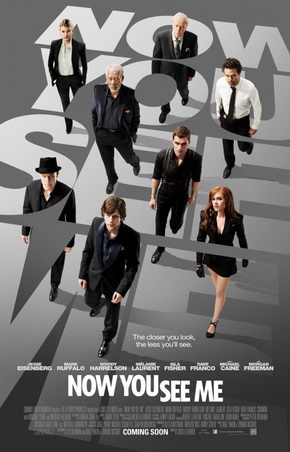
Now You See Me (2013)

The movies are a magical experience, and movies about magic can double up the fun by drawing attention to the innocuous deception of a theatrical illusion.  Unfortunately, Now You See Me spends so much time swaggering that it never really enchants. Now You See Me is ostensibly the story of four semi-professional magicians (Jesse Eisenberg, Woody Harrelson, Isla Fisher, and Dave Franco) who pull off a series of elaborate magic tricks as The Four Horsemen.  But when their illusions begin to look like theft by way of social justice, FBI agent Dylan Rhodes (Mark Ruffalo) and professional debunker Thaddeus Bradley (Morgan Freeman) begin to realize the magicians are, of course, not what they seem.

The key to any successful slight of hand is that the audience has to be so distracted by the flair that they miss the real trick.  Take Christopher Nolan’s The Prestige, a clever (perhaps brilliant) case study of competitive magicians; you’ll be so fascinated by the rivalry between Christian Bale and Hugh Jackman that you’ll miss the clues dropped by the filmmakers.  It’s possibly unfair but entirely unexpected that I’d make this comparison, but Now You See Me doesn’t let the audience play along.  Instead, we’re practically kidnapped, tied down by a film that continually insists on its own brilliance, reminding us at every turn that they’re smarter than we are.

Sure, I can be smarter than you if I don’t tell you what’s going on.  Then, the film gloats by showing you what really happened, though these scenarios are couched in so many maybes and perhapses that it’s never wholly clear what’s going on.  And when your focal character is an investigator, it’s a bit empty to have him never really understand anything.  Ruffalo’s solid as the not-smartest man in the room, and his charisma is enough to hold your attention, but it seems like a less successful riff on his character from The Brothers Bloom, which is saying something.

As for the rest of the cast, you’re looking at the disappointment of the summer.  The four leads have all done good work in the past, but the screenplay is incredibly thin, failing to distinguish any of the four characters beyond physical appearance.  You could rotate the actors in the cast, and it really wouldn’t matter; the characters are so boilerplate and so frustratingly identical that you’ll struggle to connect with them.  Perhaps the film’s worst offense?  Morgan Freeman and Michael Caine never share the frame; their scenes together crackle like a master class in acting, but we never get to see them side-by-side, which gives it a phoned-in feel.

Having said that, there’s a bit of fun to be had in some of the film’s stagier moments.  When The Four Horseman are performing, it’s an opportunity to chew some scenery, and the four leads do well there.  You might even want to see a full show by them at some point, since they convey a sense of infectious enthusiasm for their work.  And, naturally, once you’re told you’re about to be tricked, it’s engaging to watch and try to figure out where the trick is.

As Michael Caine said in The Prestige, “You want to be fooled.”  It’s a good thing, too, since Now You See Me never gives you an opportunity to figure out how the trick is done.  Nor is the ultimate explanation a fulfilling payoff; a last-minute twist is so clichéd that you’ll have already dismissed it as “too obvious.”  Now You See Me is superficial and a bit irksome, continually reminding you of its own cleverness without ever earning the moniker of “smart.”  Sad news for a strong cast, but the real trick is on the audience.

Or, in other words, now I saw it, now you don’t.

Now You See Me is rated PG-13 for “language, some action, and sexual content.”  There’s an F-bomb, playful banter, and some shouting; action consists of a car chase, a few explosions, and some shouting.  And there’s an aborted make-out scene thrown in to earn the “13.”