Showing posts with label Jennifer Lawrence. Show all posts

Monday, July 15, 2024

Cinemutants - Dark Phoenix (2019)

At a time when superhero movies are starting to lose their stranglehold on pop culture, there are really only two options: go back and watch old movies, or kill off an entire cinematic universe in spectacular fashion. This July, Marvel’s taking the latter approach with Deadpool & Wolverine, which seems primed to seal off the 20th Century Fox film universe. And while director Shawn Levy promises, “This movie is built [...] with no obligation to come prepared with prior research,” skipping the research has never really been my strong suit when it comes to franchises. It’s a perfect excuse, then, to go through the last 24 years (and 13 movies) with everyone’s favorite mutants, the X-Men.
 
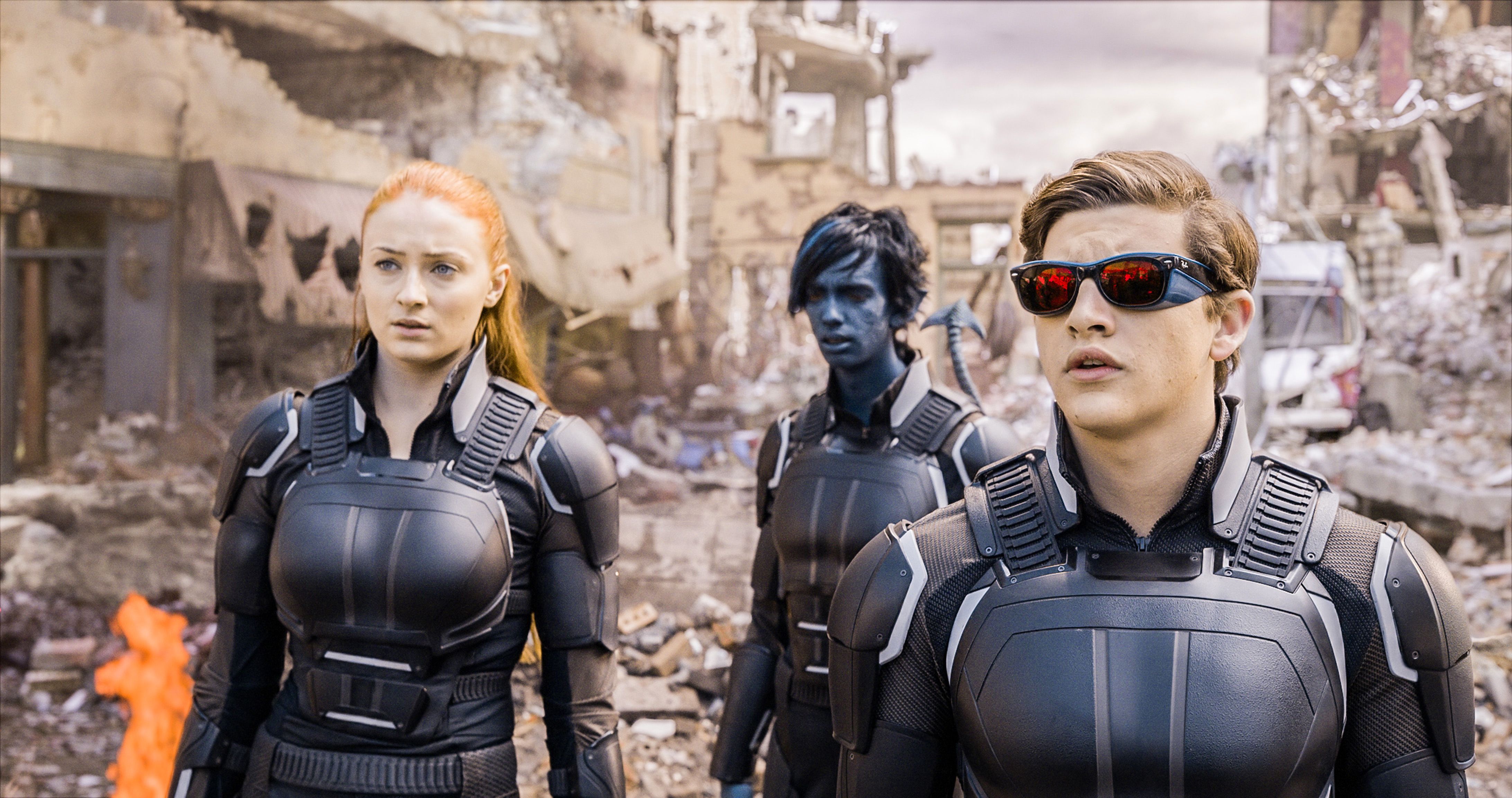
This week, from 2019, it’s Dark Phoenix. A daring rescue mission in space brings Jean Grey (Sophie Turner) into contact with the mysterious Phoenix entity, a powerful force that has the power to destroy or recreate the universe. Mystique (Jennifer Lawrence) leads the X-Men in trying to help their teammate, while a shapeshifting alien (Jessica Chastain) pursues the Phoenix for her own ends.
  1. Last of the First Class. Dark Phoenix is entirely aware of its position as the grand finale for the Fox X-Men films, and more particularly for the sub-franchise that began in 2011 with First Class. Set now in the early 1990s, it becomes increasingly impossible to believe that these characters have aged 30 years; Michael Fassbender’s Magneto wears a few wrinkles around his eyes, but everyone else seems a spry early-30s rather than approaching (at minimum) 50. It feels as though the movie can’t introduce much in the way of new material, stuck as it is with characters like Storm, Nightcrawler, and Quicksilver, who don’t have much at all to do in the plot. Instead, the movie knows it’s an ending, and so it ties up as many plot threads as it can; mutants live, mutants die, and Xavier and Magneto play one more game of chess as the credits roll.
  2. X-Women. In the eight years since First Class, Jennifer Lawrence won an Oscar, helmed her own Hunger Games franchise, and became the highest-paid actress in the world. Consequently, her presence here feels continuously compulsory, and you can practically hear her breathe a sigh of relief when (spoiler warning) Mystique dies early in the second act. Her leadership of the X-Men is an intriguing prospect, a far cry from the source material, but it comes with the grievously on-the-nose dialogue about changing the team name to “X-Women.” Granted, the women have almost always been the best developed characters, particularly under the pen of Chris Claremont (who cameos here), but the sentiment drew a derisive laugh in the theaters. Mystique says it to be profound and defiant, but Deadpool had, only a year earlier, made satirical mincemeat of the gendered team name. It’s a weird note, then, on which to start a movie about the X-Men’s most powerful woman.
  3. You are not broken. I’ll say this for Dark Phoenix; as boring and underbaked as the movie is, Sophie Turner is never quite bad in it. With a different script, she might have been a Phoenix for the ages, but this movie feels like another speedrun through the X-Men’s most iconic storyline. Where it took Chris Claremont four years and around 40 issues, both The Last Stand and Dark Phoenix try to knock it out under two hours. I have no doubt that the MCU will eventually, inevitably, take one last swing at “The Dark Phoenix Saga,” but my biggest advice would be to slow down, give the story room to breathe, and develop it as a proper three-act tragedy that impacts the universe, not just Jean’s boyfriend Cyclops. Given that Turner never got to be reborn as the Phoenix, it would be nice to see her once more in Deadpool & Wolverine, but I rather doubt it; with Hugh Jackman in tow, a cameo from Famke Janssen seems much more likely.
  4. Gap. Although no one really believed him, Hans Zimmer claimed to have retired from superhero movies after Batman v Superman. A scant three years later, he was back for Dark Phoenix, and thank goodness, because he’s one of the only performers who doesn’t seem bored. Indeed, Zimmer’s score elevates the picture and ends up being a fantastic listen when divorced from the film. (I should know, considering how often I’ve got Zimmer playing around me!) Case in point, in one of the film’s major action sequences, the X-Men struggle to cross the street, but Zimmer plays it like the definitional conflict of an era. The film’s final battle sequence, aboard a speeding train, is a little stronger, even as Zimmer continues to shred at eleven, all pounding percussion and swooping melodies. Like so many casting decisions and plot points in this franchise, one wonders what Zimmer could have done with a truly terrific film around him. If nothing else, one of the best comic book worlds now has a Hans Zimmer theme to hum while you read the latest issue.
  5. A new beginning. One almost feels a pang of regret as Dark Phoenix ends. The film’s final moments propose a few interesting ideas, including Hank McCoy as headmaster of the newly-formed Jean Grey School. But with the very first movie set in 2000 or thereabouts and Dark Phoenix landing in 1992, the film’s erstwhile prequel premise became a sort of asymptote, approaching and imitating the original films but never quite lining up with them. So we’ll never find out, for example, whether “Stewart or McAvoy?!” was Deadpool’s Professor Xavier or what became of Weapon X Wolverine after his Apocalypse cameo (or will we?). And while the film’s final frames imply that Jean’s still out there as the Phoenix, there’s no post-credits scene and no indication that Disney intends to do much of anything with the First Class timeline. Before the TVA arrives, we can safely consider this timeline pruned.
Sound off in the comments, true believers: did the First Class timeline overstay its welcome, or should the Phoenix rise one more time? Up next, you might have forgotten that Dark Phoenix wasn’t actually the last Fox-verse film. You can’t be blamed, because I never formally reviewed The New Mutants... until next week.

Monday, June 24, 2024

Cinemutants - X-Men: Apocalypse (2016)

At a time when superhero movies are starting to lose their stranglehold on pop culture, there are really only two options: go back and watch old movies, or kill off an entire cinematic universe in spectacular fashion. This July, Marvel’s taking the latter approach with Deadpool & Wolverine, which seems primed to seal off the 20th Century Fox film universe. And while director Shawn Levy promises, “This movie is built [...] with no obligation to come prepared with prior research,” skipping the research has never really been my strong suit when it comes to franchises. It’s a perfect excuse, then, to go through the last 24 years (and 13 movies) with everyone’s favorite mutants, the X-Men.
 
This week, from 2016, it’s X-Men: Apocalypse. En Sabah Nur (Oscar Isaac), the first mutant, awakens from millennia of slumber, determined to cleanse the world and start over. Meanwhile, tragedy strikes Erik Lehnsherr (Michael Fassbender), driving Mystique (Jennifer Lawrence) back into an alliance with Professor Xavier (James McAvoy), while a young Scott Summers (Tye Sheridan) joins the Xavier Academy and begins to fall for the telepathic Jean Grey (Sophie Turner).

  1. The third one’s always the worst. When Jean Grey speaks this line, ostensibly in reference to seeing Return of the Jedi, it’s clear that director Bryan Singer is taking one last dig at Brett Ratner’s The Last Stand. It’s only been a few weeks for us, but a decade later, Singer was still relitigating the old canon he wiped away in the previous film. It’s catty and distracting, especially because Apocalypse is more or less the third film in the First Class timeline, and it’s one of the franchise’s weaker outings. It’s less schizophrenic than The Last Stand, but it’s both undercooked and overbusy, with Oscar Isaac as a surprisingly unenthusiastic Apocalypse, who in another cinematic universe could very well be the biggest threat mutantkind has ever faced. But Isaac is clearly fatigued by the heavy prosthetics and needlessly dramatic dialogue (“You can fire your arrows from the Tower of Babel...”), and despite getting what should have been a fresh start from Days of Future Past, we seem to be treading the same boards all over again. If we get a mention in Deadpool & Wolverine, it’ll surely acknowledge the fact that Isaac has moved on with Marvel as Moon Knight.
  2. She’s barely aged a day. Curiously, Apocalypse is set in 1983, but you would scarcely know it’s been 20 years since First Class. There are a few throwaway lines about how well everyone is aging – the kind of lantern-hanging that Deadpool might do best – but I thought it then and I thought it now: it was a wild choice to set the primary X-Men films in the historical past and then leave them there. No one looks twenty years older, and the only good reason to leave the films in the past is to keep the rock-solid casting of James McAvoy and Michael Fassbender, who still play this trilogy like one long break-up. Jennifer Lawrence, meanwhile, has “contractual obligation” hanging over her head in a role that sees her discard her blue appearance for nominal plot reasons but more for her own professional clout. And with the reprise of so many supporting characters instead of the legion (pun intended) of options from the comics, it all feels a little claustrophobic.
  3. The glory of what’s to come. As much as Apocalypse tries to chart a new path using the same old pieces from the original films, there is certainly a sense of awe when Jean Grey finally unleashes the Phoenix Force in the final battle against Apocalypse. Seeded throughout the film in a way that never quite feels like an echo of X2, it’s an implicit promise that the next film will do justice to the “Dark Phoenix Saga” of comics legend. Whether we strike gold is a subject for debate in three weeks’ time, but almost no one enjoyed Dark Phoenix. Will the third time be a charm if we see a Phoenix in Deadpool & Wolverine? Heck, as a living embodiment of reincarnation, the Phoenix could be just the thing to bridge timelines from the Fox films into the MCU, or perhaps it’ll just be Deadpool’s sheer force of fourth-wall breaking.
  4. Weapon X. After sixteen-plus years, Hugh Jackman had very nearly done it all with Wolverine, touching on virtually every one of the costumed hero’s most famous comic book stories. Yet his uncredited cameo (which I recall being a genuine surprise) brings to life Barry Windsor-Smith’s iconic “Weapon X” design, with Wolverine as a deprogrammed and feral Frankenstein’s monster. It’s the sort of visual shout-out that rewards comics readers, while looking breathlessly cool for the normies in the audience. It also gives us a peek at how Logan’s faring in the new timeline; last we saw him, Mystique-as-Stryker was fishing him out of the river, and now we see his origin story aligning away from what we learned in X-Men Origins: Wolverine, with his brief interaction with Jean Grey retroactively cueing up his romantic fixation on her. Will the Logan we meet in Hugh Jackman have gotten his adamantium from Danny Huston or this film’s Josh Helman? Which one grows up to be Brian Cox? We may find out in a month’s time. 
  5. A sinister future. We’ve still got about four weeks left on this recap series, but believe me when I tell you the end is nigh. Case in point, this post-credits teaser that never materialized, despite a pitch-perfect opportunity for the next film to include Mister Sinister, a genetics-obsessed madman whose Essex Corporation is seen here recovering a vial of Logan’s blood. Sinister’s fixation with the Summers bloodline, too, might have made for an interesting film down the line. Still, I hope the MCU is holding Sinister in reserve, and not just for a passing cameo in Deadpool & Wolverine; lest we forget, Sinister’s comics debut found him leading the charge in the “Mutant Massacre” crossover, and his more flamboyant recent appearances would be a perfect fit for, say, David Tennant. 
Sound off in the comments, true believers: is Apocalypse the biggest misstep in the X-Universe? Or is it an underrated gem? Up next, it’s swan songs all around with Logan.

Monday, June 10, 2024

Cinemutants - X-Men: Days of Future Past (2014)

At a time when superhero movies are starting to lose their stranglehold on pop culture, there are really only two options: go back and watch old movies, or kill off an entire cinematic universe in spectacular fashion. This July, Marvel’s taking the latter approach with Deadpool & Wolverine, which seems primed to seal off the 20th Century Fox film universe. And while director Shawn Levy promises, “This movie is built [...] with no obligation to come prepared with prior research,” skipping the research has never really been my strong suit when it comes to franchises. It’s a perfect excuse, then, to go through the last 24 years (and 13 movies) with everyone’s favorite mutants, the X-Men.
 
This week, from 2014, it’s X-Men: Days of Future Past. Professor X (Patrick Stewart) and Magneto (Ian McKellen) send Wolverine (Hugh Jackman) into the past to save their future from mutant-killing Sentinel robots. In 1973, Wolverine has to bring together a despondent Charles Xavier (James McAvoy) and the incarcerated Erik Lehnsherr (Michael Fassbender) to stop Mystique (Jennifer Lawrence) from killing Bolivar Trask (Peter Dinklage), the inventor of the Sentinels.

  1. Securing our future. We can argue about whether this is the best X-Men movie (it’s easily top three), but there’s no debating the fact that this is the most X-Men movie. Two casts, parallel timelines, ready-made comics inspiration, and a continuity fix that only muddles the waters even further: Days of Future Past has everything an X-fan could want. While the change-the-past plot was intended to smooth over any errors in the timeline (or, at least, provide a plausible excuse for them), it only exposes the gossamer of the plot to brutal scrutiny. By the end of the film, just how much of the past has Logan undone? (Director Bryan Singer is at least erasing The Last Stand, but there’s a wink toward expunging X-Men Origins: Wolverine, as well.) You might still need a chart to understand how all the films relate to each other, but I’ll argue next week that, as far as time travel and continuity are concerned, Days walked so Deadpool could run.
  2. Infinite outcomes. Along with being the apex X-Men movie, Days of Future Past provides something so unique that only the superhero genre can do. As incredible as Patrick Stewart and Ian McKellan were, James McAvoy and Michael Fassbender were equally inspired casting choices. And in virtually any other genre, you’d never have an opportunity to put them on-screen together; imagine a Godfather movie that saw Marlon Brando meet Robert De Niro, or a James Bond movie where Daniel Craig teams up with Pierce Brosnan. Another way Days cues up Deadpool is by implying that both versions exist out there somewhere, simultaneously; future films followed both Professors Xavier, and it’s inconceivable that Deadpool & Wolverine won’t see other iterations (or “variants,” in MCU-speak) of recognizable characters. Let’s hope the new castings are just as good. 
  3. It all starts with her. In the comics, Kitty Pryde is the one traveling back in time to warn the X-Men about averting the future; here, though, it’s got to be Wolverine, both for the practical needs of the plot and for the fact that Hugh Jackman continues to be an audience favorite for his literal embodiment of the character. (The movie finds a creative way to keep Kitty relevant to the plot.) Meanwhile, the target of the future remains unchanged; it’s still Mystique, played by Jennifer Lawrence at the peak of her rising stardom. Two years after her Oscar for Silver Linings Playbook and a year before finishing her tenure in The Hunger Games, Lawrence makes a third-stringer background villain into a compelling and deeply human protagonist. It’s almost hard not to root for her, though Lawrence’s apparent fatigue with the role will become inescapable in the weeks to come. (A third woman, Anna Paquin’s Rogue, becomes an axis point in the “Rogue Cut,” which sees Rogue freed from a mutant prison to help Kitty Pryde save Wolverine.)
  4. In the future, do I make it? It feels like it’s been true for most of these movies, but Days of Future Past really illuminates the paradox of accurately and lovingly bringing characters to life and then giving them absolutely nothing to do. Bishop and Blink, for example, look like they stepped straight out of a comic book, but I’d be darned to tell you why, on the strength of this movie, any fan would care about them. Even Storm suffers from this paradox; as cool as it is to see Halle Berry rocking the closest thing to a mohawk we got from her, Storm’s presence in the film is barely consequential, and the film seems not to have noticed that she is essentially the last surviving faculty member at the Xavier Academy. The X-Men might have the deepest bench in comics, but the movies always seemed to focus on the same dozen or so; next week, we’ll see Deadpool do right by Colossus, who’s had less personality than window dressing in these films.
  5. Is the future truly set? Superhero storytelling is perpetually stuck in the second act; after you get through the first-act origin tales, most of these stories never truly end. (And when they do, like All-Star Superman or Old Man Logan, they’re in alternate realities.) Days of Future Past eats its cake and has it too by giving Logan a cheery send-off while also holding open the door for more stories in the First Class timeline. (Quite where Logan takes place, we’ll consider in a few weeks.) But it does seem a little suspicious – and possibly even sinister – that Bryan Singer’s happy ending seems to erase/retcon only the movies he didn’t direct. Of the beleaguered director’s many sins, this is far from the worst, but this film does seem to promise a new golden age that, more or less, never came to pass. Did the film that was meant to fix the franchise actually break it? The best films to come are the ones that play fastest and loosest with continuity...
Sound off in the comments, true believers: where does Days of Future Past sit in your estimations, and was it really ten years ago already? Up next, second chances all around when Ryan Reynolds gets another shot at the Merc with a Mouth in Deadpool.

Monday, May 27, 2024

Cinemutants - X-Men: First Class (2011)

At a time when superhero movies are starting to lose their stranglehold on pop culture, there are really only two options: go back and watch old movies, or kill off an entire cinematic universe in spectacular fashion. This July, Marvel’s taking the latter approach with Deadpool & Wolverine, which seems primed to seal off the 20th Century Fox film universe. And while director Shawn Levy promises, “This movie is built [...] with no obligation to come prepared with prior research,” skipping the research has never really been my strong suit when it comes to franchises. It’s a perfect excuse, then, to go through the last 24 years (and 13 movies) with everyone’s favorite mutants, the X-Men.
 
This week, from 2011, it’s X-Men: First Class. It’s 1962, and Charles Xavier (Patrick Stewart) is just beginning his research into mutation when he meets Erik Lehnsherr (Michael Fassbender), a mutant out for revenge on Sebastian Shaw (Kevin Bacon), the man who killed his mother. With Shaw manipulating both sides of the Cold War, Charles and Erik recruit a team of mutants, beginning with Charles’s childhood friend Raven (Jennifer Lawrence). 
 
And so we return and begin again. The reset button is practically a supporting character in the X-Men franchise, and after Origins didn’t quite recapture the magic, First Class goes back even further, both in the timeline and in reprising the actual opening scene of X-Men. (No wonder – it’s still one of the most effective origin stories and one of the best-told ones.) Director Matthew Vaughn is never too showy about the film’s 1962 setting, though a third-act retelling of the Cuban Missile Crisis feels a bit like something that belongs in Zack Snyder’s Watchmen. As a prequel, however, First Class is reveling in the untold stories, from Henry McCoy’s evolution into the blue-furred Beast (Nicholas Hoult) to Xavier’s occasional quips about losing his hair.
 
Frankenstein’s monster. A huge part of the success of First Class comes from its own secret origin, starting life as a screenplay for X-Men Origins: Magneto. By weaving Magneto’s story into a larger tapestry, we get to skip right to the best scenesalong his quest for revenge, and Fassbender is resplendent in his righteous fury. (Points taken off, though, for the infrequent intrusion of Fassbender’s own Irish accent.) We see all the reasons for Erik’s fall, sympathizing all the while with a man who sees himself as a helpless monster. And when Charles accidentally invokes the Nazi defense of “just following orders,” a chill ran up my spine because of how effectively First Class presents Magneto’s perspective. What Ian McKellen implied, First Class does well to elucidate. 
 
Groovy mutation. On the flip side, James McAvoy is a surprising Xavier, eschewing the austerity of Patrick Stewart’s performance in favor of a Swinging Sixties Charles, not above using his scientific know-how to impress the birds down at the local pub. Still, the shepherd wins out in Xavier as he assembles his first team (not G-Men, the film wryly observes, but X-Men), but more particularly when he attempts to guide Erik’s lost soul toward serenity. Indeed, it’s not hard to see First Class as a tragic love story between two men who could have been brothers; the repeated motif of the chess board, borrowed from the Bryan Singer films, suggests an unspoken bond, though a sunset picnic at the Lincoln Memorial adds a new color to the dynamic.
 
We’re the better men. I usually remember First Class fondly for the Charles and Erik dynamic, but I was surprised on this rewatch to see how many things don’t work at the same level. Kevin Bacon is hammy good fun as the film’s antagonist, but his cabal of villains are either outright boring or, in the case of January Jones’s Emma Frost, wildly miscast. Meanwhile, Hoult’s Beast is a strong supporting choice, but the rest of the team is largely indistinct; Zoe Kravitz’s Angel is a snooze, Edi Gathegi’s Darwin isn’t around long enough to make an impression, and Havok and Banshee don’t quite have personalities of their own. (On those counts, only True Believers will much care about their inclusion.) Then there’s Jennifer Lawrence’s Raven, a far cry from the sycophantic Mystique we met in the foregoing trilogy; she acquits herself well enough (despite some truly dodgy makeup), but appending her to Xavier’s origin is still a strange choice.
 
We are the future. First Class ends up walking a fine line between reboot and prequel. It’s hard to say it’s precisely a prequel to X-Men, mostly on the grounds of what happens in Days of Future Past. But while we have cameos from Hugh Jackman and Rebecca Romijn, we also get a very different Moira MacTaggert (Rose Byrne), a Beast who’s older than he should be, and a Summers brother that throws a wrench into the already murky family tree after we “met” Cyclops in 1979 last week. (Then again, the Summers family tree is notoriously gnarled in the comics, where it’s easy to lose count of who the third Summers brother was intended to be.) It’s all a helpful reminder not to take any of this too seriously, and for all my handwringing here, none of it interferes with my enjoyment of the film, which is somewhere near the top of my X-rankings.
 
Sound off in the comments, true believers: is First Class first in its class? Now that we’ve gone all the way back in time, we’ll jump to the end of the queue next week with The Wolverine, catching up with Logan after the events of The Last Stand.

Monday, June 25, 2018

mother! (2017)

I can honestly say that after Black Swan (which I listed on my Personal Canon as a film that influenced the way I approach movies), I was ready to follow Darren Aronofsky anywhere, even through the strange exhibit that was Noah, diverting if peculiar in its biblical revisionism. With mother!, however, a film that sacrifices signification for surreal spectacle, writer/director Aronofsky has transparently lost the plot.

In many ways, mother! most resembles Eraserhead by way of Rosemary’s Baby, a nightmarish portrait of a young woman (Jennifer Lawrence) and her older writer’s-blocked husband (Javier Bardem), whose pastoral life restoring a home is interrupted by the arrival of two strangers (Ed Harris and Michelle Pfeiffer) who bring with them a litany of family strife, consumption, and destruction.

mother! is perhaps the most infuriating film I can recall seeing in a very long time, and I say that as a person who very much appreciates a film that asks its audience to perform leaps of analytical reading. I like a film that makes me think, and there are few passions in my life more ardent than the work of interpretation, of thoughtful analysis, and of cinematic cryptography, but I have never wanted to throw something at a screen more than I did during mother!. There were more than a few moments when I wanted to walk away from the film – something I almost never do because of my abiding devotion to the sacredness of narrative – though it would seem that Aronofsky does not share that same investment in storytelling. mother! is catastrophically ghastly, maddening for its steadfast refusal to give the audience anything to which we can cling when the film verges, as it is wont to do, between poles of frustrating uncertainty and chaotic turmoil.

In a film where the characters are not named, even in the end credits, we have to grasp onto the performers to give the characters some kind of identity. Javier Bardem is captivating, though perhaps the word should be used in the sense of “abducting,” as the film more closely resembles a hostage situation than a moviegoing experience. One hires Bardem for his ability to turn a smile into menace without adjusting a muscle on his face, and on this count he excels as the husband (“Him,” in the credits). He’s scary, and he’s emotionally abusive, but I need more from a film than watching Jennifer Lawrence in perpetual terror for two hours. Her acting in mother! is first-rate, and she’s a perfect audience surrogate as she too faces bewilderment over the myriad of home invasions she suffers. She’s clearly terrified, but at no point did I feel that same fear. I felt angry – furious, even – at the way the film left me at the door without bothering to address the nonsense “logic” governing the whole thing.

Perhaps this is Aronofsky’s whole point, that we are, like Lawrence, thrown into a world that refuses to make sense, that tortures us to the point of despair. I did not, however, have the opportunity to despair because the sensory overload in the film transgresses far beyond human registers into the point of feeling naught but numb. Furthermore, there are things in this movie that are just vile, that would cross the rubicon of the palatable if for one second we had any emotional involvement beyond its appearance as the latest in an inventory of tasteless violence. Aronofsky peppers the film with halfhearted biblical allusions, as if applying Burroughs’s cut-up technique to the book of Genesis. (A riff on Cain & Abel approaches some interesting ground, especially as Aronofsky tips his hand that he’s going for the story of the first murder, but it flies off the rails once the film and its characters appear to have forgotten that it had happened.) If the film is an Old Testament allegory, though, what are Mother Mary and talk of forgiveness doing in the midst of all this? Noah had a similarly loosey-goosey take on textual fidelity, but at least that film had the good sense to throw in rock monsters to keep us engaged. In their place, mother! walks instead through a first-person videogame of destruction, wanton lasciviousness, religious zealotry, and the devastation of a war zone without bothering to clue us into the point of it all.

And if pointlessness is the point, if the object of the game is to obfuscate the message with colliding allegories, isn’t there a way to do that without nauseating your audience to the point of disconnection? I cannot oversell how frustratingly vile this film is, how fiercely irritating it becomes when it, like its houseguests, overstays its welcome and refuses even to gesture at what it’s trying to accomplish. It abuses us and taunts us with our unwillingness to leave. mother! undercooks its plot, overloads its allegory, and assaults the senses until anyone who cared has long since checked out. Aronofsky then slams on the gas in the film’s final minutes, recognizing he’s almost out of time and accelerating past the event horizon of the point I presume he’s trying to make – that people are terrible and God is an abusive, aloof narcissist. mother! leaves its audience with more sound and fury than its narrative could signify, but mostly I’m just left with fury – empathic fury at first, but ultimately just fury at being suckered into a two-hour vanity project that tells us only that Aronofsky is infatuated with Lawrence and with seeing her suffer while wearing translucent blousy nightwear. And if sadism is your thing, mother! is a rip-roaring good time. I, on the other hand, find it grotesque and infuriating.

mother! is rated R for “strong disturbing violent content, some sexuality, nudity, and language.” Written and directed by Darren Aronofsky. Starring Jennifer Lawrence, Javier Bardem, Ed Harris, and Michelle Pfeiffer.

Tuesday, May 31, 2016

X-Men: Apocalypse (2016)

We’re eight movies into the X-Men film universe (nine if you count Deadpool, and hey, why not?), and while a fair number of critics are feeling X-fatigue, count me among the X-static – pun intended, because I’m happy about the way that the X-Men film franchise remains static in terms of its formula. With X-Men: Apocalypse, Bryan Singer is back for his fourth X-outing, a continued strong offering which introduces plenty of mutants, action, and character development to bode well as the franchise stands poised to move into double digits.

With Professor Xavier (James McAvoy) ushering his school for mutants into an era of peace, an ancient being known as Apocalypse (Oscar Isaac) awakens in Cairo and gathers his four Horsemen – Magneto (Michael Fassbender) among them – to bring about the end of this world. While Mystique (Jennifer Lawrence) works to protect the mutants from humanity, it’s up to the next generation of X-Men – Jean Grey (Sophie Turner), Cyclops (Tye Sheridan), Quicksilver (Evan Peters), and Nightcrawler (Kodi Smit-McPhee) – to save the world from the threat of Apocalypse.

With the continuity reconstructed in the wake of Days of Future Past, Singer is free to carve out a path toward the present day with access to the full range of X-characters, regardless of whether they live, die, love, or hate in the other films. There’s something liberating about not knowing precisely whether Magneto is on the side of good or evil in this one, a line which Fassbender embodies even without much dialogue to lean on. Ditto for the introduction of Scott “Cyclops” Summers and Jean Grey, whose courtship (if one can call it that) is only just beginning; we don’t know if they’ll end up the squabbling starter-marriage from X-Men, but Turner and Sheridan are fun to watch and bring the characters to life with some very subtle yet comics-accurate hand gestures (Jean’s fingers on her temple, Scott’s dial-controlled visor).

And for all that X-Men: Apocalypse blusters on about the end of the world and the fate of mutantkind, it’s surprising that the film ends up being rather fun and incredibly human in its very personal scale. Like the Avengers movies, which have found great success in seeing its heroes out of costume, lounging about Stark Tower, X-Men: Apocalypse is at its most engaging when the X-Men recruit Nightcrawler for an impromptu trip to the mall as “a matter of national pride” (though an Avengers film might have showed said trip), or as Cyclops learns to master his abilities. It’s hard to say if there’s a real star in this film, because the X-Men are at their best when the ensemble cast is allowed to share the screen.

If this is the ensemble going forward, the more the better. While McAvoy, Fassbender, and Lawrence continue to powerhouse their way through the prequels, they’ve indicated they might not be back for a fourth outing together. It’d be a shame, to be sure, but I wouldn’t mind seeing the film continue to develop Storm and Jubilee, the latter of whom doesn’t get to display her powers just yet, and Singer’s recent tease that the next film will go to space is extremely promising for the wealth of source material on which he can draw. (Phoenix Redux, anyone?)

There have been some complaints about Apocalypse as an undercooked cliché of a villain, though I think that you need a colossal world-ending event to justify bringing together the X-Men, particularly after the last two prequels have dealt with less cosmic threats and more personal dangers (Kevin Bacon’s Sebastian Shaw, though looking to heat up the Cold War, was also a personal foil for Magneto). It is a shame to put an actor as talented as Oscar Isaac beneath all the prosthetics and makeup that go into Apocalypse, but Isaac acquits himself well with the villain’s ego and powers of persuasion. If you want a grounded superhero battle, Captain America: Civil War is still in theaters (and it holds up), but the X-Men demand something more fantastical.

To the heap of well-crafted, Singer-helmed X-titles, I have to add X-Men: Apocalypse, more fun than it promises and just as compelling as its predecessors. The final battle doesn’t leave much room for surprise (how many permutations of averted catastrophe are there?), but the road getting there is as good as anything we’ve seen yet. Singer proves himself the X-King; long may he reign.

X-Men: Apocalypse is rated PG-13 for “sequences of violence, action and destruction, brief strong language and some suggestive images.”

Monday, December 28, 2015

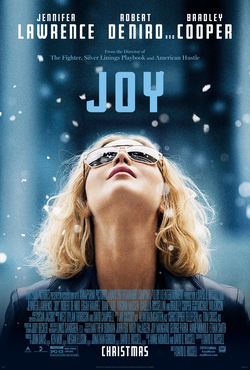
Joy (2015)

Joy rounds out a kind of thematic trilogy for director David O. Russell, but it’s a trilogy unified more by a stable company of performers – chief among them Jennifer Lawrence, Bradley Cooper, and Robert De Niro, with a few other bit players recurring in the mix. Of these, preceded by Silver Linings Playbook and American Hustle, Joy is perhaps the least successful of the lot – not by dint of being an abject failure but by never quite reaching the heights of the other two. Lawrence, however, turns in what might be her best performance yet.

Jennifer Lawrence stars as Joy Mangano, the QVC maven who made her millions with the Miracle Mop, a self-wringing cleaning device borne out of her own frustrations as a single mother living with both her father (Robert De Niro) and her ex-husband (Edgar Ramirez) in the basement. Bradley Cooper has a small supporting role as Neil Walker, the QVC exec who puts Joy’s product into the market.

Joy isn’t going to go down as Russell’s strongest film – I really do think Silver Linings Playbook holds that title – but I do think Lawrence has done her best work as a member of the Russell company, and I would put very real money on her seeing a third Best Actress nomination at the top of next year. As the eponymous Joy, Lawrence is riveting, from her beleaguered moments in the home to her natural charisma before the QVC camera. The film tasks Joy with representing the struggles faced by all women, and Lawrence is more than capable of bearing that weight.

That universality is one of the peculiarities of the film because I can’t help feeling that it would have been more successful had it adhered more strictly to the unique aspects of Joy’s story rather than an attempt to make her “every woman.” For one, I think the QVC sequences are among the best in the film, and I would have preferred this to be more than a small subplot. Russell has an eye for the innate strangeness of the QVC network, and a fuller treatment of that material (including the wonderfully strange cameo of Melissa Rivers as her mother Joan) would have been truly engaging – to say nothing of the chemistry that Lawrence and Cooper clearly have. Honestly, that’s the movie I thought we were getting, but sadly it’s unlikely we’ll see a Joy 2 that fleshes out that relationship in greater depth.

The movie keeps its eye tightly focused on Joy, often to the detriment of the other performers. It’s not that De Niro or Cooper are any less captivating than they usually are – De Niro is scene-stealing, particularly in an early tantrum about his ex-wife’s similarities with a gas leak – it’s more that there is just less of them to captivate. On reflection, it seems the largest supporting role belongs to Isabella Rossellini as Trudy, Joy’s principal investor and commercial mentor of sorts whose idiosyncratic approach to vetting entrepreneurs lends the film one of its greatest moments of empowerment. These moments provide glimpses of the A+ work that Joy might have aspired to be, had it taken off its Lawrence-shaped blinders.

Rotten Tomatoes has the self-congratulatory pun that the film “only sporadically sparks bursts of the titular emotion.” This joke misses the point of the film, because if you wanted a movie about joy you’ll have to check out Pixar’s summer offering Inside Out. This is instead a film about Joy, whose story is told reasonably well here, though the audience rightfully detects that Russell is capable of a fuller film than this. It’s perfectly serviceable, but transcendence belongs to the earlier films in this unofficial trilogy.

Joy is rated PG-13 for “brief strong language.” As might be expected, De Niro gets one F-bomb.

Monday, November 30, 2015

The Hunger Games: Mockingjay - Part 2 (2015)

I’m going to start the review off by saying that I’m making a conscious and very deliberate decision here to review The Hunger Games: Mockingjay – Part 2 as the second half of what really ought to have been one movie. I’m not going to review Part 1 on this blog, because the two films are irreconcilable to me (like both halves of Kill Bill); I watched both within 24 hours of each other, and I’m disinclined to think of them as two films for a number of reasons which will be elucidated below. Suffice it to say, Mockingjay is a strong and satisfying conclusion to the Hunger Games franchise, even against the misjudged split down the middle.

As the propaganda and military wars against the Capitol rage on, Katniss Everdeen (Jennifer Lawrence) stands as the Mockingjay, the symbol for the revolution after her survival in two successive gladiatorial Hunger Games. Katniss, resistant to the manipulations of rebel leader President Coin (Julianne Moore), finds that her friend Peeta Mellark (Josh Hutcherson) has been brainwashed by the nefarious President Snow (Donald Sutherland), and she embarks on a mission to kill the man who has ruined their lives.

I don’t think it’s hyperbole to say that Hunger Games has been the spiritual successor to Harry Potter in ways that I don’t think Twilight or Divergent ever were. All managed to grab more or less the same demographic by the ears, but only Hunger Games plumbed the same depth of ideas that JK Rowling’s wizarding saga did. (And I’m aware that all but one of them pulled the split-the-last-film-in-two move, as well.) There have been moments like these throughout the franchise, but it’s especially prevalent in Mockingjay that I sat back and realized, “Wow, this is really weighty stuff” – and it’s handled quite deftly and smartly. Questions of war, power, and the power of the image pervade Mockingjay to great effect, and the filmmakers wisely reject any simplification of the novels for a film that is purposefully unsettling.

I must continue to heap praise on Jennifer Lawrence, who adds great credibility to the character of Katniss. For an Oscar winner to continue through a young adult franchise without seeming like it’s beneath her is a creditable move that speaks highly of both her character and her performative abilities. None in the cast does any less of a strong job – Sutherland especially seems to be having a grand time in a veritable mustache-twirler of an antagonist – but Lawrence is particularly noteworthy, in large part because her performance sheds light on two key scenes of ambiguity, frustrating in the novel but abundantly more clear in the film (for the benefit of the spoiler-phobic, I’ll be cryptic – the crucial vote, and the novel’s epilogue). We know precisely what Katniss is feeling in those moments because of the way Lawrence takes her pauses, shoots her glances like an arrow.

The film is, I daresay, deliberately anticlimactic, opting for a more poignant commentary on the nature of violence than a reductive “good guys always win” ending, and for that I applaud both the filmmakers and novelist Suzanne Collins for keeping the text smart. But I can’t help but feel that the effect might have been sharper had Mockingjay not been divided – quite arbitrarily, mind you – in two. Part 1 ends a scene after a cliffhanger reminiscent of the old Batman television show – “Will Katniss Everdeen save her friend? Or will the nefarious President Snow win his war? Tune in next November...” – as if to ameliorate the shock of an abrupt ending; Part 1 tells us Katniss will survive into the next film, but it’s a move that distracts from the fact that the film is bait-and-switching us into returning for another installment.

It’d be fine if each film had its own identity, its own logical starting and stopping point. For a while it seems like that’ll happen – Part 1 seems largely focused on the propaganda filmmaking and the power of the Mockingjay as an image, where Part 2 is the more action-oriented – but the division is, as I’ve said, largely arbitrary, at roughly a midpoint in runtime. The truth of the matter is that Katniss’s move from symbol to soldier would have been more potent within the boundaries of a singular film. A number of elements would have been stronger – President Snow’s declining health, President Coin’s surrender to ambition, the advisory role of Plutarch Heavensbee (the late Philip Seymour Hoffman) – and it would have been frankly less off-putting than feeling the grab for cash.

I know I’ll likely be eating my words when Avengers: Infinity War arrives in its bifurcated form in 2018 and 2019, respectively, but it’s still possible that that pair will manage to feel like two distinct films rather than padded halves of a whole. As for Mockingjay, however, I strongly believe there’s enough substance to comprise a very powerful 150 minutes rather than two respective two-hour films. It very nearly compromises the integrity of the work, which is both potent and important, though Mockingjay is compelling enough viewing that you only begrudge the protraction a little bit.

The Hunger Games: Mockingjay – Part 2 is rated PG-13 for “intense sequences of violence and action, and for some thematic material.” Part 2 is by far the grimmest of the already grim franchise, with several of your favorite characters meeting unpleasant demises by way of arrows, explosions, and weird sewer mutants. Though the film isn’t particularly bloody, it is almost unbearably despondent in a few scenes.

Monday, August 17, 2015

Monday at the Movies - August 17, 2015

Welcome to another installment of “Monday at the Movies.”  We haven’t done one of these since May, but it seems worth commenting on the “director’s cut” of X-Men: Days of Future Past, dubbed “The Rogue Cut” for reasons that will become apparent.

X-Men: Days of Future Past - The Rogue Cut (2014/2015) – I’m not doing a full review of The Rogue Cut, which adds about fifteen minutes of unseen footage, because my original sentiment still stands. I called the theatrical release “one of the better outings in the series,” and The Rogue Cut doesn’t change that. If anything, it makes the film a stronger one, filling in what I had perceived to be a stumble before the third act begins, the beat when Mystique (Jennifer Lawrence) goes missing. Here, The Rogue Cut fills in the gap by 1) restoring Anna Paquin’s turn as Rogue in the dystopian future of the film, and 2) giving Mystique a wonderful moment with Beast (Nicholas Hoult) in 1973. While I concede that the theatrical cut isn’t less by omitting these sequences, the film is overall richer for having them. In fact, I got more of a sense that I was entering a world during The Rogue Cut, rather than the crossover event the theatrical release felt like. Although the changes are almost universally positive additions to Days of Future Past, I have a small complaint, which might not even be a negative. The Rogue Cut juxtaposes Magneto (Michael Fassbender) retrieving his helmet with Magneto (Ian McKellan) rescuing Rogue, and while I think the cross-cutting is a nifty formal trick, I can’t help but feel the former sequence was better served on its own, building more tension as we got inside the young Magneto’s head. But it’s a moment that only rings hollower if you’re familiar with the original incarnation, and everything else in The Rogue Cut is so well-crafted that it might now be my new favorite X-Men film. PS – Stay tuned for a new mid-credits sequence! (The original post-credits scene is still intact.)

That does it for this week’s edition of “Monday at the Movies.” We’ll see you here next week!

Monday, May 26, 2014

X-Men: Days of Future Past (2014)

Are we still in the first Golden Age of comic book films?  Or, post-Avengers, are we seeing a renaissance of comic book movies that wrestle with heavy thematic material in the way that previously only Christopher Nolan’s “Dark Knight Trilogy” had?  I suspect the latter, though the X-Men franchise has always used the mutant metaphor to wrestle with issues of tolerance and persecution.  With Days of Future Past, the seventh (seventh!) film in the series, though, X-Men kicks it up a few notches for one of the better outings in the series.

While former enemies Professor X (Patrick Stewart) and Magneto (Ian McKellan) have united against the threat of mutant-exterminating Sentinel robots, they send Wolverine (Hugh Jackman) into the past to 1973 to unite their younger selves (James McAvoy and Michael Fassbender) against the path to dystopia:  if Mystique (Jennifer Lawrence) kills the Sentinels’ creator Bolivar Trask (an inspired casting choice in the form of Peter Dinklage), the future is doomed.

Days of Future Past is equal parts sequel (to The Wolverine’s post-credits sequence and to First Class), prequel, and timey-wimey reboot, and with two principal casts working the same plot in two timelines, the film very easily could have spiraled out of control – both in terms of runtime and narrative.  But to returning director Bryan Singer’s credit, the film is tighter than that alleyway in Inception’s Mombasa chase scene.  Singer is obviously a fan at heart, and his passion for the project grants him a gifted hand at the wheel.

There is, throughout the film, a very present and nagging sense that much of the time travel in the film is designed to pull two profitable timelines together and, in the process, clean up some of the less popular missteps from films like X-Men Origins: Wolverine and X-Men: The Last Stand.  Fanboys and casual filmgoers alike will not complain there, so long as the film is anchored by a compelling central narrative that feels more like storytelling than like sweeping up.  This is actually a time-honored tradition in comic books, with the richer comics giving us more than just continuity clean-up.  By giving us characters and stakes to care about, Days of Future Past justifies its own existence beyond a simple “pretend those other films never happened” attitude.

Aside from a beat just before the third act begins, Days of Future Past never meanders, never bogs itself down in excess exposition or backstory.  Some of it doesn’t even jive with the past films, but thank heavens the movie doesn’t tie itself to its own inheritance; we know enough to jump into the world without having our hands held, and the filmmakers know it.  (Note to Zack Snyder when it comes to including Batman in Batman v. Superman: Dawn of Justice – we know the origin already.)  Instead, Singer and company cut loose and have fun with the source material.

At times, that fun is a little too juvenile for me, as in the case of the speedster Quicksilver (Evan Peters).  When the casting was announced, it seemed a bit of one-upmanship with Joss Whedon’s Avengers 2, where Peters’s Kick-Ass costar Aaron Taylor-Johnson will be playing the hero.  Peters’s interpretation of Quicksilver is actually quite entertaining, and the special effects used to present his abilities are stunning.  That said, as cool as it is to see a man move quickly enough to reposition a bullet in midair, the beat when he pauses to give an assailant a wedgie is more Ratner than Singer.  It’s an incredibly nitpicky nit to pick, but it’s a poke in the eye during an otherwise winning eyeball kick of a set piece.

As in First Class, the scene stealer is Fassbender’s Magneto, who’s less “early days” McKellan and more of an original stamp on the character as derived from his Holocaust origins.  Lawrence gets a few solid scenes in as the revenge-embittered Mystique – not too far from Magneto, in that respect.  While those two play extensions of their First Class iterations, McAvoy has the harder task by carrying the emotional arc of the film, rebuilding himself out of despair and toward the Patrick Stewart we know he’ll become.

The inevitable sequel X-Men: Apocalype (teased in a nifty stinger) will focus on the First Class cast, which is fine, obviously, plus we’ll probably have Hugh Jackman along for the ride as Wolverine – again, fine.  The part is essentially his by now, and he’s more than earned it.  I hope, though, that we haven’t seen the last of the “classic” cast; seeing Stewart and McKellan and a few other familiar faces reminds us just how spot-on those casting calls were.  In this respect, Days of Future Past is a lot like checking in with old friends while meeting some new ones, and it’s my hope that we don’t walk away from the former as we gain the latter.

X-Men: Days of Future Past doesn’t reinvent the superhero wheel, and it doesn’t transcend the genre into something utterly inspired like Captain America: The Winter Soldier, but it does its job more than capably well.  It’s vastly entertaining and engaging, well-acted and well-crafted.  It doesn’t have the metaphorical depth of past outings like X2, but that depth is supplanted by an emotional one that hooks the audience without preaching to it.

X-Men: Days of Future Past is rated PG-13 for “sequences of intense sci-fi violence and action, some suggestive material, nudity and language.”  There’s plenty of slicing and dicing and exploding and the usual whizz-bang stuff; male rear nudity is seen once, and we get a reference to the F-bomb heard round the world from First Class.

Monday, December 23, 2013

American Hustle (2013)

Last year David O. Russell snuck in at the tail end of the calendar with Silver Linings Playbook, a romantic comedy that reinstilled my belief in the genre; two years earlier, he’d caught my eye with The Fighter.  And with American Hustle, Russell takes the things that worked best in those movies – namely the remarkable acting talent on display – and mashes them together for a thoroughly enjoyable Oscar contender.

Based loosely on a true story – “Some of this actually happened,” an opening title card boasts – American Hustle gives us con artist Irving Rosenfeld (Christian Bale in another total body transformation) and his lover/partner Sydney “Edith” Prosser (Amy Adams) as they are forced into a federal corruption investigation led by FBI Agent Richie DiMaso (Bradley Cooper).  As the investigation bears unexpected fruit with Camden Mayor Carmine Polito (Jeremy Renner) in the crosshairs, Irving’s reckless wife Rosalyn (Jennifer Lawrence) puts her husband in jeopardy while trying to keep her marriage safe.

I almost don’t need to say much about the cast; they’re all exceptionally solid choices, the best performers from Russell’s two previous films under one roof.  As the lead (and hopefully a Best Actor candidate), Bale is almost unrecognizable were it not for his remarkable talent, and Adams demonstrates herself a perfect foil for him, continuing to break out of that “too cute for words” mode into which she might have been typecast after Enchanted.  Renner and Cooper are reliably compelling, and Lawrence continues to hold onto that “most talented young actress” title with a powerhouse performance as the spirited Rosalyn.  All handle the naturalistic dialogue very well, with improvisational quirks and touches that give the film a lived-in feel.  We come to know these people very well, thanks to the life given by the cast.

Even better than these five thrown into the same pot – plus all the supporting roles, including Louis CK as Cooper’s boss and a delightful uncredited cameo by a real legend – is the sum of the parts.  American Hustle is at once blissfully engaging and wildly unpredictable.  I don’t want to say it’s something we’ve never seen before; indeed, for many reasons it feels very much like an update on Scorsese’s Goodfellas.  But American Hustle manages to feel quite fresh, playing fast and loose with the historical facts (happily for those who know the story and those who don’t) in order to create an elaborately twisty narrative that takes its characters in surprising and entertaining directions.

All the while, Russell keeps us guessing by refusing to spoonfeed us character motivation, even with the presence of voiceover narration.  Rather than spell out plot beats and character traits, the voiceover instead fills us in on the personalities of the characters and, more importantly, the moments when we know they’re lying to themselves.  The narrative of the film is highly concerned with questions of honesty and deception, and Russell wisely plays about in it without handing us easy moral judgments.  The number of double- and triple-crosses are quite successful on an aesthetic level and satisfying on an interpretive one because we’re never expecting them.  Of course, in a movie about deception, we’ll have characters deceiving each other, but Russell manages to avoid the clichéd “gotcha” beats and instead continually sucker-punches the audience with another new twist introduced with graceful subtlety (as when we learn a key character actually can speak Arabic or when Rosalyn lets slip once or twice).

American Hustle is a movie that will leave its audience reeling, first from the sheer volume of thespianic talent on display and then from the intricate and enthralling plot structure which Russell uses to say insightful things about the problem of honesty and self-deceit.  The original title of the film was American Bulls—t, a title which would have been deliciously ironic – there’s no worse comparison to make with this film than a comparison to excrement.  American Hustle is the exact opposite – delightfully fun, solid gold.

American Hustle is rated R “for pervasive language, some sexual content and brief violence.”  The characters use the F-word quite a lot, a few adulterous affairs occur on-screen (with maybe a possible flicker of female nudity in one), and there’s a death-by-gunshot and a few minor fistfights.  Aside from the language, this one is really close to a PG-13.

Monday, November 25, 2013

The Hunger Games: Catching Fire (2013)

The Hunger Games: Catching Fire has been compared to The Empire Strikes Back, particularly along the lines of being a solid and just-different-enough second entry in a trilogy (though Hunger Games is going the cashgrab route by splitting Mockingjay into two).  The positive reviews are fantastic news for fans of the franchise – and, I suspect, newcomers – even if the movie doesn’t quite stick the landing.

After she and Peeta (Josh Hutcherson) defied the Capitol to win the 74th Hunger Games, Katniss Everdeen (Jennifer Lawrence) learns that the evil President Snow (Donald Sutherland) has arranged for her to enter the arena once more in the 75th “Quarter Quell” Hunger Games.  While facing off against other returning winners of Hunger Games past, Katniss and Peeta struggle to form new alliances while convincing the spectators they’re still in love.

Though Gary Ross did a fine job with the first outing, director Francis Lawrence (no relation, apparently) outshines his predecessor by eliminating some of Ross’s arthouse excesses – especially the shaky-cam and what I called “decadence by Lady Gaga” – and opting for a steadier approach to the story which lets the narrative instability – that is, the internal conflicts and burgeoning rebellions – carry through nonetheless.  Lawrence is equally at home directing ballroom dances, political scheming, and stealth-based action, a versatile hand at the till.

Perhaps more remarkable is the unbelievably talented cast, elevating this from the “teenybopper” genre into something with a little more gravitas.  Jennifer Lawrence, despite being an Oscar winner, never feels like she’s slumming it, instead giving it her all as the steely archer Katniss.  The rest of the returning cast are all still quite good; Sutherland is deliciously smarmy, Woody Harrelson is still stalwart as the drunken mentor Haymitch, and Elizabeth Banks steps up her game as Effie Trinket, the PR shadow who grows a conscience.  For my own philosophical reasons, I wasn’t wholly convinced by the love triangle plotline (something I didn’t dig in the books, either), but Hutcherson and Liam Hemsworth are capable – the former more so, since he’s given more to do.

As with Thor: The Dark World, in which the supremely talented Idris Elba gets a solid bit part as Heimdall, god of light, Catching Fire is littered with resplendently talented thespians fleshing out the side characters.  Ostensibly the most significant such example is Philip Seymour Hoffman’s appearance as shifty new gamemaker Plutarch Heavensbee; though he doesn’t go in for all the zany beards and spangly outfits, Hoffman’s Plutarch fits in with the sinister Capitol crowd, shiftily untrustworthy with an innocuous glint in his eye.  Also joining the cast:  Geoffrey Wright as a tech-savvy Tribute, bringing his usual class and impeccable diction; Amanda Plummer, his schizo opposite number; and Jena Malone as Johanna Mason, compellingly managing the character’s manic oscillations between sultry and shouty.  (Spoilers?  I’m especially glad she’ll be back for the sequel, since she has perfect love/hate chemistry with Lawrence.)

This sequel manages to achieve that different-but-familiar sensation, preserving the basic dystopia/decadence/arena formula of the first film without feeling repetitive (a claim, oddly enough, I can’t say holds true for the source material).  There’s just enough difference – difference done well, too – that the film manages to step into what feels like a new place, giving it that Empire Strikes Back feel:  doing the right stuff again, adding in new and better stuff (in this analogy, I suppose Hoffman is our Lando Calrissian), and ditching the parts that didn’t work.  Unfortunately, also like Empire, Catching Fire doesn’t really end; instead, the movie cuts to black just when things were getting really interesting, inviting moviegoers back for what’s already a cashgrab in two pieces.  

After Prometheus, I have a little less patience for this kind of thing, but I suppose that the biggest compliment I can pay Catching Fire is that the preceding two hours are so successful that the last-minute “To Be Continued” ends up being entirely inoffensive.  If this is fire, I’m happy to catch it.

The Hunger Games: Catching Fire is rated PG-13 “for intense sequences of violence and action, some frightening images, thematic elements, a suggestive situation and language.”  The combat scenes are shorter than in the first Hunger Games, though there are several explosions that toss bodies around.  In one scene, howling monkeys torment our heroes; in another, demonic mockingbirds.  Throughout, the specter of death haunts each character, and in one scene a woman undresses in front of three others, with no nudity shown.

Monday, March 11, 2013

Silver Linings Playbook (2012)

Academy Award winner Silver Linings Playbook makes this year’s list of “movies I got to because of the Oscars,” and it demonstrates a few important lessons to be learned going into 2013:  the romantic comedy as a genre isn’t as dead as I thought, Jennifer Lawrence is one of the most versatile actresses around, and Robert De Niro can still act his way through a movie without phoning it in.

Bradley Cooper stars as bipolar Pat, recently released from a psychiatric hospital after a messy separation with his wife.  While trying to reconnect with her in spite of a restraining order, Pat meets troubled widow Tiffany (Jennifer Lawrence), and the two strike up an unlikely friendship as they attempt to help each other through their problems.  Tiffany promises to help Pat reunite with his wife if Pat helps her win a dancing competition – and, incidentally, help his Eagles fan father (De Niro) win a bet in the process.

After The Fighter, this seems like a step away from what I’d come to expect from David O. Russell; the romantic comedy genre is a bit far from the heady biopic which finally won Christian Bale that Oscar.  But thank heavens that a fresher voice like Russell’s comes to a genre which has been otherwise formulaic, uninspiring, and often predictably pathetic, matching improbability with impotent self-importance.  The romantic comedy is a genre I’d long since written off, the clichés riddling it like so many bullets at the St. Valentine’s Day Massacre; give me Hepburn and Tracy any day of the week.  But Russell does something different here, creating something that still plays by the boy-meets-girl rules of the genre but without toadying to them.

While we’re on the subject of romantic comedies, thank goodness also that Russell didn’t cast someone like Katherine Heigl here.  Instead he’s gone with Lawrence, who is past shaping up to be one of the best actresses of her generation – she’s already there.  Lawrence is in that rare position of someone who does great genre work (see also X-Men: First Class and The Hunger Games) while knocking it out of the park with heavier stuff like this and Winter’s Bone (though the latter wasn’t really my bag).  Indeed, Silver Linings Playbook is not a perfect movie; the film stumbles between whether Pat’s devotion to his wife is endearing or delusional.  As such, the movie really takes off once Tiffany enters the picture; Lawrence imbues this potentially confusing character with an honest and unapologetic realism.  Where we’re not sure what to make of Pat, Tiffany isn’t transparent so much as she’s accessible and relatable; Lawrence is such a deft craftswoman that the character’s steely exterior doesn’t obscure the truth of her character.

The other cast members are quite good; Cooper is solid as ever, and Chris Tucker pops in to help you forget about the lackluster Rush Hour trilogy with an engaging supporting role as Pat’s confidant.  But the real surprise in the cast is that De Niro, after a long stint of roles alternating between uninspiring (Limitless and all those Fockers) and scenery-gobbling (Stardust and Machete), reminds us why he’s a great actor.  As Pat’s father, who’s sifting through his own issues while stepping on eggshells around his son, De Niro enters the pantheon of “movie dads you wouldn’t object to having.”  He never quite acts out of his own ethos, since you’ll always be thinking of him as De Niro first and Dad second, but he’s able to handle the extremes of his character with aplomb.  When he begins to weep over his son’s condition, it’s difficult not to be moved with him, but when he makes a key decision about betting on the dance competition he’s back to the same stammering repetition that elicited so many grins in Goodfellas.

All told, I’m still a bit surprised that Silver Linings Playbook got as much Oscar love as it did.  It’s not that the film is bad by any stretch of the imagination; no, once it gets going it’s quite enjoyable.  But it seems so far removed from the stalwart significance of the rest of the crop, like Argo, Django Unchained, and Zero Dark Thirty.  But perhaps if the film restores our confidence in the romantic comedy genre it also reminds us that sometimes the Oscars get it right; there’s enough good work being done here that I would have been complaining – especially had Jennifer Lawrence not taken home that trophy.

Silver Linings Playbook is rated R “for language and some sexual content/nudity.”  The F-word is used liberally (IMDB says 70+ times), and Pat is prone to erratic violent outbursts.  We see a woman nude from behind in a brief blurry flashback, while Tiffany and others speak about her promiscuous past.