Showing posts with label David O. Russell. Show all posts

Monday, December 28, 2015

Joy (2015)

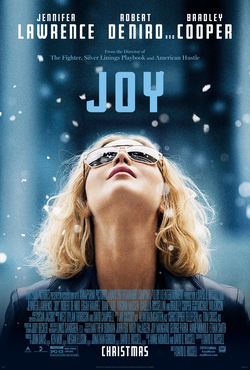
Joy rounds out a kind of thematic trilogy for director David O. Russell, but it’s a trilogy unified more by a stable company of performers – chief among them Jennifer Lawrence, Bradley Cooper, and Robert De Niro, with a few other bit players recurring in the mix. Of these, preceded by Silver Linings Playbook and American Hustle, Joy is perhaps the least successful of the lot – not by dint of being an abject failure but by never quite reaching the heights of the other two. Lawrence, however, turns in what might be her best performance yet.

Jennifer Lawrence stars as Joy Mangano, the QVC maven who made her millions with the Miracle Mop, a self-wringing cleaning device borne out of her own frustrations as a single mother living with both her father (Robert De Niro) and her ex-husband (Edgar Ramirez) in the basement. Bradley Cooper has a small supporting role as Neil Walker, the QVC exec who puts Joy’s product into the market.

Joy isn’t going to go down as Russell’s strongest film – I really do think Silver Linings Playbook holds that title – but I do think Lawrence has done her best work as a member of the Russell company, and I would put very real money on her seeing a third Best Actress nomination at the top of next year. As the eponymous Joy, Lawrence is riveting, from her beleaguered moments in the home to her natural charisma before the QVC camera. The film tasks Joy with representing the struggles faced by all women, and Lawrence is more than capable of bearing that weight.

That universality is one of the peculiarities of the film because I can’t help feeling that it would have been more successful had it adhered more strictly to the unique aspects of Joy’s story rather than an attempt to make her “every woman.” For one, I think the QVC sequences are among the best in the film, and I would have preferred this to be more than a small subplot. Russell has an eye for the innate strangeness of the QVC network, and a fuller treatment of that material (including the wonderfully strange cameo of Melissa Rivers as her mother Joan) would have been truly engaging – to say nothing of the chemistry that Lawrence and Cooper clearly have. Honestly, that’s the movie I thought we were getting, but sadly it’s unlikely we’ll see a Joy 2 that fleshes out that relationship in greater depth.

The movie keeps its eye tightly focused on Joy, often to the detriment of the other performers. It’s not that De Niro or Cooper are any less captivating than they usually are – De Niro is scene-stealing, particularly in an early tantrum about his ex-wife’s similarities with a gas leak – it’s more that there is just less of them to captivate. On reflection, it seems the largest supporting role belongs to Isabella Rossellini as Trudy, Joy’s principal investor and commercial mentor of sorts whose idiosyncratic approach to vetting entrepreneurs lends the film one of its greatest moments of empowerment. These moments provide glimpses of the A+ work that Joy might have aspired to be, had it taken off its Lawrence-shaped blinders.

Rotten Tomatoes has the self-congratulatory pun that the film “only sporadically sparks bursts of the titular emotion.” This joke misses the point of the film, because if you wanted a movie about joy you’ll have to check out Pixar’s summer offering Inside Out. This is instead a film about Joy, whose story is told reasonably well here, though the audience rightfully detects that Russell is capable of a fuller film than this. It’s perfectly serviceable, but transcendence belongs to the earlier films in this unofficial trilogy.
Joy is rated PG-13 for “brief strong language.” As might be expected, De Niro gets one F-bomb.

Monday, December 23, 2013

American Hustle (2013)

Last year David O. Russell snuck in at the tail end of the calendar with Silver Linings Playbook, a romantic comedy that reinstilled my belief in the genre; two years earlier, he’d caught my eye with The Fighter.  And with American Hustle, Russell takes the things that worked best in those movies – namely the remarkable acting talent on display – and mashes them together for a thoroughly enjoyable Oscar contender.

Based loosely on a true story – “Some of this actually happened,” an opening title card boasts – American Hustle gives us con artist Irving Rosenfeld (Christian Bale in another total body transformation) and his lover/partner Sydney “Edith” Prosser (Amy Adams) as they are forced into a federal corruption investigation led by FBI Agent Richie DiMaso (Bradley Cooper).  As the investigation bears unexpected fruit with Camden Mayor Carmine Polito (Jeremy Renner) in the crosshairs, Irving’s reckless wife Rosalyn (Jennifer Lawrence) puts her husband in jeopardy while trying to keep her marriage safe.

I almost don’t need to say much about the cast; they’re all exceptionally solid choices, the best performers from Russell’s two previous films under one roof.  As the lead (and hopefully a Best Actor candidate), Bale is almost unrecognizable were it not for his remarkable talent, and Adams demonstrates herself a perfect foil for him, continuing to break out of that “too cute for words” mode into which she might have been typecast after Enchanted.  Renner and Cooper are reliably compelling, and Lawrence continues to hold onto that “most talented young actress” title with a powerhouse performance as the spirited Rosalyn.  All handle the naturalistic dialogue very well, with improvisational quirks and touches that give the film a lived-in feel.  We come to know these people very well, thanks to the life given by the cast.

Even better than these five thrown into the same pot – plus all the supporting roles, including Louis CK as Cooper’s boss and a delightful uncredited cameo by a real legend – is the sum of the parts.  American Hustle is at once blissfully engaging and wildly unpredictable.  I don’t want to say it’s something we’ve never seen before; indeed, for many reasons it feels very much like an update on Scorsese’s Goodfellas.  But American Hustle manages to feel quite fresh, playing fast and loose with the historical facts (happily for those who know the story and those who don’t) in order to create an elaborately twisty narrative that takes its characters in surprising and entertaining directions.

All the while, Russell keeps us guessing by refusing to spoonfeed us character motivation, even with the presence of voiceover narration.  Rather than spell out plot beats and character traits, the voiceover instead fills us in on the personalities of the characters and, more importantly, the moments when we know they’re lying to themselves.  The narrative of the film is highly concerned with questions of honesty and deception, and Russell wisely plays about in it without handing us easy moral judgments.  The number of double- and triple-crosses are quite successful on an aesthetic level and satisfying on an interpretive one because we’re never expecting them.  Of course, in a movie about deception, we’ll have characters deceiving each other, but Russell manages to avoid the clichéd “gotcha” beats and instead continually sucker-punches the audience with another new twist introduced with graceful subtlety (as when we learn a key character actually can speak Arabic or when Rosalyn lets slip once or twice).

American Hustle is a movie that will leave its audience reeling, first from the sheer volume of thespianic talent on display and then from the intricate and enthralling plot structure which Russell uses to say insightful things about the problem of honesty and self-deceit.  The original title of the film was American Bulls—t, a title which would have been deliciously ironic – there’s no worse comparison to make with this film than a comparison to excrement.  American Hustle is the exact opposite – delightfully fun, solid gold.

American Hustle is rated R “for pervasive language, some sexual content and brief violence.”  The characters use the F-word quite a lot, a few adulterous affairs occur on-screen (with maybe a possible flicker of female nudity in one), and there’s a death-by-gunshot and a few minor fistfights.  Aside from the language, this one is really close to a PG-13.

Monday, March 11, 2013

Silver Linings Playbook (2012)

Academy Award winner Silver Linings Playbook makes this year’s list of “movies I got to because of the Oscars,” and it demonstrates a few important lessons to be learned going into 2013:  the romantic comedy as a genre isn’t as dead as I thought, Jennifer Lawrence is one of the most versatile actresses around, and Robert De Niro can still act his way through a movie without phoning it in.

Bradley Cooper stars as bipolar Pat, recently released from a psychiatric hospital after a messy separation with his wife.  While trying to reconnect with her in spite of a restraining order, Pat meets troubled widow Tiffany (Jennifer Lawrence), and the two strike up an unlikely friendship as they attempt to help each other through their problems.  Tiffany promises to help Pat reunite with his wife if Pat helps her win a dancing competition – and, incidentally, help his Eagles fan father (De Niro) win a bet in the process.

After The Fighter, this seems like a step away from what I’d come to expect from David O. Russell; the romantic comedy genre is a bit far from the heady biopic which finally won Christian Bale that Oscar.  But thank heavens that a fresher voice like Russell’s comes to a genre which has been otherwise formulaic, uninspiring, and often predictably pathetic, matching improbability with impotent self-importance.  The romantic comedy is a genre I’d long since written off, the clichés riddling it like so many bullets at the St. Valentine’s Day Massacre; give me Hepburn and Tracy any day of the week.  But Russell does something different here, creating something that still plays by the boy-meets-girl rules of the genre but without toadying to them.

While we’re on the subject of romantic comedies, thank goodness also that Russell didn’t cast someone like Katherine Heigl here.  Instead he’s gone with Lawrence, who is past shaping up to be one of the best actresses of her generation – she’s already there.  Lawrence is in that rare position of someone who does great genre work (see also X-Men: First Class and The Hunger Games) while knocking it out of the park with heavier stuff like this and Winter’s Bone (though the latter wasn’t really my bag).  Indeed, Silver Linings Playbook is not a perfect movie; the film stumbles between whether Pat’s devotion to his wife is endearing or delusional.  As such, the movie really takes off once Tiffany enters the picture; Lawrence imbues this potentially confusing character with an honest and unapologetic realism.  Where we’re not sure what to make of Pat, Tiffany isn’t transparent so much as she’s accessible and relatable; Lawrence is such a deft craftswoman that the character’s steely exterior doesn’t obscure the truth of her character.

The other cast members are quite good; Cooper is solid as ever, and Chris Tucker pops in to help you forget about the lackluster Rush Hour trilogy with an engaging supporting role as Pat’s confidant.  But the real surprise in the cast is that De Niro, after a long stint of roles alternating between uninspiring (Limitless and all those Fockers) and scenery-gobbling (Stardust and Machete), reminds us why he’s a great actor.  As Pat’s father, who’s sifting through his own issues while stepping on eggshells around his son, De Niro enters the pantheon of “movie dads you wouldn’t object to having.”  He never quite acts out of his own ethos, since you’ll always be thinking of him as De Niro first and Dad second, but he’s able to handle the extremes of his character with aplomb.  When he begins to weep over his son’s condition, it’s difficult not to be moved with him, but when he makes a key decision about betting on the dance competition he’s back to the same stammering repetition that elicited so many grins in Goodfellas.

All told, I’m still a bit surprised that Silver Linings Playbook got as much Oscar love as it did.  It’s not that the film is bad by any stretch of the imagination; no, once it gets going it’s quite enjoyable.  But it seems so far removed from the stalwart significance of the rest of the crop, like Argo, Django Unchained, and Zero Dark Thirty.  But perhaps if the film restores our confidence in the romantic comedy genre it also reminds us that sometimes the Oscars get it right; there’s enough good work being done here that I would have been complaining – especially had Jennifer Lawrence not taken home that trophy.

Silver Linings Playbook is rated R “for language and some sexual content/nudity.”  The F-word is used liberally (IMDB says 70+ times), and Pat is prone to erratic violent outbursts.  We see a woman nude from behind in a brief blurry flashback, while Tiffany and others speak about her promiscuous past.