If there’s one thing on which we can agree after two years and more than one hundred episodes (beyond the indomitable, indispensable powers of Kevin Conroy and Mark Hamill), it’s that Paul Dini was the show’s finest writer. As I said back in July, Dini is “arguably the show’s greatest writer, a man who fully understands Batman and his world, who can craft tales therein unlike nearly anyone else.” As master of his craft, Dini deserves his own Top 10, and with a new crop of episodes under our belt, it’s time to see how this shakes out.
Just like the preceding reprises, this list reproduces the July 2018 text where relevant, adding TNBA episodes where appropriate; removed from the immediacy of watching these episodes, commentary addenda will appear in blue. With that said, on with the show!
Showing posts with label TNBA. Show all posts
Showing posts with label TNBA. Show all posts
Wednesday, February 27, 2019


Wednesday, February 20, 2019
The Worst 10 Batman Animated Episodes
A reminder of the words of Anton Ego: “We thrive on negative criticism, which is fun to write and to read.” As good as Batman: The Animated Series and its follow-up The New Batman Adventures could be, they had a commensurate propensity to disappoint. I had initially struggled to come up with ten bad episodes, settling for eight bad ones with a forgettable flop and a two-thirds bad episode. Now, however, I’m proud to say I’ve gotten ten worst-of-the-worst.
Just like last week’s “Top 10” redux, this list reproduces the July 2018 text where relevant, adding TNBA episodes where appropriate; removed from the immediacy of watching these episodes, commentary addenda will appear in blue. With that said, on with the show!
Remember, nobody’s perfect.
Just like last week’s “Top 10” redux, this list reproduces the July 2018 text where relevant, adding TNBA episodes where appropriate; removed from the immediacy of watching these episodes, commentary addenda will appear in blue. With that said, on with the show!
Remember, nobody’s perfect.
Wednesday, February 13, 2019
The Top 10 Batman Animated Episodes (Not Written by Paul Dini)
It seems hard to believe that it’s been more than two years since we began this journey through Batman: The Animated Series and its follow-up The New Batman Adventures. Back in July 2018, after eighty-five episodes of BtAS, I took time out to rest and re-view, sorting episodes together into “Best” and “Worst” lists, giving writer Paul Dini his own special list in recognition of his standalone achievements in the field of Gotham narrative.
Now, at the end of the road, it’s time to check in with those lists one more time to see how twenty-four episodes of TNBA changes the calculus of the rankings. In the interest of being definitive, this list reproduces the July 2018 text where relevant, adding TNBA episodes where appropriate; removed from the immediacy of watching these episodes, commentary addenda will appear in blue. With that said, on with the show!
Now, at the end of the road, it’s time to check in with those lists one more time to see how twenty-four episodes of TNBA changes the calculus of the rankings. In the interest of being definitive, this list reproduces the July 2018 text where relevant, adding TNBA episodes where appropriate; removed from the immediacy of watching these episodes, commentary addenda will appear in blue. With that said, on with the show!
Wednesday, January 9, 2019
The New Batman Adventures - "Judgment Day"
 “May heaven have mercy on your souls, Two-Face – both of them.”
Gotham’s new vigilante, The Judge (Malachi Throne), takes a harder line on crime when he violently attacks The Penguin. Egged on by corrupt city councilman J. Carroll Corcoran (Steven Weber), The Judge works his way down a list of Gotham’s most wanted. While Two-Face (Richard Moll) scrambles to avoid facing the vigilante’s death sentence, Batman discovers that something far worse than a murderer lurks beneath The Judge’s robes. (Note: I’ll have to spoil the reveal below to discuss this episode fully.)
It’s a strange position to review “Judgment Day” as a series finale. It was the last episode produced but not the last one to air – that honor belongs to the masterful “Mad Love.” I’ve never been clear on how quickly the creators had to change course, though in Vulture’s oral history Bruce Timm suggests a fairly quick turnaround between The New Batman Adventures and Batman Beyond. (In that same history, Paul Dini notes, “we could have gone another two or three years on just Batman stories alone, because we also liked where we were taking the relationships.” If only!) So it seems partially fair to treat “Judgment Day” like a series finale, but we also have to acknowledge that it was more of a full stop than a proper conclusion.
As a finale, “Judgment Day” ties a bow on one of the animated programs’ longest running arcs – the fragile sanity of Harvey Dent, who debuted in the show’s fifth episode before the series’s first two-part episode depicted his fall from grace in an accident that scarred him physically and shattered him mentally. It’s both perplexing and fitting, then, that this episode introduces a third personality – that of The Judge – to accompany Harvey Dent and Two-Face (the erstwhile “Big Bad Harv”). Giving Two-Face a third personality is perhaps a bridge too far for a villain so obsessed with doubles and duality, but it compounds the tragedy of Harvey Dent and doubles-down, so to speak, on this Batman’s first and perhaps only great failure. Batman’s concluding monologue, reminiscent of a similar closing speech from Psycho, is perhaps a little too pat in explaining the narrative twist, and another pass might have helped draw out the long connection Batman and Two-Face, Bruce Wayne and Harvey Dent, have shared.
When Councilman Corcoran volunteers to help The Judge, he does so by observing, “I figure if Gordon can have his hero, why can’t I have mine?” This comparison is a fascinating one, and it’s something that, in another world, might have made for an excellent two-parter or even a season-long subplot. Positing The Judge – and, by extension, Two-Face – as Batman’s dark opposite number raises fascinating questions about which lines are important for Gotham’s vigilantes to draw, and the fact that only Corcoran notices is a bit disappointing. Along the same vein, The New Batman Adventures has prided itself on deepening the Bat-bench with Nightwing, a new Robin, and an expanded role for Batgirl, yet none of the Bat-family appears, save for a brief Alfred cameo. Batman himself doesn’t appear for nearly seven minutes while The Judge makes the rounds with Gotham’s villains. It’s a treat, to be sure, to see many of these foes again, even if Killer Croc isn’t voiced by Aron Kincaid, or if The Riddler is relegated to a news clip in his only non-hallucination appearance on TNBA. But one can’t help but feel this episode might have been fuller had someone other than Batman had a word about The Judge – especially Tim Drake, on whom Two-Face had a rather significant impact back in “Sins of the Father.”
On one point of order, “Judgment Day” is a striking series finale because of the way it invokes one of the animated project’s finest hours. Between his swooping robes, booming voice, and operatic score, it cannot be an accident that The Judge is extremely evocative of The Phantasm, the eponymous antagonist of Batman’s first and best animated film – to say nothing of the fact that Alan Burnett wrote both this episode and Phantasm’s story. Harley Quinn certainly looms largest among the pantheon of original animated creations, but there has always been something primal about The Phantasm, who never quite made the jump to the comics the way Harley did. (The Phantasm would resurface in an episode of Justice League Unlimited and a few Batman Beyond comics; when I met the writer of those comics, he speculated that the rights might have been handled differently at the time since Phantasm was released theatrically.) Nevertheless, The Phantasm has become a kind of hypostatic metaphor for the entire Batman animated project – an example of its fine visual flair, its ingenious creative writing, and its gut-level “cool” factor.
Moreover, The Phantasm represents the key conceit that Batman: The Animated Series and The New Batman Adventures always kept in mind: no matter how relentlessly cool his villains might be, Batman is the star of his own show, and every well-crafted story has to feed into exploring his specific psyche, his need for justice, and the personal connection he shares with his enemies –many of whom he may have had an accidental hand in creating. It’s also always been about the belief that one man can make a difference, that the city is a better place for this one figure standing between it and total lawlessness. We see it with The Phantasm, with Simon Trent and the redemption of his soul, even with Harley Quinn and her loony halfhearted reforms. And we see it with Harvey Dent, on whom Batman has never given up. This episode works very well as a thematic sequel to “Second Chance,” in which Harvey Dent found himself abducted by a Two-Face unwilling to accept that his better half might genuinely express contrition for his crimes. Back then, I wrote words that sum up my overall sense of the Batman animated project, words on which it may be wise to end:
We came for the earnest exploration of the Batman and his world, who he was and how his enemies came to be; we stayed for stories like this one, that remind us that these stories matter because they are about superhuman figures who remain, at the end of the day, failingly human.

Writers: Rich Fogel and Alan Burnett
Director: Curt Geda
Villains: The Judge (Malachi Throne), Two-Face (Richard Moll), The Penguin (Paul Williams), Killer Croc (Brooks Gardner), and The Riddler (John Glover)
Next episode: “The Lost Episode,” in which everything old is new again.
🦇For the full list of The New Batman Adventures reviews, click here.🦇
Wednesday, January 2, 2019
The New Batman Adventures - "Beware the Creeper"
 “Jilted madman stalks crazy clown girl – film at 11!”
While reporting on Gotham’s villains, Jack Ryder (Jeff Bennett) finds himself on the wrong side of The Joker (Mark Hamill) and his famous temper. Joker douses Ryder with the chemicals that made him the clown prince of crime seven years ago, but Ryder emerges as The Creeper, a bright yellow ludic goblin whose fractured sanity leads him on a mad chaotic spree across Gotham – and into a deep infatuation with Harley Quinn (Arleen Sorkin).
When Steve Ditko passed away in June 2018, he was rightly remembered as the co-creator of Spider-Man, Doctor Strange, and Squirrel Girl. His creations for DC Comics were somewhat less widely remembered, though chief among them was The Question – inarguably the spiritual father of Watchmen’s Rorschach. Forgotten by all but the diehard DC heads was The Creeper, the madcap alter ego of Gotham television reporter Jack Ryder. The Creeper isn’t exactly an obscure character, but he’s a pretty deep cut; I’d wager that most comics fans (this one included) can’t quote his origin story, even if they know the central Jekyll-and-Hyde conceit of the character.
Bruce Timm is on record saying that his crew made several attempts to work The Creeper into the animated series but never found a story that made good use of the character. In the show’s eleventh hour, it isn’t clear whether Timm and company finally found the right notes or if they just threw their hands up and deployed The Creeper before it was too late. I’d like to think it was the former, especially because the show gave Jack Ryder the Harvey Dent treatment and used him throughout The New Batman Adventures before finally giving him the Christmas colors of The Creeper. Writers Rich Fogel and Steve Gerber (the latter having made his mark on weird comics by creating Howard the Duck) are so enamored of the character that Batman is largely a guest star on his own show, which is oddly appropriate for a show that has risen and fallen on the strength of its villains and supporting cast. (And when the show’s star, Kevin Conroy, is as steady and consistent as ever, it can afford to lean on its villains.) This shift in focus also lends credence to my theory that The New Batman Adventures was headed toward a “brave and bold” team-up model.
“Beware the Creeper” marks the final appearance of The Joker, so it’s fitting that the show turns on its head for its greatest ne’er-do-well, a theatrical scene-stealer of the first order. In this topsy-turvy episode, Joker becomes the hero, with The Creeper dogging his every move and trying to steal his girl; at the episode’s climax, Joker begs for Batman’s help, retreating in sheer terror at the lunacy of The Creeper. It’s a laugh riot, especially as the episode operates under a kind of Looney Tunes approach to physics, with an absurdist domino chain leading to Jack Ryder’s initial transformation. Acid, fireworks, cigars, and chemical explosions all conspire to reshape Ryder’s reality before he’s presumed dead in a send-up of the most readily accepted version of The Joker’s own origin. (The episode also includes a nod to Joker’s role in the flashbacks from Batman: Mask of the Phantasm, a nice little wink for the penultimate episode.) In short, this episode is a hoot, and it knows it.
As the last Joker episode, it’s also the last episode for Harley Quinn, too. While “Mad Love” is an impossible act to follow, this episode takes the interesting approach of reminding us why we love a loon like Harley, even when she’s acting against her own best interests. Despite seeing firsthand how incidental she is for her beloved Mistah J – in a meringue-coated spoof of Marilyn Monroe, which provides a delightful excuse for Arleen Sorkin to sing for us one last time – we still feel some degree of safety with him as opposed to the daft courtship of The Creeper. Creeper’s amorous intentions are never without a whopper of comedic intent, but there is something a little scary about his irrational and relentless pursuit. Put another way, maybe we’d all get back together with our worst exes if the rebound looked like The Creeper. No matter what, though, we’re always rooting for Harley – and I think we always will.
I had said back when The New Batman Adventures began, with “Holiday Knights,” that the Joker redesign was more than a little reminiscent of contemporary cartoon Freakazoid!, and with “Beware the Creeper” we come full circle. Freakazoid, the Deadpool of his day, took great postmodern delight in deconstructing what a kid’s cartoon could look like, with a powerful metafictional bent and a visual style that was more Chuck Jones than Jack Kirby. While I never watched much Freakazoid as a kid, I’ve always been aware that this incarnation of The Creeper owes a little bit to that offbeat sensibility. Case in point, the inspired use of Billy West as Joker’s three goons Mo, Lar, and Cur – doubtless a gag built around West’s spot-on Larry Fine impression (at a time when Larry was the “forgotten Stooge,” seldom imitated). It’s a joke that works because it makes perfect sense that Joker would hire goons for their resemblance to bygone comedians, the same way Two-Face would hire sets of twins. But it’s also a joke that only works because the audience recognizes the telling, a joke told as much for the benefit of its tellers, who layer in the reference with reverence. It’s one last reminder that the creators of the show have always given their viewers credit for being smart enough to follow along, even in an episode as deliberately mindless – and ultimately, richly entertaining – as this one.

Writers: Rich Fogel and Steve Gerber
Director: Dan Riba
Villains: The Joker (Mark Hamill) and Harley Quinn (Arleen Sorkin)
Next episode: “Judgment Day,” in which it all wraps up when The Judge delivers his final verdict.
🦇For the full list of The New Batman Adventures reviews, click here.🦇
Wednesday, December 26, 2018
The New Batman Adventures - "Chemistry"
 “Relationships aren’t supposed to be easy. Even I know that, and I’m a vegetable.”
At Veronica Vreeland’s fourth wedding, Bruce Wayne meets Susan Maguire (Linda Hamilton), who sweeps our billionaire off his feet. The relationship moves fast – fast enough for Bruce to propose marriage and resign the mantle of the Bat – but Robin and Batgirl are suspicious, especially when Veronica’s new husband Michael starts displaying murderous intent.
As the clock winds down on The New Batman Adventures, “Chemistry” is an unexpectedly appropriate antepenultimate note. For a show that has been nominally about family (albeit a family that squabbles, bickers, and at times flirts inappropriately), “Chemistry” is an episode that asks what it would take for the patriarch to leave the family. It’s been a long-standing precept of the Batman universe that Batman is a foster father to the Robins, Nightwings, and Batgirls who have found their way into his fold, with stalwart Alfred as his own surrogate father; in short, Batman creates for himself a family to replace the one he lost in Crime Alley.
For Susan Maguire to come along and destabilize all of that suggests that she must be a very special lady. This episode very smartly invokes some of the most powerful moments of Batman: Mask of the Phantasm, in which a young Bruce Wayne was already considering abandoning his nascent vow of justice in favor of a life with Andrea Beaumont; in “Chemistry,” it’s the cave scene in particular, framed and scored like that Phantasm moment, that helps to land the notion that this might be Batman’s swan song. However, one never really gets the impression that this is permanent, even if this were the final episode of the Batman animated project. Like Robin and Batgirl, we recognize that this is all moving a little too quickly, and Kevin Conroy smartly keeps his Bruce voice a little too dispassionate for a man on the verge of wedded bliss. I might have liked a little more convincing that Susan was the woman of Bruce’s dreams, but perhaps writer Stan Berkowitz is more interested in the detective work of Batman’s juniors and the horror derived from the truth about Susan.
The episode begins to destabilize (in a good way) when we learn the truth about Veronica Vreeland’s fourth husband. Veronica has been a fun addition to Gotham’s supporting cast, a useful reminder of what everyone else thinks Bruce Wayne is – a vapid, shallow, and self-absorbed heir to a fortune of ungodly size. She has the early weavings of a moral fiber, having learned half a lesson from abusing Penguin in “Birds of a Feather,” but she’s hardly an altruist. Still, our investment in her, even if only as a consequence of continuity, means that “Chemistry” wrings a successful amount of horror from her husband’s monstrous transformation into – and spoilers, all – a venomous plant creature born in Poison Ivy’s lab. Michael’s shambolic lurch toward Veronica, cowering in a closet, reminds one of the better moments in “Heart of Steel,” though I wonder if I’m the only one who wishes we might have gotten one more good H.A.R.D.A.C. episode out of TNBA.
As the final Poison Ivy episode, “Chemistry” keeps its main antagonist off-screen for a while, building suspense but sadly relegating a major Bat-foe to the periphery. There’s a lot that could have been done with this character – a happier ending with the besotted Harley Quinn, perhaps, or a seed of the long-running redemption plot the comics have entertained for her. Creating plant spouses to take over global industry is perfectly of a piece with Ivy’s ecoterrorist sentiments, but her emphasis on controlling their fortunes seems a little petty for a villain who always tried to do a little good for her planet. (Say, why hasn’t Ivy ever teamed with Ra’s al Ghul to save Mother Earth?)
“Chemistry” is a kind of cold inversion of “House & Garden”; where Ivy found herself incapable of forming a family, even a synthetic one, she’s here ready to dispense with the artifice and take full advantage of her powers of photosynthetic simulation. Years later, the tie-in comics would claim/reveal that every appearance of Ivy since “Holiday Knights” was actually a plant-based doppelganger that Pamela Isley used to escape Gotham and join Alec “Swamp Thing” Holland in his botanical research; as I recall, she even washed up from the watery climax of this episode. It’s an interesting footnote for a character who’s more often than not received a fair shake from this show.

Writer: Stan Berkowitz
Director: Butch Lukic
Villains: Poison Ivy (Diane Pershing) and Susan Maguire (Linda Hamilton)
Next episode: “Beware the Creeper,” in which a clown prince is plagiarized, and three stooges take a day off.
🦇For the full list of The New Batman Adventures reviews, click here.🦇
Wednesday, December 19, 2018
The New Batman Adventures - "Mad Love"
 “Face it, Harl, this stinks. You’re a certified nutso wanted in twelve states, and you’re hopelessly in love with a psychopathic clown! At what point did my life go Looney Tunes?”
Smarting from his latest thwarted attempt to kill Commissioner Gordon, The Joker (Mark Hamill) rebuffs Harley’s advances, pushing the clown princess (Arleen Sorkin) to remember how it all began. In flashbacks, we see how she met The Joker as his psychiatrist in Arkham Asylum, before she fell in love and broke him out as his new henchgirl. As Harley remembers her past, she plans her future with her puddin’, plotting a way to rework Mr. J’s old schemes to kill Batman once and for all.
“Mad Love” is, as memory serves, the last great episode of the animated Batman project, which is really fitting in a number of ways. It’s the last episode by Paul Dini and Bruce Timm, adapting one of their seminal comic book works, and it remains the definitive statement on Harley Quinn. (We’ll see her once more, in two weeks, for a zany sideplot.) It’s a brisk twenty minutes, giving us a pair of fully-realized villains whose ambitions are clear, and it features Batman cleverly dodging his way out of danger with his trademark sense of black humor. (“She came a lot closer than you ever did... Puddin’.”) Put another way, it’s at once a high note and a mic drop for Paul Dini and Bruce Timm.
Reviewing this episode is a little like reviewing Citizen Kane – even if you haven’t seen it, you know its reputation is titanic, and the central concept is so culturally ingrained that it’s seeped into the culture by four-color osmosis. Everyone knows the story, and you’ll be unsurprised to see it crack the Top Five of my “Best Paul Dini Episodes” when all is said and done. It’s such a tight and engaging exercise in precision, with a wonderful showcase for Arleen Sorkin, who plays Harley as a multifaceted bundle of mess. She’s romantic, lovestruck, tragic, determined, afraid, clever, infatuated, obsessed, angry, and often a mix of most of them at once. What Kevin Conroy can do with the word “Go” pales in comparison to what Sorkin can do with a well-timed “Puddin’.”
Giving a villain like Harley such a complex psychological and emotional profile is a bit brave, but it’s long been the hallmark of this show that the villains are almost more the star of an episode than Batman is. Joker, too, gets his convolutions, obsessed as he is with marshalling all the strength of his comedic genius against Batman’s vast toyetic arsenal. He’s aware of the theatricality of it all, and it’s been this self-aware mania that has marked Hamill’s Joker tenure as indisputably definitive. He’s genuinely funny – on more than one level, as when he gags, “May the floss be with you!” – and yet frighteningly manipulative. This danger is something that Suicide Squad started to get right, this interpretation of The Joker as emotionally abusive and psychologically controlling, with Harley’s true tragedy being her inability to learn from her own mistakes.
Of course, in the comics, she’s long since learned her lesson, but in “Mad Love” she’s incorrigible, swooning over her Mistah J despite his endless violence. Yet at her core, she’s real; we recognize her cheery optimism and believe in her abiding capacity for love. We can’t help but admire her spirited determination to get back up and try again, even if that is the very definition of madness. In this way, she’s become a kind of accidental feminist icon, representing the capacity for strength and growth in the face of astonishing cruelty. No matter what happens to Harley, regardless of how warped her perceptions can be, she’s determined to continue to try to make the world in her own madcap image, whether that involves a shellacking of whiteface or a good thwack of her oversized mallet.
We’ve seen throughout that this series often lives or dies on the strength of a particular voiceover artist – Kevin Conroy, Mark Hamill, Michael Ansara, even Paul Williams as The Penguin. Here, though, Sorkin makes the case (if she hadn’t already) that she belongs on the Mount Rushmore of Bat-voices – indeed, such that I can’t imagine who a comparable fourth would be opposite Conroy and Hamill. (Efrem Zimbalist, Jr., maybe? Andrea Romano? Sound off in the comments.) “Mad Love” is then a kind of farewell gift; though Harley Quinn will appear once more, this episode is the treasure by which we’ll always remember her.

Writers: Paul Dini and Bruce Timm
Director: Butch Lukic
Villains: Harley Quinn (Arleen Sorkin) and The Joker (Mark Hamill)
Next episode: “Chemistry,” in which our Dark Knight finally settles down.
🦇For the full list of The New Batman Adventures reviews, click here.🦇
Wednesday, December 12, 2018
The New Batman Adventures - "Girl's Night Out"
 “An empty mall, an unguarded cash machine – who says life ain’t fair?”
A prisoner transfer from Metropolis goes sideways when Livewire (Lori Petty) escapes confinement and runs loose into Gotham City. Batgirl (Tara Strong) and Supergirl (Nicholle Tom) team up to recapture the electric supervillain, but in her escape Livewire teams up with Poison Ivy (Diane Pershing) and Harley Quinn (Arleen Sorkin) for a criminal shopping spree.
In the final scene of this episode, it’s not a spoiler to say that Supergirl and Batgirl cap off their night of crimefighting and bonding in slippers and bathrobes, with their own pints of ice cream. If there’s a better analogy for how this episode is the animated equivalent of comfort food, I can’t come up with it. “Girl’s Night Out” (odd apostrophe placement, I know) is a real treat of an episode, fan service in its purest form. Last week’s episode might be a Top 10, and so too do I need to give this one some consideration. (Next week’s is a lock.)
It’s a little surprising for me to discover that Supergirl only appeared in three episodes of Superman: The Animated Series; even more startling is that Livewire only appeared in two. These two women loom so large in my memory of the show’s 54 episodes, possibly as a consequence of this episode, which throws together the best of two animated shows (which, recall, aired for a time as a one-hour block, The New Batman/Superman Adventures, on the Kids WB network). While there is something lightly discriminatory about pitting two women against three women, given the deep bench of villains Batgirl and Supergirl could have fought, I submit that we look at “Girl’s Night Out” as uniting the DC Animated Universe’s two greatest original creations – Livewire and Harley Quinn, both manic pixies with squeaky voices, too good to be bad but too bad to be good. It’s the perfect team-up of two perfect characters, just different enough to get on each other’s nerves.
This episode also revisits the Harley & Ivy dynamic that works so well. We saw a kind of trial run for this episode in “Holiday Knights,” when the pair abducted Bruce Wayne for a holiday shopping spree and murderous nightcap, so it’s a delight to see that the friendship persists, with Ivy as the gently indulgent den mother and Harley as the impulsive ball of energy. “She tries so hard,” Ivy laments as Harley whacks away at a locked door. Sorkin is in rare form as Harley, grunting her way through endless hammer strikes, gleefully acknowledging her own madness, and knocking herself out (whoopsie-daisy!) when she forgets that Supergirl is invulnerable. We have two more Harley episodes to go after this one, and she’s well on her way to going out on a high note.
One thing that ought not go without saying is that “Girl’s Night Out” is to be commended for an episode in which Batgirl and Supergirl’s friendship is assumed as a matter of course; they have no rivalry, no deep-seated resentment, and no hang-ups about working together. Indeed, they’re only jealous of the quotidian differences between them (namely, technology, farm life, and chores). It took Batman and Superman an entire movie to learn how to get along; it’s refreshing to see these two learning from their mentors’ mistake. While Batman is gruff and agitated at needing Superman’s help to take down Livewire, Supergirl is all too happy to step in for her famous cousin and make a night of it.
In fact, this refreshing optimism is something from which The New Batman Adventures overall could have benefited. I had to keep checking this wasn’t a Paul Dini episode – it’s not, nor was Livewire’s debut – because the infectious brand of enthusiasm is Dini’s trademark approach to a universe as full of delights as this animated one. As dour and uncomfortably romantic as TNBA could be, it was episodes like this one that left us feeling good about the direction of the DCAU. Better, “Girl’s Night Out” is one of a number of episodes, like “Trial,” that feel like an open toybox adventure, dumping all the action figures onto the rug and having a blast. Sadly, this boy never had a Harley Quinn or a Livewire figure (or a Supergirl, come to think of it), but this would have been a dream of a team-up.

Writer: Hilary J. Bader
Director: Curt Geda
Villains: Livewire (Lori Petty), Harley Quinn (Arleen Sorkin), Poison Ivy (Diane Pershing), and The Penguin (Paul Williams)
Next episode: “Mad Love,” in which life goes looney tunes.
🦇For the full list of The New Batman Adventures reviews, click here.🦇
Wednesday, December 5, 2018
The New Batman Adventures - "Legends of the Dark Knight"
 “You guys are both totally clueless. First of all, Batman’s real old – like, about 50. And second, Robin’s a girl.”
While the arsonist Firefly (Mark Rolston) roams the streets of Gotham, four kids (Ryan O’Donohue, Anndi McAfee, Jeremy Foley, and Phillip Van Dyke) argue over what Batman is really like. Is he a giant pterodactyl or a rippling muscle god? Matt (O’Donohue) makes the case for a kinder, gentler Batman, while Carrie (McAfee) pictures the grimmest and grittiest Bat imaginable in this loving tribute to the works of Bill Finger, Dick Sprang, and Frank Miller.
Now that we’re getting down to the wire on the Batman animated project, “Legends of the Dark Knight” marks a number of “last” occasions – it’s the last anthology episode, and it’s the last episode filtered through the eyes of children. It’s definitely the best “kids” episode, handily thrashing “Be a Clown” and “I’ve Got Batman in My Basement.” It’s also a very strong anthology episode, but then we’ve already seen some real winners in that department (“Holiday Knights” and, of course, “Almost Got ’Im”). In other words, “Legends” makes a case for the series ending on a very strong note, and indeed this is the first of three episodes right in a row that I recall as among the strongest of The New Batman Adventures.
The central conceit of the episode – that there is no singular interpretation of Batman, that his value is in the eye of the beholder – is one that speaks very deeply to my beliefs about the value of fiction. Moreover, it’s particularly ingenious to pin the story to a group of children who turn their fandom into a kind of junior detective agency (another advantage over “Batman in My Basement”). It’s even better that this episode wears its creators’ own fandom on its sleeve, adapting two wildly divergent interpretations of Batman into a case study in the art of leaving them wanting more. I’d happily watch more in this vein, and have in fact done so; Batman: Gotham Knight did a segment like this, and an episode of The Brave and the Bold adapted Jiro Kuwata’s Bat-Manga, so it’s become something of a proud tradition for a character as multifaceted as Batman.
In the first segment, we get a cheerful Batman (Gary Owens) preventing a museum heist orchestrated by The Joker (Michael McKean). It’s a throwback to an era when Batman was unburdened of his early pulp roots, with a chest as broad as his smile. The visuals recall Dick Sprang’s 1950s Bat-art, but there’s a handshake with Robin (Brianne Siddall) straight out of Batman ’66, while McKean’s Joker recalls Olan Soule’s version of the Clown Prince from the late Sixties and Seventies. Put another way, it’s a pastiche within a pastiche, and this mash-up quality feels as anachronistic and yet as timeless as the giant props that fill the museum. There’s something very comforting about seeing Joker try to kill the Dynamic Duo by stomping on a giant piano; it’s a far cry from the Nolan and Snyder interpretations of Batman, but it feels right nonetheless, even as the kids reject it. The real star of this segment is McKean, whose Joker makes one wish he’d gotten to do more with the character; his version is rife with puns and cracking himself up, a playful jester with just a dash of sinister menace. “Mother always said I had talent,” he moons, a classic Joker line.
McKean would return to the world of the Bat as Dr. Bartholomew Wolper, Joker’s benighted shrink in the animated adaptation of The Dark Knight Returns. It’s an intriguing coincidence, then, that the next segment of the episode adapts DKR and its gritty 80s aesthetic, boiling its second issue down to a tight sequence storyboarded by the late, great Darwyn Cooke. The great casting continues; Michael Ironside is downright inspired as Batman, his voice gargling gravel over iconic paraphrases like “You don’t get it, son. This isn’t a trash heap. It’s an operating table. And I’m the surgeon.” (Miller’s original, note, was, “You don’t get it, boy. This isn’t a mudhole; it’s an operating table. And I’m the surgeon.”) Ironside would be replaced with Peter Weller for the 2012/2013 adaptation, which is a special kind of shame; though Weller was great, Ironside became a voice for a generation’s reading material. (Don’t cry for Mike, Argentina; he’d get his own day in the sun, though, as the definitive Darkseid over on Superman: The Animated Series and Justice League.)
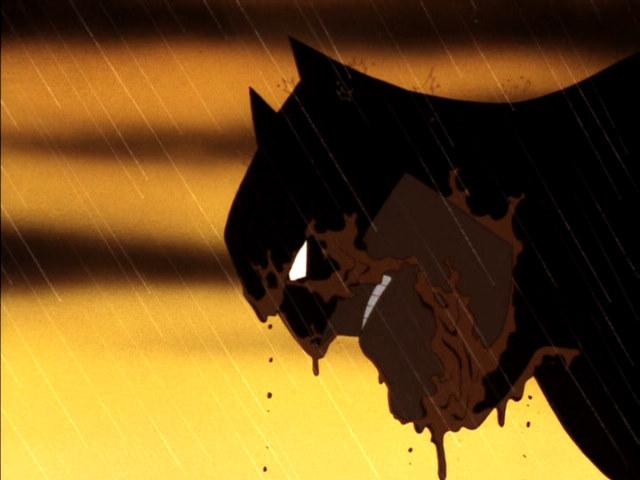 The Dark Knight Returns segment is moody and expressionistic, capturing Frank Miller’s punchy dialogue and broad cynicism about the dark future. One wonders, with Cooke serving as storyboard artist, whether this segment had any influence or overlap with the similarly futuristic Batman Beyond, whose opening sequence was masterminded by Cooke. Taken on its own, though, this segment is relentlessly cool, with a special thrill for seeing Carrie Kelley – the first female Robin – make a quick jump into animation. The standout visual, though, is the shot of rain washing the mud from Batman’s face as he defeats the Mutant Leader in single combat. It’s enough to make you want a whole show of that world, and I’m sorely tempted to revisit the movies.
Perhaps surprisingly, it is the third segment – the one starring Kevin Conroy – that ends up the weakest of the three, mostly because it can’t help but pale in comparison to two very striking takes on Batman. In this one, Batman chases Firefly and apprehends him for committing arson for hire. Divorced from the #MeToo context I read into him in “Torch Song,” Firefly is little more than a slick costume with a passing interest in lighting children on fire. Despite this part of the episode feeling somewhat compulsory, Conroy manages to hit another career note with a single syllable. When he shouts, “Go!” at the kid detectives as they flee through an opening in the inferno, Conroy packs an unbelievable amount of pathos into the word. Throughout this review series, I have stopped and noted all the wonderful, amazing things Conroy can do with his voice, and perhaps this is his apex moment, distilling an entire character into one syllable. You can hear his sorrow that children have been dragged into this mess, his fear that they will die in the fire, his anger at Firefly for endangering them, and his resilient hope that his nightly war on crime is making a difference.
“Legends of the Dark Knight” feels like it ought to be a Top 10 episode – and maybe, separated from all the great Dini episodes, it will be – but we must concede that this episode ends up somewhat less than the sum of its parts. It contains two first-rate segments and one a little weaker, and I find it hard to say whether the episode successfully communicates its message or whether I’m already predisposed to hear it. That message – that Batman is for everyone, with all versions being perfectly valid – is somewhat undermined, however, with a particularly mean-spirited joke at the expense of Joel Schumacher, who’s caricatured here as a preening pre-teen with a feather boa and a fetish for rubber-clad muscles. It’s the only sour note in the episode, but it’s pretty sour, reading like an embittered fan thumbing his nose at Schumacher’s Batman & Robin to assert his superiority over that particular interpretation. It’s perfectly legitimate not to like a movie like Batman & Robin, but this short punchline feels like the crankiest axe to grind in an otherwise jubilantly optimistic fable about fandom.
When we talk about Batman, it occurs to me that none of us is really talking about the same guy, and yet we’re all talking about the same elephant from a different vantage point. Some of us will describe Batman as a dark avenger, swooping through the night as a grim specter of obsessive vengeance. Others know him as a jovial square, willing slave to the conservative rules against jaywalking and violence. Still others think of him as a box office icon or a child’s plaything, a personal creed or just one of many in a box of toys. And the truth is, he’s all of those things. At the risk of sounding self-important in my own enlightenment, I think it’s really important for us to look at Batman from a four-dimensional perspective and realize that he’s all of his variations – pulpy, cheery, campy, gritty – a kind of cipher for the ages, telling us how we see ourselves and what sort of hero we need (or deserve). He contains multitudes, and no one interpretation has a monopoly on the character’s tone or history. There’s a part of me that wishes “Legends” were sequenced as the last episode of the series; it’s an effective series finale in the sense that it encompasses everything the show has been able to accomplish, uniting sixty years of history into as close to a unified statement as possible. And it’s a fine farewell to Batman in that it’s not an ending at all; it’s a renewal, a beginning, a reminder that he’s still out there, in all his forms, inspiring us by his example.

Writers: Robert Goodman and Bruce Timm
Director: Dan Riba
Villains: The Joker (Michael McKean), The Mutant Leader (Kevin Michael Richardson), and Firefly (Mark Rolston)
Next episode: “Girl’s Night Out,” in which the Femme Finest team up against the DCAU’s best villainesses.
🦇For the full list of The New Batman Adventures reviews, click here.🦇
Wednesday, November 28, 2018
The New Batman Adventures - "The Demon Within"
 “Gone, gone, the form of man / Rise the demon, Etrigan!”
A branding iron at auction in Gotham City draws fiercely competitive bids from occult expert Jason Blood (Billy Zane) and the impish witch boy Klarion (Stephen Wolfe Smith). It’s Bruce Wayne who places the winning bid as a “professional courtesy” to Blood, who Tim Drake is flabbergasted to learn is an ageless wizard who shares a body with Merlin’s personal paladin, Etrigan the Demon. Etrigan escapes when Klarion’s familiar, the were-cat Teekl, steals the iron, and Batman and Robin have a real hellraiser on their hands.
I have a hard time remaining objective about this episode because it was one of my earliest forays into the mad world of Jack Kirby, whose boundless imagination never took a holiday. Even after revolutionizing the “Marvel method” with Stan Lee, after formulating the Fourth World Saga practically single-handedly (and conjuring its god of evil, Darkseid), Kirby continued to churn out new and amazingly original creations like Etrigan and Klarion; the legend tells that workhorse Kirby fashioned Etrigan within the span of a lunch hour, and I believe it. There’s something immediate and dreamlike about Etrigan’s origin, summoned by Merlin to guard Camelot while bonded to a knight, wandering immortal as a god.
Put another way, I’m a real sucker for a Kirby creation, and so I’m not especially perturbed that Batman and Robin essentially become guest stars in their own show when Etrigan and Klarion come to Gotham. (See also Superman: The Animated Series, whose best episodes were the ones involving Darkseid and Kirby’s New Gods.) I’ll also argue that these dark magic characters fit quite nicely into the red-skied ethos of the redesigned Gotham. The implication that Batman already knows Etrigan makes perfect sense, extending his sense of the occult from the training we glimpsed in “Zatanna,” and this episode finally finds a good use for Robin, pitting him as the perpetually amazed sidekick entering a daft world already in progress. Indeed, this episode makes perhaps the greatest use of Robin’s diminutive stature, juxtaposing him with both the slender Klarion and the mammoth bulk of Etrigan.
In the case of The Demon, casting director Andrea Romano hit a home run when she cast Billy Zane as both Jason Blood and Etrigan. As ever, Zane brings a perfectly calibrated performance, flirting with the realm of camp when his Demon speaks in rhyme but also knowing exactly how much gravel to use to differentiate the two voices. We believe his exasperation with Klarion, and we can hear the wink in his voice as he alludes to his past in a conversation with Robin. And in the moments when he speaks the incantation to unleash Etrigan, we can almost see the forceful showiness of a Jack Kirby close-up, replete with bolded lettering and that distinctive “Kirby krackle.” It’s the kind of performance that is just fun to hear, not too far removed from Kevin Conroy’s own distinctive dulcets. This is usually the part of the review where I say it’s a shame we didn’t get more Etrigan, but I’m not sure how much more could have been done with the character while still maintaining this as a Batman show.
In fact, I almost wonder – as we approach the end of The New Batman Adventures, were the writers making a soft pitch for the show to become reinvented as a “Brave and the Bold” team-up series? After this episode, we’ve only got six to go, and two of them can be considered less at Batman episodes proper and more as team-up standalones; over on Superman, meanwhile, the showrunners gave backdoor pilots to Green Lantern, Aquaman, and The Flash (among others). Those of us in the know recall that we did get a team-up show – named, incidentally, Batman: The Brave and the Bold – and with next week’s wink-and-a-nod to a kinder, gentler Batman, perhaps this sort of episode was a necessary course-correction away from the friendless, emotionless, unfeeling Batman of whom we’ve seen all too much on TNBA – even if his friends are literal demons.

Writer: Stan Berkowitz
Director: Atsuko Tanaka
Villain: Klarion (Stephen Wolfe Smith)
Next episode: “Legends of the Dark Knight,” in which there’s no wrong way to read a Batman.
🦇For the full list of The New Batman Adventures reviews, click here.🦇
Wednesday, November 21, 2018
The New Batman Adventures - "Old Wounds"
 “He was so upset he couldn’t even talk about it. It wasn’t the first time I’ve seen him like that. What is it between you two?”
Robin finally asks Nightwing (Loren Lester) why he parted ways with Batman. Though the former Boy Wonder is reluctant to share, he tells his successor about the night Batman went too far, leading to a few confessions with Barbara Gordon (Tara Strong) and a confrontation with The Joker (Mark Hamill) where tensions boiled over.
Although the Batman animated project has largely eschewed long narrative arcs and dense continuity callbacks, “Old Wounds” is maybe the closest the show ever came to addressing its own internal mythology in an episode that promises a major revelation to answer the long-running question of why Nightwing gave up the mantle of Robin. I have very strong memories of this storyline – not as its animated instantiation but as the five-issue tie-in comic book miniseries, The Batman Adventures: The Lost Years, which preceded the episode. I remember that series fondly for its deliberate introspection, getting inside Dick Grayson’s head and tracing his path to a new identity.
Perhaps “Old Wounds” would have benefited from the breathing room that a two-parter would have given it, because the episode moves so briskly through its events that everything seems rushed and a little thin. This is an important story, maybe the second most significant one The New Batman Adventures would ever tell (in four weeks, “Mad Love” makes the case for being the most significant). The way it’s handled, though, seems perfunctory – Batman was a jerk, and Robin had enough – and it doesn’t quite gel with the healthy and positive relationship these characters had in The Animated Series. I’m reticent to pull a “book did it better” with this review, but The Lost Years took two issues to divorce Robin from Batman, establishing the conflict between Bruce’s increasing prickliness and Dick’s bristling under his mentor’s wing. “Old Wounds” distills that pattern down to an incident or two, giving us the acute feeling that we’re being rushed past important backstory. When Barbara says that “It wasn’t the first time I’ve seen him like that,” the problem is that itwas the first time the audience saw Dick like that.
Another drum I hate to beat – but once more feel the unfortunate need to strike – is that the episode gets into very strange territory when it accidentally implies that Barbara Gordon transferred her attraction to Dick Grayson onto Bruce Wayne after the former left Gotham. You can’t say I’m reading into this because of what we’ve seen from the show thus far, and you equally can’t ignore the fact that this episode includes promising sequences of Dick and Babs on a dinner date, followed by a later scene in which he visits her apartment while she’s wearing her other nightwear. I say promising because it’s an age-appropriate gesture to the long history these two share in the comics, building on light continuity with the Sub-Zero movie that preceded the redesign. But the relationship is scrapped as quickly as it’s acknowledged, ending after Batgirl reveals her identity to Dick Grayson, in a scene that uncomfortably reads like Dick thinks Babs is cheating on him with Bruce.
The revelation that Batman has always already known that Barbara Gordon is Batgirl is a clever one (though The Lost Years included sequences of Batman’s process of deduction, noting how Barbara’s tennis moves matched Batgirl’s fighting style), and his compassionate admission takes some of the sting out of the fact that he’s generally an emotionless bastard for most of this episode (and the redesign writ large). Indeed, that whole sequence in the Batcave is note-perfect, from Barbara’s crimefighting gusto to Alfred’s confession that “Yes, I admit it, I am Batman.” It’s a glimpse at a perfectly functional Bat-family, but the rest of the episode, though, does not live up to the promise of that setpiece. Nor, unfortunately, can a single episode sustain the weight of anticipation that’s been building since The New Batman Adventures began.
Writer: Rich Fogel
Director: Curt Geda
Villain: The Joker (Mark Hamill)
Next episode: “The Demon Within,” in which a witch boy and a demon demolish a bakery.
🦇For the full list of The New Batman Adventures reviews, click here.🦇
Wednesday, November 14, 2018
The New Batman Adventures - "Animal Act"
 “We got enough yahoos running around this city without having to deal with Yogi and Boo Boo, too.”
A routine evening on patrol turns into a topsy-turvy night of misrule when Batman, Robin, and Nightwing catch a gorilla climbing a radio tower and stealing some gadgetry. Amazingly, Nightwing recognizes the gorilla from his days at Haley’s Circus. Dick Grayson refuses to believe that the gorilla’s trainer, Miranda Kane (Jane Wiedlin), could be behind the theft, but Batman’s hackles are raised when a set of bears robs a warehouse. Yet despite this episode being set in Gotham City, no one notices the strange clown lurking at the periphery.
Contrary to what my synopsis would have you believe – spoiler warning – it’s not The Joker at fault in this episode. (Kudos for that about-face, at least.) It is, in fact, The Mad Hatter, making his full TNBA debut after a cameo in “Over the Edge.” Hewing closer to Sir John Tenniel’s illustrations for the literary Mad Hatter, the redesign gives us a shorter Jervis Tetch, more gnome than man; wisely, Roddy McDowall remains on hand, his dulcet tones providing the requisite lilting madness for a plot that is appropriately off-kilter.
“Animal Act” is not, however, a worthy use of the Mad Hatter, even more so than “The Worry Men,” in which even Batman was disappointed at the pure greed of the Hatter’s motives. Here the Hatter is once again after money, but his cockamamie scheme involves manipulating his human mind-control technology to allow him to conquer the animal brain. Why he’s taken this additional step is beyond me, and the episode is disappointingly uninterested in why Tetch has changed his modus operandi for such an underwhelming use of his talents.
This episode also fails to make full use of the connection to Dick Grayson’s past. (For a better version of this idea, within the last decade, comics scribe Kyle Higgins made masterful use of Nightwing’s ties to his circus past.) For a show that hasn’t quite known what to make of Nightwing, a dive into his history can give the character a better grounding in his new identity. One could imagine this episode as a spiritual sequel to “Robin’s Reckoning,” which gave us a good look at Dick Grayson as a circus orphan with a surrogate family of sorts. Seeing any of that family might have tickled the nostalgia keys. Instead, we get a generic bevy of circus types, including the circus’s ostensible new management. (Ph.D. sidebar – Miranda Kane is obviously named for Batman co-creator Bob Kane, but Miranda is the daughter of magician Prospero in Shakespeare’s The Tempest, just as this Miranda is the daughter of the circus’s last animal trainers. Circus as magic?)
All told, “Animal Act” is relatively uninspiring yet almost entirely inoffensive. It’s not a catastrophe on the order of “Critters,” but it never soars as much as it ought to. We’ll have to wait until next week to learn more about how the first Robin became Nightwing, but I’d hoped that this episode (which, also like “Worry Men,” I barely remembered) would humanize the character a little bit. Instead, it further entrenches the notion that Nightwing is a humorless cynic, jaded by his time with Batman and unable to carry on a conversation without gritting his teeth lest he strangle his former mentor. “Just following a pattern of obsessive behavior instilled on me at an early age,” he deadpans, and I can’t help but wonder why the lively Loren Lester was allowed (or encouraged) to restrict himself to a monotone for much of his tenure as Nightwing. If anything, Nightwing should continue to be a light in the darkness, especially as he departs Batman’s orbit. You’d think there ought to be more levity in a show where the Dynamic Duo fights trained bears, but there isn’t a whole lot of it to be found in “Animal Act” – or indeed, regrettably, in much of The New Batman Adventures at large.

Writer: Hilary J. Bader
Director: Curt Geda
Villain: The Mad Hatter (Roddy McDowall)
Next episode: “Old Wounds,” in which we finally learn what broke up the band.
🦇For the full list of The New Batman Adventures reviews, click here.🦇
Wednesday, November 7, 2018
The New Batman Adventures - "Cult of the Cat"
 “Wait a minute. Cat worship? Theft? Those guys should be praying to me.”
Another night, another heist, but this one runs Catwoman (Adrienne Barbeau) afoul of a murderous cult intent on retrieving the statue she filched. After their leader Thomas Blake (Scott Cleverdon) gives orders to kill, Catwoman throws herself into Batman’s arms, but when she discovers that the cult worships all things feline, Catwoman begins to wonder whether there’s another angle to this job.
This is how Catwoman’s animated tenure ends – with neither a whimper nor a bang, but a fizzle. Aside from episodes like “The Terrible Trio,” the most painful tragedy is that the show has seldom known quite what to do with Catwoman. At her best, she’s been a flirtatious foil for Batman, weaving uncomplicated schemes and snagging her share of shiny-shinies. However, the preponderance of Catwoman episodes have fixated on her namesake, pitting her against cats with the flu, lion-adjacent terrorists, and literal cat people. Throughout it all, I’ve been over here shouting, “Why? Why?”
As Catwoman’s swan song, “Cult of the Cat” is somewhere in the middle. It still has a weird obsession with making the story about cats, but it does a halfway decent job of presenting Catwoman as straddling the line between hero and criminal, using her powers of seduction to trick Batman into helping her. In those moments, this episode is flat-out great – the sequence of her in the Batmobile, slowly doling out information until Batman agrees to help save her life, is vintage Selina Kyle. Even Batman remarks on how frequently he falls for her dangerous ruses when he deadpans, “I might have been knocked out twice tonight, but I still have my long-term memory.”
The bulk of the episode, however, orbits around Thomas Blake and the titular cult, which is shockingly underdeveloped for an episode bearing Paul Dini’s name. (As a “story” credit, Dini’s contribution probably wasn’t enormous; I imagine he was called on to flesh out Catwoman’s role, since it veers close to his take in “Catwalk.”) We don’t really know what the cult wants, what its endgame is, or what its operations look like – only that its intent is murderous and its wild genetic experiments have yielded a monstrous cat-creature in a feeding pit. On this count – and I never thought I’d say this – the writers might have done well to resurrect Emile Dorian from “Tyger, Tyger,” whose mad science and feline fixation would have fed well into this episode’s underdeveloped cult leader. (Sidebar: the gag seems to be that Thomas Blake is the name of Catman in the comics, though this episode does that character absolutely no favors.)
“Cult of the Cat” continues the uninspiring bent of The New Batman Adventures toward action sequences. An opener that reminds one of From Russia With Love’s beginning shows some promise, but a protracted car chase and a dull gladiator pit sequence drag on and lost this viewer with some rapidity. I don’t have strong memories of watching this episode when it first aired, and indeed even on this rewatch I had trouble distinguishing it from “You Scratch My Back” less than three months ago; I kept waiting for Nightwing to show up, forgetting I’d already watched that episode. Worst of all, it sounds like Kevin Conroy had a head cold during this episode, depriving us of what has consistently been one of the show’s greatest joys. It’s not a terrible episode – it is at best passably, passively watchable – but it is also not especially memorable.

Writers: Paul Dini and Stan Berkowitz
Director: Butch Lukic
Villains: Catwoman (Adrienne Barbeau) and Thomas Blake (Scott Cleverdon)
Next episode: “Animal Act,” in which Nightwing wrassles a gorilla in a trenchcoat.
🦇For the full list of The New Batman Adventures reviews, click here.🦇
Wednesday, October 31, 2018
The New Batman Adventures - "Critters"
 “That’s a lot of bull.”
A year after a court order banned him from using experimental steroids on his livestock, Farmer Brown (Peter Breck) returns to Gotham with his daughter Emmylou (Dina Sherman) to unleash their latest breed of monsters. Waves of critters stomp their way through the city, with the Bat-family stumped as to their motives or how to defeat them.
“Critters” has a broad reputation as one of the worst episodes of the Batman animated project, and so I won’t bury the headline here – it’s in my bottom five. I don’t like it; it’s off-putting and uninspiring, weird for the sake of being weird, and its creators have proven themselves capable of better (Steve Gerber has a delightful range of absurdist comics to his name, while Joe R. Lansdale gave us “Perchance to Dream”). While I’ve said in the past that Batman’s greatest strength is that he is genre-bulletproof, this isn’t a story that serves him well, struggling to find a place for his skill set in a tale that feels in part like an unproduced episode of Batman ’66.
Perhaps more appropriately, “Critters” feels more like an episode of Superman: The Animated Series, with oversized monsters inspired by Jack Kirby and an emphasis on fisticuffs over conventional detective work. At the risk of drawing a line in the sand, Superman always seemed to prioritize action over story, a natural extension when your main character’s big thing is punching stuff. I felt acutely that the show never quite captured the key fact that Superman’s greatest superpower is that he always knows what the right thing is, resorting instead to finding behemoths and baddies for him to devastate with his fists. (It got some things right, of course, Lex Luthor among them, but that’s perhaps a story for another review series.) Batman, on the other hand, always seemed to be about something other than the fighting – there was a purpose, a quest to be fulfilled, a metaphor to be made. “Critters,” on the other hand, is comparatively wordless, pausing instead for visual gags like an oversized bull crashing into a china shop (yes, yes, rimshot). We saw him fight a dinosaur last week, but this is precisely what I meant when I said, “It’s not the sort of wild flight of fancy that the show should have indulged too frequently.”
And as if to emphasize that Batman’s fallen headlong into the wrong episode, he spends a good deal of time flying – yes, flying – in what feels like a vaguely toyetic Bat-hang-glider. (Yes, I’ve checked, and yes Virginia, there was a “Knight Glider” action figure.) To make matters more disorienting, the episode’s third act sees Batman duke it out in Farmer Brown’s underground bunker, which isn’t of itself a locale ill-suited to our Dark Knight, but it’s a bunker that’s dolled up to look like a sunny Midwestern prairie, which is particularly unforgiving toward the two-dimensional redesign of Batman and his Bat-family. They pass for perfect amid a red night sky, but in the stark (artificial) daylight they’re not especially robust.
If there’s one saving grace in the episode, it’s that the writers know exactly how preposterous the premise can be, and they run headlong toward that territory. If you had any doubts about the episode’s sincerity, the moment when a talking goat delivers a ransom message (with the stipulation, “No Baaaaaaa-tman”) to Commissioner Gordon ought to assuage those jangled nerves. But for the moment when we see our storytellers have their fingers crossed behind their backs, it comes entirely too late, long after the episode lost me. And the conclusion of “Critters” makes the fatal error of reminding me of “Tyger, Tyger,” another mad science-gone-wrong episode with a lackluster villain, except this one is empirically dull and never even gives Kevin Conroy a slice of poetry to recite.

Writers: Steve Gerber and Joe R. Lansdale
Director: Dan Riba
Villains: Farmer Brown (Peter Breck) and Emmylou Brown (Dina Sherman)
Next episode: “Cult of the Cat,” in which the show hits 100 and closes the catflap.
🦇For the full list of The New Batman Adventures reviews, click here.🦇
Wednesday, October 24, 2018
The New Batman Adventures - "Mean Seasons"
 “Another season, another reason... for making trouble.”
Meet the Calendar Girl (Sela Ward), who debuts a new festive outfit every time she abducts a top Gotham citizen, leaving behind a torn page from a calendar. It’s Batgirl who pieces together the pattern – that Calendar Girl is Page Monroe, a model whose contracts ran out once she turned thirty. With Calendar Girl collecting the hostages she blames for her downfall, Batman and Batgirl have to guess her next move before the abductions become murders.
“Mean Seasons” is a quick one-and-done, a gender flip of a comics villain (Calendar Man) that ends up being lightly topical in the same vein as “Torch Song” a few weeks ago. Calendar Man began life as a sort of joke character, wearing an oversized calendar and theming his crimes around various holidays; over time, the character has gotten much more sinister, dropping the theatricality and becoming a contemplative Hannibal Lecter type (cf. The Long Halloween and the Arkham videogames). Calendar Girl, on the other hand, is less menacing and more mentally ill, believing herself to be disfigured by her age.
Calendar Girl is particularly relevant today of all days, considering that Jamie Lee Curtis just this weekend posted the biggest movie opening with a female lead over 55 with her Halloween reboot/sequel, an important (and belated) defiance of this episode’s position that the entertainment industries unfairly discriminate on the basis of age. It puts “Mean Seasons” in an odd dialogue, too, with “Baby-Doll” as an episode that covers a pretty obvious point about show business on a cartoon that has no real business exploring that particular topic, and it makes me wonder how Calendar Girl and Baby-Doll might have fared in a team-up (a Harley and Ivy for the red carpet crowd?). Sidebar: why might so many of the also-ran animated Bat-villains have fared better with Baby-Doll than on their own?
I say it’s odd terrain for this episode to tread because of the curious way it bends Batman himself to accommodate the plot. First, the episode establishes Batman as a casual misogynist – he observes passingly, “Pretty girl,” before Batgirl gives him a note-perfect clapback. In doing so, however, she opens the question of just how old Batman is supposed to be: “Don’t you mean woman? She was your age when she made that commercial, Bat Boy.” But if Monroe was forced out of the industry at thirty, she had to be younger in the commercial, which means Batman himself can’t be older than thirty. It’s a silly argument to begin to have – Grant Morrison has handwaved the question by saying Batman is (currently) 79 – but it’s a sign of the episode’s slipping engagement and needless focus that I had time to be distracted by this issue. Recall, however, that Batman is far from misogyny – he is, as we learned in “The Cat and the Claw,” “an equal opportunity crimefighter.”
But “Mean Seasons” does two things really well, one of which is to give Batgirl a pivotal scene as a detective. Where “The Ultimate Thrill” presupposed Batman’s detective skill as a matter of course, we get to see Batgirl do the hard work of trolling through the Bat-computer (speaking of whom, remember the good old days when Batman would spend long hours clicking through evidence?). It’s a neat wink to Barbara Gordon’s legacy as Oracle, DC’s hacker guru for most of my life (itself a fun update on her background as a library scientist), and it gives her something better to do than flirt with Bruce Wayne.
Finally, the other thing “Mean Seasons” has going for it is that it finds a way for a dinosaur to attack Batman and Batgirl (is Robin still on this show?). It’s an action setpiece that would probably be more at home over on Superman: The Animated Series, with the main villain stepping away from the plot in order to let this sequence play out, but there is something undeniably cool about seeing the two Bats take on a (robot) dinosaur and use their wits to defeat it. It’s not the sort of wild flight of fancy that the show should have indulged too frequently, but it’s a great primal treat for those of us who had a wide assortment in our own toyboxes.

Writers: Rich Fogel and Hilary J. Bader
Director: Hiroyuki Aoyama
Villain: Calendar Girl (Sela Ward)
Next episode: “Critters,” in which we see if this really is the worst episode of the DCAU.
🦇For the full list of The New Batman Adventures reviews, click here.🦇
Wednesday, October 17, 2018
The New Batman Adventures - "Over the Edge"

Not since the likes of “Perchance to Dream” have I had to toss up a spoiler warning this big, but “Over the Edge” is one of the greatest episodes of The New Batman Adventures and indeed of the entire Batman animated project because of how fearlessly Paul Dini breaks all the rules and yet manages to put all the toys back without feeling like a cop-out. It’s an episode akin to a long chain of dominoes, toppling over in logical succession but with profoundly destructive influence.
This episode starts with a bang as Commissioner Gordon pursues Batman and Robin through the Batcave, firing a hail of bullets after them. He calls for their surrender, revealing that he knows their secret identities. All of Gotham has turned against the Dark Knight, and Batman recounts to Nightwing how it all went wrong, beginning on a night when the Scarecrow broke loose, haunted Gotham – and killed Batgirl.
And yet, it’s all a dream, the ultimate fake-out ending when it’s revealed that the entire episode has been one long nightmare inside Batgirl’s mind as she exorcises Scarecrow’s fear toxin from her body. This is an imaginary story, Alan Moore might say, but aren’t they all? In the hands of any writer less talented, it’d feel like an insult, a waste of an episode, but Dini takes the opportunity to say something new and otherwise impossible about the Bat-mythos and the family relationships that hold it together. Where The New Batman Adventures has struggled to give us a non-dysfunctional Bat-family, leave it to Paul Dini to give us a story of two fathers – Jim Gordon and Bruce Wayne – both blaming themselves (and both blaming Batman, too) for Barbara Gordon’s demise. If you’re anything like me, and you care more about Batman than most real people, this episode is a real tearjerker because of how tangible Dini makes the family dynamics feel.
It’s heart-wrenchingly believable to imagine that Barbara’s death would drive her father to investigate, finally, Batman’s secret identity, and that furthermore his rage would lead him to try to destroy his one-time friend. Bruce’s sad defense, that “the only way I could hold on to my sanity was to take matters into my own hands,” is a moment of pure pathos until Gordon replies bitterly, “That makes us even.” It’s a sobering reminder that the real power of the Batman myth is that it’s the story of one man’s efforts to heal himself by healing others, by expelling any internalized grief and manifesting it into something productive; without that impulse to save, we get something like this episode’s Gordon, a sad shell of a man who wants to eradicate his own loss by exploding it out onto others. (There’s a third father in play, of course – Alfred Pennyworth, who sacrifices his freedom to ensure that his charges can escape the police. The episode doesn’t dwell on him, for Dini is careful not to overplay this moment of quiet, selfless heroism, but his inclusion is not accidental.)
And because it’s a Paul Dini episode, the man jams as many villains as he can into the plot – six, by my count, including new redesigns for Riddler, Mad Hatter, and Bane. The talk show appearance of four villains protesting Batman’s unfair vigilantism is classic Dini, head-scratchingly funny and yet entirely plausible that this blend of nutcases would find this avenue of deluded self-justification. “We were helpless, lost souls crying out for understanding,” laments the Mad Hatter as Harley Quinn sobs about the nightmares she endures because of Batman. The idea of a television audience sympathetic to the villains isn’t quite new to Batman – Frank Miller did it in The Dark Knight Returns twelve years earlier – but its execution here is quintessential Dini humor. While the Scarecrow’s appearance in this episode is fairly brief, it’s Bane who emerges as a figure of pure terror, first a warped weapon of Gordon’s fractured psyche before revealing himself as the self-serving mastermind brute from the source material. He works better here than he did in his debut because he’s allowed to serve his own goals, even in spite of working as a gun for hire, a mercenary in the service of Gordon’s pain.
It’s an episode littered with heartbreak and grief, in big moments and small. The beat where a broken Gordon, dangling from the GCPD rooftop, bites back tears and accepts Batman’s hand is a quiet emotional scorcher, but the episode’s most powerful moment comes in the real world, when Barbara tries to admit her secret identity to her father (having already received the tacit permission of her Bat-father). I just want to quote the Commissioner’s response, because it’s damned beautiful, aided by the underrated Bob Hastings in the role that will always be the voice I hear in my head when I read a Gordon story:
Sweetheart, you’re capable of making your own decisions. You don’t need me to approve or even acknowledge them. And in this case, I can’t. All you need to know is I love you. All of you. (kiss) And that is all I have to say on the subject.The whole episode, we learn, is borne out of Barbara’s deep-rooted fear that her secrets will destroy her families, so this quiet revelation – that Gordon both knows about her alter ego and is protecting them both by not admitting it – is a masterclass in concise writing, resolving the episode’s central conflict for maximum emotional effect. Again, Dini has found a way to take an imaginary story and give its revelations significant weight in the “real” world of the story. Moreover, he manages to craft an episode in which the bad guys, despite being largely imaginary, nevertheless do not win; the fears that crippled Barbara prove both unfounded and insufficient. Both her fathers are always already on her side, wanting what’s best for her despite any jeopardy it might create for them. It’s a love much stronger than whatever romantic relationship The New Batman Adventures has been trying to generate between Bruce and Barbara, and as a result it’s one of the best episodes of what has been an odd and uneven run.

Writer: Paul Dini
Director: Yuichiro Yano
Villains: The Scarecrow (Jeff Bennett) and Bane (Henry Silva)
Next episode: “Mean Seasons,” in which Gotham doesn’t love its little calendar girl.
🦇For the full list of The New Batman Adventures reviews, click here.🦇
Subscribe to:
Posts (Atom)