Showing posts with label Seth Rogen. Show all posts

Monday, April 17, 2023

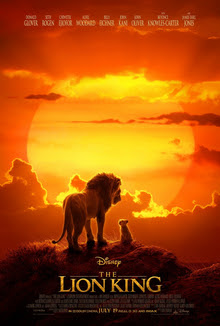
The Lion King (2019)

Most movies would be improved, I think, by imagining that you are watching them with Jeff Goldblum. And as I was watching The Lion King, Jon Favreau’s 2019 remake of the 1994 animated classic, I had the acute feeling that Goldblum’s Dr. Ian Malcolm (from Jurassic Park) was sitting next to me. I could almost hear him say, “Your animators were so preoccupied with whether they could, they didn’t stop to think if they should.”
 
By the time the end credits rolled on The Lion King, I found myself asking the same question I ask of nearly all of Disney’s live-action remakes: “Why?” Why does this film exist? Why was the remake almost identical to the original? And why was I surprised that, yet again, Disney pulled the wool over my eyes in convincing me that I hadn’t already seen this story?
 
From its opening frames, The Lion King is an exercise in déjà vu. The sun rises on an African plain, and the same Zulu opening vocals from Lebo M. ring out. If it’s not precisely shot-for-shot, it’s close enough, as Mufasa (James Earl Jones) and Sarabi (Alfre Woodard) present their son Simba (JD McCrary, then Donald Glover) to the kingdom he will one day rule. All of this has happened before, and the “Circle of Life” might as well be the creative bankruptcy that leads to a rinse-and-repeat mode of content creation.
 
To be fair, that sequence is the very model of ‘iconic’; it was, after all, packaged as a teaser trailer for the 1994 film, and it’s an absolute banger of an opener. Don’t fix what isn’t broken, they say, so I’ll give director Jon Favreau a pass on the first five minutes. When you’re a cover band, you play the hits, no matter how many times you’ve heard “Hey Jude” or “Free Bird” in your life. As the film unfolded, I thought we were heading into fairly interesting territory. This 2019 version begins to deepen the psychological profile for its villain Scar (Chiwetel Ejiofor) and his cackle of hyenas, who rebel against Mufasa for largely different reasons this time around. An explanation for his eponymous scar, and a few line changes to his solo number “Be Prepared,” feel like early forays into giving us a reason to run through the paces once more.
 
Perhaps ironically poignant, the first time that I noticed a major content change was in a sequence that revolves around, of all things, a dung beetle and his bespoke fecal boulder. Every creature in the savannah plays some small part in accidentally delivering to Rafiki (John Kani) a snarl of Simba’s mane, proving to the mandrill shaman that the lion king is still alive. It’s a fascinating rebuttal to Timon (Billy Eichner) and Pumbaa (Seth Rogen), who had just prior rebuked the idea of a “circle of life,” and it’s a slightly more credible way for Rafiki to learn of Simba’s exile. But in the end, it is an extended sequence about ossified manure, perhaps more suited to Planet Earth than a Disney feature.
 
In fact, the whole thing comes off as more of a thought experiment than a movie proper. What if, The Lion King asks, we could remove all abstraction from the original and render it as lifelike as possible so that we become not spectators but voyeurs in the animal kingdom, watching a wildlife documentary? Why include a bird who can smile or roll his eyes when we can give audiences a Zazu (John Oliver) whose physical features are limited by how an actual hornbill can move? Indeed, why make the film in such a way that the only expressions on the characters’ faces are provided by the Kuleshov effect? 
 
The answer, it seems, is behind the scenes. As far back as his Jungle Book, Jon Favreau has been experimenting with what technology can allow him to do, and the making-of featurettes for both movies show Favreau exploring his imaginary world through the use of VR technology. (A similar technical invention allows Favreau to shoot much of The Mandalorian in an immense soundstage called “The Volume,” so perhaps all’s fair in love and Star Wars.) If Favreau’s directorial outings are more about pushing the envelope of special effects, reskinning classic films just to see if he can, then The Lion King is a roaring success. But one can’t even call this a live-action adaptation – it is, rather, just differently animated, an identical remake only slightly less inessential than Gus Van Sant’s Psycho.
 
It’s not that The Lion King is badly made. The effects are good, even to the point that one might assume these were actual animals filmed on genuine African landscapes, and some of the voice casts are decent upgrades; Ejiofor in particular is a more Shakespearean Scar, while Eichner and Rogen are the surprise best-in-show (excluding, naturally, James Earl Jones’s return as Mufasa). Despite being slightly longer than the original, all of it feels overly familiar. “I know, I know,” I found myself thinking, “You’ve told me this one already.” There is a long gap between 1994’s Lion King and the Hamletthat inspired it; the difference between 1994 and 2019’s Lion Kings, however, is merely one of overlaying an Instagram filter.
 

The Lion King
 is rated PG for “sequences of violence and peril, and some thematic elements.” Directed by Jon Favreau. Written by Jeff Nathanson. Starring Donald Glover, Seth Rogen, Chiwetel Ejiofor, Alfre Woodard, Billy Eichner, John Kani, John Oliver, Beyoncé Knowles-Carter, and James Earl Jones.

Monday, July 15, 2013

This Is The End (2013)

You can read it as a scathing critique of self-obsessed celebrity culture, or you can take it as the payoff to a decade-long string of actors playing the same character over and over until they give up and play themselves.  But whichever way you choose to take it, This Is The End proves to be childishly crude, incredibly narcissistic, entirely self-indulgent – and, in the end, more fun than it has any right to be.

Trapped at James Franco’s house when a block party turns apocalyptic, a team of Frat Packers – Seth Rogen, Jay Baruchel, Jonah Hill, Craig Robinson, Danny McBride, and Franco – struggle through the Biblical apocalypse while navigating their own petty differences and personal insecurities.  For example, with a demon at the door, the men argue about where to masturbate and whether anyone is entitled to a fifth of a Milky Way bar.  Satirizing the apoca-porn genre, which fetishizes death and destruction in disturbing ways (thank you, Roland Emmerich), This Is The End takes several surprisingly earnest turns, even while its leads are giggling about drinking urine.

Let’s be honest – taking This Is The End to task for its blatant and unapologetic immaturity is a little like scolding an infant for soiling himself.  Lest we forget, the writers – if indeed we can call “improvisation facilitators” such – were the savants (emphasis on the idiot) behind Superbad, a gleefully enjoyable movie that was quite obviously written by ten-year-olds.  So of course you’re going to get jokes about genitals and more weed gags than you can shake a joint at.  Of course.  And if that’s your thing, this movie has it in spades.

I’m of mixed feelings on this one.  It’s feel-good in the sense that you’ll probably end up laughing, even in spite of yourself if you go in deliberately trying not to have a good time (why you’d do that is anyone’s guess, but such people seem to exist).  Let’s be honest (the refrain of the day, it seems) – the earnest marijuana giggles Rogen delivers like a puttering engine are infectious, especially when it’s apparent that the rest of the cast are having as much fun making the film.  The cast are all fairly engaging as overblown caricatures of themselves (including an incisive turn by Jonah Hill as the “Hollywood fake” nice guy), though the standout performance award goes to Craig Robinson, who sells it to the back row with the same gregarious delight that made Hot Tub Time Machine more of a success.  There’s something about his mumbled confessions and oblivious non-sequiturs that gives him a fantastic screen presence.

But at the same time, I have trouble giving a good review to a film that contains a five-minute rape joke.  While the masturbation location conversation has a certain victimless immaturity to it, This Is The End takes on a very uncomfortable tone when Emma Watson becomes the subject of a hypothetical-rape conversation.  Though it’s played for laughs as a series of escalating misunderstandings, the scene is made all the more distasteful by McBride’s (admittedly) self-aware scummy self-caricature; and as the rape accusation is bounced around among buddies, the film’s brutal rejection of the Bechdel test is thrown into sharp relief.  I’m willing to excuse many of the film’s excesses  (including the bizarre detail that every demon has pronouncedly enormous genitals), but I’m at a loss as to why the film couldn’t have included Kristen Bell or Aubrey Plaza or – for God’s sake! – Melissa McCarthy among the survivors.

Perhaps I’m overthinking it.  There’s a certain ad hoc insanity to which you have to surrender in order to appreciate a film like this one, a go-along-for-the-ride resignation that carries with it a kind of intoxicating bliss while the lead actors bumble their way through arguments about the quotidian aspects of morning-after survival.  While certainly not for everyone, This Is The End has enough entertainment value that most people will find something worth enjoying – be it the catchy enthusiasm, the high stakes action-comedy, or even the exaggeration of excess (note the mild-mannered Michael Cera, rendered here as an oversexed addict).  A martini glass of urine never looked so funny.

This Is The End is rated R for “crude and sexual content throughout, brief graphic nudity, pervasive language, drug use and some violence.”  Every sexual and profane epithet you can imagine gets trotted out to excessive effect; alcohol, marijuana, and cocaine are abused throughout.  We see Cera’s rear end and the aforementioned demonic genitalia (twice), while many celebrities die in quick but intense fashion (played, you guessed it, for laughs).

Monday, May 24, 2010

Observe and Report (2009)

The problem is that it's just not funny.

Observe and Report is perhaps best known as "the other mall cop movie," since it was released in fairly close proximity to Paul Blart: Mall Cop, starring Kevin James. Observe and Report is the considerably darker of the two, with Seth Rogen starring as bipolar head of mall security Ronnie Barnhardt. Ronnie becomes determined to catch a prowling flasher after the pervert exposes himself to Ronnie's sort-of secret crush, make-up counter girl Brandi (Anna Faris). As Ronnie aspires to be a real police officer and apprehend the pervert, he crosses paths several times with Detective Harrison (Ray Liotta), who quickly becomes his nemesis.

I wanted to like this movie - honest, I did. I rented this one with the full intention of watching it with my father; after all, we've seen almost all of Seth Rogen's other movies together, but he scoffed at the idea and declined to watch it with me. He was the wiser of us. Observe and Report leaves a bad taste in your mouth like coffee that's been near a fish. The laughs are tragically sparse, nothing meriting the respect of any expression beyond a soft "hah." Aziz Ansari, rapidly becoming one of my favorites, appears for a small cameo, and he's funny as always, but the rest of the film just doesn't measure up to my comedic standards. The script is flimsy, comprised of equal parts scientific improbability and obvious filler.

Aside from the film being just plain not funny, each and every character is completely and utterly repulsive. Ronnie's not easy to watch, because his bipolar disorder makes his character uneven in an unmanageable kind of way; when he's up, it seems artificial, and when he's down we'd like to believe that's not the real Ronnie. His mother is a drunken mess, and his partner Dennis (Michael Pena) is irritating until we learn he's actually a bad person. Brandi is wholly repugnant, engaging in substance abuse, vomiting, and exploiting Ronnie whenever possible; kudos to Ms. Faris for creating such a wholly detestable character, but jeers to the filmmakers for suggesting that Ronnie's love for her is anything but pathetic. As for Harrison, I just feel immensely sorry that Ray Liotta's career has fallen so far; this is the same guy who was brilliant in Goodfellas?

The overall tone and spirit of the film is epitomized in several entirely unsubtle and brutally grotesque scenes that remind us how pathetic Observe and Report truly is. In one, a sex scene between Ronnie and Brandi blurs the line between consent and date rape. It's obvious the filmmakers are going for a cheap laugh, especially when there's a heavyhanded attempt at making the whole thing innocuous by revealing that Brandi's only asleep, but by then it's too late; any viewer with a modicum of decency has already turned away with a sneer of disgust. Later, when Brandi compliments Ronnie, he lashes out at her, shouting, "If anyone here wants a girl to have sex with you and then to [have sex with] your enemy, go to Brandi! Because she's the girl that does that." Rogen's delivery here gets a quick chuckle, but then we realize just how sad his situation is, and it's just not as funny anymore.

But the moment that sums up everything I hate about this movie is the treatment of Nell, a handicapped food court employee. In one unforgettably atrocious scene, Patton "Spence" Oswalt mercilessly teases Nell because her leg brace prevents her from functioning properly; this moment lasts far too long, it's uncomfortable, and it's a reminder of the mentality that governs the whole film. Nell declares herself a born-again Christian, vowing not to have sex before marriage, but Ronnie labels that "a promise I'm going to make her break." This is the man we're supposed to root for, a man who aims to corrupt the only thing innocent about this whole ugly picture? When the movie's not busy being unfunny, it's mean-spirited and sometimes downright corrupt. If Ronnie Barnhardt is the hero this world needs, stop the planet - I want to get off.
Observe and Report is rated R "for pervasive language, graphic nudity, drug use, sexual content and violence." The language is filled with F-bombs, the flasher is shown several times in fairly explicit detail, prescription pills and alcohol are repeatedly abused, and the film includes some exorbitant shots of gore exaggerated for effect.

Thursday, May 13, 2010

Funny People (2009)

I'm off to a bad start. Out of three movies I've reviewed since my big return for another season of moviegoing, two of them have been complete duds. If it weren't for Robert Downey, Jr., I'd feel like a voice crying out in the wilderness.

But I'm not here to weep over my bad choices. I'm here to help you make good ones. I've sort of already played my hand here, but this weekend I had a chance to catch Funny People, Judd Apatow's latest. In short, despite being punctuated by some clever and classic Apatow moments, Funny People is anything but, overlong in some places and tragically predicatable in others, with a cast that could do - and has done - a heck of a lot better.

If you've seen the trailer for this, you've seen the whole movie and all its highlights. Adam Sandler plays dying comedian George Simmons, who hires newbie funny person Ira Wright (Seth Rogen) and gets a new lease on life when his disease goes into remission. With his second chance, George decides to pursue former flame Laura (an underused Leslie Mann), despite the fact that she's married to Aussie businessman Clark (Eric Bana). Hilarity, you'd expect, ensues.

Unfortunately, it doesn't. While the trailers - as well as the title and the track records of Apatow & Co. - suggest that the movie is a laugh riot, I didn't find my sides splitting. Instead, I found myself staring at the movie in disbelief - disbelief that I'd been so horribly duped, disbelief that the movie wasn't over yet (at two and a half hours, it's not for those with a short attention span), disbelief that so many funny people could be assembled in such a droll production. Perfect example - Aziz Ansari, who appears for a quick cameo role which consists primarily of him delivering his stand-up routine about how absurd Coldstone's size names are (particularly "Gotta Have It"). While Ansari is hilarious on his live album, in Funny People he's just not funny. I don't know why that is, but it's as though the movie is draining itself of humor in order to feed its own spiraling runtime.

I'm not quite sure what went wrong on the way to this movie. Maybe it's casting genuine funnyman Seth Rogen as the second banana to Adam Sandler, who for my money has never actually been funny (granted, I've never seen Happy Gilmore or Billy Madison, but I just can't believe the hype). Maybe it's the fact that Leslie Mann only gets one scene in which she's allowed to be funny; the rest of the time she spends playing a highly cliched "girl who got away but remains conflicted about it all." Maybe it's the fact that the movie could have been ninety minutes without sacrificing any of the story's heart; instead, the film is protracted and brutally long, especially in the decidedly not-funny first hour or so in which Adam Sandler is dying.

Part of the problem is that Funny People is two different movies: the life-and-death drama and the get-the-girl comedy. But where some films might be able to consolidate those two concepts into one distinct package, Funny People is fragmented almost precisely in half, and the fragmentation is so palpable that it's difficult to believe that the George Simmons playing CandyLand with the kids is the same George Simmons who was popping pills earlier and asking Ira to kill him. Nor is it easy to accept Laura's on-again-off-again flip-flop on her husband's philandering; one minute she's peeved that he's cheating, the next minute she doesn't even think about it, and the whole thing never really makes too much sense.

There are some lights in the film. Seth Rogen delivers a few of his trademark one-liner quips, often nonsensical and non sequitur, but it's an art he's mastered, and so bully for him that he can still throw a punch (metaphorically and, in the case of the film's climax, literally). Apatow's children Maude and Iris (last seen in Knocked Up) also appear, little bundles of spontaneous energy that light up whenever they're on screen. But the problem is that the film is so bloated that these shining moments seem like stars in the sky, exceptions to the rule. Sure, the many ways George and Ira lampoon a doctor's thick accent are hysterical, but they're buffered by twenty minutes on either end of just downright unfunny material.

At the core, the film's problem is false marketing. Perhaps, then, this review would have been better if the film had been entitled Marginally Funny People (in many less than funny situations). At least then I wouldn't feel cheated.
Funny People is rated "R for language and crude sexual humor throughout, and some sexuality." If you've seen one movie with any of the cast or crew involved, you know what's coming - F-bombs galore, sexual dialogue up the ying-yang, brief violence played for laughs, and a sex scene with fleeting nudity.

Sunday, May 24, 2009

Pineapple Express (2008)

These are the cats that brought you Superbad, the poster declares, and, with much of the same cast and exactly the same sense of humor, it's not hard to believe. It's also not hard to have a great time with a movie that couldn't take itself less seriously.

I'm an unabashed fan of these Judd Apatow "Frat Pack" comedies (You Don't Mess with the Zohan aside, which I couldn't even finish), but something about the premise brought a skeptical Cinema King to the sofa for the DVD run of this one. Seth Rogen plays Dale Denton, a stoner who witnesses a murder and runs to his dealer, played in top form by James Franco, to hide out. The pair end up fleeing into the woods to avoid Ted Jones (Gary Cole, the father of film's Brady Bunch and Ricky Bobby) and his feuding henchmen (Kevin Corrigan [Cousin Sean from The Departed] and Craig Robinson [Darrell from The Office]). Meanwhile, Dale tries to save his relationship with his high school girlfriend (literally, she's 18), played by Amber Heard, though this subplot fades in and out with only a hilarious appearance by Ed Begley, Jr., as Heard's father, to redeem it.

This is another in a famously uncomplicated line of comedies from Apatow & Co., but it's one of the funniest - perhaps even more so than Superbad, which I loved. Pineapple Express takes everything I loved about Superbad - silly characters, rapid-fire dialogue, and a race to... somewhere (Franco says something along the lines of the splendid line, "I wish we could run away to... nowhere.") - and adds things Superbad didn't have, like the inimtable rising star Danny McBride and plenty of gunfights & explosions. If there's one thing I can never have too much of, it's explosions.

I praised the dialogue earlier, similar praise being offered for Rogen and Evan Goldberg's previous screenplay (Superbad, for those not paying attention), especially because this movie really finds its niche in the kind of dialogue that's becoming popular these days - quick, hysterical, and occasionally mumbling. Rogen and Granco in particular do a masterful job of handling their lines, in which their characters frequently find themselves digging themselves into a verbal hole, often ending their scenes with self-conscious reflections like "That was too far" or "I shouldn't have said that, that was mean." It's also a credit to director David Gordon Green that he knows when to cut the scenes and how best to pace them so the laughs keep coming.

There's not a whole lot more to say about Pineapple Express except that it's a lot of fun. There's no heavy message - except maybe something about the nature of friendship (platonic friendship between males being a central tenet of Apatow flicks) - so it's really about having a good time. The movie won't appeal to everyone, of course; there's bound to be accusations of it being a "stupid" movie or condemnations for its drug culture backdrop. But for those who have enjoyed the Apatow train thus far, Pineapple Express might prove addicting.

The MPAA rated Pineapple Express "R for pervasive language, drug use, sexual references and violence." The violence is exceptionally cartoonish and only occasionally bloody, and the sexual references aren't as explicit as they have been in the past. Drug use, though, is all over the film, as is crass language some might not care for.