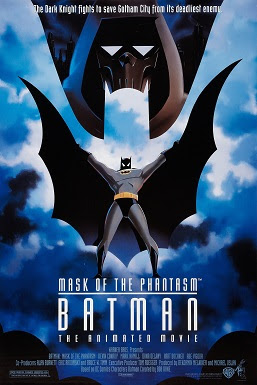
Batman: Mask of the Phantasm is rated PG for “animated violence.” Directed by Eric Radomski and Bruce Timm. Written by Alan Burnett, Paul Dini, Martin Pasko, and Michael Reaves. Based on the DC Comics. Starring Kevin Conroy, Dana Delaney, Hart Bochner, Stacy Keach, Abe Vigoda, Efrem Zimbalist Jr., and Mark Hamill.
Monday, February 27, 2023
Batman: Mask of the Phantasm (1993)
Batman: Mask of the Phantasm is rated PG for “animated violence.” Directed by Eric Radomski and Bruce Timm. Written by Alan Burnett, Paul Dini, Martin Pasko, and Michael Reaves. Based on the DC Comics. Starring Kevin Conroy, Dana Delaney, Hart Bochner, Stacy Keach, Abe Vigoda, Efrem Zimbalist Jr., and Mark Hamill.
Tuesday, October 12, 2021
Monster March II: The Mummy (1999)
If you’re having a sense of déjà vu, don’t be alarmed. We did review the Universal Mummy films back in March, and we even reviewed this remake in 2012. But for an entry on the Personal Canon itself, it deserves more than 270 words. The Mummy is one of my all-time favorite movies. Here’s why.
Thousands of years after the high priest Imhotep (Arnold Vosloo) was condemned to an eternity of suffering, librarian Evelyn Carnahan (Rachel Weisz) and her treasure-seeking brother Jonathan (John Hannah) hire adventurer Rick O’Connell (Brendan Fraser) to lead them to the fabled lost city of Hamunaptra. Beneath the sands of Hamunaptra, though, the mummified Imhotep sleeps, and this band of explorers will soon learn that what awaits them is something other than buried treasure – and infinitely worse than death.
I’ve long made the joke that The Mummy may as well be called Indiana Jones and the Curse of Hamunaptra. With a similar pace, setting, atmosphere, and attitude, The Mummy needs only a few cosmetic tweaks to sneak its way into the Indiana Jones franchise for good. Brendan Fraser is heroically fun as our cocky swashbuckling protagonist, a kind of early “fortune and glory” iteration of the good Dr. Jones. He’s got the self-aware sarcasm down pat, yet he can flip to sincerity with a well-timed smolder. In short, Fraser is the key to the movie allowing us to have fun – he’s very clearly enjoying himself, too. Like Fraser, the movie is a master of its own tone, zany and madcap at one turn, cavalier and daring at the next, without losing any of its own integrity. The movie might poke fun at itself, but it never makes a fool of its audience.
Fraser is the perfect model for what’s going on with The Mummy because the film overall is never boring. If it’s not being funny, it’s ably building tension or hosting a rollicking action sequence, helped in no small part by Jerry Goldsmith’s rousing score. As the old meme goes, Jerry Goldsmith didn’t have to go so hard, but he did that – he did that for all of us. Goldsmith’s orchestral work soars, dabbles in the romantic, and plays around in the Arabesque; it works perfectly in the film, and it’s a darned good listen outside of the cinema, too. Longtime readers of the blog know that a good score is often my favorite thing about a movie, and you can get away with a lot if the music is doing its work right. Goldsmith is trying to do an uncomplicated arrangement a la Old Hollywood, but his use of motifs and swirling patterns mean this score isn’t one to ignore. (And yes, I was listening to the score as I wrote this review. How could you tell?)
Among the rest of the cast, everyone is doing their level best to make this world believable, and they do succeed. Weisz and Hannah are divinely cast as bickering siblings – somewhat broadly caricatured, it’s true, but their devotion to the clichés make these characters feel real. Arnold Vosloo, meanwhile, has a real presence as Imhotep, and though he doesn’t say much he’s expressively sinister in the scenes when he has all his skin; when he’s in ‘monster mode,’ Imhotep is creepy and ghastly to behold, which is all the better when the movie needs that quick jolt of terror that only a decaying corpse can deliver.
Then there’s the smaller supporting roles, a veritable who’s-who of late-90s character actors. Oded Fehr (who, incidentally, played a terrorist on Sleeper Cell while Vosloo played one on 24) is tons of fun as the dead-serious protector of Hamunaptra, while Kevin J. O’Connor is equally a blast in the role of servile weasel Beni, handily a top goon in the annals of monster movies. And don’t sleep on Erick Avari, indisputably the fin-de-siècle king of “Hey, it’s that guy!”, in the thankless role of fez-wearing museum curator Dr. Bey (not to be confused with Fehr’s Ardeth Bay); in mummy movies, there’s always a guy with a fez, and there’s always a shady museum curator, so Avari is the pristine cherry on top of a perfect sundae.
One of the things I’ve always loved about The Mummy isn’t quite apparent in the film itself, though it’s equally impossible to ignore. In 1999, The Mummy comes at the tail end of a decade of period pulp films, which is precisely my favorite flavor of cinematic ice cream. I’m thinking of films like Dick Tracy, The Rocketeer, The Shadow, and The Phantom – all of which I loved as a child and still do as an adult. We can enroll Tim Burton’s 1989 Batman in this pattern, and indeed we might even consider it the progenitor of a host of imitations to follow. At the climax of the decade, The Mummy is arguably the most successful of these period pulps, though I’ll always have an elemental soft spot for The Rocketeer. I’m a sucker for this kind of heightened reality, placed into a distinct historical past, without postmodern cynicism or deliberate genre subversion. Take a story and a time period, and revel in it; that’s what The Mummy does best of all.
The Mummy is rated PG-13 for “pervasive adventure violence and some partial nudity.” Directed by Stephen Sommers. Written by Stephen Sommers, Lloyd Fonvielle, and Kevin Jarre. Starring Brendan Fraser, Rachel Weisz, John Hannah, Arnold Vosloo, Oded Fehr, and Kevin J. O’Connor.
Monday, October 4, 2021
Monster March II: Bram Stoker's Dracula (1992)
Seven months ago, we began Monster March on a Mummy Monday with Boris Karloff’s The Mummy, but the first Universal Classic Monster movie was Tod Browning’s Dracula. And so it seems appropriate to return and begin again for Monster March II (cue the spooky music) with Bram Stoker’s Dracula, nominally more faithful an adaptation, directed by Francis Ford Coppola and starring Gary Oldman as the Count in all his myriad forms.
I say “nominally more faithful,” because from frame one, Coppola’s Dracula veers wildly from the source material by reimagining the legendary vampire as a Byronic antihero, cursed by his dark past and searching for the reincarnation of his lost love in the person of Mina Murray (Winona Ryder). Alas for the Count, Mina is already engaged to solicitor Jonathan Harker (Keanu Reeves), and so Dracula’s journey to England becomes less a real estate game and more an amorous quest that just so happens to involve a little bloodletting.
Plainly put, Oldman acts rings around everyone else in the cast, even the delightfully hammy Anthony Hopkins as Abraham Van Helsing. Oldman plays Dracula in no fewer than four different iterations, and he aces all of them. Bela Lugosi was iconic, but he seems one-note in comparison to Oldman’s more sophisticated portrayal of a vampire who is alternately tortured and torturer, a lusty bedfellow and a carnivorous lover. The image of Oldman never quite supplants Lugosi, however, proof positive of just how primordial the 1931 original remains, yet Oldman’s “Old Dracula” is a close second as he defies the laws of physics, suckles at shaving razors, and commands your attention in a riveting first act.
That opening third of the film, in which Count Dracula holds Harker hostage in his castle, is the best the film ever gets, a note-perfect introduction to an adaptation that never quite lives up to its own beginning. The opening is so compelling, in fact, that you’ll almost forget that Keanu Reeves is madly out of his depth as a young British solicitor, encumbered by the worst British accent since Dick Van Dyke in Mary Poppins (and perhaps even worse, given that his greeting of “Count Dracula” sounds more like “Count Chocula”). So good is Oldman, and so spooky is his castle, that Coppola might well have stopped the film there and turned in the best short film about Dracula.
After Dracula leaves Transylvania, however, the film slows to a crawl in its depiction of Dracula as romantic foil. Oldman is often too psychotic for the work of courtship, and it’s frequently unclear whether Mina is truly falling for Dracula or whether she’s laboring under his hypnosis, his absinthe, or both. Meanwhile, the film spends a great deal of time with Lucy Westenra (Sadie Frost), her three suitors (Richard E. Grant, Cary Elwes, and Billy Campbell), and Van Helsing, such that it feels like Coppola wasn’t quite sure which film he wanted to make – the star-crossed lovers or the paranormal medical mystery. Of the two, the latter is more compelling, but it never bears Coppola’s full attention.
What’s very clear, however, is that Coppola wanted to make one of the most erotic Draculas ever, filling the film with copious nudity and literalized subtext. In doing so, however, much of the tension of the film becomes inert. To borrow an unfortunately apt line from Alfred Hitchcock, the terror is not in the bang but in the anticipation; the sensuousness of Lugosi’s Dracula was all subterranean, where Oldman’s Dracula is, in the biblical sense of the word, openly ravishing. It’s an interesting forerunner to the Twilight films, of all things, with a doomed immortal languishing as an unabashed romantic, but its erotic dimension is so overblown, so baroque, that it becomes fairly ridiculous.
Coppola’s direction, too, is sumptuous and ornate. Often Coppola is attempting to ape the filmic style of Old Hollywood, with dramatic fades and creative camera angles that would make Orson Welles blush with envy. It’s for those reasons, Coppola’s fiendish attention to classical styling, that the film’s exaggerated sexuality and violence end up distracting rather than amplifying. When Dracula licks the shaving razor that nicks Harker’s throat, it’s icky but spontaneous, yet when the vampiric Lucy vomits blood onto Van Helsing’s face, it’s nauseating for all the wrong reasons.
By dubbing the film “Bram Stoker’s” Dracula, there’s an immediate claim to authenticity, an appeal to authority that suggests this is the definitive adaptation of the novel. Hokey reincarnation notwithstanding, Coppola may have succeeded in spite of himself. The film replicates the novel’s obsession with emerging technology, particularly its intersection with the epistolary mode of storytelling, and the script has a keen interest in Stoker’s most likely inspiration, Vlad the Impaler. And Keanu Reeves aside, this Dracula stars as good a cast as any (including the woefully underrated Tom Waits as the sniveling Renfield). Yet Bram Stoker’s Dracula tries so hard to be grown up that it loses some of the power of suggestion. Lugosi could say more with a discreet bow than Oldman says by leaping into bed with his prey.
Put another way, Oldman is no Lugosi, but it’s worth it to watch him try. Gliding across the carpet and whirling a titanic sword, his Dracula is buckets of bloody fun.
Bram Stoker’s Dracula is rated R for “sexuality and horror violence.” Directed by Francis Ford Coppola. Written by James V. Hart. Based on the novel by Bram Stoker. Starring Gary Oldman, Winona Ryder, Anthony Hopkins, Keanu Reeves, Richard E. Grant, Cary Elwes, Billy Campbell, Sadie Frost, and Tom Waits.
Monday, May 31, 2021
Bat-May: Batman & Robin (1997)
Last week, I assumed I was going to pan Batman Forever, but between my childhood nostalgia and a nugget of narrative complexity, I ended up finding things to admire about the film. (I might even go so far as to say it’s underrated when it stays out of its own way.) Now that we come to the end of Bat-May, we find ourselves in the dubious company of Batman & Robin, the film which killed the franchise stone dead for nigh on a decade. I’d argue that director Joel Schumacher’s career never really recovered, though he continued to work steadily.
And it’s also worth saying that, Catwoman (2004) aside, Batman & Robin changed the way that Hollywood treats superhero movies. Kevin Feige has said as much, and it’s certainly true that you don’t get an earnest Marvel Cinematic Universe without X-Men (2000) and Spider-Man (2002) looking at Batman & Robin as the wrong way to do things. It is, they say, always darkest before the dawn, and in this case Batman & Robin is a very dark night indeed, a film that, at best, has nothing to say beyond reveling in the most arch camp imaginable – and, at worst, exists only to sell merchandise.
Gotham City has a new menace – Mr. Freeze (Arnold Schwarzenegger), whose diamond heists have plagued the city while he tries to cure his wife’s terminal illness. Batman (George Clooney) and Robin (Chris O’Donnell) suit up to save Gotham from a deep freeze when the villainous Poison Ivy (Uma Thurman) and Alfred’s young niece Barbara (Alicia Silverstone) come to town, each ready to give the Dynamic Duo their own unique brand of headaches.
It may go without saying at this point – and perhaps it should – but I like movies. I like to enjoy movies. I don’t take a lot of pleasure in deliberately watching bad movies, nor am I often content to dislike a movie. As we saw last week, I’m almost always looking for some redemptive reading of a film, some kernel of potential or some recognition that the film accomplishes its own goals. I try not to judge a film based on how I would or would not have made it. If something in a film doesn’t work, I usually try to figure out why, instead of dismissing the film out of hand. So believe me when I say that I want to like Batman & Robin. It stars my favorite fictional character of all time, and it’s got actors who are really good in other films. The best I can say about Batman & Robin, though, is that it’s really hard to look away. With all the reasons I should enjoy this movie, I kept asking myself what wasn’t working. What did this film do wrong?
The answer, I think, is very simple. Batman & Robin has nothing to say. It combines the camp “crime doesn’t pay” attitude of Batman ’66 with the “look at this, look at that” mentality of a toy commercial. For all its faults, Batman Forever at least had some narrative integrity; it made some degree of sense to include Two-Face in a movie about psychological duality, with The Riddler as a kind of emergent repressed persona. Framing Robin as the redemption of Batman’s self-imposed curse, too, fits into the unified whole of the screenplay. (It’s the delivery that doesn’t work, but we talked about that last week.) Batman & Robin, on the other hand, is a collection of bits that don’t relate to each other at all; there may be a loose thread of family between the addition of Batgirl, Mr. Freeze’s love for his wife, and Poison Ivy’s demi-adoption of Bane – but that so-called theme never rises above the level of “Some people have families.”
Where Batman Forever – and indeed the preceding three Batman films – picked its villains because of their relationship to the central theme of the film, Batman & Robin seems to have chosen its antagonists based on who was unused but popular all the same. For context: Mr. Freeze had recently been reborn, thanks to Batman: The Animated Series; Poison Ivy was too sensuous to be included on Batman ’66; and Bane was a recent addition to the rogues gallery after a top-selling comics storyline in the early 1990s. They have nothing to do with each other, and the film doesn’t even play with the incongruity of a frozen villain teaming up with the embodiment of lush, verdant life. Worse, it neuters the character of Bane, strips him of his intellect and fighting prowess, and reduces himself to a grunting accessory. (Thank heavens for Tom Hardy.)
I will say this about the lead villains, though: clearly Schwarzenegger and Thurman are having a blast in their respective roles. The campy atmosphere of the film gives both performers a license to overact, and they are devouring the scenery without discretion. Schwarzenegger cackles his way through the corniest of one-liners, but the only thing that makes his Mr. Freeze remotely compelling is airlifted from the animated episode “Heart of Ice.” Thurman, meanwhile, turns vamping into a whole new artform; her cartoonish Poison Ivy is equal parts Mae West and Eartha Kitt, a child’s idea of what dangerous sexuality looks like. These two fit right into what is essentially a high-budget episode of Batman ’66, but it is undoubtedly all spectacle, all surface.
Clooney, meanwhile, inherits the mantle of the Bat and has been of two minds about the role. On the one hand, it catapulted him from television’s ER into the role of Hollywood’s top leading man; on the other hand, the film is abysmal, and he’s admittedly not very good in the role. He plays an adequate enough Bruce Wayne, but he’s missing the nuance that Michael Keaton and Val Kilmer brought to the role. Clooney’s Bruce is all genuine, a civic-minded billionaire who’s less playboy and more socialite. (There’s also a very compelling argument to be made for a reading of this Bruce Wayne as gay, which the film probes not at all but which seems inescapable, particularly in the moment when Bruce hems and haws at the notion of marrying a lady.) I’ve long remembered Clooney as a commendable Bruce Wayne, but this time around, I think “passable” is the kindest word for the performance. As Batman, though, he’s nearly no good at all, stiff and unconvincing, with his only standout moments coming in his interactions with Robin.
On the subject of Robin, Chris O’Donnell remains strangely cast, playing the role as emotionally stunted, prone to outbursts of jealousy and impotent fury. One does wonder why this fully grown adult, bristling at his partner’s mentorship, still hangs around the Batcave at all. He has so little to do in the film that he’s barely referred to by name throughout much of the dialogue; by the time his name is spoken aloud for the first time, one almost forgets his name is “Dick,” assuming instead that Bruce has chosen that moment to resort to bratty name-calling. And then we come to Alicia Silverstone, who is so wildly out of her depth with a thankless role in a script that gives her nothing much to do at all. Indeed, one wonders why Batgirl is in this film at all; she arrives on the doorstep of Wayne Manor unbidden, with no real purpose for coming to town, and with no incentive to become a superhero other than the fact that her uncle Alfred has, inexplicably, taken the liberty of designing a molded rubber suit for her to wear.
As Alfred, Michael Gough is commendable, the only one of the cast who’s doing any acting at all. While the rest of the cast is competing to overact past each other, Gough is giving a delightfully restrained performance, deeply affecting and emotionally tender. The film’s decision to afflict poor Alfred with a nebulous medical condition notwithstanding, the genius Gough takes that opportunity to present Alfred as concealing his symptoms from his charges, halfway between the British stiff upper lip and a father’s fear that he will leave his children unable to care for themselves. Throughout the “Batman Quadrilogy,” as it’s come to be called, Gough has been one of the only steady unifying presences, and in this film you truly see why.
But the question of Alfred’s illness raises a larger point about the way the screenplay is put together. Batman & Robin is a series of MacGuffins and Chekhov’s Guns where plot elements only exist in the first half to come up in the second half, yet when these things resurface it’s without any logic or purpose. Bruce Wayne’s colossal telescope is only in the film to be used by Mr. Freeze in the climax (where it behaves like a telescope doesn’t); likewise, Alfred’s diagnosis with “MacGregor’s Syndrome” is only included so that he can get better. In the same vein, Barbara is introduced only so that she can become Batgirl – but why? There’s no narrative or thematic purpose for Batgirl in this story, and the only conclusion I can draw is that she’s been included to sell toys. And I can say that because I bought the action figure. I bought a lot of the action figures from this film.
Maybe there’s beauty in that, creating a superhero narrative to give children more fodder for their imaginative (and actual) toyboxes. But Batman & Robin is not a children’s movie in the way that, say, The Phantom Menace – a similarly “toyetic” film – was. There’s no place for children in this innuendo-laden film (I don’t even think there is a child in the film!). It’s more than just a cartoon come to life; Batman & Robin may as well be a children’s playground reenactment of a cartoon. You may see some redemptive beauty in that idea, but to me it seems sad to think that this film and these characters were cobbled together carelessly, with concern only for how these likenesses could be merchandised. It’s a sad fact of the comic book industry writ large, that unique site where art meets commerce, but after having seen some of the best films starring Batman, this one feels soulless.
In that sense, that cold and emotionless cynicism of chasing valuables, perhaps Mr. Freeze is the perfect villain after all.
Batman & Robin is rated PG-13 for “strong stylized action and some innuendos.” Directed by Joel Schumacher. Written by Akiva Goldsman. Based on the DC Comics. Starring Arnold Schwarzenegger, George Clooney, Chris O’Donnell, Uma Thurman, Alicia Silverstone, and Michael Gough.
Monday, May 24, 2021
Bat-May: Batman Forever (1995)
In an interesting way, Batman Forever was foundational for me. It was the first Batman film I had seen in theaters and, in 1995, must have been among the first films I saw in theaters. (I was bitten in 1994 with The Lion King.) I had the poster on my wall, the action figures in my toybox, and the comic book adaptation in my collection. I lived and breathed it. It was the greatest thing I’d ever seen in my life.
Time’s gone on, and it hasn’t been kind to Joel Schumacher, who picked up the directorial reins from Tim Burton and put his own avant-garde camp stamp on the franchise. For many years, fans used Schumacher as a punching bag to defend their own aggressively macho, insistently grown-up takes on Batman. Whatever Batman is, the argument went (and I admit I was in that crowd for many years), Batman Forever wasn’t it. Now that I’m older and wiser, I know that Batman can be everything at once – the genius of the character is that he is at once immutable and simultaneously infinitely adaptable. He fits into any genre, and still he persists. And I’m pleased to see that the fans are coming around to this perspective with Batman Forever, which has undergone a kind of cult reclamation such that cries of “Release the Snyder Cut” have, now fulfilled, been followed by “Release the Schumacher Cut,” which promises a longer and darker version of Forever.
Only I don’t know that it’s necessary. Don’t get me wrong, I’ll happily watch a three-hour Batman Forever, but I’m not convinced that it’s what Schumacher wanted. My sense of Batman Forever is that Schumacher intended to update the Batman ’66 format with an inflection of the Tim Burton aesthetic, and on that count – even if I don’t love it – I have to admit he made exactly the movie he set out to make. It’s silly, it’s daft, and it’s over-the-top, but it’s also got an undercurrent of psychological complexity that gets lost in the static of Schumacher bashing.
Val Kilmer dons the cape and cowl as a Bruce Wayne haunted by the death of his parents and what he sees as a disturbing reprise when acrobat Dick Grayson (Chris O’Donnell) is orphaned by Two-Face (Tommy Lee Jones). While Bruce attempts to dissuade his newfound ward from vengeance, Batman is facing a new adversary in the form of The Riddler (Jim Carrey), secretly a disgruntled employee of WayneTech who has developed a mind-control device.
Batman Forever begins, rather unfortunately, with a joke that falls very flat. Alfred (the stalwart Michael Gough) offers Batman dinner before his nightly vigil; after a strangely long pause, Batman says, in a reedy squawk, “I’ll get drive-thru.” It’s perhaps an effective table setting – we’re in for a Batman that’s cornier and more prone to one-liners, even if they don’t always work – but I suppose it’s also an indicator of how much worse the film could have been if every scene had this tone, if nothing was taken seriously. It’s also an unfortunate opener because it sells Val Kilmer short; neither the voice nor the mannerisms are quite right in this first scene, but Kilmer gets it right almost immediately thereafter. His Bruce Wayne is psychologically broken, emotionally dead, but he embodies a key interpretative theory of the character – that Bruce Wayne cannot be both happy and Batman. Instead, Kilmer finds a cold middle ground, which might read as disaffected – but isn’t that what the Bruce Wayne persona should be? Isn’t Bruce an airheaded satire on the notion of a billionaire playboy?
The only times we start to see the real Bruce Wayne – the damaged orphan boy, stunted by his parents’ murder – is in his scenes with psychologist and lover Dr. Chase Meridian, which is honestly one of the all-time great fictional names ever. Now raise your hand if you’d forgotten that Nicole Kidman was in a Batman film. (I myself forget every so often.) Her performance vamps a little bit – nowhere near what Uma Thurman would do in Batman & Robin two years later – but Kidman is pretty effective as a Jungian femme fatale. Though the film is a bit condescending with her inability to decide whether she loves Batman or Bruce Wayne, this motif of duality plays into the film’s larger investment in Bruce Wayne’s fractured psyche. Michael Keaton’s Batman recognized the disconnect between his own romantic fulfillment and his vow to avenge his parents; Chase Meridian helps Bruce to draw out the fact that he is utterly incapable of functioning as a human being while fighting crime as Batman.
Indeed, Bruce Wayne is fundamentally unable to connect with his new ward, Dick Grayson, until he unites his own twin personas, ultimately accepting the young lad as his crimefighting partner, Robin. I have no idea how old this incarnation of Dick Grayson is supposed to be; he must be under 18, for Bruce to take him in as a foster father, but Chris O’Donnell plays him like a brash mid-20s, and there’s something in that performance that doesn’t quite work. He’s hot-headed like the second comics Robin, Jason Todd, and his Dick Grayson has a dated youthful edge that perhaps hasn’t aged well. (The contemporaneous animated series took a similar tack with Robin, but it seemed to work better there.) It might be the weakest performance in the film, because it’s not quite dialed into what this film needs of a Robin; his mood swings and impetuous plans to murder Two-Face never really connect with the audience.
Then we come to the villains. I have long maintained that the fundamental problem with Batman Forever is that both Tommy Lee Jones and Jim Carrey are playing their characters as though they were Jack Nicholson’s Joker. I stand by this claim, because it certainly explains what keeps these performances from being truly faithful to the comics, but there are some nuances to draw out. It’s been widely reported that Jones and Carrey didn’t get along during filming, especially because Jones reportedly hated Carrey, telling him at one point, “I cannot sanction your buffoonery.” (True or not, has there been a more Tommy Lee Jones sentence than that?) Though to that point, I would have to ask Jones what he made of his own performance, because it is prancing buffoonery at its finest – again, precisely what the film needs of him, but it is a far cry from the more grounded Harvey Dent given us by Aaron Eckhart in The Dark Knight. But the cleverness of joining Bruce Wayne’s bifurcated psyche to a plot involving Two-Face is genius, and one wishes the screenplay had borne that out a little more directly. One also wishes that Jones had played his Two-Face a little more seriously; unlike Kilmer, whose first scene is a dud, Jones’s first scene is note-perfect as he monologues to a hostage bank guard about the universal fairness of luck.
As for Jim Carrey’s Riddler, it is a Jim Carrey performance from the mid-90s, largely indistinguishable from the rest (costuming aside). It’s that same manic oscillation, bounding and mugging. There’s a hearty helping of Nicholson in there somewhere, but the performance is perhaps more properly an amalgam of Frank Gorshin and Max Headroom – which may indeed be the Rosetta Stone for Carrey’s whole career. Carrey’s Riddler is overdone, his riddles aren’t great, but at least his chemistry with Two-Face is commendable, particularly if the off-set animosity was as feverish as it seems. His Riddler is gleefully vain, too, applied more to his appearance than to his genius, and there’s something in his envy of Bruce Wayne that gets echoed in Sam Rockwell’s begrudging RDJ-worship in Iron Man 2. These days, though, I’m particularly intrigued to see what Paul Dano brings to the role in The Batman, with his Zodiac-killer take wildly distinct from the gleeful tricksters we’ve seen thus far.
Batman Forever is filled with performances and setpieces that are watchable for their spectacle, and I practically inhaled a bowl of popcorn during the film’s bombastic first act. It’s an energy that never really lets up, but the script is full of things that happen only because the movie needs them to happen. Two-Face has no master plan, striving only to kill Batman in a disconnected string of death traps (more shades of Batman ’66), while the Riddler’s mind-control plot is both too outlandish and much too easy to foil. One can easily see why a seven-year-old Cinema King would have been enamored of this cartoon come to life, but there is a kernel of something greater in here that keeps the adult coming back – occasionally against my better judgment, but compelled all the same. There is something very savvy about Batman Forever, and one wishes the film had leaned harder into that aspect of the story rather than the neon pop-art comic book come to life (which was, after all, what Schumacher intended). Perhaps there ought to be a Schumacher Cut, after all.
Batman Forever is rated PG-13 for “strong stylized action.” Directed by Joel Schumacher. Written by Lee Batchler, Janet Scott Batchler, and Akiva Goldsman. Based on the DC Comics. Starring Val Kilmer, Tommy Lee Jones, Jim Carrey, Nicole Kidman, and Chris O’Donnell.
Monday, May 17, 2021
Bat-May: Batman Returns (1992)
I was four years old at the time, but I remember Batman Returns feeling like the most important movie ever made. I had an oversized “making of” book that I read practically to shreds. I studied the biography of Tim Burton, pored over the photographs and teasers for the plot. I could even name for you the producer of the film (Denise Di Novi, a wonderfully Gotham-esque name). I had the toys, the fast food cups. And yet, I have no memory of when I first saw the movie itself. In a way, that’s the best metaphor for a review of Batman Returns – chock-full of unforgettable bits and bobs and yet so unwaveringly strange that the whole gets lost amid the mad sum of its ludic parts.
Batman Returns is the story of three freaks – The Bat (Michael Keaton), The Cat (Michelle Pfeiffer), and The Penguin (Danny DeVito). After the events of the first film, Batman spends his nights waiting for action, silently anticipating the call to fight crime. Amid an invasion of circus clowns, The Penguin arrives from the sewers, pleading with Gotham for an opportunity to learn the truth about why his parents abandoned him. Meanwhile, exhausted secretary Selina Kyle is defenestrated and murdered by her boss (Christopher Walken), only to be reincarnated with nine lives, a feline fixation, and a Shakespearean desire for revenge.
Just like I can’t say when I first saw Batman Returns, I can’t remember how many times I’ve seen it, but on this latest viewing I was largely unprepared for just how weird this movie gets. I have always maintained that the difference between Burton’s two Batman movies is that Batman is a Batman movie directed by Tim Burton, while Batman Returns is a Tim Burton movie (co‑)starring Batman. The difference is so apparent in this one; the Gotham sets are freakishly Burton, all odd angles and grim shadows, and Returns doubles-down on its predecessor’s premise that freaks beget freaks, with a brooding meditation on how these freaks find their place in a hostile society (they retreat, or they rebel).
In short, Batman Returns is so idiosyncratically Burton that it is impossible to imagine a major franchise film – a sequel, no less – surrendering so entirely to its auteur’s vision that the titular hero ends up being subsumed by the villains. (Today, the claim is usually the reverse, that the villains are largely indistinguishable when the movies are governed by the large personalities of franchise heroes. Can you name, for example, the three villains of the Iron Man franchise?) Indeed, Burton is much more fascinated by the monstrous Penguin and the sideways-feminist Catwoman (“I am Catwoman – hear me roar”), with Batman relegated to a largely supporting role in a film that is nominally his. Keaton’s Bruce Wayne is heroic mainly in that he has sublimated his freakish impulses and wears a mask of normalcy, which Penguin is unable to do while Catwoman is entirely unwilling. In a standout sequence, Bruce and Selina attend a masked ball sans disguise, underscoring that their civilian identities are the costumes. (It’s an image that has been appropriated forever since, with a notable reprise in The Dark Knight Rises.) Penguin, meanwhile, crashes the party, as DeVito crashes the film itself, all shouts and gurgles, bile and bodysuits.
It's clear, however, that Burton’s sympathies lie with the villains. The film begins with the birth of Oswald Cobblepot, ultimately cast into a river for his monstrous appearance; despite the fact that the infant Oswald is clearly dangerous, murdering and devouring the family cat, Burton manages to find pathos in this act of attempted filicide. Likewise, at film’s end, Burton stages Penguin’s final scene as high tragedy, with oversized penguins waddling in what appears to be an impromptu funeral procession. In much the same vein that Batman (1989) belonged to Jack Nicholson’s Joker, Batman Returns is paced as if it’s Selina Kyle’s film. Selina gets a full origin story and ends up in a sort of inverted will-they-won’t-they, akin to Bruce’s arc with Vicki Vale (Kim Basinger) from Batman. Again, Burton feels more sympathy for Selina than he does for the curiously submissive Batman, evidenced by an elegiac sequence where Selina relives the trauma of her murder and proceeds to dismantle her entire apartment in a fugue of rage.
Putting it into plain English makes the film sound entirely normal, but I can’t undersell how bonkers this movie gets by adding a number of elements together. And these are all things that happen in the same movie: There’s an extended subplot about Penguin’s borderline-Trumpean bid for mayor, buoyed by Christopher Walken’s industrialist Max Shreck, who wants mayoral regime change to greenlight his construction of a power plant that will instead drain power from Gotham. (Shreck’s son, meanwhile, is played by Andrew Bryniarski, doing a transparently meatheaded Walken impression.) Circus clowns invade the edges of the frame, with Danny Elfman’s score veering carnivalesque at each turn. The whole thing is set at Christmas, casting a Burtonesque pall of sarcastic cheer over the affair. There are actual marching penguins, wearing rocket launchers, plotting to murder the children of Gotham. As delightfully strange as the movie is, one has the acutely nagging question during the whole film, “Warner Brothers was okay with this?!” (Spoilers for next week – they weren’t.)
I mentioned Danny Elfman, and he’s one of the main reasons this film succeeds. A good score can buoy any film, and while his Batman Returns score isn’t as bombastic or iconic as his work on Batman, it works really well by being dialed into exactly the movie Tim Burton wants to make. It’s traditionally superheroic when it needs to be (in those rare moments that Batman is doing hero work), but more often than not it’s playing in a strange realm of uncomfortable tragedy. His descending Penguin theme grows more and more militaristic, balanced as it is by the aforementioned carnival music. His Catwoman theme, on the other hand, plays like a tragic music box, swirling like his Edward Scissorhands work while highlighting the tragedy of Selina’s fall from innocence and her attempts to claw her way back toward peace.
Batman Returns is a film of beauty and of pain, in distinctly Burton ratios, but it is also a film almost as broadly painted as Batman ’66. Walken plays Max Shreck like a boogeyman, right down to the electrified hairdo, while DeVito’s Penguin is a thing of perverse revolting fascination, gruesome and grotesque in equal measure. Burbling black-green bile and groping every woman he finds, it is nearly impossible to find the tragic sympathy Burton feels for this grunting, snarling antagonist, who is handily the most revolting Batman foe ever committed to film. And yet, there is something expertly calibrated about Burton’s Gotham; as exquisitely eccentric as Burton’s vision may be, his Gotham seems very much of a piece with the comic book depiction. Gotham is a city of unending crime and corruption, of perpetual peril. Despite the mayor’s objections, a marauding gang of killer clowns seems to go hand-in-hand with Gotham City as a whole, particularly given the intimation that the clowns constitute a kind of haunting courtesy of Nicholson’s Joker. It’s almost a chicken-and-egg situation, where it’s unclear whether the comics birthed Burton or if Burton’s shadow warped the comics in his wake. (I’ll go out on a limb and venture the latter, though it’s equally Frank Miller’s fault.)
When I drew up the Personal Canon in 2016, there was no question that Batman belonged on it. That movie was nigh elemental in my love of superhero narratives. But Batman Returns was always the weird younger brother, the one who went away to art school and came back a changed man. I was never all the way comfortable with it, but neither could I relinquish it entirely. It’s always had a weird pull, especially as distinct from the twin day-glo Schumacher films; it was, before Christopher Nolan, what Batman movies ought to be.
Batman Returns is rated PG-13 for “brooding, dark violence.” Directed by Tim Burton. Written by Daniel Waters and Sam Hamm. Based on the DC Comics. Starring Michael Keaton, Danny DeVito, Michelle Pfeiffer, and Christopher Walken.
Monday, April 4, 2016
The Top 10 Prequel Trilogy Musical Moments
In light of that, I’m mixing it all up together, and we’re taking the work of three films as one distinct corpus. We present, then, “The Top 10 Prequel Trilogy Musical Moments” in our ongoing tribute to the maestro himself, John Williams.
A note on sources: we’re talking, of course, about the music composed by John Williams and performed by the London Symphony Orchestra. For source/cue division, I’m relying on the original soundtrack releases only, setting aside the “Ultimate Edition” Phantom Menace release, as it’s more of a straight film edit than an orchestral suite arrangement (put another way, it’s the same stuff, repackaged differently).
10. “The Immolation Scene”
Regardless of your feelings about the Prequel Trilogy, whether or not it did justice to the story of Anakin Skywalker, the music of John Williams deftly carries that saga to the point where, as ever, you could mute the dialogue and it still works. Case in point – the moment when the dismembered Anakin slides into the volcanoes of Mustafar. Obi-Wan Kenobi (Ewan McGregor) wails plaintively over the fate of his apprentice, but it’s Williams’s elegiac score that strikes the mood.
9. “Main Title/The Revenge of the Sith”
The prequel trilogy has two very understated opening sequences, but Revenge of the Sith pulls out the stops for a CGI-laden space battle, replete with an action-packed track from Williams. Beginning with warlike taiko drums, Williams holds back after the opening fanfare until dropping us into the aerial combat. Weaving in General Grievous’s theme with the familiar Force theme, Williams accounts for the combatants while compelling us to feel for the characters.
7. TIE: “Panaka and the Queen’s Protectors”
7. TIE: “The Droid Invasion/The Droid Battle”
This one’s a tie because they’re two distinct cuts on the score for The Phantom Menace, but they represent two different sides of the Battle of Naboo – on one hand, the noble palace guard and their struggle to retake the throne room, and on the other, the emotionless droid army marching toward the battlefield. Williams stakes out equally compelling motifs to represent these forces, weaving them together with a theme especially for the Naboo Starfighters and with an orchestral take of “Duel of the Fates” to create an epic soundscape for the sweeping battle sequences. (There’s even a nod to “The Imperial March” in there – a special No-Prize to those who hear it!)
6. “Anakin’s Betrayal”
Anakin’s fall to the dark side ought to feel like a real punch in the gut, and Williams delivers the musical equivalent of said shot to the belly. The choral sounds on this track feel very much like a spectator falling to his knees, weeping at the doom of the Republic as the Jedi perish in Order 66. More effective than the on-the-nose funereal march Williams devised for the prequels, “Anakin’s Betrayal” feels properly solemn.
5. “The Chase Through Coruscant”
I love a good action cue more than just about anything in the realm of Star Wars music (well, maybe not as much as a power-packed motif like “The Imperial March”), and this ten minute cue from Attack of the Clones is perfect for those late-night study binges, tense drives through traffic, or just a run-of-the-mill diversion from boredom. The frenetic pace of Williams’s drums here, coupled with an electric guitar (cut from the film) also popped up in the Quidditch scene in Harry Potter and the Chamber of Secrets – hey, if it works, it works.
4. “Love Pledge/The Arena”
After moving through the love theme from Attack of the Clones (about which, more in a bit), Williams turns in a musical piece that was butchered in the film edits but survives in majestically sinister form on the soundtrack album as a martial march fit for the Separatist forces and the great beasts to which they attempt to feed our protagonists. It echoes “The Droid Invasion” ever so slightly, but it becomes its own piece such that I wish we’d heard more of it. When I think Attack of the Clones, this is almost always the second thing I think of.
3. “Battle of the Heroes”
It all had to come to this, the clash of two titans turning against each other, with only the fate of the galaxy hanging in the balance. Even when Williams isn’t weaving in bits of “The Imperial March” or consciously echoing “Duel of the Fates,” “Battle of the Heroes” comes to a place of horrorstruck necessity, with no less respect for the grandeur of the battle. One wonders if there’s an edit of the Obi-Wan/Vader duel from A New Hope with this cut in.
2. “Across the Stars”
At the risk of this Top 10 turning into a Prequel Trilogy apologia – say what you want about the chemistry between Hayden Christensen and Natalie Portman, “Across the Stars” is a love theme that makes you believe in this relationship (even against all visual evidence). It’s a piece so beautiful it hurts, belonging more properly to the great screen romances like Gone With the Wind than to Attack of the Clones.
1. “Duel of the Fates”
This can’t be a surprise to anyone, but here’s a piece of music that really became synonymous with Star Wars in a way that only the “Main Title” and “The Imperial March” had done before – it’s overall Top Three material, for sure. “Duel of the Fates” is astonishingly and instantly epic, dethroning “O Fortuna” for sure and governing the whole Prequel Trilogy with a sense of cosmic import married to cinematic spectacle. It’s among Williams’s best work, instantly recognizable from Note One, and it carried us back to a galaxy far, far away even before we bought our tickets.
Hit the comments section to tell me your favorite Prequel Trilogy musical moment! And be sure to subscribe up above to make sure you don’t miss future reviews or my “Top 10 Force Awakens Musical Moments”!
Heads up, True Believers – we’ll continue to Make Yours Marvel this Wednesday with another installment in “The Grand Marvel Rewatch,” so check back then for 2014’s Captain America: The Winter Soldier. Or subscribe above, and receive those missives right in your inbox. Nuff said!
Thursday, August 7, 2014
The World Is Not Enough (1999)
For those who play the role long enough, there’s a Rule of
Three for Bond actors, suggesting that the performer’s third outing is his
best. Sean Connery’s got a perfect film
in Goldfinger, Roger Moore has The Spy Who Loved Me, and Daniel Craig
has the knockout Skyfall. We’re at Pierce Brosnan’s third with The World Is Not Enough, which turns out
to be the exception to the Rule of Three.
It is far and away Brosnan’s most boring outing with only a few
redeeming features.After the murder of a leading industrialist, James Bond (Brosnan) assigns himself to protect the dead man’s daughter, Elektra King (Sophie Marceau), while she moves to continue her father’s work on an oil pipeline. Bond and M (Judi Dench) suspect that the terrorist Renard (Robert Carlyle), who had kidnapped Elektra years ago, is behind the new wave of attempts on her life. Denise Richards appears in a soulless performance as nuclear physicist (ha!) Christmas Jones, whose skills include wearing tight clothing and wearing wet clothing. (The less said about her, the better.)
In a franchise full of diabolical villains, gorgeous women, and legendary action sequences, the worst thing a Bond film can be is boring. But for the most part, The World Is Not Enough is exactly that – horrifically dull. It’s not quite as dull as, say, Octopussy; TWINE does contain what is, for my money, the best opening sequence in the entire film series, in which Bond dodges a sniper before giving pursuit in a half-finished Q-boat through the Thames. It’s a great action sequence with a fantastic score by David Arnold.
It is, however, the only great action sequence in the film. Judging on this movie alone, Michael Apted is not an especially gifted director of on-screen action. Aside from the linearity of the boat chase opener, Apted’s action scenes are muddled by angles akimbo and editing which makes it difficult to tell from which direction the baddies are coming. In one scene, aerial and ground troops attack a dockside caviar factory, and it’s downright dizzying trying to keep track of who’s firing on whom; the shots are arranged in no particular order and defy Eisenstein’s idea of the montage to the point where the viewer simply gives up on trying to make sense of the collision of images.
The film’s other action sequences are a bore – a sinking submarine, a ski chase that comes nowhere near The Spy Who Loved Me’s opener, and a subterranean tunnel shootout – and the rest of the film isn’t much better. There’s a lot of talking about the plot and where it’s going, but there’s little in the way of development until the third act.
It becomes impossible to talk about the film without spoiling the big twist, so step down to the next paragraph if you prefer to remain unspoiled. For those that are still here, I’m speaking, of course, of the reveal that Elektra King – ostensibly the Bond girl – has been conspiring with her former kidnapper to take over her father’s empire. It’s actually a rather clever turn in the plot, and it takes the franchise somewhere it’s never really been; we’ve had evil women like Rosa Klebb and even most recently Xenia Onatopp, but the reveal that the Bond girl is also the Bond villain is quite smart. As Elektra, Marceau is a very strong performer, and I wonder why her international career seems to have fizzled out. In a better Bond film, Elektra might have been a top character, because Marceau handles the turn from performative victim to snarling villainess with ease. As it stands, though, she’s a bit of a diamond in the rough here in the sense that the film insists on focusing on the thuggish Renard, whose fascinating character conceit – that he is a dying man who literally feels no pain – is fumbled and never given the life that a comparable character like Jaws had.
So between that and the memorable opening sequence, The World Is Not Enough simply lives up to its title – what we have in the film is not enough to be a winner. Usually in moments like this, especially in reviewing the Bond films, I find that the good often outstrips the bad, as was the case with Tomorrow Never Dies. But here there’s just not enough of redeeming value beyond a great set-piece and a great idea. After a brilliant debut in Goldeneye, I do hope that Brosnan goes out with a bang in his next and final entry, but – spoiler alert – I’ve seen it before, and as I recall he doesn’t.
The World Is Not Enough is rated PG-13 for “intense sequences of action violence, some sexuality and innuendo.” Bond beds three women, one of whom wears only a strategically-placed bedsheet in two scenes. There’s a series of sexual innuendoes, including a particularly graphic one punning on the frequency of Christmas, and as far as action violence is concerned it’s a lot of shooting and exploding but with little to no blood visible.
James Bond and The Cinema King will return in a review of Die Another Day (2002) on September 7, 2014!
Monday, July 7, 2014
Tomorrow Never Dies (1997)
The obvious pun in any review of Tomorrow Never Dies would be, “Well, gosh, why won’t it just
die?” And for a decades-old franchise
that’s up to eighteen official entries, that might seem appropriate. Tomorrow
Never Dies is not a terminally ill film, though it does suffer from a very
bad case of head-scratching villainy and a distinct identity crisis.After a troubling crisis between British and Chinese military forces in the Pacific, M (Judi Dench) dispatches James Bond (Pierce Brosnan) to investigate media baron Elliot Carver (Jonathan Pryce), who published key details in his newspaper before they’d been made official. Suspecting Carver’s involvement, Bond reunites with his former flame, Carver’s wife Paris (Teri Hatcher) before teaming up with Chinese spy Wai Lin (Michelle Yeoh) to stop Carver’s plot from triggering World War III.
As Brosnan’s second outing as James Bond, there’s much about Tomorrow Never Dies that does work quite well, and it’s largely due to the persona the franchise had previously assumed in Goldeneye. It’s serious, but not lethally so; it’s fun, but not in the quantities we’d come to expect from the slapsticky Roger Moore vehicles. Brosnan is still a more than capable Bond, equally at home in intense action sequences and in moments of levity, including my personal favorite “banter with Q” sequence. And I very much appreciate the way Brosnan gives Bond a sense of backstory, without resorting to the heavy-handed “mention his late wife” trope the series usually employs.
The bigger problem with the film is that its central antagonist is a megalomaniac of the highest order whose plot centers on his willingness to endanger the entire world for media ratings. It’s a viciously shortsighted plot, a scorched-earth approach that could truly eradicate the audience he’s conspiring to acquire. Now there’s a bit of cleanup at the very end of the film to imply that it’s all smoke and mirrors, a “wag the dog” conspiracy, but for the most part Elliot Carver is a brutally cartoonish villain in the midst of an otherwise quite serious spy film. Worse, the absurd scope of his plot makes everyone else look like loons for taking it seriously. I’m not sure if it’s Pryce’s fault for overplaying the part or scripter Bruce Feirstein’s for undercooking the role, but it comes off like a less well-thought-out version of The Spy Who Loved Me (which also featured a submarine-eating aquatic headquarters out to spark global conflict).
The other thing about Tomorrow Never Dies – and this may be the thing that gets my goat the most whenever a film gets it wrong – is that it feels like two very distinct pieces. At first, there’s a corporate espionage plot with war in the backdrop, but then the film shifts quite quickly into international conspiracy and terrorism. Both of these could make very compelling Bond films, but they’re stitched together somewhat haphazardly, even marked by the fact that Bond has to change continents for no reason than just to get to the next act. Once each of these halves is underway, it’s truly compelling stuff, but the seam in the middle is all too visible.
I think Tomorrow Never Dies had been my first Bond film as a child, and I came to it ready to recapture those rose-colored morsels of nostalgia, but I think I realize I was a somewhat uncritical child. There is, to be sure, a number of very nice pieces in the film. There’s a fantastic update on the “sinister henchman” Bond trope in the form of Vincent Schiavelli’s Dr. Kaufman, a torturer and forensics expert, and I don’t even mind that he only gets the one set piece. It’s moments like that, and like the Lois & Clark-esque banter Teri Hatcher gets with Bond, her former lover, that suggest a much more compelling Bond film than is actually present. Heck, even the remote-controlled BMW, as outlandish as the premise sounds, is played with such fervent earnest that it works far better than it ought to. And let's give composer David Arnold a good heap of credit; his score is essentially a modern John Barry, in that he integrates the classic Bond theme with the film's main themes to give us some truly rousing music that works just as well outside the context of the film.
Having said that, if we’re willing to swallow the BMW, how outlandish must the villain’s plot be if it’s too implausible for this film? Taken in macro, Tomorrow Never Dies just doesn’t work, but on a micro scale there’s enough enjoyable material to make this better than at least half of the Bond films I’ve already reviewed.
Tomorrow Never Dies is rated PG-13 for “intense sequences of action violence, sexuality and innuendo.” As per usual, there is a lot of shooting, exploding, and fisticuffs. There’s not a lot of blood, but some of the violence is disquieting in the sense that it’s all very close and visible. As usual, Bond beds several women, though we never see anything other than bare backs; as for the innuendo, TND is one of the racier screenplays chock full of groan-worthy puns.
James Bond and The Cinema King will return in a review of The World Is Not Enough (1999) on August 7, 2014!