Showing posts with label musical. Show all posts

Monday, March 20, 2017

Batman: The Brave and the Bold - "Mayhem of the Music Meister!"

“And now my friends you have the chance / To show Batman how well you dance!”

The Music Meister (Neil Patrick Harris) “sings the song that the world wants to hear,” but when he does, anyone who listens falls under his “hypnotic trance” – a musical mind-control that compels all who hear it to sing, dance, and prance along to his criminal schemes. Can Batman (Diedrich Bader) stop this concerto of crime, or will he fall victim to the melodic maladies of the Music Meister? And will Black Canary (Grey DeLisle) prove herself sidekick – or lover?

While we’ve been looking week by week at Batman: The Animated Series, “Mayhem of the Music Meister!” represents something completely different from Batman: The Brave and the Bold. Focused less on neo-noir in the shadows of Gotham, The Brave and the Bold instead turns a loving eye toward the Silver Age of the DC Universe, with creative off-beat villains whose defeat can only be accomplished when Batman teams up with a different hero each episode, be it Aquaman, Red Tornado, the Doom Patrol, or OMAC. Tonally, it’s much closer to Batman ’66 than Batman (1989), but for true believers like myself, there’s much to love about this playful take that’s more “Caped Crusader” than “Dark Knight.”

“Mayhem” is unique also for being a musical episode, which seems pretty far beyond the pale for a character like Batman. (Tellingly, Batman never sings, save for a warbling vocalization at the episode’s climax.) But this episode is definitively one of the best of The Brave and the Bold’s 65-episode run because of how enthusiastically it embraces its quirkiness and develops an unforgettable new nemesis for Batman – The Music Meister, brought to maniacal life by Neil Patrick Harris. The songs are catchy, populated by more clever couplets than any Bat-shark repellent could rebuff, but Harris is so into the character that his dulcet tones and power chords come to wicked gleeful life with one of the best supervillain laughs of all time. (Hat-tip to NPH’s other villainous musical, Dr. Horrible’s Sing-Along Blog.)

On the surface, a villain whose power is essentially song-and-dance compulsion sounds quite bizarre, and it’s certainly the kind of thing that’s difficult to accomplish in a comic book – hence why Music Meister debuted here, even though he feels like he’d have fit right in on Batman ’66. “Mayhem” and indeed the show at large are hyper-conscious of the significance of legacy to the character of Batman, and so Music Meister unveils a number of costumes over the course of the episode – a Music Man outfit, a Liberace-esque number, a 90s-style exxxtreme suit punctuated by pouches and giant speakers, and the classical music-note suit that’s become his trademark in his short stint with fans. Even the episode’s songs gesture toward the long shadow of the bat; Green Arrow croons of his envy of Batman’s popularity as “top cat,” while Music Meister gets a ballad of frustration with the inmates at Arkham because Batman “really drives us bats.”

And against all odds, the episode also manages to include a romantic subplot that does more justice to the Green Arrow/Black Canary relationship than Arrow has accomplished in five seasons. It’s a great treat to see a completely asexual Batman obliviously repudiating Black Canary’s offer to be his “gal-pal,” and it’s equally fulfilling for Green Arrow to duet with her in a reprise of her romantic elegy “If Only,” in which she croons with a straight face, “A brave man / like no man / Be my man / Batman.” But as irresistible as the Caped Crusader may be, it’s difficult to imagine he could ever love someone “like he loves fighting villainy.”

But the unapologetic star is Music Meister himself, who gets no fewer than three starring numbers to himself. The first, “I’m The Music Meister,” introduces him with all the pomp and fanfare befitting a man who loves the sound of his own voice. Then it’s the aforementioned “Drives Us Bats” and a brief stopover to try to convince Black Canary, in “If Only,” that their voices are perfectly matched – and really, how ingenious a stroke is it that the musical villain is paired off against the hero whose superpower is her voice? Finally, it’s the James Bond-esque “The World Is Mine,” where the Music Meister trills his way through global conquest. His larcenous scheme ultimately seems quite petty, but then the character himself is frequently petulant, imprisoning Black Canary in a death trap when she rejects his advances.

In short, “Mayhem of the Music Meister!” is an episode that seems improbable at best, but it succeeds against all odds through brute force enthusiasm and unapologetically vibrant musical entertainment. It’s the kind of episode that gets stuck in your head in more ways than one, and as a one-off venture into a lighter corner of Batman’s legacy, you really can’t do much better.

Original Air Date: October 23, 2009

Writer: Michael Jelenic

Director: Ben Jones

Villains: The Music Meister (Neil Patrick Harris); Black Manta (Kevin Michael Richardson), Clock King (Dee Bradley Baker), and Gorilla Grodd (John DiMaggio)

Next episode: The Cinema King’s plate is a little too full to start reviewing two Batman cartoons at once... Wednesday, it’s back to Batman: The Animated Series for “I’ve Got Batman in My Basement.” Tonight, however, The Music Meister makes his live-action debut portrayed by Darren Criss on Supergirl, for a two-part crossover with The Flash. Tune in to The CW Monday at 8/7c for Supergirl, then Tuesday at 8/7c for The Flash!


Monday, January 2, 2017

La La Land (2016)

In one of the most famous passages from his Confessions, Saint Augustine realizes he has been moved to tears by the suicide of Dido in Virgil’s Aeneid. In hindsight, Augustine recognizes that the true tragedy was not the death of the Carthaginian queen but Augustine’s blindness to his own reality as a sinner – that is, he had no tears for the reality of his soul but rather had wasted them on the dimension of the imaginary.

I couldn’t help but think of Dido while I watched La La Land, Damien Chazelle’s eagerly-awaited follow-up to the masterful Whiplash, because it does feel like Chazelle is directly rebutting Augustine on this count. Yes, La La Land seems to declare, it is right and proper for us to weep for that which is not real, that which we cannot help but imagine in the language of film, for reality can often be dispiriting, unexpected, or filled with fear of the future.

Ryan Gosling and Emma Stone star as Sebastian and Mia, a jazz pianist and an aspiring actress whose paths continue to cross in Los Angeles until finally, inevitably, they surrender to temptation and fall in love. Amid the continual anxiety that they won’t make it in Hollywood, Sebastian and Mia inspire each other to pursue their dreams, even when they seem difficult and unattainable.

Aside from a few shots of single spotlights on jazz musicians, it’s difficult to tell that La La Land, wistful and nostalgic, comes from the same writer/director as the intensely furious Whiplash. Instead, La La Land feels like the postmodern thematic sequel to 2011’s The Artist, which reveled in the tropes of the silent film while reminding audiences of the acute sense of loss that came with the passing of an era. In the same way, La La Land embraces the aesthetic of the musicals of the 1950s (though in color, there are also affinities with the Fred-and-Gingers of the 1930s), lamenting the way that reality all so often fails to live up to the romanticized spectacle of a big Hollywood musical. Reality can be sweet, La La Land posits, but it’s got nothing on the polish and image surfaces made on a movie studio backlot.

And whether that makes the film’s final statement one of tragedy or beauty is, I think, in the eye of the beholder. If you have a romantic eye, thank God we have the movies; if yours is a cynical vision, how ignoble that we supplant reality with the image. But Chazelle is content to leave the rose-colored glasses of Hollywood in place as a filter, amplifying the emotions of the story by blowing them up into something extravagant, with a clever sense of humor that I hope isn’t lost on moviegoers. Mia and Sebastian’s first date takes them, naturally, to the movies, to see Rebel Without a Cause, but when things go awry they visit the Griffith Observatory, where parts of Rebel were set.

There, if we hadn’t been paying attention, Chazelle reveals his end game. What begins as a typical cute date turns into the fantastic (emphasis on fantasy) as they dance in the observatory and join the stars in a beautifully-shot midair waltz. It’s breathtaking in its unreality; there’s no doubt that this isn’t really happening – this isn’t Superman, after all; you won’t believe a man can fly – but isn’t it beautiful to imagine it so?

It’s really difficult to talk about this without discussing the ending of the film – and don’t worry, I won’t, because the third act has maybe the best gut-punch in recent memory, at least as far back as the last time my whole theater collectively gasped, at Frozen – so let’s shift gears and talk about the music. For those who, like me, still tremor a bit when thinking about the climax of Whiplash, there’s none of that in La La Land, thank heavens, but as far as the singing goes, I’ve seen a fair bit of critique laid at Gosling and Stone’s feet. While I do concede that they’re not the strongest singers on the screen these days, I do wonder if some of that is the point – Mia and Sebastian, as much as they want to be, are not stars just yet; Gosling’s piano playing, though, has rightly earned its share of accolades, and I do have to say that Emma Stone’s final number, “Audition” (as heard in many of the trailers), is as affective as Anne Hathaway’s “I Dreamed a Dream,” which in 2013 I described as a “heart-breaking . . . despairing ode that would drive even the stone-hearted Pharaoh to tears and will likely garner her an Oscar nod.” I have similar words to say about “Audition,” which pins all our hopes on Mia’s ability to connect with her auditioners, even as we quickly lose track of them and fall into the story Mia weaves.

La La Land is not Whiplash, although J.K. Simmons appears in both (here, he cameos as a club owner who’s a stickler for seasonal set-lists). Instead, it’s an elegy for a bygone film genre, a glimpse of a relationship which imagines itself in loftier terms, positing the question of whether “la la land” – suggesting Los Angeles, “la la” singing, and “la la” head in the clouds – is such a bad place to be. Under Chazelle’s watch, it’s anything but.

La La Land is rated PG-13 for “some language.” Written and directed by Damien Chazelle. Music by Justin Hurwitz. Starring Ryan Gosling and Emma Stone.

Monday, January 19, 2015

Into the Woods (2014)

I had so desperately wanted to begin this review with the fabulous line given to Little Red Riding Hood:  “Nice is different than good.”  Unfortunately for the sake of the pun, Into the Woods is both nice and good, a fine close to what has been another good year for Disney and perhaps the more sober alternative to the relentless cheeriness of the nation’s current Frozen mania.

The film’s opener sets the stage best:  “Once upon a time in a far-off kingdom there lay a small village at the edge of the woods, and in this village lived a young maiden (Anna Kendrick as Cinderella), a carefree young lad (Daniel Huttlestone as the bean-stalked Jack), and a childless baker (James Corden) with his wife (Emily Blunt).”  The curse of a witch (Meryl Streep) sets these characters into a quest through the woods, where they cross paths with Little Red Riding Hood (Lilla Crawford), a pair of narcissistic princes (Chris Pine and Billy Magnussen), and a Big Bad Wolf (Johnny Depp).

As someone unfamiliar with the stage play – and deliberately so, in order to take the film on its own terms – I can’t help but see Into the Woods as another fabulous step forward for Disney in its current phase of self-reflexive reinvention.  Those who don’t know the play might be surprised, as I was, by the film’s clever fake-out climax which delivers the “happily ever after” about forty minutes too early and then dissects just how untenable that ending would have been – warts, discontents, and unfinished business.  It’s smart stuff, the kind of revisionist fairy tale that we’re seeing played out in stuff like the Fables comics and, more closely to Into the Woods, the true-love fallacies of Frozen and Brave.

As for the lyrical elephant in the room, Stephen Sondheim’s trademark syncopated style of “talk singing” isn’t for everyone, and even folks who liked Tim Burton’s Sweeney Todd adaptation from a few years back will find Into the Woods somewhat less melodic, governed more by motifs than catchy tunes.  For me, I liked the music enough to go out in search of the soundtrack, if only for the tour de force “Prologue,” a fifteen-minute introduction to all the characters and major plots that also gives us the whimsical eponymous chorus “Into the woods / It’s time to go...”

I like the music, but I’m sure it’s because the performers are all quite charismatic.  I can’t think of many actresses who could sell a line like “I caught him in the autumn in my garden one night!” – but, as the oft-quoted line from Modern Family goes, “Meryl Streep could play Batman and be the right choice.”  Streep, who did Mamma Mia! with more class than anyone expected, lends the Witch an equal dose of class, and she does wonders with the maternal scenes with Rapunzel as well as absolutely killing it in the witchier bits.  I honestly don’t have a bad word about any of the aforementioned cast, although I’ll throw in the two-cents that I really could have used more Johnny Depp.  Touted as a centerpiece of the ensemble cast, Depp only appears for about five minutes – which are captivating, don’t get me wrong, with his vaguely pedophilic Wolf devouring scenery and children in one fell gulp.

I think the reason I fell so fast in love with Into the Woods, aside from the equally captive audience sharing the theater with me, is that the characters are very well-crafted and – tragically, a rarity these days – eminently likeable.  Everyone, from the Baker and his wife to Red Riding Hood, has a story arc, compelling motivations, and at least one ingenious turn of phrase (either by smart rhyme or admirable manipulation of rhythm).  When things don’t go well for them, the audience feels it; when the characters triumph, we feel it even more.  This is a musical adaptation that remembers those of us who don’t already love the story, so director Rob Marshall works extra hard to get all of us swept away by the once-upon-a-times.

And while I’m on the subject of the captive audience, Into the Woods is an effortless crowd pleaser, even amid a somewhat gloomy ending.  There’s something for everyone in here, plenty of year-end spectacle and spectacular performances:  “It Takes Two” is a catchy and slyly romantic duet, where “Agony” is the musical number that’ll elicit the most laughs as the Princes compare male-privilege sorrows.  Into the Woods manages to be self-reflexive without being overtly cynical – “Careful the tale you tell” seems to be the moral of this story, and it’s evident that the filmmakers have been very careful indeed.  What more can I say?  I had an infectiously good time, escapism layered with enough narrative criticality not to feel like a brain-drain.  I’d happily go back into the woods once more.

Into the Woods is rated PG for “thematic elements, fantasy action and peril, and some suggestive material.”  There’s fairy-tale discussion of curses and creatures, though the film darkens considerably in the second half when a giantess walks the earth and several characters die in emotionally-charged sequences.  The Wolf is played as a metaphor for sexual awakening with pedophilic overtones, while the Prince’s philandering ways lead to serious questions about seduction and fidelity.  All told, though, this is no less appropriate than most of, say, Disney’s late-90s offerings.

Monday, November 3, 2014

Monday at the Movies - November 3, 2014

Welcome to another edition of “Monday at the Movies.”  We haven’t reviewed a musical around these parts, so let’s give it a go.

Rent (2005) – Let’s begin by separating the film from the stage play (which I’ve never seen) and take the movie adaptation on its own merits.  I feel about Rent very much the same way I felt about the last musical I reviewed, Baz Luhrmann’s Moulin Rouge – on a technical level, I see that the moving parts work, and there are some fine performers clearly invested in the material, but from an audience perspective both Moulin Rouge and Rent felt very empty.  I’ll qualify this review by quoting my Moulin Rouge review – I don’t think I’m the audience for this film – but as a reviewer that doesn’t let the movie off the hook.  Rent feels empty because it seems to strip away a lot of what makes the characters individually definable (see the Plinkett test) and reduces a lot of their motivations to “I’ve got problems, man, and life is tough.”  A few deleted scenes really draw this out, especially with the character of Mark, who seems hollow in the film proper but has a much fuller characterization when he gets to, for lack of a better term, sing about his feelings.  I already have a tenuous relationship with musicals – I really like exuberantly dumb musicals like High School Musical or tonally thick ones like Sweeney Todd – so I’m certain that Rent isn’t for me.  Maybe if I’d come to it with the stage play in mind:  I get the strong sense that this particular Rent is targeted to those with the stage play near and dear at heart.  For those of us newcomers, however, the effect is much closer to wondering what all the fuss is about.

That does it for this week’s edition of “Monday at the Movies.” We’ll see you here next week for reviews of Big Hero 6 and Interstellar, and this Friday is the Double-Oh-Seventh of the month... The Cinema King has a full dance card, so be sure to subscribe – you won’t want to miss a moment!

Monday, February 10, 2014

Monday at the Movies - February 10, 2014

Welcome to another edition of “Monday at the Movies.” We’ve got another musical on the docket, but how does it compare to High School Musical 2?

Moulin Rouge (2001) – I’m really not the target audience for this. I’m quite certain of that. Having said that, my reaction to Moulin Rouge is really quite lukewarm. In Moulin Rouge Baz Luhrmann invents the velvet-vomit aesthetic with a rock opera take on fin-de-siècle Paris starring Ewan McGregor as an aspiring playwright and Nicole Kidman as the cabaret courtesan who loves him. The film might have made a bigger impact had I seen it earlier; thirteen years after its release, it feels like a lot of what I’ve already seen, especially in the wake of Luhrmann’s The Great Gatsby (about which I felt similarly ambivalent). Both films opened with their protagonist/narrator on a typewriter, the words zooming across the screen. As for the central conceit, the gimmicky pastiche of pop tunes and prewar visuals, it’s clever initially, and the use of Elton John’s “Your Song” is actually quite perfect for a romantic film. After a while, though, it gets tedious and at one point – the moment at which Jim Broadbent, otherwise engaging in the movie, is forced to sing Madonna’s “Like a Virgin” – quite demoralizing. Throw in John Leguizamo’s brutal caricature of Toulouse-Lautrec and a runtime that feels much longer than its two hours, and Moulin Rouge will have you seeing red. Unless of course you’re into this sort of thing. If you surrender to the chemistry Kidman and McGregor clearly have between themselves and overlook the fact that the film tries to compensate for its lack of substance with an overabundance of style, you’ll have yourself a blast. As for me, I’ll be over here with the more convincing flicks.

That does it for this week’s edition of “Monday at the Movies.” We’ll see you here next week!

Monday, February 3, 2014

Monday at the Movies - February 3, 2014

Welcome to another edition of “Monday at the Movies.” This week, we are (as The Beatles would put it) fixing a hole in our coverage of a very special trilogy.

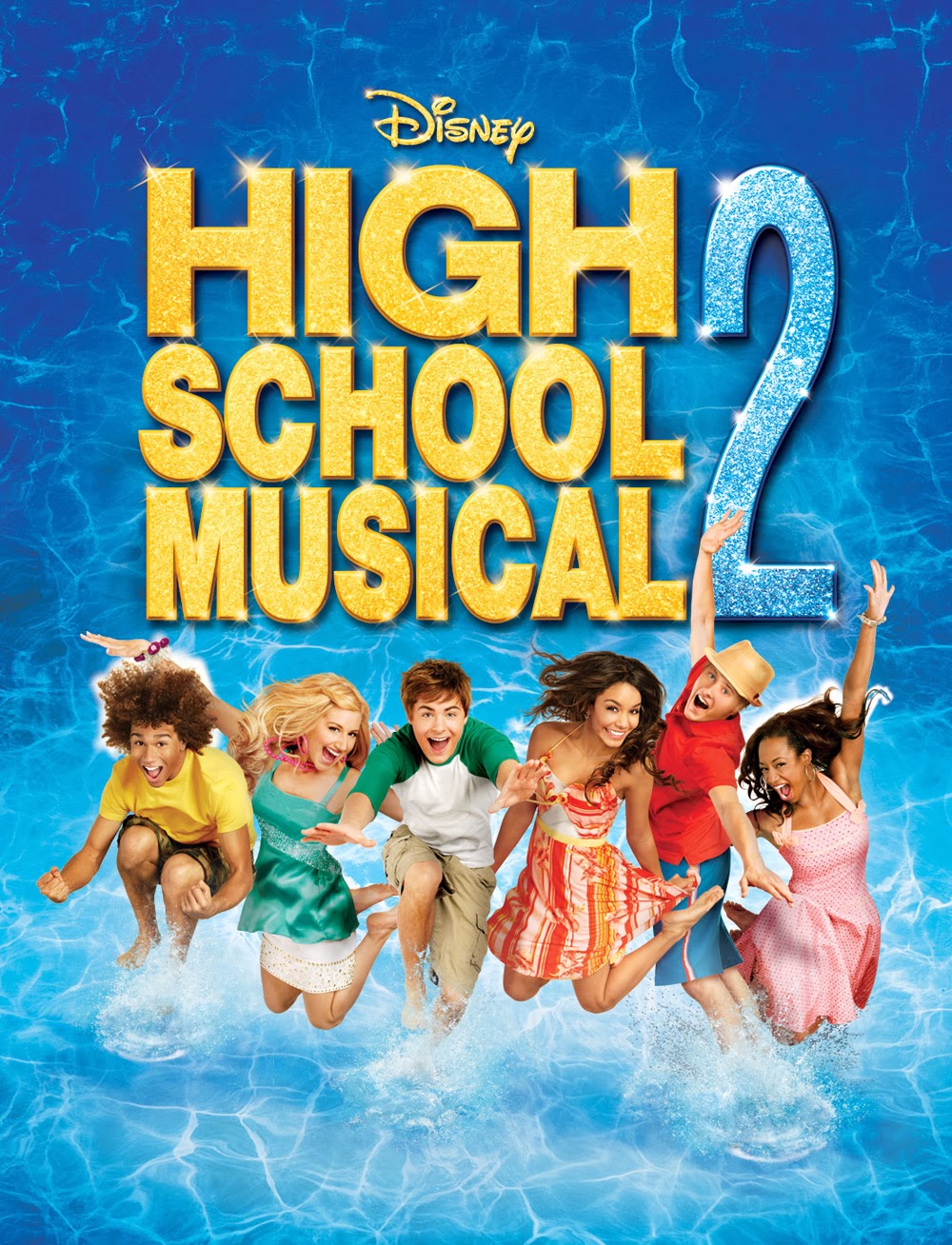
High School Musical 2 (2007) – It’s quite surprising that I never formally reviewed this film, as it’s my personal favorite in the trilogy.  The summer after High School Musical finds the Wildcats working at Lava Springs Country Club; Troy (Zac Efron) and Chad (Corbin Bleu) are on kitchen duty, while Gabriella (Vanessa Hudgens) lifeguards for pampered twins Sharpay (Ashley Tisdale) and Ryan (Lucas Grabeel).  What I like best about this film is the way it deepens the character relationships significant.  Troy and Chad get a trial-by-fire when the former’s future calls, and Ryan gains some self-confidence by stepping out of his sister’s shadow (indeed, Grabeel steals the show with a layered performance).  It’s not that you’re looking at Oscar-caliber performances, but after the first film the crew clearly know the strengths of their cast and play to those strengths, as when Troy and Sharpay get the duet you didn’t know you wanted from the first film.  The songs, too, are catchier, capturing the exuberance of summer vacation balanced by a fear of an uncertain future.  Wisely, Disney keeps the angst at bay, never surrendering the zeitgeisty just-have-fun of the plot and maintaining a high-energy infectious enthusiasm.  If you’re not smiling during Troy’s “Bet on It” number (or, more likely, guffawing at the goofiness), then you’re likely too cool for the room, a resident of Hipster Central, Population: You.  The hallucinatory “Humuhumunukunukuapua’a” alone is worth the price of admission for that weird moment when Disney meets David Lynch.  More of the same, really, from the first film, just bigger and better, setting the stage for the third installment in the trilogy with, finally, a big kiss on the Lava Springs golf course.

That does it for this week’s edition of “Monday at the Movies.”  We’ll see you here next week, but don’t forget to tune in this Friday for the Double-Oh-Seventh of the month with a very special returning star!

Thursday, January 10, 2013

Les Misérables (2012)

I’m of two minds regarding Tom Hooper’s Les Misérables, the Oscar-bait adaptation of the long-running musical.  There are good things to say about the film, but the delivery of the movie’s technical aspects is so distracting that I came away feeling a bit disappointed.

You know the story, adapted from Victor Hugo’s sprawling epic about French justice and revolution:  Former convict Jean Valjean (Hugh Jackman) is doggedly pursued by Inspector Javert (Russell Crowe) for breaking parole after serving 19 years for stealing a loaf of bread.  After experiencing God’s mercy, Valjean builds a new life for himself, raising the daughter of his late employee Fantine (Anne Hathaway).  The film reaches its third act when the daughter, Cosette (Amanda Seyfried), falls in love with brave young revolutionary Marius (Eddie Redmayne), embroiling Valjean and Javert in a conflict larger than themselves.

Preliminary disclaimer:  I’d never seen the musical version before, though I’ve read the novel and seen the mostly successful Liam Neeson/Geoffrey Rush film version.  I’m aware that the following “Why is there so much singing in a musical?” is a bit like bemoaning a Superman film for too much flying.

But the singing in the film doesn’t always work.  It’s been my custom to review musicals by musical number, of which there are two kinds in this sung-through musical:  full and distinct pieces, and interludes where the dialogue is sung.  Consequently, a movie where nearly every word is sung is difficult to break down in paragraph form.  There are some standout pieces, to be fair; Hathaway is heart-breaking with “I Dreamed a Dream,” a despairing ode that would drive even the stone-hearted Pharaoh to tears and will likely garner her an Oscar nod – if not a win – come February.

In the scene-stealer category, we have a surprisingly delightful “Master of the House,” featuring Sacha Baron Cohen and Helena Bonham Carter as crooked innkeepers.  As the Thénardiers, Cohen and Carter recur throughout the film (always unexpectedly, always agreeably) but take center stage in this giddy revelry in corruption, reminiscent of their deliciously evil turns in Sweeney Todd.  Their enchanting abilities were never truly in question, but the unanticipated levity their presence brings helps to alleviate some of the grim and unsuccessful elements of the film.

The film’s bleakness isn’t inherently a fault; truth be told, Hugo’s novel is a depressing one.  Les Mis conveys that quite well; in spite of the distracting talk-singing, Jackman and Crowe are both quite good in their roles as tortured and torturer, conveying a wide range of subtle emotions and conveying characterization past the singing that would tell rather than show.  Indeed, the greatest success of the film is that Jackman and Crowe manage to emote past their distracting tendency to sing every word; it’s almost as though there’s a better movie in here somewhere, if only the singing were reined in or at least less operatic.  I wonder, for example, why you cast someone like Russell Crowe, who plainly can’t sing, opposite Hugh Jackman, whose musical theater pedigree is significant and self-evident.

What the film doesn’t do well is provide the counter to the tragedy; though Hooper isn’t wallowing in sadness, the purported ray of sunshine falls flat.  Yes, the Thénardiers are a delight each time they appear, but the film offers as its source of optimism the uncompelling relationship of Cosette and Marius.  Seyfried is squandered as Cosette, reduced to nothing more than a pretty face on which Marius pins his hopes – hopes which he quickly abandons in favor of his duty.  Marius, too, gives voice to the meaninglessness of his comrades’ deaths (a moment when less singing would have meant more emotional weight), but the saccharine wedding scene that follows feels forced and unconvincing.  Redmayne clearly has love in his eyes when he looks at Cosette – leading me to wonder when this actor’s “moment” will come – but Cosette doesn’t requite it as well as I’d like.

Which gets me back to the central problem of Les Mis – the sense of imbalance.  Hooper’s direction is quite distracting in moments, as when he rapidly zooms in on a soloist like the end of the line on a roller coaster.  These disorienting moments felt more at home in the grand guignol surrealism of Sweeney Todd but never quite fit in this mostly realistic piece.  In short, the movie is too theatrical, too operatic, to work within the confines of a film.  Like Danny Boyle with Frankenstein, perhaps Hooper would have been better served by moving his production to the stage.

I don’t like being the guy who pulls apart a multimillion-dollar movie from behind a hundred-dollar laptop, but there are things that work in this film and there are things that don’t.  Perhaps this film is not made for someone like me (buzz indicates it’s certain to clean up at the Oscars), but for my money the film does not succeed in the same way that Sweeney Todd did.

Les Misérables is rated PG-13 “for suggestive and sexual material, violence and thematic elements.”  Prostitution is implied during the story, and we see one exchange with no nudity.  The June Rebellion is depicted with several deaths by gunfire, some with bloody sprays (though nothing on the order of Django Unchained).  I have yet to know what “thematic elements” are.

Monday, April 9, 2012

Monday at the Movies - April 9, 2012

Welcome to Week Fifteen of “Monday at the Movies.” We’re back to the three-film template with three “genre flicks”: a musical, a meta-mockumentary, and a remake.

Repo! The Genetic Opera (2008) – I have a hesitant affection for the Saw franchise (mostly redeemed by Tobin Bell’s star-marking performance), so this Darren Lynn Bousman rock opera is something I’ve orbited but to which I’ve never committed. While I’m no foe of musicals, the cast seemed a mixed bag: Paul Sorvino and Anthony Head on the one hand, Paris Hilton on the other. All told, Repo! is an odd hybrid of Sweeney Todd and the Saw franchise, with a dollop of dystopia thrown in for set dressing. Make no mistake – this is an opera, with generational rises and falls punctuated by bombastic solos and Sondheim-esque talk-singing. Sorvino is Rotti Largo, the dying organ transplant baron in search of a new heir after his brood (including Hilton as the surgery addict Amber Sweet); he finds one in Shilo (Spy Kids alum Alexa Vega), the daughter of his top organ-collecting repo man (Anthony Head). Among the film’s greatest strengths is its highly stylized look, ready-made for the Hot Topic crowd, and its rich plot, whipping between multiple threads which all tie together at the opera-within-an-opera finale. Unfortunately, though, the runtime is a little brief, and each plot thread is introduced with an exposition-heavy montage which might have been better served with a more extended flashback or musical sequence. Additionally, the film will turn off many with its gruesome violence (blood flows, intestines spill, and a face even falls off) and its musical style (more rhythmic slam poetry than melodious harmony), but I found it an enjoyable enough 90-some minutes.

Tristram Shandy: A Cock and Bull Story (2006) – Steve Coogan and Rob Brydon (best known as “those guys in the Michael Caine impressions video”) star in this metafictional adaptation of Laurence Sterne’s famously sprawling proto-postmodern novel, at once a filming of the book and a mockumentary on the making of said filming. After finally reading Tristram Shandy, I went back to the film, and my suspicions were confirmed – the film has many more jokes for those in the know, but it’s at its best when Coogan and Brydon are turned loose upon each other in a battle of one-ups-manship and celebrity impersonations. We begin with a riveting conversation in the makeup chairs, move to a half-hour adaptation of the first few volumes of the novel, and conclude with a failed preview screening of the failed film. There’s about 45 minutes that are almost entirely negligible, dwelling on Coogan’s self-caricature and ruminating a bit too much on the unfilmability of the novel. As a result, it’s easy to get distracted once the film stops showing the straight adaptation segments, especially in the moments when Coogan and Brydon are kept apart. There are a few clever bits, as when Gillian Anderson is cast to play the Widow Wadman, but this is a plot that doesn’t get as much attention as it ought. I’ll say this, though; rewatching Tristram Shandy has reminded me how much I still need to see The Trip, in which Coogan and Brydon team up for a restaurant road trip.

12 Angry Men (1997) – Having glowingly reviewed the Sidney Lumet original last week, I was delighted to see that the remake is available on YouTube. I was even more delighted by the all-star cast – Jack Lemmon, George C. Scott, Ossie Davis, and James Gandolfini, among others. But almost immediately I realized this was a case of a remake which doesn’t do enough to distance itself from the original, nor does it remain slavishly loyal in apparent devotion. Instead, it’s an indistinct reflection of the original, right down to imitative line readings (especially from Tony Danza as Juror #7). While Lemmon does gravitas without even thinking about it, he’s a far cry from Henry Fonda, and even Scott doesn’t improve upon the performance of Lee J. Cobb. Indeed, the only performance which adds something to the film is Mykelti Williamson’s turn as Juror #10; here the white supremacist Ed Begley is replaced by a lapsed member of the Nation of Islam, spouting bigotry against the Hispanic defendant. This clever update, however, is overshadowed by the fact that the film frequently oversimplifies itself, telling instead of showing, as when Juror #3’s bias against the defendant is verbalized instead of implied (as in the original). While it’s in theory a good idea to put contemporary actors into an old classic, when they don’t turn in a new or interesting product, even Juror #12 – straight out of Mad Men – couldn’t sell it to an audience. Stick with the original; this one’s guilty of stagnation.

That does it for this week’s edition of “Monday at the Movies.” We’ll see you here next week!

Monday, August 9, 2010

Sweeney Todd: The Demon Barber of Fleet Street (2007)

Happy Monday, folks, and welcome to Depp Week at The Cinema King. In celebration of the work of one of the most talented actors of our generation, we'll begin our look at some of Johnny Depp's recent work and evaluate how he's done over the last ten years. We'll begin with the performance that netted Depp his third Oscar nod and his first (and, to this date, only) Golden Globe win: that of the singing, slicing barber Sweeney Todd.

One of my earliest musical reviews (of Hairspray, also from 2007) conducted itself in a song-by-song analysis, which was a format I found a) conducive to musical reviews and b) a stylistic shake-up amid the tedium of formula. I'll begin by way of a few prefatory notes. First, I am enamored with this movie; I've said before that it is the movie Tim Burton's been trying to make all his life. Second, I concede that it is not for everyone: Johnny Depp's performance is among his best, but it may not be for everyone; the brutal violence is stunning in a way that may repulse; and a few alterations to the source material may cause Sondheim diehards to spurn this adaptation. Finally, it is a musical, a fact not made apparent by the marketing team, and so some moviegoers may feel tricked. But, if you're like me - an open-minded Depp-head with a Burton fetish (for that is how best Burton's imagery may be described) - Sweeney Todd might be more delicious than a meatpie - with or without human filling.

The film opens on a ship (no, not a pirate ship; that's later on in Depp Week) with the mysterious Sweeney Todd (Depp) and the wide-eyed sailor Anthony (Jamie Campbell Bower) each arguing that "There's No Place Like London." Anthony comes from a place of naivete, suggesting that London is the most beautiful city in the world, while Sweeney Todd - fresh off an unjust stint in prison - remarks on the ugliness of the city by way of an anecdote about a barber (Sweeney, pre-prison) and his wife who were targeted by the dastardly Judge Turpin (Alan Rickman). The story ends unfinished, and the two part ways. Depp instantly inhabits the skin of the dark and disturbed stranger, evoking pathos before we even know why his eyes are so sunken; Bower is sort of beige, more of a sounding board than an actual character, but at least his singing voice is professional-sounding.
Sweeney finds his way to Mrs. Lovett (Helena Bonham Carter) and her meat pie emporium, wherein are sold "The Worst Pies in London." It's a perfect introduction to Mrs. Lovett and a perfect opportunity for HBC to show off just how delectably nutty she can be as she bemoans the bad luck her business has suffered. HBC continues to shine with "Poor Thing," as she reveals to Sweeney that his wife has killed herself, which leads Sweeney into the revenge ballad "My Friends," essentially a love song to the razors he plans to use as murder weapons. As Mrs. Lovett cloys and attempts to ingratiate herself with Sweeney, HBC gets one more chance to kook it up, but all eyes on this number ought to be on Depp, who pushes his voice as far as it can go - and succeeds.

The plot takes a step back for a moment as Anthony meets the love of his life - Joanna (Jayne Wisener), Sweeney's daughter and ward to Judge Turpin. The catch is that she's locked up ("Green Finch and Linnet Bird"), and her legal guardian isn't too keen on letting her go. The obvious solution here is to sing about it - Anthony gets the solo "Joanna" and promises to free his love before the end of the movie. This set of tracks might turn a few viewers away, but do stick with the film: Anthony and Joanna are slower parts of the picture, but intentionally so, as they're to provide a sort of counterpoint to the Sweeney/Lovett madness. Indeed, Joanna is more a MacGuffin than an actual character, since she's the thing Sweeney, Anthony, and Turpin are all chasing.

The plot takes a second, albeit more intriguing detour with "Pirelli's Miracle Elixir," a street-performance-turned-sales-pitch. The host, the Italian Adolfo Pirelli (Sacha Baron Cohen), serenades about his potion, which he and his young apprentice Toby (Ed Sanders) promise will regrow hair. But Sweeney calls them out and initiates "The Contest," a shaving competition to see who is the better barber. I won't spoil who the victor of the challenge is, but I will say that this is a great branching-out role for Cohen. Though he's known for his prankumentaries like Borat and Bruno, Cohen is at home as Pirelli, whose theatricality demands an actor who can play comedy with a straight face; Cohen is that actor, balancing the disingenuous front Pirelli wears with the actual menace beneath the blue frills.

Disheartened that his scheme is running slowly, Sweeney sulks as Mrs. Lovett encourages him to "Wait." It's a fairly low-key moment, but compared to the high intensity to come, it's a much needed breather, and it gives Burton a chance to play with some interesting angles and shots of mirrors in what is otherwise a scene of just one person singing to another. The calm, of course, precedes a storm, and with "Pretty Women" Sweeney gets his opportunity for revenge on Judge Turpin. It's a fantastically tense moment, as Sweeney readies his razors. It's also a unique scene because how often do you get to hear Alan Rickman sing? As quickly as this scene begins, it ends abruptly; Anthony interrupts, sending the Judge out of the barber shop and Sweeney into a rage. Suddenly, Sweeney has his "Epiphany" - the world is filled with monsters like Judge Turpin, which means the revenge scheme is thinking too small. As Sweeney vows to slit as many throats as possible, you'll get chills; finally, after about an hour of playing his cards close to the chest, Depp cuts loose and unleashes the full scope of his character's madness. It's this scene, as well as the next hour to follow, that I'm convinced earned Depp his nomination, since it's what fans of his trademark audacious insanity have come to expect and cherish.

And how do we top a number about genocide? Add cannibalism to the mix, suggests Mrs. Lovett in "A Little Priest." With all the bodies piling up, she teases, why not use them to boost my business, too? The song is infectiously loony, catchy in a way that giggles after laughing gas are; we know this is wrong, but the sheer normality and the subdued mirth evident in the performances of Depp and HBC are precursors to the kind of dark humor that governs the movie. But the movie pulls back a little from high satire and returns to its tragic roots with a reprise of "Joanna," in which Anthony's continuing love for Joanna is counterbalanced with Sweeney's sad realization that his original mission has slipped away from him - and that he no longer cares. Visually this is the most spectacular number, loosing Burton's bloody vision for the character by depicting throat after throat slit in spectacularly gushing fashion like something out of Tarantino's wildest imaginings; by pulling back on the intensity of the singing, it provides a built-in apology for the somewhat odd choice of casting Johnny Depp in a musical, since the feelings behind the music are vastly more important - and Depp does a dynamite job of revealing those emotions.

Mrs. Lovett dominates the next few tracks: "God, That's Good!" in which she introduces a hungry London to her latest culinary concoction; "By the Sea," a perfectly deluded number in which she details her lovestruck vision for a blissful future with an otherwise disinterested Sweeney; and "Not While I'm Around," in which she's forced to make a difficult promise to Toby, who's beginning to grow wise to Sweeney's machinations upstairs. The real highlight, though, is the Shakespearean tragedy that governs the film's ten-minute "Final Scene." Here, all the disparate plot threads - Sweeney's quest for revenge on the Judge, Mrs. Lovett's conflict over her love for Sweeney and for Toby, Anthony's pursuit of Joanna, and even that nutty old beggar woman who's been meandering in and out of the plot - tangle together with lightning speed, and before you know it, it's over - culminating in the most heartbreaking homage to the Pieta. Burton omits (wisely, in the opinion of this reviewer) the stage production's songs in the final scene, making it more about the things that characters aren't saying to each other; it's visually stunning and composed in a way that instills a building sense of dread that closes with a cathartic collapse of the house of cards these characters have built for themselves.

It's a film that'll leave you breathless. Once you've caught your breath, though, you might find yourself humming along to a few bars. It'll take a lot more than ale to wash that taste out.
Sweeney Todd: The Demon Barber of Fleet Street is rated R "for graphic bloody violence." The movie is littered with angry arterial sprays, though all the blood appears in a highly stylized form, much thicker and color-desaturated than its real-life counterpart.

Tune in tomorrow, folks, because we're looking at another Depp/Burton collaboration - Charlie and the Chocolate Factory - as Depp Week continues here at The Cinema King.

Thursday, June 25, 2009

High School Musical 3: Senior Year (2008)

When it comes to the subject of High School Musical 3: Senior Year, I have two confessions.

First confession: I saw this movie of my own volition. I wasn’t dragged, and I wasn’t sitting in the fourth row for any reasons but my own.

Second confession: I actually liked HSM 3 (to use ‘Wildcat’ shorthand).Coming from a guy whose favorite movie of all time is Christopher Nolan’s The Dark Knight (followed closely by Martin Scorsese’s The Departed), that may come as a bit of a shock. So I suppose a third confession is in order: I’m actually a fan of the franchise.

True, I don’t have posters of Zac Efron on my wall, nor do I own a single pink cap, but I do own the first movie on DVD, and I even know what a jazz square is.

Maybe I’m a little biased, then. But where the first two installments of the franchise were fluffy teeny-bopper schmaltz-fests, Senior Year is actually a movie in its own right.
Efron leads the ensemble cast (with six leads and scads of supporting characters) as the Wildcats are chugging through those last days of high school. There’s no senioritis here; Troy, Gabriella (Vanessa Hudgens), Sharpay (Ashley Tisdale) and Ryan (Lucas Grabeel, still my favorite) are all scrambling to stage their last musical at East High, a chronicle of their own experiences as they head off to college. Throw prom and separation anxiety - Gabriella’s moving to Stanford, exactly 1,053 miles away from her doe-eyed boyfriend - and three new sophomores into the mix, and you’ve got a $42 million opening weekend.

If the first two movies had catchy songs (who didn’t find themselves ready to “Bop to the Top” or ask “What Time Is It?” in the first two?), Senior Year plays the music to the hilt. I could walk through each of the film’s 12 musical sequences (two more than usual), but there’s really not a dud in the bunch.

“Now or Never” is a fun race against the clock as Troy and the basketball team have only 16 minutes to win a state championship. “I Want It All” will have you humming along as Sharpay and Ryan dream of star status. And “Just Wanna Be with You” is perhaps the most moving piece of the whole film, powerful in its simplicity.

Then there’s “Senior Year Spring Musical” itself, an eight minute track which features reprises of many of the movie’s most memorable tracks. This is unquestionably the best scene in the movie, in which all the characters get to shine, even the ridiculous show-off Jimmy “The Rocket” (newcomer Matt Prokop).

‘Ridiculous’ is probably a word I should use more frequently, both in relation to the movie itself and my enjoyment of it. Try to keep a straight face when Troy dances it out during “Scream” or when he and his best friend Chad inexplicably turn into little kids during “The Boys Are Back.”

Though the music is top notch here, catchy without being overtly bubblegum-ish, the acting isn’t slouching, either. Admittedly, the caliber of acting in a Disney movie isn’t something to analyze too closely, but there’s no question these six have graduated near-legitimacy. Grabeel’s got a part in Milk, the Sean Penn biopic of Harvey Milk, and Efron’s fronting a Footloose remake in 2010. [Alas, this has changed since I wrote this review. It seems Efron doppleganger Chace Crawford is now going to cut footloose.]

Here, the actors feel comfortable in their roles. Efron is all too believable as the confused Troy Bolton, torn between the basketball court and the stage. Hudgens will break your heart as she copes with leaving East High, and Tisdale is delightful as scheming queen bee Sharpay. Even Corbin Bleu fits perfectly as Chad, whose principal preoccupation is finding the perfect way to ask Taylor (Monique Coleman) to the prom.

I’m not a fan of the three newcomers - the aforementioned Jimmy “Rocketman” Zara, Tiara Gold (Jemma McKenzie-Brown) and Donny Dion (Justin Martin). I can understand Disney’s desire to spin these three off into a new trilogy, but it’s tough to get behind any of them. Instead of being interesting new characters, they seem only to be younger versions of Troy, Sharpay and Chad. Tiara is perhaps the worst offender, frustratingly uninspired and with little to no singing ability at all.

HSM 3 won’t win any awards - or hearts, for that matter - but I feel fairly confident I got my money’s worth here, an assertion I wouldn’t make for its box office competition, Saw V. In terms of pure (both unadulterated and innocent) fun, though, it’s difficult not to empathize with the movie’s cast. They’re clearly having a blast with this one.

I did, too.
High School Musical 3: Senior Year is rated G for being so gosh darn wholesome.

Friday, May 29, 2009

Soul Men (2008)

I've read somewhere that Sam Jackson won't turn down a movie role and will take anything that comes his way. I wonder if that's true.


A movie like Soul Men makes me ask that question, though I can understand why Jackson might have accepted the role. On paper, Soul Men looks bona fide: despite a long-standing feud over women and Lord knows what else, retired soul singers Floyd Henderson (the late Bernie Mac) and Louis Hinds (Jackson) reunite on a cross-country tour on their way to the Apollo to pay tribute to their late colleague Marcus Hooks. As a comedy film about two feuding musicians - particularly ones who speak as rapid-fire and as profanely as Bernie Mac & Sam Jackson, it seems like it's a good idea.


Well, it was. The execution left something to be desired, however. While both lead actors are decent and believable as their characters, the movie trips over its own emotional center, dulling the chemistry between Henderson and Hinds. When in full comedy mode, Bernie Mac & Sam Jackson are solid gold, and they're not bad singers either. But when the film moves into territory about a long-lost daughter (Sharon Leal), the film fumbles the ball.


The laughs are strong, but they're few and ultimately far between. Of course, no one can drop a string of F- and M-F-bombs like Sam Jackson, and even Bernie Mac holds his own in this domain, but the movie doesn't have nearly enough of these fun moments to keep an audience fidgetless for 90-some minutes. I didn't have as much fun with this as I did Run Fatboy Run, but it's hard not to at least crack a smile when Sam Jackson's on the screen. They seem like they're having fun, so at times that bleeds through, particularly in a few scenes between Henderson and Hinds that had to be improvised.


Rent Soul Men if you're a fan of either of the protagonists, but there are better films in each of their respective canons.

Soul Men earned an "R for pervasive language, and sexual content including nudity" from the MPAA. From these two guys, it shouldn't come as a surprise that the language is coarse as sandpaper. Nudity is brief, restricted to one scene, though discussion and clothed depictions of sexual situations are abundant.

Tuesday, July 1, 2008

Hairspray (2007)

At the risk of sounding horribly dull and cliched, remakes are a tricky subject. A lot of people don't like talking about them. To be fair, we've had two great remakes - John Huston's 1941 film noir masterpiece The Maltese Falcon (a remake of two previous adaptations of Dashiell Hammett's eponymous novel) and Scorsese's 2006 Oscar-winning epic The Departed (a remake of Hong Kong mob story Infernal Affairs).

But for every good remake, we get thirty like Gus Van Sant's Psycho or The Ladykillers (from the Coen Bros. slump of the early 2000s) or - God forgive me for even invoking this film's name - Steve Martin's The Pink Panther. And lest we forget, Nic Cage's version of The Wicker Man, unintentionally hysterical with lines like "Step away from the bike!" and "HOW'D IT GET BURNED?!", was a remake of a British suspense/horror film with Christopher Lee (automatically superior by default).

So you can understand why I typically roll my eyes when word of a remake whispers around IMDb - case in point, the pointless Keanu Reeves starring in a pointless remake of The Day The Earth Stood Still. I get even more skeptical when a film purports itself to be a remake of an obscure 80s movie from a midnight movie director with a strong cult following and no possible way of being family friendly.

Then a movie called Hairspray comes along and completely reinvents my concept of what a remake should be. Though technically a second-degree remake (being a filmed version of the Broadway musical based on John Waters's original 1988 film), Adam Shankman's Hairspray is, in my opinion, the third best film of 2007 (landing behind There Will Be Blood and Sweeney Todd: The Demon Barber of Fleet Street).

And, as it turns out, the difference between second and third place is one dud song; where Sweeney had no songs worth fast-forwarding, Hairspray sadly has one right in the middle of the movie. So, since it's a musical and since I fear becoming formulaic, I'll walk through the plot synopsis song by song. "Good Morning Baltimore," a peppy number about the power of dreams and the need to follow them (lest, as Cherry Darling informed us in Planet Terror, "dreams become the thing you talk about instead of the thing you do"), introduces us to pleasantly plump Tracy Turnblad, played to bubbly perfection by newcomer Nikki Blonsky (who seems thus far to have been a one trick pony). Then it's time to meet "The Nicest Kids in Town," the twenty dancers on the Corny Collins Show, a TV dance program hosted by exaggeratedly swanky yet slightly exasperated host Corny Collins (James Marsden). Among the Kids are lead dancer Amber (Brittany Snow, who takes the catty blonde cliche and plays it to the hilt) and top heartthrob Link (Zac Efron, finally getting a chance to spread his wings away from the Mouse).
When Corny announces that Nicest Kid Brenda is taking a leave for "Just nine months," Tracy sees her chance and auditions for the show. But she comes up against Amber's stage-mom matriarch Velma (a delightfully wicked Michelle Pfeiffer), "Miss Baltimore Crabs," who's determined to keep anyone who's different off the show (sensing the message yet?). Later, Tracy's sent to detention, a paradise of dancing and diversity where the races mix and groove - and where Tracy finally meets Link and falls in love. "I Can Hear the Bells" - can you? Finally the "Ladies Choice" gets a song all to himself, giving Efron the opportunity for his vocals to shine and giving Tracy the opportunity to have her dance moves seen.

To the delight of best friend Penny (Amanda Bynes, who [it seems] can actually act!) and Tracy's parents Wilbur (Christopher Walken, a caricature of himself but a lovable one) Edna (John Travolta, who with a Baltimore accent and a LOT of makeup actually passes as slightly feminine), Tracy snags a spot on the Corny Collins Show, to the predicted chagrin of Velma and Amber who both loathe "The New Girl in Town." They also hate Negro Day, Corny's monthly episode featuring African-American dancers and crooners led by Motormouth Maybelle (Queen Latifah) and her son Seaweed (Elijah Kelley, whose talent and resemblance to Sammy Davis Jr. ought to land him a spot in a biopic).

Tracy has hit the big time, even scoring a spokesgirl spot for Mr. Pinky (a marvelous cameo from Jerry Stiller, who played Wilbur in the original movie) during "Welcome to the 60s," in which Edna gets her makeover. In terms of pure fun, it's tough to beat "Run and Tell That," Seaweed's ode to being different. Even Maybelle's "Big, Blonde, and Beautiful" is sweet as chocolate cake, which Maybelle and Edna ingest in mass quantities to make the Coneheads blush. A reprise of "BB&B" features Velma attempting (hysterically fruitlessly) to seduce Wilbur, while Edna gets dolled up for her man, who she catches in an apparently compromising position with Velma. The two women collide, and Edna forces Wilbur to move out.
Wilbur atones with Edna in a catchy duet of romance, "You're Timeless to Me," which couples dated references to the Sixties with slightly insulting professions of love ("You're like a fatal disease, babe / But there's no cure / So let this fever rage"). Then comes the aforementioned dud, "I Know Where I've Been," Maybelle's message of racial integration no matter the price, layered over a march on the racist practices of Velma's station WYZT.

But the best number comes after the protest march, when Tracy is imprisoned in Penny's basement awaiting a trip to "the big house," when Penny is similarly tethered to her bed via jump rope, while Link waits for Tracy to come home, and while Seaweed aims "to rescue the fair maiden" Penny - it's "Without Love," by far the standout song in terms of vocals, lyrics, even direction a la Shankman. The rest would be criminal for me to describe in any detail (even Corny's last number, "Hairspray," is a barrel of fun), but suffice it to say that Tracy succeeds in teaching the whole world that - no matter what repression society places - "You Can't Stop The Beat."

I didn't say much about the perfect casting choices made in this movie, because the real star of the film is the music, including a few new numbers by the songwriting team of Wittman & Shaiman, such as the end credits tune "Come So Far (Got So Far to Go)" which will make you sit through the entire credit sequence, something I hardly ever do. But the cast is perfect, too; from Bynes to Walken, from Snow to Marsden, it's impossible to find someone who isn't spot-on for their specific role. Even Paul Dooley, in a small role as Ultra-Clutch Hairspray's exec, simmers with frustration at "that chubby communist" Tracy. The film is also addicting; it's one of those works that whenever it's on cable I can't resist turning it on just to see where they're at - and then stay until the end.

The dialogue (and occasionally lyrics) is hilarious, allowing the anti-racism medicine to go down with more than a spoonful of sugar. A great deal of the laughs come from the impeccable delivery of campy lines such as "Plastic little spastic" or "I am now a checkerboard chick!" (both delivered by Bynes, a real comedic talent whose roles here and in She's the Man tell me she needs the right vehicle to shine) The problem with Waters's original is the deliberate pandering to an audience seeking camp; as Edna, Divine seemed awkwardly masculine while trying to hard, and the original ending featured a roach bomb in one character's beehive do. This new interpretation of the story is effortless, intentionally yet subtly cheesy without calling attention to itself.

If I had a complaint, it's that two of the stage production's songs, "Mama, I'm a Big Girl Now" and "Cooties," have been cut - the former a foot-stomping temper tantrum shared by Amber, Penny, and Tracy at their overbearing mothers, and the latter serving as Amber's "talent portion" at the Miss Teenage Hairspray Spectactular. Maybe I'm just a Brittany Snow fan (and I have been since her turn as white supremacist Ariel on Nip/Tuck) who wanted to see more of her in the movie, but it seems these two songs might have made up for "I Know Where I've Been" (which really could have been cut). Sure, it'd give the film an almost 2.5 hour runtime, but I'm asking more from Zack Snyder in his Watchmen adaptation. Come on, Shankman; it's not too late to film these scenes and put them in a director's cut! (Versions of the songs appear in the end credits, but they're somehow not as charming without accompanying visuals.)

At one point, Link tells Edna that he was "just at home, practicing my new twist on the twist." All too often, "new twists" don't go over so well; Catwoman, anyone? Thank heavens this movie does so well at polishing a somewhat slipshod original production into a Top Five movie.

Saturday, May 31, 2008

High School Musical (2006)

When director Kenny Ortega and crew decided to open High School Musical with a song entitled "Start of Something New," I don't think they knew how prophetic their words would be.

High School Musical is at the center of a Disney hypestorm the likes of which only Jack Sparrow has rivaled. And with the third installment in the widely popular series due out in October (and this being one of the films that I remember well enough to not have to re-view it before reviewing it), it seems an opportune moment to take a critical look at the Wildcat phenomenon. [For reasons of space, fluidity, and focus, I'll only examine the first film for now and take up the second one later. When I see the third film, Senior Year, I'll let you know what I think.]

I've argued that High School Musical (HSM for short) is basically a Disney-fied retread of Shakespeare's great tragedy Romeo and Juliet, so let me briefly explicate that one for anybody who hasn't heard my argument already. [The following is an excerpt from a critical writing of mine which examined the ways in which teen comedies modernize Shakespeare. The other two films under consideration, 10 Things I Hate About You and She's the Man, will probably be reviewed here later.]

Of the three, then, High School Musical is the most difficult to establish a line to Shakespeare. High School Musical is “loosely based on William Shakespeare's Romeo and Juliet and featuring a high school jock and a science nerd as star-cross'd lovers” (from the Sunday Territorian's 2/18/07 article “Tweens love School”). Specifically, High School Musical turns the basketball (and its star player Troy) and scholastic decathlon (and its star, Gabriella) teams into Montagues and Capulets, “[t]wo households, both alike in dignity,” attempting to prevent the “star-crossed lovers” from joining in the winter musicale (from Romeo and Juliet, 1.1.1, 6). Unlike the other two films under consideration, High School Musical dramatically alters the ending of its source material, by replacing Shakespeare’s double-suicide ending with a peppy song-and-dance number, “We’re All in This Together” (HSM). Where Shakespeare cautions about the problems inherent in bad blood, High School Musical offers a view of all the positives to be gleaned from working together to accomplish one goal. That Disney’s High School Musical soft-soaps Shakespeare’s original ending is no surprise; after all, this same studio, as Tony Howard notes, commercialized “Hamlet into The Lion King and politically corrected The Tempest in Pocahontas” (Howard 318, from Howard's “Shakespeare’s cinematic offshoots,” published in The Cambridge Companion to Shakespeare on Film, with editor Russell Jackson. Cambridge: Cambridge University Press, 2007).

Longest paragraph on this blog? Probably. Most scholarly/erudite? Definitely. Most well thought-out? Certainly.

By way of further plot summary, hunky basketball star Troy (Zac Efron, for whom we have this movie to thank) and geeky but still attractive brain child Gabriella (Vanessa Hudgens, a lass I have to commend for her scandal-rebound) meet by chance on Christmas vacation and sing a duet together. When it turns out that Gabriella and Troy go to the same high school, they decide to audition for the "winter musicale," Twinkle Towne. They land a callback - much to the chagrin of resident diva Sharpay (the laudable Ashley Tisdale) and her twin brother Ryan (Lucas Grabeel, who gets his chance to shine in the sequel). Singing, dancing, and - believe it or not - sabotage ensue as the school conspires to keep Troy and Gabriella from being together.

It's pretty much no secret that I'm a fan of this movie, but I didn't start this way. It took about three viewings before it grew on me. The first time I saw it, I watched it to find out what all the hubbub was about but gave up before the third song - a pity, since that's now one of my favorites - saying, "This is stupid. A bunch of kids running around singing. Lame, Disney, lame." The second time, I watched it with my grandmother as a sort of joke, mock singing a few of the songs afterwards.

Something happened in between the second and third viewing - perhaps the trip to Disney World, where I'm convinced there's something in the water - that the movie began to grow on me. It's infectiously fun, with catchy tunes and endearing characters. It's no secret why the under-20 crowd are getting hooked on HSM, but I think it's just as much fun for the over-20s as well. Heck, I'm over 20, and I still enjoy putting this movie in or catching it on cable. And I'd be lying if I said that these actors aren't any good in other roles (see Hairspray to watch Efron really blossom, or... well, that's about it for anyone else.)

The film hits a few sour notes which impede my viewing, but perhaps these are just my hang-ups. 1) I've studied this film in perhaps too much depth, so it's a challenge to enjoy it without overanalyzing it. 2) Efron doesn't do his own singing (Drew Seeley, a more trained vocalist, fills in), and it's a noticeable difference that I'm glad the sequel rectified. 3) The "villains" of the piece, the Evans twins, are in my mind more likeable than our protagonists. Their songs are catchier, their scenes are funnier, and for my money they're just prettier people. Shallow? Perhaps.

That being said, I don't want to be too positive at the risk of sounding like a starstruck tweeny-bopper. Oh, what the heck. The Mouse knows how to make a good movie. I credit the one-two punch of Jack Sparrow/Zac Efron (with a lot of Hannah Montana thrown in for good measure and great money) with saving Disney from a lackluster stock report, but there's something to be said for the good clean family fun that all three provide.

Before this review gets too much longer, I should point out that this is by no stretch of the imagination a perfect movie or even a great movie on the par of The Departed (also from 2006) or Casablanca. It is, however, a lot of fun and a great way to just let go for 90 minutes.

Just don't be surprised if you continue to "Bop to the Top" (by far the catchiest tune in the whole show) long after you've seen the movie.