Showing posts with label ghosts. Show all posts

Monday, August 7, 2023

Haunted Mansion (2023)

I’ve been on something of a cinematic high lately, recapturing the magic of the movies with a few hits right in a row. I have wondered over the last several months whether I’ve outgrown movies, lapped my favorite franchises and genres, yet movies like Mission: Impossible – Dead Reckoning, Oppenheimer, and Barbie have reminded this moviegoer that it’s not “a me problem.” Movies can still be fun, they can even be great, but lately they just haven’t been.
 
With Disney’s Haunted Mansion, dear readers, we’re back – back to disappointments at the box office, creaky scripts and undercooked performances designed to cash in on nostalgia, a distinctive brand, or both. This Haunted Mansion is a sight better than the Eddie Murphy foray that preceded it two decades ago, but as bars go that’s a fairly low one to hurdle. 
 
Gabbie (Rosario Dawson) and her son Travis (Chase W. Dillon) have just moved to Louisiana and taken up residence in, well, a haunted mansion. An attempt to exorcise the home unites a grieving astrophysicist (LaKeith Stanfield), an off-kilter priest (Owen Wilson), a history professor (Danny DeVito), and a low-rent medium (Tiffany Haddish) against nearly 1,000 ghouls led by the leering Hatbox Ghost (Jared Leto).
 
I was on the fence about seeing Haunted Mansion for a number of reasons. Back in 2003, the Eddie Murphy film of the same name had failed to impress; today, the trailers were similarly undistinguished, and its Rotten Tomatoes rating was less than stellar. Plus, I reminded myself, the whole affair would likely be landing on Disney+ within six weeks. But too much time on one’s hands is a dangerous proposition, and so I plunked down for two dismal hours (not counting a slate of less inspiring trailers) that I cannot in good faith recommend to any but the most thoroughly indoctrinated devotees of the theme park attraction which lends its name and likeness to Haunted Mansion.
 
The Eddie Murphy take on The Haunted Mansion debuted in 2003, grafting the theme park set decoration onto a fairly boilerplate ghost story about doomed love and spooky manors. But another film was released that year – Pirates of the Caribbean: The Curse of the Black Pearl – and Disney has been chasing that high ever since, hoping against hope that any of its myriad attractions would prove to be the next bankable franchise. (I loved Tomorrowland, though not everyone did, and the less said about Jungle Cruise, the better.) In my head, Pirates and Haunted Mansion are two halves of the same coin: dense and intricate attractions hung together by a mere suggestion of a story amid a collection of memorable mise-en-scènes. They’re handily my two favorite rides at Walt Disney World, over and against even the thrilliest roller coasters.
 
They cracked Pirates well enough, wringing the franchise dry to the point that only Johnny Depp’s mountainous legal woes could end the film series. Yet this is the second Haunted Mansion in as many decades, with no less than Guillermo Del Toro trying to make it work circa 2012. (One has to imagine his Crimson Peak shares some DNA with The Haunted Mansion.) This particular Haunted Mansion has only one credited writer (Katie Dippold, late of the beleaguered Ghostbusters reboot), but a litany of voices have contributed to the script at varying stages, to the point where no character feels like they’re in the same film. Owen Wilson and Danny DeVito clown their way through the film, almost a Disney-fied Waiting for Ghost-dot, while Tiffany Haddish’s character is either a buffoon or the world’s greatest psychic, depending on what the plot requires. And then there’s LaKeith Stanfield, who is frankly better than the film deserves, handily carrying an emotional arc that actually manages to move the audience, even if nothing else in the film is clicking.
 
The film’s greatest mystery is why mega-stars like Jamie Lee Curtis and Jared Leto are anywhere near this thing. Not because they’re too good for the movie, but because their parts could well and truly have been played by anyone, and at least someone slightly less expensive. Curtis is stately and imperious as Madame Leota, but after receiving what amounts to a Lifetime Achievement Award for her role in Everything Everywhere All At Once, she doesn’t need to stoop to a third-rate Eleanor Audley imitation, and her blue crystal ball does more acting than most others in the film. Leto especially makes almost no impression, aside from a brief flashback where we see a Hatbox Ghost pre-decapitation; his ghost face is purely computer-generated, while his voice is run through so many filters that it might as well be Mae West under there. (He gets the “And” credit too, which suggests he made a boatload of money on this movie, which... good for him, I suppose.)
 
There are a few chuckles in the film, and at least one decent jump-scare, but on the whole the film feels like a collection of bits that don’t exactly work together. It feels assembled by committee, and just about the only thing to justify its existence is the presence of a cacophony of cameos from recognizable props like chairs, stanchions, and wallpaper. While stretching rooms and hatchets in the attic may not mean much to the general moviegoing public – and indeed they mean not much more in context – they’re sure to light up any foolish mortal who knows the Haunted Mansion(s) well. And if I’d been streaming the film at home, perhaps I’d have been more forgiving of this Haunted Mansion. But as it stands, those little cameos and winking nods only made me wish I were on vacation.

And why this wasn't released in October, I'm sure I can't say.
 

Haunted Mansion
 is rated PG-13 for “some thematic elements and scary action.” Directed by Justin Simien. Written by Katie Dippold. Starring LaKeith Stanfield, Tiffany Haddish, Owen Wilson, Danny DeVito, Rosario Dawson, Jamie Lee Curtis, and Jared Leto.

Monday, July 18, 2016

Ghostbusters (2016)

Set the “controversy” aside, and take the movie on its own terms. Ghostbusters is plenty of fun and a pretty strong example of how to remake a movie with sufficient reverence balanced by satisfactory innovation.

Years ago, Erin Gilbert (Kristen Wiig) and Abby Yates (Melissa McCarthy) coauthored a book on the paranormal, but Erin has tried to distance herself with a legitimate career in academia. A haunted house in New York, however, brings the two back together, with Abby’s new partner Jillian Holtzmann (Kate McKinnon) and streetwise MTA employee Patty Tolan (Leslie Jones) rounding out the pack of paranormal investigators dubbed “Ghostbusters,” who become the last line of defense when New York is riddled with ghosts.

I was among the skeptics when a Ghostbusters remake was announced – having nothing to do with the gender switch, but based entirely on the fact that the original Ghostbusters movie is alchemically good, difficult to duplicate like lightning in a bottle. And remakes almost never live up to the original, let alone surpass it (aside from The Maltese Falcon and The Departed, that is). So I was a little trepidatious while in line for my ticket, but the trailers had looked funny enough, and I hadn’t been to the movie theater in nearly two months.

I’ll say that I went into this film expecting it to be something less than Personal Canon material, and I’ve found that the lower I temper my expectations the more I tend to enjoy a film. But I think Ghostbusters is genuinely entertaining even without the expectation threshold. It’s not, however, a classic like the first Ghostbusters – at least, not yet, perhaps – but it’s quite far from disgracing the legacy of the original. No, it’s a case study in how to do a remake right; it nods toward the original (including fun cameos from nearly all of the original cast, save Rick Moranis), moves in its own direction, and doesn’t forget to have fun along the way. What it’s not, and I think some of us were expecting it, is a legacy film, in which the ladies accept the mantle from the original team. As great as it would have been to see Dr. Venkman back on screen, it’s a smarter play to let the film run in its own direction.

Melissa McCarthy continues to be the queen of physical comedy, bounding about the screen while attached to a misfiring Ghostbusters backpack; she’s equally at home with quick delivery, like the moment she realizes that her proposed slogan for the Ghostbusters already belongs to another group. Kristen Wiig is perfect at playing it straight, hamming it up in overdrawn romantic gestures toward her new secretary (Chris Hemsworth, in a fun comedic turn), but it’s Kate McKinnon who steals the show as ostensibly this film’s Egon Spengler, the socially awkward genius. It’s the only role loosely borrowed from the original, but McKinnon does crazy eyes and lingering silences better than anyone. For Jones, the film never quite develops her “New York expert” character trait, but she gets to have just as much fun as the others and even ties in with one of the most fun cameos of the film.

Your childhood is safe. It’s only a movie. (It’s only a movie, the horror trailers would have us repeat.) It’s a very fun movie, the second coming of Slimer but far from the greatest film of the summer. It’s diverting and entertaining – and good heavens, is it loud! – but for an afternoon off, it’s good spectacle and hopefully the start of a new franchise where the fun keeps rolling even beyond the credits (after which, you’ve got to stay).

Ghostbusters is rated PG-13 for “supernatural action and some crude humor.” There are ghosts in here, and some of them barf green slime.

Monday, October 26, 2015

Crimson Peak (2015)

It’s no secret around these parts that Guillermo del Toro and I have had something of a parting of the ways when it comes to his most recent films. I’m a staunch admirer of his Hellboy films, and I think Pan’s Labyrinth is about as good as it gets when it comes to stylized magical realism. But Pacific Rim (at the risk of reopening that can of worms) left a bitter taste in my mouth. Fortunately, Crimson Peak is a bit of a return to form for del Toro, even though it suffers through a bumpy opening act or two to get there.

A modern woman in the fin de siècle mode, Edith Cushing (Mia Wasikowska) falls for the dashing Sir Thomas Sharpe (Tom Hiddleston) while finishing her first novel – not a ghost story, but “a story with a ghost in it.” Though her stern banker father (Jim Beaver) disapproves, Sir Thomas courts Edith with everything he’s got. When the two marry and move to Allerdale Hall with Sir Thomas’s sister Lucille (Jessica Chastain), Edith discovers that there are skeletons in the Sharpe closet, ghosts in the ancestral home, and a bevy of other gothic tropes imperiling her very life.

It’s probably better to start with the bad news, because the effect Crimson Peak had on me did something very similar, tempering my exuberance for the film’s climax with a middling-at-best first hour. The problem with Crimson Peak is that it isn’t quite sure whether it wants to be a satire of the Gothic or a wholehearted revel through the genre. We can tell that del Toro is extremely well-read in the Gothic; the film carries with it a virtual checklist of tropes. (Moody castle? Check. Uncomfortably close siblings? Check. A murder/inheritance plot? Check.) But there is at the same time an accompanying sense that the performers are playing their parts a little too earnestly, working perceptibly too hard to convince the audience to play along with the fiction.

Take, for example, one of the worst things a film can do – a long and brutally on-the-nose expository monologue. Crimson Peak has such a one, in which Edith’s father chastises Sir Thomas for his effete and privileged upbringing, something that the coarse hands of a true American could never know. Now, this is a fine subtext, and it’s been played often enough that the audience could probably glean it from a well-crafted scene or two. But del Toro, for reasons that escape me, verbalizes these sentiments with painstaking precision, turning a subtle character motivation into a blunt instrument. This is to say nothing of the unsubtle parallels between Edith’s novel and the film we’re watching, both of which take great pains to tell us that “it’s not a ghost story, but a story with a ghost in it.” Yes, we know, but why does del Toro feel he needs an apologia-cum-apology to enter the genre?

The truth of the matter is that Crimson Peak is at its best when it surrenders wholeheartedly to the Gothic genre and turns into an unapologetic haunted house of horrors. del Toro’s ghosts, grotesquely gory skeletons, are genuinely terrifying, and the jump scares they elicit are first-rate fare for Halloween. What’s more, there’s enough left unspoken, communicated solely by the mood of the film, that Crimson Peak is a fine discussion-prompter once you’ve left the cinema. (And if it’s a dark and chilly night, so much the better!) I am more convinced by Edith’s efforts at detection as she pieces together the myriad mysteries of Allerdale Hall than I am by a comparable effort on the part of her physician (Charlie Hunnam), who extemporizes at length on the Sherlock Holmes books which sit in his office.

Cinema is a medium of showing, not telling, and del Toro proves in the back half of Crimson Peak that he’s a master at it. But it does very much feel like the first hour of Crimson Peak was made by the same man who made Pacific Rim, not Pan’s Labyrinth. Where the former was all sound and pixelated fury, signifying nothing but an orgiastic self-indulgence in digital trickery, the latter served as evidence of a sophisticated and sensitive cinematic eye. Crimson Peak is of two minds about its own identity, but if you can slog through the first half you’ll love the second.

Crimson Peak is rated R for “bloody violence, some sexual content and brief strong language.” The ghosts are skeletal, gruesomely bloody, or both, and there’s a fair amount of other graphic violence in store. There’s a somewhat intense sex scene in which only a man’s rear end is show (the woman keeps on her gown, which is somewhat ridiculous for the number of petticoats it contains). One F-word appears.

Monday, September 17, 2012

Monday at the Movies - September 17, 2012

Welcome to Week Thirty-Five of “Monday at the Movies.”  Having wrapped our look at the “Alien Quadrilogy,” we unintentionally continue profiling the work of Sigourney Weaver this week with a franchise in which I’d honestly forgotten she appeared.  You all know the song; now try to get it out of your head.

Ghostbusters (1984) – First, Ivan Reitman’s comedy classic is not remembered for being a particularly great or innovative movie.  The film frequently compromises its own internal logic, there is a dearth of character development in nearly every face on the screen, and at times the film feels like a huckster trying to sell you a bridge.  What saves the film, though, redeems all those faults and makes Ghostbusters a hit – the infectious camaraderie and earnest enthusiasm of its protagonists.  It must have been a thrill seeing Bill Murray, Dan Aykroyd, Harold Ramis, and Ernie Hudson standing side-by-side on the silver screen; added bonuses include Rick Moranis and Sigourney Weaver as unwitting pawns in a supernatural scheme.  The undisputed star is, of course, Murray, whose semi-improvisational style points out the film’s oddities with droll self-confidence (“We came, we saw, we kicked its ass!”), contrasting nicely with Aykroyd and Ramis’s gee-whiz enthusiasm for the premise.  Unfortunately, the script isn’t as tight as Ramis’s would be in the brilliant Groundhog Day a decade later; we don’t quite get a handle on the villain’s big scheme, and the characters are relatively flat.  But Ramis, co-writing with Aykroyd, does know the art of the non sequitur, as in the famous Stay-Puft Marshmallow Man sequence, and it gives the actors and actresses plenty of room to have fun.  This, I think, is the film’s greatest strength; it’s incredibly fun, which prevents the viewer from nitpicking too closely.  If cinema is escapism, Ghostbusters is a top-notch example of that tradition, warts and all.
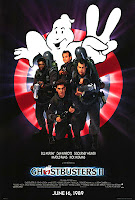
Ghostbusters II (1989) – In the sequel, the flaws are more apparent, in part because the film opens itself too much to the negative effects on time.  Operating after a real-time gap, Ghostbusters II finds the paranormal exterminators out of a job and out of public favor; if it’s a commentary on box-office demand, it’s a depressing way to begin the film.  In fact, for a comedy, this is a pretty depressing film.  Murray, whose sardonic wit carried most of the first film, seems genuinely bored here, and Aykroyd’s sincerity seems like he’s trying too hard; Ramis doesn’t do much other than serve as a punchline for other characters to imply how creepy he is.  Weaver gets more to do here, presumably as a consequence of her coronation as resident sci-fi queen; her battle to save her son from a reincarnated Carpathian portrait is genuine and compelling, even if the foe isn’t.  The film also gives Moranis a larger role, which is a credit to any movie; his desire to be a “real” Ghostbuster is touching and clever all at once.  The soundtrack, though, is distractingly outdated, even more so than the original film’s ultra-80s theme tune.  I’m feeling surprisingly down on this movie, which catches me off-guard because I loved it so much as a child (I even had the coloring book, of all things).  And it’s not to say that this is a bad movie; it’s probably as intrinsically good as the original.  But what happens in Ghostbusters II is that the cracks show more clearly so that a “just good” movie never quite transcends beyond that level.

That does it for this week’s edition of “Monday at the Movies.” We’ll see you here next week for an exciting new feature in the realm of The Cinema King – stay tuned!

Wednesday, August 11, 2010

Charlie St. Cloud (2010)

We interrupt your regularly scheduled Depp Week programming to bring you Charlie St. Cloud, Zac Efron's latest - and lightest - box office outing.

Efron plays the eponymous Charlie, taking off his dancing shoes and donning a winter coat of angst as the troubled teen who blames himself for the car crash that killed his younger brother Sam (Charlie Tahan). Charlie would have died too, were it not for the prayerful intercession of paramedic Florio Ferrente (Ray Liotta), but now that he's alive, Charlie has the unique ability to communicate with ghosts - particularly with Sam, with whom he had promised to practice baseball every day before college. But as Charlie wallows in his grief, working as a caretaker in a graveyard and throwing away his potential, he meets Tess Carroll (Amanda Crew), a spirited sailor who teaches Charlie the meaning of life - and letting go.

Allow me to first begin by saying that there is a very specific type of audience for whom this movie will hold almost unanimous appeal - and I'm not referring to the two old ladies I met this weekend who raved up and down about how "fantastic" and "spectacular" this picture was. For fans of the emotional catharsis, for Lifetime subscribers who can't get enough "life is for the living" morals, for people who just want to see Zac Efron take his shirt off - this movie offers all that in spades. But for more discerning viewers, I think Charlie St. Cloud comes up wanting.

Let me also add by way of preface that this isn't necessarily a bad movie. It's not terrible, but it's just not very good; on a scale of 1 to 10, it's probably a four or a five. The film itself is not very well-made, consisting mostly of fluffy emotions and hints of a story with more potential (potential perhaps lived up to in the Ben Sherwood novel on which the movie is based) than is acted upon. The biggest distraction in the film is Efron himself; I've admitted that I'm a fan of his career, and I think he's on his way to at least B-list stardom. But Charlie St. Cloud as a movie seems determined not to let him advance; for all the emoting and performing that Efron seems willing to do, the film spends far more time on shots that director Burr Steers (of 17 Again fame) must have consciously orchestrated in order to elicit maximum attractiveness out of Efron. There are a myriad of shots such as Charlie walking toward a window as soft light streams from the drapes and brings out the baby blue in his eyes; college students may one day craft a drinking game in which participants imbibe each time Efron takes his shirt off - two shots if the disrobing is not essential to the plot (which is, to say, always).

There are other people in the film, too; chief among them is Amanda Crew, who isn't asked to do very much in the film but who seems like she might be the next Jessica Biel if given the opportunity and a better haircut. Tahan is similarly unchallenging as ghostly Sam, but there's a sense of sibling chemistry between him and Efron which lends their scenes a genuine sense of authenticity and are some of the less improbable scenes in the film. As is often the case, Ray Liotta is criminally underused; though he makes the most of his two scenes in the film, the fact remains that he is only given two scenes in the film - hardly the stuff of a comeback, though he's an able caretaker of the film's "second chances" message, which is hammered repeatedly throughout the movie. Oh, yeah - and Kim Basinger's in here too, though I think the crew forgot about her during production as her character simply disappears with little more than an oblique "She moved" reference.

For a discerning viewer, a lot of the film will come off as very unsubtle. Dialogue consists mostly of characters shouting morals at each other - "Life is for the living!" and "You have to let go!" and "You were given a second chance for a reason!" among them. More notably, there's a plot twist borrowed wholesale from The Sixth Sense (no, Zac Efron's not actually dead, so I didn't spoil it... or maybe I did), but it's so blatantly obvious that the textbook foreshadowing barrels through the film like the freight train from Inception. But the most important lesson the film can teach us, it seems, is that Zac Efron has dreamy good looks that will plop ticketholders into seats faster than Dennis Miller can craft a metaphor.

If you've got a craving for eye candy, please see Charlie St. Cloud, if only to send a message that we're done with this whole Twilight business. Discerning moviegoers? You can still catch that Inception matinee.
Charlie St. Cloud is rated PG-13 "for language including some sexual references, an intense accident scene and some sensuality." I actually thought the innuendo was pretty tame, though parents might not like the "romantic interlude in a graveyard" scene, in which nothing but shadowplay is seen. The accident scene is startling but in a way that's been done to death; some mild blood accompanies this and another accident scene.

Stay tuned, folks, because your regularly scheduled programming for Depp Week continues next on The Cinema King as we go south of the border for Once Upon a Time in Mexico.

Thursday, March 4, 2010

Paranormal Activity (2009)

Alfred Hitchcock once opined, “There is no terror in the bang, only in the anticipation of it.” The latest in the shaky-cam horror genre, Paranormal Activity, consists of a lot of anticipation with a feeble but well-intentioned bang at the end.


We have 1999’s The Blair Witch Project to thank for this new subgenre of horror flicks, in which the camerawork is as much of a character as the actual people in the film. This is the genre that brought us Cloverfield (good), Quarantine (bad) and of course Blair Witch (ugly despite its inventiveness). Paranormal Activity falls somewhere between good and ugly, sadly falling short of its “scariest movie ever” hype (nice try, Time magazine).

New faces Katie Featherston and Micah Sloat play fictionalized versions of themselves in a seemingly haunted house. We quickly learn that Katie has been haunted since the age of eight, and the house is just the latest dwelling for something more demonic than a mere ghost.


The star of the film isn’t Featherston, who does a more than serviceable job being frightened out of her wits. It’s not Sloat, who brings a fun and slightly cynical attitude to a genre that sometimes takes itself too seriously. The real star is the camera that Micah purchases to document the titular paranormal activity that’s running rampant in the house.


Consequently, the nighttime scenes punctuated only by a timestamp are the most compelling in the 90-some minutes of the film. Katie and Micah prop a camera by their bedside before turning in for the night, and the ensuing footage forms the emotional backbone of the movie. The special effects shine (to reveal these effects would be to spoil some of the film’s more terrifying surprises), and you’ll never again look at those things that go bump in the night the same way.


If the film put more of an emphasis on these nocturnal hauntings, it might very well have been the scariest movie of the year (and heck, it might be anyway, when we consider that horror flicks tend to put more of an emphasis on chests over deaths).


But Paranormal Activity suffers from the same tendencies that irreparably hurt Blair Witch - namely, scenes in which characters recover from hauntings and try to explain what’s happening to them dominate the picture. Katie and Micah spend far too much time being afraid and not enough time being frightened; there’s a semantic but important distinction, and it makes all the difference as to whether the audience is bored or terrified.


For comparative purposes, look to 2008’s The Strangers, in which masked murderers stalked Liv Tyler and Scott Speedman in their cabin retreat. There the protagonists spent the entire movie terrified, and so did the audience. Where Paranormal Activity lets us breathe between frights, The Strangers never let up, with its omnipresent killers crouching in every shadow. The ghost/demon/whatever-it-is haunting Katie and Micah only comes out at night.


But it’s not all boring. The film hits a few great bangs, sometimes literally. Footfalls, creaks and tricks of the light (especially an ominous blink-and-you’ll-miss-it shadow) are more terrifying than anything you’ll see in the Saw series, in which the only thing left that’s still frightening is that the franchise hasn’t been euthanized.


But if Paranormal Activity marks the death knell of the shaky cam genre, it’s an appropriate bookend. Blair Witch wasn’t scary at all, but it showed some potential. Paranormal Activity, on the other hand, cashes in on that potential but still leaves something to be desired as far as quantitative scares go.


At least, that’s what I’ll tell myself until the next time I hear a creaky floorboard in the middle of the night.


Paranormal Activity gets a spooky "R for language," which includes a few heat-of-the-moment F-bombs but does not include the bangs and jump moments for which the film is infamous.

Tuesday, June 2, 2009

Wind Chill (2007)

Let's go ahead and put Wind Chill on the list of reasons why I like George Clooney, who produced this thrilling horror picture directed by Gregory Jacobs. You won't, of course, feel any of Clooney's influence on the work, but I'm glad he was smart enough to bring this movie to life.

I've been a big fan of Emily Blunt since becoming a begrudging fan of The Devil Wears Prada (and, to an extent, Meryl Streep), and so her starring role in a horror film (after my recent encounter with the disappointing Blair Witch Project) was enough of an impetus for me to pick up a movie I'd never even heard of and give it a shot.

I'm glad I did. Blunt plays a college student traveling home to Delaware for Christmas break. Rather than take the bus home, she checks the ride board and finds a car headed to Delaware, though she's initially perturbed by the shy yet subtly unsettling driver, who's concealing a fairly large secret. A detour on Route 606 goes awry, and the two crash into a snowbank. Yet the budding conflict between these two co-eds is the least of their worries; the snowy woods, naturally, appear to be haunted.

First, I must offer the same caveat I gave when reviewing The Descent - perhaps this film only worked because I watched it after midnight with all the lights off. At any rate, that certainly helped make the movie a success. What helps more is the direction Jacobs gives here, building an ominous mood throughout the work, beginning with the mystery surrounding Holmes's character and reaching its discomfiting peak as the never-named protagonists try to wait out the snow storm until dawn. This movie has just the right amount of just the right kind of chills, the kind that made The Strangers a surprise success - those moments where we see an out-of-focus figure lurking just behind our oblivious hero (here, heroine more often than not). The ghosts in these woods are numerous, each more frightening than the last; though it's difficult to top the first ghost Blunt encounters, Martin Donovan's sketchy highway patrolman comes darned close.

There are a few moments in the movie that come close to not working, but they're quick and don't interfere with the thrills and chills the movie offers. The introduction of a philosophical tenet key to the meaning of the film seems a touch hackneyed, though it's quickly (and deftly) forgotten, only to be recalled when it matters. Furthermore, the movie falters a little when the history of Route 606 is revealed; the movie's put virtually on hold for a minute or so while one character narrates a ton of exposition that, honestly, attentive viewers would have been able to piece together.

And the ending. It's a good ending the way screenwriters Joseph Gangemi and Steven Katz crafted it, but it could have been a touch better if the writers had gone for a Twilight Zone-style twist ending rather than the easier and more digestible dénouement. (After the ratings analysis, I'll tell you what my ending would have been, for those interested.)

For those looking for a few good chills and a deep unsettling feeling in the pit of one's stomach, Wind Chill is perfectly serviceable in that regard. When done right, the formula of Pretty Protagonist + Creepy Male + Ghosts + Eerie Surroundings ought to equal success. The formula frequently falters, however, but Wind Chill adds up in all the right places.


The MPAA rated Wind Chill "R for some violence and disturbing images." It'd be brutally painful for me to reveal what these images are, since they're strong elements in the surprisingly dreadful mood Jacobs works so hard to craft. Suffice it to say that the ghosts are very unattractive, in varying stages of decay, and some of the ramifications of the car crash aren't pretty either.

Now for The Cinema King's ending. As it stands, the film ends - SPOILER ALERT - with Guy dying and becoming one of the ghosts, doomed as it were to repeat this life. Guy manages to save Girl from Patrolman and eventually leads her through the snowy woods to safety. What I would have liked to see would have looked very similar to this, only with Girl becoming one of the ghosts, as well. Something like that would have brought the theme of repetition fully to life, would have put that final kick to the audience's gut, and would have made Rod Serling blush with envy. In the words of the great and venerable Dennis Miller, "Of course, that's just my opinion. I could be wrong."