Showing posts with label Steve Carell. Show all posts

Monday, June 30, 2014

Monday at the Movies - June 30, 2014

Welcome to another edition of “Monday at the Movies.” This week, we tackle two truly despicable movies.

Despicable Me (2010) – Hardcore Disney snobs like myself often miss out on good animated films from other studios simply as a matter of personal prejudice, and Despicable Me is certainly among those nearly-missed opportunities.  I say “good” and not “great” not because Despicable Me is a disappointment – it isn’t – but it never fully accesses the transcendent quality of, say, an Up or a Toy Story 3.  Instead of striving for exceptionalism, Despicable Me is quite satisfied with telling a rather familiar story; here, sinister supervillain Gru (Steve Carell) finds his heart warming when he involves three adorable orphans in his scheme to steal a shrink ray and, by extension, the moon.  It is a story, as Beauty and the Beast would have it, as old as time, but the filmmakers work to tell a solid rendition of that story.  What they bring to the table – and what I say is ultimately the film’s greatest success – is a cuteness factor that goes up to eleven.  It’s funny that Gru is somewhat sidelined (at least, for this reviewer) in his own movie; I, and I suspect other audience members as well, was more captivated by the pygmy-like yellow jabbering Minions and their setpiece antics.  The scene-stealer, though, is the youngest of the orphans, Agnes (Elsie Fisher), who has a way with both youthful naïveté (mistaking a Cheeto for a caterpillar) and boisterous overexaggeration (“It’s so fluffy, I’m gonna die!”).  Perhaps the reason these two contingents steal center stage is because the main antagonist, voiced by Jason Segel, is neither interesting nor tolerable; consequently, we want to see Gru succeed not on his merits, but rather so we can be shut of Vector and his irksome antics.  Fortunately, the film compensates with an “aww”-inspiring supporting cast.

Despicable Me 2 (2013) – As much as I liked the first film for what it was, I enjoyed the sequel even more because it rectifies the first film’s major sin and continues to spotlight Agnes and the Minions.  Carell is back as Gru, this time contracted by the Anti-Villain League to find a villain who’s stolen a MacGuffin; Gru is partnered with an affable newbie, Lucy Wilde (Kristen Wiig), while beginning to suspect Mexican restaurateur Eduardo Perez (Benjamin Bratt) of being the former villain El Macho.  By giving Gru a more compelling plotline and a more engaging cast of immediately supporting characters, the film gives Carell more interesting material, which subsequently sharpens his game.  Despicable Me 2, still directed by Pierre Coffin and Chris Renaud, is acutely aware of what worked in the first film – namely, Agnes and the Minions – and pulls off a remarkably difficult feat:  it’s a sequel with restraint.  Rather than pelt us with overdoses of essentially the same jokes, Coffin & Renaud amplify without deafening.  There are more Minions, yes, but they’re still funny because of the non sequitur nature of their nattering and flair for costuming (personal favorite: “French Maid Minion”).  Ditto for Agnes, who’s still soul-crushingly cute, but now for different reasons than before.  All told, Despicable Me 2 feels more organic, less storytelling-by-numbers than its predecessor, which makes me optimistic about the two forthcoming entries in the franchise.  These aren’t genre-bending films, nor are they tremendously innovative, but don’t mistake their unsophistication for drivel.  Despicable Me 2 is plenty of fun, with a strong additive of cuteness – a solid middle-of-the-road animated film without lofty ambitions but with instead a keen earnestness.

That does it for this week’s edition of “Monday at the Movies.” We’ll see you here next week for the Double-Oh-Seventh of the month!

Monday, July 30, 2012

Monday at the Movies - July 30, 2012

Welcome to Week Twenty-Eight of “Monday at the Movies.”  A few romantic comedies on tap this week, plus a film so disturbing I feel uncomfortable saying I enjoyed it.

A Clockwork Orange (1971) – A long, long time ago, I directed readers to an essay by David Bordwell in which he draws the distinction between an excellent film and a film that is to one’s liking.  I invoke Bordwell here because I think he might be the key to my take on Kubrick’s A Clockwork Orange; it’s a great film, certainly, excellent by technical standards and one of Kubrick’s more accomplished films, but it’s entirely different to “like” on a purely evaluative level.  For one, its protagonist Alex DeLarge (Malcolm McDowell in the epitome of a career-making performance) is a brutal sadist who spends his evenings raping and engaging in “ultra-violence.”  Perhaps worse, Kubrick’s filmmaking attempts to get us to sympathize with – and even like – Alex, a disconcerting premise once you realize what’s afoot.  I’m probably in the minority on this one, but I usually find Kubrick a bit... boring; Dr. Strangelove is, I admit, genius, but I’ve never been able to watch 2001 or The Shining in one sitting because they seem plodding and aimless – which may be the point, perhaps, but they’re just not “to my liking.”  (The first hour of Full Metal Jacket, though, is brilliant.)  But here Kubrick displays his ability to keep a scene moving even if the camera is stationary, and though much of the film is repulsive on a moral level, it’s transfixing on an aesthetic one, helped in no small part by the quirky yet unspeakably evil performance McDowell turns in.

Crazy, Stupid, Love (2011) – I’m on record as not being the world’s biggest Steve Carell fan, and Crazy, Stupid, Love does very little to swing me in the other direction.  Which is not to say that the film isn’t enjoyable – halfway far from it.  I say halfway because there are really two movies going on in Crazy, Stupid, Love (one, it seems for each unnecessary comma in the title):  in one, divorcee Steve Carell tries life without his wife Julianne Moore, while in the other his womanizing wingman Ryan Gosling reforms his ways after meeting girl-of-his-dreams Emma Stone.  As is usually the case with these kinds of films, it’s the latter plot, the supporting one, that succeeds far more than the former.  The problem, perhaps, is that Carell is too real as a man who’s had his heart ripped out; just when the supposed comedy is getting to the funny bits, Carell mopes into frame with his sad-sack character to remind us just how miserable he is.  It’s a shame, because Gosling and Stone are so talented and so charismatic together that one wishes for a movie revolving solely around them.  As a consequence of being so schizophrenic, the film’s message is a mixed one – is love possible or not?  Or is it merely difficult but worthwhile?  If the latter, tell me something I don’t know.  Aside from the Gosling/Stone scenes, I will credit the film with a rather clever third act twist, something I didn’t know to see coming.

Friends with Benefits (2011) – Remember that time that the two leads from Black Swan starred in separate movies about casual sex?  I certainly do, but after seeing Natalie Portman in No Strings Attached (with an uninspiring Ashton Kutcher as her co-lead) I wasn’t exactly ready to join Mila Kunis and Justin Timberlake in Friends with Benefits.  Turns out the joke was on me, because Friends with Benefits is by far the better of this odd couple.  Director Will Gluck, who made such a winner out of Easy A with Emma Stone, creates a solidly funny film here, which is by and large victorious thanks to the infectious chemistry between Kunis and Timberlake; their characters are likeable from the first, and – pivotally for a comedy film – they’re funny, too.  Also back from Easy A is Patricia Clarkson, who reprises her role as the kooky and sexually liberated mother, this time of Kunis’s character.  The only part of the equation that doesn’t fit is Richard Jenkins as Timberlake’s Alzheimer’s-afflicted father, whose outbursts lead not to comic relief but to unexpectedly heartfelt pathos.  While the film falls prey to the clichés of the romantic comedy genre, it does so more credibly than No Strings Attached, without asking us to cry for the protagonists when their bizarre experiment complicates itself.  Wisely, the film remembers that we have to like our characters in order to want to see them together, and Gluck and company – particularly his leads – achieve both by leaps and bounds.

That does it for this week’s edition of “Monday at the Movies.” We’ll see you here next week!

Tuesday, June 8, 2010

Anchorman: The Legend of Ron Burgundy (2004)

I believe Anchorman has reached a place for (at the very least) my generation at which it can be regarded as a comedy classic, and so - at the risk of redundancy - I submit for your approval my glowing review of the film that really made Will Ferrell a movie star.
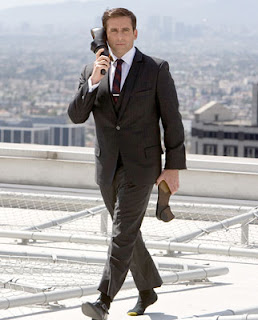
Ferrell plays Ron Burgundy, top newsman in San Diego and leader of the Channel 4 News Team; loyal sidekicks include boisterous Champ Kind (David Koechner) on sports, ladies' man Brian Fantana (Paul Rudd) on features, and 48-point IQ Brick Tamland (Steve Carell) on weather. The "man's world" of the 1970s is rocked when Channel 4 adds Veronica Corningstone (Christina Applegate) as the industry's first female anchor; soon, Ron and Veronica find themselves alternating between bouts of lovemaking and (somewhat un)professional rivalry.

In a way, I believe that Anchorman came at a time that redefined the American comedy; coupled with movies like Wedding Crashers and Dodgeball - note the shared cast members in all these - Anchorman introduced to audiences the new face of comedy, both personally (with new cast who hadn't really done comedy on film before) and metaphorically (in terms of the kinds of laughs to be elicited). Anchorman represents a slip in the "mugging for laughs" movement I associate with people like David Spade and Norm MacDonald, who pause or crack grins after saying or doing something funny so that the audience has time to laugh before the movie continues on; here, though, the laughs continue on more like a rolling barrel down a hill than down a staircase - like a snowball as distinct from a jumping bean.

This success is due in large part to first-time director Adam McKay, who knows how to time a lot of the jokes and doesn't prolong any scene beyond its lifespan. Exactly the opposite - McKay has a keen sense for timing, knowing exactly how long a scene needs to be while remaining funny. Best example? The news team rumble that occurs halfway through the film. It begins with a few modest giggles, particularly because of the perfectly overdrawn rival anchor Wes Mantooth (Vince Vaughn). Soon, though, it escalates into the territory of the absolutely ludicrous, with Mexican newsmen joining the fight as a flaming man and a brandished trident amp up the comedy until the shot quick-cuts away from the fight to a post-game pep talk in Ron Burgundy's office, all paced perfectly. One wonders if the Coen Brothers were inspired by this cut when crafting the J.K. Simmons scenes in Burn After Reading (also a modern comedy classic).

But more credit belongs to all the performers, who display a deft capacity to create fully fleshed-out characters with a funny bone the size of Nebraska. Ferrell is in front and deservedly so, but his supporting cast shines brighter if only because there are just so many of them. Rudd, Koechner, and Applegate are fine supporting characters, subtly revealing more about their characters as the film progresses. But it's Carell who steals the show in a way that all the best comedic supporting actors can; Brick Tamland's the one who gets quoted the most by fans, if only for his brilliantly subdued "I love lamp" and his portrayal of a borderline-retarded weatherman whose perpetual disorientation only gets funnier and never feels like a broken record. Anchorman is littered with bit players like Vaughn, Fred Willard, Jack Black, Danny Trejo, and Seth Rogen who do fine work here even though they're not given very much screen time at all. Small doses, especially when it comes to perfect comedic timing, aren't always a bad thing.

What I like best about Anchorman, though, is the brand of humor the film employs, emphasizing personality over action, situation over punchline. Sure, it's funny to see Ron and Veronica throw typewriters at each other, but what's funnier about this scene is the clash of personalities at stake and the fact that each character believes themselves superior to the other. I've lambasted films for being all anticipation and no bang, but Anchorman handles anticipation in a bold new way; by introducing characters who are already funny, we can't help but laugh when we see these characters, even if they're not doing anything funny. Brick Tamland is funny even when he's not putting marshmallow fluff into a toaster, precisely because he's the kind of character who puts marshmallow fluff into a toaster. Ron Burgundy is funny not because of what he says or does, but he's funny purely on the virtue of being Ron Burgundy. Simply put, the movie earns all of its laughs.

In short, I cannot fathom any serious moviegoer, especially one who loves comedies, who has not seen this movie. Anchorman - along with its protagonist, Ron Burgundy - truly is legendary.
Anchorman: The Legend of Ron Burgundy comes in two varieties - one of which is rated PG-13 "for sexual humor, language and comic violence." The dialogue is raunchy but not distractingly so, although it is incredibly sexist. One key F-bomb and a few lesser profanities (most of them excremental in nature) appear, as does a ludicrous fight scene played for laughs. An unrated version is only marginally different, with slightly more F-bombs and a bit more sexual dialogue, as well as more excremental material.

Saturday, June 21, 2008

Get Smart (2008)

Would you believe "best movie of the year"? No. Would you believe "funniest movie of the year"? No. Would you believe "so-so espionage farce with a few good chuckles"?

That's approximately my assessment of Get Smart, a movie that unfortunately let all of the good parts out of the bag with its marketing campaign. A sequel/update of the classic television series of the same name, Get Smart is a spy farce in the tradition of Austin Powers with Steve Carrell as the imperfect Maxwell Smart, Agent 86 in CONTROL.

When Smart is promoted by The Chief (Alan Arkin, perhaps the funniest actor in the movie), he teams up with sexy superspy Agent 99 (an incredibly gorgeous Anne Hathaway) and the suave Agent 23 (Dwayne Johnson, who is still "The Rock" even if he drops the nickname from his credits) to fight the forces of KAOS and its pseudo-leader Siegfried (Terence Stamp, who's again as out of place here as he was in Elektra). Obligatory references to the original TV show, half-hearted laughs, and spectacular explosions ensue.

Something tells me this movie would have been funnier if I hadn't seen the trailers, although call that the "Cinema King Paradox" - too-good trailers ruin a movie, but I wouldn't see a movie if I didn't like the trailers. Go figure. The problem here is that all the funny moments, punchlines, and slapstick choreography have been spoiled by the trailers, which contain the best parts of the film. One notable exception - Alan Arkin delivers a line near the end of the film that made me about fall out of my chair. Oh, yeah, that and crunchy pudding. And a hysterical cameo by Patrick Warburton (Puddy) as... well, I won't ruin it. Best casting since Heath Ledger as The Joker, though.

(Speaking of The Joker, I was inordinately thrilled by the presentation of the "Happy Trails" trailer for The Dark Knight which appeared before my screening of Get Smart. Available at http://whysoserious.com/happytrails for those poor folks who haven't seen it yet.)

Perhaps part of the problem is that Get Smart tries to be a serious espionage story with injections of comedy. What's then disorienting about that is that the film falls into all the spy tropes - feuding partners who fall in love, a surprise double agent (whose identity I predicted even before the story introduced the threat of a double agent), the villain's henchman who develops a conscience, &c - without adequately poking fun at these cliches --- something the Austin Powers scene did brilliantly. [I still crack up at the scene where Dr. Evil's son asks him of Austin Powers, "Why don't you just shoot him?!"]

There aren't as many laughs as the trailer would lead you to believe, and if you've seen the trailer, you've already seen the best parts of the movie. But there's something to be said for a movie that contains a ton of explosions, something a filmgoer such as myself can always appreciate. It's just that I was looking for something a little more substantial in a movie this weekend. Of course, it was between this and The Love Guru, so I think my choice was fairly obvious.

Oh, well. Missed it by that much.