Showing posts with label Morgan Freeman. Show all posts

Monday, April 21, 2014

Transcendence (2014)

While I spend a lot of time on this blog heralding the innovative vision of Christopher Nolan, I’ve never mentioned the name Wally Pfister, Nolan’s chief cinematographer and a key guiding hand in the creation of that aforementioned vision.  The shadow of Nolan looms large over Pfister’s directorial debut Transcendence, though the end result feels more like the work of an impressionist than a disciple.

Transcendence stars Johnny Depp as Dr. Will Caster, an artificial-intelligence scientist shot with a radiation-laced bullet by anti-tech terrorists.  During his last weeks, Will’s wife Evelyn (Rebecca Hall) works to digitize and upload her husband’s consciousness, to the dismay of their friend Max Waters (Paul Bettany).  Max fears that the program Evelyn activates isn’t really Will, fears that take on weight when “Will” quickly advances beyond the realm of the possible.

Transcendence clearly rides the post-Inception wave of high-concept science fiction, a wave dominated by the technical achievement of Gravity.  With Transcendence, Pfister and screenwriter Jack Paglen tackle the issue of the singularity, a post-human digital environment epitomized by the idea of “living long enough to upload.”  The film poses a number of important questions about this technology – how much of a personality is changed during the dehumanizing process of uploading?  What are the upward limits of “transcendence”?  And at what point does AI surpass our understanding of conventional morality?

Unfortunately, Transcendence never really answers those questions, stopping short at presenting them.  What’s frustrating, though, is that the film presents these questions as though they will become important plot points, as when anxiety arises about whether “Will” is really Will; though at least one scene teases an answer to the question, it’s never revisited until the conclusion, which takes the answer for granted.  To be fair, this is Paglen’s film debut as well as Pfister’s, and he’s already offered something smarter than most science fiction does, but it is only half the battle.

Just as the script only takes us halfway there, the rest of the film never quite emotionally engages.  Depp and Hall have genuine chemistry together, playing the quirky-scientist-couple brilliantly in the one scene they have together before Will is shot, and Hall proves herself the actual star of the show with a commanding lead as the increasingly-distraught Evelyn.  As for Depp, he acquits himself rather well, playing a subdued performance that you won’t believe comes from the same man as last summer’s Tonto.  The rest of the cast, though – Morgan Freeman and Cillian Murphy among them – are basically interchangeable, which is a shame given the range they’ve displayed elsewhere (and largely in Nolan films).

This, then, is the larger weakness of Transcendence – its inability to pass the Plinkett test,1 which requires characters to be distinct beyond physical appearance and function to the plot.  Will and Evelyn for all intents and purposes pass the test, though none of the other characters do.  The result is a fairly uneven film, in which two out of three running plotlines proceed purely on the requirements of the narrative itself.  The film needs an antagonist for its central AI-based protagonist, so a thinly characterized terrorist group (RIFT) is created, with oblique gestures at their motives.  Common sense suggests that the US government might object to the existence of “Will” on their soil, so a team of government agents chases the plot wherever it goes.

I’ve never fully understood why some moviegoers have difficulty connecting emotionally to Christopher Nolan’s work.  Despite the overtly cerebral nature of his films, they’re anchored by very human stories, such that the very ending of Inception cares more for how its protagonist acts than whether what’s happening is actually real.  (The same can’t be said for twist-ending flicks like The Sixth Sense, where the revelation is all.)  With Transcendence, though, I feel like I’ve approximated that sensation; Will and Evelyn aside, I couldn’t engage emotionally with any of the characters on screen and indeed found several of their decisions – mostly shifts in allegiance – to be baffling beyond the necessity of the plot.  I have no idea, for example, how Freeman’s character goes from desk-jockey scientist to FBI analyst, or why (potential spoilers ahead) Paul Bettany’s character joins up with RIFT – beyond, that is, the need for characters in a film to move toward the conclusion of the plot.

At the core of Transcendence is a very moving, very meaningful science-fictional take on a hetero-organic marriage between a woman and her computer – the dark response, I suppose, to Spike Jonze’s Her.  Orbiting that compelling story, though, is a series of narrative false steps and mechanical storytelling that make Transcendence more of a disappointment than Pfister’s promising career to date would have foretold.  One wonders what would have come of “Christopher Nolan’s Transcendence” had a more deft filmmaker been at the helm.  Transcendence is just shy of a failure, feeling more like the training wheels on Pfister’s bike were taken off a bit too soon.

Transcendence is rated PG-13 for “sci-fi action and violence, some bloody images, brief strong language and sensuality.”  There are a few shootings with a fair amount of blood (mostly seen as bloodstains on clothing), and some viewers might be ooked out by the moments when machines augment human bodies via healing or implantation.


1 Plinkett dismantles the Star Wars prequels in a series of YouTube videos for many reasons, most prominently its failure to create characters as rich as the ones from the original trilogy. A focus group in his Phantom Menace review is able to describe with great precision the personalities of Han Solo and C-3PO but is unable to do the same for Qui-Gon Jinn and Queen Amidala.↩

Monday, February 17, 2014

The Lego Movie (2014)

It’d be a very short putt to brush off The Lego Movie as an extended toy commercial, but it would have been even easier to make that version of the film.  Instead, and fortunately for moviegoers, The Lego Movie more than lives up to its theme tune, “Everything Is Awesome,” by being exuberantly fun, deliciously creative, and containing a whopper of an important message.

Emmet Brickowski (Chris Pratt) is your average-joe Lego minifigure, indistinct in every way until he finds the Piece of Resistance, an object which freedom fighter Wyldstyle (Elizabeth Banks) and wizard Vitruvius (Morgan Freeman) tell him is the key to saving the Lego universe from the dastardly plans of President Business (Will Ferrell).  Emmet joins the other Master Builders – including spaceman Benny (Charlie Day), Unikitty (Alison Brie) and Batman (Will Arnett) – to discover his awesome destiny.

Critical approval of The Lego Movie is currently holding at 96% over on that tomato-based review site, and it’s no wonder.  Rather than pander to what we’d expect from a film based on a toy (looking at you, Transformers), The Lego Movie does some very creative things while building that creativity into the very fabric of the narrative, literalizing what amounts to a cogent critique of the current state of cinema.  The dystopia of The Lego Movie is the consequence of a cultural apathy for innovation, a contentment to follow instructions, ingest empty pop music, and consume expensive coffee.  The Lego builders rely on old formulas, stable sets of instructions to shape their world.

As a remedy for the plight of creativity, Emmet learns to build outside the box, without the crutch of directions.  Like the rest of the Master Builders, Emmet has to think in new ways, assembling extant pieces into original and fantastic shapes, utilizing the old forms only when absolutely necessary.  It’s a wonderful commentary on Hollywood’s remake-happy philosophy; rather than give moviegoers something they’ve never seen before (Emmet’s double-decker couch), filmmakers are all too reliant on proven formulas (cars with a wheel... and three other wheels).

It’s perhaps ironic that Batman is included in the Master Builders in the film, as he’s one of the most frequently deployed “pieces” in Hollywood’s toybox.  But even in the case of Batman, The Lego Movie proves its point.  We’ve seen possibly every incarnation of Batman on the silver screen – a deliberately campy one in 1966, Tim Burton’s comic-booky version, Schumacher’s homoerotic-inflected hero, and back to Nolan’s ultra-gritty realism – but The Lego Movie avoids falling into the stereotype of any of the previous incarnations by taking Batman in a new direction, guided by Arnett’s perfect voiceover work.  Taking a satirical bent on the “Dark Knight” and all his grim trappings, Arnett’s Batman is performative and growly, but it’s moments like Batman’s hatred of rainbows that add something new to the character.  Taking the pieces that filmmakers have already used, The Lego Movie shows us how to be creative by reinterpreting and revising (emphasis on “vision”).  Take note, Zack Snyder!

The Lego Movie is so delightfully self-aware, casting Morgan Freeman as an omniscient sorcerer but continually undercutting the character with delightful one-liners.  The film is full of surprises, best experienced and not spoiled, so I’ll refrain from my usual litany of review bullet points and conclude by saying that The Lego Movie is, simply put, awesome.

The Lego Movie is rated PG “for mild action and rude humor.”  Really, the movie is quite tame, and were it not for a scene or two where Lego figures are threatened with being melted, it’s entirely appropriate for all audiences.  I mean, my goodness – the characters won’t even say “gosh” as a swear word (Emmet spells it out to avoid speaking it).

Monday, November 18, 2013

Last Vegas (2013)

We’ve come to regard The Hangover as a kind of golden standard which at least perfected the “weekend gone wrong” genre (if not kickstarting it).  And Last Vegas, with its all-star cast of Hollywood’s golden-year’d actors, has been marketed as a kind of Hangover for the over-50 crowd (or, unintentionally, 20-somethings like me).  But where Last Vegas sputters in places The Hangover soared, the film ultimately entertains on the sheer ethos of its A-list, A-game stars.

Last Vegas finds Michael Douglas on the eve of his marriage to his early-30s trophy girlfriend.  After convincing the reluctant Robert De Niro to join in spite of his “unresolved issues” with Douglas, Kevin Kline and Morgan Freeman fly to Las Vegas for the big reunion and the bachelor party for their perennially single friend.  Hijinks, of course, ensue.

Where The Hangover was innovative in the unexpected relentlessness of its rolling-in-the-aisles laughs, Last Vegas is the victim of its own marketing campaign, which tragically blew some of the best gags in the film (the rotating bed and Morgan Freeman’s window escape, to allude to a few).  And having seen the trailer more than once (the consequence of being a too-frequent moviegoer), these truly funny moments didn’t elicit much more than a weak chuckle – less than they deserved, but all I could muster.  There are a few genuine laughs (i.e., the conceit that a misogynistic “bro” mistakes the four friends for mobsters), but the best, to rework the old Browning poem, has already been.

Last Vegas never really surpasses the brilliant idea of “let’s get all our talented old people in one movie” (see also Red, The Best Exotic Marigold Hotel).  And not every movie needs to surpass convention, so if I dial back my standards of grandeur Last Vegas ends up being a pretty successful film.  The “Flatbush Four” are all reliably gifted performers and play to their strengths – Douglas the charismatic bachelor, De Niro the crochety East Coaster, Freeman the polysyllabic golden-throat, and Kline the goofy sidekick.  We know their work well enough to know what to expect, though a nice surprise comes from De Niro’s more heartfelt moments; from an actor who sometimes seems to phone it in, it’s nice to see a performance that (while not Oscar-worthy) still plucks a heartstring or two.  In fact, any one of these actors is worth the price of admission, and the combination of four can’t help but succeed, even in a bad movie (which, fortunately, Last Vegas isn’t).

The other nice surprise about the film – which, decently, the trailers didn’t spoil – is Mary Steenburgen’s lounge singer Diana, a keen counterpart to the testosterone-heavy cast.  (Sidebar:  I just realized she’s for this film what Heather Graham was for The Hangover.)  She won’t be passing any Bechdel tests any time soon, and I can’t say I was a fan of the predictable “older woman course-corrects girl-crazy bachelor” plotline, but at least the film keeps us guessing on which bachelor she’ll land.  Diana is a different brand of character than the competitive machismo fleshing out the rest of the cast, often calling out characters on their self-deceptions; it’s a clever storytelling technique which allows the film to be smarter than a less rigorous draft of the screenplay would have been.

Ultimately, Last Vegas didn’t knock me out like I wanted it to, but 90 minutes in the company of four of Hollywood’s finest is, to quote one of my professors from my first semester of graduate school, “as good a choice as any.”

Last Vegas is rated PG-13 “for sexual content and language.”  There’s a seduction scene in which nudity is implied, though we see nothing more than bare shoulders; there are a few unenthusiastic and brief innuendos, as well as (according to IMDb) one F-bomb and a few weaker profanities.  Quite tame, particularly compared to The Hangover.

Thursday, June 13, 2013

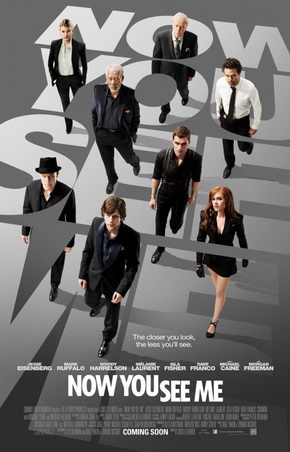
Now You See Me (2013)

The movies are a magical experience, and movies about magic can double up the fun by drawing attention to the innocuous deception of a theatrical illusion.  Unfortunately, Now You See Me spends so much time swaggering that it never really enchants. Now You See Me is ostensibly the story of four semi-professional magicians (Jesse Eisenberg, Woody Harrelson, Isla Fisher, and Dave Franco) who pull off a series of elaborate magic tricks as The Four Horsemen.  But when their illusions begin to look like theft by way of social justice, FBI agent Dylan Rhodes (Mark Ruffalo) and professional debunker Thaddeus Bradley (Morgan Freeman) begin to realize the magicians are, of course, not what they seem.

The key to any successful slight of hand is that the audience has to be so distracted by the flair that they miss the real trick.  Take Christopher Nolan’s The Prestige, a clever (perhaps brilliant) case study of competitive magicians; you’ll be so fascinated by the rivalry between Christian Bale and Hugh Jackman that you’ll miss the clues dropped by the filmmakers.  It’s possibly unfair but entirely unexpected that I’d make this comparison, but Now You See Me doesn’t let the audience play along.  Instead, we’re practically kidnapped, tied down by a film that continually insists on its own brilliance, reminding us at every turn that they’re smarter than we are.

Sure, I can be smarter than you if I don’t tell you what’s going on.  Then, the film gloats by showing you what really happened, though these scenarios are couched in so many maybes and perhapses that it’s never wholly clear what’s going on.  And when your focal character is an investigator, it’s a bit empty to have him never really understand anything.  Ruffalo’s solid as the not-smartest man in the room, and his charisma is enough to hold your attention, but it seems like a less successful riff on his character from The Brothers Bloom, which is saying something.

As for the rest of the cast, you’re looking at the disappointment of the summer.  The four leads have all done good work in the past, but the screenplay is incredibly thin, failing to distinguish any of the four characters beyond physical appearance.  You could rotate the actors in the cast, and it really wouldn’t matter; the characters are so boilerplate and so frustratingly identical that you’ll struggle to connect with them.  Perhaps the film’s worst offense?  Morgan Freeman and Michael Caine never share the frame; their scenes together crackle like a master class in acting, but we never get to see them side-by-side, which gives it a phoned-in feel.

Having said that, there’s a bit of fun to be had in some of the film’s stagier moments.  When The Four Horseman are performing, it’s an opportunity to chew some scenery, and the four leads do well there.  You might even want to see a full show by them at some point, since they convey a sense of infectious enthusiasm for their work.  And, naturally, once you’re told you’re about to be tricked, it’s engaging to watch and try to figure out where the trick is.

As Michael Caine said in The Prestige, “You want to be fooled.”  It’s a good thing, too, since Now You See Me never gives you an opportunity to figure out how the trick is done.  Nor is the ultimate explanation a fulfilling payoff; a last-minute twist is so clichéd that you’ll have already dismissed it as “too obvious.”  Now You See Me is superficial and a bit irksome, continually reminding you of its own cleverness without ever earning the moniker of “smart.”  Sad news for a strong cast, but the real trick is on the audience.

Or, in other words, now I saw it, now you don’t.

Now You See Me is rated PG-13 for “language, some action, and sexual content.”  There’s an F-bomb, playful banter, and some shouting; action consists of a car chase, a few explosions, and some shouting.  And there’s an aborted make-out scene thrown in to earn the “13.”

Monday, March 25, 2013

Olympus Has Fallen (2013)

Slavoj Žižek famously remarked that September 11th had been the real-world equivalent of the disaster fantasies gleefully played out in American cinema for decades before – our secret cultural dream had come to life as a horrible nightmare.  If that’s the case, I’m concerned about what that bodes for Olympus Has Fallen, a serviceable if not entirely memorable political disaster thriller.

Essentially 24 by way of Die Hard, Olympus Has Fallen finds the White House under siege – then occupied – by North Korean forces who take the President (Aaron Eckhart) hostage.  With the Speaker of the House (Morgan Freeman) in charge, the United States government is about to accede to the terrorists’ demands before they realize they still have a man on the inside – former Secret Service agent Mike Banning (Gerard Butler), who vows to save the President.

This movie seemed to come out of nowhere for me; I hadn’t seen any trailers until the week before it opened, and the only thing I thought I knew was, “Isn’t Channing Tatum supposed to be in that?”  (Turns out he’s doing White House Down, set to release in June.  Time will tell which one is the better variation on the theme.)  But when I heard Antoine Fuqua was directing, all I had to do was remember Training Day before plunking down in the second row.  Looking back on Fuqua’s filmography, Olympus Has Fallen is much closer in tone to his more action-y King Arthur and Shooter than the tense thriller Training Day, which perhaps owes more to Denzel Washington’s astounding performance.  But Fuqua’s ability to direct the heck out of an action sequence serves Olympus well; the initial takeover scene is dreadful in that it’s full of the dread that accompanies the inevitable.  While the film slightly overplays the patriotism card by opening and closing on an American flag, the sight of the White House under siege ought to dishearten American filmgoers, and Fuqua’s direction highlights the simplicity of its vulnerability, recalling similarly unflinching terrorist attacks from 24.

But here’s the thing about comparing Olympus Has Fallen to other entries in the political action/thriller genre – this isn’t a terribly original movie.  You’ve seen a lot of iterations of this plot before, you can telegraph most of the main beats thanks to some unsubtle foreshadowing, and to be perfectly honest the film won’t live up to some comparisons.  For example, the equally hokey Air Force One, regardless of the special place it holds in my heart, is more personal and therefore more compelling, and it’s tough to top Die Hard when it comes to movies about a man alone in occupied territory.  But if originality is the biggest misstep in Olympus Has Fallen, fine – it does well within the genre, its action sequences are fine, and its protagonist is highly engaging.

Morgan Freeman is stellar as always, especially when he grapples with the gravitas of his new responsibility.  I didn’t entirely buy the idea that he’s ill-equipped for the job, as the movie seems to insinuate; wisely, though, the film doesn’t stress this issue, especially because Freeman’s played presidential before, to some acclaim.  Eckhart continues channeling that Americanness-by-Redford, his snarling defiance of the terrorists recalling the best of his role as Harvey Dent.  But it’s Butler’s show, by far, and he’s such a good action hero that you’ll never ask yourself, “Why didn’t they get Bruce Willis?”  (From what I hear, maybe this should have been the latest Die Hard?)  Between this and 300, let’s give Butler the “next action hero” crown; he’s got the physicality down, he has the relatable everyman features, and he’s the master at those snide one-liners.

At the end of the day, though, those one-liners probably won’t stick in your head.  Olympus Has Fallen won’t be making my BluRay wish list come fall, but if I see it on cable in between bouts of channel-surfing, I’m sure I’ll stop back in.  Though it shares a few cast members, Olympus Has Fallen is no Dark Knight Rises – it is, however, enjoyable enough.

Olympus Has Fallen is rated R “for strong violence and language throughout.”  This is a pretty bloody flick with a lot of shootings and stabbings, peppered with salty language in F-sharp.

Friday, August 31, 2012

The Dark Knight Rises - EPIC Review

Enough time has passed, I believe, that a more extensive and more specific look may be taken at Christopher Nolan’s The Dark Knight Rises.  In the tradition of 2008’s “Epic Review” of The Dark Knight, I’ll be discussing more in depth what I enjoyed about the film, which will inevitably entail spoilers of both general plotlines and specific dialogue which I’ll invoke.  The goal is, I hope, to provide a more detailed assessment of the film beyond my earlier review which gushed over the technical aspects of the film but could only allude to the story and its effect on me.  For safety’s sake, the bulk of the review can be found after the jump; those reading this review from anywhere other than the front page will be advised that spoilers begin below the first image in this review.

I cannot stress this enough:  if you have not seen The Dark Knight Rises yet, do not read any further.  The success of the film depends wholly on allowing it to develop at its own pace; any spoilers therein would detract from the overall experience.

Wednesday, July 18, 2012

Armrest Review - The Dark Knight, Part One

Welcome to another edition of “Armrest Reviews,” a new series in which I, The Cinema King, will partner up with a fellow filmgoer to review films as we watch them.  That’s right, we’ll be writing our unexpurgated observations as we watch the film, meaning you could theoretically read the review while watching the movie and “watch along” with us.

I’m joined again by The Popcorn Prince, who’s been watching movies for almost as long as I have.  He’s a big Batman fan, so I’m pleased to have him by my side once more.  For today’s Armrest Review, we’ll be watching The Dark Knight, the middle – and perhaps greatest – installment in The Dark Knight Trilogy.

Tuesday, July 17, 2012

Armrest Review - Batman Begins, Part Three

Welcome to the first edition of “Armrest Reviews,” a new series in which I, The Cinema King, will partner up with a fellow filmgoer to review films as we watch them.  That’s right, we’ll be writing our unexpurgated observations as we watch the film, meaning you could theoretically read the review while watching the movie and “watch along” with us.

A further welcome back for the final part of our Armrest Review of Batman Begins, the first entry in Christopher Nolan's "Dark Knight Trilogy."  As before, I’m joined by The Popcorn Prince, who’s been watching movies for almost as long as I have.  He’s a big Batman fan, so I’m pleased to have him by my side for the next installment of this series.  

Armrest Review - Batman Begins, Part Two

Welcome to the first edition of “Armrest Reviews,” a new series in which I, The Cinema King, will partner up with a fellow filmgoer to review films as we watch them.  That’s right, we’ll be writing our unexpurgated observations as we watch the film, meaning you could theoretically read the review while watching the movie and “watch along” with us.

A further welcome back for the second part of our Armrest Review of Batman Begins, the first entry in Christopher Nolan's "Dark Knight Trilogy."  As before, I’m joined by The Popcorn Prince, who’s been watching movies for almost as long as I have.  He’s a big Batman fan, so I’m pleased to have him by my side for the next installment of this series.

Monday, May 14, 2012

Monday at the Movies - May 14, 2012

After a brief hiatus, welcome to Week Nineteen of “Monday at the Movies.”  Between reading Stieg Larsson’s The Girl Who Kicked the Hornets’ Nest and attending a second screening of The Avengers (still highly recommended), we’ve only got one movie on the docket today.

RED (2010) – Can it be?  A comic book movie whose source material I’ve never read?  But the premise of the film – Hollywood’s finest senior citizens (a cast of all-stars, including Bruce Willis, Morgan Freeman, John Malkovich, Helen Mirren, and Brian Cox) portraying “retired” intelligence agents – was too good to resist.  And on this, my second viewing, I realized that the plot is really ancillary.  What gets these agents out of retirement is a series of assassinations which eventually finds them in the crosshairs, but very few moviegoers are going to latch onto that in the way that they’ll latch onto the character types.  Ringo Starr thought he might win an Oscar if he acted naturally, but while you won’t see any Oscar-winning performances here you will see actors playing to their strengths:  in essence, the aged Avengers.  Willis is the strong, silent type; Freeman is the jovial elder with a voice of gold; Malkovich is the nutty and unstable one; and Mirren and Cox are the romancing agents from opposite ends of the Cold War.  The chemistry – and extreme sense of fun – flies off the screen and will leave you with a big smile on your face.  It’s not the deepest spy film you’ll see all year, but it’s probably the most fun. 

That does it for this week’s edition of “Monday at the Movies.” We’ll see you here next week!

Wednesday, July 30, 2008

The Dark Knight (2008) - EPIC Review

I suppose that by way of apology I should explain pour quoi this review was so long in coming. I know that after my first viewing - which was (be jealous) truly an IMAX experience - I was so overwhelmed that not only could I not speak for five minutes on the car ride home but I also knew on some level that any initial reaction to this movie would have been no more than one could get from a teenybopper seeing The Jonas Brothers for the first time.

So I had to see it again. Within 24 hours. And then again. And again. And guess what? I'm going back. Because it's the movie we need and the movie we deserve. <-- That's a reference to the movie. If you haven't seen it, it might not be a good idea to read this review since I'll both be liberal in referencing dialogue and discussing plot points (although I won't be revealing any on the scale of "Rosebud is the sled" I will be exploring issues with which even casual Batman fans should be familiar), and I'll be featuring a proliferation of images that (again) won't give too much away but might be better left unseen by the uninitiated. Just go and see the movie, then check back with me, since you'll get more out of this review. Back? Where do we begin? Three years ago a little director called Christopher Nolan made a little movie called Batman Begins which, if we're being honest, made only comparatively little splashes at the box office. But then again, it's not about the money. It's about sending a message. And the message was that comic book movies could be serious works of cinematic literacy without compromising the source material.

The Dark Knight is no exception to this rule and unquestionably is the golden standard by which all other comic book movies - and indeed perhaps all other movies, period - will be weighed. (I can feel nothing but pity for future directors of comic book movies who are destined to fall short of this cinematic perfection.) Picking up where the first movie left off, The Dark Knight finds its eponymous hero (Christian Bale, back in the role for which he was born) facing escalation in the form of amped up enemies and do-gooder Bat-doppelgangers -- and a new nemesis, the self-professed "agent of chaos" known only as The Joker (the divine Heath Ledger, who's receiving all the accolades he deserves for this, his final and most magnificent role). All the old cast are back for this one, save Katie Holmes who's replaced by the less irritating Maggie Gyllenhaal. And we have a few new faces, too - of course, Ledger as the "dog chasing cars" man supposedly without a plan, Eric Roberts as mobster Sal Maroni, and Aaron Eckhart as Gotham's white knight Harvey Dent, the straitlaced D.A. with a touch of destiny about him.
Why so serious? For some comic relief, we have (Sir) Michael Caine and Morgan Freeman back as butler Alfred and CEO Lucius, respectively, but a great deal of the laughs - uncomfortable ones though they may be - come from Ledger's Joker, upon whom I cannot heap enough praise without sounding like either a sheep critic who feels obliged to respect the actor in light of his ultra-untimely passing or a giggly fanboy (the latter of which is probably closer to the truth) marveling at this, the truest interpretation of Batman's greatest nemesis. Though his first scene on-screen - a heist brilliantly planned by The Joker - won't get a lot of chuckles, his second appearance most certainly will. The Joker holds the mob financially hostage, unveils his master plan for correcting Gotham, and executes - and I do mean executes - the strangest, most audacious magic trick since Nolan's 2006 magical mystery tour The Prestige. Should we laugh at something like that? It's difficult not to. He does that, makes us question our ethics and morals for laughing at the more gruesome moments of life. It makes one think, that's all.

Making us think is one of Nolan's specialties here. This is so much more than just a seminal entry in the world of comic book adaptations - which, make no mistake, it is. The Bat-gauntlet has been thrown down. But The Dark Knight is, among many things, a mature rumination on the very nature of heroism, of deceit, of good and evil and the mutual necessity one has for the other. The very concept of heroism is up for grabs here, as well-intentioned civilians doll up like the Bat and take on crime themselves. "What gives you the right?" one asks Batman. Hockey pads or not, one has to admit that it does take a certain brand of madness to dress as a Fledermaus and dive from rooftops. And "madness, as you know, is like gravity. All it takes is a little push."

Where the first film devoted a great deal of contemplation to mulling the power and pains of fear, here the main issue at stake is duality - the mirror relationship between good and evil - with a liberal dose of secrecy thrown in for good measure. The clearest example of duality is of course the nature of the battle between Gotham's Dark Knight and its anarchic harbinger of lawlessness, The Joker. "I don't want to kill you!" the Joker cackles at one point. "What would I do without you? You... you complete me." Earlier, in a home video of sorts, Joker grins as he decries Batman's need for secrecy and suggests "This is how craaaaaazy Batman's made Gotham."

Surely this is cause for contemplation; Batman's first villains in this series were mere mortals (not so mere, though, should Nolan choose to play up Ra's al-Ghul's immortality in later installments) with fear toxins and utopian aspirations. Gotham before Batman had never seen a man so without rules as The Joker, a man willing to allow himself to be killed for a punchline.
And no discussion of duality could be complete without Harvey Dent. Just as Scarecrow was the perfect way to explore fear, the district attorney - the white knight - is Nolan's masterstroke in the discussion of doublethink. "I believe in Harvey Dent," the oft-repeated aphorism goes. To believe in Harvey Dent, though, is to believe in a world that doesn't need Batman, a world where crime can be stopped in the courts. The Joker, of course, begs to differ and endeavors to "turn [Dent's] little plan on itself." Failing to corrupt The Dark Knight (even finding him "too much fun"), Joker turns to the white one. Because all it takes is a little push to win the battle for Gotham's soul. Aaron Eckhart's performance as Harvey Dent is sadly lost in the shuffle of praise for the movie - and undeservedly so. As Dent, Eckhart has the unenviable task of playing an optimist in a world without hope, a task made all the more impossible once everything is taken from him - even his Robert Redford good looks. In a way then, Harvey is a mirror of Batman as well; where Batman lost everything and chose good, Harvey seeks revenge and sense in a world gone mad - decency in an indecent time, as Dent cries at the film's second climax.

Oh, yeah. There are two climaxes to the movie. You read that right. The screenplay by the Nolans is a marvelous examination of the Batman mythos, drawing on all of the best Caped Crusader chronicles to create what is the most complete, most honest, most magnificent Batman story ever told. (And this from a reviewer who loves Jeph Loeb's The Long Halloween!) This two climax bit is part of the magic of the movie (and also a nod to the rise of Two-Face?); just as one major threat is defeated, Batman is reminded that the battle for Gotham's soul has yet to be won. This final act of the film is haunting - pure poetry. The chills that ran up my arms couldn't have been from the air conditioning in the theater, because I felt the hair on my arm stand up at all four screenings - in different venues, no less. As The Joker hangs upside down and taunts Batman with his notion that "I think you and I are destined to do this... forever" the camera slowly does a 180 and turns so that The Joker appears to be right-side up... but he isn't. The world, Nolan tells us in a brilliant use of visual language, has been turned topsy turvy, on its head just as the "SLaughter is the best medicine" semi earlier in the film.
For me to delve any further into scholarly analysis would be to give short shrift to my duties as a reviewer (although if I haven't by now convinced you of the film's marvelous nature, you might need a quick reminder - Rotten Tomatoes ranks it 94% fresh, but only because 6% of critics are afraid to join the crowd). Every actor brings an A-game or better to the table, so we might as well go right down the line. Christian Bale actually plays three parts here: gravelly Batman, "fake" playboy Bruce Wayne, and the real Wayne who legitimately wants to do right but understands the necessity of his facades. As butler and confidante Alfred, Michael Caine is pitch-perfect, providing the perfect amount of levity while also bringing gravitas by keeping the secret that could crush his employer's spirit. You'll never believe Gary Oldman is British, since he plays such a spot-on Chicago-style cop as Lt. Gordon. I've already lauded Aaron Eckhart's turn as Harvey Dent; the biggest compliments I can give Maggie Gyllenhaal is that she's not Katie Holmes and that she made me forget that I really don't like her - especially in a scene where she finally gives Harvey "an answer." And of course Morgan Freeman, who's rapidly becoming one of my favorites, is unindictable, saying more with an enigmatic smile than, oh, let's say Keanu Reeves can do with a whole movie. Heck, even Eric Roberts comes close to inciting curiosity that he wasn't in one of the Godfather movies.

Then there's Heath Ledger, who's in a caliber all his own. Where each other actor is physically recognizable (well, except for Eckhart in the second half), Ledger completely immerses himself in the role and disappears behind that David Lynch voice and a face only Baby Jane Hudson could love. If you thought Johnny Depp's turn as Captain Jack Sparrow was a physical transformation, wait until you see this. Ledger blows Jack Nicholson (as much fun as he was) out of the water with a dark and gruesome anarchist who delights in chaos and physical abuse. Moviegoers aren't screaming "Oscar!" for no reason, and it's got nothing to do with the tragic passing of Ledger back in January. It's got everything to do with the highest echelon of acting that I've ever seen.

There are some who say that the editing befuddles, but these must be the same nitwits that cried foul at the "confusing" plot of the second and third Pirates of the Caribbean movies. The only confusing thing about this movie is how it can be so irreproachable and still be made by humans. It's as layered as an Alan Moore plot, with little nuggets to reward repeat viewings - like the year imprinted on Harvey's silver dollar or the ballerina grace with which the opening bank robbery is choreographed. The script is endlessly quotable without being showy, by far surpassing 300 for "Most catchphrases in a single bound." A great deal of that is delivery, because when you get down to it there's nothing truly remarkable about the line "Here's my card."

The soundtrack, too, is everything a movie score should be - gentle in spots (courtesy of James Newton Howard) and aggressive in others (characteristically Hans Zimmer's work), all without screaming "Listen to me!" From the chaotically frenzied Joker theme ("Why So Serious?" on the soundtrack) to the majestic Batman action theme ("Like A Dog Chasing Cars" and "I'm Not A Hero" as best highlights), the score swoops like a - "Like a submarine, Mr. Wayne. A submarine." And the special effects - well, they're virtually nonexistent. You see, Nolan is an advocate of hyper-realism in his filmmaking, so almost none of what you see is CGI. Yes, Nolan really blew up the Brachs candy factory (which stands in for a somewhat more targetable facade). Yes, Nolan really flipped a semi on its head. Yes, Nolan really filmed a car chase scene on Wacker in Chicago. I'm pretty sure he didn't really crash a helicopter into a skyscraper, but it looks damn cool anyway.

I'm this close to announcing a new king in the land of cinema. No, I'm not abdicating my throne as The Cinema King. I'm mere centimeters (or one more screening, preferably IMAX) from placing The Departed at #2 on the list of Greatest Movies of All Time. Because here's another perfect movie. It's unquestionably the best movie of 2008, and I see no competition in sight.

Saturday, July 26, 2008

The Shawshank Redemption (1994)

Didn't I say Frank Darabont is the undisputed master of adapting Stephen King's writings for the big screen? Had I seen Darabont's work in chronological order, The Shawshank Redemption would have sold me in a way that The Mist already did. As it stands, though, seeing The Shawshank Redemption 14 years after its release (I know, I waited that long?) only solidifies my belief that Darabont-King is as powerful a partnership as Bonnie and Clyde.

I'm quite certain I'm the last person in the world who hadn't seen what IMDB.com consistently ranks in the Top Three Movies of all time, so is a plot summary really necessary? Doesn't everyone already know that this is a testament to the endurance of the human spirit as told through the example of humble Andy Dufresne (Tim Robbins) and his wrongful imprisonment in Shawshank? And do I need to highlight Morgan Freeman's equally pivotal and heartfelt role as fellow convict Red? Need I mention the venal and villainous prison staff, corrupt Warden Norton (a gruesomely inhuman Bob Gunton) and cruel Captain Hadley (Clancy Brown, who you'll never believe after this went on to voice SpongeBob's crabby employer Mr. Krabs)?

Do I need to tell you to see this film if you haven't already? This is excellent, moving filmmaking, unflinching in its depiction of prison life and unrelenting in its honest portrayal of integrity. Star performances abound here, from Robbins as the most decent man alive to Freeman who does more than just portray the wise mentor. Neither the direction nor the score call attention to themselves, the hallmark of a job well done.

The pace is leisurely, taking its time to explore character more than generate suspense. The plot meanders, turning to and fro through plot twist after plot twist - the acquisition of Shawshank's library is peaceful but surprising nonetheless. Then the end - in which a poster of Raquel Welch proves to be more important than anyone might imagine (save those who, like me, read Stephen King's original short story, Rita Hayworth and the Shawshank Redemption) - drops like a sack of potatoes, and as the film unfolds the truth of what happened the night Shawshank changed forever, your jaw will drop in "I should have seen this coming but wow what an ending!" glory.

Of course this is also the movie that gave us a sterling narration from Morgan Freeman. Freeman's the real reason I rented this one, being more than impressed with his performance in The Dark Knight, and he doesn't disappoint here. Nor does Tim Robbins, of whom I'm not a particular fan but who redeems himself and his character over the course of the movie. Credit a solid screenplay and solidly human acting for this Redemption.

Tuesday, July 22, 2008

Batman Begins (2005)

It's perhaps difficult to appreciate now, three years after Batman began, what director Christopher Nolan did for the comic book movie genre. For land's sakes, folks, Bryan Singer's Superman - the all-American Boy Scout ambassador of good will - was considerably more angsty in response to the smash hit called Christian Bale as Bruce Wayne, alias Batman. With a new take on the quintessential origin story, a few plausible revamps to the old rogues gallery, and a solid cast, Christopher Nolan redeemed the Batman franchise from the Schumacher debacle.

And all that with nary a Batnipple in sight.

How does every Batman origin story need to start? In the alley behind the theater where Thomas and Martha Wayne were gunned down by oft-faceless hood Joe Chill (not The Joker, Tim Burton, but nice try), right? WRONG. In typical Nolan fashion, Batman Begins toys with the audience's expectation of chronology that origin flicks like Spider-Man and Superman led us to anticipate. As Bruce Wayne (Christian Bale, one of the best living actors) receives his training from Ra's al Ghul (Ken Watanabe) and the League of Shadows - especially personal mentor Henri Ducard (the perma-divine Liam Neeson), his backstory is fleshed out. By the time he returns to Gotham to clean up the city and (in the words of Jeph Loeb, arguably one of the greatest Batman writers of all time) make good on his "promise on the grave of my parents to rid this city of the evil that took their lives." Among the evildoers are Scarecrow (Cillian Murphy, immaculately exuding creepiness through his eerie eyeglasses) and mob boss Carmine Falcone (Tom Wilkinson) - but there is good in Gotham. Detective Jim Gordon (Gary Oldman) and legal beagle Rachel Dawes (a bland Katie Holmes, the only strained link in a pitch-perfect chain), as well as Wayne associates Lucius Fox (the ever-eloquent Morgan Freeman, who just gets better at playing himself as time goes on) and butler Alfred (Michael Caine, whose moments of levity are well-appreciated), are on hand to assist in the neverending battle.

If it smacks of an ensemble cast, it's not. The focus, make no mistake, is on Bale's Dark Knight. With a cavalcade of great actors (only two of whom, I might add, hail from the continent which birthed Batman in the first place), it might be easy for any one of them to get lost in the shuffle, but thankfully each holds his own. You'll pardon the sexist language, but Holmes is out of her league here - then again, I can't think of an appropriate modern actress who wouldn't be (I say appropriate because Judi Dench would rock but might be more believable as Alfred's love interest). What helps the cast along is a whizbang screenplay by Nolan & David S. Goyer which not only sets the groundwork for a franchise but stands alone on its own merits, not the least of which is its clever use of repetition to further plot points and recall earlier hints and foreshadowings.

So the cast is mostly impeccable, the screenplay tight as a pimped-out ride. Of the direction I have only positive things to say. Nolan is a master both at intense action scenes such as a Batmobile chase scene and at moments of "arranging matches" drama as when Falcone explains the law of Gotham to Bruce. Relying on CGI to the point of nihilsm, Nolan gives his hyper-realistic take on Batman that extra layer of authenticity by showing us reality on the screen. Chicago never looked so corrupt - nor worth saving. Additionally, a score composed by Hans Zimmer and James Newton Howard deftly bounces between peaks and troughs of action. Though it's not as "listenable" as some of Zimmer's other soundtracks (such as the uber-catchy scores for the Pirates of the Caribbean franchise), the score here doesn't call attention to itself but rather supplements the visuals in a way that is almost subconscious.

It's an intelligent movie. The heroes are walking that fine line between good and evil, bending society's conventions and occasionally the laws to achieve real justice. The movie, in a theme that would be more fully fleshed out in its sequel, also asks where the line is and whether Batman is crossing it. The threat of escalation, too, lingers over the whole shebang, further questioning the label of "hero." And the villains are even less civil than previously; Scarecrow, for example, is less than reluctant to target innocent women and children so long as they fear him. Where Spider-Man 3 hit heavy the metaphor of "villain [Venom and the black suit] as revenge," Batman Begins is an elegant contemplation of fear and power, even if the bullet-train climax is less than wholly realistic.

And for a movie that drew applause not precisely at the end of the movie but rather 30 seconds prior to conclusion with the mere turning over of a playing card within an evidence bag, Batman Begins is a movie that needed no sequel. Certainly I won't grumble over The Dark Knight or even deem it unnecessary. But Batman Begins is more than able to survive and thrive in independence, with a complete ending that we might believe could occur in the real world.

Of course, then came a little film known as The Dark Knight, which shattered expectations - and box office records.

Mr. Nolan, I never got a chance to thank you for Batman Begins...

"And you'll never have to ."

Friday, July 18, 2008

Gone Baby Gone (2007)

Memo to the Affleck brothers - Ben, stick to directing, but leave the acting to your brother Casey.

Based on the Dennis Lehane novel of the same name, Gone Baby Gone is less the story of a child's abduction than it is a character study of those searching for her - private detectives Patrick Kenzie and Angie Gennaro (Casey Affleck and Michelle Monaghan), the Boston Police (Morgan Freeman and Ed Harris), and the girl's own family (Amy Ryan, Titus Welliver, and Amy Madigan) - and how far they're willing to go to make sure the case ends happily. The plot is supremely revelatory, exposing piece by piece details of the abudction, building to a conclusion as shocking as Agatha Christie's Murder on the Orient Express. Ultimately the film becomes a meditation, much like Alan Moore's magnum opus Watchmen, on the morality of making things right. Which lines (as I'm certain Christian Bale finds himself asking as Batman) are worth crossing?

Let it be known first and foremost that I am not the world's greatest Ben Affleck fan. He was supposed to be blind in Daredevil? He was supposed to be British in Shakespeare in Love? He got an Oscar before Martin Scorsese?! So that makes my enjoyment of his direction here all the more landmark since it makes me a convert to the church of Affleck. Ben displays a knack for direction that would surprise any who are familiar with his empty portrayals that ought not be as irritating as they often find themselves. Similarly, Casey Affleck is incredible as the lead detective on the case, proving that he's as versatile as he is worldweary-voiced, racking up the Oscar nominations that Ben thought he had coming with his dismal turn in Hollywoodland in what appears to be a mockery of George Reeves.

The ensemble cast is similarly powerful, with the exception of Monaghan, whose most powerful scenes take place behind closed doors where we can't even see her. Freeman and Harris are their usual selves, respectively wise and tempermental, but they do such a good job at those roles that their casting seems natural. And Amy Ryan, as the lackadaisical addict mother who seems that she couldn't care less whether her child returns, deserves every accolade she receives for her turn, up to and including the Oscar nomination that is rightfully hers.

As unpredictable as it is extraordinary, Gone Baby Gone does what a lot of movies do - get me to jump in my seat - but it also does what very few films can do these days - smack me with a contemplative surprise ending. To ruminate further on it would be to spoil the movie for anyone, but suffice it to say that this movie kicks you in the gut the way The Sixth Sense did when you realized the full import of the line "I see dead people."