Showing posts with label Christoph Waltz. Show all posts

Monday, October 11, 2021

No Time to Die (2021)

It’s hard to believe it’s been twenty months since I set foot in a movie theater. It’s perhaps harder to accept that it wasn’t a superhero movie that brought me back to the box office – though two, Black Widow and Shang-Chi, have been released since my last outing with Birds of Prey in February 2020. I hadn’t missed a Marvel movie until this year, yet nor had I missed a James Bond vehicle starring Daniel Craig. Fifteen years and five films after Casino Royale, I had to see this supposed swan song in all its IMAX glory.

It isn’t Craig’s best – that honor still and forever goes to Skyfall, as perfect a Bond movie as you can get – but No Time to Die is a fitting conclusion to this iteration of the character, thematically consistent and perhaps the most Fleming-esque of the Craig era.


Five years after defeating the forces of Spectre, James Bond (Daniel Craig) is called back into the fight after Lyutsifer Safin (Rami Malek) kidnaps a defecting scientist (David Dencik) and his powerful bioweapon. The chase for Safin finds Bond crossing paths with his old friend Felix Leiter (Jeffrey Wright), a new 00-agent (Lashana Lynch), and his old love Madeleine Swann (Léa Seydoux) before the trail leads back, as it always does, to Ernst Stavro Blofeld (Christoph Waltz).


As much as the Craig-era Bond films have struggled to fit all its disparate parts into one unified narrative – we all remember how Spectre tried unsuccessfully to weave its antecedents together – the films have been at their best when considering the psychological toll that Bond’s life is taking on the man. Casino Royale intimated that Bond’s callous womanizing stemmed from a deep personal trauma, while Skyfall showed us that happened when Bond’s closest relationship (with Judi Dench’s M) got too close. No Time to Die picks up on the unlikely ending of Spectre, in which Bond ostensibly rode off into the sunset with Madeleine Swann, but it wisely reminds us that Bond has been down this road before, in more films than just Casino Royale. There are numerous nods, for example, to (and this may be a very light spoiler) On Her Majesty’s Secret Service, which for many is the gold standard for Bond. (Appropriately enough, it was #007 when I ranked the films in 2014.)


But No Time to Die is conscious of its place as a finale of sorts, and so we get reunions with Felix Leiter from Casino Royale and Quantum of Solace, and with the Blofeld of Spectre; there’s even a wink-nod at Skyfall with a portrait of Judi Dench and a well-timed cameo from her porcelain bulldog. These references tie Craig’s tenure together more authentically than Spectre’s stubborn insistence that it was all connected, but the true payoff is in Craig’s Bond getting a better understanding of himself. He’s cognizant of his own flaws, sensitive to his blind spots, and determined all the same to save the world as only he can. When one character asks him if he knows the worst thing about himself, he quips, “My timing?” He’s become self-aware and, in the process, self-realized. Having taken Bond from his roots to his ultimate self, it’s only fair that Craig calls it a day and leaves the character for the next – and, perhaps not insignificantly, seventh – incarnation.


No Time to Die is, then, a kind of grand tour through the Craig era, but it has its eye on a more distant past, going back to Connery’s 1962 debut and to the Ian Fleming novels of that era. Safin is not, as the rumor mill had hoped, secretly Doctor No in disguise, though his island lair may as well be the good doctor’s; with its hazmat-suited servants, nuclear generators, and vaulted ceilings, one half-expects Joseph Wiseman to saunter out in his Nehru jacket. Meanwhile, the lair’s retractable bay doors are straight out of the film version of You Only Live Twice, while the denouement and a certain Jack London epigraph are airlifted from the novel of the same name. The 1967 film, scripted by Roald Dahl, was somewhat less than faithful to Fleming’s 1964 original, which saw Bond stalking Blofeld in a poison garden; here, it’s Safin who becomes the lethal horticulturalist, while Bond has no Tracy to avenge but comes bearing equally personal motivations. Indeed, I came out of No Time to Die – as I often do when a new Bond film arrives – finding myself lunging for the Ian Fleming novels on my bookshelf. 
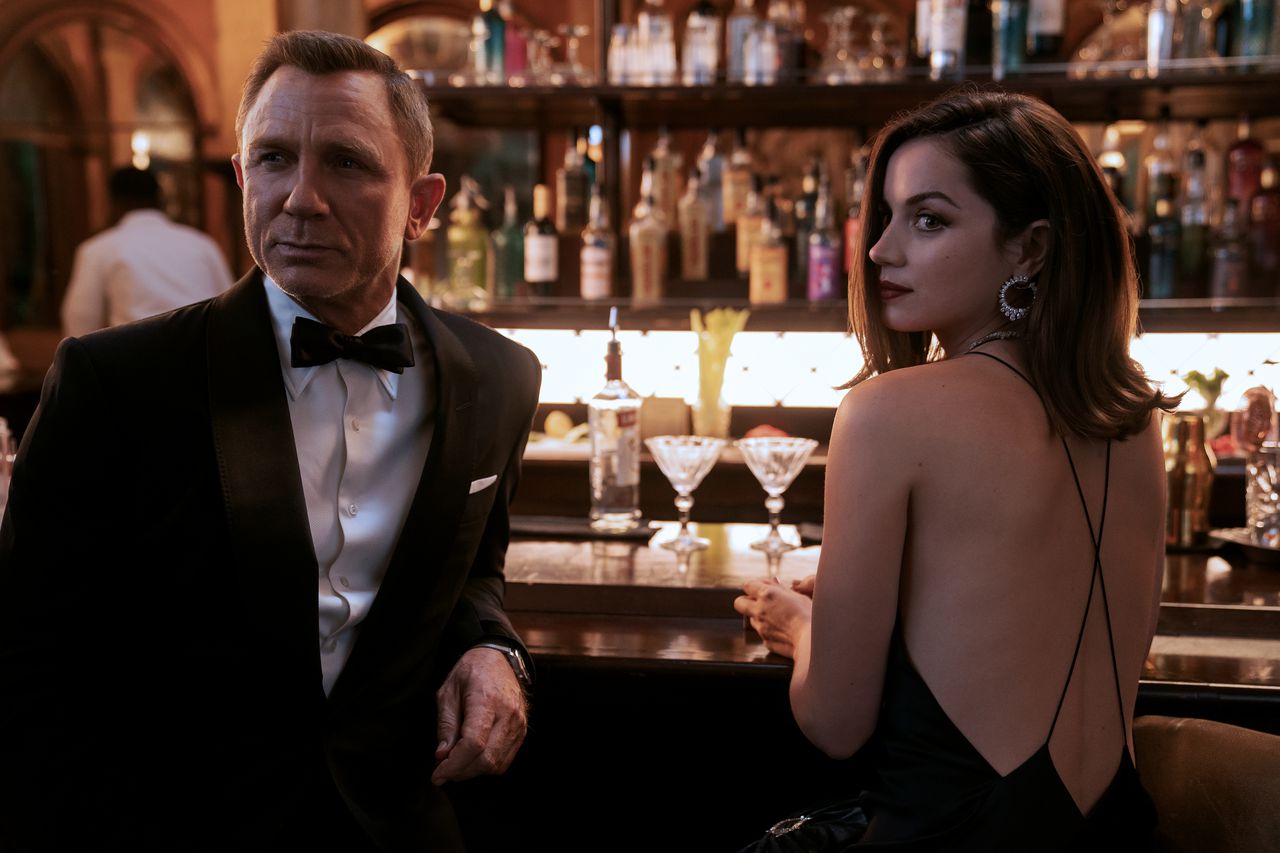

One wonders what Fleming would have made of this latest Bond film. Once you get past the big-budget trappings and the unfathomable gadgetry, I imagine Fleming would find something very familiar in Daniel Craig’s interpretation, globetrotting yet guarded, equal parts damaged and damaging. There’s so much in this film that works, thanks to the distinctive persona Craig has crafted for Bond. Once you have a character as solid as this one, the rest is a breeze, especially by the time the film makes its way to Cuba for an unforgettable sequence costarring the inimitable and infectiously fun Ana de Armas, late of Knives Out with Craig. Where she was timid and prone to fits of nausea as domestic worker Marta Cabrera, de Armas is a far cry from Knives Out here as Paloma, who winkingly exaggerates her naïveté while nervously downing a vodka martini. It’s almost criminal that she has only the one sequence, though one wonders if she too might recur down the road.

The unlikely star of the film – though perhaps not so unlikely, if you’ve been reading my blog for a while – is Hans Zimmer. After a forgettable title track by Billie Eilish, Zimmer runs away with the film, giving us a rousing score that had me stomping my feet with excitement. When he’s not winking at previous soundtracks, Zimmer is remixing and reinventing Monty Norman’s Bond theme with fearless aplomb. Thomas Newman did a fine job with Skyfall (though he revisited his own footsteps too closely with Spectre), yet throughout No Time to Die Zimmer makes a compelling case for the next Bond maestro. If Inception was a kind of proto-Bond for director Christopher Nolan, its Zimmer score was only the beginning; his love theme here is reminiscent of Inception’s showstopper “Time,” while his 007 action beats would be equally at home in Nolan’s ski lodge setpiece. David Arnold’s score for Casino Royale famously winked in the direction of Bond as we know him, and Zimmer takes us over the finish line with dexterity. 


It was a gamble to try to tell one story across five films, rather than tell more standalone stories about the world’s greatest spy. Before his untimely passing at 56, Fleming came to that concept late in his novel series, with his final three books forming a kind of “Blofeld trilogy.” No Time to Die is, finally, the successful culmination of that ambition, and it gives a suitable arc to these versions of Fleming’s characters. Whether it’s an ending or a transition may be for the casting directors to decide; let’s hope, however, that the MI6 crew – Ralph Fiennes, Ben Whishaw, and Naomie Harris – opt to stick around for that sense of internal continuity. Yet if you find yourself wondering, as the credits roll, what comes next – stick around. There’s no postcredits sequence, but there is one final guitar riff and the words “James Bond Will Return.” So too will I; after twenty months, it was fun to go to the theater once again and tell the coronavirus that now was no time to die.


No Time to Die is rated PG-13 for “sequences of violence and action, some disturbing images, brief strong language, and some suggestive material.” Directed by Cary Joji Fukunaga. Written by Neal Purvis, Robert Wade, Cary Joji Fukunaga, and Phoebe Waller-Bridge. Starring Daniel Craig, Rami Malek, Léa Seydoux, Lashana Lynch, Ben Whishaw, Naomie Harris, Jeffrey Wright, Christoph Waltz, and Ralph Fiennes.

Monday, November 16, 2015

Spectre (2015)

While Skyfall was for a lot of us the fulfilled promise of the Bond update kickstarted by Casino Royale, a kind of “And we’re back” (as Mark Kermode has, as always, so eloquently put it) Spectre is the second half of that sentence, a sort of “...and we’re here to stay.” To be fair Spectre isn’t the triumph that Skyfall was – recall Skyfall made #2 on my definitive ranking of every Bond film ever, though it’s too soon to rank Spectre. But it’s a worthy successor, a fine if occasionally too personal 24th installment.

After receiving an order from the late M, James Bond (Daniel Craig) follows a trail of criminals to the den of a mysterious figure (Christoph Waltz), heretofore presumed to be dead, and his organization known as SPECTRE. An encounter with an old friend leads Bond to Dr. Madeline Swann, who will help Bond and Q (Ben Whishaw) take down SPECTRE, while the new M (Ralph Fiennes) and his aide Miss Moneypenny (Naomie Harris) work against the surveillance project of rising bureaucrat Max Denbigh (Andrew Scott).

I’m going to go so far as to label Skyfall transcendent – breathtakingly beautiful and tightly narrated, with all the action you’d want from a Bond film without the foolish frivolity toward which the franchise is occasionally prone. It’s so good that I daresay Spectre never could have lived up to it, in the way that Thunderball could never have been as good as Goldfinger. Taken on its own merits, though, Spectre is good enough.

Starting with the pre-credits sequence, a staple of any Bond flick, Spectre doesn’t disappoint. In a long-take opening (whose CGI trickery takes away none of the punch of seeing Bond really do his stuff), director Sam Mendes takes us into the heart of a Day of the Dead celebration, cuing up the thematic content of the film with a lovely bit of eye candy in the form of Bond’s effortless heroics. Like Skyfall’s opener, it moves through a number of sub-setpieces rather quickly, lacking only a snide one-liner to cap it all off.

The rest of the film’s action is top-notch: a car chase through Rome, a fistfight on a train, a ski chase in which neither participant is actually skiing, and then two variations on the escape-from-the-compound trope. All of these play very well within the narrative, striking a great balance between the Bourne-inflected realism of the Craig era and the gentle absurdity we’ve seen in older films, but they’re played to delight, not to strain credulity. Indeed, they serve as nice reminders of what film we’re watching; just when the film starts to take itself too seriously, we’re treated to a nice bit of levity, like Bond surviving the collapse of a building by landing on a sofa.

There’s the rumor – an evergreen, really – that Spectre is Craig’s last outing as Bond. Much as we’ve heard that one before, Spectre does feel in a lot of ways like the end of an era. It pays off a lot of narrative threads from the last three films, including the most delightful amplification of the roles of M, Q, and Moneypenny. Largely absent from the early Craig films, this supporting cast gets a great opportunity to shine in their own subplot, from which Bond is largely absent but which manages to be as compelling as his conflict with Waltz’s villain. If it’s Craig’s swan song, I hope Fiennes, Whishaw, and Harris stick around – the MI6 gang are as interesting as they’ve ever been.

On Waltz: he’s every bit the scenery-nibbler we’d want out of a classic Bond villain, a fine successor to Javier Bardem’s Raoul Silva. There’s an intriguing way that Waltz unites both the campy classicism of the Connery era with a very contemporary sensibility vis-à-vis surveillance and anonymous terrorism. And if this is the last Craig film, it’s clear that the filmmakers are eager to tie it all up in a way that I don’t actually think was necessary. It doesn’t detract from the film, though it is a little distracting how overt this move is. There’s a beat where those who hadn’t recently seen Casino Royale might be a little dizzied by the reappearance of that film’s Mr. White, and there’s an unconvincing move to tie Skyfall into a larger narrative (when it works just as well, if not better, as a Goldfinger-esque standalone).

There’s what I would say is my biggest critique of Spectre (aside from a disappointing show by the film’s soundtrack, with a forgettable title track by Sam Smith and a score by Thomas Newman, who phones it in a little too much, borrowing heavily from Skyfall both in motifs and, in a few moments, in what sound like actual edits from earlier musical cues): the film tries a little too hard, a little too openly, to unite the previous films together. Maybe it’s just the tenor of the earlier films, where there were loose and insignificant attempts to hold the films together; where the Connery era had SPECTRE as a shadowy bogeyman whom, we assumed, Bond was always already fighting, Spectre attempts to make that unifying thread the stuff of revelation, of narrative twists, but there are ways to do that which don’t show the filmmakers’ hand so baldly. Additionally, we’ve been glad to see Daniel Craig as a more personal James Bond, in that his Bond takes things more personally – mourns the dead more willingly, pursues cases more intensely, and even hooks up with Moneypenny (finally!). He’s been a more personal Bond, but Spectre tries to move that more-personal quality out of the realm of subtext and into the arena of the actual plot, with Waltz’s Franz Oberhauser linked to Bond’s past. While this isn’t a bad move for the franchise (and I suspect the filmmakers have their eye on ways to continue this narrative thread), it comes off as largely unnecessary; the subtext was already there, and excavating it to the surface doesn’t actually do much more for the film.

Here’s the thing, though – it doesn’t take away from Spectre. The move toward the much more personal Bond isn’t hamfisted or sloppy; it’s just not essential for this viewer, but what we have is still quite entertaining. There are a number of frankly breathtaking action beats, fascinating developments in Craig’s Bond, who continues to be the most compelling Bond (even if Sean Connery is still a fan favorite), and moments of pure exuberance that remind you why Bond has endured for more than fifty years and twenty-five films (counting, as we ought, Never Say Never Again). It’s no Skyfall, but then what is?

Spectre is rated PG-13 for “intense sequences of action and violence, some disturbing images, sensuality and language.” There is the usual quantity of Bond heroics, including car chases, fist fights, and explosions. One character is facially disfigured in an unpleasant way, and Bond makes out with two separate women (the rest is left to implication). One or two S-words (no, Mr. Connery, not swords) are invoked.

Monday, November 4, 2013

Monday at the Movies - November 4, 2013

Welcome to another edition of “Monday at the Movies.”  This week, the play’s the thing!

Carnage (2011) – I was actually quite proud of myself on this one because I didn’t let Roman Polanski’s repugnant past impede my enjoyment of Carnage, an adaptation of the Yasmina Reza play.  Instead, I found myself won over by four immensely compelling performances.  Jodie Foster & John C. Reilly play the parents of a boy struck by the son of another couple, Kate Winslet & Christoph Waltz.  12 Angry Men fans will likely relish the insular nature of the film, whose action takes place solely within one apartment and its connecting hallway.  This cinematic claustrophobia permits the performances to, pardon the pun, take center stage.  Quickly we see that the ceremony on which the couples stand is a precarious peace predicated on the perpetuation of pretty faces and posturing; Foster’s performance is a bold one as she breaks down and exposes the degree to which her character is entirely full of herself by blubbering through self-satisfied liberal platitudes, while Reilly reveals the polar opposite, a suppressed John Wayne sublimated by his wife’s feelgoodery.  Across the table, Winslet and Waltz are pitch-perfect as self-righteous and condescending spouses who can barely say two words to each other without making a phone call or, quite literally, throwing up.  Waltz is the only one who seems to resist epiphany here, his eye rolls and workaholic behavior an interesting type apart from his talky Tarantino turns.  It’s not that Foster and Reilly are bad, but Winslet and Waltz are in a stratosphere all their own, though they know how to let the other members of the ensemble take the screen back when need be.  An incisive look at how the hot-button issue of bullying may be a load of grandstanding and self-righteousness, Carnage is smart and delightful, four tour-de-force performances in a riveting bundle.

That does it for this week’s edition of “Monday at the Movies.”  We’ll see you here next week, and don’t forget that this Thursday is the Double-Oh-Seventh of the month...!

Wednesday, December 26, 2012

Django Unchained (2012)

It’s all been building to this:  I’ve spent the last few months revisiting the oeuvre of Quentin Tarantino here at The Cinema King, all in preparation for Django Unchained – Tarantino’s eighth directorial feature.  Django Unchained is, at worst, an odd film; at best, it’s another wickedly entertaining entry from one of this generation’s most vivid and unique filmmakers.

Django Unchained stars Jamie Foxx as the eponymous freeman, liberated from slavery in order to assist the theatrical bounty hunter Dr. King Schultz (Christoph Waltz) in tracking his prey.  Django and Schultz make a deal:  if Django helps Schultz track the nefarious Brittle Brothers, Schultz will help Django free his wife Broomhilda (Kerry Washington), a promise which leads the pair to the plantation of Calvin J. Candie (Leonardo DiCaprio).  At Candieland, Django and Schultz pretend they are shopping for slaves, though Candie’s house slave Stephen (Samuel L. Jackson, by way of Uncle Ben) suspects the pair are being less than honest.

In many ways, Django is a kind of departure for Tarantino.  For one, the film isn’t littered with blood and guts like some of his earlier works, though there’s still enough of the old ultra-violence (especially at the end) to interest even Alex DeLarge.  Moreover, the film is told in a straightforward linear fashion, without the temporal hijinks we’ve come to expect since Pulp Fiction and Kill Bill.  Finally, and possibly most surprisingly, Django is the first Tarantino film to deal with “serious” issues like slavery instead of stopping short at visceral themes like revenge (an overarching theme, though, of all Tarantino films).

All of this, however, is to say what the film doesn’t do.  What the film does do is provide a snappy and engaging romp through a dark chapter in American history, a kind of Gone With the Wind for our generation.  As with Inglourious Basterds, Tarantino explodes his setting, touring the entirety of the antebellum South (circa 1858) with Foxx and Waltz as our tour guides.  Django is a “spaghetti southern” in this regard, as we follow two eclectic protagonists on a deeply personal quest through a perilous landscape.

Of these two protagonists, Waltz is (perhaps unexpectedly) the far more compelling.  Foxx is serviceable as Django; his determination to save his wife is tangible, but his deeper personality is never really accessible (a subplot about his humanity ebbing while he impersonates a black slaver, for example, never really pans out).  As Schultz, though, Waltz steals the show with his garrulous and gregarious performance; much as he did as Hans Landa in Basterds, Waltz brings this character to explosive life, deftly handling Tarantino’s tricky dialogue and humanizing Schultz’s contempt for the institution of slavery in the way that I wanted to see done in Lincoln.  (In this respect, then, Django is more honest with its audience than Lincoln was – a sentence I never thought I’d write!)

The third trademark of a Tarantino film, aside from extreme violence and peppy prose, is a solid supporting cast.  And in this Django does not disappoint.  We’ve got the “unlikely choice” – Don Johnson as a slaveowner a la Colonel Sanders.  We’ve got the “big name” – DiCaprio, who drips detestability as the film’s ostensible antagonist.  Though his Southern accent seems a garish caricature, I suspect that’s the point; Tarantino villains are seldom subtle, and the broad strokes surrounding Calvin J. Candie make it all the easier for us to hate him.  Finally, there’s the “veteran collaborator” – Samuel L. Jackson as Stephen.  If Waltz steals the show from Foxx, Jackson steals it right back in the film’s third act, making Stephen a nuanced menace somewhere between Stepin Fetchit and Darth Vader.  The gross stereotyping in his early scenes may elicit laughs, but those laughs quickly give way to fear when we see the true cruel danger he poses.  Jackson handles both aspects well and doesn’t forget to chew the scenery along the way.

Indeed, Foxx aside, most of the players in the film seem to be having a great deal of fun with the picture, which helps the audience have fun, too.  Django is probably not the “important film” Tarantino hoped it would be by tackling such a weighty issue as slavery, but it does so in a mature way without preaching a sermon the audience already believes.  Instead, Tarantino tries to have some fun with the material, and the film he’s created steps far enough out of the boundaries of realism that the audience can have an uncomplicatedly good time.

Django Unchained is rated R “for strong graphic violence throughout, a vicious fight, language and some nudity.”  There are several cartoonishly bloody shootouts, a scene of two slaves being forced to fight to the death, F-bombs and N-words galore, and two fleeting glimpses of naked slaves being tortured.

Monday, September 6, 2010

Inglourious Basterds (2009)

It's not spoiling anything to reveal that Quentin Tarantino's most recent film, Inglourious Basterds [sic], closes with one character remarking to another, "I think this just might be my masterpiece." The film is punctuated with moments like this, when one character says to another (as Hitler to Goebbels, for another example), that the other has just achieved his crowning glory. While I'm not convinced that Inglourious Basterds is Tarantino's magnum opus (it's tough to top Pulp Fiction, for my money), it does represent a return to form after indulgent experiments like Kill Bill and Death Proof.

Inglourious Basterds is, per Tarantino's description, a spaghetti western with World War II imagery, with the story divided into five semi-standalone chapters, each revolving around one set of character interactions. The film follows, separately, a ragtag team of Jewish-American soldiers scalping Nazis on the orders of their quirky Lieutenant Aldo Raine (Brad Pitt, channelling Foghorn Leghorn); Jewish fugitive Shosanna Dreyfus (Mélanie Laurent), who plans to use her movie theater to kill Nazis during the premiere of war hero Fredrick Zoller's (Daniel Brühl) biopic; British Lieutenant Archie Hicox (Michael Fassbender), commissioned by Winston Churchill to aid German actress-turned-secret-agent Bridget von Hammersmark (Diane Kruger) in an attempt to blow up the Nazi premiere, ignorant of Shosanna's plot; and SS Colonel Hans Landa (Christoph Waltz, in a performance well-deserving of its Supporting Actor Oscar), the ranking Nazi official standing between Hitler himself and all these plots, which converge in a stellar finale that's as fun as it is fantastic.


I've voiced my discomfort with labeling Inglourious Basterds Tarantino's masterpiece, but if it's not Number One it's certainly Number Two (although I may change my tune once I rewatch Reservoir Dogs). The screenplay is one of Tarantino's best, in the "interconnected disconnect" tradition of Pulp Fiction and, to a lesser extent, Kill Bill, in which vignettes are tied together as part of a narrative thread but are easily (re)watchable outside the context of the film as a whole. The script is a taut exercise in dramatic tension, deceptively composed of long scenes of dialogue (often subtitled from German or French) but which bring to a simmer intense anxiety about if and when each character's deception will be revealed and cause events to boil over into a brutally gory yet classically Tarantino shoot-'em-up sequence (which, don't worry, happens more often than not).

Perhaps, then, we can ascribe a masterpiece to Tarantino, but with the caveat that it isn't his only one. If we're hellbent on labeling Inglourious Basterds the masterpiece, we can always excuse Pulp Fiction for being partially co-authored by Roger Avery. But Basterds is all Tarantino, showing a maturity level that heretofore has been absent (but, in retrospect, showed signs of nascency in Death Proof); rather than clutter his work with blatant homages and showy stylization, Tarantino wisely pulls back on both, creating a work that's more subtle than I think most of us knew Tarantino could produce. It's not for nothing the film nabbed a Best Picture nomination, you see. It stands as the perfect intersection of a first-rate screenplay and a more-than-capable cast.

The true star of the film is Tarantino's dialogue, which manages to transcend the drudgery of subtitles by leaping off the screen without calling attention to its own built-in flair (from what I've been told, the translation work isn't bad, either). But the members of the cast are all so good that it's difficult to find a star made of flesh and blood. Is it Pitt, who takes first billing bcause of his name recognition but whose star power is dwarfed by the comparatively small role he plays? Is it Laurent, a protagonist in the tradition of The Bride who does a solid job portraying all her character's fears and determination? Is it Waltz, who obviously dominated the public imagination about the film with a delightfully nuanced and delectably wicked performance as the Nazi with as many cards up his sleeve as held close to his chest? Or should we merely throw our hands up in uncertainty by saying it's an ensemble cast? Well, it is. But they're all so good that you won't notice, for example, that Pitt is absent for the first, third, and most of the fourth acts; actors like Fassbender and especially Waltz take control of their screen time such that you'll forget that it isn't entirely their movie.

It's a movie that isn't really about anything. It's about World War II, sure, but it's more the story of a group of very radical figures fighting it on different terms, on different fronts, and for different reasons. One of the most significant features for me is the way in which the film brilliantly cheats itself; it contains the single most creative way I've ever seen for dealing with a film in which the objective is to assassinate Hitler - even though we know Hitler was never assassinated (Bryan Singer did an equally solid but different job with Valkyrie, though it's nothing on the scale of audaciousness that Basterds brings to the table). Hint: the first major clue comes before the first scene of the film; pay attention.

Oh, what the heck. High tension, tight scripting, fantastic performances - maybe it is his masterpiece, after all.
Inglourious Basterds is, like every Quentin Tarantino movie, rated "R for strong graphic violence, language and brief sexuality." Obviously, the language and the violence are pretty extreme, with F-bombs and scalpings all over the place, as well as the sporadic bloody shoot-out. There's an implied sexual liasion between Goebbels and his translator, and Fredrick flirts heavily with Shosanna, but it's pretty tame compared to other Tarantino films in this regard.