Showing posts with label Roger Moore. Show all posts

Sunday, December 7, 2014

The James Bond Countdown

Welcome back to the ostensible finale of the two-year Double-Oh-Seventh celebration of the James Bond franchise.

What a time for it, too, with Thursday’s announcement that “Bond 24” will be entitled Spectre (release date October 23, 2015 – so expect our review on October 26).  The title has such delightfully ominous associations in the world of 007.  The official plot synopsis:

A cryptic message from Bond’s past sends him on a trail to uncover a sinister organisation. While M battles political forces to keep the secret service alive, Bond peels back the layers of deceit to reveal the terrible truth behind SPECTRE.

With Lea Seydoux and Monica Bellucci as the Bond girls, Ralph Fiennes and Ben Whishaw returning as M and Q, and Christoph Waltz and Andrew Scott rumored to be playing the villains, perhaps the most exciting news is that Sam Mendes is back after a franchise high-point with Skyfall.  It seems like he’ll be picking up on plot points from the Craig era – secret organizations, political pressure against MI6, further exploration of Bond’s heretofore unseen past.  All good news, especially for someone who loved Skyfall the way I did.

But just how much did I love Skyfall?  At the end of two years’ worth of reviews, what do I make of the entire James Bond film series?   You’ve come to the right place; after the jump, you can read my James Bond Countdown, ranking all twenty-four 007 movies.


Friday, March 7, 2014

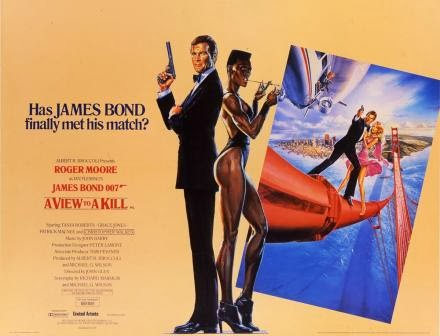
A View to a Kill (1985)

We’ve really had just about enough of Roger Moore around these parts.  From boring to offensively bad, Roger Moore’s tenure as James Bond has really disappointed after the initial promise he showed in Live and Let Die and The Man with the Golden Gun. After seven films and twelve years, A View to a Kill marks Moore’s last outing as 007, and it’s mixed feelings all around.  The film itself isn’t bad, but one gets the feeling that Moore has wasted too much time getting here.

After uncovering something to do with a computer chip, James Bond (Moore) seeks out the chip’s manufacturer, cyber-wunderkind Max Zorin (Christopher Walken).  Bond poses as an equestrian, then a journalist, to uncover the truth about Zorin’s mad scheme.  Along the way Bond is aided by fellow agent Godfrey Tibbett (Patrick Macnee) and heiress Stacey Sutton (Tanya Roberts) and foiled by Zorin’s Amazonian bodyguard May Day (Grace Jones).

A View to a Kill has a poor reputation among the Bond canon, though I don’t think the film is irredeemable.  I’m a fan of films where Bond has to put clues together to uncover a case, and this film plays that up quite well with a number of seemingly disparate plot threads – computer circuitry, illegal horse breeding, Nazi eugenics – that all come together with a satisfying cohesion.  It’s especially fun to see Moore puzzle through the matter with Macnee, the original John Steed, by his side; the two do a neat kind of “Grumpy Old Men” routine that riffs nicely on the shared espionage background between the two.

Having said that, Moore is really just too old to keep doing this sort of thing.  It’s clever when the film attempts to confront it, but once Macnee leaves the plot we’re asked to forget Moore’s age and regard him once more as the spry agent Bond ought to be.  But it’s a brutally unsuccessful move, made all the more apparent by how clearly youthful both Roberts and Jones are.  When Moore’s Bond beds both, it’s like catching a lusty grandfather in bed with a cheerleader; it feels both wrong and uncomfortable.  The other type of physical scenes also flounder due to his age, especially the ones involving complex stunts like another ski jump.  (You were right, Spy Who Loved Me:  nobody does it better.)

Fortunately, the film has an amazing antagonist in Christopher Walken.  Let that sink in:  Christopher Walken is a Bond villain, and it’s everything you’d expect from that sentence.  Walken is at his mid-80s nuttiest here, emphasizing all the wrong syllables and cocking his head at peculiar angles to give his character a fully off-kilter vibe.  Though the film relies on a clue-based structure, there’s no question that Walken, with his albino afro and shifty-eyed glances – is the villain, which allows him to surrender entirely to the character’s hammy quirks.  Best of all, Walken funnels that goofiness into full-blown psychosis; where some Bond villains have trouble toeing that line, Walken makes Zorin both engaging and terrifying, even without that curious subplot where (spoilers?) he’s revealed to be a Nazi test tube baby.

Perhaps even more than Walken’s performance, what helps A View to a Kill is its uncanny and unmistakable resemblance to the franchise’s finest hour – Goldfinger.  The basic plot outline is the same:  mad billionaire with lethal sidekick cooks up scheme to destroy resource and increase his own wealth.  While A View to a Kill never makes the connection explicit, with nary a reference in sight, reappropriating the successful formula carries with it a tried-and-true aspect that isn’t very surprising.  That is, it already worked in Goldfinger, so A View to a Kill doesn’t see a need to reinvent the wheel.  It’s ironic that we saw the same thing happen with Never Say Never Again, which rebranded Thunderball, though View to a Kill takes the remake angle a step further and at least does more than merely change the scenery.

And honestly, after all the missteps we’ve seen in the Roger Moore era, it’s subconsciously refreshing to be reminded of Goldfinger, arguably Connery’s and the franchise’s gold standard.  We’ve been through so much with Moore that I almost forgive the sin of uncreativity because it means we’re moving on to something new and different.  Plus, tell me the idea of Goldfinger starring Christopher Walken isn’t tempting.

A View to a Kill is rated PG.  There are several scenes of implied nudity (bare shoulders and backs), and in one scene a man machine-guns a crowd while another character is killed by an explosive.

Roger Moore may be out, but James Bond and The Cinema King will return in a review of The Living Daylights (1987) on April 7, 2014!

Tuesday, January 7, 2014

Octopussy (1983)

As we enter a new year, Roger Moore’s tenure on Bond is winding down (only one more entry left after this one), and it sure shows.  I’ve had my complaints about Moore’s outings as Bond – Moonraker was mystifyingly bad, while For Your Eyes Only was a forgettable step in the right direction – but Octopussy really takes the cake as, no contest, the dullest Bond yet.

James Bond (Roger Moore) is back in action after 009 dies uncovering a fake jewelry trafficking ring in East Berlin.  Bond smokes out smuggler Kamal Khan (Louis Jourdan) at an auction house and follows Khan to India, where he meets Octopussy (Maud Adams) and her gang of female assassins.  While dodging Kamal Khan’s attempts to kill him, Bond works to uncover a plot between Khan and the villainous Russian General Orlov (Steven Berkoff, practically choking on the scenery as a villain without a mustache to twirl).

The best thing I can say about Octopussy is that John Barry’s soundtrack is first-rate as ever, the kind of definitive Bond score that deserves a much better film.  I’m a huge believer in the idea that a soundtrack can do much of the lifting in a film if the other elements don’t quite hit it, and John Barry’s iconic work scoring Bond films automatically sets any entry apart from the ones where Barry is absent.  If you were to listen to the score and imagine a Bond movie in your head, it’d be a hit.

The execution on Octopussy, though, is execrable.  I’m really not sure whether this or Moonraker is worse; Moonraker has the “advantage” of veering so far off the rails that it’s an unmitigated catastrophe, but at least it had about an hour of somewhat engaging material.  In Octopussy, there’s honestly only one scene that didn’t bore me; like Moonraker, I’d actually tried to watch Octopussy once before but gave up.  And I can’t remember where I gave up because nothing in Octopussy is memorable.  Honestly, I took notes during the film because I knew it’d drop from my memory quickly and I had a hard enough time paying attention because of how tragically boring the film is.

A big part of the problem is that Roger Moore has overstayed his welcome.  Throughout his five previous films, I’ve noted that there is a glimmer of Bond inside of him that often seems smothered by the distinctly not-Bond films in which he’s starring, but in Octopussy we can’t help but notice that (at 55) Moore looks and moves like an old man.  Indeed, much of the film’s glacial pace is exacerbated by the fact that Bond never really moves quickly, even in moments of peril.  His action scenes are dimmed by his immobility, and his love scenes are unconvincing in their placidity.  (Compare to Diamonds Are Forever, in which Sean Connery looked quite old but still managed to capture that wry 007 glint in his eye.)

The plot doesn’t pick up any of the slack from Moore, either.  Some of the initial set pieces are based on Ian Fleming’s short stories, and the problem with adapting these stories to film is that nothing really happens in them.  It’s incredibly boring to watch Bond observe an auction on film because we don’t have his internal narration to follow (and besides, Moore looks old enough that he might fall asleep in his seat).  Furthermore, stringing these stories together results in an incredibly disjointed film experience that sees the plot veer sharply between storylines that never quite hang together; consequently, the viewer really needs to be paying attention to the tenuous links holding the plots together (I’m still a little murky on when exactly the film switched from jewel heist to mutually assured destruction).

As for that one scene that’s mildly compelling?  It’s right at the end of the film, when Louis Jourdan finally becomes the villain the film deserves, converting his disdain for Bond into actual hatred rather than just mere annoyance; simultaneously, Bond struggles to maintain his grip on a small aircraft midflight.  It’s the kind of stunt that the film needed more of – not the embarrassing clown costume, the cringeworthy Tarzan yell, the grotesque stereotypes of India that are actually offensive (you’d think the whole nation was one poverty-stricken slum through which white men literally throw money around as a diversion).

The worst thing of all is that Octopussy is not so exuberantly bad that it’s watchable.  Octopussy never musters up the energy to be anything other than uninteresting.  In fact, the most exciting moment is when the film actually ends and you can finally go to sleep.

Octopussy is rated PG.  A woman is seen fully nude emerging from a swimming pool, albeit at a great distance.  There are a few fistfights, shootouts, and seductions, but all with the naughty bits kept out of frame.  The only blood in the film is seen when Bond removes a leech from his chest.

James Bond and The Cinema King – and Sean Connery! – will return in a review of Never Say Never Again (1983) on February 7, 2014!

Saturday, December 7, 2013

For Your Eyes Only (1981)

There’s a recurring gag in Monty Python skits where Graham Chapman interrupts as “The Colonel,” who always intercedes when he feels that the skit has become “far too silly.”  While there’s no Chapman cameo in For Your Eyes Only, one gets the feeling that The Colonel’s refrain was bandied about in the wake of Moonraker, resulting in a Bond film that takes itself much more seriously, even if the end product is somewhat forgettable.

After the pre-credits disposal of a villain who for legal reasons (and in spite of the Nehru suit, traction collar, and white cat) can’t be named Blofeld, James Bond (Roger Moore) travels across Eastern Europe to Greece in order to locate a missing MacGuffin – here, it’s a missile guidance control system or whatnot.  Bond becomes entangled in a smuggling rivalry between Aristotle Kristatos (Julian Glover) and Milos Columbo (Topol), each of whom claims the other is Bond’s target; at the same time, Bond allies himself with Melina Havelock (Carole Bouquet), out to avenge the death of her parents.

By way of opening remarks, let me applaud the filmmakers – particularly director John Glen, on his first outing as a director – for moving Bond in a more serious direction.  For the past few months, I’ve contended that there is a solid James Bond lurking somewhere inside Roger Moore, but it’s often buried beneath bland chicanery and an overdose of camp.  We get to see some of that “solid Bond” come out in For Your Eyes Only, but at the same time it seems that much of the Bond humor has been stripped away from this one.  There are numerous moments begging for a Bond quip, deaths of henchmen that go unremarked.  (Later, we’ll see Daniel Craig find a nice middle ground with his dry sardonic black humor.)

So while this Bond is a conscious refutation of its campy precursors, that distancing comes at the cost of the overall Bond vibe; For Your Eyes Only feels like James Bond has been dropped into a different film franchise altogether, in which he’s playing a kind of guest role.  I’m not saying Bond doesn’t get enough screen time; he’s omnipresent as always, but he seems like a silent observer to a lot of the film, even taking a backseat at times to Melina Havelock’s revenge plot.  It’s a good thing Carole Bouquet holds her own in the film, proving capable in action sequences and in close-ups of simmering vengeance.  The chemistry, though, is never really there; she and Bond feel perpetually in each other’s way until they end up in bed together.

The honest truth?  That’s about all I remember from this movie.  As someone who prides himself on a particularly strong memory, For Your Eyes Only is like a complete blur for me, even after only a few days.  While the idea of a more serious Bond is a fantastic one, the execution on this is just passable; the film meets the bare minimum standard for gravitas by stripping away the fun but without replacing it with something compelling.  The bait and switch with the villain is a real eye-roller; Bond simply takes the word of the second “suspect” that the first is the real baddie, who admits with what amounts to a casual shrug, a “Yeah, you got me,” and a perfunctory mustache twirl.  And (spoilers) Julian Glover is terribly disappointing as Kristatos; where his Nazi sympathizer Walter Donovan in Indiana Jones and the Last Crusade was memorably sinister, here his chief act of villainy seems to be his relentless pursuit of a sexual liaison with an underage figure skater.

James Bond deserves better.  Heck, this film deserves better than to fade into the foggy recesses of my mind.  There’s enough that could have worked had the movie been... well, had the movie been a different movie altogether.  But in spite of it all, For Your Eyes Only is not offensively bad, which is more than I can say for Moonraker.  Moonraker was at least an unwatchable train wreck that descended into madcap incredulity with whiplash-inducing speed before our very eyes; For Your Eyes Only merely plods forward until it ends, bizarrely enough, with a Margaret Thatcher caricature.  It’s a step in the right direction, but darned if I can’t remember which direction it is.

For Your Eyes Only is rated PG.  Aside from the standard seductions, one woman very nearly exposes too much décolletage, while another wears a transparent white top and (in another scene) exposes her buttocks.  A few men are injured in aquatic scenes, with blood floating in the water; several other deaths occur, mostly off-screen and/or bloodlessly.

James Bond and The Cinema King will return – in the New Year – in a review of Octopussy (1983) on January 7, 2014!  (Heads-up:  like Moonraker, I’ve never actually been able to finish Octopussy.  We’re in trouble.)

Thursday, November 7, 2013

Moonraker (1979)

Consistently ranked among the worst of the James Bond films, Moonraker is that rare movie on which I gave up the first time.  A few years ago, after about forty minutes, I couldn’t take it anymore, but after revisiting the film for this review series, I can safely report that I made the wrong move – but only by about twenty minutes.  There’s actually about an hour’s worth of good material in Moonraker before the film descends into a weird self-parodying science-fiction cartoon, a totally bland mess of a movie.

After a space shuttle mysteriously disappears, James Bond (Roger Moore) investigates Hugo Drax (Michael Lonsdale), the creator of said shuttle. Bond quickly forms an alliance with the beautiful astronaut Holly Goodhead (Lois Chiles) while uncovering Drax’s plan to foster a new master race in outer space – aided by Bond’s returning nemesis Jaws (Richard Kiel).

If the plot sounds exactly like The Spy Who Loved Me by way of Star Wars, don’t adjust your sets; what you’re detecting is a bizarre self-plagiarism that shoots for the moon, misses, and lands not among the stars but in a place devoid of the thrills and sincerity that made Spy a success.  The self-evident lack of creativity damages the film by drawing attention to its faults; what Spy did well, Moonraker bungles, and what Spy bungled, Moonraker outright fails.  Where Stromberg was a little droll yet maniacal, Drax is literally boring, mumbling his lines, shuffling his feet, and never really making eye contact with anyone.  As Drax’s opposite number, Moore is trying – he really is – but Moore’s level of tongue-in-cheek only casts too much light on the inherently absurd film before us.

The film’s greatest sins could encompass a post all their own, though among them are an apparent misunderstanding of the physics of deep space, the whiplash-inducing tonal shift into science fiction once the NASA cavalry arrive with laser guns, and the film’s unforgivable mistreatment of Jaws.  Arguably the major find of the franchise, Jaws was a colossal contributing factor to Spy’s success; the scowl, the physicality, and those teeth all combined into an unforgettable character, which Kiel deftly brought to life.  But the promise contained in Jaws’s pre-credits appearance – really a great opener, in which Bond, Jaws, and another airman battle over two parachutes in free fall – tragically flops when the film demotes Jaws first to a Wile E. Coyote caricature, hapless yet indestructible, before shoehorning him into both an uninspiring romantic subplot and (spoiler warning?) an utterly unconvincing redemption plot.

It’s really a shame, because there’s a skeleton of a great Bond movie in there somewhere, and if we hadn’t just seen the exact same plot in Spy Who Loved Me it’d be a winner; it keeps the sleuthing intact, and the idea that Holly Goodhead is secretly a CIA agent is a clever twist that Chiles pulls off well.  Indeed, it’s almost disappointing that Bond successfully beds her, since her apparent resistance of Bond’s charms is such a compelling angle – a step, perhaps, toward the franchise’s later moves away from the “Bond girl” trope (best embodied, literally, by Britt Ekland’s bikini in The Man with the Golden Gun).

Is Moonraker the worst Bond ever?  I’m not ready to go quite that far – it is, unmistakably, a movie that is difficult to enjoy, at best tepid and uninspiring and at worst viciously schlocky and pretty much bad.  It’s in strong competition with Diamonds Are Forever for my least favorite Bond thus far, and it’s the first entry for which I’ve really agreed with the popular consensus that finds Moore’s Bond guilty of crimes against moviegoers.  And for once, in spite of my usually optimistic outlook, I’m rather uneasy about the future of the franchise; where Diamonds Are Forever might have been shrugged off as Connery’s unenthusiastic last hurrah, we still have three more outings with Roger Moore.

Moonraker is rated PG.  The violence is really quite cartoony, replete with laser guns in the film’s final battle; Bond beds three women, but there’s nothing shown below the shoulders.

James Bond and The Cinema King will return in a review of For Your Eyes Only (1981) on December 7, 2013!

Monday, October 7, 2013

The Spy Who Loved Me (1977)

The Spy Who Loved Me is a big moment for this reviewer – it’s #10 in the canon, the first (in sequence) Bond film I’d never seen before this review series, it introduces the iconic nemesis Jaws, and it’s consistently ranked as Roger Moore’s best entry as Agent 007.  Goldfinger’s not in any danger of being dethroned as the top Bond flick, but I’d say Spy is about as good as Moore has gotten thus far.  Third time, as they say, is the charm.

As British and Soviet submarines go missing, James Bond (Moore) is dispatched to find out how the subs are being tracked, while his opposite number in the KGB, Anya “XXX” Amasova (Barbara Bach), does the same.  Amid tussles with the steel-toothed crony Jaws (Richard Kiel), 007 and XXX uncover the plot of madman Karl Stromberg (Curt Jurgens) to develop a master race dwelling in an underwater biosphere.

It sounds kind of hokey to type out like that – and indeed there is something implausible in the big scheme – but the execution works because it plays much closer to director Lewis Gilbert’s last Bond outing, You Only Live Twice (which saw Blofeld stealing rockets to hold the world hostage).  And as the tenth Bond film in fifteen years, this one is populated with what feel like shout-outs to some of the series’ greatest hits:  XXX references Tracy Bond, Stromberg’s lair recalls Dr. No’s aquarium dining room, and Jaws plays very successfully like an update of silent butler Oddjob.  These little nods add up to a rewarding experience that winks endearingly at the audience, as all good Bond films ought to.

Another great thing about Spy is how well Moore comes into the role.  I’ve given Moore positive marks in his first two outings as the top superspy, but those notes always came with the caveat that he was no Sean Connery.  With Spy, Moore fully steps out of Connery’s shadow and comes up with a Bond that is quite original and wholly his.  He’s light when he needs to be (including a great scene where he zings off one-liners as Amasova attempts to drive stick) and romantic enough to make his seductions plausible.  Better, though, Moore deftly makes the shift to action hero, at home in hand-to-hand combat with the titanic Jaws and mastering the cold-blooded disdain that Bond ought to have when confronting megalomaniacs like Stromberg.

It’s only a shame that the other actors in the film don’t kill it like Moore does.  In the unfortunate tradition of most “Bond girls,” Barbara Bach is badly miscast with an inconsistent Russian accent to match.  It’s clear she was cast more for her décolletage than her delivery, to the film’s detriment; the plotline in which she comes to realize that Bond killed her lover (in a stellar pre-credits sequence involving ski jumps and the most British parachute ever) would have been much better served in the hands of a defter actress – or at least an actress who can emote beyond doe-eyed.  (I wonder what someone like Julie Christie could have brought to the role.)

Additionally, I wasn’t sold by Curt Jurgens as the villain, since he overplays the grandiloquence of the character without leveling in much menace.  His part in the film is small, restricted to his base of operations; in almost every scene Stromberg is seated at his dinner table, which subconsciously suggests that he might have been phoning it in a bit.  Jurgens is far from the franchise’s best villain, though the creative team manages to make his nutty scheme bearable if not plausible.  (Sidebar:  Apparently James Mason was considered for the role – what a loss for moviegoers everywhere that he wasn’t hired!)  Wisely, it seems, the film relies more on Jaws, an unstoppable physical force, a silent giant with a great visual hook.

With a lackluster villain and an uninspiring Bond girl – arguably two-thirds of the Bond formula – it’s even more surprising that the film works as well as it does.  Perhaps Moore gets a bad rap, since it’s predominantly his shoulders upon which the film rests and succeeds.  He’s a fine Bond here, and the decision to set much of the film in the Middle East gives a unique and intriguing atmosphere that makes the film eminently watchable. 


The Spy Who Loved Me is rated PG.  The “nudity” in the opening credits is a little clearer than it usually is, and in addition to Bond seducing two women we see one naked from the side through hazy shower glass.  There are explosions galore, a few fist/gunfights, and one of Bond’s coldest kills ever (though no blood is seen).

James Bond and The Cinema King will return in a review of Moonraker (1979) on November 7, 2013!  And I’ll be back on Thursday for a review of Alfonso Cuarón’s Gravity – stay tuned!

Saturday, September 7, 2013

The Man with the Golden Gun (1974)

After a lackluster debut in Live and Let Die, Roger Moore’s tenure as Bond was off to an inauspicious start, peppered with inopportune humor and a dated sensibility.  Though not quite perfect, The Man with the Golden Gun vastly improves on its predecessor for a more than enjoyable second outing with Moore.

James Bond (Moore) receives a death threat from legendary assassin Francisco Scaramanga (Christopher Lee), who vows to kill 007 with a bullet from his golden gun.  Facing a mandatory leave of absence from MI6, Bond instead opts to pursue Scaramanga across Asia, a quest less-than-ably assisted by secret agent Mary Goodnight (Britt Ekland).  But on Scaramanga’s secret island base – under the custodial care of his henchman Nick Nack (Hervé Villechaize) – Bond discovers Scaramanga’s real motives in the midst of a duel quite literally to the death.

I had good things to say about Roger Moore in Live and Let Die: surprising even myself, considering his reputation as an unpalatable Bond for today’s grim-n-gritty crowd.  Fortunately, those still stand with Golden Gun.  Moore’s Bond is different than Connery’s, less aggressive and more suave; he remains entirely capable, compelling, and convincing as an able-bodied (in every sense of the word) secret agent.  He delivers the one-liners with the right placement of his tongue in his cheek, but he’s equally at home firing a pistol or pursuing clues (more on those later).

More importantly, though, Christopher Lee is a phenomenally first-rate Bond villain as Scaramanga.  More than atoning for Live and Let Die’s rather limp villainous cast, Lee is the baddie we deserve – perhaps no surprise, considering his impressive thespian résumé.  Indeed, with anyone else wielding the titular golden gun, this film might have been a dull entry in the canon, but Lee’s presence elevates the picture into another stratosphere.  It helps that the character is exceptionally well-written, with fascinating motivations (even amid a slightly hokey technosabotage subplot) and – if we’re being totally honest – a really cool gimmick in the form of that some-assembly-required firearm.  Lee and Moore play off each other quite well; in a parallel universe somewhere, there’s a version of this film starring Sean Connery opposite Lee, but for now this one will do (although the Steve Coogan/Rob Brydon reinterpretation ain’t bad, either).

The less said about Britt Ekland, the better; she’s the worst kind of Bond Girl, the kind whose irrelevance to the plot is thrown into sharp relief whenever the screenwriters shoehorn her into a romantic scene with Bond.  Perhaps worse, it’s apparent that Ekland was not cast on the strengths of her audition tape; instead, it seems she was cast solely for the wardrobe change in the third act which restricts her to a skimpy bikini and makes her literally the butt of a joke about her incompetence as a field agent.  Similar jeers go to Clifton James as Sheriff J.W. Pepper, apparently on vacation in Thailand; this boorish caricature of a performance feels entirely out of place in this film, a brutal swerve toward lowbrow comic relief that’s as out of place as Larry the Cable Guy would have been in Skyfall.  (Please, Lord, don’t let any important decision makers see that idea.)

Ultimately what redeems The Man with the Golden Gun – Lee aside, of course – is director Guy Hamilton’s navigation of a screenplay that takes him back to his Goldfinger roots.  Like most of my favorite Bond movies, this one involves Bond searching out clues and evidence; neither he nor the audience has all the pieces when the film starts.  This air of mystery that Hamilton cultivates, even amid the irritating supporting cast and the grotesquely misplaced slapstick comedy, makes The Man with the Golden Gun an engrossing feature film, one that plays to the strengths of its leads and its director.  Compared to Live and Let Die, Golden Gun ends up being Moore’s (and Hamilton’s) finer hour.

But I hear the next one is even better?

The Man with the Golden Gun is rated PG.  The standard amount of gunplay occurs in this film, though a few headshots with bloody trickles are shown.  Bond seduces two women; two women are seen naked, though one is behind frosted glass, and the other is implied to be skinny-dipping.

James Bond and The Cinema King will return in a review of The Spy Who Loved Me (1977) on October 7, 2013!  (And would you believe I’ve actually never seen this one before?)

Wednesday, August 7, 2013

Live and Let Die (1973)

Replacing Sean Connery is a tall order; George Lazenby already tried it, with mostly successful results.  With Live and Let Die, Roger Moore – fresh off a comparable turn as Simon Templar in The Saint – steps into those big shoes in a Bond film that’s quite Seventies, quite American, and quite different from what we’ve seen thus far.  But is it any good?  The verdict in brief is that the film itself isn’t a fantastic first entry for Moore, though he acquits himself well in the role.

A series of mysterious murders puts Bond, James Bond (Moore) on the trail of Dr. Kananga (Yaphet Kotto) and the heroin kingpin Mr. Big from Harlem to the voodoo swamps of Louisiana.  When Bond falls in with the virginal fortuneteller Solitaire (Jane Seymour), he becomes enmeshed in the gang’s activities and must face a gauntlet of unusual henchmen before coming face-to-face with Mr. Big himself.

I’ve said that the best Bond films are the ones where Bond has to piece together clues in order to uncover the big mastermind behind the plot, but there’s something quite maddening about how long it takes for Bond to discover the big twist – (spoiler warning) that Dr. Kananga is Mr. Big.  It’s barely a revelation, concealed by some poor prosthetics and an unconvincing voice modulation, and the way in which the film quickly disposes of the big reveal makes me wonder why it’s even in the plot at all.  I’d much rather have spent more time on Mr. Big’s oddball henchmen – the hoarse-voiced Whisper, the prosthetic-clawed Tee Hee, and the voodoo Loa Baron Samedi (who may or may not be immortal).  These characters are reduced to window dressing by the film, which unfortunately never gives them the chance to shine as Goldfinger did for Oddjob.

As the resident Bond girl, Jane Seymour is naïve yet sexy, a compelling love interest for the sexually aggressive Bond (more on that later) with a wit about her that has more than a little something to do with her powers of clairvoyance (which, like Samedi’s resurrection, the film wisely accepts without question).  It’s entirely distracting, though, that Seymour is – like so many of her predecessors – dubbed over by Nikki van der Zyl; the result is that Seymour sounds just like Ursula Andress from Dr. No, and I can’t for the life of me understand this casting decision.  After all, Seymour can speak English relatively well.

But enough bandying about.  What to make of Roger Moore, the newest Bond in our rewatch (and, in hindsight, the longest serving 007)?  The good news is that he steps into the role rather seamlessly; his Bond has echoes of Connery and smartly so, while he picks up the sophistication of George Lazenby but without the milquetoast.  His sexual prowess is a bit more refined than Connery’s rougher edges, such that he doesn’t even use his hands to unzip one lady’s nightie, and his seduction of Solitaire is so calculated you can almost hear Connery mumbling, “Why didn’t I think of that?”  But even in the action sequences, amid the marring effect of too much comic relief, Moore seems at home as the world’s top secret agent – on foot, in a boat, in a car.

But ultimately the film wears its 1973 birthday on its sleeve with a bit too much pride as to how badly dated it is.  Forget Blaxploitation – this is Bondsploitation, and the two genres don’t mix as well as that shaken-not-stirred.  But with a promising new lead behind the wheel of the proverbial Aston Martin, perhaps the best is yet to be – let this one die so that Bond can live.

Live and Let Die is rated PG.  Quite tame by Bond standards thus far in the canon, the film depicts a fair bit of gunplay, sans blood, though one man explodes (again, without blood and with laughable special effects).  Bond courts three lasses, though none show anything immodest.

James Bond and The Cinema King will return in a review of The Man with the Golden Gun (1974) on September 7, 2013!