Showing posts with label James Earl Jones. Show all posts

Monday, April 17, 2023

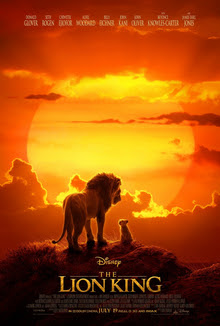
The Lion King (2019)

Most movies would be improved, I think, by imagining that you are watching them with Jeff Goldblum. And as I was watching The Lion King, Jon Favreau’s 2019 remake of the 1994 animated classic, I had the acute feeling that Goldblum’s Dr. Ian Malcolm (from Jurassic Park) was sitting next to me. I could almost hear him say, “Your animators were so preoccupied with whether they could, they didn’t stop to think if they should.”
 
By the time the end credits rolled on The Lion King, I found myself asking the same question I ask of nearly all of Disney’s live-action remakes: “Why?” Why does this film exist? Why was the remake almost identical to the original? And why was I surprised that, yet again, Disney pulled the wool over my eyes in convincing me that I hadn’t already seen this story?
 
From its opening frames, The Lion King is an exercise in déjà vu. The sun rises on an African plain, and the same Zulu opening vocals from Lebo M. ring out. If it’s not precisely shot-for-shot, it’s close enough, as Mufasa (James Earl Jones) and Sarabi (Alfre Woodard) present their son Simba (JD McCrary, then Donald Glover) to the kingdom he will one day rule. All of this has happened before, and the “Circle of Life” might as well be the creative bankruptcy that leads to a rinse-and-repeat mode of content creation.
 
To be fair, that sequence is the very model of ‘iconic’; it was, after all, packaged as a teaser trailer for the 1994 film, and it’s an absolute banger of an opener. Don’t fix what isn’t broken, they say, so I’ll give director Jon Favreau a pass on the first five minutes. When you’re a cover band, you play the hits, no matter how many times you’ve heard “Hey Jude” or “Free Bird” in your life. As the film unfolded, I thought we were heading into fairly interesting territory. This 2019 version begins to deepen the psychological profile for its villain Scar (Chiwetel Ejiofor) and his cackle of hyenas, who rebel against Mufasa for largely different reasons this time around. An explanation for his eponymous scar, and a few line changes to his solo number “Be Prepared,” feel like early forays into giving us a reason to run through the paces once more.
 
Perhaps ironically poignant, the first time that I noticed a major content change was in a sequence that revolves around, of all things, a dung beetle and his bespoke fecal boulder. Every creature in the savannah plays some small part in accidentally delivering to Rafiki (John Kani) a snarl of Simba’s mane, proving to the mandrill shaman that the lion king is still alive. It’s a fascinating rebuttal to Timon (Billy Eichner) and Pumbaa (Seth Rogen), who had just prior rebuked the idea of a “circle of life,” and it’s a slightly more credible way for Rafiki to learn of Simba’s exile. But in the end, it is an extended sequence about ossified manure, perhaps more suited to Planet Earth than a Disney feature.
 
In fact, the whole thing comes off as more of a thought experiment than a movie proper. What if, The Lion King asks, we could remove all abstraction from the original and render it as lifelike as possible so that we become not spectators but voyeurs in the animal kingdom, watching a wildlife documentary? Why include a bird who can smile or roll his eyes when we can give audiences a Zazu (John Oliver) whose physical features are limited by how an actual hornbill can move? Indeed, why make the film in such a way that the only expressions on the characters’ faces are provided by the Kuleshov effect? 
 
The answer, it seems, is behind the scenes. As far back as his Jungle Book, Jon Favreau has been experimenting with what technology can allow him to do, and the making-of featurettes for both movies show Favreau exploring his imaginary world through the use of VR technology. (A similar technical invention allows Favreau to shoot much of The Mandalorian in an immense soundstage called “The Volume,” so perhaps all’s fair in love and Star Wars.) If Favreau’s directorial outings are more about pushing the envelope of special effects, reskinning classic films just to see if he can, then The Lion King is a roaring success. But one can’t even call this a live-action adaptation – it is, rather, just differently animated, an identical remake only slightly less inessential than Gus Van Sant’s Psycho.
 
It’s not that The Lion King is badly made. The effects are good, even to the point that one might assume these were actual animals filmed on genuine African landscapes, and some of the voice casts are decent upgrades; Ejiofor in particular is a more Shakespearean Scar, while Eichner and Rogen are the surprise best-in-show (excluding, naturally, James Earl Jones’s return as Mufasa). Despite being slightly longer than the original, all of it feels overly familiar. “I know, I know,” I found myself thinking, “You’ve told me this one already.” There is a long gap between 1994’s Lion King and the Hamletthat inspired it; the difference between 1994 and 2019’s Lion Kings, however, is merely one of overlaying an Instagram filter.
 

The Lion King
 is rated PG for “sequences of violence and peril, and some thematic elements.” Directed by Jon Favreau. Written by Jeff Nathanson. Starring Donald Glover, Seth Rogen, Chiwetel Ejiofor, Alfre Woodard, Billy Eichner, John Kani, John Oliver, Beyoncé Knowles-Carter, and James Earl Jones.

Monday, December 19, 2016

Rogue One (2016)

It’s Disney’s galaxy, folks; we just live in it. But as I’ve said over and over, now is the best time to be alive. We’ve got comic book superheroes on film and television, engaging as ever, and we’ve got a new Star Wars film coming out every year. And if they continue to be as good as Rogue One is, that’s reason enough to hold onto the planet for another rotation around the sun.

As the Empire nears completion of its mammoth Death Star weapon just before the events of the original Star Wars film, a band of Rebels led by Cassian Andor (Diego Luna) and his droid co-pilot K-2SO (voiced by Alan Tudyk) seeks out Jyn Erso (Felicity Jones), the daughter of the weapon’s chief engineer. While the Death Star’s military director Orson Krennic (Ben Mendelsohn) grapples for power by proving the strength of his facility, Jyn bristles at the notion of joining the Rebellion but finds herself drawn into the struggle as she searches for her father.

If you’ve been around this long, you know I’m something of a shill when it comes to the genres I love. It’s not that these movies can do no wrong – I took Suicide Squad to task for biting off more than it could chew and for being “more than a little strangely crafted” – but maybe I’m a little more forgiving just because these are “my” genres, movies that feel made for me. But Rogue One is, I think, a great Star Wars movie that does everything a Star Wars movie ought to do. Since buying Lucasfilm lock, stock, and Greedo-shot-first barrel, Disney has been quite enamored of the Original Trilogy era, setting its television shows, comic books, novels, and now spin-off films in that period. But they’ve been equally keen on butting up against our sense of what Star Wars can be – that is, led by someone who isn’t a whiny blond dude, with next-to-no lightsaber combat.

Rogue One is both of those things, and more, depicting the run-up to A New Hope in a way that will forever color the way we look at the original film (answering in the process a question fans have had for about forty years in the process). But it does so in a way that deepens our understanding of the Star Wars mythos – at least, the post-Disney purge canon. Rogue One unites disparate elements from the Prequels, the Original Trilogy, Clone Wars and Rebels, from tie-in books like James Luceno’s Catalyst to what I’m pretty sure are a few weapons from the Lego Star Wars video games. We even, finally, get references to the mysterious Whills, referenced in early drafts of the screenplay and novelization to Star Wars. All of this, thankfully, is never beholden to an audience’s preexisting knowledge, serving instead like bonus frequencies on the electromagnetic spectrum for those of us who have eyes trained to see them.

Because at its core, Rogue One is a film about a girl, her father, and the galaxy that finds itself depending quite unexpectedly on them. If you always thought the galaxy revolved around the Skywalkers, Rogue One asks you to look again; there’s only one Skywalker here, but as I predicted last week he’s treated like an ominous specter at the periphery of this story, the armor-plated embodiment of fury waiting for an excuse to unleash his hate. By and large, though, Rogue One is more interested in its scrappy band of Rebels, new characters all, some of whom are bound to become new fan favorites. K-2SO’s deadpan cynicism recalls a kind of killer Baymax, while the warrior duo of Chirrut Îmwe (Donnie Yen, my personal fave) and Baze Malbus (Jiang Wen) shed light on the Force from the vantage point of someone who isn’t a Jedi.

Amid all the fresh new characters who I’d gladly follow into spin-offs of their own, though, Rogue One is thoroughly Felicity Jones’s show. Although some have drawn superficial lines between Jyn Erso and Daisy Ridley’s Rey, Jones does a fabulous job differentiating her character from the one found in The Force Awakens. There’s an unexpected emotional depth to Jyn, which Jones lets us see Jyn has repressed for so very long. She lets it burble over every so often, to great effect, and we never have a hard time believing that the tough persona she puts on in front of the other Rebels is just a defensive mechanism.

On the subject of the film’s villains, I will say that my first impression of Orson Krennic is that he’s a little undercooked. I have the disadvantage of having read the prequel novel before the film, so I know him a little better than most filmgoers, but his motivations and rank in the Empire might have been made clearer. Mendelsohn does a good job turning Krennic into a snarling power-hungry Imperial middleman, but as it is, Krennic takes a backseat to the Empire at large. Here the Empire is a giant and well-oiled machine, whose hold over the galaxy is more intimidating than any one figure could be. Then again, how daunting can an Imperial be in a film with Darth Vader? As the trailers have hinted, Krennic has a very memorable scene with Vader which puts Krennic in perspective relative to the Imperial machine he serves. Still, there’s a more personal story to be told, considering Krennic’s long history with the Erso family.

It wouldn’t be a Cinema King review without a wild comparison or two, and so I offer that Rogue One is very much akin to Captain America: The First Avenger. We knew where both films would end up – Darth Vader tells us as much in Star Wars, while we knew Cap was going to end up on ice, only to be thawed out in time for The Avengers. But just because the ending is a foregone conclusion, an accidental spoiler forty years in the making, that doesn’t mean we can’t have fun along the way, in a movie that feels more heartfelt than you might expect, given that at least a few of our heroes might have a tragic fate bearing down on them. There’s room for a few surprises along the way, but more importantly Rogue One clicks up with Batman v Superman: Dawn of Justice in its personification of the quintessentially human emotion of hope. Both films, even as things look quite grim, find room for optimism, for persistence in the face of adversity because “men are still good” and “rebellions are built on hope.” It’s always darkest before the dawn, we recall from an earlier Batman film, but the dawn – or in this case, the new hope – is coming.

And for moviegoers, it isn’t all that essential to hope that the Star Wars franchise continues to thrive under the gloved thumb of the Mouse. Mickey’s two-for-two. The Force is truly with us.

Rogue One: A Star Wars Story is rated PG-13 for extended sequences of sci-fi violence and action. Directed by Gareth Edwards. Written by Chris Weitz & Tony Gilroy and John Knoll & Gary Whitta. Starring Felicity Jones, Diego Luna, Ben Mendelsohn, Alan Tudyk, Donnie Yen, Wen Jiang, Forest Whitaker, Riz Ahmed, Mads Mikkelsen, and James Earl Jones.

Sunday, May 4, 2014

Return of the Jedi (1983)

At the end of the Star Wars trilogy, it’s virtually impossible to top The Empire Strikes Back, which truly is a perfect movie.  But fortunately Return of the Jedi isn’t a fumble – think Godfather III without Sofia Coppola.  It’s a fitting conclusion to the Original Trilogy, though a few beats feel repeated from Star Wars.

The Empire has begun constructing a second Death Star, but before the Rebels can launch their attack Luke Skywalker (Mark Hamill) and Princess Leia (Carrie Fisher) must rescue their carbonite-frozen friend Han Solo (Harrison Ford) from the slimy clutches of the vile gangster Jabba the Hutt.  After that memorable first act, Luke must contend with the revelations about his father while all his Jedi training tells him he must face Darth Vader (voiced by James Earl Jones) one last time while his friends launch an assault on the Death Star’s shield generator on the forest moon of Endor.

I have a very vivid memory of the first time I watched Return of the Jedi – I was eating bubble gum ice cream (we had gone to Baskin Robbins between the Jabba and Endor scenes), and the lush greenery of the Endor sequence impressed me, since I had only seen Empire Strikes Back on a black and white television.  Now, I’m not that old, but I have a harder time looking objectively at Return of the Jedi than at the prequels, partially because of this childhood remembrance; I don’t have a problem, for example, with the cuddly teddy bear Ewoks (though I think that using Wookiees might have been more interesting), and the first act in Jabba’s palace is really more of an extended precredits sequence in the James Bond tradition.

But it all adds up to something really quite entertaining, even if it steps on the toes of Star Wars a bit with a retread of the Death Star trench run climax.  After the sturm und drang of Empire Strikes Back, Jedi feels refreshing without the whiplash of an abrupt course correction.  The Jabba sequence, more prologue than plot, really only serves to get Han Solo back into the story, but director Richard Marquand keeps it interesting by populating the scene with fascinating visuals and a fantastically confident performance by Hamill.

Hamill’s turn as Luke Skywalker, now a full-fledged Jedi Knight, makes me very excited for the as yet unnamed Episode VII, because by the time Jedi rolls around the core group of performers are obviously very comfortable in their roles; if Star Wars felt a little bumpy for the fresh-faced nature of the cast, the big three are their characters in this installment.  The Han/Leia relationship comes to fruition here, and Ford & Fisher play it very well, very naturally, with a nice reprise of the “I love you”/“I know” exchange. 

The stakes are upped by the appearance, finally, of Emperor Palpatine, portrayed with fine villainy by Ian McDiarmid.  For a role that’s mostly sedentary, McDiarmid exudes menace with every snarled vowel and malicious glint in his eye.  Furthermore, the Force-lightning trick works better here than in Attack of the Clones, because it’s the only weapon the decrepit Palpatine has beyond his words; it’s a fantastic surprise that the wizened old geezer can actually do real damage.  This new villain perhaps mitigates the overly adorable nature of the Ewoks, who manage to dismantle an Imperial garrison with sticks and stones; with Palpatine commanding the fleet from the air, the Empire continues to feel like a true threat.

But in spite of the compounded darkness in the film, Return of the Jedi is probably the most feel-good of the franchise.  Star Wars tastes good going down too, but the original film carries more of a sense of astonishment at innovation than comfort at the company of old friends.  Return of the Jedi feels like the band getting back together, with all the laughs and nostalgia that a fine epilogue should have.  For a series that begins as ill-advisedly as The Phantom Menace did, Return of the Jedi brings us back to where we ought to be – a definitive science-fiction epic for the ages.

Return of the Jedi is rated PG for “sci-fi action violence.”  More of the same from the last outings, really – lightsaber duels, a mechanized hand is severed, explosions and blaster fire, and one skimpy metal bikini.

Thanks for joining us today for “Star Wars Day”!  We’ll be back tomorrow with a review of The Amazing Spider-Man 2, and then again on Wednesday for the Double-Oh-Seventh of the month!

The Empire Strikes Back (1980)

If Star Wars is a perfect movie, it may seem hard to believe that The Empire Strikes Back is a more perfect movie.  The Empire Strikes Back follows religiously in its predecessor’s footsteps, though it turns the excellence up to eleven with a darker yet more human story that takes its characters to their most emotional moments.

Three years after the destruction of the Death Star, the Rebel Alliance’s hidden base on the ice world of Hoth is discovered by the Empire, and the Rebels flee after a spectacular battle in the snow.  Luke Skywalker (Mark Hamill) journeys to Dagobah to continue his training as a Jedi under the tutelage of the diminutive Yoda (Frank Oz), while Han Solo (Harrison Ford) and Princess Leia (Carrie Fisher) fight their mutual attraction and the pursuing Empire.  All three become pawns in a larger game controlled by Darth Vader (David Prowse & James Earl Jones), who wants revenge for the Empire and holds a dark secret about what really happened to Luke’s father...

The Empire Strikes Back amps up everything that Star Wars did correctly but augments the gee-whiz science-fiction angle with a more grounded sense of characterization.  The characters in Star Wars seem a lot like archetypes, which isn’t bad for a high mythic narrative, but The Empire Strikes Back really plays up the personalities of Luke, Leia, and Han (and, to a degree, Darth Vader).  It’s really the result of stronger writing; I’ve chastised George Lucas all along for creating relatively flat characters (cf. the Plinkett rule), but Leigh Brackett and Lawrence Kasdan’s screenplay feels much more three-dimensional and even more engaging.

Subsequently, the core cast members all rise to the occasion.  The will-they/won’t-they courtship between Leia and Han is positively electrifying, and Fisher & Ford nail the dynamic with a healthy dose of wry banter and lingering glances.  Even before we fully learn that the two are in a Benedict/Beatrice standoff, the chemistry between them tingles, and you’ll be pulling for them to end up together long before Han delivers his iconic last line (ad-libbed, to boot!).  As for Hamill, he’s given the unenviable task of acting opposite a puppet for much of his screen time, but his work onscreen is so compelling that you might forget Yoda is a glorified Muppet.  (One senses that Yoda’s introduction is what Lucas wanted out of Jar Jar Binks, but as per usual Empire offers a masterclass in how to do a movie right.)

I’m going to go out on a limb here and suggest that The Empire Strikes Back is one of the principal forerunners of our current grim-n-gritty approach to genre narrative.  Without Empire’s focus on the darker side of conflict, both internal and external, I doubt we’d have The Dark Knight and its ilk.  I don’t want to take away from Christopher Nolan’s accomplishment – he really did kickstart the movement in comic book films – but there’s much in Empire that feels comparable to the Nolan level of respect for the source material.  Director Irvin Kershner regards the Star Wars franchise incredibly reverently, telling a story with tremendous sincerity that aims not just to entertain but to follow a strand of very human logic and emotion that just happens to have dueling lightsabers, asteroid fields, and little green gurus.

As in Revenge of the Sith, the third act of Empire is frankly astonishing.  (The key difference being, of course, that the rest of Empire is unproblematically dynamite, as well.)  Underlined all the while by a tour de force score by John Williams, which works beautifully even through the headphones of an iPod, all the film’s plotlines come to a boil on Cloud City, with Han and Leia trapped in Vader’s web.  Emotions are running high – love, betrayal, fear, resolve, Vader’s menace.  As Luke comes to the rescue, it’s impossible not to get caught up in the good-vs.-evil plot, even though we know the forces of good are horribly outnumbered.  The revelation of Vader’s master plan and his darkest secret are exceptionally memorable, very well-crafted by all hands on the creative deck.  It’s a moment that sweeps you up, 34 years later, making you feel as excited as the first time you heard the words, “No, I am your father.”  And even having the prequels tell you that already, even after it’s been homage’d very nearly to death, Jones’s delivery is still powerful enough to send a chill through you.

The film ends in a very grim place, though as the credits roll there’s a breathtaking feeling of having been taken on a whirlwind journey through a galaxy of exciting possibilities, guided by an able pilot in the form of – no, not Han Solo, not even George Lucas – director Irvin Kershner and his able copilots Brackett and Kasdan.  The Empire Strikes Back was long my favorite movie of all time (up until, at least, I finally saw Casablanca), and it’s still Top Ten material for me, standing solidly in the ranks of the perfect movies.

If nothing else, it’s fine context for the strangest thing that Lando Calrissian (Billy Dee Williams) has ever done.

The Empire Strikes Back is rated PG for “sci-fi action/violence.”  A few lightsaber duels transpire, and two result in dismemberment.  Darth Vader force-chokes a few minions to death, and a character is frozen in carbonite amid fears that he might not survive.  Other laser blasts and explosions occur, as do a few kisses.

We’ll be back in two hours for the final installment of this review series, a look at Return of the Jedi!

Star Wars (1977)

Even if you strip away all the bells and whistles of the myriad “Special Edition” rereleases, at the core of Star Wars (now known also as Episode IV – A New Hope) is what I’m ready to label a “perfect movie,” a deft example of genre-(re)defining science fiction that never hits a sour note as it tells a relatively simple story with graceful aplomb.

Luke Skywalker (Mark Hamill) is a farmboy with dreams of space travel when the Rebellion against the malevolent Empire arrives on his doorstep in the form of two droids – R2-D2 and C-3PO – carrying data that could spell the end of the Empire’s latest technological terror, the Death Star.  Luke and his new mentor Ben Kenobi (Alec Guinness) charter the Millennium Falcon, captained by roguish Han Solo (Harrison Ford) and his Wookiee copilot Chewbacca, though their flight is derailed by an effort to rescue Princess Leia (Carrie Fisher) from the very embodiment of evil, Darth Vader (movements by David Prowse, voice by James Earl Jones).

After all the disappointment we’ve endured over the last few hours’ worth of reviews, it’s amazingly easy to fall back in love with the franchise from the very opening shot of two starships in combat – which brilliantly tells us everything we need to know without a single word of dialogue:  an enormous Star Destroyer bearing down on the miniscule and outgunned fleeing Rebel ship.

I do want to judge the Original Trilogy on its own merits and not quite in comparison to its prequel successors, but Star Wars does such a deft job of storytelling that it’s a wonder this is the same George Lucas who would later inflict Jar Jar Binks and ultimately meaningless political posturing upon us.  Star Wars is elegant in its simplicity – there are good guys and there are bad guys, and any special effects in the film are entirely at the service of the plot (rather than the other way around).

In fact, even before Lucas went in and revised the films with all his computer trickery (some of which is actually an improvement, especially the scene between Jabba and Han, which was absent from the initial theatrical release), Star Wars has aged spectacularly well.  Though I’ve seen the movie umpteen times by now, this most recent rewatch still captured all the movie magic for me, and it’s probably the most fun I’ve had with a movie since Captain America: The Winter Soldier.  There’s action, adventure, humor, romance (even if it’s uncomfortable knowing that Luke and Leia are related), a remarkably tight screenplay, and a slew of first-rate performances – the constellation required for a perfect movie.  And let’s not forget the John Williams score, the (mostly) unsung hero of the series, which swoops and soars when it needs to but pulls out the heavy brass lines when villainy is afoot.

If the film feels in any way familiar, remember that Star Wars distilled preexisting myth narratives and simultaneously reinvented them; it’s impossible to imagine a film in the mythic realm that hasn’t been influenced by this classic tale.  Even without the prequels, the introduction of Darth Vader, gliding over the bodies of fallen Rebel soldiers, is instantly iconic, and Jones’s vocal performance is genuinely chilling.  The rest of the cast, too, are doing pitch-perfect character work – Hamill naïve but determined, Ford charismatic yet cocky, Fisher resolute and courageous, and Sir Alec Guinness as the scene-stealer among them all, wise and pragmatic.  Each of these roles is legendary, but the addition of all of them together in a tightly-plotted and intensely focused screenplay results in... well, how many ways can I say “perfect movie”?

Science fiction at an undeniable apex, Star Wars proves a worthy inauguration to a long-lasting franchise, even nearly forty years after the fact.  Take it on its own or as the first/fourth chapter in a longer narrative; Star Wars is a perfect film.

Star Wars is rated PG for “sci-fi violence and brief mild language.”  A few folks get blasted by laser fire and explosions (both in person and in spaceships); one is choked to death, and another is briefly choked by The Force.  A planet and a space station explode, killing all aboard.  The expletives are of the “damn” and “hell” variety.

We’ll be back in two hours with (Star Wars: Episode V –) The Empire Strikes Back!