Showing posts with label Ralph Fiennes. Show all posts

Monday, January 3, 2022

The King's Man (2021)

Matthew Vaughn knows he doesn’t need to keep making Kingsman movies, right? The original Kingsman film, The Secret Service, was a breath of fresh air (and a welcome bit of counterprogramming for those of us who didn’t want to see 50 Shades of Gray for Valentine’s Day 2015). The Golden Circle, however, was somewhat inert as a sequel, cringingly gross and overly enamored of itself. Fortunately, The King’s Man is a sight better than The Golden Circle, but it is dizzy and daft in a way that does it no favors.

The pacifist Orlando, Duke of Oxford (Ralph Fiennes), wants nothing more than to keep his son Conrad (Harris Dickinson) out of the military, but the rising tides of the First World War conspire against them. Orlando and his servants (Gemma Arterton, Djimon Hounsou) form an ad hoc intelligence agency with Conrad to root out a conspiracy that includes the likes of Rasputin (Rhys Ifans), Mata Hari (Valerie Pachner), and Vladimir Lenin (August Diehl).


It’s worth remembering, after seven years and three films, that this all began as an adaptation of a 2012 comic book by Mark Millar (Kick-Ass) and Dave Gibbons (Watchmen). I haven’t read the original comic in some years now, but my recollection was that it’s a fine soft send-up of the James Bond formula. However, as I was watching The King’s Man, I was thinking of another comic book I’d been reading earlier that day – Bill Willingham’s Fables, which imagines (in the tradition of Alan Moore’s League of Extraordinary Gentlemen) what would happen if all the fairy tales were true, their characters all inhabiting the same universe. And this is exactly the conceit of The King’s Man; with so many larger-than-life historical figures running around between 1914 and 1918, what if they all knew each other? What if most of them were in an international ring of espionage together?


When it’s done with fictional characters, it opens up a new world of possibilities, but there’s something discomfiting when it’s a constellation of real historical figures. Perhaps it’s a failing of my own imagination, but I think it’s also true that The King’s Man mucks about with very recent history in transparent and unfulfilling ways. Ultimately, it’s a failing of the film not to do something interesting with this reckless historiography. (See instead, for example, Inglourious Basterds.) If I’m spending time trying to remember my college survey courses in history, the film isn’t working.


Apologies to Ralph Fiennes, who is plainly better than anything the screenplay gives him to do. He works the dialogue like a prestige World War I film, and he navigates the action sequences like something out of a Daniel Craig 007 flick. It’s when the film channels its Bond DNA that The King’s Man really sings, as in a third-act confrontation atop a mountainous plateau. The franchise seems to have jettisoned the gross-out laddish humor of The Golden Circle, and it’s for the best, yet the Bond-ier sequences remind the audience just how good The Secret Service was, and why. 


As the film wound down its James Bond denouement, I found myself wishing more of the film had been like that, more Spy Who Loved Me and not alternate history. As it stands, The King’s Man is very episodic, which works somewhat in its favor; if you’re not enjoying the plot, so the old saying might go, stick around for twenty minutes until it changes. But consequently the film’s big claim that it all matters because it’s all interconnected – right up to a big bad reveal that’s a bit obvious even if you don’t recognize a certain actor’s voice – falls flat when it doesn’t quite feel like a united whole. Instead, The King’s Man is a collection of bits, some better and some worse, that never exactly add up to something grander.


Then there’s the matter of the postcredits scene, which promises/threatens that the historical muckraking will continue, with a particular bygone villain who is so baldly obvious that it might better have been left to a satire of The King’s Man. Indeed, so outlandish is the moment when two prominent historical figures shake hands and conspire toward The King’s Man II that one can only assume from the deadly straight-faced presentation that the filmmakers know how patently silly it is. We can also hope that they know better. The King’s Man is fun but not fun enough, and I think it is high time that Matthew Vaughn move on to something else.


The King’s Man is rated R for “sequences of strong/bloody violence, language, and some sexual material.” Directed by Matthew Vaughn. Written by Matthew Vaughn and Karl Gajdusek. Based on the comics by Mark Millar and Dave Gibbons. Starring Ralph Fiennes, Gemma Arterton, Rhys Ifans, Matthew Goode, Tom Hollander, Harris Dickinson, and Djimon Hounsou.

Monday, October 11, 2021

No Time to Die (2021)

It’s hard to believe it’s been twenty months since I set foot in a movie theater. It’s perhaps harder to accept that it wasn’t a superhero movie that brought me back to the box office – though two, Black Widow and Shang-Chi, have been released since my last outing with Birds of Prey in February 2020. I hadn’t missed a Marvel movie until this year, yet nor had I missed a James Bond vehicle starring Daniel Craig. Fifteen years and five films after Casino Royale, I had to see this supposed swan song in all its IMAX glory.

It isn’t Craig’s best – that honor still and forever goes to Skyfall, as perfect a Bond movie as you can get – but No Time to Die is a fitting conclusion to this iteration of the character, thematically consistent and perhaps the most Fleming-esque of the Craig era.


Five years after defeating the forces of Spectre, James Bond (Daniel Craig) is called back into the fight after Lyutsifer Safin (Rami Malek) kidnaps a defecting scientist (David Dencik) and his powerful bioweapon. The chase for Safin finds Bond crossing paths with his old friend Felix Leiter (Jeffrey Wright), a new 00-agent (Lashana Lynch), and his old love Madeleine Swann (Léa Seydoux) before the trail leads back, as it always does, to Ernst Stavro Blofeld (Christoph Waltz).


As much as the Craig-era Bond films have struggled to fit all its disparate parts into one unified narrative – we all remember how Spectre tried unsuccessfully to weave its antecedents together – the films have been at their best when considering the psychological toll that Bond’s life is taking on the man. Casino Royale intimated that Bond’s callous womanizing stemmed from a deep personal trauma, while Skyfall showed us that happened when Bond’s closest relationship (with Judi Dench’s M) got too close. No Time to Die picks up on the unlikely ending of Spectre, in which Bond ostensibly rode off into the sunset with Madeleine Swann, but it wisely reminds us that Bond has been down this road before, in more films than just Casino Royale. There are numerous nods, for example, to (and this may be a very light spoiler) On Her Majesty’s Secret Service, which for many is the gold standard for Bond. (Appropriately enough, it was #007 when I ranked the films in 2014.)


But No Time to Die is conscious of its place as a finale of sorts, and so we get reunions with Felix Leiter from Casino Royale and Quantum of Solace, and with the Blofeld of Spectre; there’s even a wink-nod at Skyfall with a portrait of Judi Dench and a well-timed cameo from her porcelain bulldog. These references tie Craig’s tenure together more authentically than Spectre’s stubborn insistence that it was all connected, but the true payoff is in Craig’s Bond getting a better understanding of himself. He’s cognizant of his own flaws, sensitive to his blind spots, and determined all the same to save the world as only he can. When one character asks him if he knows the worst thing about himself, he quips, “My timing?” He’s become self-aware and, in the process, self-realized. Having taken Bond from his roots to his ultimate self, it’s only fair that Craig calls it a day and leaves the character for the next – and, perhaps not insignificantly, seventh – incarnation.


No Time to Die is, then, a kind of grand tour through the Craig era, but it has its eye on a more distant past, going back to Connery’s 1962 debut and to the Ian Fleming novels of that era. Safin is not, as the rumor mill had hoped, secretly Doctor No in disguise, though his island lair may as well be the good doctor’s; with its hazmat-suited servants, nuclear generators, and vaulted ceilings, one half-expects Joseph Wiseman to saunter out in his Nehru jacket. Meanwhile, the lair’s retractable bay doors are straight out of the film version of You Only Live Twice, while the denouement and a certain Jack London epigraph are airlifted from the novel of the same name. The 1967 film, scripted by Roald Dahl, was somewhat less than faithful to Fleming’s 1964 original, which saw Bond stalking Blofeld in a poison garden; here, it’s Safin who becomes the lethal horticulturalist, while Bond has no Tracy to avenge but comes bearing equally personal motivations. Indeed, I came out of No Time to Die – as I often do when a new Bond film arrives – finding myself lunging for the Ian Fleming novels on my bookshelf. 


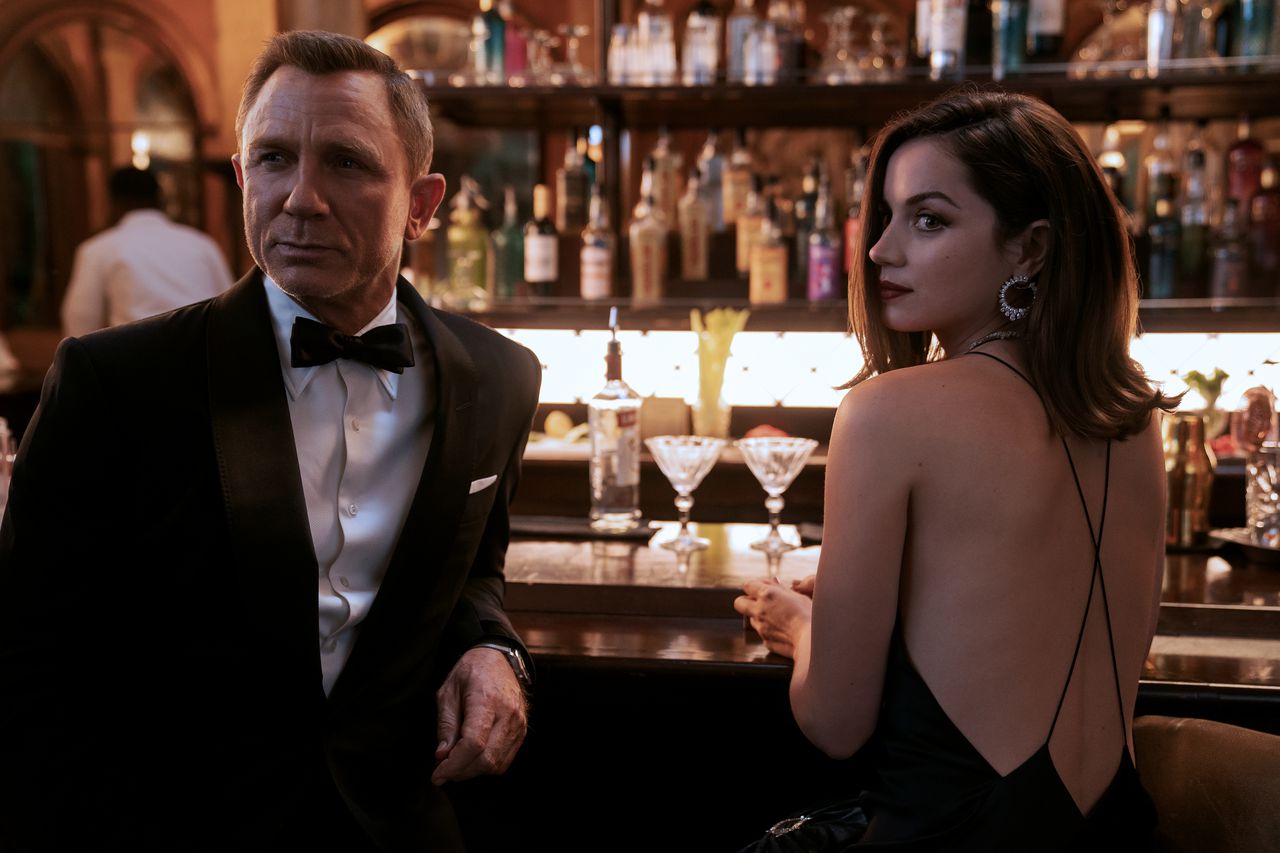
One wonders what Fleming would have made of this latest Bond film. Once you get past the big-budget trappings and the unfathomable gadgetry, I imagine Fleming would find something very familiar in Daniel Craig’s interpretation, globetrotting yet guarded, equal parts damaged and damaging. There’s so much in this film that works, thanks to the distinctive persona Craig has crafted for Bond. Once you have a character as solid as this one, the rest is a breeze, especially by the time the film makes its way to Cuba for an unforgettable sequence costarring the inimitable and infectiously fun Ana de Armas, late of Knives Out with Craig. Where she was timid and prone to fits of nausea as domestic worker Marta Cabrera, de Armas is a far cry from Knives Out here as Paloma, who winkingly exaggerates her naïveté while nervously downing a vodka martini. It’s almost criminal that she has only the one sequence, though one wonders if she too might recur down the road.

The unlikely star of the film – though perhaps not so unlikely, if you’ve been reading my blog for a while – is Hans Zimmer. After a forgettable title track by Billie Eilish, Zimmer runs away with the film, giving us a rousing score that had me stomping my feet with excitement. When he’s not winking at previous soundtracks, Zimmer is remixing and reinventing Monty Norman’s Bond theme with fearless aplomb. Thomas Newman did a fine job with Skyfall (though he revisited his own footsteps too closely with Spectre), yet throughout No Time to Die Zimmer makes a compelling case for the next Bond maestro. If Inception was a kind of proto-Bond for director Christopher Nolan, its Zimmer score was only the beginning; his love theme here is reminiscent of Inception’s showstopper “Time,” while his 007 action beats would be equally at home in Nolan’s ski lodge setpiece. David Arnold’s score for Casino Royale famously winked in the direction of Bond as we know him, and Zimmer takes us over the finish line with dexterity. 


It was a gamble to try to tell one story across five films, rather than tell more standalone stories about the world’s greatest spy. Before his untimely passing at 56, Fleming came to that concept late in his novel series, with his final three books forming a kind of “Blofeld trilogy.” No Time to Die is, finally, the successful culmination of that ambition, and it gives a suitable arc to these versions of Fleming’s characters. Whether it’s an ending or a transition may be for the casting directors to decide; let’s hope, however, that the MI6 crew – Ralph Fiennes, Ben Whishaw, and Naomie Harris – opt to stick around for that sense of internal continuity. Yet if you find yourself wondering, as the credits roll, what comes next – stick around. There’s no postcredits sequence, but there is one final guitar riff and the words “James Bond Will Return.” So too will I; after twenty months, it was fun to go to the theater once again and tell the coronavirus that now was no time to die.


No Time to Die is rated PG-13 for “sequences of violence and action, some disturbing images, brief strong language, and some suggestive material.” Directed by Cary Joji Fukunaga. Written by Neal Purvis, Robert Wade, Cary Joji Fukunaga, and Phoebe Waller-Bridge. Starring Daniel Craig, Rami Malek, Léa Seydoux, Lashana Lynch, Ben Whishaw, Naomie Harris, Jeffrey Wright, Christoph Waltz, and Ralph Fiennes.

Monday, February 13, 2017

The Lego Batman Movie (2017)

I was pleasantly surprised – I think we all were – by The Lego Movie, which ended up being more heartfelt and entertaining than it had any right to be. Its ostensible spin-off, The Lego Batman Movie, is quite fun, albeit in another direction; rather than critique what in 2014 I called “Hollywood’s remake-happy philosophy,” The Lego Batman Movie lasers its vision on Batman for a loving farce of all that the character can be, has been, and ought to be.

Will Arnett returns to voice The Dark Knight, darker than ever with a new theme song and a smashing set of gadgets, vehicles, and outfits. He’s a Batman that has it all, except for a family, and at the insistence of his trusty butler Alfred (Ralph Fiennes, delightfully droll), Batman takes under his wing the young orphan Dick Grayson (Michael Cera). While Batman learns to work with new police commissioner Barbara Gordon (Rosario Dawson), The Joker (Zach Galifianakis) plots his latest scheme, smarting from Batman’s declaration that Joker is not his greatest enemy.

With The Lego Movie, there was a sense that anything was possible and everything was awesome. For The Lego Batman Movie, everything is still awesome (though that earworm won’t wend its way to your brain in the movie proper), though there’s less a sense that anything can happen and more a focused attempt to bring every aspect of Batman to bear on this adaptation. I’d venture to say every corner of the Bat-mythos is spotlighted here, from the 1940s serials to Batman v Superman, from Crazy Quilt to The Mutant Leader.

For this reason, I’d hazard a guess that I loved this movie more than more filmgoers because it engages with my favorite aspect of my favorite fictional character – this idea that Batman is a conceptually rich figure with a myriad of possibilities built into his very nature. It’s difficult to imagine Captain America in space, or Superman in a mafia noir, or Iron Man in a detective story, or Green Lantern in World War II. Yet Batman works in all these settings, and so I reveled in the idea that The Lego Batman Movie embraces everything that’s ever been done with the character as equally valid (even if, as Alfred says, 1966 was “that weird one”).

There’s something of a farce at play, but it’s one done in earnest and without a trace of malice. Batman is the same grim-n-gritty caricature from The Lego Movie, snarling and petulant, but it’s giddy fun to watch him serenely chow down on lobster thermidor in his Bat-dinghy. Batman’s aversion to teamwork gets turned up to eleven here, providing the framework for a fairly boilerplate “learn to get along” plot that works largely because it’s dressed up in a cape and Bat-ears. In spite of gently spoofing the Bat, there’s something very accurate about the film’s portrayal; Joker’s obsession with Batman rings quite true with the comics, which have leaned toward interpreting his hate as repressed love, while Batman’s “master builder” status (inherited from The Lego Movie) feels of a piece with his apparent canonical ability to create any gadget.

If I have a critique about the film, it’s that its marketing was a little misleading in the sense that the trailers and posters promised a coterie of Bat-villains running the gamut from The Riddler to Egghead. Yes, these characters all do appear, as does the entirety of the Justice League, but I can’t help feeling that they’re somewhat underused, particularly considering the all-star voice cast behind them (Channing Tatum returns as Superman, while Conan O’Brien debuts as Riddler). Only The Joker gets any considerable amount of screen-time – appropriate, naturally – though the reduction of the other villains to near-cameo status feels a bit like someone wafting cake beneath your nose, only to deliver pie. (Fortunately, though, it’s not Joker’s preferred “cyanide pie in the face.”)

The Lego Batman Movie is delirious in its satire and throws everything into the mix for a playful romp through the Bat-mythos. I’ve seen a lot of critics take Lego Batman as an opportunity to turn up their nose at Batman v Superman, as if two competing interpretations of Batman can’t coexist. Rather, I think Lego Batman makes quite the opposite argument – that Batman can wear any suit he likes (with apologies to Henry Ford, even if it’s not black; even if it has rabbit ears, Bat-nipples, or a tutu). Batman goes through cultural evolutions all the time – about every four years, by Alfred’s math – and so Lego Batman ought to be something that cultivates our appreciation for the character’s infinite possibilities, not something that we use to tear down the past. Heck, it’s a Lego movie. Let’s build something.

The Lego Batman Movie is rated PG for “rude humor and some action.” Directed by Chris McKay. Written by Seth Grahame-Smith, Chris McKenna, Erik Sommers, Jared Stern, and John Wittington. Starring Will Arnett, Zach Galifianakis, Michael Cera, Rosario Dawson, and Ralph Fiennes.

Monday, February 22, 2016

Hail, Caesar! (2016)

Hail, Caesar! tickles a lot of my moviegoing fancies: it’s a dark comedy farce courtesy of the Coen Brothers, in which an all-star cast of buffoons blunders their way through old Hollywood while the plot twists and turns like a postmodern poodle chasing its own tail. That may not be everyone’s cup of tea, recalling the plotless meandering of The Big Sleep and its successors, but for me it’s the most fun I’ve had at a movie in a long while (yes, maybe even more fun than Deadpool).

Eddie Mannix (Josh Brolin) has the unenviable job of being the chief “fixer” for Capitol Pictures; when something goes amuck, it’s Eddie’s task to make sure the motion picture shows go on. The latest catastrophe he’s tasked with suppressing is the abduction of Baird Whitlock (George Clooney), Capitol’s number-one star, though somewhat of a lush and a dim bulb. Of course, the Capitol lot is busy with numerous other crises, including a disgruntled mermaid (Scarlett Johansson), a highstrung director (Ralph Fiennes) and his twanging lead actor (Alden Ehrenreich), twin newspaper columnists (Tilda Swinton and Tilda Swinton), and a chipper musical star (Channing Tatum).

I’m reviewing Hail, Caesar! as someone who has very much partaken of the Coen kool-aid, so if The Big Lebowski was never your cup of tea or if Burn After Reading left you feeling parched, this is really more of the same, and you’d be better off watching something else. I say “more of the same” not as a negative, because I’m personally delighted to see more of the madcap mania the Coens have turned into a personal brand because it’s not something I get anywhere else at the cinema. No one does horseplay like Joel and Ethan Coen.

As for the plotlessness of Hail, Caesar!, the film is akin to an indoor amusement ride in which the audience shuffles from film set to film set to peek in on a day (27 hours, to be precise) in the life of 1950s Hollywood, and each of these individual setpieces is an exercise in the line between straight-face and satire. The Coens are masters at straddling this line, allowing the characters’ idiocy to penetrate to the foreground without the need to resort to caricature or signposting. On the surface, there’s nothing intrinsically funny about Tatum’s song-and-dance routine, but there’s something about the deadset sincerity, coupled with the amazingly insightful small nods to clichés of the era (such as taking the bartender’s dish rag and polishing his bald dome with it), leave the audience rolling with laughter – a continuous giggle punctuated by bursts of glee. Which is not to say there aren’t jokes; the moment when an Eastern Orthodox priest dismisses a chariot stunt as “fakey” is as funny as anything in a comedy special, and the moment when Hobie finds it difficult to drop his accent when saying “Would that it twere so simple” gets funnier the longer the gag goes on.

Then there’s the ever-present Coen delight of seeing a team of A-listers perambulating through the spectacle. Brolin is engaging as the over-hardboiled fixer, gritting his way through exaggerated Catholic guilt, and his interactions with the other cast members carry the film on his tensed shoulders. As ever, it’s a delight to see George Clooney playing the quintessential Coen idiot, who here scratches his head at his own kidnapping while being naively dazzled when his captors introduce him to the writings of Karl Marx. Even Coen mainstay (and spouse) Frances McDormand pops in for a vignette as a film editor whose scarves get caught in the projection reels. Delightfully madcap cameos like this one make Hail, Caesar! a standout.

At the conclusion of Hail, Caesar! everything wraps up fairly quickly and tidily. Whether this is a ending far too pat for the demands of realism, or whether I simply didn’t want the film to end, is up for debate; or is it, as the film suggests, a commentary on the function of films in society, as illusory dreams constrained by their own rules, entirely divorced from reality? It’s the final indication that Hail, Caesar! is something much smarter than it might initially present. The joke is on the characters, not on the audience, and the steadfast refusal of the Coens to pander is a tremendous credit to us and to them. Hail, Caesar! indeed!

Hail, Caesar! is rated PG-13 for “some suggestive content and smoking.” There’s a quick mention of an unwed pregnancy and one unelaborated mention of sodomy.

Heads up, True Believers – we’ll continue to Make Yours Marvel this Wednesday with another installment in “The Grand Marvel Rewatch,” so check back then for 2010’s Iron Man 2. Or subscribe above, and receive those missives right in your inbox. Nuff said!

Monday, November 16, 2015

Spectre (2015)

While Skyfall was for a lot of us the fulfilled promise of the Bond update kickstarted by Casino Royale, a kind of “And we’re back” (as Mark Kermode has, as always, so eloquently put it) Spectre is the second half of that sentence, a sort of “...and we’re here to stay.” To be fair Spectre isn’t the triumph that Skyfall was – recall Skyfall made #2 on my definitive ranking of every Bond film ever, though it’s too soon to rank Spectre. But it’s a worthy successor, a fine if occasionally too personal 24th installment.

After receiving an order from the late M, James Bond (Daniel Craig) follows a trail of criminals to the den of a mysterious figure (Christoph Waltz), heretofore presumed to be dead, and his organization known as SPECTRE. An encounter with an old friend leads Bond to Dr. Madeline Swann, who will help Bond and Q (Ben Whishaw) take down SPECTRE, while the new M (Ralph Fiennes) and his aide Miss Moneypenny (Naomie Harris) work against the surveillance project of rising bureaucrat Max Denbigh (Andrew Scott).

I’m going to go so far as to label Skyfall transcendent – breathtakingly beautiful and tightly narrated, with all the action you’d want from a Bond film without the foolish frivolity toward which the franchise is occasionally prone. It’s so good that I daresay Spectre never could have lived up to it, in the way that Thunderball could never have been as good as Goldfinger. Taken on its own merits, though, Spectre is good enough.

Starting with the pre-credits sequence, a staple of any Bond flick, Spectre doesn’t disappoint. In a long-take opening (whose CGI trickery takes away none of the punch of seeing Bond really do his stuff), director Sam Mendes takes us into the heart of a Day of the Dead celebration, cuing up the thematic content of the film with a lovely bit of eye candy in the form of Bond’s effortless heroics. Like Skyfall’s opener, it moves through a number of sub-setpieces rather quickly, lacking only a snide one-liner to cap it all off.

The rest of the film’s action is top-notch: a car chase through Rome, a fistfight on a train, a ski chase in which neither participant is actually skiing, and then two variations on the escape-from-the-compound trope. All of these play very well within the narrative, striking a great balance between the Bourne-inflected realism of the Craig era and the gentle absurdity we’ve seen in older films, but they’re played to delight, not to strain credulity. Indeed, they serve as nice reminders of what film we’re watching; just when the film starts to take itself too seriously, we’re treated to a nice bit of levity, like Bond surviving the collapse of a building by landing on a sofa.

There’s the rumor – an evergreen, really – that Spectre is Craig’s last outing as Bond. Much as we’ve heard that one before, Spectre does feel in a lot of ways like the end of an era. It pays off a lot of narrative threads from the last three films, including the most delightful amplification of the roles of M, Q, and Moneypenny. Largely absent from the early Craig films, this supporting cast gets a great opportunity to shine in their own subplot, from which Bond is largely absent but which manages to be as compelling as his conflict with Waltz’s villain. If it’s Craig’s swan song, I hope Fiennes, Whishaw, and Harris stick around – the MI6 gang are as interesting as they’ve ever been.

On Waltz: he’s every bit the scenery-nibbler we’d want out of a classic Bond villain, a fine successor to Javier Bardem’s Raoul Silva. There’s an intriguing way that Waltz unites both the campy classicism of the Connery era with a very contemporary sensibility vis-à-vis surveillance and anonymous terrorism. And if this is the last Craig film, it’s clear that the filmmakers are eager to tie it all up in a way that I don’t actually think was necessary. It doesn’t detract from the film, though it is a little distracting how overt this move is. There’s a beat where those who hadn’t recently seen Casino Royale might be a little dizzied by the reappearance of that film’s Mr. White, and there’s an unconvincing move to tie Skyfall into a larger narrative (when it works just as well, if not better, as a Goldfinger-esque standalone).

There’s what I would say is my biggest critique of Spectre (aside from a disappointing show by the film’s soundtrack, with a forgettable title track by Sam Smith and a score by Thomas Newman, who phones it in a little too much, borrowing heavily from Skyfall both in motifs and, in a few moments, in what sound like actual edits from earlier musical cues): the film tries a little too hard, a little too openly, to unite the previous films together. Maybe it’s just the tenor of the earlier films, where there were loose and insignificant attempts to hold the films together; where the Connery era had SPECTRE as a shadowy bogeyman whom, we assumed, Bond was always already fighting, Spectre attempts to make that unifying thread the stuff of revelation, of narrative twists, but there are ways to do that which don’t show the filmmakers’ hand so baldly. Additionally, we’ve been glad to see Daniel Craig as a more personal James Bond, in that his Bond takes things more personally – mourns the dead more willingly, pursues cases more intensely, and even hooks up with Moneypenny (finally!). He’s been a more personal Bond, but Spectre tries to move that more-personal quality out of the realm of subtext and into the arena of the actual plot, with Waltz’s Franz Oberhauser linked to Bond’s past. While this isn’t a bad move for the franchise (and I suspect the filmmakers have their eye on ways to continue this narrative thread), it comes off as largely unnecessary; the subtext was already there, and excavating it to the surface doesn’t actually do much more for the film.

Here’s the thing, though – it doesn’t take away from Spectre. The move toward the much more personal Bond isn’t hamfisted or sloppy; it’s just not essential for this viewer, but what we have is still quite entertaining. There are a number of frankly breathtaking action beats, fascinating developments in Craig’s Bond, who continues to be the most compelling Bond (even if Sean Connery is still a fan favorite), and moments of pure exuberance that remind you why Bond has endured for more than fifty years and twenty-five films (counting, as we ought, Never Say Never Again). It’s no Skyfall, but then what is?

Spectre is rated PG-13 for “intense sequences of action and violence, some disturbing images, sensuality and language.” There is the usual quantity of Bond heroics, including car chases, fist fights, and explosions. One character is facially disfigured in an unpleasant way, and Bond makes out with two separate women (the rest is left to implication). One or two S-words (no, Mr. Connery, not swords) are invoked.

Monday, September 14, 2015

Harry Potter and the Order of the Phoenix (2007)

With three directors over the course of four films, the one thing the Harry Potter films haven’t had is visual continuity. Which is fine, don’t get me wrong – the thing I really appreciate about the films is how they render the same world from different vantage points. With Order of the Phoenix, director David Yates climbs aboard the Hogwarts Express, and he’ll be with us for the rest of the journey (four films down, four to go). And while we’ll have consistency of vision, I’m not terrifically excited by that because Order of the Phoenix is my least favorite Harry Potter film – not just by dint of comparison, but because I’m genuinely underwhelmed by this one.

Though the wizarding world carries on in a state of denial, Harry Potter (Daniel Radcliffe) knows the truth – the dark lord Voldemort (Ralph Fiennes) has returned. The Ministry of Magic installs the stern Dolores Umbridge (Imelda Staunton) at Hogwarts, amid the vehement disapproval of headmaster Albus Dumbledore (Michael Gambon), and Harry is elected to supplement the education of his fellow students with some practical Defense Against the Dark Arts lessons.

The older I get, I seem to have less patience for the old argument “the book was better.” It seems there’s a latent old media prejudice in there, for a film can be as thoughtful as a book (albeit in a different way). And so I don’t lament the excision of particular subplots; indeed, I didn’t notice the film had cut Quidditch until it was pointed out to me. What I do lament is the excision of depth. J.K. Rowling’s prose style is very smart, very contemplative, giving us a very powerful omniscient narrator who can tell us quite a bit about the characters and their motivations.

On film, however, Yates doesn’t seem able to capture that narrative depth. Instead, we have a lot of characters, including many new ones, who all seem terribly interesting but who don’t have the opportunity on screen to prove it. Take for example the titular Order of the Phoenix, a collection of powerful witches and wizards who hide out in a magical house doing... well, it’s not actually that clear. It’s obvious to the readers of the book, and that’s a problem, because the film and the book ought to be tangentially complementary experiences. There are so many intriguing characters in the order – the werewolf Remus Lupin, back from Prisoner of Azkaban; his shape-changing paramour Nymphadora Tonks, and the criminally underused Gary Oldman in his third role as Sirius Black.  But the film touches these only briefly, and moviegoers may find themselves wondering why book-readers have grown so attached to characters who appear on screen with minimal weight.

Yates, it seems, is not terribly interested in the Order, even if I am. What intrigues him more about the plot is its political statements about governance in a time of fear and the place of centralized authority in education. These are weighty issues, and Order of the Phoenix is the most political of the Harry Potter movies because of them. The analogy to Neville Chamberlain is perhaps less obvious to American audiences, but it’s quite clear that Yates dismisses the right of any government to interfere in a student’s education, and he does so with the wonderful casting of Imelda Staunton. As Professor Umbridge, Staunton is delightfully detestable and a fine adversary for Harry and his friends. Though she never rises to the level of Voldemort in terms of pure evil or clear motivations (other than reveling in literally torturing her students), she’s a fine fill-in while the Dark Lord schemes off-screen.

Order of the Phoenix introduces two more new characters, Ravenclaw classmate Luna Lovegood (Evanna Lynch) and mad mass murderess Bellatrix Lestrange (Helena Bonham Carter). Of the latter, little need be said – if ever perfect casting existed, it’s HBC as a killer lunatic with Tim Burton’s hair. Lynch’s Luna, though, is the real find of the film, enchanting in a deliriously dreamy sort of way. Sadly, the film doesn’t give her much of an arc (nor does the franchise, as I recall), but her scenes with Radcliffe are so good, the chemistry between them so strong as the two bond over the losses they’ve endured, that I believe – and here I’m about to say something book readers will judge heretical – the films should have departed from the books and had Harry end up with Luna and not Ginny Weasley, who’s been undercooked since Chamber of Secrets.

At the end of the day, a disappointing Harry Potter movie is still a step more interesting than a lot of what’s out there. Yates has an interesting visual style, and I especially like the way he crafts the Ministry as this austere brick building with inverted colors, illuminated primarily by magic wands. But the storytelling on display in Order of the Phoenix is nowhere near as strong as it’s been in previous installments, and the film does a disservice to most of its characters by narratively shortchanging them. Put another way, Order of the Phoenix treads too much water where it ought to be gliding, losing too much momentum by attempting to tell us what’s important when it ought to be showing us.

Harry Potter and the Order of the Phoenix is rated PG-13 for “sequences of fantasy violence and frightening images.” You have a lot of scenes of wizards silently casting spells, propelling each other across the room, and flying around in smoky forms. One character is killed by magic, while another is tortured.

Monday, September 7, 2015

Harry Potter and the Goblet of Fire (2005)

Although it takes a veritable meat-cleaver to its source material, pruning more than 700 pages into 150-some minutes of film, Mike Newell’s Harry Potter and the Goblet of Fire is a strong contender for my new favorite Harry Potter film. I’d always maintained that Alfonso Cuarón’s Prisoner of Azkaban held that rank, and although Goblet of Fire isn’t as moody or as visually striking it’s a tight and engaging film that gives us the most spectacular (emphasis on “spectacle”) Harry Potter film yet.

When the fabled and dangerous Triwizard Tournament unites three wizarding schools at Hogwarts, Harry Potter (Daniel Radcliffe) inexplicably finds himself the fourth contestant for the Triwizard Cup. While his friends Ron (Rupert Grint) and Hermione (Emma Watson) work to keep him alive during the perilous games, Harry learns that the Dark Lord Voldemort (Ralph Fiennes) is once again plotting his return.

Goblet of Fire is, in a way, the Willy Wonka of the Harry Potter world, in that it consists of a very episodic movement from event to event while a grander story is being told. But where a Willy Wonka adaptation runs the risk of feeling somewhat obligatory, shuffling its audience from set piece to set piece, Goblet of Fire manages to maintain a level of tension throughout, compounded by the fact that Harry isn’t necessarily the best competitor in the Triwizard Tournament. He might lose this thing, and it might kill him before Voldemort can.

Here I’ve got to step aside and breathe a sigh of “Finally...!” at the arrival of Ralph Fiennes as Voldemort. Finally, the series has its Darth Vader, its Sauron, its inimitable force of evil to match the inherent goodness of the Potter gang. While Newell does a fine job humanizing the Hogwarts crew, giving them opportunities for a range of very human emotions and quintessential teenage experiences, Goblet of Fire really ought to be remembered as Harry Potter and the Amazing Fifteen Minutes with Voldemort. While we’ve heard tales of Voldemort’s evil and seen incarnations of his ghostly lingerings, it’s something else entirely to behold Fiennes in all his glory, offering a master class in malice and demonstrating for the viewer exactly why the very thought of his name terrifies the wizarding world. If the rest of the films can capture the character as well as Goblet does, we’re looking at the franchise’s Empire Strikes Back moment.

As much as I want to spend this review lavishing praise on Fiennes’s Voldemort, there are other things in the film, and the other things are really quite successful. In streamlining the novel’s plot to focus less on the academic calendar (Hogwarts is, lest we forget, first and foremost a school), Newell instead focuses on the spectacle of the Tournament and all its task-based adventuring. We have colossal dragons, ephemeral mer-people, and a spooky maze populated with fewer horrors than in the book but with an impeccable visual style that makes the sequence a compelling lead-up to the graveyard climax. Much as I loved Cuarón’s Burton-lite visuals, Newell has a flair for the visual that is less stylized than affective. Goblet is full of small successes, moments when the film surprises you by how well it’s working. (Take, for example, the occasion of the death of a character; the plaintive wail that accompanies said character’s passing is more moving than half of any given year’s Oscar nominations, a powerful moment from a bit performer that sells the film’s pathos.)

I started this rewatch-and-review for the Harry Potter films because of how fun the Lego video games have been, but I’m sticking with them because of how well-crafted these movies have been. Removed as we are from the hype surrounding the books when they debuted, it’s comforting – and refreshing – to see thoughtful and well-made adaptations that offer something cinematically engaging for devotees and dilettantes alike.

Harry Potter and the Goblet of Fire is rated PG-13 for “sequences of fantasy violence and frightening images.” You have your run of the mill magical hijinks, although this one amps up the tension by including dragons and beastly mer-people, as well as the arrival of Lord Voldemort and the on-screen abrupt (but bloodless) killing of a fairly important character.

Monday, November 19, 2012

Skyfall (2012)

One of my favorite narrative devices is Chekhov’s Gun – that plot element that is introduced solely because it’s going to pay off later.  If you see a gun, you know it’s going to be fired (or used in some other meaningful way).  Skyfall, the 23rd James Bond film, is littered with many such rewarding moments, leading me to label it “Chekhov’s Bond.”

And oh, is that a good thing.  Skyfall is one of the best Bond films in recent memory, even surpassing Casino Royale in several important ways.

After a brush with death in a fantastic pre-credits sequence, James Bond (Daniel Craig) is called back into active service when a series of intelligence attacks puts the life of M (Judi Dench) in danger.  It’s up to 007 to stop Raoul Silva (Javier Bardem) and find out just why he wants M dead – fortunately, Bond has the help of quartermaster “Q” (Ben Whishaw) and slinky secret agent Eve (Naomie Harris).

Since Daniel Craig was cast as the sixth (official) Bond, Skyfall is the film for which we’ve been waiting.  Sure, Casino Royale was breathtakingly realistic in its prequel treatment of the iconic superspy, but its plausibility lacked a certain Bond-iness.  No Q, no one-liners to speak of, and no martinis:  Skyfall restores all of these to the Bond mythos and, without spoiling anything, sets up an exciting fresh-but-familiar direction for the franchise. 

There is much about Skyfall that feels familiar.  There are nods to bygone Bonds – Goldfinger’s Aston Martin appears, the explosion at MI6 recalls The World Is Not Enough, and there’s a cryptic allusion to Jaws – but these feel organic rather than forced, acknowledging the long legacy of the series on this, its fiftieth anniversary (Dr. No debuted in 1962).  Yet these references are not what makes Skyfall such a return to form; rather, there’s a sense that this is, finally, a Bond movie and not a Bond prequel.  Silva is more a Bond villain than Le Chiffre or Dominic Greene, the return of Q’s gadgetry is unexpectedly welcome, and when Craig adjusts his cufflinks after a spectacular action sequence he brings to life a Bond worthy at last to stand beside Connery and Brosnan.

Craig isn’t the only one doing a marvelous job here.  Though Bond films haven’t always been renowned for their spot-on acting, Skyfall is filled with talented stars who are as compelling as anything this side of the Oscar season.  Craig maintains the gravitas established in the last two films but cuts loose enough to bring that Bond sense of humor to bear, wisecracking in the middle of an interrogation and punning his way through a final confrontation.  And Bardem is a suitably creepy foe, his blond locks and impeccable scheme distinguishing him from his “other” villainous role in No Country for Old Men.  Whishaw and Harris too are welcome additions to the series, with their roles set up for future appearances.

Let’s not forget Ralph Fiennes and Albert Finney, who play a government official and a helpful groundskeeper, respectively; they’re two reliable actors with long pedigrees, and they add that likely air of dignity they always bring.  But the “breakout” star of Skyfall is Judi Dench, in her seventh outing as M – “outing” being the operative word there, since she gets to step out of the office quite a bit, even more than she did as the hostage in The World Is Not Enough.  Dench gets plenty to do here, lending a hand in a few action sequences and layering emotional depth onto what has usually been a stuffy desk job.  While her talent comes as no surprise, we’re blessed that Skyfall takes full advantage of it.

Director Sam Mendes was perhaps an unlikely choice to helm a Bond film, known more for his introspective American Beauty than anything else.  He brings that same interiority to bear on Skyfall, but he does it without sacrificing any of the big-budget spectacle we’ve come to expect from 007.  Two separate train sequences, a great chase scene in the middle of London’s busiest tube station, and a thrilling shoot-out in a decaying British manor – Skyfall has enough major action pieces to tick off the boxes and more.  Mendes is surprisingly deft with these, controlling our perspective without resorting to any shaky-cam shenanigans.  These are smart, stable action sequences, reminding me once more how much I’d like a Christopher Nolan Bond movie (but then that’s me getting distracted).

Skyfall loses none of the Craig era’s approach toward relevance; Silva’s plot recalls Wikileaks and the worst of chickens coming home to roost, while M’s response is a reminder of how much the world has changed in the last decade (a wry wink, perhaps, to the satellite laser of death from 2002’s Die Another Day).  But Skyfall also emphasizes how much Bond still matters; there’s a very interesting comparison to be made here with The Dark Knight Rises, in that both took their heroes back to Square One to remind them that their true strength lies in their beginnings. 

With a return to form to match Bond’s revisiting of his roots, Skyfall is a great reminder that the sky (at least, post-Quantum of Solace) isn’t falling – rather, it’s the limit.  Whenever we see “Bond 24,” it’s already primed for greatness.


Skyfall is rated PG-13 “for intense violent sequences throughout, some sexuality, language and smoking.”  It being a Bond film, there are many action sequences, plenty of gunfire, and bloody consequences thereof.  Bond also seduces several women, though no nudity is seen.  An F-bomb, a few cigarettes, and several cocktails (including that famous martini) are included, as well.  Ultimately, Skyfall is no less appropriate than any other Bond film.

Stay tuned for Wednesday’s review of Steven Spielberg’s Lincoln, followed by a Thanksgiving surprise!  (P.S. – I’m aware this is the first Bond Film reviewed on this site – don’t worry, that’s an oversight that will be corrected before long...)

Monday, January 9, 2012

Monday at the Movies - January 9, 2012

Welcome to Week Two of "Monday at the Movies." On the docket for this week, four films adapted from popular novels (an unintentional link), including one where The Cinema King reverses a decade-long antipathy toward a particular fantasy film!

Harry Potter and the Deathly Hallows, Part 2 (2011) – I’ve never been overly captivated by the Harry Potter franchise. That is, I’ve never fallen head over heels in love with the movies, but I’ve taken them for what they are – well-done and imaginative but otherwise unremarkable fantasy adaptation films. And this film (affectionately dubbed 7B by myself and others) had to do a lot to win me over, mostly because I couldn’t approve of paying to see it after my now-legendary attempt at a midnight show of 7A. Now that I’ve rented it (for free), I’m ready to say that 7B was a well-done close to the franchise, but I think a lot of reviewers fell over this movie in a dead faint by overstating the film’s good attributes – chief among them a strong cast of England’s Finest (including a great turn from Ralph Fiennes as Lord Voldemort) and exciting action sequences. This is an effective second half of a film, but as a film in its own right 7B doesn’t quite work. There were plenty of moments where the film faltered by standing on its own, including moments where a quick expositional memory jog would have filled in gaps or even moments where the film didn’t clearly articulate what was happening (i.e., the moment when one character dies – but it’s not clear which of two characters). I liked it, and I wouldn’t unsee it, but it didn’t quite live up to the hype. Fans and devotees, though, will gobble this up.

The Lord of the Rings: The Fellowship of the Ring (2001) – Mark it, loyal readers. The Cinema King has to reverse policy. The first time I saw Peter Jackson’s adaptation of the Tolkien series, I fell asleep. After a rousing introduction narrated by Cate Blanchett, the film faltered for me. But after ten years of decrying the film as “The Wizard of Oz without ever actually getting to Oz,” the browbeating of literally everyone else who saw it induced me to give it a second shot. And honestly, I’m kind of glad I did. Fellowship is much more exciting then I remember, with plenty of great cast members and a plethora of well-directed rousing battle scenes. I’ve also tried reading the Tolkien novels, but those I find completely impenetrable because the story takes a backseat to the mythology and the linguistics; fortunately, Jackson makes knowledge of each creature’s name nonessential and wisely prizes the narrative and character interactions. The best of these is Sean Astin’s level-red dedication to and compassion for his friend Frodo (Elijah Wood, who’s nowhere near as amiable as his traveling companion). I was glad that I opted to rewatch this film and moved toward the second one with eager anticipation.

The Lord of the Rings: The Two Towers (2002) – After a good experience with the first film, I was incredibly disappointed with The Two Towers. Here is the glacial pace I remember, the problems of divergent focus, the not-much-happening mood pervading most of the whole film. After a promising first installment, the Lord of the Rings franchise starts to fall apart for me. Where the first film had strong character interaction, here Peter Jackson loses track of many of his key players every so often without a thematic link to bind them together. The film’s only significant action sequence comes at the end, much like in Pirates of the Caribbean: At World’s End; here, though, the two hours of buildup are nowhere near intriguing enough to merit a three-hour runtime. While new characters Gollum and the Ents are entertaining and well-performed, they’re not given much to do other than tease things to come in the third installment. And my problems with Frodo continue here; he’s generally unlikeable, frequently misled, and more than a bit condescending. And a closing monologue about the nature of endings alludes to the problems of this film as a story – there isn’t one. But the promise of an ending is enough, I believe me, to do something I never thought I'd do - watch the third film.

Tinker Tailor Soldier Spy (2011) – Knowledge of the cast alone (Gary Oldman, Colin Firth, Tom Hardy, Toby Jones, Ciaran Hinds, Mark Strong, and John Hurt) was enough for me to pick up the John le Carré novel before even seeing a trailer, and I’m pleased to report that the film lives up to the book’s reputation and does a classy, thorough job of adapting the source material. Gary Oldman plays the uber-collected mole-hunter George Smiley, pursuing a double agent at the top of British intelligence during the height of the Cold War. The performances here are solid, as expected, although the atypical nature of this spy story (nothing blows up, and more relies on what is not said than what is actually done) might alienate some. Additionally, the plot is obtuse, although like Inception the right amount of mental calisthenics will prevent audiences from getting too lost in the details. But director Tomas Alfredson does an extremely solid job creating a very 1970s vibe throughout the whole movie, juggling flashbacks and multiple settings with great visual cues (such as the color of Smiley’s trademark specs). If Tinker Tailor Soldier Spy doesn’t net Oldman the Oscar he’s deserved for so many years, it might be time to hang it up as far as the little gold man is concerned.

That does it for this week’s edition of “Monday at the Movies.” We’ll see you here next week!