Showing posts with label Jesse Eisenberg. Show all posts

Thursday, July 28, 2016

Batman v Superman: Dawn of Justice [Ultimate Edition] (2016)

Memo to Warner Brothers: when Zack Snyder wants to make a three-hour movie about superheroes, let him. The studio is now oh-for-two in theatrical releases when compared to “ultimate edition” director’s cut. They did it in 2009 with Watchmen, and seven years later Batman v Superman: Dawn of Justice sees Snyder’s longer vision improve upon the original. This time out, the difference is more negligible – theatrically, I thought BvS was more successful than Watchmen – and while the Ultimate Edition won’t change many opinions on this highly polarizing film, it does deepen the experience and even clarify a few things in such a way that we really don’t need the theatrical cut any more.

It’s impossible to discuss the differences without throwing up a major SPOILER WARNING for anyone who either missed the theatrical cut or would like to go into the Ultimate Edition without knowing the differences. Suffice it to say, though, that the Ultimate Edition is not a substantially different movie, with the added half hour consisting mostly of added beats and deeper plots but no major additions (in the vein, for example, of Hollis Mason’s death in Watchmen).

Perhaps the most significant change is that in the film Lex Luthor becomes a much more prominent character – not because Jesse Eisenberg gets any more screen time than before (he doesn’t) but because the film reveals or clarifies the extent of his scheming. The desert plot against Superman now involves implicating his heat vision by using a flamethrower, the African witness Kahina Ziri is revealed to be a Luthor stooge, and Clark’s reassignment to the charity beat is implied to be at Luthor’s request. By extension, this clarifies Luthor’s plot by revealing that it’s all his plot, an effort to discredit the Man of Steel. And in an extension of the prison cell confrontation with Batman, Lex slyly admits he’s pleading insanity to conceal the extent of his crimes. (Batman’s response is too good to spoil here but perhaps winks toward what Lex Luthor’s future holds.)

Then again, if Lex Luthor becomes a much more visible puppet-master, we also have to acknowledge that Clark Kent (Henry Cavill) has a much more prominent presence in the plot of the Ultimate Edition. The theatrical cut includes a few beats where Clark updates Perry White (Laurence Fishburne) on several journalistic endeavors, but the Ultimate Edition goes more cinematic by showing, not telling, these interviews. We see firsthand the terrified Gothamites interviewed by Clark, see him and Lois (Amy Adams) confront the witnesses and evidence against Superman, and we also learn – I think crucially – that many of Lex’s machinations involve lead-lined bombs and bullets (which, we all know, is a weakness of Superman’s super-vision). Seeing Clark Kent humanizes Superman, so crucial to the last act’s turn in Batman’s character, and we finally feel that this isn’t a Batman movie with Superman in it: it’s the collision promised by the title.

As for what the Ultimate Edition doesn’t do? That’ll probably continue to irk detractors; the much-ado’d “Martha” moment isn’t changed, nor is the frankly jarring moment when the plot stops so Wonder Woman (Gal Gadot) can read her email and tease the next decade’s worth of franchises. But similarly, neither is Wonder Woman’s nor Batman’s role much changed; Gadot is still stunningly able as Diana Prince, and Ben Affleck might just be the definitive cinematic Batman (apologies to Christian Bale, on the grounds that Affleck seems to have emerged wholesale from Batman: The Animated Series). The promise that each of these dynamic stars will soon helm their own films – Wonder Woman in 2017, Bat-fleck some time further on – is more than enough to keep fans salivating. These performances are, in the words of the film’s opening narration, “diamond absolutes.”

That peculiar choice of phrase, intoned by Bruce Wayne in the film’s opening moments, brings me back to the thing I still love the most about Batman v Superman – its sweepingly and unapologetically operatic tone. I had said of the film’s self-serious approach to its own epic scale, “Batman v Superman takes the claim that superheroes are modern mythology to its logical extension – this is comics mythology writ large, in which men and women stand shoulder to shoulder with gods, do battle, and discover something about both god and man.” And I stand by those words. If The Avengers proved that superhero movies could be big in terms of quantity, Batman v Superman continues in its Ultimate Edition to demonstrate that comic book films can be big in a different way, in a way that doesn’t just underscore their cultural importance – it foregrounds, reinscribes, and literalizes it.

By and large, the Marvel films have been intellectually uncomplicated – and I don’t mean that as an insult. There have been big ideas in Marvel’s recent output, like Winter Soldier’s concern with oversight or Iron Man’s meditation on intellectual property rights. It’d be hyperbolic, however, to claim that those movies are “idea films”; rather, they’re films with ideas. Batman v Superman, however, is smart, perhaps even overburdened by existential, metaphorical, theological, and political questions. (A surfeit of intellectual discourse is, for my money, never a bad thing.)

To push the comparison once more to Marvel – again, not to diminish the illustrious competition to DC’s cinematic universe, but to illuminate how successfully Batman v Superman moves in the opposite direction – Marvel permits readers to read symbolism beneath and into the surface level. Batman v Superman demands that we instead read the surface as symbol, and it teaches us to do this in the opening shots. We begin with the death of Thomas and Martha Wayne, juxtaposed with young Bruce’s fall into a proto-Batcave. We’ve seen this before, we think, recalling the heights of Christopher Nolan’s recent trilogy.

But then the film shows the impossible – we see Bruce Wayne fly, ascending on the wings of bats. Immediately, Batman v Superman instructs us that the surface is densely symbolic, representational in a way our eyes initially reject. The rest of the movie proceeds in this vein; as our protagonists uncover the layers plotting against them, we viewers uncover the cerebral depths of the film’s contemplation. Where Nolan included young Bruce’s fall as a way to demonstrate how humanity picks itself back up, Batman v Superman veers religious, rendering instead a world in which humanity must permit itself to be lifted by a higher power. Consider, then, the Lex Luthor monologue delivered, atop a skyscraper of his own construction, about the problems of evil in the world and his own belief that devils come not from hell but from the sky. 

The end result, I believe, points to Lex’s greatest sin – his blindness to his own hypocrisy. What makes Batman heroic, by comparison, is his willingness to have his eyes opened, to realize how much he has become the thing he hated. What makes Superman godly, then, are his struggles with the great burden of power and responsibility he bears, his Christ-like moment of temptation coming in the Ultimate Edition when he wanders to a mountain, presumably to die. There, he speaks with his father, who reassures him that human life is worth saving, that each of us can save the other, if we only had eyes to see our own abilities and theirs.

Batman v Superman: Dawn of Justice is a stronger film in its Ultimate Edition, albeit one that won’t win over entrenched disparagers or hardline cynics. It is, however, evidence that when it comes to comic book movies Zack Snyder is better than his theatrical editions give him credit. (Sucker Punch, though, remains exploitatively creepy and more than a little bit lame.) I just hope that we won’t need an “Ultimate Edition” of Justice League to see it, that Warner Brothers wises up and lets Snyder run wild.

Batman v Superman: Dawn of Justice – Ultimate Edition is rated R for “sequences of violence.” To my eyes, there’s no discernible difference in the quantity of violence, but it did appear that a few moments were bloodier in this newer cut. There are added shots of people being shot and their bodies burned, and there is an added F-bomb and a shot from behind of a nude Bruce Wayne.

Monday, March 28, 2016

Batman v Superman: Dawn of Justice (2016)

The big story of the weekend ended up being that Batman v Superman: Dawn of Justice, Zack Snyder’s sequel to Man of Steel, is critic-proof. Despite a Rotten Tomatoes score hovering in the neighborhood of 30%, the film took in about $170 million, on pace for more than $420 million worldwide. I’m one of the people who didn’t quite see what all the hullabaloo was surrounding Man of Steel – I rather enjoyed it as a more sobered first step in Superman’s hero’s journey.

Count me among those, then, who continue not to get it – I think Batman v Superman is a suitably epic next installment in the growing DC Comics cinematic universe, big and grand and contemplative.

The film begins with yet another retelling of the murder of the Waynes, but it can be said more properly to begin with Bruce Wayne (Ben Affleck) in Metropolis on the day of the city’s destruction in Man of Steel, witnessing firsthand the breathtaking new dangers facing earth. Eighteen months later, the world ponders the powers and intentions of Superman (Henry Cavill), who labors under the weight of his titanic responsibilities, while Batman considers taking the fight to the Man of Steel. Meanwhile, Lex Luthor (Jesse Eisenberg) attempts to manipulate the world for his own ends, which involve defaming – or destroying – Superman for good.

Critical opinion seems to agree on two things – Batman v Superman is operatic, and it is not a Marvel movie. Somehow, both of those have been received as negatives against the film’s favor, and yet I think those are among the film’s greater strengths. First, the grandiose scale of the film. I had the opportunity to rewatch Man of Steel the night before seeing Batman v Superman, and there’s a few shots in that film of mankind looking up at the Superman/Zod battle, in a way that’s very reminiscent of the old Jack Kirby Fantastic Four comics. Slack-jawed gaping is humanity’s proper response to the arrival of gods. And make no mistake: in the mythic vernacular, the DC pantheon are gods who aspire to be human (Marvel, meanwhile, features humans who aspire to be heroes).

So I don’t understand the complaint that the film is too operatic. Does this mean that the film means more than it ought to, that it assumes a mythic significance unbecoming of itself? I vehemently disagree. I will note as a matter of personal taste that there are fewer jokes in the film than I might have liked, that the tone is a little darker than I might have gone, but there is a powerful difference between a film’s ambitions and one’s own personal expectations. Batman v Superman is very much of a piece with Man of Steel in terms of tone and scale, and to me this is a compelling distinction between the DC and Marvel cinematic universes. Believe me, as someone who’s rewatched nearly all of the MCU films in the past three months, I don’t want a “Marvel’s Superman.” I want something different.

The nature of characters like this is that they endure, no matter how a creator riffs on them. If you want a Superman who refuses to kill, you’ve got comics and films that do that. If your Superman can take a life – indeed, can see the necessity in taking Zod’s – you’ve got comics and films for that. You can find a Batman who frighteningly devastates criminals, as he does here, or you can go seek out a Batman who fights a mustachioed Joker. Point being, the complaint that Batman v Superman misses the point about these characters, frankly, misses the point about these characters. Batman v Superman takes the claim that superheroes are modern mythology to its logical extension – this is comics mythology writ large, in which men and women stand shoulder to shoulder with gods, do battle, and discover something about both god and man.

All of this is to say nothing by way of actual review – just a cursory rebuttal of some of the more prominent critiques of the film. It’s got less humor than some might like, and it is ponderous in a way that the action movie crowd might not expect, but I don’t think any of that is a disservice to the film. If anything, Batman v Superman’s operatic quality is augmented by the script’s approach to subtext – namely, that it inscribes subtext as literal text, as when the film quite literally puts Superman on trial for the events of the preceding film, asking, “Must there be a Superman?”, invoking the Elliot S! Maggin classic story of the same name. Additionally, Batman’s devotion to his unique brand of justice and vengeance is literalized when he’s given an opportunity to prevent history from repeating itself.

I was an early doubter of Affleck’s ability to do Batman justice, but I think he’s an excellent choice, particularly as Bruce Wayne, where he’s able to toggle between playboy billionaire and dark knight sans cowl. His Batman is very much what you’d expect, marked by an exceptionally bulky physique. I have only kind things to say about Jeremy Irons as Alfred, here more militarily inclined but with much more of the incisive snark that Michael Caine’s Alfred lacked (Caine’s was kinder, gentler, more inclined to good-natured ribbing).

The real surprises here are Gal Gadot’s smirking Wonder Woman, who almost entirely steals the film’s third act, and Jesse Eisenberg’s Lex Luthor. Of all the shoutouts to upcoming DC films – and there are quite a few, some delivered with more subtlety than others (but what does one expect, in this era of franchises?) – Wonder Woman is the most promising; the tastes we get of her in this film, nuanced with mystery and exceptional combat skills, portend a wonderful solo film next June. Eisenberg’s Luthor, meanwhile, telegraphs his Zuckerberg-esque eccentricity, but it conceals a darker psychology, a twisted mind which reveals itself in a pitch-perfect Luthor soliloquy.

Batman v Superman proves, as Man of Steel forewarned, that DC’s slate is not necessarily going to be quintessential popcorn fare – and I say that as an unabashed devotee of popcorn movies. These are movies that require a bit of digesting, that are unafraid to confront their viewers with heady thematic content, symbolic registers, and a careful bit of thought. If it’s straight fun you’re wanting, the line for Guardians of the Galaxy 2 starts over there. Batman v Superman is fun in a different way, with the feeling of fulfillment that comes from sighing as the credits roll, “Now that’s a show.” It’s spectacle in a self-assured way, bombast with an emphasis on “bomb,” a 21st century epic that isn’t afraid to go full Greek chorus and literalize its own subtext. It may not to be everyone’s liking, and that’s fine – but there are also those of us who like this sort of thing, and I’m one of them.

Batman v Superman: Dawn of Justice is rated PG-13 for “intense sequences of violence and action throughout, and some sensuality.” There are shootings and lots of punching, but most of it is bloodless. A few characters are branded, one receives a long cut down his face, while a few characters are stabbed with some graphic content shown. Superman and Lois kiss passionately a few times during the film, and another woman wears dresses that predominantly show off her back. Overall, the grim tone may unsettle younger viewers.

Heads up, True Believers – we’ll continue to Make Yours Marvel this Wednesday with another installment in “The Grand Marvel Rewatch,” so check back then for 2013’s Thor: The Dark World. Or subscribe above, and receive those missives right in your inbox. Nuff said!

Thursday, June 13, 2013

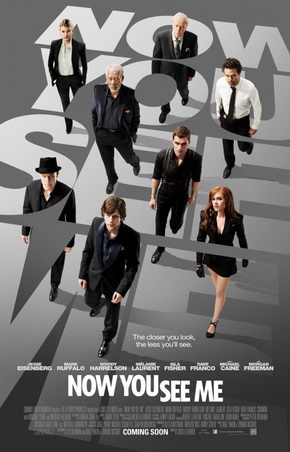
Now You See Me (2013)

The movies are a magical experience, and movies about magic can double up the fun by drawing attention to the innocuous deception of a theatrical illusion.  Unfortunately, Now You See Me spends so much time swaggering that it never really enchants. Now You See Me is ostensibly the story of four semi-professional magicians (Jesse Eisenberg, Woody Harrelson, Isla Fisher, and Dave Franco) who pull off a series of elaborate magic tricks as The Four Horsemen.  But when their illusions begin to look like theft by way of social justice, FBI agent Dylan Rhodes (Mark Ruffalo) and professional debunker Thaddeus Bradley (Morgan Freeman) begin to realize the magicians are, of course, not what they seem.

The key to any successful slight of hand is that the audience has to be so distracted by the flair that they miss the real trick.  Take Christopher Nolan’s The Prestige, a clever (perhaps brilliant) case study of competitive magicians; you’ll be so fascinated by the rivalry between Christian Bale and Hugh Jackman that you’ll miss the clues dropped by the filmmakers.  It’s possibly unfair but entirely unexpected that I’d make this comparison, but Now You See Me doesn’t let the audience play along.  Instead, we’re practically kidnapped, tied down by a film that continually insists on its own brilliance, reminding us at every turn that they’re smarter than we are.

Sure, I can be smarter than you if I don’t tell you what’s going on.  Then, the film gloats by showing you what really happened, though these scenarios are couched in so many maybes and perhapses that it’s never wholly clear what’s going on.  And when your focal character is an investigator, it’s a bit empty to have him never really understand anything.  Ruffalo’s solid as the not-smartest man in the room, and his charisma is enough to hold your attention, but it seems like a less successful riff on his character from The Brothers Bloom, which is saying something.

As for the rest of the cast, you’re looking at the disappointment of the summer.  The four leads have all done good work in the past, but the screenplay is incredibly thin, failing to distinguish any of the four characters beyond physical appearance.  You could rotate the actors in the cast, and it really wouldn’t matter; the characters are so boilerplate and so frustratingly identical that you’ll struggle to connect with them.  Perhaps the film’s worst offense?  Morgan Freeman and Michael Caine never share the frame; their scenes together crackle like a master class in acting, but we never get to see them side-by-side, which gives it a phoned-in feel.

Having said that, there’s a bit of fun to be had in some of the film’s stagier moments.  When The Four Horseman are performing, it’s an opportunity to chew some scenery, and the four leads do well there.  You might even want to see a full show by them at some point, since they convey a sense of infectious enthusiasm for their work.  And, naturally, once you’re told you’re about to be tricked, it’s engaging to watch and try to figure out where the trick is.

As Michael Caine said in The Prestige, “You want to be fooled.”  It’s a good thing, too, since Now You See Me never gives you an opportunity to figure out how the trick is done.  Nor is the ultimate explanation a fulfilling payoff; a last-minute twist is so clichéd that you’ll have already dismissed it as “too obvious.”  Now You See Me is superficial and a bit irksome, continually reminding you of its own cleverness without ever earning the moniker of “smart.”  Sad news for a strong cast, but the real trick is on the audience.

Or, in other words, now I saw it, now you don’t.

Now You See Me is rated PG-13 for “language, some action, and sexual content.”  There’s an F-bomb, playful banter, and some shouting; action consists of a car chase, a few explosions, and some shouting.  And there’s an aborted make-out scene thrown in to earn the “13.”

Sunday, October 3, 2010

The Social Network (2010)

I think we can all agree on two things: David Fincher is a solid filmmaker (even though I'm probably the only person on the planet who isn't keen on Fight Club [long story], I'm considering giving it a second watch), and The Social Network is kind of a step out of bounds for Fincher, whose filmography - including Se7en, Zodiac, and The Game - reads more like a list of "creepiest movies of our generation" than an application to direct a biopic-of-sorts about the founders of Facebook. But Fincher's nothing if not dextrously versatile, and The Social Network adds another notch to Fincher's "here's what I'm capable of" belt.

The Social Network is a highly unflattering portrait of the people who claim to have "invented" Facebook, arguably the most high-profile Web site since Google - the antisocial and nominal founder Mark Zuckerberg (Jesse Eisenberg), his financier and best friend Eduardo Saverin (Andrew Garfield), Napster founder and Facebook's demi-PR guy Sean Parker (Justin Timberlake), and rowing team twins Cameron and Tyler Winklevoss (both played by Armie Hammer), who claim intellectual property rights - and the lawsuits that divided all of them. The film cuts between legal depositions of the main characters and the events they describe, methodically and deliberately leaving the audience to interpret what went wrong and who (if anyone) stole from whom.

Fincher does a solid turn directing here, deftly keeping the pace moving as characters register slights as betrayals and as alliances crumble under the weight of paranoia and profit. Though the film's first cuts between testimonials and actual events are a little jarring for those who didn't follow the Facebook news feed (pun intended), Fincher quickly sorts out who's after what but wisely refuses to spoonfeed us a good guy/bad guy dichotomy. True, the film and its Aaron Sorkin screenplay cast Saverin in a more sympathetic light than Zuckerberg receives, and the Winklevosses are portrayed as jock heavies more than intellectual heavyweights, but it's not clear by the end of the film how we're supposed to feel about the whole thing.

In particular, the film functions a great deal like Cobb's top at the end of Inception (the significance I won't reveal, so as not to spoil it for the DVD-waiters); it means whatever we project onto it, particularly the ambiguous final shot, scored at least somewhat ironically to The Beatles' "Baby You're A Rich Man." It seems, in the opinion of this reviewer, that The Social Network is a kind of light jeremiad against the ugly irony of using the Internet as a way to increase, not detract from, social interaction, and it appears more than slightly condemning of the sort of person who creates something only for public acceptance and the label of "cool." To these people, money is secondary to status, which also subordinates (again ironically) human companionship. One could, of course, read the film's ending as hopeful; title cards let us know that everyone got a little bit of what they wanted all along, but the uncertainty etched into the film's closing cut-to-black is more wobble than topple. It's a testament to Fincher's skill, then, that the ambiguity that pervades the film is more conducive to interpretation than to accusations of waffling.

Fincher also does a fine job pulling together a few "rising stars" (I use the term somewhat skeptically), giving me faith in at least some of the careers-to-be. Jesse Eisenberg, of course, is the undisputed star here, and for good reason; I've decried him as "the B-List Michael Cera" for his turns in Adventureland and Zombieland, but here he's starting to come into his own. The simultaneous wave of revulsion and sympathy you'll feel toward Zuckerberg by the end is equal parts Fincher and Eisenberg, with the latter now wielding a more promising future than his character. Andrew Garfield is more sympathetic as Saverin, pulling out all the stops on the road to pathos by plausibly depicting all the ambivalent feelings of his best friend's so-called betrayal; reminiscent of a young James Franco (wow, how old does that make me, then?), Garfield's making me less nervous about his front role in the Spider-Man reboots (that and the rumored casting of Emma Stone as Mary-Jane). Justin Timberlake's performance is a little more complicated, however, as I'm not sure if it's Timberlake or the character that's a touch hammy; while Sean Parker is flashy and flighty, my perception of Timberlake is much the same. So it's unclear to me whether what I'm seeing is either very poor or very convincing acting.

Maybe this is just me reading a little too much Gail Simone and other feminist theory, but I'm a bit disappointed with the treatment of the female characters in The Social Network. This is a boys'-club movie, with the facts forcing an aspect on the men of the story, but all the female characters are fairly one-dimensional and ultimately little more than impetuses for men to act. Case in point: Sean Parker's introductory scene finds him in bed with a Stanford girl, a fact we learn from a lingering shot of her panty-clad derriere; we learn her name (Amy), her major (French), and little else. Though Amy is an inconsequential character in the big scheme, she's indicative of the role of women at large in the story, which is a shame when you have such a talented female cast on board. I'm dying to see Rooney Mara as Lisbeth Salander in Fincher's The Girl with the Dragon Tattoo, but it's a shame that all she does as Erica Allbright in this film is break up with Zuckerberg and incite him to start an online revolution after his heart breaks (well, maybe). Brenda Song finally gets a chance to break out of the Disney playhouse (after the unfortunate departure of Ashley Tisdale, I gave up on The Suite Life of Zack & Cody and Song's ditzy heiress London Tipton), but she's essentially window dressing as Saverin's girlfriend Christy Lee; while she's certainly very pretty, Christy isn't asked to do anything else but hang on Eduardo's arm. We're told that she's psychotic and controlling, but there's only one scene where she's allowed to be that - her last one, which is unfortunate considering how well she does in it. And Rashida Jones, of The Office and I Love You, Man (whose misogynistic title, curiously, gave her more material than here) fame, is credible as a second-year legal associate who delivers the film's closing monologue - and eulogy of sorts - with sangfroid and aplomb; sadly, that's the first time she does anything more than offer meaningful glances and eat a salad. Ultimately, the film hinges on what Erica Allbright will do next, but it's too little/too late for a film that's so masculine-dominated.

This is not to say that The Social Network is anti-feminist or flawed beyond salvation. It's merely a disappointing (and for this reviewer, distracting) sin of omission that doesn't really hurt the finished product. Fincher does such a good job with the rest of the movie that he almost atones for the negligible treatment of the fairer sex. What Fincher has made here is a work that examines both a particular true story and the nature of "true stories" themselves; wisely, the movie is credited as "based on" a book about the true facts rather than on the "true story" itself, which invites a whole host of questions about what's true and what isn't. Like Rashomon, The Social Network suggests that truth is subjective, and (like Lost) argues that who the characters are and how they interact with each other is ultimately more important than what they're doing.

If nothing else, the film might lead a few viewers to go home and deactivate their Facebook profile, so unflattering is the creation myth behind the social networking site. As for the movie itself, though, I can do little else than invoke the already-labored Facebook pun and state simply, "Like."
With content friendly for the Facebook generation, The Social Network is rated PG-13 "for sexual content, drug and alcohol use and language." The film implies more than one sexual rendezvous with nothing shown beyond hasty disrobing to the undergarment level; characters abuse marijuana, alcohol, and cocaine frequently, and approximately three F-bombs are dropped.

Thursday, March 4, 2010

Zombieland (2009)

After Jennifer's Body (and after the last few posts retroactively updated the blog with reviews I'd written a while back), I needed a fresh movie to restore my faith in the cinema. It was with reservation that I slid Zombieland into my DVD player, but within moments my trepidation was assuaged.

You see, I love a zombie movie that doesn't take itself seriously - Shaun of the Dead is on my as-yet-unpublished "Best of the 2000s" list - and if the undead tongue is firmly in the decaying cheek, I'm right there. Zombieland is another entry in a long line of zombie movies with a sense of humor, and it's one of the better ones.

In an America populated primarily by zombies and where identities are subordinated to destinations (our protagonist is named Columbus, because that's where he's going), survival of the fittest is the order of the day, and the prize for those who make it is the promise of the last Twinkie on earth. Narrator Columbus (Jesse Eisenberg, who seems to be the B-list Michael Cera) meets up with Tallahassee (a fabulous Woody Harrelson), who's all about one-upsmanship and making zombie-killing an art while searching for that last Twinkie. The unlikely duo match wits several times with con artist sisters Wichita (Emma Stone) and Little Rock (Abigail Breslin) before a delightful showdown at the most bitingly contagious theme park this side of Disney World.

While I'm not a big fan of Eisenberg - Adventureland (also set, curiously, at an amusement park) left me cold and I'd much rather watch Michael Cera do the same act - Harrelson rarely lets me down, and his turn as Tallahassee is iconic for all the right reason, setting a new standard for infectiously fun zombie-killers in the same way that Zac Efron redefined teeny-bopper musicals. Stone is cute in a quirky kind of way, and she's entirely believable as a sneaky survivalist. Breslin's cute, too, like a less pretentious and more talented Dakota Fanning with more appeal to a broader audience. So the cast is a lot of fun.

(Note: I think the statute of limitations on spoilers has expired, but just in case... skip this paragraph if you don't want a pleasant mid-flick surprise spoiled.) The most fun, though, comes from an entirely unpredictable and extremely kitschy cameo appearance by Bill Murray, playing himself as one of the last remaining non-infected humans. Murray plays himself, but he does it with as much dry wit as in his most acclaimed roles (Groundhog Day and Ghostbusters, which gets a name check here). There's nothing un-funny about his five or so minutes in the middle of the movie, and the rest of the film almost feels like a letdown once he exits the stage.

The second half of the film has a different feel after the dynamically rip-roaring opening hour, but it's still a lot of fun. It's hard to believe that, in the forty or so years since George Romero made zombies cool, there are still creative ways to kill the undead (again). But how about garden shears? A car door? A piano? Zombieland has all that and more, especially the unforgettable "Double Tap" rule that must be seen to be fully appreciated.

The film is gratuitously violent, but its excessive nature is not purposeless, because the film is so ludiccrously over the top that the blood-and-guts effects have to be similarly beyond the pale. So while some fans might object to the slow-mo shot of a zombie vomiting blood over the opening credits, those of us who are in on the joke know that Zombieland is intentionally dialing the genre up to eleven. Watching Tallahassee do his thing - giggling maniacally and taunting the zombies as he goes - should be proof enough that the filmmakers are having as much fun as they'd like us to have.

It's a biting good time.

Zombieland is, no surprise, rated "R for horror violence/gore and language." The gore certainly isn't for the squeamish, but the language wouldn't make Joe Pesci blush.