Showing posts with label mafia. Show all posts

Monday, April 30, 2012

Monday at the Movies - April 30, 2012

Welcome to Week Eighteen of “Monday at the Movies.” Just when you thought we were out, we’re pulled back in to the world of The Godfather!

The Godfather: Part II (1974) – There are those who say the sequel is better than the 1972 original. I don’t know about all that (I’m incredibly fond of the first Godfather), but Part II is every bit as good as the film that preceded it. Simultaneously a prequel and a sequel, Part II juxtaposes the rise of immigrant Vito Corleone (Robert De Niro) with the tenure of his son Michael (Al Pacino) as he contends with moves for legitimacy in the Vegas casino industry, an assassination attempt facilitated by a betrayal from within, a Congressional inquisition, and a smiling enemy (Lee Strasberg as Hyman Roth) attempting to slide a knife in his back. For my money, the Vito chapters are stronger, although I appreciate the Michael scenes more each time I see the film for two reasons: one, I enjoy the difficult plot the more I understand it and recognize the subtlety; and two, Al Pacino’s performance here is likely his all-time career best. (Take, for example, the exchange between him and his wife when Kay tells him she’s taking the children.) As before, the supporting cast excels: Robert Duvall’s work as Tom Hagen reminds me how empty that part of Part III felt, De Niro and Bruno Kirby are spot-on as Vito and Clemenza without feeling slavishly bound to the original actors, and John Cazale absolutely steals the movie as the malleable brother Fredo. In fact, Pacino and Cazale have what I maintain is the best scene of the film, a boathouse confessional which should have netted an Oscar for both; theirs is the relationship which anchors the film, for which I find myself, as I get older, returning to the film more than for the Vito plotline, which is amusing and entertaining, a lighter counterpart to the heavy burden with which Michael finds himself saddled by the film’s end. The first film needed no sequel, but the second proved how much more could be added to the saga; having only seen the third installment once, I’ll be curious to see if it transcends this film’s sense of completion.

Stay tuned for the final Godfather review. But for now, that does it for this week’s edition of “Monday at the Movies.” We’ll see you here next week!

Monday, April 16, 2012

Monday at the Movies - April 16, 2012

Welcome to Week Sixteen of “Monday at the Movies.” Only one film this week, one that makes me think I really ought to put up a “Top 10 Movies” list.

The Godfather (1972) – Forty years and one month ago, a film widely regarded the best of all time opened in American cinemas. Based on the brutally popular Mario Puzo novel, The Godfather has achieved iconic status in global pop culture, rendering any comments I might add as mere kindling to the inferno. Everyone knows the story – Vito Corleone (Marlon Brando) runs one of New York’s top mob families, and as the film progresses we witness his son Michael (Al Pacino) move from war hero to father’s son. What struck me about this most recent rewatch was the way that every scene is memorable, with no moments of dry disinterest. We move from the wedding to the backroom deals to assassination plots, through a tour of Italy to rises and falls in the Corleone family, concluding with the often-imitated baptism montage and the film’s final moments, which imbue as much gravitas on a closing door as possible. The dialogue is snappy and eminently quotable, the performances are riveting, Nino Rota’s soundtrack is the ultimate in mafia music, and director Francis Ford Coppola set the standard for what every other mob movie now has to live up to. There's so much more that I could say about the film, so much that deserves mention - James Caan's hotheaded Sonny, Robert Duvall's perfectly collected Tom Hagen, Richard S. Castellano's lovable heavy Clemenza (who wouldn't want this guy at a wedding?), and even Abe Vigoda's work as Tessio, proving that he hasn't aged a day since 1972 because he's been 90 all his life. And in an era where we’re texting and multitasking to our brain’s fullest capacity, I was flabbergasted that the film’s three-hour runtime never bored me or forced me to grab my iPad to check e-mails or Facebook. So strong is the allure of this film after more than forty years that it’s as close to Italian wine as film has captured – improving with age and making us look forward to the next installment. My only regret is that I didn’t have time this week to return for the sequel, but reviewing the next films in the series is an offer I cannot refuse.

Stay tuned for more reviews of The Godfather franchise, but for now that does it for this week’s edition of “Monday at the Movies.” We’ll see you here next week!

Wednesday, June 11, 2008

Find Me Guilty (2006)

I never thought I'd say these words, but here goes: I enjoyed a Vin Diesel movie.

Sidney Lumet's 2006 courtroom drama/comedy (my third Lumet film this summer... noticing a pattern yet?) Find Me Guilty suffers from what I like to call "Brad Pitt in Twelve Monkeys" syndrome. This condition of cinema (which will probably soon be retitled "Heath Ledger in The Dark Knight") is not something that speaks ill of the film. Instead, it's high praise for a performance that steps so far outside of the otherwise humdrum career of a lackluster actor and allows the person in question to actually ACT.

The actor in question here is Vin Diesel, who plays Jackie DiNorscio, a New York mobster who elects to defend himself in what becomes the longest trial in federal court history. Though he has no legal experience - save for his self-profession that he's "spent half of my life in jail" - "Jackie Dee" actually does a serviceable job defending himself against an elaborate case built by professional prosecutors.

Chalk it up to Lumet, who I'm sure is responsible for getting this knockdown bang-up performance out of Diesel. After all, this is a guy whose credits include The Pacifier and three Fast and Furious movies. So I wasn't expecting a stellar performance, but Diesel surprises here, virtually unrecognizable as he steps into the shoes of DiNorscio. Other performances here of note include Peter Dinklage as another defense lawyer, who seems miscast because he seems underused; Alex "Moe Greene" Rocco as the surly mob boss at the top of the trial; and Annabella Sciorra, who boils up the screen in her one scene as Jackie's wife.

The screenplay is electrifyingly humorous, with much of the courtroom dialogue allegedly taken from actual court transcripts. If the percent of actual dialogue is as high as a title card leads me to believe, this must have been a real circus to see! Of course, too, Lumet's direction is all right, but nothing calls attention to the direction as in some of his other projects.

One down note on the film is that the momentum it builds in the courtroom scenes - which is considerable and hysterical - is lost in some of the other scenes, so the movie feels like it drags its heels in a few spots. It's also a disappointment to read that, in real life, the jury in the case had been bribed.

The movie on its own, though, as a whole, is perhaps not Sidney Lumet's best work, but it's unquestionably Diesel's best work to date.

Saturday, May 31, 2008

You Kill Me (2007)

"My name is Frank, and I'm an alcoholic."

Frank (Sir Ben Kinglsey) is also a hitman for the Polish mafia in Buffalo in John Dahl's You Kill Me. Dahl - and a riveting performance by Kingsley - succeed in making an alcoholic murderer an endearing protagonist, so it's a good thing that the film doesn't rely on anything but the character of Frank Falenczyk.

Frank, who's been sent by "the family" to San Francisco to dry out, meets up with an AA sponsor (an understated Luke Wilson) and falls in love with a girl named Laurel (Tea Leoni). That's just the first act of the movie, and for me to describe in any detail the second half of the film would be to give away a few plot surprises, including whether or not Frank manages to stay sober - perhaps a bigger challenge than rival mobster O'Leary (Dennis Farina).

The script by Christopher Markus and Stephen McFeely is one of the funnier ones from 2007 with enough laughs to keep the movie clipping along without getting bogged down in a punchline-a-thon. And a great deal of the laughs come from Kingsley's intense portrayal, wherein he never seems to break character. Although he doesn't look Polish and doesn't always sound Polish, Kingsley forces you to believe that he is Frank.

I called Luke Wilson "understated" because he seems at times to have phoned in his performance, alternating between genuine concern for Frank's sobriety and empty presence on the screen. Ditto for Tea Leoni, who is supposed to be playing a complex wounded bird but who never seems to get anything across with her role other than a body for Kingsley to face as he delivers his lines. Dennis Farina and Philip Baker Hall, as rival mob bosses in Buffalo, are interesting, but they're not given enough screentime and so function as buffers between scenes about Frank.

There are a lot of better movies than You Kill Me, but this is a smart comedy - short and sweet. I can't praise Kingsley enough for really immersing himself in the role, and I'm afraid I have little else to say about the film. So let's just say this - if Alcoholics Anonymous was this fun, we'd have more in recovery.

Tuesday, May 27, 2008

The Departed (2006)

To those who know me at least peripherally, it shouldn't come as a surprise that I chose Martin Scorsese's 2006 Oscar-winner (finally) The Departed to be the inagural review. After all, it de-throned The Empire Strikes Back on my list of the best movies of all time. The Departed is, simply put, the best movie ever made. And I will fight to the death on that one. It's that good.

It used to be that Martin Scorsese was the precocious salutatorian of the Academy Awards; his achievments in film (Goodfellas stands out the most) were commended but received little more than a pat on the back and a "Keep up the good work" while movies like Dances with Wolves (ugh) took home the gold. Heck, The Three 6 Mafia won an Oscar before Marty.

The Departed changed all that and deservedly so. It goes without saying that this is Scorsese's magnum opus, it having been already established that this is the best movie ever made. I seldom level the label of "perfect" on a movie, but if ever oh ever a perfect movie there was, The Departed is one because... well, it has everything. One of my favorite quotes about cinema comes from Jean-Luc Godard: "All you need for a movie is a gun and a girl." Well, maybe that's true and maybe it isn't, but The Departed has all that and more.

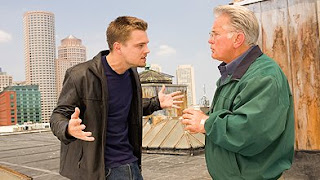
I hate to tell too much of the plot, since The Departed surprised me at every turn in a way movies normally don't - but should. The basic premise here is a mob story, with Jack Nicholson heading up the Boston Mafia as Frank Costello. Costello's mob has an informant in the Boston State Police - Matt Damon's delightfully scummy Colin Sullivan. Yet what almost no one in the film knows is that the cops have a man inside the Mafia - Billy Costigan, as portrayed by Leonardo DiCaprio, in the role that convinced me he had more depth than the waters into which he sank in Titanic. A tangled web of betrayal ensues, and if you see any of the last half-hour coming, James Randi has a prize for psychics like you.


Though the movie is based on the 2002 Hong Kong crime thriller Mou Gaan Dou (or Infernal Affairs), The Departed is so decidedly American that it seems a disservice to Scorsese and screenwriter William Monahan to call this a remake. Re-imagining might be a better word for it, since there's so much more flavor here. Scorsese's flair for directing and coaxing stellar performances from his players (did anyone know Kangaroo Jack alum Anthony Anderson could act?), editor Thelma Schoonmaker's intuitive method of editing the visuals, and a killer soundtrack are things that the original from Hong Kong was missing, things that guide your enjoyment of the movie without you even realizing it.

The old joke about Martin Scorsese is that all his movies have to include "Gimme Shelter" by The Rolling Stones. But I dare you to watch The Departed and listen to "Gimme Shelter" the same way again. If Tarantino changed the way we listen to non-diegetic music, he was plagiarizing from Scorsese. The music here is almost a character in itself; The Dropkick Murphys track "I'm Shipping Up to Boston" has achieved the public recognition that Pulp Fiction gave to Dick Dale's "Misirlou." The nifty thing about the soundtrack here is that you can notice it as an entity in and of itself, or you can let the movie wash over you like a tidal wave of cinematic perfection.

This is a perfect movie to watch with someone who's never seen it before, because the surprises in the movie are at least on a par with the shower scene in one of my favorite Hitchcock films, Psycho. Not that a main character gets killed in the first half, but there are quite a few moments that will challenge your conventions of how a movie should behave. Take for example the first twenty minutes. Just when you think the film's done a cold open and omitted opening credits, The Dropkick Murphys kick on, cue title card, and you know you're in for a whole lot of awesome. And it doesn't let up - from the omni-profane Alec Baldwin as the scene-stealing Captain Ellerby sparring with equally fascinating Sgt. Dignam (Oscar nominee Mark Wahlberg) to the freeze-frame that closes the film - this is 151 minutes of cinematic perfection.

Act accordingly.