Showing posts with label Michael Fassbender. Show all posts

Monday, June 24, 2024

Cinemutants - X-Men: Apocalypse (2016)

At a time when superhero movies are starting to lose their stranglehold on pop culture, there are really only two options: go back and watch old movies, or kill off an entire cinematic universe in spectacular fashion. This July, Marvel’s taking the latter approach with Deadpool & Wolverine, which seems primed to seal off the 20th Century Fox film universe. And while director Shawn Levy promises, “This movie is built [...] with no obligation to come prepared with prior research,” skipping the research has never really been my strong suit when it comes to franchises. It’s a perfect excuse, then, to go through the last 24 years (and 13 movies) with everyone’s favorite mutants, the X-Men.
 
This week, from 2016, it’s X-Men: Apocalypse. En Sabah Nur (Oscar Isaac), the first mutant, awakens from millennia of slumber, determined to cleanse the world and start over. Meanwhile, tragedy strikes Erik Lehnsherr (Michael Fassbender), driving Mystique (Jennifer Lawrence) back into an alliance with Professor Xavier (James McAvoy), while a young Scott Summers (Tye Sheridan) joins the Xavier Academy and begins to fall for the telepathic Jean Grey (Sophie Turner).
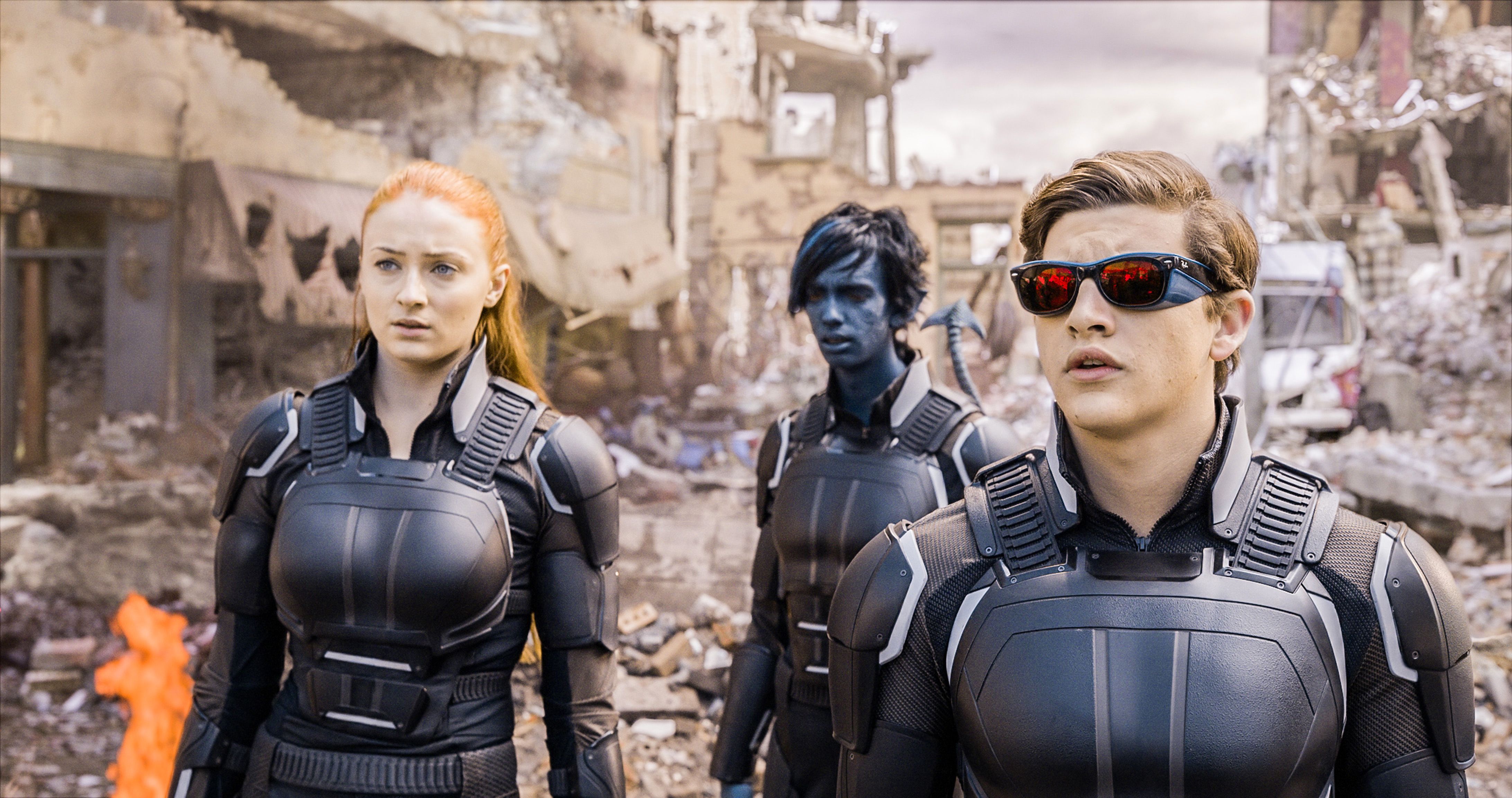
  1. The third one’s always the worst. When Jean Grey speaks this line, ostensibly in reference to seeing Return of the Jedi, it’s clear that director Bryan Singer is taking one last dig at Brett Ratner’s The Last Stand. It’s only been a few weeks for us, but a decade later, Singer was still relitigating the old canon he wiped away in the previous film. It’s catty and distracting, especially because Apocalypse is more or less the third film in the First Class timeline, and it’s one of the franchise’s weaker outings. It’s less schizophrenic than The Last Stand, but it’s both undercooked and overbusy, with Oscar Isaac as a surprisingly unenthusiastic Apocalypse, who in another cinematic universe could very well be the biggest threat mutantkind has ever faced. But Isaac is clearly fatigued by the heavy prosthetics and needlessly dramatic dialogue (“You can fire your arrows from the Tower of Babel...”), and despite getting what should have been a fresh start from Days of Future Past, we seem to be treading the same boards all over again. If we get a mention in Deadpool & Wolverine, it’ll surely acknowledge the fact that Isaac has moved on with Marvel as Moon Knight.
  2. She’s barely aged a day. Curiously, Apocalypse is set in 1983, but you would scarcely know it’s been 20 years since First Class. There are a few throwaway lines about how well everyone is aging – the kind of lantern-hanging that Deadpool might do best – but I thought it then and I thought it now: it was a wild choice to set the primary X-Men films in the historical past and then leave them there. No one looks twenty years older, and the only good reason to leave the films in the past is to keep the rock-solid casting of James McAvoy and Michael Fassbender, who still play this trilogy like one long break-up. Jennifer Lawrence, meanwhile, has “contractual obligation” hanging over her head in a role that sees her discard her blue appearance for nominal plot reasons but more for her own professional clout. And with the reprise of so many supporting characters instead of the legion (pun intended) of options from the comics, it all feels a little claustrophobic.
  3. The glory of what’s to come. As much as Apocalypse tries to chart a new path using the same old pieces from the original films, there is certainly a sense of awe when Jean Grey finally unleashes the Phoenix Force in the final battle against Apocalypse. Seeded throughout the film in a way that never quite feels like an echo of X2, it’s an implicit promise that the next film will do justice to the “Dark Phoenix Saga” of comics legend. Whether we strike gold is a subject for debate in three weeks’ time, but almost no one enjoyed Dark Phoenix. Will the third time be a charm if we see a Phoenix in Deadpool & Wolverine? Heck, as a living embodiment of reincarnation, the Phoenix could be just the thing to bridge timelines from the Fox films into the MCU, or perhaps it’ll just be Deadpool’s sheer force of fourth-wall breaking.
  4. Weapon X. After sixteen-plus years, Hugh Jackman had very nearly done it all with Wolverine, touching on virtually every one of the costumed hero’s most famous comic book stories. Yet his uncredited cameo (which I recall being a genuine surprise) brings to life Barry Windsor-Smith’s iconic “Weapon X” design, with Wolverine as a deprogrammed and feral Frankenstein’s monster. It’s the sort of visual shout-out that rewards comics readers, while looking breathlessly cool for the normies in the audience. It also gives us a peek at how Logan’s faring in the new timeline; last we saw him, Mystique-as-Stryker was fishing him out of the river, and now we see his origin story aligning away from what we learned in X-Men Origins: Wolverine, with his brief interaction with Jean Grey retroactively cueing up his romantic fixation on her. Will the Logan we meet in Hugh Jackman have gotten his adamantium from Danny Huston or this film’s Josh Helman? Which one grows up to be Brian Cox? We may find out in a month’s time. 
  5. A sinister future. We’ve still got about four weeks left on this recap series, but believe me when I tell you the end is nigh. Case in point, this post-credits teaser that never materialized, despite a pitch-perfect opportunity for the next film to include Mister Sinister, a genetics-obsessed madman whose Essex Corporation is seen here recovering a vial of Logan’s blood. Sinister’s fixation with the Summers bloodline, too, might have made for an interesting film down the line. Still, I hope the MCU is holding Sinister in reserve, and not just for a passing cameo in Deadpool & Wolverine; lest we forget, Sinister’s comics debut found him leading the charge in the “Mutant Massacre” crossover, and his more flamboyant recent appearances would be a perfect fit for, say, David Tennant. 
Sound off in the comments, true believers: is Apocalypse the biggest misstep in the X-Universe? Or is it an underrated gem? Up next, it’s swan songs all around with Logan.

Monday, June 10, 2024

Cinemutants - X-Men: Days of Future Past (2014)

At a time when superhero movies are starting to lose their stranglehold on pop culture, there are really only two options: go back and watch old movies, or kill off an entire cinematic universe in spectacular fashion. This July, Marvel’s taking the latter approach with Deadpool & Wolverine, which seems primed to seal off the 20th Century Fox film universe. And while director Shawn Levy promises, “This movie is built [...] with no obligation to come prepared with prior research,” skipping the research has never really been my strong suit when it comes to franchises. It’s a perfect excuse, then, to go through the last 24 years (and 13 movies) with everyone’s favorite mutants, the X-Men.
 
This week, from 2014, it’s X-Men: Days of Future Past. Professor X (Patrick Stewart) and Magneto (Ian McKellen) send Wolverine (Hugh Jackman) into the past to save their future from mutant-killing Sentinel robots. In 1973, Wolverine has to bring together a despondent Charles Xavier (James McAvoy) and the incarcerated Erik Lehnsherr (Michael Fassbender) to stop Mystique (Jennifer Lawrence) from killing Bolivar Trask (Peter Dinklage), the inventor of the Sentinels.

  1. Securing our future. We can argue about whether this is the best X-Men movie (it’s easily top three), but there’s no debating the fact that this is the most X-Men movie. Two casts, parallel timelines, ready-made comics inspiration, and a continuity fix that only muddles the waters even further: Days of Future Past has everything an X-fan could want. While the change-the-past plot was intended to smooth over any errors in the timeline (or, at least, provide a plausible excuse for them), it only exposes the gossamer of the plot to brutal scrutiny. By the end of the film, just how much of the past has Logan undone? (Director Bryan Singer is at least erasing The Last Stand, but there’s a wink toward expunging X-Men Origins: Wolverine, as well.) You might still need a chart to understand how all the films relate to each other, but I’ll argue next week that, as far as time travel and continuity are concerned, Days walked so Deadpool could run.
  2. Infinite outcomes. Along with being the apex X-Men movie, Days of Future Past provides something so unique that only the superhero genre can do. As incredible as Patrick Stewart and Ian McKellan were, James McAvoy and Michael Fassbender were equally inspired casting choices. And in virtually any other genre, you’d never have an opportunity to put them on-screen together; imagine a Godfather movie that saw Marlon Brando meet Robert De Niro, or a James Bond movie where Daniel Craig teams up with Pierce Brosnan. Another way Days cues up Deadpool is by implying that both versions exist out there somewhere, simultaneously; future films followed both Professors Xavier, and it’s inconceivable that Deadpool & Wolverine won’t see other iterations (or “variants,” in MCU-speak) of recognizable characters. Let’s hope the new castings are just as good. 
  3. It all starts with her. In the comics, Kitty Pryde is the one traveling back in time to warn the X-Men about averting the future; here, though, it’s got to be Wolverine, both for the practical needs of the plot and for the fact that Hugh Jackman continues to be an audience favorite for his literal embodiment of the character. (The movie finds a creative way to keep Kitty relevant to the plot.) Meanwhile, the target of the future remains unchanged; it’s still Mystique, played by Jennifer Lawrence at the peak of her rising stardom. Two years after her Oscar for Silver Linings Playbook and a year before finishing her tenure in The Hunger Games, Lawrence makes a third-stringer background villain into a compelling and deeply human protagonist. It’s almost hard not to root for her, though Lawrence’s apparent fatigue with the role will become inescapable in the weeks to come. (A third woman, Anna Paquin’s Rogue, becomes an axis point in the “Rogue Cut,” which sees Rogue freed from a mutant prison to help Kitty Pryde save Wolverine.)
  4. In the future, do I make it? It feels like it’s been true for most of these movies, but Days of Future Past really illuminates the paradox of accurately and lovingly bringing characters to life and then giving them absolutely nothing to do. Bishop and Blink, for example, look like they stepped straight out of a comic book, but I’d be darned to tell you why, on the strength of this movie, any fan would care about them. Even Storm suffers from this paradox; as cool as it is to see Halle Berry rocking the closest thing to a mohawk we got from her, Storm’s presence in the film is barely consequential, and the film seems not to have noticed that she is essentially the last surviving faculty member at the Xavier Academy. The X-Men might have the deepest bench in comics, but the movies always seemed to focus on the same dozen or so; next week, we’ll see Deadpool do right by Colossus, who’s had less personality than window dressing in these films.
  5. Is the future truly set? Superhero storytelling is perpetually stuck in the second act; after you get through the first-act origin tales, most of these stories never truly end. (And when they do, like All-Star Superman or Old Man Logan, they’re in alternate realities.) Days of Future Past eats its cake and has it too by giving Logan a cheery send-off while also holding open the door for more stories in the First Class timeline. (Quite where Logan takes place, we’ll consider in a few weeks.) But it does seem a little suspicious – and possibly even sinister – that Bryan Singer’s happy ending seems to erase/retcon only the movies he didn’t direct. Of the beleaguered director’s many sins, this is far from the worst, but this film does seem to promise a new golden age that, more or less, never came to pass. Did the film that was meant to fix the franchise actually break it? The best films to come are the ones that play fastest and loosest with continuity...
Sound off in the comments, true believers: where does Days of Future Past sit in your estimations, and was it really ten years ago already? Up next, second chances all around when Ryan Reynolds gets another shot at the Merc with a Mouth in Deadpool.

Monday, May 27, 2024

Cinemutants - X-Men: First Class (2011)

At a time when superhero movies are starting to lose their stranglehold on pop culture, there are really only two options: go back and watch old movies, or kill off an entire cinematic universe in spectacular fashion. This July, Marvel’s taking the latter approach with Deadpool & Wolverine, which seems primed to seal off the 20th Century Fox film universe. And while director Shawn Levy promises, “This movie is built [...] with no obligation to come prepared with prior research,” skipping the research has never really been my strong suit when it comes to franchises. It’s a perfect excuse, then, to go through the last 24 years (and 13 movies) with everyone’s favorite mutants, the X-Men.
 
This week, from 2011, it’s X-Men: First Class. It’s 1962, and Charles Xavier (Patrick Stewart) is just beginning his research into mutation when he meets Erik Lehnsherr (Michael Fassbender), a mutant out for revenge on Sebastian Shaw (Kevin Bacon), the man who killed his mother. With Shaw manipulating both sides of the Cold War, Charles and Erik recruit a team of mutants, beginning with Charles’s childhood friend Raven (Jennifer Lawrence). 
 
And so we return and begin again. The reset button is practically a supporting character in the X-Men franchise, and after Origins didn’t quite recapture the magic, First Class goes back even further, both in the timeline and in reprising the actual opening scene of X-Men. (No wonder – it’s still one of the most effective origin stories and one of the best-told ones.) Director Matthew Vaughn is never too showy about the film’s 1962 setting, though a third-act retelling of the Cuban Missile Crisis feels a bit like something that belongs in Zack Snyder’s Watchmen. As a prequel, however, First Class is reveling in the untold stories, from Henry McCoy’s evolution into the blue-furred Beast (Nicholas Hoult) to Xavier’s occasional quips about losing his hair.
 
Frankenstein’s monster. A huge part of the success of First Class comes from its own secret origin, starting life as a screenplay for X-Men Origins: Magneto. By weaving Magneto’s story into a larger tapestry, we get to skip right to the best scenesalong his quest for revenge, and Fassbender is resplendent in his righteous fury. (Points taken off, though, for the infrequent intrusion of Fassbender’s own Irish accent.) We see all the reasons for Erik’s fall, sympathizing all the while with a man who sees himself as a helpless monster. And when Charles accidentally invokes the Nazi defense of “just following orders,” a chill ran up my spine because of how effectively First Class presents Magneto’s perspective. What Ian McKellen implied, First Class does well to elucidate. 
 
Groovy mutation. On the flip side, James McAvoy is a surprising Xavier, eschewing the austerity of Patrick Stewart’s performance in favor of a Swinging Sixties Charles, not above using his scientific know-how to impress the birds down at the local pub. Still, the shepherd wins out in Xavier as he assembles his first team (not G-Men, the film wryly observes, but X-Men), but more particularly when he attempts to guide Erik’s lost soul toward serenity. Indeed, it’s not hard to see First Class as a tragic love story between two men who could have been brothers; the repeated motif of the chess board, borrowed from the Bryan Singer films, suggests an unspoken bond, though a sunset picnic at the Lincoln Memorial adds a new color to the dynamic.
 
We’re the better men. I usually remember First Class fondly for the Charles and Erik dynamic, but I was surprised on this rewatch to see how many things don’t work at the same level. Kevin Bacon is hammy good fun as the film’s antagonist, but his cabal of villains are either outright boring or, in the case of January Jones’s Emma Frost, wildly miscast. Meanwhile, Hoult’s Beast is a strong supporting choice, but the rest of the team is largely indistinct; Zoe Kravitz’s Angel is a snooze, Edi Gathegi’s Darwin isn’t around long enough to make an impression, and Havok and Banshee don’t quite have personalities of their own. (On those counts, only True Believers will much care about their inclusion.) Then there’s Jennifer Lawrence’s Raven, a far cry from the sycophantic Mystique we met in the foregoing trilogy; she acquits herself well enough (despite some truly dodgy makeup), but appending her to Xavier’s origin is still a strange choice.
 
We are the future. First Class ends up walking a fine line between reboot and prequel. It’s hard to say it’s precisely a prequel to X-Men, mostly on the grounds of what happens in Days of Future Past. But while we have cameos from Hugh Jackman and Rebecca Romijn, we also get a very different Moira MacTaggert (Rose Byrne), a Beast who’s older than he should be, and a Summers brother that throws a wrench into the already murky family tree after we “met” Cyclops in 1979 last week. (Then again, the Summers family tree is notoriously gnarled in the comics, where it’s easy to lose count of who the third Summers brother was intended to be.) It’s all a helpful reminder not to take any of this too seriously, and for all my handwringing here, none of it interferes with my enjoyment of the film, which is somewhere near the top of my X-rankings.
 
Sound off in the comments, true believers: is First Class first in its class? Now that we’ve gone all the way back in time, we’ll jump to the end of the queue next week with The Wolverine, catching up with Logan after the events of The Last Stand.

Tuesday, February 15, 2022

Alien: Covenant (2017)

After I saw Prometheus in 2012, ostensibly returning director Ridley Scott’s prequel to Alien, I had such a viscerally negative experience that I’ve never gone back and rewatched the film. It worked on an instinctive level, with enough scares and dread, but the meandering narrative left me unfulfilled. It was a film without an ending, a prequel without a need to participate in the same universe. 

In fact, Prometheus was such an overall negative experience for me that it took me four years to watch its sequel, Alien: Covenant, which came out in 2017. At least this time, the film is unabashed about its ties to the Alien franchise, but it is so unbearably ponderous, and it takes far too long for much of anything to happen. By the time the film hits its strongest notes, most in the audience may have long since fallen asleep.


Android Walter (Michael Fassbender) awakens his ship of colonists after a solar flare damages their vessel. Once the repairs are complete, Captain Oram (Billy Crudup) and his second Daniels (Katherine Waterston) discover a mysterious broadcast that leads them to a planet perfectly suited for their settling mission. The planet, however, is home to a giant storm, a few mysterious creatures, and another android (also Fassbender) who appears to be the only survivor of a doomed ship ten years ago.


Alien: Covenant begins with a lengthy sequence between Fassbender’s robotic David and his human inventor, played by an uncredited Guy Pearce. The dialogue is laborious and painstakingly self-serious, as though this is the first time that such a scene has been presented between creator and creation. Pearce and Fassbender limp their way through dismally tedious monologues about creating life, and just when you think the scene can’t verge any further into cliché, Fassbender begins playing, of all things, Wagner on a conveniently adjacent piano. It’s guaranteed to induce a hearty groan from anyone who’s seen a science-fiction movie in the last forty years, yet this prologue is so sententious that it casts a dour pall over the rest of the movie.


It’s another forty minutes or so before the plot of the film really gets going, after taking much too long to introduce a crew of no fewer than nine characters – half of whom, don’t worry, will be alien fodder before too long. You’ll have to wait nearly an hour before seeing so much as a hint of an alien, which is a bit of a problem, especially because the alien hijinks in Covenant aren’t anything we haven’t seen before. There are blundering humans who unwittingly infect themselves with alien spores, alien eggs that ought to ring a bell for fans of this franchise, and things that go bump in the dark. There’s even a familiar piece of heavy machinery that plays a significant role early in the film’s climax; it’s not the cargo-loader from Aliens, but it’s close. 


Indeed, Mark Kermode has rightly called Alien: Covenant a “greatest-hits” collection, reprising so many recognizable moments to diminishing effect. One senses that Ridley Scott is re-staging them with all the dramatic flourish of the original King Kong, as if to say it’s all been building to this – ta-da! Yet we’ve been down this road once or twice already; we’ve seen it all before. There’s an instinctual fear of the darkness and of sudden scares, and Scott is deft at manipulating the audience into being startled, but at the same time any eagle-eyed Alien fan will probably spot some of these jumps coming. (Cautionary tale: if you’re in space, never ever go into a medical bay.)


Just about the only fresh thing the film does is to cast Fassbender as the dueling android twins David and Walter. Fassbender shines in these twin roles, not least of all because of the different accents he employs. He manages to make both characters visually distinctive in their mannerisms and bearings, yet Alien: Covenant finds a way to wear out your patience in a few navel-gazing sequences where the two androids explain the plot to each other before – and I cannot make up this level of narcissism – kissing. It’s a perfect metaphor for how enamored the film is of itself and its own weighty, needless mythology. 


You sense that the makers of Alien: Covenant are trying, really trying. Katherine Waterston is a fine update on the Sigourney Weaver archetype, and the film gives her enough room to carve out a unique take on the role. But no one else is quite trying at the level of Fassbender and Waterston, and the film is mired in its own reflection. There are things that will always work in an Alien film, but that doesn’t mean you can string them together time after time for a guaranteed winner. It took me four years to watch Alien: Covenant; maybe I should have waited a little longer.


Alien: Covenant is R for “sci-fi violence, bloody images, language and some sexuality/nudity.” Directed by Ridley Scott. Written by Jack Paglen, Michael Green, John Logan, and Dante Harper. Starring Michael Fassbender, Katherine Waterston, Billy Crudup, Danny McBride, and Demián Bichir.

Tuesday, May 31, 2016

X-Men: Apocalypse (2016)

We’re eight movies into the X-Men film universe (nine if you count Deadpool, and hey, why not?), and while a fair number of critics are feeling X-fatigue, count me among the X-static – pun intended, because I’m happy about the way that the X-Men film franchise remains static in terms of its formula. With X-Men: Apocalypse, Bryan Singer is back for his fourth X-outing, a continued strong offering which introduces plenty of mutants, action, and character development to bode well as the franchise stands poised to move into double digits.

With Professor Xavier (James McAvoy) ushering his school for mutants into an era of peace, an ancient being known as Apocalypse (Oscar Isaac) awakens in Cairo and gathers his four Horsemen – Magneto (Michael Fassbender) among them – to bring about the end of this world. While Mystique (Jennifer Lawrence) works to protect the mutants from humanity, it’s up to the next generation of X-Men – Jean Grey (Sophie Turner), Cyclops (Tye Sheridan), Quicksilver (Evan Peters), and Nightcrawler (Kodi Smit-McPhee) – to save the world from the threat of Apocalypse.

With the continuity reconstructed in the wake of Days of Future Past, Singer is free to carve out a path toward the present day with access to the full range of X-characters, regardless of whether they live, die, love, or hate in the other films. There’s something liberating about not knowing precisely whether Magneto is on the side of good or evil in this one, a line which Fassbender embodies even without much dialogue to lean on. Ditto for the introduction of Scott “Cyclops” Summers and Jean Grey, whose courtship (if one can call it that) is only just beginning; we don’t know if they’ll end up the squabbling starter-marriage from X-Men, but Turner and Sheridan are fun to watch and bring the characters to life with some very subtle yet comics-accurate hand gestures (Jean’s fingers on her temple, Scott’s dial-controlled visor).

And for all that X-Men: Apocalypse blusters on about the end of the world and the fate of mutantkind, it’s surprising that the film ends up being rather fun and incredibly human in its very personal scale. Like the Avengers movies, which have found great success in seeing its heroes out of costume, lounging about Stark Tower, X-Men: Apocalypse is at its most engaging when the X-Men recruit Nightcrawler for an impromptu trip to the mall as “a matter of national pride” (though an Avengers film might have showed said trip), or as Cyclops learns to master his abilities. It’s hard to say if there’s a real star in this film, because the X-Men are at their best when the ensemble cast is allowed to share the screen.

If this is the ensemble going forward, the more the better. While McAvoy, Fassbender, and Lawrence continue to powerhouse their way through the prequels, they’ve indicated they might not be back for a fourth outing together. It’d be a shame, to be sure, but I wouldn’t mind seeing the film continue to develop Storm and Jubilee, the latter of whom doesn’t get to display her powers just yet, and Singer’s recent tease that the next film will go to space is extremely promising for the wealth of source material on which he can draw. (Phoenix Redux, anyone?)

There have been some complaints about Apocalypse as an undercooked cliché of a villain, though I think that you need a colossal world-ending event to justify bringing together the X-Men, particularly after the last two prequels have dealt with less cosmic threats and more personal dangers (Kevin Bacon’s Sebastian Shaw, though looking to heat up the Cold War, was also a personal foil for Magneto). It is a shame to put an actor as talented as Oscar Isaac beneath all the prosthetics and makeup that go into Apocalypse, but Isaac acquits himself well with the villain’s ego and powers of persuasion. If you want a grounded superhero battle, Captain America: Civil War is still in theaters (and it holds up), but the X-Men demand something more fantastical.

To the heap of well-crafted, Singer-helmed X-titles, I have to add X-Men: Apocalypse, more fun than it promises and just as compelling as its predecessors. The final battle doesn’t leave much room for surprise (how many permutations of averted catastrophe are there?), but the road getting there is as good as anything we’ve seen yet. Singer proves himself the X-King; long may he reign.

X-Men: Apocalypse is rated PG-13 for “sequences of violence, action and destruction, brief strong language and some suggestive images.”

Monday, August 17, 2015

Monday at the Movies - August 17, 2015

Welcome to another installment of “Monday at the Movies.”  We haven’t done one of these since May, but it seems worth commenting on the “director’s cut” of X-Men: Days of Future Past, dubbed “The Rogue Cut” for reasons that will become apparent.

X-Men: Days of Future Past - The Rogue Cut (2014/2015) – I’m not doing a full review of The Rogue Cut, which adds about fifteen minutes of unseen footage, because my original sentiment still stands. I called the theatrical release “one of the better outings in the series,” and The Rogue Cut doesn’t change that. If anything, it makes the film a stronger one, filling in what I had perceived to be a stumble before the third act begins, the beat when Mystique (Jennifer Lawrence) goes missing. Here, The Rogue Cut fills in the gap by 1) restoring Anna Paquin’s turn as Rogue in the dystopian future of the film, and 2) giving Mystique a wonderful moment with Beast (Nicholas Hoult) in 1973. While I concede that the theatrical cut isn’t less by omitting these sequences, the film is overall richer for having them. In fact, I got more of a sense that I was entering a world during The Rogue Cut, rather than the crossover event the theatrical release felt like. Although the changes are almost universally positive additions to Days of Future Past, I have a small complaint, which might not even be a negative. The Rogue Cut juxtaposes Magneto (Michael Fassbender) retrieving his helmet with Magneto (Ian McKellan) rescuing Rogue, and while I think the cross-cutting is a nifty formal trick, I can’t help but feel the former sequence was better served on its own, building more tension as we got inside the young Magneto’s head. But it’s a moment that only rings hollower if you’re familiar with the original incarnation, and everything else in The Rogue Cut is so well-crafted that it might now be my new favorite X-Men film. PS – Stay tuned for a new mid-credits sequence! (The original post-credits scene is still intact.)

That does it for this week’s edition of “Monday at the Movies.” We’ll see you here next week!

Monday, May 26, 2014

X-Men: Days of Future Past (2014)

Are we still in the first Golden Age of comic book films?  Or, post-Avengers, are we seeing a renaissance of comic book movies that wrestle with heavy thematic material in the way that previously only Christopher Nolan’s “Dark Knight Trilogy” had?  I suspect the latter, though the X-Men franchise has always used the mutant metaphor to wrestle with issues of tolerance and persecution.  With Days of Future Past, the seventh (seventh!) film in the series, though, X-Men kicks it up a few notches for one of the better outings in the series.

While former enemies Professor X (Patrick Stewart) and Magneto (Ian McKellan) have united against the threat of mutant-exterminating Sentinel robots, they send Wolverine (Hugh Jackman) into the past to 1973 to unite their younger selves (James McAvoy and Michael Fassbender) against the path to dystopia:  if Mystique (Jennifer Lawrence) kills the Sentinels’ creator Bolivar Trask (an inspired casting choice in the form of Peter Dinklage), the future is doomed.

Days of Future Past is equal parts sequel (to The Wolverine’s post-credits sequence and to First Class), prequel, and timey-wimey reboot, and with two principal casts working the same plot in two timelines, the film very easily could have spiraled out of control – both in terms of runtime and narrative.  But to returning director Bryan Singer’s credit, the film is tighter than that alleyway in Inception’s Mombasa chase scene.  Singer is obviously a fan at heart, and his passion for the project grants him a gifted hand at the wheel.

There is, throughout the film, a very present and nagging sense that much of the time travel in the film is designed to pull two profitable timelines together and, in the process, clean up some of the less popular missteps from films like X-Men Origins: Wolverine and X-Men: The Last Stand.  Fanboys and casual filmgoers alike will not complain there, so long as the film is anchored by a compelling central narrative that feels more like storytelling than like sweeping up.  This is actually a time-honored tradition in comic books, with the richer comics giving us more than just continuity clean-up.  By giving us characters and stakes to care about, Days of Future Past justifies its own existence beyond a simple “pretend those other films never happened” attitude.

Aside from a beat just before the third act begins, Days of Future Past never meanders, never bogs itself down in excess exposition or backstory.  Some of it doesn’t even jive with the past films, but thank heavens the movie doesn’t tie itself to its own inheritance; we know enough to jump into the world without having our hands held, and the filmmakers know it.  (Note to Zack Snyder when it comes to including Batman in Batman v. Superman: Dawn of Justice – we know the origin already.)  Instead, Singer and company cut loose and have fun with the source material.

At times, that fun is a little too juvenile for me, as in the case of the speedster Quicksilver (Evan Peters).  When the casting was announced, it seemed a bit of one-upmanship with Joss Whedon’s Avengers 2, where Peters’s Kick-Ass costar Aaron Taylor-Johnson will be playing the hero.  Peters’s interpretation of Quicksilver is actually quite entertaining, and the special effects used to present his abilities are stunning.  That said, as cool as it is to see a man move quickly enough to reposition a bullet in midair, the beat when he pauses to give an assailant a wedgie is more Ratner than Singer.  It’s an incredibly nitpicky nit to pick, but it’s a poke in the eye during an otherwise winning eyeball kick of a set piece.

As in First Class, the scene stealer is Fassbender’s Magneto, who’s less “early days” McKellan and more of an original stamp on the character as derived from his Holocaust origins.  Lawrence gets a few solid scenes in as the revenge-embittered Mystique – not too far from Magneto, in that respect.  While those two play extensions of their First Class iterations, McAvoy has the harder task by carrying the emotional arc of the film, rebuilding himself out of despair and toward the Patrick Stewart we know he’ll become.

The inevitable sequel X-Men: Apocalype (teased in a nifty stinger) will focus on the First Class cast, which is fine, obviously, plus we’ll probably have Hugh Jackman along for the ride as Wolverine – again, fine.  The part is essentially his by now, and he’s more than earned it.  I hope, though, that we haven’t seen the last of the “classic” cast; seeing Stewart and McKellan and a few other familiar faces reminds us just how spot-on those casting calls were.  In this respect, Days of Future Past is a lot like checking in with old friends while meeting some new ones, and it’s my hope that we don’t walk away from the former as we gain the latter.

X-Men: Days of Future Past doesn’t reinvent the superhero wheel, and it doesn’t transcend the genre into something utterly inspired like Captain America: The Winter Soldier, but it does its job more than capably well.  It’s vastly entertaining and engaging, well-acted and well-crafted.  It doesn’t have the metaphorical depth of past outings like X2, but that depth is supplanted by an emotional one that hooks the audience without preaching to it.

X-Men: Days of Future Past is rated PG-13 for “sequences of intense sci-fi violence and action, some suggestive material, nudity and language.”  There’s plenty of slicing and dicing and exploding and the usual whizz-bang stuff; male rear nudity is seen once, and we get a reference to the F-bomb heard round the world from First Class.

Monday, August 13, 2012

Monday at the Movies - August 13, 2012

Welcome to Week Thirty of “Monday at the Movies.”  Following last week’s coverage of the X-Men trilogy, this week we’re taking a look at the two prequels that have been released thus far.

X-Men Origins: Wolverine (2009) – As indisputably the most famous X-Man, it’s no surprise Hugh Jackman’s Wolverine got his own spin-off, and the prequel treatment sheds light on his mysterious past, unknown even to himself.  The film goes all the way back to his childhood with his brother Victor “Sabretooth” Creed (Liev Schreiber) through his time as an experiment at the hands of William Stryker (Danny Huston) and concluding with a visit to Three Mile Island and a confrontation with Weapon XI (alias Deadpool, here played by Ryan Reynolds).  Wolverine is something of a mixed bag; while there are truly great moments in the film, even fans of the franchise will find this movie overstaffed.  Jackman proves himself Wolverine incarnate once more, Huston is a fine stand-in for a young Brian Cox, and Schreiber is another in a long line of great comic book performances, lending his Oscar-worthy chops to an ambiguous antagonist who’s quite literally able to chew the scenery.  The story’s very interesting too, fleshing out a complicated backstory with a deft credits montage (which could be its own movie) and a fill-in-the-blanks attitude that resolves some of the unsolved flashbacks of X2.  But while the heart of the film is gold, it’s padded out with an overfull cast of characters and too many undeveloped sideplots.  It’s fun for insiders to see The Blob or Gambit show up, but the film is so focused on Wolverine (and rightly so) that it barely scratches the surface of these characters; consequently, so many characters do so little that many of the supporting actors do little more than phone in their performances (see Taylor Kitsch’s groan-worthy “accent” as Gambit).  The film rushes to its conclusion, no doubt because of its many side trips, but the news that a sequel will take the newly-amnesiac Wolverine to Japan is promising, even if only to see Jackman romp as Wolverine once more.

X-Men: First Class (2011) – Matthew Vaughn’s period-piece prequel was one of 2011’s surprise hits; after the bloated Wolverine’s disappointing presentation, my expectations were low.  But First Class does so many things right that I’m ready to say it’s the best and most enjoyable of the X-Men films.  James McAvoy and Michael Fassbender turn in A-plus performances as Charles Xavier and Erik Lensherr (the man who would be Magneto), channeling but never aping their predecessors.  Their “First Class,” led by Jennifer Lawrence as Mystique, is a ragtag group that proved before The Avengers that an ensemble superhero cast was doable, and Kevin Bacon lends an element of well-done camp as the piece’s maniacal villain.  The script is ambitious and plays its Sixties vibe to the hilt, replete with Nazi-hunting, Cold War tension, and groovy clothing.  In the hands of a lesser director, the script would have flopped, but Vaughn owes far more to the able cast who breathe life into the characters, realizing fully their inner struggles and “great responsibility.”  It’s not that comic book movies generally have bad acting; it’s that many of us aren’t expecting Oscar-caliber.  Hence the surprising strength of First Class, especially rising star Fassbender’s heartbreaking turn as a man for whom peace is a waning option.  Only January Jones as the psychic Emma Frost disappoints, drifting lackadaisically through an otherwise top-notch company.  But what First Class wisely remembers ends up being its greatest strength; for all the sturm und drang which usually occupies the genre, superhero films are supposed to be fun, and by the end of the film you’ll agree with Charles – “That’s a groovy mutation.”

That does it for this week’s edition of “Monday at the Movies.” We’ll see you here next week, but stay tuned for a full review of The Bourne Legacy this Wednesday!

Wednesday, June 13, 2012

Prometheus (2012)


Like the titan Prometheus, Ridley Scott is sometimes treated like the man who brought science-fiction fire to the American cinema, if only for his impressive one-two punch of Alien and Blade Runner.  With Prometheus, Scott returns to his roots and, so to speak, mankind’s in a sci-fi epic that finds its protagonists exploring the genesis of man.  But while the scale is epic, the result is somewhat lukewarm, successful on many levels but in other places suffering from its servitude to its own mythology.

Funded by elderly tycoon Peter Weyland (Guy Pearce), a team of scientists led by archaeologist Elizabeth Shaw (Noomi Rapace) travels to a distant world after disparate hieroglyphics point to humanity’s origins.  In search of “The Engineers,” mysterious beings that may have seeded Earth with the potential for life, Shaw and her colleagues soon discover that their destination is filled with horrors, and that Weyland employees Meredith Vickers (Charlize Theron) and the android David (Michael Fassbender) have their own agendas.

While Scott protested (perhaps too much) that Prometheus wasn’t quite a prequel to the Alien franchise, he later compromised by conceding that Prometheus was linked to Alien and contained prequel-like elements, insisting all the while that Prometheus needed to be taken on its own terms.  Since I’ve only seen the original once, when I was perhaps too young (indeed, my best memories of the film come from its place in Disney World’s “Great Movie Ride”), I can appreciate Prometheus as its own entity but can’t help recognizing how the movie very nearly falls apart because of its connection to the original series.

Screenwriter Damon Lindelof caught a lot of flak for ending Lost (with Carlton Cuse) without addressing much of the series’ mythology, instead focusing on the characters and their story arcs.  It seems that Lindelof is pulling the same trick here, introducing a mythology which the characters pursue but which the audience never quite comprehends.  Case in point:  the film begins with an Engineer planting the genetic seeds of human DNA on Earth millennia ago, yet the rest of the film abandons this premise in favor of Engineers who want to destroy Earth.  While the audience doesn’t need to be spoon-fed answers (although that happens a few times in the movie, often when characters say “Listen to me” or “You mean to tell me...?”), it’s insulting to the viewer when characters literally leave the confines of the film to seek answers, presumably in a sequel.

But wait! you cry.  Doesn’t it matter more how the characters are affected by their quest for answers?  Well, sure, except in Prometheus characters enter the film with questions and leave it to pursue those same questions, with no discernible development in between.  The only catharsis in the film comes in a last-second jump moment that finally and explicitly concretizes the connection between Prometheus and Alien.  While it’s a recognizable payoff, it’s more Easter egg than satisfying conclusion, as if we’re meant to cheer and not to recognize this isn’t an ending but rather a tease for Prometheus 2.  (A comparison:  it’s the same thing as if The Dark Knight had ended with Batman chasing after The Joker – cut to black – before showing us that Bane was breaking into Wayne Manor at that moment; end credits.  Thank heavens the Nolans are smarter writers than Lindelof.)

It’s unfortunate that Rapace, the ostensible star, has been given so little to do in this and Sherlock Holmes: A Game of Shadows, her American blockbuster debuts, since she’s probably a very qualified actress (I’ve never seen her Girl with the Dragon Tattoo but have only heard promising things).  Indeed, the only actor who distinguishes himself in the cast is Fassbender, who does fascinating work as David.  While an android is supposedly emotionless and inhuman, Fassbender imbues David with several very subtle characteristics, including his fan-worship of Peter O’Toole’s Lawrence of Arabia and his burgeoning disdain for his xenophobic (and robophobic) fellow travelers.  He’s a bit like Dr. Manhattan from Watchmen, seemingly unfeeling but ultimately saying everything with a twitch as potent as a sob.

All of this would seem to suggest that Prometheus is a terrible movie, downright rubbish with only a Fassbender in the rough to redeem it.  Surprisingly, such isn’t quite the case with Prometheus.  Rather, this is a film that succeeds by being bizarrely compelling, if only as a spectacle.  Much of this is due to Scott’s dexterity as a storyteller; even if the story signifies nothing in the end, it’s told not by an idiot but by a skilled craftsman who knows exactly where to deploy his sound and fury.

If I were to sum up the one emotion I felt during the film, it’s “dread.”  Not dread of a bad movie without a refund, but dread – fear – terror – for the characters I shouldn’t have cared about.  Like a great horror/thriller ought to, Prometheus managed to get me to murmur, “No, no, that’s not good.  Don’t do that” time and time again as, perhaps predictably, the humans make a series of bad choices that leads to their inevitable extermination.  There’s no jump moment to rival the “last supper” scene in the original Alien, although an invasive surgical procedure got me squirming and led the guy two seats over to abandon his place in our row until the worst had passed.

Though I felt cheated by the way I hadn’t been given a full movie (much the same reaction I had to Harry Potter and the Deathly Hallows, Part 1, the reason I waited to rent Part 2), what prevented me from asking for a refund was that the story, while incomplete, was well-told.  Though Lindelof drops the ball a bit, Scott swoops in for a save and turns Prometheus from a fumble to a field goal (but a touchdown it ain’t).  If nothing else, it's ensured that this will not be the last time you see the world "Alien" on this site.
 Prometheus is rated R “for sci-fi violence including some intense images, and brief language.”  The terrors that await the crew of the ship are not for the faint-hearted, and such terrors include (but are not limited to) (POTENTIAL SPOILERS) entanglement, impalement, asphyxiation, smashing, decapitation, bludgeoning, incineration, and evaporation.  I can’t remember any off-color language, although Idris Elba has a hilarious verbal seduction scene with Charlize Theron.

Monday, September 6, 2010

Inglourious Basterds (2009)

It's not spoiling anything to reveal that Quentin Tarantino's most recent film, Inglourious Basterds [sic], closes with one character remarking to another, "I think this just might be my masterpiece." The film is punctuated with moments like this, when one character says to another (as Hitler to Goebbels, for another example), that the other has just achieved his crowning glory. While I'm not convinced that Inglourious Basterds is Tarantino's magnum opus (it's tough to top Pulp Fiction, for my money), it does represent a return to form after indulgent experiments like Kill Bill and Death Proof.

Inglourious Basterds is, per Tarantino's description, a spaghetti western with World War II imagery, with the story divided into five semi-standalone chapters, each revolving around one set of character interactions. The film follows, separately, a ragtag team of Jewish-American soldiers scalping Nazis on the orders of their quirky Lieutenant Aldo Raine (Brad Pitt, channelling Foghorn Leghorn); Jewish fugitive Shosanna Dreyfus (Mélanie Laurent), who plans to use her movie theater to kill Nazis during the premiere of war hero Fredrick Zoller's (Daniel Brühl) biopic; British Lieutenant Archie Hicox (Michael Fassbender), commissioned by Winston Churchill to aid German actress-turned-secret-agent Bridget von Hammersmark (Diane Kruger) in an attempt to blow up the Nazi premiere, ignorant of Shosanna's plot; and SS Colonel Hans Landa (Christoph Waltz, in a performance well-deserving of its Supporting Actor Oscar), the ranking Nazi official standing between Hitler himself and all these plots, which converge in a stellar finale that's as fun as it is fantastic.


I've voiced my discomfort with labeling Inglourious Basterds Tarantino's masterpiece, but if it's not Number One it's certainly Number Two (although I may change my tune once I rewatch Reservoir Dogs). The screenplay is one of Tarantino's best, in the "interconnected disconnect" tradition of Pulp Fiction and, to a lesser extent, Kill Bill, in which vignettes are tied together as part of a narrative thread but are easily (re)watchable outside the context of the film as a whole. The script is a taut exercise in dramatic tension, deceptively composed of long scenes of dialogue (often subtitled from German or French) but which bring to a simmer intense anxiety about if and when each character's deception will be revealed and cause events to boil over into a brutally gory yet classically Tarantino shoot-'em-up sequence (which, don't worry, happens more often than not).

Perhaps, then, we can ascribe a masterpiece to Tarantino, but with the caveat that it isn't his only one. If we're hellbent on labeling Inglourious Basterds the masterpiece, we can always excuse Pulp Fiction for being partially co-authored by Roger Avery. But Basterds is all Tarantino, showing a maturity level that heretofore has been absent (but, in retrospect, showed signs of nascency in Death Proof); rather than clutter his work with blatant homages and showy stylization, Tarantino wisely pulls back on both, creating a work that's more subtle than I think most of us knew Tarantino could produce. It's not for nothing the film nabbed a Best Picture nomination, you see. It stands as the perfect intersection of a first-rate screenplay and a more-than-capable cast.

The true star of the film is Tarantino's dialogue, which manages to transcend the drudgery of subtitles by leaping off the screen without calling attention to its own built-in flair (from what I've been told, the translation work isn't bad, either). But the members of the cast are all so good that it's difficult to find a star made of flesh and blood. Is it Pitt, who takes first billing bcause of his name recognition but whose star power is dwarfed by the comparatively small role he plays? Is it Laurent, a protagonist in the tradition of The Bride who does a solid job portraying all her character's fears and determination? Is it Waltz, who obviously dominated the public imagination about the film with a delightfully nuanced and delectably wicked performance as the Nazi with as many cards up his sleeve as held close to his chest? Or should we merely throw our hands up in uncertainty by saying it's an ensemble cast? Well, it is. But they're all so good that you won't notice, for example, that Pitt is absent for the first, third, and most of the fourth acts; actors like Fassbender and especially Waltz take control of their screen time such that you'll forget that it isn't entirely their movie.

It's a movie that isn't really about anything. It's about World War II, sure, but it's more the story of a group of very radical figures fighting it on different terms, on different fronts, and for different reasons. One of the most significant features for me is the way in which the film brilliantly cheats itself; it contains the single most creative way I've ever seen for dealing with a film in which the objective is to assassinate Hitler - even though we know Hitler was never assassinated (Bryan Singer did an equally solid but different job with Valkyrie, though it's nothing on the scale of audaciousness that Basterds brings to the table). Hint: the first major clue comes before the first scene of the film; pay attention.

Oh, what the heck. High tension, tight scripting, fantastic performances - maybe it is his masterpiece, after all.
Inglourious Basterds is, like every Quentin Tarantino movie, rated "R for strong graphic violence, language and brief sexuality." Obviously, the language and the violence are pretty extreme, with F-bombs and scalpings all over the place, as well as the sporadic bloody shoot-out. There's an implied sexual liasion between Goebbels and his translator, and Fredrick flirts heavily with Shosanna, but it's pretty tame compared to other Tarantino films in this regard.