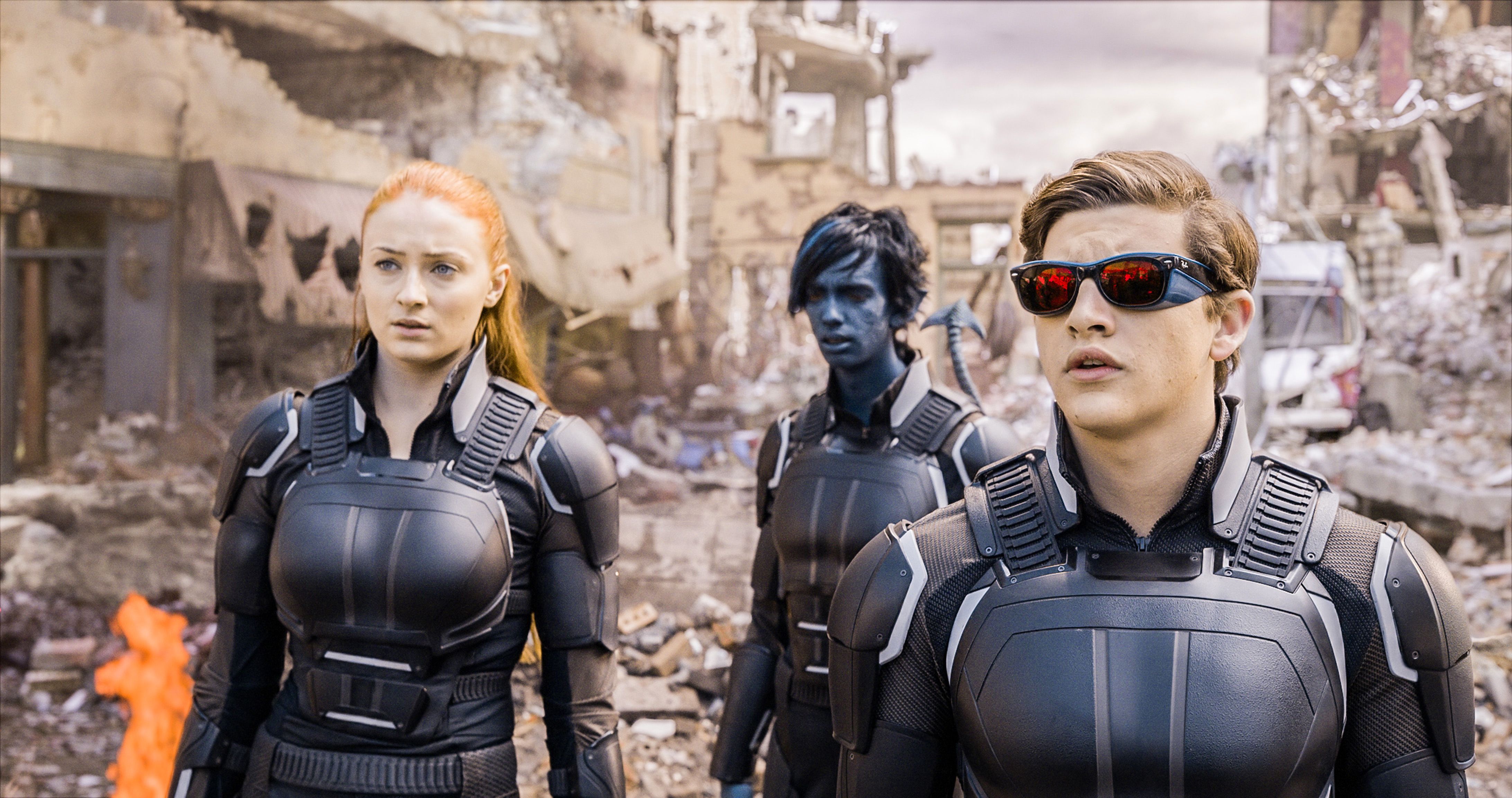
- The third one’s always the worst. When Jean Grey speaks this line, ostensibly in reference to seeing Return of the Jedi, it’s clear that director Bryan Singer is taking one last dig at Brett Ratner’s The Last Stand. It’s only been a few weeks for us, but a decade later, Singer was still relitigating the old canon he wiped away in the previous film. It’s catty and distracting, especially because Apocalypse is more or less the third film in the First Class timeline, and it’s one of the franchise’s weaker outings. It’s less schizophrenic than The Last Stand, but it’s both undercooked and overbusy, with Oscar Isaac as a surprisingly unenthusiastic Apocalypse, who in another cinematic universe could very well be the biggest threat mutantkind has ever faced. But Isaac is clearly fatigued by the heavy prosthetics and needlessly dramatic dialogue (“You can fire your arrows from the Tower of Babel...”), and despite getting what should have been a fresh start from Days of Future Past, we seem to be treading the same boards all over again. If we get a mention in Deadpool & Wolverine, it’ll surely acknowledge the fact that Isaac has moved on with Marvel as Moon Knight.
- She’s barely aged a day. Curiously, Apocalypse is set in 1983, but you would scarcely know it’s been 20 years since First Class. There are a few throwaway lines about how well everyone is aging – the kind of lantern-hanging that Deadpool might do best – but I thought it then and I thought it now: it was a wild choice to set the primary X-Men films in the historical past and then leave them there. No one looks twenty years older, and the only good reason to leave the films in the past is to keep the rock-solid casting of James McAvoy and Michael Fassbender, who still play this trilogy like one long break-up. Jennifer Lawrence, meanwhile, has “contractual obligation” hanging over her head in a role that sees her discard her blue appearance for nominal plot reasons but more for her own professional clout. And with the reprise of so many supporting characters instead of the legion (pun intended) of options from the comics, it all feels a little claustrophobic.
- The glory of what’s to come. As much as Apocalypse tries to chart a new path using the same old pieces from the original films, there is certainly a sense of awe when Jean Grey finally unleashes the Phoenix Force in the final battle against Apocalypse. Seeded throughout the film in a way that never quite feels like an echo of X2, it’s an implicit promise that the next film will do justice to the “Dark Phoenix Saga” of comics legend. Whether we strike gold is a subject for debate in three weeks’ time, but almost no one enjoyed Dark Phoenix. Will the third time be a charm if we see a Phoenix in Deadpool & Wolverine? Heck, as a living embodiment of reincarnation, the Phoenix could be just the thing to bridge timelines from the Fox films into the MCU, or perhaps it’ll just be Deadpool’s sheer force of fourth-wall breaking.
- Weapon X. After sixteen-plus years, Hugh Jackman had very nearly done it all with Wolverine, touching on virtually every one of the costumed hero’s most famous comic book stories. Yet his uncredited cameo (which I recall being a genuine surprise) brings to life Barry Windsor-Smith’s iconic “Weapon X” design, with Wolverine as a deprogrammed and feral Frankenstein’s monster. It’s the sort of visual shout-out that rewards comics readers, while looking breathlessly cool for the normies in the audience. It also gives us a peek at how Logan’s faring in the new timeline; last we saw him, Mystique-as-Stryker was fishing him out of the river, and now we see his origin story aligning away from what we learned in X-Men Origins: Wolverine, with his brief interaction with Jean Grey retroactively cueing up his romantic fixation on her. Will the Logan we meet in Hugh Jackman have gotten his adamantium from Danny Huston or this film’s Josh Helman? Which one grows up to be Brian Cox? We may find out in a month’s time.
- A sinister future. We’ve still got about four weeks left on this recap series, but believe me when I tell you the end is nigh. Case in point, this post-credits teaser that never materialized, despite a pitch-perfect opportunity for the next film to include Mister Sinister, a genetics-obsessed madman whose Essex Corporation is seen here recovering a vial of Logan’s blood. Sinister’s fixation with the Summers bloodline, too, might have made for an interesting film down the line. Still, I hope the MCU is holding Sinister in reserve, and not just for a passing cameo in Deadpool & Wolverine; lest we forget, Sinister’s comics debut found him leading the charge in the “Mutant Massacre” crossover, and his more flamboyant recent appearances would be a perfect fit for, say, David Tennant.
Monday, June 24, 2024
Cinemutants - X-Men: Apocalypse (2016)
Monday, June 5, 2023
Spider-Man: Across the Spider-Verse (2023)
Five years and one Oscar later, Into the Spider-Verse just happens to be my favorite Spider-Man film. Apologies to Spider-Man 2 and Far From Home, which are the best that live-action Spidey has to offer, but Into the Spider-Verse is such a diamond absolute of a movie, so entertaining in an effortless way that belies its complex juggling act. It was a joy to queue it up the night before seeing its sequel, Across the Spider-Verse, which might have been a bad idea: Across is fantastic, but its predecessor was perfect.
Sixteen months after becoming his world’s Spider-Man, Miles Morales (Shameik Moore) is still juggling his responsibilities to his school, his family, and his city. But a surprise visit from his not-so-secret crush Gwen “Spider-Woman” Stacy (Hailee Steinfeld) forces Miles to reckon with his place in the Spider-Verse, an interconnected multiversal web of superheroes under attack from the villainous Spot (Jason Schwartzman). Miles finds himself teaming with old friends like recent dad Peter B. Parker (Jake Johnson) and new allies like Spider-Man India (Karan Soni) and Spider-Punk (Daniel Kaluuya) – all led by the humorless Miguel O’Hara (Oscar Isaac), who understands Miles’s great responsibility better than anyone.
Across the Spider-Verse goes big. It’s purportedly the longest animated film in American cinematic history, and it’s packed to the gills with more spider-people than most comic books can accommodate. Across begins with an extended sequence set on Earth-65, home of Spider-Gwen, and it’s such an engaging bit of table-setting that one fairly wishes the whole movie had been Gwen’s; the scene looks like something out of a Robbi Rodriguez comic, and the film might very well have been Gwen’s wholesale had the second act kept her front and center. (Fear not, true believers, Sony has already promised Gwen will be leading a spin-off film and, we can reasonably assume, next year’s Beyond the Spider-Verse.)
Indeed, my second-biggest gripe with Across – albeit far from a dealbreaker – is that the film struggles to be a two-hander between Gwen and Miles. It reminds one of middle chapters like The Empire Strikes Back and Infinity War, both of which interposed their antagonists as protagonists while splitting up the good guys on parallel narrative tracks. The first and third acts of Across belong to Gwen, but the middle act is solidly Miles, still plucky and earnest with his tongue firmly in his cheek. In the first film, he managed to turn the theory of relativity into a cheesy pick-up line, and here he’s fully inherited the uniquely Spider-Man brand of goofball sarcasm. Across never quite balances them the way that Empire so gracefully did – we lose Gwen’s plot when we see her through Miles’s eyes – but if Gwen is this film’s Leia, Miles is still squarely its Luke.
Like Luke Skywalker, Miles enters into a much bigger world in Across, serving also as the audience’s gateway into the larger realm of the Spider-Verse. These sequences on the densely-populated Earth-928 are going to be ripe for a home video audience to freeze-frame and analyze, loaded with cameos and references from the last sixty years of Spider-Man content. But amid all these homages and single-frame appearances, the creative team have not forgotten to anchor it all to compelling story arcs for the primary characters – their longing to belong, their fears of commitment, and their rebellious wonderings whether they’re able to write their own stories. This, after all, is what made Into the Spider-Verse such a roaring success – that we managed to meet no fewer than five new Spiders and parallel versions of villains like Doctor Octopus, all in under two hours without shortchanging any of them.
The makers of Across have more time to play, but paradoxically it seems they didn’t have enough time, because the film speeds along for two hours and twenty minutes before slamming on the brakes. To be fair, ending a story with “to be continued” is one of the oldest and noblest traditions in comic book history, and it does solidify the film in conversation with Empire Strikes Back and Infinity War. Yet while I’m a little rankled that the film stops rather than ends, I think my principal complaint is actually the fact that I don’t have more of this film already being injected directly into my eyeballs. The principal story arcs have mostly concluded, and the characters have made choices that show how far they’ve grown, but there is still something shamelessly corporate about mandating my attendance at Beyond the Spider-Verse by withholding the end of the story until March 2024. (Don’t worry, guys, I was already planning on it!)
I never check my watch during a movie, and so I had thought the third act was just ramping up when Across flashed those three cliffhanger words across our screen. And so, if that’s actually the beginning of a brand-new first act, I’m legitimately excited to see what happens next. I’m equally thrilled to see how the creators deepen the world one more time; the introductions of Spider-Man India and Spider-Punk are so compelling that we forget that we haven’t seen Spider-Man Noir, Spider-Ham, or Peni Parker this time around. Which other spiders are waiting for us just beyond Beyond? If the third installment in the trilogy is as breakneck and beautiful as the second, we might have to rethink whether we let other franchises get away with the cliffhanger ending.
Spider-Man: Across the Spider-Verse is rated PG for “sequences of animated action violence, some language, and thematic elements.” Directed by Joaquim Dos Santos, Kemp Powers, and Justin K. Thompson. Written by Phil Lord, Christopher Miller, and David Callaham. Based on the Marvel Comics. Starring Shameik Moore, Hailee Steinfeld, Bryan Tyree Henry, Luna Lauren Vélez, Jake Johnson, Jason Schwartzman, Karan Soni, Daniel Kaluuya, and Oscar Isaac.
Monday, October 25, 2021
Dune (2021)
There’s a moment in Denis Villeneuve’s long-anticipated Dune that will take your breath away. However, I can’t tell you what that moment is – not because it’d be a spoiler to do so, but because there are so many of these moments in Dune that it’s impossible to predict which one will do it for you. It isn’t likely to be the next Star Wars as its marketing declares, but Dune is majestic in its enormity, and even with its simultaneous release on HBO Max it demands to be seen in the largest, loudest auditorium available.
Paul Atreides (Timothée Chalamet) reckons with his destiny as an ersatz “chosen one” when his father, Duke Leto of House Atreides (Oscar Isaac), is assigned custody of the unforgiving desert world Arrakis – a planet populated by colossal sandworms, the native Fremen people, and the hallucinogenic drug known as spice. While Paul and his mother Lady Jessica (Rebecca Ferguson) study his prophetic dreams, the corpulent Baron Harkonnen (Stellan Skarsgård) schemes against House Atreides in his quest to retake Arrakis.
These are only some of the things that happen in Dune, and there are so many more characters who don’t fit into a brief plot synopsis. The scope of the film is compounded by the fact that Villeneuve is consciously adapting only half of Frank Herbert’s dense 600-page novel, with a fairly logical if abrupt breaking point midway through the story. I say “abrupt” only because by that point Dune is so resolutely in its groove and the audience is well and truly vibing with the film that any stopping point would feel jarring; put another way, I would have been just as content to see another two hours and thirty-six minutes. It’s not that the movie is unsatisfying, but rather that it’s too satisfying to stop, like a theme park dark ride you don’t want to get off.
Perhaps appropriate for a movie set largely on a desert planet, Denis Villeneuve is on a real hot streak. I haven’t seen his 2013 Enemy yet, but every other film since that year – Prisoners, Sicario, Arrival, and Blade Runner 2049 – has been a winner. Particularly in the latter two, both science fiction films, Villeneuve is finding his niche: speculative futures of overwhelmingly immense scale, where humanity is both dwarfed and magnified in the shadow of the profound. Amy Adams had to reckon with an expanding sense of the cosmos in Arrival, while Blade Runner 2049 was Ryan Gosling’s confrontation with his own ebbing humanity in a foreboding neon cityscape. Here, in the year 10191, everything is enormous – the worms, the spacecraft, the political maneuvering, and the veritable heft of destiny (manufactured or genuine) – and no filmmaker is better equipped than Villeneuve to carry those weights.
An IMAX screen so perfectly befits the size of Dune, but its speaker system is perhaps even better suited for the task. Throughout the film your bones will rattle, thanks to Hans Zimmer, who turns in the Hans Zimmer-iest score imaginable. (Equally Zimmer is the sprawling release of the score, which spans three albums and nearly five hours of orchestration.) It’s atonal, lingering, and eclectic, perhaps the only film score in recent memory to include both an electric guitar, bagpipes, and a didgeridoo. The bass shakes to the point where it’s unclear whether you’re hearing a spaceship in flight or Hans Zimmer in action; either way, the sound design is so meticulous and acute that it becomes a character in and of itself. See also the moments when Paul and his mother use “the voice,” a kind of Jedi mind trick that erases free will; the first time we heard “the voice,” its bass shattering eardrums before the words make it to our auditory canals, everyone in my theater sat up a little straighter.
I think diehard fans of the novel will enjoy what Villeneuve has built, and it seems that more casual filmgoers are digging it, too. I came to Dune from the unique position of having just read the book – or, at least, half of it; I had wanted to finish the novel entire before seeing the movie, but as it stood I got within twenty pages of the film’s chosen ending. (I promise I’ll finish before Dune Part II, the sequel which seems inevitable now.) In the process of translation, some of the characters got flattened, particularly and disappointingly the Duke himself. Duke Leto is a terrific character in the novel, torn between his duty, political machinations beyond his control, and his personal loyalty to his bloodline; he’s heroic, chivalric, and gracious, but the film seems content to let Oscar Isaac’s natural charisma do most of the character work. Conversely, Timothée Chalamet’s Paul is more human and accessible than the novel’s distant and aloof protagonist, perhaps because of his increased self-consciousness of his place as the manufactured messiah of Arrakis.
Instead of diving deep into the characters, it seems that Villeneuve has gone the more unconventional route of letting his visual design do the character work. There are some lines about backstory, and there’s a clever narrative device in the form of Paul’s talking schoolbooks, but largely Villeneuve lets the images do the talking. It’s a mode of storytelling that seems to have fallen out of favor of late, trusting your set designers and cinematographer to do their job well. The Harkonnens are the villains because of their unfathomable ugliness, their unlit home and grotesque bodies belying the depravity of their souls; save for his distinctive voice, it’s almost impossible to recognize Stellan Skarsgård beneath the mass of flesh that is Baron Vladimir. Likewise, the Atreides are the heroes because of how gosh-darn pretty they are, warm and human. They’re also the only ones who seem to be having any fun, especially Jason Momoa as the swashbuckling (and brilliantly named) Duncan Idaho, about whom I would surely watch a miniseries or two.
Dune is a movie into which you can easily sink, like a hot bath or a deep hill of shifting sand (both of which figure prominently in striking images within the film). It’s as much an atmosphere as a narrative, like the moodier bits of Blade Runner 2049 dialed up to eleven. Most importantly, Dune is like a dream, as in the best cinema can be, from which one does not want to awaken. Maybe it’s a little obtuse, maybe it’s bigger and more ambitious than it ought to be, but Denis Villeneuve has earned the right to make idiosyncratic science fiction. Dune is an event, a kind of heraldic “welcome back” moment for moviegoers who may have forgotten (as indeed I did) what kind of narrative spectacle best belongs in the cinema.
Dune is rated PG-13 for “sequences of strong violence, some disturbing images, and suggestive material.” Directed by Denis Villeneuve. Written by Jon Spaihts, Denis Villeneuve, and Eric Roth. Based on the novel by Frank Herbert. Starring Timothée Chalamet, Rebecca Ferguson, Oscar Isaac, Josh Brolin, Stellan Skarsgård, Dave Bautista, Zendaya, Charlotte Rampling, Jason Momoa, and Javier Bardem.
Monday, December 23, 2019
Star Wars: The Rise of Skywalker (2019)
When The Last Jedi came out two years ago, I observed of its theme (but for whatever reason did not say so in my review) that it seemed to be the story of “looking for hope in Alderaan places.” The film had been a tale of failures, of misplaced hope and crushing defeats, but it also ended up reaffirming that the Resistance’s true hope lay in the princess of Alderaan and her brother in exile, and the legacy they were building for the next generation. In the follow-up, The Rise of Skywalker, that legacy comes to bear in unexpected ways, crowd-pleasing and recontextualizing for an emotionally successful finale to this Sequel Trilogy and the Skywalker Saga writ large.(As ever, there won’t be spoilers here; even the major reveal, divulged in the film’s opening crawl, is a sacred mystery in this review.)
After narrowly escaping The Last Jedi with their lives, agents of the Resistance are on the run from the First Order, gathering what few allies they can find in a galaxy that’s given up. While Kylo Ren (Adam Driver) marshals the forces of the First Order, Rey, Finn, and Poe (Daisy Ridley, John Boyega, and Oscar Isaac) head into the unknown in search of a way to prevent the complete obliteration of the Resistance, meeting new friends and old while Rey decides, once and for all, what her destiny will be.
So much exhausting ink is being spilled about whether or not The Rise of Skywalker “betrays” The Last Jedi by walking back or diminishing certain aspects of the film, whether or not this film “ruins” Star Wars or if returning director J.J. Abrams hates predecessor Rian Johnson. All of this is to say that no one hates Star Wars more than Star Wars fans, especially that vexing vocal minority monopolizing internet chatter. In the case of The Rise of Skywalker, I found myself strongly reminded of Return of the Jedi, itself a capper to a trilogy and an ostensible end to a story. Both films play it a little safer than their edgier forebearers, but both make up for that decrease in originality by dialing up the emotional resonance. Where Return of the Jedi reunited its heroic trinity for one last mission, Rise of Skywalker gives us Rey, Finn, and Poe properly together for the first time, having kept them apart for much of the preceding two films. It’s a real joy to see these three side by side, and their interactions carry the weight of all the adventures we didn’t get to see between films.
Critics have lamented the way the film is perhaps overfilled with setpieces, characters, and side quests, to which I have to say, I hope they enjoyed their first Star Wars film – because this is a franchise that has always been overfull of bits, fodder for imagination and tie-in media alike. True, Rise of Skywalker begins with its foot on the gas and never quite lets up, but as the third film in a trilogy there’s not a lot of time for much else, especially when the stakes are as dire as they are here. In fact, however, there’s a beat near the end of the second act where the plot does slow down, and it’s one of the most emotionally resonant corners of the film.
I was disappointed to find my audience so quiet during the film because there are a number of moments where you want to pump your fists and cheer. (The biggest laugh seemed to be who gets the line, “I’ve got a bad feeling about this.”) Perhaps audiences have been down this road so many times since 2015 – where, recall, the Milennium Falcon’s appearance got a big cheer – but suffice it to say I was charmed and cheered by more than a few sequences, including, and this is not a spoiler, a silent cameo from the Maestro himself, John Williams. Speaking of Williams, it’s his grand finale, too, and there are only so many ways to praise a man with more than 50 Academy Award nominations; he’s got an impressive body of work on which to draw, and he does so in ways that are breathtaking. I sense, however, that J.J. Abrams is still less comfortable with an orchestral score than Rian Johnson was, so I’m eager to see the film again after getting more familiar with the score (which remains, incidentally, my favorite component of any Star Wars material, period).
In the way that Return of the Jedi was an ending that gestured at a beginning, Rise of Skywalker is the final act in a nine-piece story, with plenty of space for what happens next, but it’s also acutely aware that there are things it needs to resolve. Leavened with the usual amount of space nonsense – which I love – the film cobbles macguffins together to get us to a sequence that orbits around Chekhov’s gun while wrapping up one of the Sequel Trilogy’s most potent emotional questions, and my only complaint is that it does so in a way that makes me want a whole movie or two of just thatcomponent. But taken as part three of three (and I feel I must be terribly vague here) the impossibility of continuation is perhaps for the best, as it needs first to resolve an entire arc, not establish a new one. That’s what the toys are for, folks.
As with nearly any film, there are moments I would have done differently. I’d have liked to see a few returning faces have a few more scenes, but there isn’t really anything to trim to make room for that. (In a post-Endgame world, though, I’d have been up for a three-hour space opera!) But in a world where toxic fandom demands that a piece of art conform to every single expectation, where the villains of the story are the ones who insist on rewriting history to accede to their vision for the galaxy, I find it’s much healthier to review the film we actually got instead of the one I might have made. And the Rise of Skywalker before us is pretty swell.
Star Wars: Episode IX – The Rise of Skywalker is rated PG-13 for “sci-fi violence and action.” Directed by J.J. Abrams. Written by Chris Terrio, J.J. Abrams, Derek Connolly, and Colin Trevorrow. Starring Carrie Fisher, Mark Hamill, Adam Driver, Daisy Ridley, John Boyega, Oscar Isaac, and Anthony Daniels. (And a few more!)
Monday, December 18, 2017
Star Wars: The Last Jedi (2017)
No one, it seems, hates Star
Wars as much as Star Wars fans.
To be fair, we’ve been wronged by the franchise we profess to love – the
much-maligned Prequel Trilogies are cumbersome and inelegant, and the less said
about the “Holiday Special” the better – but I think by and large the fanbase
has been spoiled by a profusion of content and thus has developed a very narrow
view of what Star Wars ought to be. The Last Jedi, the eighth episode in a
franchise that now also includes “Anthology Films,” flies in the face of that
narrow vision of Star Wars and does
something truly unique with the franchise while remaining (to borrow a phrase
from its composer, John Williams) quintessentially Star Wars-ian.(As ever, you can trust me to give you the spoiler-free treatment. Believe me when I tell you that the plot summary below is only half of the first act, but if you haven’t seen it and want to go in totally unspoiled, skip down to the last paragraph, and don’t listen to the soundtrack, because Williams is not shy about quoting identifiable cues.)
The Force having awakened in the previous film, The Last Jedi picks up moments later, as Rey (Daisy Ridley) encounters Luke Skywalker (Mark Hamill) in his self-imposed, grimly pessimistic exile. While Rey implores Luke to rejoin the galaxy and teach her the ways of the Force, Leia Organa (Carrie Fisher) leads the Resistance in evacuating their D’Qar base; Poe Dameron (Oscar Isaac) butts heads with Vice Admiral Holdo (Laura Dern); and defector Finn (John Boyega) joins up with mechanic Rose Tico (Kelly Marie Tran) to seek out a way to keep the First Order off their tail. And speaking of the film’s villains, Kylo Ren (Adam Driver) is dispatched by the Supreme Leader Snoke (Andy Serkis) to snuff out the Resistance, the Jedi Order, and his own demons.
The Last Jedi covers a lot of ground, and it’s been rightly compared to The Empire Strikes Back for its divergent plot structure. Where The Force Awakens was relentlessly linear and unilaterally focused on a tight narrative, The Last Jedi sprawls out on this galactic tapestry and gives us no shortage of plots to follow. Like in Empire, the plots splinter off and converge in unexpected ways, and the audience is never quite sure what’s going to happen. I’ve seen a lot of outlets that report the film doesn’t “play it safe” and “takes risks” with the franchise – there is a moment, about halfway through the film, at which point I realized I had no idea what was going to happen because something I’d taken for granted had changed completely. After that, I found myself trying to keep up with the film as it heroically outpaced my expectations. As we galloped into the third act, I found myself quite literally gasping for air; I’d forgotten to breathe, and it took an unexpected shock to jar me back to life.
There’s not a bad performance in the bunch, and to say more might encroach on the territory of spoilers. Daisy Ridley gives a fantastically driven performance as a woman who is finally running toward her destiny, while Adam Driver is magnetic as he wrestles with the legacies he’s being forced to inherit. Far and away, the film belongs to Mark Hamill, who’s given a meaty character arc once Rey holds out that lightsaber on the island of Ahch-To, but Carrie Fisher gives a hell of a swan song as General Leia, who looms over the film like the regal war hero we know her to be. Then there’s the trio of new faces, of whom Kelly Marie Tran is the most engaging and likely a new fan favorite as she presents a giddy new look at what it means to be a hero of the Resistance from the vantage point of the mechanic Rose Tico; Laura Dern and Benicio del Toro turn in compelling performances, too, and all three of them are examples of what Star Wars has done best – introduce us to slices of a character’s life and invite us to study further into that galaxy far, far away. For The Last Jedi is, like all of the Star Wars universe, a story about the personal stakes of good and evil, about a series of individual choices that add up to galactic mythology because every life is precious, every moment sacred, every interaction blessed by significance because each life exists in its own expanded universe of stories. (Rose has her own tie-in book; Holdo appears in an earlier novel about Leia; and del Toro’s DJ has his own comic book coming soon – crass consumerism it may be, but sign me up for the lot of it.)
By way of critique, I’ll say that there are a few moments in the movie that don’t quite feel like Star Wars to me – new abilities we see on display, new technologies, even incidental characters who feel as if they’ve been imported from another franchise. Where some have taken this with resentment, #NotMyStarWars, I’m in the camp where those plot devices feel like fresh angles on a franchise that had already recapped its greatest hits with The Force Awakens and, to an extent, Rogue One. The tone of the film does, however, occasionally flirt with the line between deflating comedy and moments of high drama; where Guardians of the Galaxy, Vol. 2 tripped headlong over its own shoes into a pratfall in its best effort to prevent us from engaging with an emotion beyond laughter, The Last Jedi uses these moments to show us that a person is never only one thing. Someone mired in the deepest depression can find an opportunity for levity; life-or-death stakes end up blinking when they stare us down and we shrug our shoulders as if to say, “Do your worst.”
Surprisingly, I didn’t cry at this one. I still get a little choked up at the reunion of Han and Leia in The Force Awakens – kudos to John Williams, who did nonpareil work there and who continues to live up to his own legend. (Thank goodness, by the way, the “Canto Bight” theme is on the soundtrack!) I did, however, feel a swell of admiration at a film that managed to defy my expectations and yet make a perfect amount of sense. There may have been a few things I would have done ever so slightly differently, but of what movie isn’t that true? At film’s end, I felt thrilled, breathless, captivated. Though it’s the longest entry in the franchise, I could have easily done another hour. We’ve got two years until the as-yet-untitled Episode IX, but director Rian Johnson has given us a lot to pore over, and I can’t wait to see it again. Moreover, my excitement for the future of the franchise is stratospheric, because this all could have gone horribly wrong. The galaxy is in good hands, and there’s room for hope.
The Last Jedi is rated PG-13 for “sequences of sci-fi action and violence.” Written and directed by Rian Johnson. Starring Mark Hamill, Carrie Fisher, Adam Driver, Daisy Ridley, John Boyega, Oscar Isaac, Andy Serkis, Domhnall Gleeson, Anthony Daniels, Gwendoline Christie, Kelly Marie Tran, Laura Dern, and Benicio del Toro.
Tuesday, May 31, 2016
X-Men: Apocalypse (2016)
We’re eight movies into the X-Men film universe (nine if you
count Deadpool, and hey, why not?),
and while a fair number of critics are feeling X-fatigue, count me among the
X-static – pun intended, because I’m happy about the way that the X-Men film
franchise remains static in terms of its formula. With X-Men: Apocalypse, Bryan Singer is back for his fourth X-outing, a
continued strong offering which introduces plenty of mutants, action, and
character development to bode well as the franchise stands poised to move into
double digits.With Professor Xavier (James McAvoy) ushering his school for mutants into an era of peace, an ancient being known as Apocalypse (Oscar Isaac) awakens in Cairo and gathers his four Horsemen – Magneto (Michael Fassbender) among them – to bring about the end of this world. While Mystique (Jennifer Lawrence) works to protect the mutants from humanity, it’s up to the next generation of X-Men – Jean Grey (Sophie Turner), Cyclops (Tye Sheridan), Quicksilver (Evan Peters), and Nightcrawler (Kodi Smit-McPhee) – to save the world from the threat of Apocalypse.
With the continuity reconstructed in the wake of Days of Future Past, Singer is free to carve out a path toward the present day with access to the full range of X-characters, regardless of whether they live, die, love, or hate in the other films. There’s something liberating about not knowing precisely whether Magneto is on the side of good or evil in this one, a line which Fassbender embodies even without much dialogue to lean on. Ditto for the introduction of Scott “Cyclops” Summers and Jean Grey, whose courtship (if one can call it that) is only just beginning; we don’t know if they’ll end up the squabbling starter-marriage from X-Men, but Turner and Sheridan are fun to watch and bring the characters to life with some very subtle yet comics-accurate hand gestures (Jean’s fingers on her temple, Scott’s dial-controlled visor).
And for all that X-Men: Apocalypse blusters on about the end of the world and the fate of mutantkind, it’s surprising that the film ends up being rather fun and incredibly human in its very personal scale. Like the Avengers movies, which have found great success in seeing its heroes out of costume, lounging about Stark Tower, X-Men: Apocalypse is at its most engaging when the X-Men recruit Nightcrawler for an impromptu trip to the mall as “a matter of national pride” (though an Avengers film might have showed said trip), or as Cyclops learns to master his abilities. It’s hard to say if there’s a real star in this film, because the X-Men are at their best when the ensemble cast is allowed to share the screen.
If this is the ensemble going forward, the more the better. While McAvoy, Fassbender, and Lawrence continue to powerhouse their way through the prequels, they’ve indicated they might not be back for a fourth outing together. It’d be a shame, to be sure, but I wouldn’t mind seeing the film continue to develop Storm and Jubilee, the latter of whom doesn’t get to display her powers just yet, and Singer’s recent tease that the next film will go to space is extremely promising for the wealth of source material on which he can draw. (Phoenix Redux, anyone?)
There have been some complaints about Apocalypse as an undercooked cliché of a villain, though I think that you need a colossal world-ending event to justify bringing together the X-Men, particularly after the last two prequels have dealt with less cosmic threats and more personal dangers (Kevin Bacon’s Sebastian Shaw, though looking to heat up the Cold War, was also a personal foil for Magneto). It is a shame to put an actor as talented as Oscar Isaac beneath all the prosthetics and makeup that go into Apocalypse, but Isaac acquits himself well with the villain’s ego and powers of persuasion. If you want a grounded superhero battle, Captain America: Civil War is still in theaters (and it holds up), but the X-Men demand something more fantastical.
To the heap of well-crafted, Singer-helmed X-titles, I have to add X-Men: Apocalypse, more fun than it promises and just as compelling as its predecessors. The final battle doesn’t leave much room for surprise (how many permutations of averted catastrophe are there?), but the road getting there is as good as anything we’ve seen yet. Singer proves himself the X-King; long may he reign.
X-Men: Apocalypse is rated PG-13 for “sequences of violence, action and destruction, brief strong language and some suggestive images.”
Monday, February 29, 2016
Monday at the Movies - February 29, 2016
Ex Machina (2015)
– While everyone was excited about Mad Max: Fury Road as a genre film that got nominated for Best Picture, it’s a
shame that the smarter film (which, rightly so, was nominated for Original
Screenplay and Visual Effects) wasn’t at least beside Mad Max on the top. As part of the post-Inception wave of original moody science fiction, Ex Machina asks probing questions about
the place of artificial intelligence, the limits of scientific ethics, and the
vulnerability of human life in the face of its greatest creations. Oscar Isaac
stars as Nathan, a reclusive tech genius who invites his employee Caleb
(Domhnall Gleeson) to his cabin to run a Turing test on his latest invention, a
sentient robot named Ava (Alicia Vikander). Caleb’s trip, though, takes a turn
when Ava insinuates that Nathan is not telling the whole truth. Now I’ll admit
I’m a sucker for this sort of thing, a smart piece of science fiction with an
intricate screenplay, but there’s no denying that Ex Machina is gripping in the insular way you might expect from a
stage play or brisk novella. Rather than go for broke with spectacle,
first-time director Alex Garland (who adds this to a number of his other
screenplays in the sf genre) keeps the tension internal, raising horrifying
possibilities in ways that even viewers who might have anticipated them come to
dread. It’s tightly acted between the three central cast members and a
supporting fourth, Sonoya Mizuno as Nathan’s silent assistant Kyoko, and
compelling in a way that something so much more spectacular might fail to be. Ex Machina is well performed, hauntingly
horrifying, and definitely not one to be missed for any self-respecting science
fiction aficionado.That does it for this week’s edition of “Monday at the Movies.” We’ll see you next week!
BUT FIRST – heads up, True Believers – we’ll continue to Make Yours Marvel this Wednesday with another installment in “The Grand Marvel Rewatch,” so check back then for 2011’s Thor. Or subscribe above, and receive those missives right in your inbox. Nuff said!
Monday, December 21, 2015
Star Wars: The Force Awakens (2015)
First of all, if you haven’t seen The Force Awakens just yet, read on without fear of being spoiled
(although really, what else did you have to do this weekend?). I’m very
sensitive to the fact that this is a film with a heavy curtain of secrecy
around it. The spoilers are out there if you really want them, but I’d advise
anyone to go into The Force Awakens
with a clean palate because this is a film that works best when it washes over
you and introduces itself to you on its own terms. It’s a remarkable achievement,
breathing new life into a franchise that needed it, setting a fantastic tone
for the forthcoming Disney era.Again, no spoilers here, so I’ll refrain from the usual plot synopsis, only to say that the film’s opening title crawl is immensely captivating stuff, clicking into place a lot of the rumors and official releases such that you have an instant sense of the state of that galaxy far, far away these thirty years after Return of the Jedi. In addition to the familiar faces of Han Solo (Harrison Ford), Luke Skywalker (Mark Hamill), and Leia Organa (Carrie Fisher) – listed in the order they’re credited on the film – The Force Awakens introduces us to a new trio: stormtrooper Finn (John Boyega), scavenger Rey (Daisy Ridley), and hotshot Poe Dameron (Oscar Isaac). And menacing the galaxy is one more black-clad acolyte of the dark side, Kylo Ren (Adam Driver), and the First Order’s plan to unseat the Republic.
I found myself thinking immediately of the words of Obi-Wan Kenobi from Return of the Jedi: “You cannot escape your destiny.” And while I’m on record as being one of those moviegoers who ordinarily detests the deus ex machina of destiny, it’s undeniably woven into the fabric of the Star Wars universe, and director JJ Abrams does some very intriguing work with it. Throughout The Force Awakens, we have characters who are either running from their destiny or sprinting headlong toward it, and all of them end up pretty much exactly where they are meant to be – from the stormtroopers in the opening scene to the folks present in the final shot of the film (and what a gorgeous, sweeping final shot it is). Heck, even Greg Grunberg, a childhood friend of Abrams, fulfills his destiny by appearing here as an X-wing pilot.
JJ Abrams had the unenviable task of being the only person to direct a Star Wars film without George Lucas's hand on his shoulder (including, of course, The Clone Wars and that horrible thing I watched last Friday). While I’ve never been a full Abrams disciple, there’s no question that he more than lives up to the legacy of the original trilogy. (As for the prequels, they’re largely set aside, save for one passing reference.) As a director, Abrams keeps the pace of the film at an even clip, sprinkling in enough humor to make this possibly the funniest Star Wars film in the saga without compromising the film’s overall tone. More apparent is the film’s reverential and referential attitude toward the original trilogy; nearly every sequence in the film has some callback to a previous moment, giving lie to George Lucas’s oft-quoted refrain about the poetry of the saga. But what’s remarkable here is that the aggregate effect isn’t one of plagiarism; there’s a deference, to be sure, to what came before, but it advances the saga forward and cues up more than enough for Episodes VIII and IX to continue to explore.
Bizarrely, and actually gratefully, I’m more interested in the new characters than in the returning faces. Yes, there’s a wonderful reintroduction moment for every returning character (even the ones you weren’t expecting to be applause-worthy), but the Finn-Rey-Poe trio could easily be the new Luke-Leia-Han for this generation, and not necessarily in that order. This is great news for the franchise as a whole, because it shows that Star Wars is capable of sustaining itself beyond the inevitable first flash of nostalgia that The Force Awakens was always destined (there’s that word again) to invoke. And say what you want about the prequels, but they always pointed to A New Hope, never sufficiently building their own world (save for those long and tedious political conversations). The Force Awakens propels the narrative forward, to say nothing of the introduction of an equally compelling trio (or quartet, depending on how you do the math) of antagonists. Let’s just say this – Kylo Ren is everything we wanted from Hayden Christensen’s Anakin Skywalker.
I’ll have to see the film again to give a more detailed assessment – I know there are folks chomping at the bit to talk about some of the more spoileriffic details – and I’d like to revisit the film with more of the John Williams score under my belt. I was just too overwhelmed by the film to drink it all in at once. And that’s such a good thing. I felt myself smiling like a child again once those blue words “A long time ago...” appeared on the screen, felt my jaw fall as the title crawl clued me into the story. I smiled, I laughed, I gasped, and I very nearly cried in a few moments, and not only out of sadness when the film went for the emotional tug. My eyes were misty because I felt, finally, I’d come home. Chills up my arms, chokes in my throat (not the kind induced by the dark side, mind you), and a permanent grin across my face: these were the feelings The Force Awakens conjured up in me. Like some magical incantation, cast out across the void of decades, Star Wars is back.
Star Wars: The Force Awakens is rated PG-13 for “sci-fi action violence.” This film is slightly bloodier than previous Star Wars films, but the level of violence and action is about the same.