Showing posts with label James McAvoy. Show all posts

Monday, June 24, 2024

Cinemutants - X-Men: Apocalypse (2016)

At a time when superhero movies are starting to lose their stranglehold on pop culture, there are really only two options: go back and watch old movies, or kill off an entire cinematic universe in spectacular fashion. This July, Marvel’s taking the latter approach with Deadpool & Wolverine, which seems primed to seal off the 20th Century Fox film universe. And while director Shawn Levy promises, “This movie is built [...] with no obligation to come prepared with prior research,” skipping the research has never really been my strong suit when it comes to franchises. It’s a perfect excuse, then, to go through the last 24 years (and 13 movies) with everyone’s favorite mutants, the X-Men.
 
This week, from 2016, it’s X-Men: Apocalypse. En Sabah Nur (Oscar Isaac), the first mutant, awakens from millennia of slumber, determined to cleanse the world and start over. Meanwhile, tragedy strikes Erik Lehnsherr (Michael Fassbender), driving Mystique (Jennifer Lawrence) back into an alliance with Professor Xavier (James McAvoy), while a young Scott Summers (Tye Sheridan) joins the Xavier Academy and begins to fall for the telepathic Jean Grey (Sophie Turner).
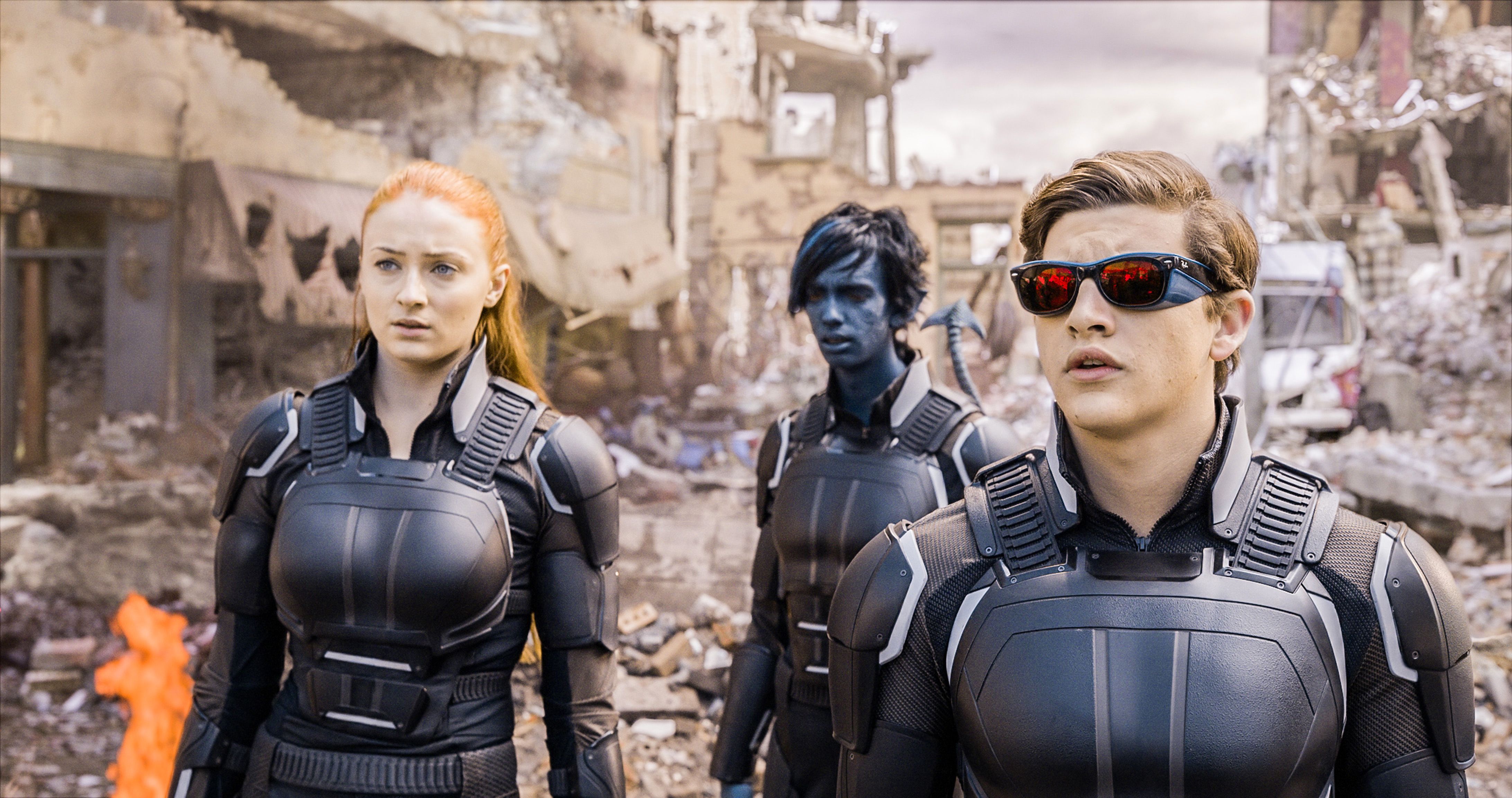
  1. The third one’s always the worst. When Jean Grey speaks this line, ostensibly in reference to seeing Return of the Jedi, it’s clear that director Bryan Singer is taking one last dig at Brett Ratner’s The Last Stand. It’s only been a few weeks for us, but a decade later, Singer was still relitigating the old canon he wiped away in the previous film. It’s catty and distracting, especially because Apocalypse is more or less the third film in the First Class timeline, and it’s one of the franchise’s weaker outings. It’s less schizophrenic than The Last Stand, but it’s both undercooked and overbusy, with Oscar Isaac as a surprisingly unenthusiastic Apocalypse, who in another cinematic universe could very well be the biggest threat mutantkind has ever faced. But Isaac is clearly fatigued by the heavy prosthetics and needlessly dramatic dialogue (“You can fire your arrows from the Tower of Babel...”), and despite getting what should have been a fresh start from Days of Future Past, we seem to be treading the same boards all over again. If we get a mention in Deadpool & Wolverine, it’ll surely acknowledge the fact that Isaac has moved on with Marvel as Moon Knight.
  2. She’s barely aged a day. Curiously, Apocalypse is set in 1983, but you would scarcely know it’s been 20 years since First Class. There are a few throwaway lines about how well everyone is aging – the kind of lantern-hanging that Deadpool might do best – but I thought it then and I thought it now: it was a wild choice to set the primary X-Men films in the historical past and then leave them there. No one looks twenty years older, and the only good reason to leave the films in the past is to keep the rock-solid casting of James McAvoy and Michael Fassbender, who still play this trilogy like one long break-up. Jennifer Lawrence, meanwhile, has “contractual obligation” hanging over her head in a role that sees her discard her blue appearance for nominal plot reasons but more for her own professional clout. And with the reprise of so many supporting characters instead of the legion (pun intended) of options from the comics, it all feels a little claustrophobic.
  3. The glory of what’s to come. As much as Apocalypse tries to chart a new path using the same old pieces from the original films, there is certainly a sense of awe when Jean Grey finally unleashes the Phoenix Force in the final battle against Apocalypse. Seeded throughout the film in a way that never quite feels like an echo of X2, it’s an implicit promise that the next film will do justice to the “Dark Phoenix Saga” of comics legend. Whether we strike gold is a subject for debate in three weeks’ time, but almost no one enjoyed Dark Phoenix. Will the third time be a charm if we see a Phoenix in Deadpool & Wolverine? Heck, as a living embodiment of reincarnation, the Phoenix could be just the thing to bridge timelines from the Fox films into the MCU, or perhaps it’ll just be Deadpool’s sheer force of fourth-wall breaking.
  4. Weapon X. After sixteen-plus years, Hugh Jackman had very nearly done it all with Wolverine, touching on virtually every one of the costumed hero’s most famous comic book stories. Yet his uncredited cameo (which I recall being a genuine surprise) brings to life Barry Windsor-Smith’s iconic “Weapon X” design, with Wolverine as a deprogrammed and feral Frankenstein’s monster. It’s the sort of visual shout-out that rewards comics readers, while looking breathlessly cool for the normies in the audience. It also gives us a peek at how Logan’s faring in the new timeline; last we saw him, Mystique-as-Stryker was fishing him out of the river, and now we see his origin story aligning away from what we learned in X-Men Origins: Wolverine, with his brief interaction with Jean Grey retroactively cueing up his romantic fixation on her. Will the Logan we meet in Hugh Jackman have gotten his adamantium from Danny Huston or this film’s Josh Helman? Which one grows up to be Brian Cox? We may find out in a month’s time. 
  5. A sinister future. We’ve still got about four weeks left on this recap series, but believe me when I tell you the end is nigh. Case in point, this post-credits teaser that never materialized, despite a pitch-perfect opportunity for the next film to include Mister Sinister, a genetics-obsessed madman whose Essex Corporation is seen here recovering a vial of Logan’s blood. Sinister’s fixation with the Summers bloodline, too, might have made for an interesting film down the line. Still, I hope the MCU is holding Sinister in reserve, and not just for a passing cameo in Deadpool & Wolverine; lest we forget, Sinister’s comics debut found him leading the charge in the “Mutant Massacre” crossover, and his more flamboyant recent appearances would be a perfect fit for, say, David Tennant. 
Sound off in the comments, true believers: is Apocalypse the biggest misstep in the X-Universe? Or is it an underrated gem? Up next, it’s swan songs all around with Logan.

Monday, June 10, 2024

Cinemutants - X-Men: Days of Future Past (2014)

At a time when superhero movies are starting to lose their stranglehold on pop culture, there are really only two options: go back and watch old movies, or kill off an entire cinematic universe in spectacular fashion. This July, Marvel’s taking the latter approach with Deadpool & Wolverine, which seems primed to seal off the 20th Century Fox film universe. And while director Shawn Levy promises, “This movie is built [...] with no obligation to come prepared with prior research,” skipping the research has never really been my strong suit when it comes to franchises. It’s a perfect excuse, then, to go through the last 24 years (and 13 movies) with everyone’s favorite mutants, the X-Men.
 
This week, from 2014, it’s X-Men: Days of Future Past. Professor X (Patrick Stewart) and Magneto (Ian McKellen) send Wolverine (Hugh Jackman) into the past to save their future from mutant-killing Sentinel robots. In 1973, Wolverine has to bring together a despondent Charles Xavier (James McAvoy) and the incarcerated Erik Lehnsherr (Michael Fassbender) to stop Mystique (Jennifer Lawrence) from killing Bolivar Trask (Peter Dinklage), the inventor of the Sentinels.

  1. Securing our future. We can argue about whether this is the best X-Men movie (it’s easily top three), but there’s no debating the fact that this is the most X-Men movie. Two casts, parallel timelines, ready-made comics inspiration, and a continuity fix that only muddles the waters even further: Days of Future Past has everything an X-fan could want. While the change-the-past plot was intended to smooth over any errors in the timeline (or, at least, provide a plausible excuse for them), it only exposes the gossamer of the plot to brutal scrutiny. By the end of the film, just how much of the past has Logan undone? (Director Bryan Singer is at least erasing The Last Stand, but there’s a wink toward expunging X-Men Origins: Wolverine, as well.) You might still need a chart to understand how all the films relate to each other, but I’ll argue next week that, as far as time travel and continuity are concerned, Days walked so Deadpool could run.
  2. Infinite outcomes. Along with being the apex X-Men movie, Days of Future Past provides something so unique that only the superhero genre can do. As incredible as Patrick Stewart and Ian McKellan were, James McAvoy and Michael Fassbender were equally inspired casting choices. And in virtually any other genre, you’d never have an opportunity to put them on-screen together; imagine a Godfather movie that saw Marlon Brando meet Robert De Niro, or a James Bond movie where Daniel Craig teams up with Pierce Brosnan. Another way Days cues up Deadpool is by implying that both versions exist out there somewhere, simultaneously; future films followed both Professors Xavier, and it’s inconceivable that Deadpool & Wolverine won’t see other iterations (or “variants,” in MCU-speak) of recognizable characters. Let’s hope the new castings are just as good. 
  3. It all starts with her. In the comics, Kitty Pryde is the one traveling back in time to warn the X-Men about averting the future; here, though, it’s got to be Wolverine, both for the practical needs of the plot and for the fact that Hugh Jackman continues to be an audience favorite for his literal embodiment of the character. (The movie finds a creative way to keep Kitty relevant to the plot.) Meanwhile, the target of the future remains unchanged; it’s still Mystique, played by Jennifer Lawrence at the peak of her rising stardom. Two years after her Oscar for Silver Linings Playbook and a year before finishing her tenure in The Hunger Games, Lawrence makes a third-stringer background villain into a compelling and deeply human protagonist. It’s almost hard not to root for her, though Lawrence’s apparent fatigue with the role will become inescapable in the weeks to come. (A third woman, Anna Paquin’s Rogue, becomes an axis point in the “Rogue Cut,” which sees Rogue freed from a mutant prison to help Kitty Pryde save Wolverine.)
  4. In the future, do I make it? It feels like it’s been true for most of these movies, but Days of Future Past really illuminates the paradox of accurately and lovingly bringing characters to life and then giving them absolutely nothing to do. Bishop and Blink, for example, look like they stepped straight out of a comic book, but I’d be darned to tell you why, on the strength of this movie, any fan would care about them. Even Storm suffers from this paradox; as cool as it is to see Halle Berry rocking the closest thing to a mohawk we got from her, Storm’s presence in the film is barely consequential, and the film seems not to have noticed that she is essentially the last surviving faculty member at the Xavier Academy. The X-Men might have the deepest bench in comics, but the movies always seemed to focus on the same dozen or so; next week, we’ll see Deadpool do right by Colossus, who’s had less personality than window dressing in these films.
  5. Is the future truly set? Superhero storytelling is perpetually stuck in the second act; after you get through the first-act origin tales, most of these stories never truly end. (And when they do, like All-Star Superman or Old Man Logan, they’re in alternate realities.) Days of Future Past eats its cake and has it too by giving Logan a cheery send-off while also holding open the door for more stories in the First Class timeline. (Quite where Logan takes place, we’ll consider in a few weeks.) But it does seem a little suspicious – and possibly even sinister – that Bryan Singer’s happy ending seems to erase/retcon only the movies he didn’t direct. Of the beleaguered director’s many sins, this is far from the worst, but this film does seem to promise a new golden age that, more or less, never came to pass. Did the film that was meant to fix the franchise actually break it? The best films to come are the ones that play fastest and loosest with continuity...
Sound off in the comments, true believers: where does Days of Future Past sit in your estimations, and was it really ten years ago already? Up next, second chances all around when Ryan Reynolds gets another shot at the Merc with a Mouth in Deadpool.

Monday, May 27, 2024

Cinemutants - X-Men: First Class (2011)

At a time when superhero movies are starting to lose their stranglehold on pop culture, there are really only two options: go back and watch old movies, or kill off an entire cinematic universe in spectacular fashion. This July, Marvel’s taking the latter approach with Deadpool & Wolverine, which seems primed to seal off the 20th Century Fox film universe. And while director Shawn Levy promises, “This movie is built [...] with no obligation to come prepared with prior research,” skipping the research has never really been my strong suit when it comes to franchises. It’s a perfect excuse, then, to go through the last 24 years (and 13 movies) with everyone’s favorite mutants, the X-Men.
 
This week, from 2011, it’s X-Men: First Class. It’s 1962, and Charles Xavier (Patrick Stewart) is just beginning his research into mutation when he meets Erik Lehnsherr (Michael Fassbender), a mutant out for revenge on Sebastian Shaw (Kevin Bacon), the man who killed his mother. With Shaw manipulating both sides of the Cold War, Charles and Erik recruit a team of mutants, beginning with Charles’s childhood friend Raven (Jennifer Lawrence). 
 
And so we return and begin again. The reset button is practically a supporting character in the X-Men franchise, and after Origins didn’t quite recapture the magic, First Class goes back even further, both in the timeline and in reprising the actual opening scene of X-Men. (No wonder – it’s still one of the most effective origin stories and one of the best-told ones.) Director Matthew Vaughn is never too showy about the film’s 1962 setting, though a third-act retelling of the Cuban Missile Crisis feels a bit like something that belongs in Zack Snyder’s Watchmen. As a prequel, however, First Class is reveling in the untold stories, from Henry McCoy’s evolution into the blue-furred Beast (Nicholas Hoult) to Xavier’s occasional quips about losing his hair.
 
Frankenstein’s monster. A huge part of the success of First Class comes from its own secret origin, starting life as a screenplay for X-Men Origins: Magneto. By weaving Magneto’s story into a larger tapestry, we get to skip right to the best scenesalong his quest for revenge, and Fassbender is resplendent in his righteous fury. (Points taken off, though, for the infrequent intrusion of Fassbender’s own Irish accent.) We see all the reasons for Erik’s fall, sympathizing all the while with a man who sees himself as a helpless monster. And when Charles accidentally invokes the Nazi defense of “just following orders,” a chill ran up my spine because of how effectively First Class presents Magneto’s perspective. What Ian McKellen implied, First Class does well to elucidate. 
 
Groovy mutation. On the flip side, James McAvoy is a surprising Xavier, eschewing the austerity of Patrick Stewart’s performance in favor of a Swinging Sixties Charles, not above using his scientific know-how to impress the birds down at the local pub. Still, the shepherd wins out in Xavier as he assembles his first team (not G-Men, the film wryly observes, but X-Men), but more particularly when he attempts to guide Erik’s lost soul toward serenity. Indeed, it’s not hard to see First Class as a tragic love story between two men who could have been brothers; the repeated motif of the chess board, borrowed from the Bryan Singer films, suggests an unspoken bond, though a sunset picnic at the Lincoln Memorial adds a new color to the dynamic.
 
We’re the better men. I usually remember First Class fondly for the Charles and Erik dynamic, but I was surprised on this rewatch to see how many things don’t work at the same level. Kevin Bacon is hammy good fun as the film’s antagonist, but his cabal of villains are either outright boring or, in the case of January Jones’s Emma Frost, wildly miscast. Meanwhile, Hoult’s Beast is a strong supporting choice, but the rest of the team is largely indistinct; Zoe Kravitz’s Angel is a snooze, Edi Gathegi’s Darwin isn’t around long enough to make an impression, and Havok and Banshee don’t quite have personalities of their own. (On those counts, only True Believers will much care about their inclusion.) Then there’s Jennifer Lawrence’s Raven, a far cry from the sycophantic Mystique we met in the foregoing trilogy; she acquits herself well enough (despite some truly dodgy makeup), but appending her to Xavier’s origin is still a strange choice.
 
We are the future. First Class ends up walking a fine line between reboot and prequel. It’s hard to say it’s precisely a prequel to X-Men, mostly on the grounds of what happens in Days of Future Past. But while we have cameos from Hugh Jackman and Rebecca Romijn, we also get a very different Moira MacTaggert (Rose Byrne), a Beast who’s older than he should be, and a Summers brother that throws a wrench into the already murky family tree after we “met” Cyclops in 1979 last week. (Then again, the Summers family tree is notoriously gnarled in the comics, where it’s easy to lose count of who the third Summers brother was intended to be.) It’s all a helpful reminder not to take any of this too seriously, and for all my handwringing here, none of it interferes with my enjoyment of the film, which is somewhere near the top of my X-rankings.
 
Sound off in the comments, true believers: is First Class first in its class? Now that we’ve gone all the way back in time, we’ll jump to the end of the queue next week with The Wolverine, catching up with Logan after the events of The Last Stand.

Monday, January 21, 2019

Glass (2019)

I was an early believer on Unbreakable – I can still vividly recall the ads in comic books of the time heralding the fact that Alex Ross had created artwork for the DVD release. In that sense, I have always already been the perfectly calibrated audience for Shyamalan’s fascination with superheroes; I’ve been in the trenches of fandom with him this whole time, and I’ve come back to Unbreakable from time to time as I get older and deeper into the genre. Even as Shyamalan’s career has met with less than stellar reception, most of us have wondered when he’d do a sequel to his one superhero movie, especially as the genre became billion-dollar business.

No one expected him to backdoor his way into the terrain through his split-personality abduction horror film Split – spoilers, it’s a sequel to Unbreakable – but if that’s the way we get to Glass, so be it. It’s been nineteen years (much ado is made within the film itself) as David Dunn (Bruce Willis) continues to do the superhero thing, with his vigilante eyes set on serial killer Kevin Wendell Crumb (James McAvoy). Meanwhile, Elijah Price (Samuel L. Jackson) languishes in a mental institution under the care of Dr. Ellie Staple (Sarah Paulson), who believes that “Mister Glass” suffers from psychotic delusions.

As much as I felt weirdly cheated by the fact that Split was a covert sequel to Unbreakable, a misplaced and almost perfunctory twist, there’s an undeniable frisson of delight in seeing Willis, McAvoy, and Jackson on screen together, as if you can hear Shyamalan giggling from behind the camera, “Can you believe they let me get away with this?” And despite the crossover factor being markedly less ambitious than, say, Avengers: Infinity War, Glass manages to scratch that same itch, especially when all three are together. (Shyamalan’s cameo, in which he appears to claim that at least three of his cameos have all been the same man, is perhaps a bridge too far, but even there we find something mildly admirable in his overreach.)

To repeat what I said above, I had an acute sense during Glass that it was a movie designed to target my specific brand of fandom – my intense devotion to the genre and the way it helps us imagine and re-envision ourselves as the heroes we need. It stars three actors who I adore, turning in varying levels of exquisite performance. Willis continues, admittedly, to phone it in a bit, but as David Dunn I have the sense that Willis doesn’t actively resent being in the film (as was apparent in, for one, Cop Out). David has always been a more contemplative, quiet hero type, so it’s fine that Willis leaves the flashier performances to the film’s antagonists – itself a kind of genre-based decision. McAvoy was riveting in Split, but in Glass he revs up his performance by transitioning between personalities without the aid of costume changes. Far and away, though, as the title presages, the film belongs to the magisterial talents of Samuel L. Jackson, who gleefully carves the scenery and boxes up the rest to take home for later. Delivering impassioned monologues with eyes gleaming with fiery madness, Jackson is equally compelling in the moments when he’s not talking, as we try to divine what’s going on behind his silence. At home in both a hospital gown and his more ostentatious purple leather suit, Mister Glass is the kind of villain on which a franchise can properly be hung.

At the same time, and as much as I found myself digging the mythopoetic jazz Shyamalan is laying down with the genre, I understand entirely that the film isn’t for everyone, that Glass’s mixed-to-negative reviews are not quite unfair. As superhero films go, this is one of the talkier ones, and its genre deconstruction isn’t perhaps as revelatory as Shyamalan hopes (though it might have been nineteen years ago). Moreover, Shyamalan’s proclivity for “twists” in his storytelling stacks up in the film’s third act, with nearly as many false endings as the third Lord of the Rings movie, and though not all of these twists land with the mind-blowing effect of The Sixth Sense’s final developments, Shyamalan ultimately arrives at a place where I felt – if not accepting – at least understanding what he had tried to accomplish. Despite the broad ambitions of its morality play, the film’s scale is exceedingly intimate, but in those moments Shyamalan displays that he has lost none of his dexterity with miniature moments of terror, of the bumps-in-the-night scares on which he made his name with The Sixth Sense and Signs (which I recall, on the strengths of its sound mixing alone, being immensely terrifying in a dark room). 

If The Visit was Shyamalan’s low-budget back-to-basics return, with Split edging his way toward his earlier successes, it’s hard not to hope that Glass marks a sort of new beginning for a man whose career langured in critical limbo and popular dismissal. While this may not be the sort of superhero film for everyone, its methodical deliberateness is exactly my cup of tea and a useful counterprogramming if you’re feeling a bit worn by the blockbusters of the genre. Glass is so delightfully idiosyncratic that it’s all too easy to be swept along by the steady, purposeful drive of the story.

Glass is rated PG-13 for “violence including some bloody images, thematic elements, and language.” Written and directed by M. Night Shyamalan. Starring James McAvoy, Bruce Willis, Anya Taylor-Joy, Sarah Paulson, Spencer Treat Clark, and Samuel L. Jackson.

Monday, December 11, 2017

Monday at the Movies - December 11, 2017

Welcome to another installment of “Monday at the Movies.” This week, I’m a year late to the Split party, but imagine how the rest of the audience felt when they wound up sixteen years late to the party. Caution: spoilers for Split do follow.

Split (2016) – M. Night Shyamalan is a figure of some controversy, the bulk of whose oeuvre Wikipedia aptly describes as “poorly received but sometimes financially successful.” Split was reviewed by many as the debut of late Shyamalan, a slight return to form and a turn toward a more prosperous cinematic career. Split is, to be fair, leaps and bounds better than much of Shyamalan’s recent work, but – in the words of Mark Kermode – “so is, y’know, slamming your hand in a car door.” Split features a rightly well-regarded performance by James McAvoy as Kevin, possessed as he is by 24 personalities, some of which drive him to abduct a trio of vulnerable teenage girls (Anya Taylor-Joy, Haley Lu Richardson, Jessica Sula) for sinister, mysterious purposes. The film is largely competent and even occasionally terrifying as the girls are menaced by McAvoy’s multiple personalities; McAvoy does a remarkable job creating personas recognizable by different distortions of the same face even before he speaks in a variety of intonations, and Shyamalan has found three actresses very effective at bearing the burden of the film’s horror. The film’s climax, though, felt a bit of a letdown as the plot quite literally runs away after making what might be a condescending interpretation of self-harm before pulling a Prometheus and deferring the story’s end for a future installment; the truth about Kevin is apparently revealed (though not much else is resolved, and even that’s up for a spot of interpretation).  But Shyamalan makes a bizarre decision when his final scene casts the entire film as a sequel to Unbreakable (2000). It’s a peculiar way to build a franchise, and indeed a third film – Glass – is evidently due in 2019 to unite the two disparate films, but it does feel that Shyamalan has traded an ending for a reminder of what might have been his last great film. Come for McAvoy’s compelling performance, but leave with a peculiar taste in your mouth as the film ends with a few bewildering creative calls. Having said that, though, I’m always up for more Unbreakable.

That does it for this week’s edition of “Monday at the Movies.” We’ll see you next week!

Monday, August 14, 2017

Atomic Blonde (2017)

Between Atomic Blonde and Tinker Tailor Soldier Spy, I’m really digging the “retro spy” genre – and I’m including throwback spy flicks like Kingsman. There’s something very satisfying about the technological limits placed on the story, which must proceed without the advantages of cell phones and Wi-Fi; usually that careful crafting leads to a more cerebral script – something I always appreciate – and ends up having a trickle-down effect on the rest of the creative process. Going into the theater, I hadn’t known that Atomic Blonde was a period piece, nor had I realized quite how much I’d like the film – both of which were welcome surprises.

It’s 1989. The Berlin Wall is about to come down, and MI6 sends Lorraine Broughton (Charlize Theron) behind the Iron Curtain to find a list of operatives stolen from a dead agent. Berlin station chief Percival (James McAvoy) helps her into East Berlin and enlists her help with East German defector Spyglass (Eddie Marsan), who’s stolen the list. While Lorraine looks for the truth amid a dalliance with French operative Delphine Lasalle (Sofia Boutella), she begins to wonder who she can trust.

I was exhausted after Atomic Blonde – not because the movie was overlong or boring to the point that my hindquarters went numb, but because I’d had to keep up with the film’s sneaky storytelling while enduring the intense and enervating action sequences. Atomic Blonde is not a film that goes for easy moments; none of it looks effortless, and the audience has to work just as hard as Lorraine to discover the identity of Satchel, a traitor in the ranks of MI6. But at least we have the good fortune not to get in the middle of those fight scenes, because they’re incredibly vicious.

Director David Leitch has done a fair job of staging his action scenes like single takes; there’s some digital trickery, to be sure, but in the moment it looks as though these long fights are all done in a straight cinematic line. We’ve got two long and arresting fights staged in apartment buildings – one in the living room, one on the stairs – that most other directors might have done in forty-cuts-per-second shakycam, but Leitch’s patient attention to the intensity of the fights allows them to exhaust the moviegoer and the characters, whose breathy pauses and stumbles make the combat even more real. Brownie points are due to the storytellers who devised Lorraine’s creative uses of an extension cord, a record player, and a doorframe.

In the interminable wait for Bond 25 and the ever-present question of whether Daniel Craig will suit up once or twice more, Charlize Theron proves herself a capable “Lady Bond,” although that does a disservice to Lorraine Broughton. There are certain similarities – their capabilities in close combat, their equal dexterity in the art of seduction – but Lorraine almost feels more of a piece with Bryan Mills in Taken, possessed of a “certain set of skills” that make her unstoppable, even as the odds against her increase. She’s more vulnerable than Mills, though, emotionally and physically; her stake in this fight is personal, and her fling with Delphine seems more genuine than any Bond girl’s. Moreover, those moments where she picks herself off the floor and continues to fight, even as she’s bruised and short of breath, give the character a smartly-crafted strength.

The soundtrack to the film is a smashing mix tape of 80s tracks, and the cinematography is as unforgivingly fluorescent as I imagine the 1980s would have been. It all adds up to a nicely unified experience, where the stark white lights of an interrogation room echo the neon pipes of a Berlin hotel room. Amid it all, there is the brainy sense of needing to keep up and the fervent hope that, as the credits roll, this won’t be the last time we see Lorraine Broughton. I’m ready to enroll her in the same camp as Wonder Woman, welcome alternatives to the same-old/same-old dudes who have run these genres for fifty years. Roll on the new, but please give me a moment to catch my breath.

Atomic Blonde is rated R for “sequences of strong violence, language throughout, and some sexuality/nudity.” Directed by David Leitch. Written by Kurt Johnstad. Based on the graphic novel The Coldest City by Antony Johnston and Sam Hart. Starring Charlize Theron, James McAvoy, Sofia Boutella, Eddie Marsan, John Goodman, and Toby Jones.

Tuesday, May 31, 2016

X-Men: Apocalypse (2016)

We’re eight movies into the X-Men film universe (nine if you count Deadpool, and hey, why not?), and while a fair number of critics are feeling X-fatigue, count me among the X-static – pun intended, because I’m happy about the way that the X-Men film franchise remains static in terms of its formula. With X-Men: Apocalypse, Bryan Singer is back for his fourth X-outing, a continued strong offering which introduces plenty of mutants, action, and character development to bode well as the franchise stands poised to move into double digits.

With Professor Xavier (James McAvoy) ushering his school for mutants into an era of peace, an ancient being known as Apocalypse (Oscar Isaac) awakens in Cairo and gathers his four Horsemen – Magneto (Michael Fassbender) among them – to bring about the end of this world. While Mystique (Jennifer Lawrence) works to protect the mutants from humanity, it’s up to the next generation of X-Men – Jean Grey (Sophie Turner), Cyclops (Tye Sheridan), Quicksilver (Evan Peters), and Nightcrawler (Kodi Smit-McPhee) – to save the world from the threat of Apocalypse.

With the continuity reconstructed in the wake of Days of Future Past, Singer is free to carve out a path toward the present day with access to the full range of X-characters, regardless of whether they live, die, love, or hate in the other films. There’s something liberating about not knowing precisely whether Magneto is on the side of good or evil in this one, a line which Fassbender embodies even without much dialogue to lean on. Ditto for the introduction of Scott “Cyclops” Summers and Jean Grey, whose courtship (if one can call it that) is only just beginning; we don’t know if they’ll end up the squabbling starter-marriage from X-Men, but Turner and Sheridan are fun to watch and bring the characters to life with some very subtle yet comics-accurate hand gestures (Jean’s fingers on her temple, Scott’s dial-controlled visor).

And for all that X-Men: Apocalypse blusters on about the end of the world and the fate of mutantkind, it’s surprising that the film ends up being rather fun and incredibly human in its very personal scale. Like the Avengers movies, which have found great success in seeing its heroes out of costume, lounging about Stark Tower, X-Men: Apocalypse is at its most engaging when the X-Men recruit Nightcrawler for an impromptu trip to the mall as “a matter of national pride” (though an Avengers film might have showed said trip), or as Cyclops learns to master his abilities. It’s hard to say if there’s a real star in this film, because the X-Men are at their best when the ensemble cast is allowed to share the screen.

If this is the ensemble going forward, the more the better. While McAvoy, Fassbender, and Lawrence continue to powerhouse their way through the prequels, they’ve indicated they might not be back for a fourth outing together. It’d be a shame, to be sure, but I wouldn’t mind seeing the film continue to develop Storm and Jubilee, the latter of whom doesn’t get to display her powers just yet, and Singer’s recent tease that the next film will go to space is extremely promising for the wealth of source material on which he can draw. (Phoenix Redux, anyone?)

There have been some complaints about Apocalypse as an undercooked cliché of a villain, though I think that you need a colossal world-ending event to justify bringing together the X-Men, particularly after the last two prequels have dealt with less cosmic threats and more personal dangers (Kevin Bacon’s Sebastian Shaw, though looking to heat up the Cold War, was also a personal foil for Magneto). It is a shame to put an actor as talented as Oscar Isaac beneath all the prosthetics and makeup that go into Apocalypse, but Isaac acquits himself well with the villain’s ego and powers of persuasion. If you want a grounded superhero battle, Captain America: Civil War is still in theaters (and it holds up), but the X-Men demand something more fantastical.

To the heap of well-crafted, Singer-helmed X-titles, I have to add X-Men: Apocalypse, more fun than it promises and just as compelling as its predecessors. The final battle doesn’t leave much room for surprise (how many permutations of averted catastrophe are there?), but the road getting there is as good as anything we’ve seen yet. Singer proves himself the X-King; long may he reign.

X-Men: Apocalypse is rated PG-13 for “sequences of violence, action and destruction, brief strong language and some suggestive images.”

Monday, May 26, 2014

X-Men: Days of Future Past (2014)

Are we still in the first Golden Age of comic book films?  Or, post-Avengers, are we seeing a renaissance of comic book movies that wrestle with heavy thematic material in the way that previously only Christopher Nolan’s “Dark Knight Trilogy” had?  I suspect the latter, though the X-Men franchise has always used the mutant metaphor to wrestle with issues of tolerance and persecution.  With Days of Future Past, the seventh (seventh!) film in the series, though, X-Men kicks it up a few notches for one of the better outings in the series.

While former enemies Professor X (Patrick Stewart) and Magneto (Ian McKellan) have united against the threat of mutant-exterminating Sentinel robots, they send Wolverine (Hugh Jackman) into the past to 1973 to unite their younger selves (James McAvoy and Michael Fassbender) against the path to dystopia:  if Mystique (Jennifer Lawrence) kills the Sentinels’ creator Bolivar Trask (an inspired casting choice in the form of Peter Dinklage), the future is doomed.

Days of Future Past is equal parts sequel (to The Wolverine’s post-credits sequence and to First Class), prequel, and timey-wimey reboot, and with two principal casts working the same plot in two timelines, the film very easily could have spiraled out of control – both in terms of runtime and narrative.  But to returning director Bryan Singer’s credit, the film is tighter than that alleyway in Inception’s Mombasa chase scene.  Singer is obviously a fan at heart, and his passion for the project grants him a gifted hand at the wheel.

There is, throughout the film, a very present and nagging sense that much of the time travel in the film is designed to pull two profitable timelines together and, in the process, clean up some of the less popular missteps from films like X-Men Origins: Wolverine and X-Men: The Last Stand.  Fanboys and casual filmgoers alike will not complain there, so long as the film is anchored by a compelling central narrative that feels more like storytelling than like sweeping up.  This is actually a time-honored tradition in comic books, with the richer comics giving us more than just continuity clean-up.  By giving us characters and stakes to care about, Days of Future Past justifies its own existence beyond a simple “pretend those other films never happened” attitude.

Aside from a beat just before the third act begins, Days of Future Past never meanders, never bogs itself down in excess exposition or backstory.  Some of it doesn’t even jive with the past films, but thank heavens the movie doesn’t tie itself to its own inheritance; we know enough to jump into the world without having our hands held, and the filmmakers know it.  (Note to Zack Snyder when it comes to including Batman in Batman v. Superman: Dawn of Justice – we know the origin already.)  Instead, Singer and company cut loose and have fun with the source material.

At times, that fun is a little too juvenile for me, as in the case of the speedster Quicksilver (Evan Peters).  When the casting was announced, it seemed a bit of one-upmanship with Joss Whedon’s Avengers 2, where Peters’s Kick-Ass costar Aaron Taylor-Johnson will be playing the hero.  Peters’s interpretation of Quicksilver is actually quite entertaining, and the special effects used to present his abilities are stunning.  That said, as cool as it is to see a man move quickly enough to reposition a bullet in midair, the beat when he pauses to give an assailant a wedgie is more Ratner than Singer.  It’s an incredibly nitpicky nit to pick, but it’s a poke in the eye during an otherwise winning eyeball kick of a set piece.

As in First Class, the scene stealer is Fassbender’s Magneto, who’s less “early days” McKellan and more of an original stamp on the character as derived from his Holocaust origins.  Lawrence gets a few solid scenes in as the revenge-embittered Mystique – not too far from Magneto, in that respect.  While those two play extensions of their First Class iterations, McAvoy has the harder task by carrying the emotional arc of the film, rebuilding himself out of despair and toward the Patrick Stewart we know he’ll become.

The inevitable sequel X-Men: Apocalype (teased in a nifty stinger) will focus on the First Class cast, which is fine, obviously, plus we’ll probably have Hugh Jackman along for the ride as Wolverine – again, fine.  The part is essentially his by now, and he’s more than earned it.  I hope, though, that we haven’t seen the last of the “classic” cast; seeing Stewart and McKellan and a few other familiar faces reminds us just how spot-on those casting calls were.  In this respect, Days of Future Past is a lot like checking in with old friends while meeting some new ones, and it’s my hope that we don’t walk away from the former as we gain the latter.

X-Men: Days of Future Past doesn’t reinvent the superhero wheel, and it doesn’t transcend the genre into something utterly inspired like Captain America: The Winter Soldier, but it does its job more than capably well.  It’s vastly entertaining and engaging, well-acted and well-crafted.  It doesn’t have the metaphorical depth of past outings like X2, but that depth is supplanted by an emotional one that hooks the audience without preaching to it.

X-Men: Days of Future Past is rated PG-13 for “sequences of intense sci-fi violence and action, some suggestive material, nudity and language.”  There’s plenty of slicing and dicing and exploding and the usual whizz-bang stuff; male rear nudity is seen once, and we get a reference to the F-bomb heard round the world from First Class.

Monday, August 13, 2012

Monday at the Movies - August 13, 2012

Welcome to Week Thirty of “Monday at the Movies.”  Following last week’s coverage of the X-Men trilogy, this week we’re taking a look at the two prequels that have been released thus far.

X-Men Origins: Wolverine (2009) – As indisputably the most famous X-Man, it’s no surprise Hugh Jackman’s Wolverine got his own spin-off, and the prequel treatment sheds light on his mysterious past, unknown even to himself.  The film goes all the way back to his childhood with his brother Victor “Sabretooth” Creed (Liev Schreiber) through his time as an experiment at the hands of William Stryker (Danny Huston) and concluding with a visit to Three Mile Island and a confrontation with Weapon XI (alias Deadpool, here played by Ryan Reynolds).  Wolverine is something of a mixed bag; while there are truly great moments in the film, even fans of the franchise will find this movie overstaffed.  Jackman proves himself Wolverine incarnate once more, Huston is a fine stand-in for a young Brian Cox, and Schreiber is another in a long line of great comic book performances, lending his Oscar-worthy chops to an ambiguous antagonist who’s quite literally able to chew the scenery.  The story’s very interesting too, fleshing out a complicated backstory with a deft credits montage (which could be its own movie) and a fill-in-the-blanks attitude that resolves some of the unsolved flashbacks of X2.  But while the heart of the film is gold, it’s padded out with an overfull cast of characters and too many undeveloped sideplots.  It’s fun for insiders to see The Blob or Gambit show up, but the film is so focused on Wolverine (and rightly so) that it barely scratches the surface of these characters; consequently, so many characters do so little that many of the supporting actors do little more than phone in their performances (see Taylor Kitsch’s groan-worthy “accent” as Gambit).  The film rushes to its conclusion, no doubt because of its many side trips, but the news that a sequel will take the newly-amnesiac Wolverine to Japan is promising, even if only to see Jackman romp as Wolverine once more.

X-Men: First Class (2011) – Matthew Vaughn’s period-piece prequel was one of 2011’s surprise hits; after the bloated Wolverine’s disappointing presentation, my expectations were low.  But First Class does so many things right that I’m ready to say it’s the best and most enjoyable of the X-Men films.  James McAvoy and Michael Fassbender turn in A-plus performances as Charles Xavier and Erik Lensherr (the man who would be Magneto), channeling but never aping their predecessors.  Their “First Class,” led by Jennifer Lawrence as Mystique, is a ragtag group that proved before The Avengers that an ensemble superhero cast was doable, and Kevin Bacon lends an element of well-done camp as the piece’s maniacal villain.  The script is ambitious and plays its Sixties vibe to the hilt, replete with Nazi-hunting, Cold War tension, and groovy clothing.  In the hands of a lesser director, the script would have flopped, but Vaughn owes far more to the able cast who breathe life into the characters, realizing fully their inner struggles and “great responsibility.”  It’s not that comic book movies generally have bad acting; it’s that many of us aren’t expecting Oscar-caliber.  Hence the surprising strength of First Class, especially rising star Fassbender’s heartbreaking turn as a man for whom peace is a waning option.  Only January Jones as the psychic Emma Frost disappoints, drifting lackadaisically through an otherwise top-notch company.  But what First Class wisely remembers ends up being its greatest strength; for all the sturm und drang which usually occupies the genre, superhero films are supposed to be fun, and by the end of the film you’ll agree with Charles – “That’s a groovy mutation.”

That does it for this week’s edition of “Monday at the Movies.” We’ll see you here next week, but stay tuned for a full review of The Bourne Legacy this Wednesday!