Showing posts with label Kevin Conroy. Show all posts

Monday, February 27, 2023

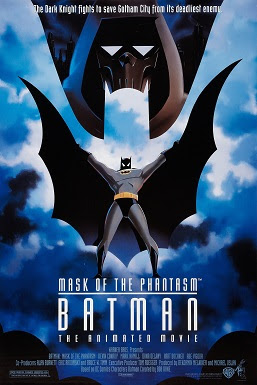
Batman: Mask of the Phantasm (1993)

“I need it to be different now. I know I made a promise, but I didn’t see this coming. I didn’t count on being happy.”
 
When I reviewed Batman: Mask of the Phantasm back in 2012, I said that it was “impossible” to compare it to The Dark Knight, finding Phantasm to be “quintessential.” Four years later, in my first expansion of my Personal Canon, Mask of the Phantasm made the cut – and yet I had said it was “imperfect... the resolution doesn’t quite hold up after repeat viewings.”
 
Reader, I was wrong. This review could have been so many things – an edition of “Take Two Tuesdays,” a continuation of my 2017-2019 reviews of Batman: The Animated Series, or part of my heretofore undeclared attempt to review every movie on the Personal Canon. Even before rereading my original review, I wanted to revisit Mask of the Phantasm because it deserved so much more than just 250 words in that “Monday at the Movies” format – especially on the occasion of its 30th anniversary this year. Whatever I was thinking in 2012, Phantasm has never truly let me down.
 
The Batman (Kevin Conroy) is a wanted man, wrongly accused of the murders of some of Gotham’s most notorious mobsters. Batman is hot on the trail of the real killer, The Phantasm (Stacy Keach), when an old flame returns to town – Andrea Beaumont (Dana Delany), whose past relationship with Bruce Wayne is explored in heartbreaking flashbacks, even as the plot marches inexorably toward a final confrontation with The Joker (Mark Hamill).
 
I always forget that Phantasm is as brief as it is. In the neighborhood of 75 minutes, it’s hard to find a film that hits all the bases like this one does: suspense, romance, comedy, heartbreak. Between dynamite action sequences and deeply human character work, Mask of the Phantasm includes no fewer than three origin stories across two timelines, telling an indelible and original story about Batman. It’s a tale that has cast its own shadow over Batman in the past thirty years, with fans constantly asking, “When will the Phantasm show up?” (The Phantasm appeared in Batman Beyond comics circa 2015 and in 2020’s Batman/Catwoman; over on film, we got a name-only tease in Batman v Superman, while the Phantasm is frequently name-checked in wishlists for the inevitable sequel to The Batman.)
 
Yet the reason I’ve never quite sounded the call for more Phantasm stories is because this one is perfect. The comics did a semi-sequel to the film in Batman & Robin Adventures, in an issue that could only be called “Shadow of the Phantasm.” While it’s a fun romp, it’s not indispensable, and it essentially leaves the characters in the same place where the film did: separated, exiled, and presumed dead. I’m being cagey about spoilers, even though the film is thirty years old and the action figure infamously unmasked the Phantasm just in time to disappoint kids on Christmas. My spoiler-phobia is largely due to my quasi-religious devotion to stories and the art of storytelling, but it’s also because the mystery isn’t entirely the point; if you know how tragedies work, you’ll plot this one out in short order.
 
Because the key to Phantasm isn’t that it’s a mystery; it’s a film noir about brooding avengers and the dark shadowy antiheroes who love them. It’s a tragedy about what happens when people let their pasts define them, but it’s also about the inescapability of the past, of chickens coming home to roost when it’s least convenient. Indeed, the past looms as large as the heavy tombstone on which the WAYNE family name is inscribed, and the real pain of the film is Bruce Wayne’s inability to escape that destiny he pledged for himself. “The way I see it,” Andrea snipes in one incisive moment, “the only one in this room controlled by his parents is you.”
 
Phantasm is somewhat unique for a Batman origin story in that we never see the murder of the Waynes, that random act of devastating violence that set Bruce Wayne on a course of dark vengeance. Instead, the film takes their loss as a given and sets the real origin story as a choice – Bruce Wayne chooses his vow over his own selfhood, and when he dons the cape and cowl for the first time, it’s not a moment of triumph. Alfred intones, “My God!” and recoils. The music swells, but even that refrain is sobered and pained. From that moment on, Bruce Wayne is the performance, a careless playboy charade who has to hide himself away from others lest they see through his façade.
 
The Phantasm, too, is a performance, reciting the ominous refrain, “Your angel of death awaits,” like some grim prophecy that explains everything. Outfitted with a theatrical costume and an insistence on dramatic violence, the Phantasm is wrestling with demons that have nothing to do with framing Batman for murder. Meanwhile, the mobsters – most notably Sal Valestra, voiced by Abe Vigoda – are stuck in their roles, playing out cheap imitations of The Godfather while their past catches up to them. The casting of Vigoda is inspired, mired in the genre’s past while playing on the arrested timelessness of Vigoda’s permanent old age.
 
Paradoxically, only The Joker is perfectly liberated. If you didn’t know he was in the movie, his first appearance reads like something out of a nightmare; the film takes a hard pivot and bends around his manic gravity. At first, the mobsters try to recruit Joker to protect them from Batman, but the incorrigible Joker can’t help but take over the plot for his own purposes, bumping off as many gangsters as The Phantasm does. He even seems to grasp the cruel irony of the film’s finale, laughing with gleeful abandon as he, Batman, and The Phantasm stare down certain death. Indeed, throughout Joker plays the Shakespearean fool, commenting on the coincidences of the plot, calling out red herrings about Phantasm’s identity, and cracking wise with a sense of humor best suited to the gallows of Gotham.
 
I haven’t said anything about the voice cast because the scripting is so impressive, but suffice it to say that Kevin Conroy remains the definitive Batman, giving us no fewer than three takes on the character (costumed vigilante, fresh-faced bachelor, and jaded philanthropist). He can plumb the depths of grief or crack a wry one-liner, and he’s the voice I’ll always hear in my head for any comic book. Ditto for Mark Hamill, whose Joker is so good that you forget he was ever a farmboy from Tatooine. Hamill has a knack for uncomfortable punchlines like “That’s what I want to see, a nice big smile.” Then there’s Dana Delany, who has to be the emotional heart of the story while keeping her own feelings clenched beneath a cool exterior. She can keep pace with both Bruce Wayne and Batman, and using nothing but her voice, she convinces us that she’s Bruce’s true star-crossed lover.
 
Ultimately, the reason people want more Phantasm isn’t because there’s more to say. It’s because this film is so good, so perfect, that 75 minutes feels criminally brief. We want to hear Conroy and Hamill riffing on each other until the end of time. We want to chase happiness just like Bruce Wayne does, and we want to revel in the bittersweet fatefulness that finds Bruce pursuing a darker calling. Or maybe we just want to live in that glorious art deco Gotham, painted on black with red skies, with a breathtaking Shirley Walker score to make sense of it all. (I know I do.) It’s an agonizingly human story, heightened by the presence of elaborate costumes and a certain Clown Prince, and as in the best films no one wants to see it end.
 
I don’t know what I meant in 2012 by “doesn’t quite hold up,” because Phantasm is a movie that has held up – and it has held me up when I’ve felt down about storytelling, disappointed by my favorite genre, or just grim about life itself. It’s almost like a calculated distillation of a superhero narrative, sweeping from start to finish, from origin story to never-ending battle. It’s not a movie that necessarily makes one feel good about humanity, but it does make one feel good about being alive. What life is worth living if you don’t have Conroy and Hamill narrating it?
 

Batman: Mask of the Phantasm
 is rated PG for “animated violence.” Directed by Eric Radomski and Bruce Timm. Written by Alan Burnett, Paul Dini, Martin Pasko, and Michael Reaves. Based on the DC Comics. Starring Kevin Conroy, Dana Delaney, Hart Bochner, Stacy Keach, Abe Vigoda, Efrem Zimbalist Jr., and Mark Hamill.

Thursday, August 4, 2016

Batman: The Killing Joke (2016)

It’s safe to say that Alan Moore and Dave Gibbons turned in a work that is both seminal and controversial when they created The Killing Joke back in 1988. It’s a work that has sparked heated debate about its content, its treatment of Barbara Gordon, and its recently challenged ambiguous ending (which I’ll admit eluded even me at first). And I’m extremely satisfied with the forty-five minute animated adaptation DC Comics released this week, for reasons I’ll enumerate.

But for reasons I cannot begin to understand, the adaptation is preceded by the cartoon equivalent of a steaming dump taken to profane the very concept of the character of Barbara Gordon. Spoilers are going to follow on this one, folks, but the long and short of it is that you can skip the first twenty-eight minutes of the film and regale yourself with everything you wanted from a Killing Joke adaptation, or you can watch the whole thing and sit in a stunned stupor as you wonder how so many people thought this was a good opening act.

The Killing Joke is the quintessential Batman v. Joker tale, in which the Clown Prince of Crime (Mark Hamill) attempts to prove a point to his Dark Knight foe (Kevin Conroy) that madness is the only sane reaction to the tyranny of the world’s “random uncontrollability.” This existential dilemma plays out on the bodies of retired Batgirl Barbara Gordon (Tara Strong) and her father Commissioner Gordon (Ray Wise), victims of Joker’s obsession with the Batman.

It’s the ultimate Joker story, proving just how terrifying the grinning jester can be by exposing us to the very blackness at the core of his soul. It features some of the darkest humor ever uttered from those crimson lips, brutally uncomfortable in a way that is precisely the point. It’s a story about how deep the Joker’s obsession with Batman runs, even as the reader begins to see just how close these two diverging paths really are. Is Batman, too, mad? Is this a path that necessarily ends in death? Though Alan Moore has largely dismissed Killing Joke, there are some really good ideas in there.

There are also some really abhorrent things in there, some things with which every comics fan must wrestle, particularly the text’s treatment of Barbara Gordon. And I’m honestly not sure where I end up on this debate – is the text simply presenting the Joker’s horrors in all their appalling brutality, or is there something approaching at best ignorant representation and at worst virulent misogyny in the book’s violence? The book undeniably deprives Barbara of much of her agency and even some of her humanity in reducing her to a pawn in the conflict between Batman and Joker, but fortunately so much good work was done in the comics about how Barbara healed and became something even greater in the form of Oracle, the information broker of the DC Universe and arguably one of its smartest tech-savvy heroes. This, I contend, is the crux of the superhero genre – it’s a core narrative about how we make ourselves into our greatest ideals, how we build ourselves into the best possible versions of ourselves. That’s why Batman is the greatest superhero: he’s us, as we wish to be, at the cost we fear paying. He’s not superhuman, but he is a super human.

When producer Bruce Timm and writer/adapter Brian Azzarello announced some time back that they were adding a Batgirl-centric prologue to the film, in part to pad out the runtime and in part to give Barbara a more leading role, I was intrigued. I’ve always regretted that Barbara is merely a victim in The Killing Joke, so it was good to hear that the film’s creators were attuned to that sensitive element of the book. Now for a little thought experiment: in one sentence, give me a reason to care about Batgirl. If you don’t know much about Batgirl, you can try it with any character you admire – just one reason to care about them. Write it down.

Did you write down, “She’s able to have sex with Batman”? No? Oh, well, that’s the best thing Azzarello came up with. Look, I admire the man’s work tremendously, and I’ve met him in person and found him to be wise and affable. But how in the world did the man who gave us Doctor 13: Architecture and Morality decide that the best way to get audiences invested in Batgirl was to hook her up with Batman in a creepy, sleazy rooftop one-night-stand that reduces both of them to petulant children the morning after? In what alternate universe is that either palatable or acceptable? It’s leery and exploitive in a way that participates in, not decries, the Joker’s violence of the same kind. And I wish to heavens I were exaggerating when I say that the prologue is capped off by a scene of Barbara jogging as – and I swear on all that’s holy, I’m not stretching the truth – the camera lingers over her jiggling behind and chest, never ascending past her shoulders. I try to keep the language PG on this blog, but I have all manner of vituperative commentary just under my bitten tongue.

After that, about which I could decry so, so much more (like the fact that the prologue is ultimately, from a cinematic point of view, entirely unnecessary, as it’s never so much as acknowledged again), the film takes a complete 180-turn into a rendition of the graphic novella that leans hard into accuracy, embellishing just a little bit in ways that are really quite engaging. This Killing Joke does more with the carnival freaks, an intriguing visual here made into a coterie of Joker’s maddest henchmen, and it sets one of Joker’s monologues in a room that’s quite literally topsy-turvy, amping up the madness in a way that the comic only used words to accomplish.

In a very real sense, this is the Killing Joke for which we waited. The animation is a compelling if visibly low-budget approximation of Brian Bolland’s highly precise penciling, and the voice cast is Conroy and Hamill at their level best. The first time we hear Joker’s laugh, I burst into an irresistible smile and snicker. “That’s my Joker,” I thought, “and here’s my Killing Joke.” But that first half-hour I can guarantee I will never watch again. It angers me just to think about it. A friend of mine once said, “I know Batman better than I know most real people I know,” and I feel that way about Batgirl too. I care about this character in a way that I think no one watching only this film possibly could. She’s plucky, brave, and brainy as all get-out, and she deserves so much better. The original Killing Joke comic did violence to her, and it’s abhorrent to see that the violence continues. In the comics, Barbara healed and became Oracle, but here the credits roll and nobody seems terribly bothered by any of it. (Do stay through the credits, though.)

As I wrap up this review, I’ve got a stack of new comic books waiting for my eyes, but I’m so eager to go back and enjoy the forty-five minutes of Killing Joke proper once more. It’s on those grounds, then, that I can recommend The Killing Joke: it’s a gourmet steak dinner preceded by the crudest crudité imaginable. If I were a principled man, I’d boycott DC Animated Films from here on out. But next up, it’s Justice League Dark. And I can’t say no to an animated Swamp Thing. I just can’t. And that’s no joke.

Batman: The Killing Joke is rated R for “some bloody images and disturbing content.” This isn’t one for the kiddies; Barbara’s injuries are pretty graphic, and the shots of her pained body are framed in a way that obscures the most explicit details but leaves the imagination to run rampant. Then there’s the offensive hypersexualization of the character, the aforementioned jogging shot and a beat in which Barbara removes her mask and costume, wearing a bra, before the Hitchcockian pan away. The film is relentlessly dreary, bleak in the way it needed to be to do the book justice, and it spares no blood. Weirdly, though, the language is self-censored, as when a mobster says “What the eff?” If you’re going to go for the R rating, why stop short on that point?

Monday, October 27, 2014

Monday at the Movies - October 27, 2014

Welcome to another edition of “Monday at the Movies.”  After being disappointed by last week’s sojourn into so-called horror, it’s time to return to what we do best – something we haven’t done, believe it or not, since July!

Batman: Assault on Arkham (2014) – First of all, the title of this film is an abject misnomer.  Assault on Arkham is unequivocally a Suicide Squad movie in which Batman makes a few appearances.  But because of the Dark Knight’s marketability and a welcome performance by Kevin Conroy (who so thoroughly owns the character at this point), the title misleads.  The Suicide Squad, working on the deceitful orders of government official Amanda Waller, is tasked to break into Arkham Asylum in order to recover a stolen piece of data; being that the team is comprised of supervillains working off their sentences – led by the master assassin Deadshot (Neal McDonough), with Harley Quinn (Hynden Walch) stealing the show with her repeated cries of “Yahtzee!” – the team can barely keep from betraying itself to stay alive.  I really enjoyed this film, for precisely the reason that might turn off a lot of viewers:  Assault on Arkham is probably the edgiest animated film out of DC, replete with a fair amount of gore and PG-13 brushes of nudity.  It’s a welcome relief to see that the studio is willing to take a risk here and there with some of their lesser-known properties, even if that gamble is counterbalanced by the presence of the ever-bankable Batman and a tenuous tie to the wildly popular Arkham video games.  That said, to long-time fans of the comic book source material, there’s little to surprise in Assault on Arkham; anyone with a casual knowledge of the Suicide Squad knows exactly who’s telling which lies, and so the real joys of the film are to be found in the edgy appropriation of character relationships (especially the manic way Harley Quinn tries to bait her former lover, The Joker).  With a Suicide Squad movie en route from DC’s live-action division, this is a good introduction to the concept.  (Recommended also:  the “Task Force X” episode of Justice League Unlimited, which finds a similar roundup of rogues breaking into the Justice League’s orbital Watchtower.)

That does it for this week’s edition of “Monday at the Movies.” We’ll see you here next week!

Monday, March 4, 2013

Monday at the Movies - March 4, 2013

Welcome to this week’s edition of “Monday at the Movies.”  This week, two DC Animated films adapting popular storylines from the comics.

Justice League: Doom (2012) – One of the best Batman stories of the last fifteen years took place in the pages of JLA, when it was revealed that Batman kept files on all his Justice League teammates detailing their weaknesses and how to exploit them should a Justice Leaguer go rogue.  This animated film adapts that storyline, reuniting the Justice League animated voice cast (Tim Daly, Kevin Conroy, Susan Eisenberg) in a battle against themselves when immortal caveman Vandal Savage steals and enacts Batman’s contingency plans as part of a larger scheme for – you guessed it – world conquest.  The film works almost as a coda to Justice League Unlimited, showing the cracks in the team as well as the expanding roster (Cyborg finally joins the team).  The voice cast is first-rate, as always (even if I’m sorry Mirror Master isn’t Scottish), but the animation style is a little too stripped down for my tastes, with streamlined features resembling Saturday morning anime more than the Timmverse style I’ve come to expect from these features.  Overall, there are parts that work and parts that don’t – the choice of supervillains in the Legion of Doom is mostly insignificant, as most characters here are interchangeable with any other rogues.  But the characterizations of Superman and Green Lantern (voiced by Nathan Fillion) are spot-on, with Superman shining in a suicide intervention scene while Green Lantern swaggers through a rescue mission.  Ultimately the film is hit or miss, though it finally achieves Justice League status by creating a threat so big that everyone has a role to play.  Justice League fans will appreciate it, though it’s not quite the caliber of the animated series from the last decade.

Superman vs. The Elite (2012) – My favorite Superman stories always ask the question, “Why do we need Superman?”  The answer provided in Superman vs. The Elite (adapted from Joe Kelly’s “What’s So Funny About Truth, Justice, and the American Way?”) interrogates Superman’s refusal of lethal deterrent against a team of superpowered policemen who aren’t afraid to kill the bad guys (the execution of a long-time Superman villain is a perfect demonstration of that).  George Newbern (late of Justice League) and Pauley Perrette (Abby on NCIS) star as Superman and Lois Lane, doing good work that melds the animated sensibility with the repartee of the Donner films, and as Manchester Black, the central antagonist of the film, Robin Atkin Downes is repellently smug, spouting language that I think is deliberately out of place in a cartoon like this.  The film creates a new arc for The Elite, establishing them first as budding heroes before their moral code puts them in opposition to Superman – an improvement from the comic, which dropped them into the story without first building conflict.  What works less well is the animation style, which is quite two-dimensional and gives most characters the look of overfed bulldogs with Buzz Lightyear chins.  It’s a shame that the film doesn’t look better, because the writing in it is solid, particularly the ending, in which Superman attempts to prove to a bloodthirsty Metropolis that his way is better.  While not as quintessential as All-Star Superman, Superman vs. The Elite offers an alternate approach to the ongoing relevance of Superman.

That does it for this week’s edition of “Monday at the Movies.” We’ll see you here next week, but don’t forget that this Thursday is the Double-Oh-Seventh of the month, and you know what that means...

Monday, July 23, 2012

Monday at the Movies - July 23, 2012

Welcome to Week Twenty-Seven of “Monday at the Movies.” After a Batman-heavy week last week, we’re going to shift gears dramatically this week and spend the day with a few animated Superman movies, all adapted from recent comics storylines (all of which are worth reading).

All-Star Superman (2011) – This is a difficult film for me to review, and so I’ll say up front that your results may vary.  I’m a huge fan of the Grant Morrison/Frank Quitely series from which this film is adapted, and the film is a very faithful adaptation with many of the book’s highlights included (my favorite, alas, didn’t make the cut).  That said, I recognize that the film has structural problems endemic to the source material; rather than a unified story, the film feels like a series of vignettes starring the same characters.  There’s an ongoing plot holding the vignettes together – Superman is dying – but viewers may be turned off by the somewhat fragmented storytelling (though, again, the late Dwayne McDuffie did a marvelous job adapting the 12-issue source material).  While this isn’t the classic voice cast we know and love (see the last two reviews of this post), James Denton is surprisingly heartfelt as the Man of Steel, embodying the heavy emotional burden that comes with being a dying savior, while Anthony LaPaglia does a Lex Luthor dripping with hatred for his enemy; LaPaglia is no Clancy Brown, but he’s a solid fill-in.  The surprise success, though, is Christina Hendricks as Lois Lane, who handles the character’s trademark snark with aplomb but, like Denton, hits the pathos when needed.  And for a superhero film that brings a tear to the corner of your eye, All-Star Superman might just be the most successful Superman movie of our lifetime.

Superman/Batman: Public Enemies (2009) – Public Enemies is iconic in every sense of the word, and while I wasn’t overly enamored with it the first time I saw it, I’ve found a lot to appreciate in a film that is far more than the mere slugfest for which I initially mistook it.  This film reunites Tim Daly and Kevin Conroy as Superman and Batman, the first extended team-up since 1996’s The Batman/Superman Movie; for good measure, Clancy Brown returns as President Lex Luthor, who uses his new political power to seek revenge against his caped foes when a Kryptonite meteor enters Earth’s atmosphere.  I could spend pages falling over in a dead faint over the strength of the voice cast, but if you’ve read my blog for more than a day you know that for me these are, simply put, the definitive voices of the DC Universe.  Adapted from the Jeph Loeb/Ed McGuinness series, Public Enemies is admittedly light on plot, with waves of supervillains assaulting our costumed protagonists, and a few plotlines have been streamlined for the abbreviated direct-to-video format (gone is any mention of Batman reopening his parents’ murder).  But what the film lacks in narrative substance, it makes up in thematic depth.  This film – especially the first twenty or so minutes – gets at the heart of the modern Superman/Batman team-up story by showing how unlikely it is that these two radically different types would ever work together, then demonstrating just why the partnership works.  It’s one built on mutual respect and understanding – perhaps begrudgingly so at times, on Batman’s part – and the chemistry between Daly and Conroy atones for any of the film’s missteps.  It’s unlikely we’ll see these two on the big screen any time soon, but Public Enemies fills that spot nicely.

Superman/Batman: Apocalypse (2010) – Apocalypse is misleading, and consequently disappointing, on several very important levels.  In short, Apocalypse is a sequel to Public Enemies that picks up on the Kryptonite meteor, revealed to contain another survivor from Superman’s doomed homeworld – his cousin Supergirl.  For one, what seems like executive sexism prompted the title to be changed from Superman/Batman: Supergirl, which is a shame because the original title much more accurately reflected what the film truly is – a Superman film in which Big Blue meets his Kryptonian cousin with Batman caught in the middle; Batman’s very much a supporting player in this film until the very end, so the inclusion of Supergirl might come as a surprise to unsuspecting viewers.  Secondly, the film goes to great lengths to reunite Tim Daly and Kevin Conroy with Susan Eisenberg as Wonder Woman, but principal villain Darkseid is voiced by newcomer Andre Braugher, who brings almost no gravitas or personality to the role.  Indeed, Braugher is barely threatening as the ostensible god of evil, a sad step down from Michael Ironside’s voice as gravelly as the mad god’s craggy face.  As for Summer Glau as Supergirl, she’s spunky and endearing, and the film gratefully straightens out the murky origin she had in the comics; it’s just a shame that she didn’t have a better vehicle to headline as the Maid of Steel.  What we have is perfectly serviceable and not a colossal waste of time like Superman: Doomsday, but it likely won’t hold much for viewers who aren’t already fans of the source material.

That does it for this week’s edition of “Monday at the Movies.” We’ll see you here next week!  But stay tuned for Wednesday's review (finally) of The Amazing Spider-Man!