Showing posts with label 2010s. Show all posts

Monday, April 17, 2023

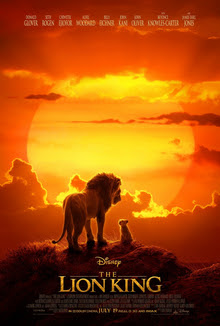
The Lion King (2019)

Most movies would be improved, I think, by imagining that you are watching them with Jeff Goldblum. And as I was watching The Lion King, Jon Favreau’s 2019 remake of the 1994 animated classic, I had the acute feeling that Goldblum’s Dr. Ian Malcolm (from Jurassic Park) was sitting next to me. I could almost hear him say, “Your animators were so preoccupied with whether they could, they didn’t stop to think if they should.”
 
By the time the end credits rolled on The Lion King, I found myself asking the same question I ask of nearly all of Disney’s live-action remakes: “Why?” Why does this film exist? Why was the remake almost identical to the original? And why was I surprised that, yet again, Disney pulled the wool over my eyes in convincing me that I hadn’t already seen this story?
 
From its opening frames, The Lion King is an exercise in déjà vu. The sun rises on an African plain, and the same Zulu opening vocals from Lebo M. ring out. If it’s not precisely shot-for-shot, it’s close enough, as Mufasa (James Earl Jones) and Sarabi (Alfre Woodard) present their son Simba (JD McCrary, then Donald Glover) to the kingdom he will one day rule. All of this has happened before, and the “Circle of Life” might as well be the creative bankruptcy that leads to a rinse-and-repeat mode of content creation.
 
To be fair, that sequence is the very model of ‘iconic’; it was, after all, packaged as a teaser trailer for the 1994 film, and it’s an absolute banger of an opener. Don’t fix what isn’t broken, they say, so I’ll give director Jon Favreau a pass on the first five minutes. When you’re a cover band, you play the hits, no matter how many times you’ve heard “Hey Jude” or “Free Bird” in your life. As the film unfolded, I thought we were heading into fairly interesting territory. This 2019 version begins to deepen the psychological profile for its villain Scar (Chiwetel Ejiofor) and his cackle of hyenas, who rebel against Mufasa for largely different reasons this time around. An explanation for his eponymous scar, and a few line changes to his solo number “Be Prepared,” feel like early forays into giving us a reason to run through the paces once more.
 
Perhaps ironically poignant, the first time that I noticed a major content change was in a sequence that revolves around, of all things, a dung beetle and his bespoke fecal boulder. Every creature in the savannah plays some small part in accidentally delivering to Rafiki (John Kani) a snarl of Simba’s mane, proving to the mandrill shaman that the lion king is still alive. It’s a fascinating rebuttal to Timon (Billy Eichner) and Pumbaa (Seth Rogen), who had just prior rebuked the idea of a “circle of life,” and it’s a slightly more credible way for Rafiki to learn of Simba’s exile. But in the end, it is an extended sequence about ossified manure, perhaps more suited to Planet Earth than a Disney feature.
 
In fact, the whole thing comes off as more of a thought experiment than a movie proper. What if, The Lion King asks, we could remove all abstraction from the original and render it as lifelike as possible so that we become not spectators but voyeurs in the animal kingdom, watching a wildlife documentary? Why include a bird who can smile or roll his eyes when we can give audiences a Zazu (John Oliver) whose physical features are limited by how an actual hornbill can move? Indeed, why make the film in such a way that the only expressions on the characters’ faces are provided by the Kuleshov effect? 
 
The answer, it seems, is behind the scenes. As far back as his Jungle Book, Jon Favreau has been experimenting with what technology can allow him to do, and the making-of featurettes for both movies show Favreau exploring his imaginary world through the use of VR technology. (A similar technical invention allows Favreau to shoot much of The Mandalorian in an immense soundstage called “The Volume,” so perhaps all’s fair in love and Star Wars.) If Favreau’s directorial outings are more about pushing the envelope of special effects, reskinning classic films just to see if he can, then The Lion King is a roaring success. But one can’t even call this a live-action adaptation – it is, rather, just differently animated, an identical remake only slightly less inessential than Gus Van Sant’s Psycho.
 
It’s not that The Lion King is badly made. The effects are good, even to the point that one might assume these were actual animals filmed on genuine African landscapes, and some of the voice casts are decent upgrades; Ejiofor in particular is a more Shakespearean Scar, while Eichner and Rogen are the surprise best-in-show (excluding, naturally, James Earl Jones’s return as Mufasa). Despite being slightly longer than the original, all of it feels overly familiar. “I know, I know,” I found myself thinking, “You’ve told me this one already.” There is a long gap between 1994’s Lion King and the Hamletthat inspired it; the difference between 1994 and 2019’s Lion Kings, however, is merely one of overlaying an Instagram filter.
 

The Lion King
 is rated PG for “sequences of violence and peril, and some thematic elements.” Directed by Jon Favreau. Written by Jeff Nathanson. Starring Donald Glover, Seth Rogen, Chiwetel Ejiofor, Alfre Woodard, Billy Eichner, John Kani, John Oliver, Beyoncé Knowles-Carter, and James Earl Jones.

Tuesday, February 15, 2022

Alien: Covenant (2017)

After I saw Prometheus in 2012, ostensibly returning director Ridley Scott’s prequel to Alien, I had such a viscerally negative experience that I’ve never gone back and rewatched the film. It worked on an instinctive level, with enough scares and dread, but the meandering narrative left me unfulfilled. It was a film without an ending, a prequel without a need to participate in the same universe. 

In fact, Prometheus was such an overall negative experience for me that it took me four years to watch its sequel, Alien: Covenant, which came out in 2017. At least this time, the film is unabashed about its ties to the Alien franchise, but it is so unbearably ponderous, and it takes far too long for much of anything to happen. By the time the film hits its strongest notes, most in the audience may have long since fallen asleep.


Android Walter (Michael Fassbender) awakens his ship of colonists after a solar flare damages their vessel. Once the repairs are complete, Captain Oram (Billy Crudup) and his second Daniels (Katherine Waterston) discover a mysterious broadcast that leads them to a planet perfectly suited for their settling mission. The planet, however, is home to a giant storm, a few mysterious creatures, and another android (also Fassbender) who appears to be the only survivor of a doomed ship ten years ago.


Alien: Covenant begins with a lengthy sequence between Fassbender’s robotic David and his human inventor, played by an uncredited Guy Pearce. The dialogue is laborious and painstakingly self-serious, as though this is the first time that such a scene has been presented between creator and creation. Pearce and Fassbender limp their way through dismally tedious monologues about creating life, and just when you think the scene can’t verge any further into cliché, Fassbender begins playing, of all things, Wagner on a conveniently adjacent piano. It’s guaranteed to induce a hearty groan from anyone who’s seen a science-fiction movie in the last forty years, yet this prologue is so sententious that it casts a dour pall over the rest of the movie.


It’s another forty minutes or so before the plot of the film really gets going, after taking much too long to introduce a crew of no fewer than nine characters – half of whom, don’t worry, will be alien fodder before too long. You’ll have to wait nearly an hour before seeing so much as a hint of an alien, which is a bit of a problem, especially because the alien hijinks in Covenant aren’t anything we haven’t seen before. There are blundering humans who unwittingly infect themselves with alien spores, alien eggs that ought to ring a bell for fans of this franchise, and things that go bump in the dark. There’s even a familiar piece of heavy machinery that plays a significant role early in the film’s climax; it’s not the cargo-loader from Aliens, but it’s close. 


Indeed, Mark Kermode has rightly called Alien: Covenant a “greatest-hits” collection, reprising so many recognizable moments to diminishing effect. One senses that Ridley Scott is re-staging them with all the dramatic flourish of the original King Kong, as if to say it’s all been building to this – ta-da! Yet we’ve been down this road once or twice already; we’ve seen it all before. There’s an instinctual fear of the darkness and of sudden scares, and Scott is deft at manipulating the audience into being startled, but at the same time any eagle-eyed Alien fan will probably spot some of these jumps coming. (Cautionary tale: if you’re in space, never ever go into a medical bay.)


Just about the only fresh thing the film does is to cast Fassbender as the dueling android twins David and Walter. Fassbender shines in these twin roles, not least of all because of the different accents he employs. He manages to make both characters visually distinctive in their mannerisms and bearings, yet Alien: Covenant finds a way to wear out your patience in a few navel-gazing sequences where the two androids explain the plot to each other before – and I cannot make up this level of narcissism – kissing. It’s a perfect metaphor for how enamored the film is of itself and its own weighty, needless mythology. 


You sense that the makers of Alien: Covenant are trying, really trying. Katherine Waterston is a fine update on the Sigourney Weaver archetype, and the film gives her enough room to carve out a unique take on the role. But no one else is quite trying at the level of Fassbender and Waterston, and the film is mired in its own reflection. There are things that will always work in an Alien film, but that doesn’t mean you can string them together time after time for a guaranteed winner. It took me four years to watch Alien: Covenant; maybe I should have waited a little longer.


Alien: Covenant is R for “sci-fi violence, bloody images, language and some sexuality/nudity.” Directed by Ridley Scott. Written by Jack Paglen, Michael Green, John Logan, and Dante Harper. Starring Michael Fassbender, Katherine Waterston, Billy Crudup, Danny McBride, and Demián Bichir.

Tuesday, February 8, 2022

Terminator: Dark Fate (2019)

If you asked me to explain the multiple alternate and parallel timelines at play in The Terminator and its sequels, I’ll quickly change the subject. I don’t fully understand them myself, nor do I believe any of the filmmakers have tried to keep the continuity house in order. What’s more, though, all these disparate timelines are far and away the least interesting thing about any Terminator film, which are at their best when they mash up impressive action sequences with an unstoppable metallic killer whose immortality may as well be lifted from a slasher horror film’s antagonist. 

Case in point, Terminator: Dark Fate, which ignores most of the sequels and pretends – just like its predecessors, Terminator Salvation and Terminator Genisys – that only the first two Terminator films “actually” happened. For a franchise that continually rewrites itself, Dark Fate is an oddball legacy sequel (or legacy-quel, if you will) that works much better when it’s not sidestepping its own prismatic past.


Years after Sarah Connor (Linda Hamilton) averted Judgment Day and the rise of Skynet, a new Terminator (Gabriel Luna) arrives in Mexico City to kill Dani Ramos (Natalia Reyes). Assuming Dani will be the mother of some new future messiah, Sarah rushes to her side, only to find the cybernetically-augmented Grace (Mackenzie Davis) has already time-travelled to save Dani from the forces of the future.


What separates Dark Fate from the other Terminator sequels is the return, supposedly triumphant, of franchise forefather James Cameron, who had no hand in the preceding three films. Here, Cameron is one of six credited writers, but one senses that his voice rings the loudest. Each of the trio of protagonists is that very specific Cameron brand of Strong Female Protagonist – tough and resilient with only enough emotional complexity to feel human; indeed, their heroic prowess seems measurable by the size of their firearms, a Freudian insight which feels almost retrograde for 2019. What felt innovative for the 1984 original (and Cameron’s Aliens two year later) now feels familiar and perhaps overdone. It’s as though Cameron has returned to the franchise both to save it and to insist upon reminding us (however spurious the claim) that he invented tough-as-nails heroines. 


In short, it’s the girlboss Terminator, even if it doesn’t quite explore that concept until very late in the film, when we finally learn why Dani is essential to the future (in a plot twist that is telegraphed either effectively or obviously, depending on where you’re sitting). Dark Fate asks, “What if, this time, a lady helped a lady save a lady?” Points for finding a new angle on an old favorite, I suppose, and kudos to the trio of women anchoring the film for all doing a credible and watchable job. Hamilton’s return is ostensibly the centerpiece of the film, even more so than Arnold Schwarzenegger reinventing his role as an aging Terminator, while Davis is a clever update on the Kyle Reese archetype. The film does her a disservice, though, to focus more on her physicality than her personality, given a brief flashback that only teases what she’s really like.


Then there’s Natalia Reyes, who has the closest thing to a character arc in the film, and it’s because of her emotional attunement as Dani that the film’s third-act twist lands at all. The film asks her to be John Connor and Sarah Conner and her own person all at once, and Reyes manages to take the film’s thin character sketch and finds a way to track Dani’s evolution from factory worker to future hero. I’d be just as happy to see any of these three come back for a future Terminator film, though I would recommend audiences not get too attached. We’ve been down this road before, with Terminator 3 and Salvation and Genisys each promising a new direction that never came to pass. 


We don’t, however, come to a Terminator film for internal logic or amazing new characters. After decades of fits and starts, we keep coming back for the bang-up action sequences, and on that count Dark Fate truly delivers. The film’s first act includes a freeway chase that’s very nearly as good as the one at the heart of The Matrix Reloaded (though I’m sure the proper antecedent is in Terminator 2, which I haven’t seen recently enough to recall with precision), and the pace never quite lets up. We’ve also got a claustrophobic sequence within an immigration detainment center, with a climax set amid an expansive pursuit over land, sea, and air. Throughout, director Tim Miller is constantly recalibrating the bar, both raising it for effect and narrowing his scope to give this action film a welcome degree of versatility. 


Dark Fate is very seldom boring, and perhaps the only sense of fatigue in the film is the idea that we’ve been told four times now that, no, no, this is what a Terminator film ought to do. At the core of the franchise is an irresistible – and proven – premise, though the box office receipts seem to be a tale of diminishing returns. As these films often remind us, the future is not written – and nor, it seems, are the sequels this film had been hoping to greenlight. Dark Fate may have portended its own future with its eponymous subtitle, casting the franchise prospects into uncertainty. 


Terminator: Dark Fate is rated R for “violence throughout, language, and brief nudity.” Directed by Tim Miller. Written by James Cameron, Charles Eglee, Josh Friedman, David Goyer, Justin Rhodes, and Billy Ray. Starring Linda Hamilton, Arnold Schwarzenegger, Mackenzie Davis, Natalia Reyes, and Gabriel Luna.

Tuesday, October 19, 2021

Monster March II: Frankenweenie (2012)

Frankenweenie is not quite the movie I was expecting. Certainly I got more than my fair share of Tim Burton hijinks, all angular bodies and the subtle terrors of the suburbs. What I wasn’t expecting was how much of a faithful and loving adaptation Frankenweenie would prove to be of the original James Whale Frankenstein – and what a fitting inclusion for Monster March II. (Remakes and mash-ups and sequels, oh my.)

Young Victor Frankenstein (Charlie Tahan) loses his beloved dog Sparky (Frank Welker) in an unfortunate accident, but the words of his eccentric science teacher (Martin Landau) inspire Victor to undertake his own experiment. Sparky lives! Yet as Victor struggles to keep his science project secret, his classmates begin to realize that his experiment has the potential to change their town.


From the beginning of Frankenweenie, it seems that Tim Burton has set out to make a film about his own childhood. The story begins with Victor screening his latest short film for his parents. Like Burton, Victor clearly has an appreciation for low-budget horror with all its gimmicks and movie magic, even equipping his parents with 3-D glasses for the living room premiere. It’s the sort of peculiar precise detail that suggests Burton actually lived this moment. Already the film was defying my expectations, and I do wish Burton had spent more time on this hobby of Victor’s; I’m not sure how it would fit into the Frankenstein allegory he’s telling, but it’s certainly unique and clearly a passion for Burton.


As Victor attempts to discover a world beyond his love for his dog, the film veers into a riff on Edward Scissorhands, which was itself a kind of Franken-fable (with Johnny Depp as a kinder, gentler creature who nonetheless became feared for his unnatural appearance). Here Burton’s obsession with the simulacrum of the suburbs is on full display; though the streets and houses all look normal, the people that occupy them are anything but – especially the children, who are cartoonish and borderline monstrous, even before their fierce competitive spirit drives them to burglarize his attic laboratory. Kids can be real creeps, Burton says here, and having had a childhood myself I would have to agree.


Yet if the film starts out in the vein of Edward Scissorhands, it well and truly reminds us by the end of the story that it’s from the same odd mind that brought us The Nightmare Before Christmas. Victor’s relationship with the reanimated Sparky is both bizarre and sweet, a comfortable niche for Burton, but the creature horror of the film’s third act puts one in mind of the vampire bat toy that Jack Skellington’s minions set loose on Christmas Eve. As the children of New Holland reanimate their pets, only some of whom have joined the choir invisible, one can almost hear Burton gleefully rubbing his hands together from behind the camera as he intones, “I will show you fear in a handful of sea monkeys!” 


Frankenweenie is plenty enjoyable, even when it feels a bit like a Tim Burton cover band, but it’s of particular interest this month for being a spot-on adaptation of the Frankenstein legend, especially as remediated through the lens of horror films like the Karloff classic. (Indeed, one neighborhood boy, voiced by Martin Short, may as well be Karloff.) Colin Clive’s ecstatic “It’s alive!” is replaced by Victor’s more jubilant “I did it!” And of course, no modern Frankenstein would be complete without Elsa Lanchester’s iconic hairdo from Bride of Frankenstein, though it would be criminal to spoil who gets to wear it. (Perhaps surprisingly, it’s not the neighbor girl Elsa Van Helsing, voiced by Winona Ryder.) This is a madcap Frankenstein, a mishmosh of all the iconography Burton loved as a child, run through his instantly recognizable stop-motion filter. It is perhaps exactly the movie you’d anticipate coming from Burton, but by the same token it’s never quite the movie you expect. After two hundred years, this old story still has a little spark to it.


Frankenweenie is rated PG for “thematic elements, scary images, and action.” Directed by Tim Burton. Written by John August and Tim Burton. Starring Charlie Tahan, Martin Short, Catherine O’Hara, Martin Landau, Winona Ryder, and Frank Welker.

Monday, December 23, 2019

Star Wars: The Rise of Skywalker (2019)

When The Last Jedi came out two years ago, I observed of its theme (but for whatever reason did not say so in my review) that it seemed to be the story of “looking for hope in Alderaan places.” The film had been a tale of failures, of misplaced hope and crushing defeats, but it also ended up reaffirming that the Resistance’s true hope lay in the princess of Alderaan and her brother in exile, and the legacy they were building for the next generation. In the follow-up, The Rise of Skywalker, that legacy comes to bear in unexpected ways, crowd-pleasing and recontextualizing for an emotionally successful finale to this Sequel Trilogy and the Skywalker Saga writ large.

(As ever, there won’t be spoilers here; even the major reveal, divulged in the film’s opening crawl, is a sacred mystery in this review.)

After narrowly escaping The Last Jedi with their lives, agents of the Resistance are on the run from the First Order, gathering what few allies they can find in a galaxy that’s given up. While Kylo Ren (Adam Driver) marshals the forces of the First Order, Rey, Finn, and Poe (Daisy Ridley, John Boyega, and Oscar Isaac) head into the unknown in search of a way to prevent the complete obliteration of the Resistance, meeting new friends and old while Rey decides, once and for all, what her destiny will be.

So much exhausting ink is being spilled about whether or not The Rise of Skywalker “betrays” The Last Jedi by walking back or diminishing certain aspects of the film, whether or not this film “ruins” Star Wars or if returning director J.J. Abrams hates predecessor Rian Johnson. All of this is to say that no one hates Star Wars more than Star Wars fans, especially that vexing vocal minority monopolizing internet chatter. In the case of The Rise of Skywalker, I found myself strongly reminded of Return of the Jedi, itself a capper to a trilogy and an ostensible end to a story. Both films play it a little safer than their edgier forebearers, but both make up for that decrease in originality by dialing up the emotional resonance. Where Return of the Jedi reunited its heroic trinity for one last mission, Rise of Skywalker gives us Rey, Finn, and Poe properly together for the first time, having kept them apart for much of the preceding two films. It’s a real joy to see these three side by side, and their interactions carry the weight of all the adventures we didn’t get to see between films.

Critics have lamented the way the film is perhaps overfilled with setpieces, characters, and side quests, to which I have to say, I hope they enjoyed their first Star Wars film – because this is a franchise that has always been overfull of bits, fodder for imagination and tie-in media alike. True, Rise of Skywalker begins with its foot on the gas and never quite lets up, but as the third film in a trilogy there’s not a lot of time for much else, especially when the stakes are as dire as they are here. In fact, however, there’s a beat near the end of the second act where the plot does slow down, and it’s one of the most emotionally resonant corners of the film.

I was disappointed to find my audience so quiet during the film because there are a number of moments where you want to pump your fists and cheer. (The biggest laugh seemed to be who gets the line, “I’ve got a bad feeling about this.”) Perhaps audiences have been down this road so many times since 2015 – where, recall, the Milennium Falcon’s appearance got a big cheer – but suffice it to say I was charmed and cheered by more than a few sequences, including, and this is not a spoiler, a silent cameo from the Maestro himself, John Williams. Speaking of Williams, it’s his grand finale, too, and there are only so many ways to praise a man with more than 50 Academy Award nominations; he’s got an impressive body of work on which to draw, and he does so in ways that are breathtaking. I sense, however, that J.J. Abrams is still less comfortable with an orchestral score than Rian Johnson was, so I’m eager to see the film again after getting more familiar with the score (which remains, incidentally, my favorite component of any Star Wars material, period).

In the way that Return of the Jedi was an ending that gestured at a beginning, Rise of Skywalker is the final act in a nine-piece story, with plenty of space for what happens next, but it’s also acutely aware that there are things it needs to resolve. Leavened with the usual amount of space nonsense – which I love – the film cobbles macguffins together to get us to a sequence that orbits around Chekhov’s gun while wrapping up one of the Sequel Trilogy’s most potent emotional questions, and my only complaint is that it does so in a way that makes me want a whole movie or two of just thatcomponent. But taken as part three of three (and I feel I must be terribly vague here) the impossibility of continuation is perhaps for the best, as it needs first to resolve an entire arc, not establish a new one. That’s what the toys are for, folks.

As with nearly any film, there are moments I would have done differently. I’d have liked to see a few returning faces have a few more scenes, but there isn’t really anything to trim to make room for that. (In a post-Endgame world, though, I’d have been up for a three-hour space opera!) But in a world where toxic fandom demands that a piece of art conform to every single expectation, where the villains of the story are the ones who insist on rewriting history to accede to their vision for the galaxy, I find it’s much healthier to review the film we actually got instead of the one I might have made. And the Rise of Skywalker before us is pretty swell.

Star Wars: Episode IX – The Rise of Skywalker is rated PG-13 for “sci-fi violence and action.” Directed by J.J. Abrams. Written by Chris Terrio, J.J. Abrams, Derek Connolly, and Colin Trevorrow. Starring Carrie Fisher, Mark Hamill, Adam Driver, Daisy Ridley, John Boyega, Oscar Isaac, and Anthony Daniels. (And a few more!)

Tuesday, October 15, 2019

Joker (2019)

I wasn’t going to review Joker. As you can probably tell from the infrequent updates here, I’ve been taking a little hiatus from movie reviews to recharge, focusing on other creative projects while waiting for the right film to spark up my reviewing energies again. But I can’t get Joker out of my head – nor, it seems, are media outlets interested in letting this movie just get away. On the one hand, you’ve got ardent comics fans who are beating the drum and hard for this movie; on the other, you’ve got the media at large trying distressingly to will into existence a mass shooting in this film’s name. Then again, the movie seems to anticipate and decry the media’s bloodthirsty and misguided reaction… all of which makes me wonder how certain I am that as movies go Joker is, well, just fine.

Joker is part Batman prequel, part Taxi Driver remake, leavened with The King of Comedy and flame-broiled by an incendiary performance courtesy of Joaquin Phoenix. Phoenix stars as Arthur Fleck, a sad clown-for-hire with a bevy of psychological problems and a handful of pills whose prescriptions are about to run out. He’s the caregiver for his addled mother (Frances Conroy); he’s carrying a torch for Sophie (Zazie Beetz) down the hall; and he never misses a late-night episode of Murray Franklin (Robert De Niro). But Gotham City circa the 1980s is a pressure cooker of decadence and madness, and it’s about to boil over.

But is it? And is he? Or did he…? One of the central tenets of The Joker is that he’s an inscrutable cipher, a man without an identity or an origin. “If I’m going to have a past,” Joker says in Moore & Bolland’s Killing Joke, “I prefer it to be multiple choice!” (Bolland gets a “special thanks” credit, and if Moore didn’t hate movie adaptations he probably would have, too.) Without giving away too much of the game in Joker, director Todd Phillips is very careful to intimate (and at one point outright declare) that Arthur Fleck is an unreliable narrator. For any of my grievances about the film, I have to give Phillips a strong pat on the back for circumventing the certainty that would have run this film counter to The Joker’s innate unknowability; indeed, the one moment where Phillips baldly explains that a thing we saw happen did, in fact, not happen is one of the film’s major missteps, assuming the audience is not clever enough to understand that what Arthur sees isn’t always what’s real.

Joker has been surrounded and very nearly drowned in a morass of “hot takes” and cultural extrapolations that wonder if the film is “bad for society” or “dangerous.” And the truth of the matter is, Joker is nowhere near dynamic enough to merit such extensive commentary. It is, in a word, fine, elevated by Phoenix’s bravura performance as the man who would be clown prince. Phoenix is stratospheric as Arthur Fleck, manic depressive and skeletal with a painful persistent laugh that nags at him like a hiccup. Wholly void of mirth, Arthur’s laugh is, like its owner, a shell of humanity, an empty imitation of glee. He’s trying to fit in, trying to find joy, but the world beats him down again and again. It is in this sense that Joker is a kind of four-color Taxi Driver, and if you’ve seen the preceding film you’ve seen much of what makes this Joker tick. (Perhaps I would have loved Joker if I didn’t already love Scorsese.)

The comparison to Taxi Driver explains and simultaneously deflates the hogwash claim that the movie is sympathetic to the kind of lunacy the media has feared this film will inspire because – and this is key – presentation is not sanction. Or, as Mark Kermode so eloquently puts it, “He’s not sympathetic; he’s pitiful.” It would take a very special and deliberate misreading of the film to find unchallenged sympathy for The Joker in this film. Again, Phillips is quite deliberate about deflating Arthur’s own notions about himself, about unbalancing the audience just when it thinks it understands him. In that sense it’s a surprisingly smart and nuanced film, coming from the director of the hilarious but hardly erudite Hangover, whose sequels were the very definition of diminishing returns. 

In another sense, though, the film is brutally one-note, single-minded in its relentless bleak worldview. Its gags (if one can call them that) are telegraphed loud and clear, with all the subtlety of an oncoming train. This brutal directness works to the film’s advantage in a climactic third-act sequence, which works like a perfectly tense setpiece, though the film doesn’t quite build to the scene in a unified manner. Throughout the film, everything is terrible, no one is trustworthy, and hope – so key to what I love about comics and the superhero genre – is nowhere to be found. Batman, too, is just out of reach, though the sidelong glances Phillips throws his way are among the more interesting pivots from conventional mythology, interesting precisely (though perhaps only) because they are pivots. In a genre that is constantly imperiled by sameness, persistently in danger of being “note-d” to death by bonebrained studio heads, I’ll always be a champion of the peculiar, of the different, of the unique, though I find I can’t quite muster up the enthusiasm for Joker in the same way that I did and continue to do for Batman v Superman. Where the latter is positively bursting with ideas, doomed like Icarus never to see its full potential met, Joker contains only about one or two – intriguing ideas, no doubt, but hardly enough to merit the vociferous condemnation of those who haven’t even seen the film.

Ultimately, I think Joker ends up as a cipher, a bit like its titular character. It means what you bring to it, and it doesn’t quite challenge any of those notions – except, I maintain, that we are meant to sympathize with Arthur Fleck. In true noir fashion, every scene is told from Arthur’s perspective, so even in those moments where you might feel sympathy, you must recognize that it’s because the story has been filtered through a teller who is (perhaps willfully) unstable. If you want to read this as an “eat the rich” Occupy fable or a prayer for mental health care or an argument on one or the other side of the gun debate, Joker gives you a coil of rope but doesn’t commit enough to hang you with it. Put another way, Joker is only ever really dedicated to showcasing Joaquin Phoenix’s idiosyncratic madman, and in that regard it’s the only place where the film unapologetically succeeds. 

Anyone who has a passing familiarity with my review style and my tastes in pop culture should know that I would love nothing more than to love this movie. I should probably see it again to make sure I’m confident in my take on the movie, but I’m not in a particular rush to see it again. It was fine.

Joker is rated R for “strong bloody violence, disturbing behavior, language and brief sexual images.” Directed by Todd Phillips. Written by Todd Phillips and Scott Silver. Based on the DC Comics. Starring Joaquin Phoenix, Robert De Niro, Zazie Beetz, Frances Conroy, and Brett Cullen.

Monday, March 11, 2019

Captain Marvel (2019)

Twenty-one movies in, the Marvel Cinematic Universe makes winning look effortless. As its original crop of Avengers begins to rotate out (so we assume), Marvel’s been marching toward Avengers: Endgame with the dually unenviable tasks of wrapping up a decade’s worth of stories while seeding another decade’s. With Captain Marvel, the franchise tries so many new things that it’s a wonder the film seems so comfortable, with its star Brie Larson feeling right at home as the hero who’s always already been woven into the Marvel tapestry.

Circa 1995, the Kree warrior Vers (Larson) crashlands on Earth, where she’s met by rising SHIELD agent Nicholas Fury (a de-aged Samuel L. Jackson). Fury is understandably baffled by her stories of intergalactic war and an invading army of Skrull shapeshifters, but it’s Vers who finds herself jumbled by impossible memories of a life on earth. As her commanding officer (Jude Law) sets out to rescue his protégé, the Skrull leader Talos (Ben Mendelsohn) searches earth for a device that will turn the tide in his peoples’ war against the Kree.

It used to be that the phrase “comic booky” was thrown around derisively, to cast the aspersion that a film emulated the gaudiest, most puerile impulses of the medium. Now, however, I’m comfortable saying that Captain Marvel is the best kind of “comic booky” movie, in the sense that it packs in an expansive mythology, replete with nods forward and backward to the MCU’s continuity (Djimon Hounsou and Lee Pace reprise – or is it preprise? – their roles as Korath and Ronan from Guardians of the Galaxy). It’s also delightfully comic booky in its use of the cinematic screen as a comics frame, with visual images overlapping and echoing in a way that reminds me of how well Zack Snyder mastered the technique in Watchmen; directors Anna Boden and Ryan Fleck manage to communicate almost exclusively visually, as in the myriad ways they use, for example, the color of blood to indicate chronology, revelation, and memory. 

Moreover, Captain Marvel is exceedingly comic booky for its willingness to reinvent what came before. I won’t spoil any of the film’s big twists, but suffice it to say that the movie’s Captain Marvel does not have the same secret origin as she does in the comics, largely because the comics are as tangled, refracted, and impenetrable as the stereotypes portend. In streamlining and refashioning, though, this Captain Marvel’s origin echoes all the versions from the comics and repurposes the story into something new and potent, something that works for this character and for the trajectory of the Marvel Cinematic Universe. With its mid-90s setting, the film does fascinating work fitting into this long-running story, particularly with young agents Nick Fury and Phil Coulson.

But the film is rightfully Brie Larson’s, and she is far and away dynamite as the woman who would be Captain Marvel. Her performance is being compared to Gal Gadot’s in Wonder Woman or to Chadwick Boseman’s in Black Panther, but I think she’s much closer to Chris Evans in Captain America: The Winter Soldier – coming into herself with ease and a grin, effortlessly comfortable with herself and her friends even as her world is changing seismically around her. She’s funny, she’s confident, and she’s able to sell the trust and intimacy that comes with the kind of deep friendship she forms with Fury and others. It’s the kind of performance that can carry a franchise quite readily, and I for one am ready for Captain Marvel 2 (Kree Boogaloo?).

Special shout-out section: Samuel L. Jackson is a blast as a young Nick Fury. We get to see shades of the hardline Director Fury, but his youth and inexperience lets some of the Sam Jackson charm trickle in, and we never tire of seeing him cozy up with Goose the cat. Ben Mendelsohn is buckets of fun as Talos, who’s got more personality than a lot of unmemorable Marvel villains; Mendelsohn’s play with accents and his dexterous hand at manipulating his Skrull prosthetics make me hope that if/when the Skrulls do return, Mendelsohn will pop back into the MCU. Finally, much has been made of the fact that Pinar Toprak is the MCU’s first female composer, and she turns in a pretty exciting score. The music has often been a sticking point for Marvel, who are usually criticized for bland forgettable scores, but I’ve loved most of them and hope to hear more from Toprak in the future. Like Larson, she fits right in.

The Winter Soldier remains the gold standard for me, but Captain Marvel continues very nicely the easy-winning streak of debut films like Doctor Strange and Black Panther. It’s a movie with plenty of surprises, for newcomers and true believers alike, and it clicks into place with the delicate precision of the best comic book “retcons,” asking us to look back at the past and wonder if it really happened the way we think it did. At one point in the credits, we’re promised “Captain Marvel will return” – though where precisely, I shan’t spoil – as if we had any doubt that Marvel’s latest gamble would have a long-running payoff. Marvel has been on a real winning streak, and for a character whose namesake is, in a way, the very studio that’s introducing her, Captain Marvel is another success.

Captain Marvel is rated PG-13 for “sequences of sci-fi violence and action, and brief suggestive language.” Directed by Anna Boden and Ryan Fleck. Written by Anna Boden, Ryan Fleck, and Geneva Robertson-Dworet, Nicole Perlman, and Meg LeFauve. Based on the Marvel Comics by Stan Lee, Gene Colan, Roy Thomas, Kelly Sue DeConnick, and David López. Starring Brie Larson, Samuel L. Jackson, Ben Mendelsohn, Lashana Lynch, Annette Bening, Clark Gregg, and Jude Law.

Monday, February 11, 2019

Cold Pursuit (2019)

With variable returns beginning from Taken, the indisputably finest of the genre, Liam Neeson has become Hollywood’s go-to for grizzled revenge thrillers. While Cold Pursuit has been marketed as the next high-concept riff on an old classic – Liam Neeson kills people with a snowplow, the posters promise – the end result is something closer to Fargo than Taken, more dark comedy than dark night of the soul, though Neeson seems not to know it.

Neeson stars as Nels Coxman, snowplow driver and citizen of the year in Kehoe, Colorado. When his son turns up dead of a heroin overdose, Nels senses a darker truth and sets out for revenge on the drug dealers who killed his boy, working his way to the Viking (Tom Bateman) at the top of the distribution ladder.

In my journey toward avoiding trailers altogether (I’ve worked my way up to ignoring the “final trailers,” often riddled with spoilers), I admit I never saw a promo for Cold Pursuit and only knew of its existence because of early posters that showed Liam Neeson dragging a body past a snowplow. “I’m in,” I said confidently, but now that I’ve come out of the theater, I’m not exactly sure what I had gotten into in the first place. Cold Pursuit is an odd movie with a meticulously tuned sense of what is funny, what is conventional, and what constitutes finality. “What the hell was that movie?” I asked when the credits rolled, and I genuinely don’t know what to make of it. I enjoyed it, certainly, and got a fair dose of thrills from Neeson’s ability to turn mundane vengeance into Shakespearean violence. But at the same time I felt myself being recalibrated over the course of the movie, aghast at an early gag about morgue equipment but gradually realizing that the whole film finds humor in offbeat interruptions, as in a gag of magnifying returns where the names of the deceased appear as title cards. 

The film continues a surprising number of subplots, many of which overwhelm Neeson’s by the end of the film, and it’s in these side stories that the film stretches its dark comedic wings. When the film’s focus is on Nels Coxman and his drive for revenge, it’s a mostly straight action thriller; Liam finds a baddie, interrogates him with varying degrees of roughness, and executes him with brutal precision. Elsewhere in the film, though, mobsters struggle with fantasy football drafts, quarrel over who’s on body disposal duty, and take to the ski slopes because they were “born to fly.” One senses that Neeson was starring in one film – and perhaps the finest joke of all is that he is deadly serious in ways the rest of the film steadfastly refuses to be, that Neeson persisted in Taken form when the film called for Fargo. 

Cold Pursuit is director Hans Petter Moland’s American debut, remaking his Norwegian film, and perhaps the Scandinavian sensibility that gave us The Girl with the Dragon Tattoo (famously marketed as the “feel-bad Christmas movie” for American audiences) is to blame for this mad experiment in tonal shifts. It’s certainly not conventional American fare and can catch a moviegoer off-guard if they, like yours truly, enter a theater unaware. And yet, as a moviegoer increasingly aware of his own idiosyncratic sensibilities, there is something undeniably appealing about a director throwing caution to the wind and making a film that only he could have made. One could imagine a version of this film from the Taken crowd that would have been exactly what I expected, for better or for worse. So in that sense, Cold Pursuit earns my respect for giving me something I didn’t expect but ended up liking all the same.

Cold Pursuit is rated R for “strong violence, drug material, and some language including sexual references.” Directed by Hans Petter Moland. Written by Frank Baldwin. Based on the film Kraftidioten by Hans Petter Moland. Starring Liam Neeson, Laura Dern, Tom Bateman, Emmy Rossum, William Forsythe, Domenick Lombardozzi, John Doman, and Tom Jackson.

Monday, January 21, 2019

Glass (2019)

I was an early believer on Unbreakable – I can still vividly recall the ads in comic books of the time heralding the fact that Alex Ross had created artwork for the DVD release. In that sense, I have always already been the perfectly calibrated audience for Shyamalan’s fascination with superheroes; I’ve been in the trenches of fandom with him this whole time, and I’ve come back to Unbreakable from time to time as I get older and deeper into the genre. Even as Shyamalan’s career has met with less than stellar reception, most of us have wondered when he’d do a sequel to his one superhero movie, especially as the genre became billion-dollar business.

No one expected him to backdoor his way into the terrain through his split-personality abduction horror film Split – spoilers, it’s a sequel to Unbreakable – but if that’s the way we get to Glass, so be it. It’s been nineteen years (much ado is made within the film itself) as David Dunn (Bruce Willis) continues to do the superhero thing, with his vigilante eyes set on serial killer Kevin Wendell Crumb (James McAvoy). Meanwhile, Elijah Price (Samuel L. Jackson) languishes in a mental institution under the care of Dr. Ellie Staple (Sarah Paulson), who believes that “Mister Glass” suffers from psychotic delusions.

As much as I felt weirdly cheated by the fact that Split was a covert sequel to Unbreakable, a misplaced and almost perfunctory twist, there’s an undeniable frisson of delight in seeing Willis, McAvoy, and Jackson on screen together, as if you can hear Shyamalan giggling from behind the camera, “Can you believe they let me get away with this?” And despite the crossover factor being markedly less ambitious than, say, Avengers: Infinity War, Glass manages to scratch that same itch, especially when all three are together. (Shyamalan’s cameo, in which he appears to claim that at least three of his cameos have all been the same man, is perhaps a bridge too far, but even there we find something mildly admirable in his overreach.)

To repeat what I said above, I had an acute sense during Glass that it was a movie designed to target my specific brand of fandom – my intense devotion to the genre and the way it helps us imagine and re-envision ourselves as the heroes we need. It stars three actors who I adore, turning in varying levels of exquisite performance. Willis continues, admittedly, to phone it in a bit, but as David Dunn I have the sense that Willis doesn’t actively resent being in the film (as was apparent in, for one, Cop Out). David has always been a more contemplative, quiet hero type, so it’s fine that Willis leaves the flashier performances to the film’s antagonists – itself a kind of genre-based decision. McAvoy was riveting in Split, but in Glass he revs up his performance by transitioning between personalities without the aid of costume changes. Far and away, though, as the title presages, the film belongs to the magisterial talents of Samuel L. Jackson, who gleefully carves the scenery and boxes up the rest to take home for later. Delivering impassioned monologues with eyes gleaming with fiery madness, Jackson is equally compelling in the moments when he’s not talking, as we try to divine what’s going on behind his silence. At home in both a hospital gown and his more ostentatious purple leather suit, Mister Glass is the kind of villain on which a franchise can properly be hung.

At the same time, and as much as I found myself digging the mythopoetic jazz Shyamalan is laying down with the genre, I understand entirely that the film isn’t for everyone, that Glass’s mixed-to-negative reviews are not quite unfair. As superhero films go, this is one of the talkier ones, and its genre deconstruction isn’t perhaps as revelatory as Shyamalan hopes (though it might have been nineteen years ago). Moreover, Shyamalan’s proclivity for “twists” in his storytelling stacks up in the film’s third act, with nearly as many false endings as the third Lord of the Rings movie, and though not all of these twists land with the mind-blowing effect of The Sixth Sense’s final developments, Shyamalan ultimately arrives at a place where I felt – if not accepting – at least understanding what he had tried to accomplish. Despite the broad ambitions of its morality play, the film’s scale is exceedingly intimate, but in those moments Shyamalan displays that he has lost none of his dexterity with miniature moments of terror, of the bumps-in-the-night scares on which he made his name with The Sixth Sense and Signs (which I recall, on the strengths of its sound mixing alone, being immensely terrifying in a dark room). 

If The Visit was Shyamalan’s low-budget back-to-basics return, with Split edging his way toward his earlier successes, it’s hard not to hope that Glass marks a sort of new beginning for a man whose career langured in critical limbo and popular dismissal. While this may not be the sort of superhero film for everyone, its methodical deliberateness is exactly my cup of tea and a useful counterprogramming if you’re feeling a bit worn by the blockbusters of the genre. Glass is so delightfully idiosyncratic that it’s all too easy to be swept along by the steady, purposeful drive of the story.

Glass is rated PG-13 for “violence including some bloody images, thematic elements, and language.” Written and directed by M. Night Shyamalan. Starring James McAvoy, Bruce Willis, Anya Taylor-Joy, Sarah Paulson, Spencer Treat Clark, and Samuel L. Jackson.

Monday, January 7, 2019

Spider-Man: Into the Spider-Verse (2018)

We like to say that “the geeks have won.” It’s a victory that’s been called more often than Barbara Stanwyck’s bedside telephone in Sorry, Wrong Number, but each time it feels like geekdom has achieved the unthinkable – be it the smash debut of The Avengers or introducing comics-accurate oddballs like King Shark and Professor Pyg on primetime. In 2018, the geeks won by having a banner year, with three animated superhero films alongside major showings by their live-action counterparts. However you slice it, we can have a productive argument about whether the cartoon with a Spider-Pig was actually the best one – a true win for the geeks.

Spider-Man: Into the Spider-Verse (finally) introduces Miles Morales (Shameik Moore) to the big screen as Brooklyn’s new friendly neighborhood Spider-Man after a spider bite puts him in a league with his universe’s Peter Parker (Chris Pine). I say “his” universe, for Brooklyn becomes host to a coterie of spider-people after The Kingpin (Liev Schreiber) tears a hole in the fabric of space-time with a particle accelerator experiment. Joining Miles are a shlubbier Spidey (Jake Johnson), Spider-Woman (Hailee Steinfeld), the black-and-white Spider-Man Noir (Nicolas Cage), and Peter Porker, the Spectacular Spider-Ham (John Mulaney) – all in search of a way home.

I’ve said in the past that Batman is the greatest fictional character because of his chameleonic ability to accommodate whatever his audience needs – he can be the paragon of camp, the apex gargoyle, a space-age dark knight, or a kid-friendly crusader. When I say that, however, I’m usually not thinking of Spider-Man, for whose comparable metamorphoses Spider-Verse makes a compelling argument. Spider-Verse posits a veritable spider-prism (kids next door, rocker chicks, tough-guy gangsters, wise-cracking pigs, and more), each of whom accesses the central truth of Spider-Man – that with great power, there must also come great responsibility. You can’t run away, you can’t turn your back; your family and your friendly neighborhood are counting on you. For all his myriad forms, it’s hard to imagine Batman in a film like this one, teamwork having never been his strong suit. (Singular dislocation suits Batman better than prismatic conjunction; cf. Batman Ninja, Batman Beyond, etc.)

It’s equally hard to imagine that Spider-Verse works as well as it does. Its irreverent approach to storytelling, layering origin stories in a gag that never loses its comedic punch, helps the viewer navigate fifty years of convoluted chronology with deft precision. (Its comics counterpart, 2014’s Spider-Verse crossover, is comparably impenetrable.) Make no mistake, though; for all its spider-people, Spider-Verse is well and truly Miles’s film, a full origin story for the newest Spider-Man (who debuted in 2011). Here Miles is quite a character, engaging and relatable because of his eminent humanity; he’s shy but gifted, funny and earnest. What’s more, there comes a moment in the film where you’d almost rather he not become Spider-Man because of how well we like Miles and the unique story being told with him; it almost seems a shame to put him in a costume and give him a fairly recognizable super-action narrative. But the exceedingly clever script finds a way to weave that hero’s journey into the story already in progress (including a few, ahem, touching callbacks).

Of course, so much of the film’s success owes to its lanky animation style, delicately exaggerated in the best Tex Avery tradition. The slightly jerky movements and modest design tweaks help divorce Spider-Verse from strict representation and move it into a realm where it feels like anything can happen, where any abstract incursion fits right in (cf. Spider-Ham). Animation naturally unfetters a filmmaker’s aspirations in the way that a comic book page renders all things possible beyond constraints of budget. That’s not to say that Spider-Verse is cheap (its budget has been reported at $90 million), but it’s hard to imagine a live-action film capturing all the peculiar quirks of this world, to say nothing of its technicolor climax or the characters that almost need to belong to an animated world (again, Spider-Ham, but also the monochromatic Spider-Man Noir). I knew I was in for a visual treat even from the trailers, but nothing can really prepare a moviegoer for the first appearance of the massive Kingpin – whose sheer mass cannot be understated. Even this, though, is essential character work; Kingpin’s colossal bulk distorts gravity around him, in the way that his particle accelerator tampers with the laws of physics in order to pull in the objects of his plot (no spoilers, but the script is smart to make Kingpin three-dimensional, giving him a full and possibly legitimate reason for risking the fate of the universe).

As dark as the film can be, wading into heavy subplots about betrayal, disappointment, and loss, Spider-Verse is exuberantly, boundlessly fun. I can’t, for example, point at someone or touch their shoulder without thinking of particular jokes in the film and guffawing my webs off. But the film also tickles my specific devotion to superheroes for its relentless optimism. Yes, the situation is dire, with cataclysmic consequences, but here’s a kid from Brooklyn who stands at the center of this massive web with the power to save everyone, and all he needs to do is figure himself out. What’s more, he has a loving family and a network of friends to help him through difficult times; no matter how isolated he feels, Miles Morales is never alone. Reducing him to “the black Spider-Man” doesn’t do justice to the depth of this character or the ways he advances and perpetuates the legend of Spider-Man without the guilt or baggage of Peter Parker.

I’m not ready to wade into the battlefields of “who did it better?” just yet. (As I get older, I’m losing patience with these pithy ‘hot takes’ that end more conversations than they start.) The geeks have well and truly won when we can have Black Panther and Spider-Verse, when we get a long-overdue Incredibles 2 alongside them and Avengers: Infinity War, to say nothing of Aquaman, Venom, Deadpool 2, and Ant-Man and the Wasp. (Phew!) It’s an embarrassment of riches, not unlike the spider-cornucopia presented in Spider-Verse, with something for everyone and everything adding up to a romping good time. Best of all, Spider-Verse got me to dust off my Marvel Unlimited subscription and queue up a slate of spider-comics to read. That’s how the geeks win.

Spider-Man: Into the Spider-Verse is rated PG for “frenetic sequences of animated action violence, thematic elements, and mild language.” Directed by Bob Persichetti, Peter Ramsey, and Rodney Rothman. Written by Phil Lord and Rodney Rothman. Based on the Marvel Comics by Stan Lee, Steve Ditko, Brian Michael Bendis, Sara Pichelli, and Dan Slott. Starring Shameik Moore, Jake Johnson, Hailee Steinfeld, Mahershala Ali, John Mulaney, Nicolas Cage, Kathryn Hahn, Liev Schreiber, and Chris Pine.

Monday, December 24, 2018

Aquaman (2018)

I don’t think any of us could have expected that we’d get an Aquaman movie before, say, The Flash or another of DC’s heavy-hitters that hasn’t labored under decades of “talks to fish” jokes. (Thank credited writer Geoff Johns, who spent years recently doing yeoman’s work to boost the profile of Aquaman comics after the character languished following Peter David’s seminal 1990s run.) But here we are, in the wake of a disappointingly passable Justice League and a DC cinematic universe that looks to be more standalone than unified – which is actually smart. Instead of chasing the Marvel method, DC appears to be organizing its universe around its unique and resonant characters, even if they (Wonder Woman, Harley Quinn, Aquaman) aren’t the ones you’d expect. 

Enter, then, Jason Momoa as Arthur Curry, rightful heir to the Atlantean throne currently held by his half-brother Orm (Patrick Wilson), who wants to unite the seven kingdoms of the sea in an offensive against the surface world. Drafted into the conflict by princess Mera (Amber Heard) and royal advisor Vulko (Willem Dafoe), the man who would be Aquaman sets off on a quest to reclaim his birthright and his destiny.

As a piece of big-screen spectacle – placed at Christmastime, it feels a bit out of place, but so too does its land-and-sea protagonist – Aquaman is a real popcorn movie. Looking like an underwater Tron: Legacy, with a narrative that feels like a cross between Thor and Indiana Jones (and a Rupert Gregson-Williams score that’s part Vangelis, part Henry Jackman, and part Junkie XL), there is something contagious about Aquaman’s gee-whiz enthusiasm for bright lights, big setpieces, and wild monstrous creatures. From merpeople to colossal crabs, from talking krakens to zombie fishmen, director James Wan is clearly having a ball inventing and adapting the daftest denizens of the deep. Moreover, the film carries with it a sense that any mad adventure could be just around the corner – par for the course are a tidal wave or jumping out of a plane without a parachute. Don’t worry too much, the film seems to say; just have fun.

And for the most part, Aquaman is quite fun, thanks in large part to Momoa’s seafaring swagger. When we last saw him in Justice League, he was the surfer bro monarch, howling with glee and cackling “My man!” while spearing parademons. Here he’s lost none of that cockiness, overconfident and scrapping for a fight. His headstrong nature is countered by Amber Heard’s steady Mera, always cautious and deductive but a strong hand in a fight as she defies her father (Dolph Lundrgren, astride a seahorse) and his alliance with Orm.

Poor Heard, though, is saddled with scores of expositional dialogue, as are most of the characters in the film. Atlantis and its rival kingdoms are dense in mythology, and there’s a lot of ground/water to cover, but the film does pack in a lot, including Aquaman’s three biggest villains. On that count, despite the film threatening to buckle under its own weight, it is possibly the most straight-faced comics-accurate superhero film in recent memory, with Mera, Orm, and Black Manta (Yahya Abdul-Mateen II) looking as if they’ve stepped directly off the printed page without any self-conscious jokes. In fact, it’s easy to overlook a lot of the film’s flaws – choppy exposition, cartoonish filters on the visuals and the audio – because of how earnestly it emulates its source material; when Orm puts on that Ocean Master helmet, it’s like looking into the eyes of an Ivan Reis page. Indeed, from Zack Snyder we sense that James Wan has inherited that widescreen approach to the cinematic frame as a comic book panel, slowing down key action beats to give us a fist-pumping rah-rah pose before revving back up.

There are moments in Aquaman that are difficult to engage, moments that take you out of the film because of how ludic and unserious it can be; for me, it was the moments when some of the dialogue, already leaden with exposition, was muffled by an underwater filter that sounds like a kid in a bathtub (Tom Hardy, eat your heart out). But the film is buoyed by its relentless exuberance and my own predisposition to like this sort of movie when it doesn’t step grotesquely out of line. Between a comics-accurate Black Manta and Nicole Kidman wearing a sequined amphibious skeleton, the geeks have well and truly won.

Aquaman is rated PG-13 for “sequences of sci-fi violence and action, and for some language.” Directed by James Wan. Written by David Leslie Johnson-McGoldrick, Will Beall, Geoff Johns, and James Wan. Based on the DC Comics. Starring Jason Momoa, Amber Heard, Willem Dafoe, Patrick Wilson, Dolph Lundgren, Yahya Abdul-Mateen II, Temuera Morrison, and Nicole Kidman.

Monday, December 17, 2018

The Mule (2018)

At 88 years old, it’s a wonder anyone is calling Clint Eastwood a lazy filmmaker. Despite his notoriety for eschewing multiple takes, Eastwood remains a workhorse, turning out two films this year when his contemporaries are browsing leaflets for retirement homes. The Mule is classic late Eastwood, brisk and deliberate without any pretense of political correctness; one can almost hear Eastwood from behind the camera, growling that any young whippersnappers in hearing range ought to take a look and see how it’s done.

Clint Eastwood stars as workaholic horticulturalist Earl Stone, who’s lost his family after years of throwing himself into his work. Short on cash, Earl finds himself a mule for a drug cartel, shuttling contraband across state lines in his dilapidated pick-up truck. The film is complemented by parallel narratives involving a trio of DEA agents (Bradley Cooper, Michael Peña, and Laurence Fishburne) and the cartel’s decadent leader (Andy Garcia). 

There is something quite methodical about Eastwood’s directing here, an unshowy pacing that doesn’t descend into cliché; there’s little cat-and-mouse in the DEA subplot, for example. It’s a little like Heat if the classic showdown were set in a waffle house – we get there when we get there, with a minimum of glamour. Indeed, if memory serves, the only firearms discharged are on Garcia’s skeet-shooting range. Eastwood is more interested in a character sketch than an octogenarian Sicario, and his cantankerous Earl is very much of a piece with The Mule’s spiritual predecessor Gran Torino.

Gran Torino shares screenwriter Nick Schenk with The Mule, and it shows. Though Earl Stone isn’t as extreme in his prejudice as Walt Kowalski was, Eastwood is unafraid to show him as a sympathetic throwback, someone surprised to meet a lesbian biker gang but more interested in helping repair their engines than in talking down to them. Walt might have thrown a few slurs their way, but Earl greets them cheerily. It seems Earl is more perplexed by texting and the internet than by issues of difference, scratching his head at a generation raised by search engines instead of fathers. As cantankerous yet genial, Eastwood shines, a commanding if doddering heart to the film.

As good as Eastwood is and as well-developed as his character is, I couldn’t help but wish the rest of the movie were as thoroughly fleshed-out. We don’t know very much, for example, about the DEA agents on Earl’s trail. There’s a gesture toward a parallel with Earl about putting work before family, but much of that rings shallow when it’s told but not shown. A throwaway line about Peña’s five children, for one, never materializes into something meaningful because the movie is almost wholly disinterested in anyone else’s interiority. Similarly, the cartel plotline doesn’t land as forcefully as it could because, as even the film’s characters readily admit, it’s hard to tell one drug lord from the next. The only criminal with a semblance of a personality is Garcia as Laton, though I wonder how much of that comes from the page and how much comes from Garcia’s own magnetic, underrated capabilities. 

The Mule is a wholly unique flick, resembling others only tangentially. It’s itinerant in scope and methodical in temperament, quirksome and curious. It can’t be a big-budget blank check, but it’s certainly a creative blank check in that the premise is something so curiously specific that it takes the clout of Clint Eastwood to assemble it in this particular fashion. It’s also a healthy indicator that Eastwood in all his peculiar specificity shows no signs of slowing down, which is for this reviewer a very good thing.

The Mule is rated R for “language throughout and brief sexuality/nudity.” Directed by Clint Eastwood. Written by Nick Schenk. Based on a true story. Starring Clint Eastwood, Bradley Cooper, Taissa Farmiga, Michael Peña, Alison Eastwood, Andy Garcia, Laurence Fishburne, and Dianne Wiest.

Tuesday, November 6, 2018

Take Two Tuesday: Tomorrowland (2015) ...or, Put a Pin in It

2015 does not sound like that long ago, but three years feels like an eternity. I have distinct memories of seeing Tomorrowland in the theaters, and objectively it feels like only yesterday, even though the calendar tells me it was more than 1,200 days. Time flies, it seems, whether you’re having fun or whether you’re hurtling toward dystopia. The world seems like a grimmer place than it did three years ago, which is really saying something because I think we all recognize that the sky has been falling for some time now.

I’ve had a lot going on in my life of late, spending a lot of unpleasant time in my own head, and it feels like I hit a crisis point a few weeks ago. It was perhaps, then, appropriate that I came back to Tomorrowland at exactly the moment I needed it. When I reviewed it in 2015, you’ll recall that I was of two minds about it. “Tomorrowland is an important film,” I wrote, “playing to some of my political/aesthetic predispositions, but it’s not as good as it ought to be.” I was cynical about the film’s attempt to kickstart an imaginative revolution, frustrated that the film hadn’t delivered on its utopian promise. I wanted to goto Tomorrowland, and I expected the film to take me there.

Reader, I missed the point. Put another way, I had spent far too long asking, “Wasn’t the future wonderful?” without realizing that I should have been asking, “Won’t the future be wonderful?” (Light spoilers follow.)

In a way, Tomorrowland has never really left me. As a lifelong visitor to Walt Disney World, it’s around every corner of my memory, a direct right turn off Main Street in the Magic Kingdom. I’ve listened to the Michael Giacchino score more times than I can count; iTunes tells me I’ve listened to one track, “Pin-Ultimate Experience,” a whopping 113 times (which makes it #59 on my Top 100 Most Played list), and it’s almost certainly my favorite Giacchino score. A few months back, I finally read the tie-in prequel novel, largely because it includes a comic book, and I’ve continued to study Brad Bird’s career with great interest, most recently with Incredibles 2. And I bought the Blu-Ray about six months ago, knowing that I’d never fully dislodged the film, and noodled around the special features until finally plunking down a few hours last week to rewatch the film.

There is a great big beautiful tomorrow animated short on the Blu-Ray, “The Origins of Plus Ultra,” that was originally intended to be the film’s opener. I understand it was cut for reasons of pacing and because it reveals some of the film’s mythology a little too early (Clooney covers some of it at the top of the third act, in Paris). But it does queue up the film such that I find it difficult to imagine the film without it, because the short prepares the audience for the central question of the film – “What happened to human endeavor? Aren’t we better than this?”

Tomorrowland is an intervention film, no doubt about it, but I think critics mistook Bird’s frustration for mere crankiness, and I share his frustration. Our world seems paradoxically broken, with one crowd shouting that the world’s problems don’t exist, and the other insisting that the problems aren’t fixable. Then there’s Casey Newton (Britt Robertson) in the middle, amazed that no one has thought to ask how to save the future. There’s something endearing about Casey’s deadpan naiveté, about her complete disbelief that no one has considered pursuing a solution. Bird has stacked the deck, no question; you get to do that when you’re writing an allegory. But there is something so inspiring when Casey’s relentless optimism forestalls the apocalypse, if only for a few seconds – a jarring moment of hope for fallen cynic Frank Walker (George Clooney). The way the film stops on this beat is downright chilling, and it’s a credit to Bird that the film doesn’t need to overexplain what’s just happened; a pause on a ticking clock is enough for a thinking audience to understand that Casey is, quite literally, our last hope. And yes, I am a sucker for films that talk about how to save humanity from its fallen state (cf. Batman v Superman).

The film remains a little bit clunky, with an occasional exposition dump like the ones co-writer Damon Lindelof employed on Lost, but there is here a simultaneous charm to them. “Now I finally answer your question, you’re gonna interrupt me?” Walker interjects, at which time I realized that the mythology of the film was all just window dressing for Bird’s real message – that there is no time to waste, that the future is now, and that someone has to step up and build it. It’s as if Brad Bird is shaking the collective audience by the shoulders and imploring us, “Get off your ass and build Tomorrowland!”

There’s a wonderful line in another Bird film – Ratatouille, one of my all-time favorites – in which a critic discards his pessimism upon realizing, “Not everyone can become a great artist, but a great artist can come from anywhere.” It’s this message that infects the film’s final moments, in which the next generation of prime movers is recruited. Many of them come from humble beginnings, yes, but if Casey believes in them, we’re in good hands. I realized only now that the film’s framing device, narrated by Walker and Casey, isn’t a screenwriting cheat. It’s a fully integrated part of the story because the entire film is the advertisement on the pin. When Casey touches the pin in what is undoubtedly the film’s best, most breathtaking sequence, she sees the promise of Tomorrowland; the next set of pins, then, will essentially show the film Tomorrowland and take its beholders to that promised land. In this way, the film teaches us how to read it; we are, all of us, the next Casey Newtons.

It’s a scary position, but it’s a promising one. It’s a hopeful one, and heavens, do we need it. I no longer think the film is a failure – I think its success will be measured by what we do with it. As a piece of fiction, the film is a bit unwieldy, as the ambition of its ideas perhaps surpasses what you can reasonably accomplish in a two-hour Disney movie, but I’ll always take a movie of ideas over a movie of mere spectacle. Bird has denied that his work is influenced by Ayn Rand (the director doth protest too much, methinks), but both are creators whose stories are life-support machines for philosophies; Bird is more optimistic than Rand, but he shares her notion that the creators of the world cannot be shackled by conventional wisdom, that they must be allowed to save the world. “I was designed to find dreamers,” the animatronic Athena (an underrated Raffey Cassidy) declares, and I think Bird senses a kinship with her. Athena oddly becomes the heart of the film – oddly, because she has no heart – but then that’s the way of most science fiction. She’s the one who dispenses the pins, and she points the way for the dreamers, but she can’t take us to Tomorrowland without our help.

On second watch, I think I’m ready to go so far as to say that Tomorrowland is a Personal Canon film. Remember that the idea of the Personal Canon was always that these were movies that helped explain me to the world, and I think so much of what I believe about politics and art is in Tomorrowland. It’s the reason why I sought out an orange T pin (the Chevrolet giveaway, not the unreasonable facsimile) even after having a lukewarm reaction to the film; it’s the reason I can’t stop listening to the Giacchino score. I wanted to possess the film’s ideas in some tangible remnant. Maybe I couldn’t have exactly the film I expected, but I could distill that ideal into a few symbols – a circular enamel promise of tomorrow and a majestic swooping score that flies as lofty as our aspirations. 

Tomorrowland is a film that looks at me and asks me to get out of my rut and help save the world by doing the things I am uniquely qualified to do. It’s a film that makes me laugh and makes me cry; it’s a film that has high philosophical debates and spectacular explosions. It’s got nods to Star Wars and Disney World and the promise of a bright future. It’s a movie that needs to be seen because it’s an idea that needs to be heard. I’m so glad to have given the film another chance, because Tomorrowland asks me to give myself a second chance, too.