Showing posts with label Ben Whishaw. Show all posts

Monday, October 11, 2021

No Time to Die (2021)

It’s hard to believe it’s been twenty months since I set foot in a movie theater. It’s perhaps harder to accept that it wasn’t a superhero movie that brought me back to the box office – though two, Black Widow and Shang-Chi, have been released since my last outing with Birds of Prey in February 2020. I hadn’t missed a Marvel movie until this year, yet nor had I missed a James Bond vehicle starring Daniel Craig. Fifteen years and five films after Casino Royale, I had to see this supposed swan song in all its IMAX glory.

It isn’t Craig’s best – that honor still and forever goes to Skyfall, as perfect a Bond movie as you can get – but No Time to Die is a fitting conclusion to this iteration of the character, thematically consistent and perhaps the most Fleming-esque of the Craig era.


Five years after defeating the forces of Spectre, James Bond (Daniel Craig) is called back into the fight after Lyutsifer Safin (Rami Malek) kidnaps a defecting scientist (David Dencik) and his powerful bioweapon. The chase for Safin finds Bond crossing paths with his old friend Felix Leiter (Jeffrey Wright), a new 00-agent (Lashana Lynch), and his old love Madeleine Swann (Léa Seydoux) before the trail leads back, as it always does, to Ernst Stavro Blofeld (Christoph Waltz).


As much as the Craig-era Bond films have struggled to fit all its disparate parts into one unified narrative – we all remember how Spectre tried unsuccessfully to weave its antecedents together – the films have been at their best when considering the psychological toll that Bond’s life is taking on the man. Casino Royale intimated that Bond’s callous womanizing stemmed from a deep personal trauma, while Skyfall showed us that happened when Bond’s closest relationship (with Judi Dench’s M) got too close. No Time to Die picks up on the unlikely ending of Spectre, in which Bond ostensibly rode off into the sunset with Madeleine Swann, but it wisely reminds us that Bond has been down this road before, in more films than just Casino Royale. There are numerous nods, for example, to (and this may be a very light spoiler) On Her Majesty’s Secret Service, which for many is the gold standard for Bond. (Appropriately enough, it was #007 when I ranked the films in 2014.)


But No Time to Die is conscious of its place as a finale of sorts, and so we get reunions with Felix Leiter from Casino Royale and Quantum of Solace, and with the Blofeld of Spectre; there’s even a wink-nod at Skyfall with a portrait of Judi Dench and a well-timed cameo from her porcelain bulldog. These references tie Craig’s tenure together more authentically than Spectre’s stubborn insistence that it was all connected, but the true payoff is in Craig’s Bond getting a better understanding of himself. He’s cognizant of his own flaws, sensitive to his blind spots, and determined all the same to save the world as only he can. When one character asks him if he knows the worst thing about himself, he quips, “My timing?” He’s become self-aware and, in the process, self-realized. Having taken Bond from his roots to his ultimate self, it’s only fair that Craig calls it a day and leaves the character for the next – and, perhaps not insignificantly, seventh – incarnation.


No Time to Die is, then, a kind of grand tour through the Craig era, but it has its eye on a more distant past, going back to Connery’s 1962 debut and to the Ian Fleming novels of that era. Safin is not, as the rumor mill had hoped, secretly Doctor No in disguise, though his island lair may as well be the good doctor’s; with its hazmat-suited servants, nuclear generators, and vaulted ceilings, one half-expects Joseph Wiseman to saunter out in his Nehru jacket. Meanwhile, the lair’s retractable bay doors are straight out of the film version of You Only Live Twice, while the denouement and a certain Jack London epigraph are airlifted from the novel of the same name. The 1967 film, scripted by Roald Dahl, was somewhat less than faithful to Fleming’s 1964 original, which saw Bond stalking Blofeld in a poison garden; here, it’s Safin who becomes the lethal horticulturalist, while Bond has no Tracy to avenge but comes bearing equally personal motivations. Indeed, I came out of No Time to Die – as I often do when a new Bond film arrives – finding myself lunging for the Ian Fleming novels on my bookshelf. 
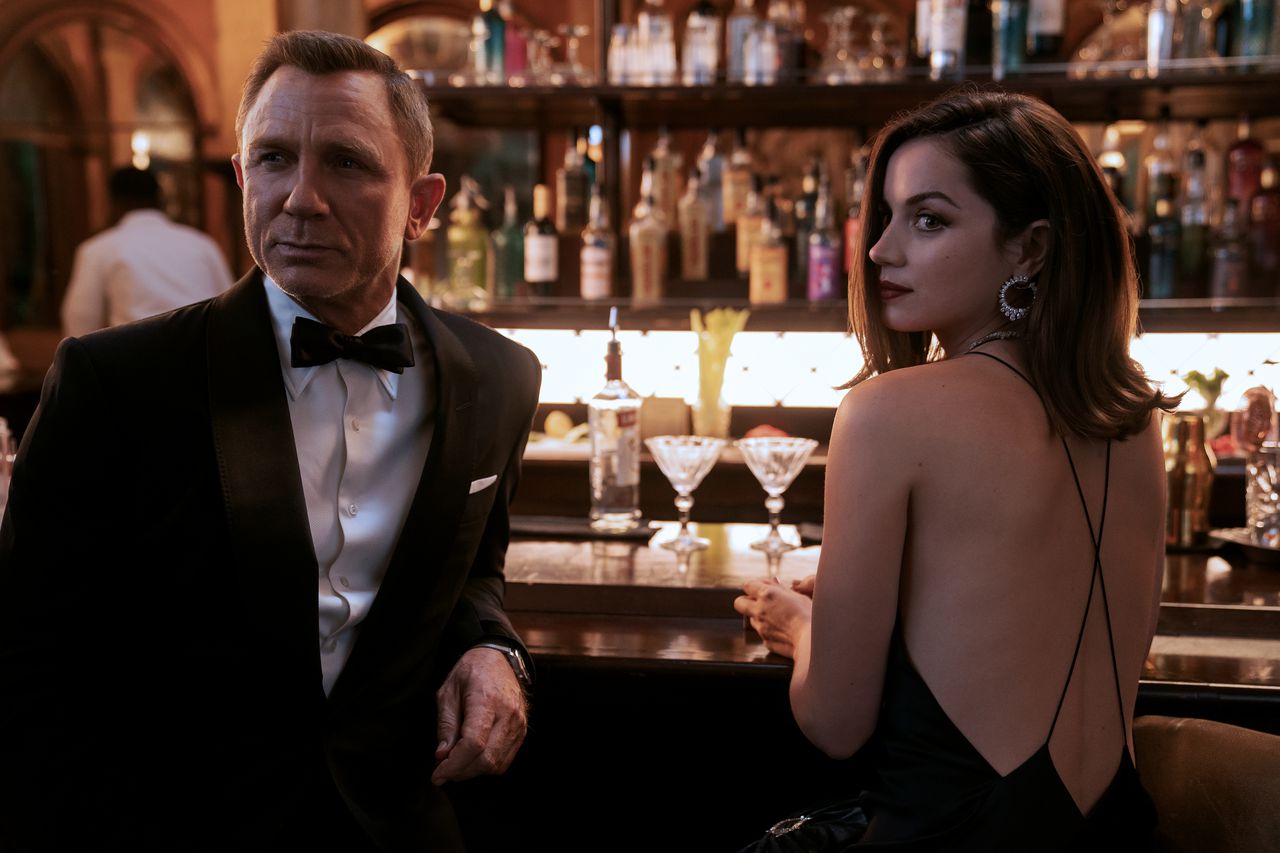

One wonders what Fleming would have made of this latest Bond film. Once you get past the big-budget trappings and the unfathomable gadgetry, I imagine Fleming would find something very familiar in Daniel Craig’s interpretation, globetrotting yet guarded, equal parts damaged and damaging. There’s so much in this film that works, thanks to the distinctive persona Craig has crafted for Bond. Once you have a character as solid as this one, the rest is a breeze, especially by the time the film makes its way to Cuba for an unforgettable sequence costarring the inimitable and infectiously fun Ana de Armas, late of Knives Out with Craig. Where she was timid and prone to fits of nausea as domestic worker Marta Cabrera, de Armas is a far cry from Knives Out here as Paloma, who winkingly exaggerates her naïveté while nervously downing a vodka martini. It’s almost criminal that she has only the one sequence, though one wonders if she too might recur down the road.

The unlikely star of the film – though perhaps not so unlikely, if you’ve been reading my blog for a while – is Hans Zimmer. After a forgettable title track by Billie Eilish, Zimmer runs away with the film, giving us a rousing score that had me stomping my feet with excitement. When he’s not winking at previous soundtracks, Zimmer is remixing and reinventing Monty Norman’s Bond theme with fearless aplomb. Thomas Newman did a fine job with Skyfall (though he revisited his own footsteps too closely with Spectre), yet throughout No Time to Die Zimmer makes a compelling case for the next Bond maestro. If Inception was a kind of proto-Bond for director Christopher Nolan, its Zimmer score was only the beginning; his love theme here is reminiscent of Inception’s showstopper “Time,” while his 007 action beats would be equally at home in Nolan’s ski lodge setpiece. David Arnold’s score for Casino Royale famously winked in the direction of Bond as we know him, and Zimmer takes us over the finish line with dexterity. 


It was a gamble to try to tell one story across five films, rather than tell more standalone stories about the world’s greatest spy. Before his untimely passing at 56, Fleming came to that concept late in his novel series, with his final three books forming a kind of “Blofeld trilogy.” No Time to Die is, finally, the successful culmination of that ambition, and it gives a suitable arc to these versions of Fleming’s characters. Whether it’s an ending or a transition may be for the casting directors to decide; let’s hope, however, that the MI6 crew – Ralph Fiennes, Ben Whishaw, and Naomie Harris – opt to stick around for that sense of internal continuity. Yet if you find yourself wondering, as the credits roll, what comes next – stick around. There’s no postcredits sequence, but there is one final guitar riff and the words “James Bond Will Return.” So too will I; after twenty months, it was fun to go to the theater once again and tell the coronavirus that now was no time to die.


No Time to Die is rated PG-13 for “sequences of violence and action, some disturbing images, brief strong language, and some suggestive material.” Directed by Cary Joji Fukunaga. Written by Neal Purvis, Robert Wade, Cary Joji Fukunaga, and Phoebe Waller-Bridge. Starring Daniel Craig, Rami Malek, Léa Seydoux, Lashana Lynch, Ben Whishaw, Naomie Harris, Jeffrey Wright, Christoph Waltz, and Ralph Fiennes.

Monday, January 28, 2019

Monday at the Movies - January 28, 2019

Welcome to another installment of “Monday at the Movies.” This week, two films wildly different in tone and yet unmistakably British in their sensibilities.

The Death of Stalin (2018) – Few people can make me laugh as hard as Armando Iannucci, he whose British series The Thick of It can’t be enjoyed on a single viewing because you’ll miss half the jokes while splitting your sides at its creative profanity and monumentally madcap antics. After Iannucci ravaged the mundanely moronic ("All roads lead to Munich") in the lead-up to the Iraq War in Thick of It’s spinoff film In the Loop, he turns his satirical eye to the Soviet Union in the wake of Josef Stalin’s death and finds the Communist Party in chaos, beginning with the puddle of urine in which the party leader’s corpse is found. The cast is as unpredictable as the punchlines – we now live, folks, in a world where Steve Buscemi plays Nikita Khrushchev (and yes, Virginia, there is a “bury you” joke). Meanwhile we’ve got Jeffrey Tambor as the melancholy Georgy Malenkov, ill-suited to the leadership role he inherits; noted Shakespearean Simon Russell Beale as the oily Lavrentiy Beria of the secret police; and Jason Isaacs as Georgy Zhukov, all too eager to lead his army into open revolt. It’s a cast of all-stars (including Rupert Friend and Andrea Riseborough as Stalin’s children), but the biggest draw is the film’s pitch-black humor, depicting Stalin’s worst atrocities as something akin to a Karl Marx Brothers film. There are moments when one is not quite sure whether to laugh or recoil in horror, as when an executioner just gives up halfway down his line of victims, but Iannucci is quite successful at capturing the ambient paranoia that comes from not knowing who to trust in a totalitarian regime – and the absurdity when a brood of vipers is forced to try to trust one another.

Paddington 2 (2017) – With the benefit of hindsight, Paddington 2 might well be one of the best films of 2017. A film like this has no right to be as charming, intricately constructed, or genuinely emotional as Paddington 2 manages to be. Now that the well-mannered Paddington (Ben Whishaw) has taken up residence in London, he goes in search of a birthday present for his Aunt Lucy, only to find the perfect pop-up book out of his price range. After a series of odd jobs, Paddington is framed for the theft of the book, landing unceremoniously in a Victorian-era prison where he befriends the entire population – including prison cook Knuckles McGinty (Brendan Gleeson) – through the powers of civility and marmalade. Paddington 2 is even better than its predecessor, somehow more earnest now that it’s dispensed with the need to explain how and why an affable bear is living with ordinary people. Instead the filmscape is opened up to boundless adventures where Paddington’s relentless cheeriness persists, undaunted by his circumstances. Whether he’s shoved into the role of accidental barber or whether he finds himself teaching a prison how to make orange jam, Paddington is so endearing that it’s almost a personal offense when something unfortunate befalls him; “how dare they,” I said aloud at one point, “how dare the filmmakers do this to such a nice bear!” For all the antics and charm that the film possesses – really, I cannot overstate just how charming this movie is – it has an astonishing emotional depth rooted in Paddington’s love for his Aunt Lucy, and the film’s final moments are guaranteed to get you teary-eyed in a way that I thought only Pixar had been able to capture with computer-generated characters.

That does it for this week’s edition of “Monday at the Movies.” Stay tuned for Wednesday’s final Batman animated review!

Monday, August 13, 2018

Monday at the Movies - August 13, 2018

Welcome to another installment of “Monday at the Movies.” This week, a pair of movies that are – shall we say – exceedingly British.

Paddington (2014) – Despite my reservations that the titular bear was neither as cute as the Peggy Fortnum illustrations nor voiced by Colin Firth, I found myself captivated by the shameless whimsy and defiant British-ness of Paddington. In the case of the former, the bear looks much better in motion than he does in still photos, charmingly expressive; on the matter of the latter, Ben Whishaw is a fine Paddington, imbuing this unique bear with a roguish innocence that never misses a giggle when he pulls a marmalade sandwich from under his hat. There is something striking about the way writer/director Paul King (no relation; himself helming his first movie, a remarkable moment) manages to capture the madcap logic of a children’s story, in which a renegade shower massage can flood a bathroom while a sinister taxidermist (Nicole Kidman, between proud mouthfuls of scenery) plots to stuff and mount a living creature for a surprisingly well-developed and narratively integrated reason. I was also impressed at how artfully developed many of the film’s gags proved to be; for instance, a mishap with a handheld vacuum cleaner establishes the strength of the device for a pivotal and deft setpiece late in the film. For a character as prominent and marketable as Paddington Bear, it would have been exceptionally easy to make a lazy film that cashes in on the character’s adorable reputation, but it was quite apparent that everyone involved on Paddington cared deeply about the character and his legacy, and it strikes me that they have done right by him.

Victoria and Abdul (2017) – Here’s a film that offers Judi Dench the chance to be alternatingly heartwarming and cantankerous for two hours while breathing life into one of Britain’s most prominent figures (returning to a role, incidentally, for which she was nominated for an Oscar in Mrs. Brown). If that’s not a recipe for a good time at a film, I haven’t found one, because Judi Dench is riveting in this “mostly” true story about Queen Victoria’s friendship with an Indian subject, Abdul Karim (Ali Fazal), who becomes a teacher (“munshi”) and a confidante in the regent’s final years. Victoria and Abdul is funnier but no less delightful than I anticipated, taking a wry postcolonial approach to the British Empire, acknowledging its dehumanizing aspects in a sobering scene with Abdul’s friend Mohammed (Adeel Akhtar) but also highlighting Victoria’s efforts to learn more about her subjects, even if her naiveté is somewhat charming (“This mango is off,” she repeats in one notable scene). The cast is rounded out by Tim Pigott-Smith, Michael Gambon, Paul Higgins, and Eddie Izzard, all of whom play their xenophobia rather broadly in a quintessentially British tongue-in-cheek interrogation of prejudice; it’s all Izzard can do not to twirl his mustache as Victoria’s eldest son, horrified that a lowborn subject has his mother’s ear in a way he never has. The film is irrevocably and undeniably Dench’s, though, equally enthralling while asleep at tea or while insisting that her faculties have never been sharper, in a single-take monologue that lays bare in equal measure her insecurities and accomplishments. It’s a powerhouse moment in a potent performance, a real shame that she was snubbed at last year’s Oscars.

That does it for this week’s edition of “Monday at the Movies.” We’ll see you next week!

Monday, November 16, 2015

Spectre (2015)

While Skyfall was for a lot of us the fulfilled promise of the Bond update kickstarted by Casino Royale, a kind of “And we’re back” (as Mark Kermode has, as always, so eloquently put it) Spectre is the second half of that sentence, a sort of “...and we’re here to stay.” To be fair Spectre isn’t the triumph that Skyfall was – recall Skyfall made #2 on my definitive ranking of every Bond film ever, though it’s too soon to rank Spectre. But it’s a worthy successor, a fine if occasionally too personal 24th installment.

After receiving an order from the late M, James Bond (Daniel Craig) follows a trail of criminals to the den of a mysterious figure (Christoph Waltz), heretofore presumed to be dead, and his organization known as SPECTRE. An encounter with an old friend leads Bond to Dr. Madeline Swann, who will help Bond and Q (Ben Whishaw) take down SPECTRE, while the new M (Ralph Fiennes) and his aide Miss Moneypenny (Naomie Harris) work against the surveillance project of rising bureaucrat Max Denbigh (Andrew Scott).

I’m going to go so far as to label Skyfall transcendent – breathtakingly beautiful and tightly narrated, with all the action you’d want from a Bond film without the foolish frivolity toward which the franchise is occasionally prone. It’s so good that I daresay Spectre never could have lived up to it, in the way that Thunderball could never have been as good as Goldfinger. Taken on its own merits, though, Spectre is good enough.

Starting with the pre-credits sequence, a staple of any Bond flick, Spectre doesn’t disappoint. In a long-take opening (whose CGI trickery takes away none of the punch of seeing Bond really do his stuff), director Sam Mendes takes us into the heart of a Day of the Dead celebration, cuing up the thematic content of the film with a lovely bit of eye candy in the form of Bond’s effortless heroics. Like Skyfall’s opener, it moves through a number of sub-setpieces rather quickly, lacking only a snide one-liner to cap it all off.

The rest of the film’s action is top-notch: a car chase through Rome, a fistfight on a train, a ski chase in which neither participant is actually skiing, and then two variations on the escape-from-the-compound trope. All of these play very well within the narrative, striking a great balance between the Bourne-inflected realism of the Craig era and the gentle absurdity we’ve seen in older films, but they’re played to delight, not to strain credulity. Indeed, they serve as nice reminders of what film we’re watching; just when the film starts to take itself too seriously, we’re treated to a nice bit of levity, like Bond surviving the collapse of a building by landing on a sofa.

There’s the rumor – an evergreen, really – that Spectre is Craig’s last outing as Bond. Much as we’ve heard that one before, Spectre does feel in a lot of ways like the end of an era. It pays off a lot of narrative threads from the last three films, including the most delightful amplification of the roles of M, Q, and Moneypenny. Largely absent from the early Craig films, this supporting cast gets a great opportunity to shine in their own subplot, from which Bond is largely absent but which manages to be as compelling as his conflict with Waltz’s villain. If it’s Craig’s swan song, I hope Fiennes, Whishaw, and Harris stick around – the MI6 gang are as interesting as they’ve ever been.

On Waltz: he’s every bit the scenery-nibbler we’d want out of a classic Bond villain, a fine successor to Javier Bardem’s Raoul Silva. There’s an intriguing way that Waltz unites both the campy classicism of the Connery era with a very contemporary sensibility vis-à-vis surveillance and anonymous terrorism. And if this is the last Craig film, it’s clear that the filmmakers are eager to tie it all up in a way that I don’t actually think was necessary. It doesn’t detract from the film, though it is a little distracting how overt this move is. There’s a beat where those who hadn’t recently seen Casino Royale might be a little dizzied by the reappearance of that film’s Mr. White, and there’s an unconvincing move to tie Skyfall into a larger narrative (when it works just as well, if not better, as a Goldfinger-esque standalone).

There’s what I would say is my biggest critique of Spectre (aside from a disappointing show by the film’s soundtrack, with a forgettable title track by Sam Smith and a score by Thomas Newman, who phones it in a little too much, borrowing heavily from Skyfall both in motifs and, in a few moments, in what sound like actual edits from earlier musical cues): the film tries a little too hard, a little too openly, to unite the previous films together. Maybe it’s just the tenor of the earlier films, where there were loose and insignificant attempts to hold the films together; where the Connery era had SPECTRE as a shadowy bogeyman whom, we assumed, Bond was always already fighting, Spectre attempts to make that unifying thread the stuff of revelation, of narrative twists, but there are ways to do that which don’t show the filmmakers’ hand so baldly. Additionally, we’ve been glad to see Daniel Craig as a more personal James Bond, in that his Bond takes things more personally – mourns the dead more willingly, pursues cases more intensely, and even hooks up with Moneypenny (finally!). He’s been a more personal Bond, but Spectre tries to move that more-personal quality out of the realm of subtext and into the arena of the actual plot, with Waltz’s Franz Oberhauser linked to Bond’s past. While this isn’t a bad move for the franchise (and I suspect the filmmakers have their eye on ways to continue this narrative thread), it comes off as largely unnecessary; the subtext was already there, and excavating it to the surface doesn’t actually do much more for the film.

Here’s the thing, though – it doesn’t take away from Spectre. The move toward the much more personal Bond isn’t hamfisted or sloppy; it’s just not essential for this viewer, but what we have is still quite entertaining. There are a number of frankly breathtaking action beats, fascinating developments in Craig’s Bond, who continues to be the most compelling Bond (even if Sean Connery is still a fan favorite), and moments of pure exuberance that remind you why Bond has endured for more than fifty years and twenty-five films (counting, as we ought, Never Say Never Again). It’s no Skyfall, but then what is?

Spectre is rated PG-13 for “intense sequences of action and violence, some disturbing images, sensuality and language.” There is the usual quantity of Bond heroics, including car chases, fist fights, and explosions. One character is facially disfigured in an unpleasant way, and Bond makes out with two separate women (the rest is left to implication). One or two S-words (no, Mr. Connery, not swords) are invoked.

Monday, November 19, 2012

Skyfall (2012)

One of my favorite narrative devices is Chekhov’s Gun – that plot element that is introduced solely because it’s going to pay off later.  If you see a gun, you know it’s going to be fired (or used in some other meaningful way).  Skyfall, the 23rd James Bond film, is littered with many such rewarding moments, leading me to label it “Chekhov’s Bond.”

And oh, is that a good thing.  Skyfall is one of the best Bond films in recent memory, even surpassing Casino Royale in several important ways.

After a brush with death in a fantastic pre-credits sequence, James Bond (Daniel Craig) is called back into active service when a series of intelligence attacks puts the life of M (Judi Dench) in danger.  It’s up to 007 to stop Raoul Silva (Javier Bardem) and find out just why he wants M dead – fortunately, Bond has the help of quartermaster “Q” (Ben Whishaw) and slinky secret agent Eve (Naomie Harris).

Since Daniel Craig was cast as the sixth (official) Bond, Skyfall is the film for which we’ve been waiting.  Sure, Casino Royale was breathtakingly realistic in its prequel treatment of the iconic superspy, but its plausibility lacked a certain Bond-iness.  No Q, no one-liners to speak of, and no martinis:  Skyfall restores all of these to the Bond mythos and, without spoiling anything, sets up an exciting fresh-but-familiar direction for the franchise. 

There is much about Skyfall that feels familiar.  There are nods to bygone Bonds – Goldfinger’s Aston Martin appears, the explosion at MI6 recalls The World Is Not Enough, and there’s a cryptic allusion to Jaws – but these feel organic rather than forced, acknowledging the long legacy of the series on this, its fiftieth anniversary (Dr. No debuted in 1962).  Yet these references are not what makes Skyfall such a return to form; rather, there’s a sense that this is, finally, a Bond movie and not a Bond prequel.  Silva is more a Bond villain than Le Chiffre or Dominic Greene, the return of Q’s gadgetry is unexpectedly welcome, and when Craig adjusts his cufflinks after a spectacular action sequence he brings to life a Bond worthy at last to stand beside Connery and Brosnan.

Craig isn’t the only one doing a marvelous job here.  Though Bond films haven’t always been renowned for their spot-on acting, Skyfall is filled with talented stars who are as compelling as anything this side of the Oscar season.  Craig maintains the gravitas established in the last two films but cuts loose enough to bring that Bond sense of humor to bear, wisecracking in the middle of an interrogation and punning his way through a final confrontation.  And Bardem is a suitably creepy foe, his blond locks and impeccable scheme distinguishing him from his “other” villainous role in No Country for Old Men.  Whishaw and Harris too are welcome additions to the series, with their roles set up for future appearances.

Let’s not forget Ralph Fiennes and Albert Finney, who play a government official and a helpful groundskeeper, respectively; they’re two reliable actors with long pedigrees, and they add that likely air of dignity they always bring.  But the “breakout” star of Skyfall is Judi Dench, in her seventh outing as M – “outing” being the operative word there, since she gets to step out of the office quite a bit, even more than she did as the hostage in The World Is Not Enough.  Dench gets plenty to do here, lending a hand in a few action sequences and layering emotional depth onto what has usually been a stuffy desk job.  While her talent comes as no surprise, we’re blessed that Skyfall takes full advantage of it.

Director Sam Mendes was perhaps an unlikely choice to helm a Bond film, known more for his introspective American Beauty than anything else.  He brings that same interiority to bear on Skyfall, but he does it without sacrificing any of the big-budget spectacle we’ve come to expect from 007.  Two separate train sequences, a great chase scene in the middle of London’s busiest tube station, and a thrilling shoot-out in a decaying British manor – Skyfall has enough major action pieces to tick off the boxes and more.  Mendes is surprisingly deft with these, controlling our perspective without resorting to any shaky-cam shenanigans.  These are smart, stable action sequences, reminding me once more how much I’d like a Christopher Nolan Bond movie (but then that’s me getting distracted).

Skyfall loses none of the Craig era’s approach toward relevance; Silva’s plot recalls Wikileaks and the worst of chickens coming home to roost, while M’s response is a reminder of how much the world has changed in the last decade (a wry wink, perhaps, to the satellite laser of death from 2002’s Die Another Day).  But Skyfall also emphasizes how much Bond still matters; there’s a very interesting comparison to be made here with The Dark Knight Rises, in that both took their heroes back to Square One to remind them that their true strength lies in their beginnings. 

With a return to form to match Bond’s revisiting of his roots, Skyfall is a great reminder that the sky (at least, post-Quantum of Solace) isn’t falling – rather, it’s the limit.  Whenever we see “Bond 24,” it’s already primed for greatness.


Skyfall is rated PG-13 “for intense violent sequences throughout, some sexuality, language and smoking.”  It being a Bond film, there are many action sequences, plenty of gunfire, and bloody consequences thereof.  Bond also seduces several women, though no nudity is seen.  An F-bomb, a few cigarettes, and several cocktails (including that famous martini) are included, as well.  Ultimately, Skyfall is no less appropriate than any other Bond film.

Stay tuned for Wednesday’s review of Steven Spielberg’s Lincoln, followed by a Thanksgiving surprise!  (P.S. – I’m aware this is the first Bond Film reviewed on this site – don’t worry, that’s an oversight that will be corrected before long...)