Showing posts with label James Bond. Show all posts

Monday, October 11, 2021

No Time to Die (2021)

It’s hard to believe it’s been twenty months since I set foot in a movie theater. It’s perhaps harder to accept that it wasn’t a superhero movie that brought me back to the box office – though two, Black Widow and Shang-Chi, have been released since my last outing with Birds of Prey in February 2020. I hadn’t missed a Marvel movie until this year, yet nor had I missed a James Bond vehicle starring Daniel Craig. Fifteen years and five films after Casino Royale, I had to see this supposed swan song in all its IMAX glory.

It isn’t Craig’s best – that honor still and forever goes to Skyfall, as perfect a Bond movie as you can get – but No Time to Die is a fitting conclusion to this iteration of the character, thematically consistent and perhaps the most Fleming-esque of the Craig era.


Five years after defeating the forces of Spectre, James Bond (Daniel Craig) is called back into the fight after Lyutsifer Safin (Rami Malek) kidnaps a defecting scientist (David Dencik) and his powerful bioweapon. The chase for Safin finds Bond crossing paths with his old friend Felix Leiter (Jeffrey Wright), a new 00-agent (Lashana Lynch), and his old love Madeleine Swann (Léa Seydoux) before the trail leads back, as it always does, to Ernst Stavro Blofeld (Christoph Waltz).


As much as the Craig-era Bond films have struggled to fit all its disparate parts into one unified narrative – we all remember how Spectre tried unsuccessfully to weave its antecedents together – the films have been at their best when considering the psychological toll that Bond’s life is taking on the man. Casino Royale intimated that Bond’s callous womanizing stemmed from a deep personal trauma, while Skyfall showed us that happened when Bond’s closest relationship (with Judi Dench’s M) got too close. No Time to Die picks up on the unlikely ending of Spectre, in which Bond ostensibly rode off into the sunset with Madeleine Swann, but it wisely reminds us that Bond has been down this road before, in more films than just Casino Royale. There are numerous nods, for example, to (and this may be a very light spoiler) On Her Majesty’s Secret Service, which for many is the gold standard for Bond. (Appropriately enough, it was #007 when I ranked the films in 2014.)


But No Time to Die is conscious of its place as a finale of sorts, and so we get reunions with Felix Leiter from Casino Royale and Quantum of Solace, and with the Blofeld of Spectre; there’s even a wink-nod at Skyfall with a portrait of Judi Dench and a well-timed cameo from her porcelain bulldog. These references tie Craig’s tenure together more authentically than Spectre’s stubborn insistence that it was all connected, but the true payoff is in Craig’s Bond getting a better understanding of himself. He’s cognizant of his own flaws, sensitive to his blind spots, and determined all the same to save the world as only he can. When one character asks him if he knows the worst thing about himself, he quips, “My timing?” He’s become self-aware and, in the process, self-realized. Having taken Bond from his roots to his ultimate self, it’s only fair that Craig calls it a day and leaves the character for the next – and, perhaps not insignificantly, seventh – incarnation.


No Time to Die is, then, a kind of grand tour through the Craig era, but it has its eye on a more distant past, going back to Connery’s 1962 debut and to the Ian Fleming novels of that era. Safin is not, as the rumor mill had hoped, secretly Doctor No in disguise, though his island lair may as well be the good doctor’s; with its hazmat-suited servants, nuclear generators, and vaulted ceilings, one half-expects Joseph Wiseman to saunter out in his Nehru jacket. Meanwhile, the lair’s retractable bay doors are straight out of the film version of You Only Live Twice, while the denouement and a certain Jack London epigraph are airlifted from the novel of the same name. The 1967 film, scripted by Roald Dahl, was somewhat less than faithful to Fleming’s 1964 original, which saw Bond stalking Blofeld in a poison garden; here, it’s Safin who becomes the lethal horticulturalist, while Bond has no Tracy to avenge but comes bearing equally personal motivations. Indeed, I came out of No Time to Die – as I often do when a new Bond film arrives – finding myself lunging for the Ian Fleming novels on my bookshelf. 
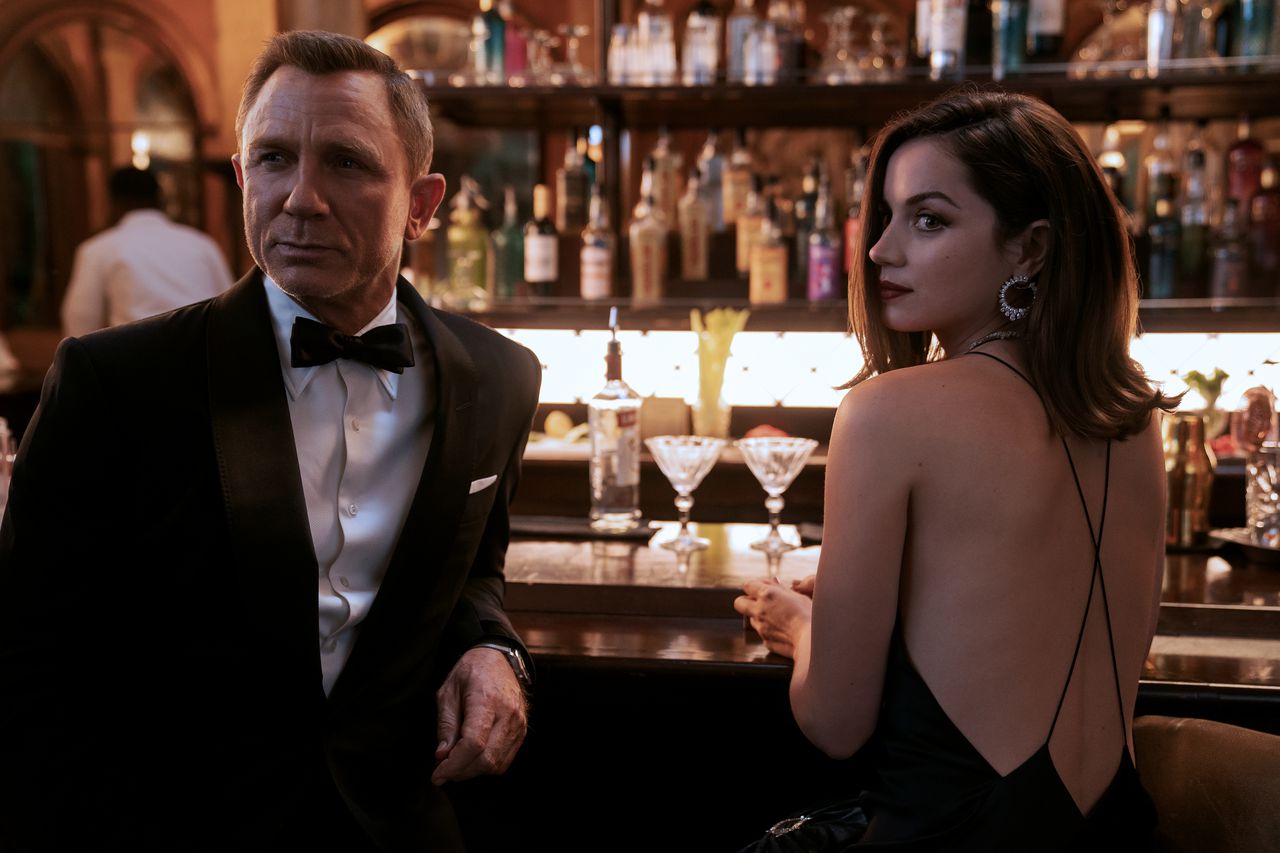

One wonders what Fleming would have made of this latest Bond film. Once you get past the big-budget trappings and the unfathomable gadgetry, I imagine Fleming would find something very familiar in Daniel Craig’s interpretation, globetrotting yet guarded, equal parts damaged and damaging. There’s so much in this film that works, thanks to the distinctive persona Craig has crafted for Bond. Once you have a character as solid as this one, the rest is a breeze, especially by the time the film makes its way to Cuba for an unforgettable sequence costarring the inimitable and infectiously fun Ana de Armas, late of Knives Out with Craig. Where she was timid and prone to fits of nausea as domestic worker Marta Cabrera, de Armas is a far cry from Knives Out here as Paloma, who winkingly exaggerates her naïveté while nervously downing a vodka martini. It’s almost criminal that she has only the one sequence, though one wonders if she too might recur down the road.

The unlikely star of the film – though perhaps not so unlikely, if you’ve been reading my blog for a while – is Hans Zimmer. After a forgettable title track by Billie Eilish, Zimmer runs away with the film, giving us a rousing score that had me stomping my feet with excitement. When he’s not winking at previous soundtracks, Zimmer is remixing and reinventing Monty Norman’s Bond theme with fearless aplomb. Thomas Newman did a fine job with Skyfall (though he revisited his own footsteps too closely with Spectre), yet throughout No Time to Die Zimmer makes a compelling case for the next Bond maestro. If Inception was a kind of proto-Bond for director Christopher Nolan, its Zimmer score was only the beginning; his love theme here is reminiscent of Inception’s showstopper “Time,” while his 007 action beats would be equally at home in Nolan’s ski lodge setpiece. David Arnold’s score for Casino Royale famously winked in the direction of Bond as we know him, and Zimmer takes us over the finish line with dexterity. 


It was a gamble to try to tell one story across five films, rather than tell more standalone stories about the world’s greatest spy. Before his untimely passing at 56, Fleming came to that concept late in his novel series, with his final three books forming a kind of “Blofeld trilogy.” No Time to Die is, finally, the successful culmination of that ambition, and it gives a suitable arc to these versions of Fleming’s characters. Whether it’s an ending or a transition may be for the casting directors to decide; let’s hope, however, that the MI6 crew – Ralph Fiennes, Ben Whishaw, and Naomie Harris – opt to stick around for that sense of internal continuity. Yet if you find yourself wondering, as the credits roll, what comes next – stick around. There’s no postcredits sequence, but there is one final guitar riff and the words “James Bond Will Return.” So too will I; after twenty months, it was fun to go to the theater once again and tell the coronavirus that now was no time to die.


No Time to Die is rated PG-13 for “sequences of violence and action, some disturbing images, brief strong language, and some suggestive material.” Directed by Cary Joji Fukunaga. Written by Neal Purvis, Robert Wade, Cary Joji Fukunaga, and Phoebe Waller-Bridge. Starring Daniel Craig, Rami Malek, Léa Seydoux, Lashana Lynch, Ben Whishaw, Naomie Harris, Jeffrey Wright, Christoph Waltz, and Ralph Fiennes.

Monday, November 16, 2015

Spectre (2015)

While Skyfall was for a lot of us the fulfilled promise of the Bond update kickstarted by Casino Royale, a kind of “And we’re back” (as Mark Kermode has, as always, so eloquently put it) Spectre is the second half of that sentence, a sort of “...and we’re here to stay.” To be fair Spectre isn’t the triumph that Skyfall was – recall Skyfall made #2 on my definitive ranking of every Bond film ever, though it’s too soon to rank Spectre. But it’s a worthy successor, a fine if occasionally too personal 24th installment.

After receiving an order from the late M, James Bond (Daniel Craig) follows a trail of criminals to the den of a mysterious figure (Christoph Waltz), heretofore presumed to be dead, and his organization known as SPECTRE. An encounter with an old friend leads Bond to Dr. Madeline Swann, who will help Bond and Q (Ben Whishaw) take down SPECTRE, while the new M (Ralph Fiennes) and his aide Miss Moneypenny (Naomie Harris) work against the surveillance project of rising bureaucrat Max Denbigh (Andrew Scott).

I’m going to go so far as to label Skyfall transcendent – breathtakingly beautiful and tightly narrated, with all the action you’d want from a Bond film without the foolish frivolity toward which the franchise is occasionally prone. It’s so good that I daresay Spectre never could have lived up to it, in the way that Thunderball could never have been as good as Goldfinger. Taken on its own merits, though, Spectre is good enough.

Starting with the pre-credits sequence, a staple of any Bond flick, Spectre doesn’t disappoint. In a long-take opening (whose CGI trickery takes away none of the punch of seeing Bond really do his stuff), director Sam Mendes takes us into the heart of a Day of the Dead celebration, cuing up the thematic content of the film with a lovely bit of eye candy in the form of Bond’s effortless heroics. Like Skyfall’s opener, it moves through a number of sub-setpieces rather quickly, lacking only a snide one-liner to cap it all off.

The rest of the film’s action is top-notch: a car chase through Rome, a fistfight on a train, a ski chase in which neither participant is actually skiing, and then two variations on the escape-from-the-compound trope. All of these play very well within the narrative, striking a great balance between the Bourne-inflected realism of the Craig era and the gentle absurdity we’ve seen in older films, but they’re played to delight, not to strain credulity. Indeed, they serve as nice reminders of what film we’re watching; just when the film starts to take itself too seriously, we’re treated to a nice bit of levity, like Bond surviving the collapse of a building by landing on a sofa.

There’s the rumor – an evergreen, really – that Spectre is Craig’s last outing as Bond. Much as we’ve heard that one before, Spectre does feel in a lot of ways like the end of an era. It pays off a lot of narrative threads from the last three films, including the most delightful amplification of the roles of M, Q, and Moneypenny. Largely absent from the early Craig films, this supporting cast gets a great opportunity to shine in their own subplot, from which Bond is largely absent but which manages to be as compelling as his conflict with Waltz’s villain. If it’s Craig’s swan song, I hope Fiennes, Whishaw, and Harris stick around – the MI6 gang are as interesting as they’ve ever been.

On Waltz: he’s every bit the scenery-nibbler we’d want out of a classic Bond villain, a fine successor to Javier Bardem’s Raoul Silva. There’s an intriguing way that Waltz unites both the campy classicism of the Connery era with a very contemporary sensibility vis-à-vis surveillance and anonymous terrorism. And if this is the last Craig film, it’s clear that the filmmakers are eager to tie it all up in a way that I don’t actually think was necessary. It doesn’t detract from the film, though it is a little distracting how overt this move is. There’s a beat where those who hadn’t recently seen Casino Royale might be a little dizzied by the reappearance of that film’s Mr. White, and there’s an unconvincing move to tie Skyfall into a larger narrative (when it works just as well, if not better, as a Goldfinger-esque standalone).

There’s what I would say is my biggest critique of Spectre (aside from a disappointing show by the film’s soundtrack, with a forgettable title track by Sam Smith and a score by Thomas Newman, who phones it in a little too much, borrowing heavily from Skyfall both in motifs and, in a few moments, in what sound like actual edits from earlier musical cues): the film tries a little too hard, a little too openly, to unite the previous films together. Maybe it’s just the tenor of the earlier films, where there were loose and insignificant attempts to hold the films together; where the Connery era had SPECTRE as a shadowy bogeyman whom, we assumed, Bond was always already fighting, Spectre attempts to make that unifying thread the stuff of revelation, of narrative twists, but there are ways to do that which don’t show the filmmakers’ hand so baldly. Additionally, we’ve been glad to see Daniel Craig as a more personal James Bond, in that his Bond takes things more personally – mourns the dead more willingly, pursues cases more intensely, and even hooks up with Moneypenny (finally!). He’s been a more personal Bond, but Spectre tries to move that more-personal quality out of the realm of subtext and into the arena of the actual plot, with Waltz’s Franz Oberhauser linked to Bond’s past. While this isn’t a bad move for the franchise (and I suspect the filmmakers have their eye on ways to continue this narrative thread), it comes off as largely unnecessary; the subtext was already there, and excavating it to the surface doesn’t actually do much more for the film.

Here’s the thing, though – it doesn’t take away from Spectre. The move toward the much more personal Bond isn’t hamfisted or sloppy; it’s just not essential for this viewer, but what we have is still quite entertaining. There are a number of frankly breathtaking action beats, fascinating developments in Craig’s Bond, who continues to be the most compelling Bond (even if Sean Connery is still a fan favorite), and moments of pure exuberance that remind you why Bond has endured for more than fifty years and twenty-five films (counting, as we ought, Never Say Never Again). It’s no Skyfall, but then what is?

Spectre is rated PG-13 for “intense sequences of action and violence, some disturbing images, sensuality and language.” There is the usual quantity of Bond heroics, including car chases, fist fights, and explosions. One character is facially disfigured in an unpleasant way, and Bond makes out with two separate women (the rest is left to implication). One or two S-words (no, Mr. Connery, not swords) are invoked.

Sunday, December 7, 2014

The James Bond Countdown

Welcome back to the ostensible finale of the two-year Double-Oh-Seventh celebration of the James Bond franchise.

What a time for it, too, with Thursday’s announcement that “Bond 24” will be entitled Spectre (release date October 23, 2015 – so expect our review on October 26).  The title has such delightfully ominous associations in the world of 007.  The official plot synopsis:

A cryptic message from Bond’s past sends him on a trail to uncover a sinister organisation. While M battles political forces to keep the secret service alive, Bond peels back the layers of deceit to reveal the terrible truth behind SPECTRE.

With Lea Seydoux and Monica Bellucci as the Bond girls, Ralph Fiennes and Ben Whishaw returning as M and Q, and Christoph Waltz and Andrew Scott rumored to be playing the villains, perhaps the most exciting news is that Sam Mendes is back after a franchise high-point with Skyfall.  It seems like he’ll be picking up on plot points from the Craig era – secret organizations, political pressure against MI6, further exploration of Bond’s heretofore unseen past.  All good news, especially for someone who loved Skyfall the way I did.

But just how much did I love Skyfall?  At the end of two years’ worth of reviews, what do I make of the entire James Bond film series?   You’ve come to the right place; after the jump, you can read my James Bond Countdown, ranking all twenty-four 007 movies.


Friday, November 7, 2014

Quantum of Solace (2008)

I don’t want to be “that guy,” someone who extrapolates a grandiose criticism from a very nitpicky observation, but Quantum of Solace is the only Bond film that doesn’t begin with the gun barrel sequence, which should be an immediate red flag that what we’re about to see is either not a Bond film or one that exists in a rough unfinished state, missing a few key components.  Obviously, Quantum of Solace is a case of the latter – an unfinished product with a puzzler for a plot and an apparent attempt to refuse to be the James Bond movie Casino Royale promised.

While pursuing the secret organization who killed his lover, James Bond (Daniel Craig) discovers that one of its members, Dominic Greene (Mathieu Amalric), is conspiring with a South American despot to stage a coup and dominate a key world resource.  Bond works to prevent this conspiracy, avenge his lover, and help Camille Montes (Olga Kurylenko) find her own peace – all while M (Judi Dench) struggles to contain an increasingly renegade Bond.

First of all, the plot of Quantum of Solace is exceptionally thin; Bond encounters the main plot only by coincidence, and he’s only following suspicion of wrongdoing for the bulk of the film.  I much prefer either the classic “mission briefing” mode of storytelling for Bond, or the slowly unraveling grand conspiracy.  Quantum is neither, a mingle-mangle of setpieces that almost feel as though they’re out of order (Bond flies to the desert to uncover Greene’s plot, goes back to the city to not confront Greene, then travels back to the desert).

In a Bond film, those setpieces can be everything, with great action sequences even partially redeeming a bad Bond film.  For me, that’s honestly what sets Quantum of Solace a notch below Die Another Day – Die Another Day had that memorable duel sequence, a half-chase through a Cuban clinic, and an outlandish but still fun hovercraft fight.  Quantum’s action pieces begin promisingly enough, with a great car chase through Siena, but it quickly becomes apparent that director Marc Forster is not as deft with directing action as Martin Campbell was on Casino Royale.  Often Forster will cut away from the action at its most interesting, as when a plane stunt occurs largely behind a mountain.  It’s artistic editing that reminds us how good Forster was in Stranger Than Fiction but how out-of-place he seems in a big-budget franchise.

The willful cutting of the camera’s gaze away from the action is just one of the places where Quantum stubbornly refuses to be a Bond film, completely missing the memo from Casino Royale.  In Casino Royale, Martin Campbell and the crew showed us how to update Bond while staying true to the (let’s be honest here) formula of the franchise – disfigured villain, suave (super)hero, sultry siren with a curious name, big-stakes plot.  Casino Royale added in “psychological realism,” shook it up (never stirred), and turned out an invigorating fresh approach to Bond.  Quantum seems to have taken the lesson as “be as un-Bond as possible.”  Dominic Greene isn’t disfigured beyond his small stature, which is probably meant as a comment on the banality of evil, but it doesn’t work when the script asks him to become a physical threat to Bond.  Gemma Arterton’s turn as Agent Fields feels like a bad gag when she refuses to tell Bond her first name, which the credits reveal is “Strawberry” – it’s a wonderful gag with a wink toward outlandish predecessors like Pussy Galore and Xenia Onatopp, but the movie dangles it in front of us like a cat toy on a string.

The best material in Quantum, it seems, is elsewhere – off camera, in the credits, or nestled in the viewer’s imagination.  The saddest thing about the film is its unlived potential, glimmers of what the follow-up to Casino Royale should have been; there are disparate plot threads involving a Bond driven mad by revenge, Felix Leiter’s attempt to work against a corrupt CIA, M’s begrudging willingness to trust Bond, and the parallels between Bond and Camille’s quest for vengeance – but these are presented in mere outline form, painted with the broadest of strokes.  Any one of these could have made a compelling backbone to the second in a new era of James Bond, but crumpled together as they are, the whole ends up being so much less than the sum of its parts.

Let’s be fair – Quantum of Solace was damaged by the 2007-2008 Writers’ Strike.  Forster and Craig are on record as saying that they personally tuned up the screenplay between takes, and that almost certainly accounts for the lack of cohesion or semblance of narrative structure.  Essentially, it’s like taking a blacksmith to task for not being a computer engineer – to which I have to respond, however, that it would have been better to wait for Steve Jobs.  Quantum would have benefited immeasurably from a professional writer’s eye, and I would rather have waited for a true successor to Casino Royale.  What we get instead is a Godfather III, more epilogue than proper sequel.

Quantum of Solace fortunately ends with one of its best sequences, in which Bond finally confronts the double agent responsible for his lover’s death and (minor spoilers) steadfastly refuses to kill him.  He and M have a semi-touching conversation about revenge before she asks him to return to the agency.  “I never left,” he answers, trudging away alone in the snowfall.  If Casino Royale ended with the promise that James Bond truly was back, Quantum of Solace at least accounts for its own missteps in this moment by reassuring us that Bond hasn’t gone anywhere and is perhaps finally ready to inherit the mantle suggested by Casino Royale.

Of course, we know that’s what ended up happening.  Consider Quantum a speedbump on the road to Skyfall.

Quantum of Solace is rated PG-13 for “intense sequences of violence and action, and some sexual content.”  The violence isn’t quite bloody, but especially in the last sequence you can really feel some of the more visceral bits.  It’s not as intense as Casino Royale, though.  Aside from one brief encounter, Bond doesn’t sleep with the Bond girl, and any other sexual encounters are only mentioned, not shown, though there is an attempted sexual assault.

We’ve reached the end of a two-year journey through the Bond canon, but don’t hang up your tuxedos just yet – James Bond and The Cinema King will return with a special bonus feature on December 7, 2014!  (And you don’t have to wait until then to read a review of Skyfall – we did that ages ago.)

Tuesday, October 7, 2014

Casino Royale (2006)

After Die Another Day nearly killed the franchise with excess, Casino Royale is exactly the course correction audiences needed, expected, and desired from James Bond.  Perhaps the greatest thing about Casino Royale is how it desperately wants the audience’s faith in the franchise, coupled with how brilliantly the film achieves that goal.

Casino Royale reboots the franchise to the early days of James Bond (Daniel Craig), newly minted as Agent 007 in the 00 division of MI6.  In the wake of his pursuit of a small-time bombmaker, Bond follows the trail of clues to the Bahamas, then Montenegro, where he is enlisted in a high-stakes poker game against terrorist financier Le Chiffre (Mads Mikkelsen).  Armed with $15 million courtesy of treasury agent Vesper Lynd (Eva Green), Bond must bankrupt Le Chiffre, an expert poker player who already knows Bond is coming for him.

From the black-and-white precredits sequence, which almost makes one wish the whole film had been shot monochromatically, what is immediately striking is just how visceral Casino Royale is.  Doubtless this is the casualty of living in the shadow of The Bourne Identity (released the same year as Die Another Day), which is widely credited with injecting a healthy dose of gritty realism into the spy film genre, but Casino Royale never seems like it’s aping someone else’s act; rather, the film succeeds by adapting the lessons in realism from Bourne into the preexisting template of what a Bond film should be.

That lesson is to step away from all the theatricality of the Bond films because they often made the character a pawn in a larger-than-life aesthetic catastrophe.  Take Moonraker, which tried to up the scales by sending Bond to outer space but succeeding only in escaping the gravitational pull of being watchable.  Consider the other space laser in the Bond canon, Die Another Day, a frigid mess unwilling to commit to tonal consistency.  No, it’s impossible not to hear the voice of director Martin Campbell, who had helmed Goldeneye to great success, shouting at the previous films, “Look what you’ve done to the place!”  You can’t tell me that it’s an accident that Campbell was summoned back to right the ship, because as before he excels at exactly this sort of thing.

Once more, Campbell is asked to introduce us to a new Bond, Daniel Craig.  Dubbed “James Blond” by viewers focusing on entirely the wrong aspect of his performance, Craig brings an icy exterior to Bond, his sense of humor coming less from a place of self-confidence and more from a Dalton-esque disdain for his enemies.  Where Connery and Moore delivered the one-liners with a wink and a slight smirk, Craig manages to be deadly serious about being clever, something that really comes out in subsequent viewings beyond the initial shock of thinking he’s not very funny.  We have to remember that this is an early Bond, a prequel reboot (a preboot?), and Craig does a first-rate job of giving us glimmers of the Bond we expect to see while layering in psychological nuance.

Something we’ll really see developed in the Craig era is the relationship between Bond and M.  Judi Dench is held over from the Brosnan films, and thank God for that because she’s bloody brilliant.  From her very first scene in Casino Royale, which finds her refusing to let her assistant get a word in edgewise, Dench is inspired casting, continuing her force-of-nature portrayal of the head of MI6.  Her relationship with Bond is especially compelling, not quite maternal but oddly affectionate nonetheless.  M is clearly confident in the abilities of her newly-promoted protégé, initially without cause, and this faith in Bond is much more engaging than the steely nature of the male Ms before her.  I’ll never complain any time Judi Dench shows up anywhere, and the apparent continuity contradiction of her presence shouldn’t bother anyone in the slightest because her M is a fantastic addition to the Bond canon.  (If it truly distresses you, just imagine that “James Bond” is a codename and not a real name.  It’ll also explain why a secret agent is so flippant about using his real name.)

I could take a few paragraphs to say effusive things about Mikkelsen and Green, but the thrust of it is that they fit perfectly with the more grounded ethos of Casino Royale and their performances are delightful updates on the “Bond baddie” and “Bond girl” (respectively).  What I’m more struck by, though, is how effective a director Campbell is, measurable by his dexterity with purely visual language.  There are many sequences that proceed without dialogue, yet the film communicates it all deftly.  We don’t need to be told, for example, that Bond is putting on a façade each time he plays it cool, because Campbell gets a hell of a performance out of Craig.  The brief moments of running commentary during the poker games feel slightly abrasive because the film works so strongly with the visual, even for someone who knows little about card games.  The action sequences – which, incidentally, are stellar – bear the mark of solid direction, both for remaining exciting and for slickly refusing to call attention to themselves.  Bond’s chase-parkour-siege sequence early in the film never flounders, and it’s to Campbell’s credit that he stages a stairwell fistfight with as much dexterous grace as Bond’s attempt to discern Le Chiffre’s ‘tell.’

If I have a complaint about Casino Royale, it’s that it ends twice when the first conclusion would have sufficed.  But the second ending does set up a vital piece of Bond’s character – his detached womanizing – and gives us the dynamite last shot in which 007 finally delivers the one line you’ve been waiting the whole time.  Once those five words get spoken and the film cuts to black with the musical sting you’ve also been anticipating (I won’t spoil either, but true believers know which ones I mean), I can’t imagine anyone not feeling a strong chill of accomplishment up the spine with an awed murmur of “And we’re back.”  “James Bond will return,” the credits promise in that noble tradition, but Casino Royale has demonstrated that Bond has already returned.  And we’re back.

Casino Royale is rated PG-13 for “intense sequences of violent action, a scene of torture, sexual content and nudity.”  While the violence isn’t pervasive, it is quite intense when it happens; the fight scenes are very well choreographed, and they feel very visceral, including a scene in which a nude Bond (nothing is shown) is assaulted with a carpet beater.  Bond has romantic encounters with two women who don’t show anything more than their neckline.

James Bond and The Cinema King will return in a review of Quantum of Solace (2008) on November 7, 2014!

Sunday, September 7, 2014

Die Another Day (2002)

After forty years and half as many movies, the James Bond franchise has legs like few others (Godzilla comes to mind for longevity), and on the surface Die Another Day pays homage to a lot of great moments from the long history of the series.  The film itself, however, is the epitome of a trainwreck:  it starts strong and quickly derails, all the while remaining a ruin away from which you can’t tear your eyes.

After months of torture in a North Korean prison camp, James Bond (Pierce Brosnan) is released in a hostage trade orchestrated by M (Judi Dench) to root out a British conspirator.  Bond pursues Korean terrorist Zao (Rick Yune) to Cuba, where he learns that American spy Jinx Johnson (Halle Berry) is also on the case.  Together, the two follow the trail to British diamond baron Gustav Graves (Toby Stephens) and his orbital laser satellite.

From that plot synopsis, you already have a sense of the biggest problem with Die Another Day – its staggering unevenness.  The film sprints from setpiece to setpiece with little connective tissue between scenes other than someone coming in and expositing to Bond, “This is where you need to go next.”  The more dangerous message of these weak transitions is the intimation that Bond is rusty and doesn’t know his way around a secret mission anymore.  Consequently, the inorganic quality of the plot results in a film that is neither a triumph nor a catastrophe.  There are moments when Die Another Day is quite entertaining, but the moments when it isn’t prevent the whole from coalescing into a fulfilling moviegoing experience.

Case in point – at about the midpoint of the film, there’s a fantastic fencing match between Bond and Graves.  It’s energetic, fantastically choreographed and directed, and essential in developing the personalities of the two men.  The stuntwork is quite excellent, and the scene positively crackles.  Like any good setpiece, it’s easily divorced from the larger narrative, enjoyable on its own merits, but everything surrounding the duel is incomprehensibly disconnected; it’s anyone’s guess why the two men duel in the first place, nor does it make much sense for Graves to invite Bond to his secret lair after the duel.

And when the whole film proceeds in such a way, it’s just exhausting.  The fundamental flaw of the film is that in nearly every aspect of the narrative, Die Another Day is unable to commit to one direction.  In the character of Jinx, the filmmakers have an opportunity to give Bond an equal number, a female American agent every bit as skilled as he is; instead, Jinx is as often (if not more frequently) a damsel in distress.  Halle Berry is very good in the role, equally smart and sexy, but the role itself is somewhat thin.  After one particularly great fight sequence in the bowels of a plummeting airplane, Jinx dispatches her adversary and then quite literally sits down and waits for Bond to save her.

The Jinx of the first half of the film would never have done that, but it seems that halfway through Die Another Day everything in the film goes topsy-turvy and stops making sense.  The film’s opener, with hovercrafts and silly puns, is ludicrous enough but remains safely within the loose realism of the Bond films.  Once we get into the second half, with space lasers and ice palaces, the film surrenders entirely to poor CGI effects and absurd gadgetry far beyond what the boundaries of credulity can accommodate.  As if the invisible car weren’t preposterous enough, the film sees Bond surfing multiple times, and in the film’s climax Gustav Graves dons an electrified suit of armor for no apparent reason whatsoever; there’s a gag about making his suitcase device more ergonomic, but you won’t find this gizmo in an IKEA near you. 

It’s a real shame that Die Another Day goes so far off the rails, not only because it’s Brosnan’s final outing as 007, though it is tragic that the promise of Goldeneye was never fully met during Brosnan’s tenure.  The presence of story beats that actually work well – the motivation of the villain to live up to his father, the traitor within MI6 as an update on the classic henchman trope, and M’s unwavering faith in Bond – each make the film that much more excruciating because there are glimpses of a Bond film that could have been.  Instead, we get a movie with more explosions in the opening sequence than any other entire Bond film, turning up the volume instead of the intellect.

Perhaps the worst aesthetic offense is the moment when M tells Bond, “While you were gone, the world changed,” suggesting a post-9/11 self-awareness and a recognition of the new state of geopolitics.  Unfortunately, though, the film never really engages with that idea.  While positing a new paradigm for Bond, the film goes for broke in the direction of the worst excesses of the franchise; the space laser recalls Moonraker, while the hyper-technology seems like an unironic version of the exploding pen Never Say Never Again pulled off with a knowing wink.  With all the other callbacks to earlier films – Jinx’s bikinied exit from the ocean a la Dr. No, the Union Jack parachute ripped from The Spy Who Loved Me, and even more overt allusions like the Thunderball jetpack’s cameo, among others – the fortieth anniversary of the film franchise seems to attempt to argue implicitly that Bond doesn’t need to change.  The end result, however, tells an entirely different story; this is a Bond in desperate need of a new wind of change (so long as he doesn’t attempt to surf on it).

Die Another Day is rated PG-13 for “action violence and sexuality.”  There’s a quick flash of blood in one scene of impalement and an occasional slash during a duel sequence; other characters die with no blood visible, while the film shows glimpses of Bond being tortured in North Korea.  As noted above, nearly everything explodes in this film.  Bond sleeps with two women (a low number for him), but all we see are bare backs.

James Bond and The Cinema King will return in a review of Casino Royale (2006) on October 7, 2014!

Thursday, August 7, 2014

The World Is Not Enough (1999)

For those who play the role long enough, there’s a Rule of Three for Bond actors, suggesting that the performer’s third outing is his best.  Sean Connery’s got a perfect film in Goldfinger, Roger Moore has The Spy Who Loved Me, and Daniel Craig has the knockout Skyfall.  We’re at Pierce Brosnan’s third with The World Is Not Enough, which turns out to be the exception to the Rule of Three.  It is far and away Brosnan’s most boring outing with only a few redeeming features.

After the murder of a leading industrialist, James Bond (Brosnan) assigns himself to protect the dead man’s daughter, Elektra King (Sophie Marceau), while she moves to continue her father’s work on an oil pipeline.  Bond and M (Judi Dench) suspect that the terrorist Renard (Robert Carlyle), who had kidnapped Elektra years ago, is behind the new wave of attempts on her life.  Denise Richards appears in a soulless performance as nuclear physicist (ha!) Christmas Jones, whose skills include wearing tight clothing and wearing wet clothing.  (The less said about her, the better.)

In a franchise full of diabolical villains, gorgeous women, and legendary action sequences, the worst thing a Bond film can be is boring.  But for the most part, The World Is Not Enough is exactly that – horrifically dull.  It’s not quite as dull as, say, Octopussy; TWINE does contain what is, for my money, the best opening sequence in the entire film series, in which Bond dodges a sniper before giving pursuit in a half-finished Q-boat through the Thames.  It’s a great action sequence with a fantastic score by David Arnold.

It is, however, the only great action sequence in the film.  Judging on this movie alone, Michael Apted is not an especially gifted director of on-screen action.  Aside from the linearity of the boat chase opener, Apted’s action scenes are muddled by angles akimbo and editing which makes it difficult to tell from which direction the baddies are coming.  In one scene, aerial and ground troops attack a dockside caviar factory, and it’s downright dizzying trying to keep track of who’s firing on whom; the shots are arranged in no particular order and defy Eisenstein’s idea of the montage to the point where the viewer simply gives up on trying to make sense of the collision of images.

The film’s other action sequences are a bore – a sinking submarine, a ski chase that comes nowhere near The Spy Who Loved Me’s opener, and a subterranean tunnel shootout – and the rest of the film isn’t much better.  There’s a lot of talking about the plot and where it’s going, but there’s little in the way of development until the third act. 

It becomes impossible to talk about the film without spoiling the big twist, so step down to the next paragraph if you prefer to remain unspoiled.  For those that are still here, I’m speaking, of course, of the reveal that Elektra King – ostensibly the Bond girl – has been conspiring with her former kidnapper to take over her father’s empire.  It’s actually a rather clever turn in the plot, and it takes the franchise somewhere it’s never really been; we’ve had evil women like Rosa Klebb and even most recently Xenia Onatopp, but the reveal that the Bond girl is also the Bond villain is quite smart.  As Elektra, Marceau is a very strong performer, and I wonder why her international career seems to have fizzled out.  In a better Bond film, Elektra might have been a top character, because Marceau handles the turn from performative victim to snarling villainess with ease.  As it stands, though, she’s a bit of a diamond in the rough here in the sense that the film insists on focusing on the thuggish Renard, whose fascinating character conceit – that he is a dying man who literally feels no pain – is fumbled and never given the life that a comparable character like Jaws had.

So between that and the memorable opening sequence, The World Is Not Enough simply lives up to its title – what we have in the film is not enough to be a winner.  Usually in moments like this, especially in reviewing the Bond films, I find that the good often outstrips the bad, as was the case with Tomorrow Never Dies.  But here there’s just not enough of redeeming value beyond a great set-piece and a great idea.  After a brilliant debut in Goldeneye, I do hope that Brosnan goes out with a bang in his next and final entry, but – spoiler alert – I’ve seen it before, and as I recall he doesn’t.

The World Is Not Enough is rated PG-13 for “intense sequences of action violence, some sexuality and innuendo.”  Bond beds three women, one of whom wears only a strategically-placed bedsheet in two scenes.  There’s a series of sexual innuendoes, including a particularly graphic one punning on the frequency of Christmas, and as far as action violence is concerned it’s a lot of shooting and exploding but with little to no blood visible.

James Bond and The Cinema King will return in a review of Die Another Day (2002) on September 7, 2014!

Monday, July 7, 2014

Tomorrow Never Dies (1997)

The obvious pun in any review of Tomorrow Never Dies would be, “Well, gosh, why won’t it just die?”  And for a decades-old franchise that’s up to eighteen official entries, that might seem appropriate.  Tomorrow Never Dies is not a terminally ill film, though it does suffer from a very bad case of head-scratching villainy and a distinct identity crisis.

After a troubling crisis between British and Chinese military forces in the Pacific, M (Judi Dench) dispatches James Bond (Pierce Brosnan) to investigate media baron Elliot Carver (Jonathan Pryce), who published key details in his newspaper before they’d been made official.  Suspecting Carver’s involvement, Bond reunites with his former flame, Carver’s wife Paris (Teri Hatcher) before teaming up with Chinese spy Wai Lin (Michelle Yeoh) to stop Carver’s plot from triggering World War III.

As Brosnan’s second outing as James Bond, there’s much about Tomorrow Never Dies that does work quite well, and it’s largely due to the persona the franchise had previously assumed in Goldeneye.  It’s serious, but not lethally so; it’s fun, but not in the quantities we’d come to expect from the slapsticky Roger Moore vehicles.  Brosnan is still a more than capable Bond, equally at home in intense action sequences and in moments of levity, including my personal favorite “banter with Q” sequence.  And I very much appreciate the way Brosnan gives Bond a sense of backstory, without resorting to the heavy-handed “mention his late wife” trope the series usually employs.

The bigger problem with the film is that its central antagonist is a megalomaniac of the highest order whose plot centers on his willingness to endanger the entire world for media ratings.  It’s a viciously shortsighted plot, a scorched-earth approach that could truly eradicate the audience he’s conspiring to acquire.  Now there’s a bit of cleanup at the very end of the film to imply that it’s all smoke and mirrors, a “wag the dog” conspiracy, but for the most part Elliot Carver is a brutally cartoonish villain in the midst of an otherwise quite serious spy film.  Worse, the absurd scope of his plot makes everyone else look like loons for taking it seriously.  I’m not sure if it’s Pryce’s fault for overplaying the part or scripter Bruce Feirstein’s for undercooking the role, but it comes off like a less well-thought-out version of The Spy Who Loved Me (which also featured a submarine-eating aquatic headquarters out to spark global conflict).

The other thing about Tomorrow Never Dies – and this may be the thing that gets my goat the most whenever a film gets it wrong – is that it feels like two very distinct pieces.  At first, there’s a corporate espionage plot with war in the backdrop, but then the film shifts quite quickly into international conspiracy and terrorism.  Both of these could make very compelling Bond films, but they’re stitched together somewhat haphazardly, even marked by the fact that Bond has to change continents for no reason than just to get to the next act.  Once each of these halves is underway, it’s truly compelling stuff, but the seam in the middle is all too visible.

I think Tomorrow Never Dies had been my first Bond film as a child, and I came to it ready to recapture those rose-colored morsels of nostalgia, but I think I realize I was a somewhat uncritical child.  There is, to be sure, a number of very nice pieces in the film.  There’s a fantastic update on the “sinister henchman” Bond trope in the form of Vincent Schiavelli’s Dr. Kaufman, a torturer and forensics expert, and I don’t even mind that he only gets the one set piece.  It’s moments like that, and like the Lois & Clark-esque banter Teri Hatcher gets with Bond, her former lover, that suggest a much more compelling Bond film than is actually present.  Heck, even the remote-controlled BMW, as outlandish as the premise sounds, is played with such fervent earnest that it works far better than it ought to.  And let's give composer David Arnold a good heap of credit; his score is essentially a modern John Barry, in that he integrates the classic Bond theme with the film's main themes to give us some truly rousing music that works just as well outside the context of the film.

Having said that, if we’re willing to swallow the BMW, how outlandish must the villain’s plot be if it’s too implausible for this film?  Taken in macro, Tomorrow Never Dies just doesn’t work, but on a micro scale there’s enough enjoyable material to make this better than at least half of the Bond films I’ve already reviewed.

Tomorrow Never Dies is rated PG-13 for “intense sequences of action violence, sexuality and innuendo.”  As per usual, there is a lot of shooting, exploding, and fisticuffs.  There’s not a lot of blood, but some of the violence is disquieting in the sense that it’s all very close and visible.  As usual, Bond beds several women, though we never see anything other than bare backs; as for the innuendo, TND is one of the racier screenplays chock full of groan-worthy puns.

James Bond and The Cinema King will return in a review of The World Is Not Enough (1999) on August 7, 2014!

Saturday, June 7, 2014

Goldeneye (1995)

There is a distinct sense with Goldeneye, even more so than in For Your Eyes Only and Licence to Kill, that the filmmakers are declaring quite emphatically, “All right, enough kidding around, here’s your James Bond for the modern era.”  Third time’s a charm – Goldeneye is an unqualified success, arguably one of the better Bond films in the franchise.

In a distinctly post-Soviet era, James Bond (Pierce Brosnan) finds himself butting heads with the new M (Judi Dench) while the Janus syndicate steals military-grade weaponry as part of a revenge plot undertaken against Britain by Alec Trevelyan (Sean Bean) and the lethal Xenia Onatopp (Famke Janssen).  But for Bond, this one is personal – Trevelyan was once his partner, the presumed dead 006.

Nearly everything about this film screams “New Direction,” and looking back on it I’m finding it difficult to say bad things about it.  You know I like to get the bad news out of the way first – and I don’t want to call Goldeneye a perfect movie just yet, because as good as it is it still isn’t that distillation of quintessential Bond that Goldfinger was – but there’s really not bad news to be given here, other than perhaps the fact that the soundtrack is a little dated, a very clear artifact of the mid-90s action movie boom.

But other than that, it’s a rousing smash of a film, exuberantly entertaining and all in a very rightly earned show-offy kind of way.  It reinvents a number of wheels, most successfully the arrival of a female M, played brilliantly by Judi Dench.  Dench brings all that classic Judi Dench-y quality, for lack of a better term – she’s spirited and confident, taking none of Bond’s chauvinistic attitude and even turning it around on him in one of the more memorable speeches in the franchise.

Bond himself gets a new coat of paint here, and I’m not just referring to the new lead actor.  Brosnan is impeccable in his first outing as Bond, completely nailing a more human characterization without sacrificing any of the secret agent’s notable tongue-in-cheek nature.  Indeed, Brosnan finds a fantastic middle ground between Timothy Dalton’s sturm and Roger Moore’s drag, ladling on the innuendo without feeling like he’s breaking character to do so.

The most remarkable thing about Goldeneye is the quality of action setpieces, which could make or break a Bond film.  Fortunately, the ones in Goldeneye are all memorable, very entertaining, and most importantly relevant to the plot.  Director Martin Campbell makes these scenes very personal, keeping the camera tight in and snapping out for perspective; the fact that there’s little digital fakery only makes the film more appealing.  Easily the standout sequence is the chase through St. Petersburg, in which the villain drives a getaway car while Bond pursues in a tank.  It’s an idea that doesn’t work on paper, but it’s executed in a very clever way that never gives a campy wink to the audience about the sheer impossibility of the feat.  Instead, we’re allowed to revel in the sheer fun of it, right down to the beat when Bond straightens his tie.

It’s a moment that tells us so much about Brosnan’s Bond.  He’s able to do insanely cool things and look damned good while doing them.  It’s an apt way to describe Goldeneye itself, because it is one of the best Bond films in the canon, certainly the best in a long while in the history of this review series.  Bond really is back, and golly are we glad to have him.

Goldeneye is rated PG-13 for “a number of sequences of action/violence, and for some sexuality.”  By this point, we know what to expect from a James Bond movie – lots of explosions and gunfire, mostly bloodless.  Bond beds three women, and the villain makes leering remarks at one of them; the lead female villain kills men with her thighs, and Bond nearly kills the audience with some really heavy innuendoes.

James Bond and The Cinema King will return in a review of Tomorrow Never Dies (1997) on July 7, 2014! 

Wednesday, May 7, 2014

Licence to Kill (1989)

Where I thought The Living Daylights was a welcome return to form for James Bond if a little unmemorable, I have much nicer things to say about Timothy Dalton’s second outing as the British superspy.  Although Licence to Kill isn’t a perfect Bond film, it does make me wonder what a third Dalton entry might have looked like.

After his old pal Felix Leiter is attacked on his wedding night, James Bond (Dalton) springs into revenge mode against the man responsible, drug lord Franz Sanchez (Robert Davi).  Cut off from official British support and on the run from his own friends as well as Sanchez’s, Bond teams up with Sanchez’s pilot Pam Bouvier (Carey Lowell) to bring the kingpin’s empire down around him.

If The Living Daylights was a throwback to the Sean Connery era, Licence to Kill is definitely a precursor to the current Daniel Craig incarnation.  Dalton’s Bond is dead serious here, more so than in his debut film.  In fact, Bond only starts cracking one-liners at the very end.  It’s entirely consistent with the tone of the film, which is really quite grim, though it does seem a little less like James Bond and more like a generic action hero.  Either way, Dalton is an infinitely compelling lead; his determination and moral outrage is very well played, and it’s great fun to watch him scheme against Sanchez.

That level of intellectual sophistication is another very welcome tonal shift in Licence to Kill.  Where some Bond films have been content to let Bond blunder into the plot (or, more frequently, have the plot assigned to him), Dalton’s Bond takes charge almost immediately, shooting out when necessary but also – and this is something I’d love to see Bond do more often – setting up dominoes and tricking Sanchez into knocking them over.  It’s nearly impossible for me to reconcile the fact that this film is directed by John Glen, who previously inflicted Octopussy upon us.  It’s probably Glen’s best directorial outing; he keeps the pace moving for the entire runtime with no real dead spots.

In a weird way, Davi fills the humor void left by Bond with a litany of droll puns; for example, after feeding a man to a shark, he notes wryly, “He disagreed with something that ate him” (a line from Fleming’s Live and Let Die novel).  Elsewhere, he carves out a romantic rival’s heart and calls it “my little valentine.”  Davi and/or the screenplay is obviously trying to set Sanchez up as Bond’s true opposite number, though the comparison doesn’t quite work with such a humorless Bond.  It does make Sanchez a memorable villain, a nice change of pace from the world-domineering evildoers who’ve preceded him in this franchise.  (Keep your eyes peeled for a very young Benicio del Toro as Sanchez’s creepy crony Dario.)

Licence to Kill is a very gritty Bond, and for me that’s really not a bad thing.  In fact, I’d go so far as to say that this film is actually quite underrated in the Bond canon.  True, it’s not an honest-to-goodness Bond film without the punchlines, but it melds enough of the Bond trappings – including a much-enhanced role for Desmond Llewellyn’s gadget-happy Q – with classic late-80s action flair to create an entertaining and enjoyable Bond film.

Licence to Kill is rated PG-13 for “for action violence and drug content.”  This is definitely the bloodiest Bond to date (and maybe still is to this day):  men are fed to sharks, exploded in compression chambers, ground up in a shredder, shot, impaled, exploded, and lit on fire – all in unflinchingly graphic detail.  (I cringed twice, and I’m made of relatively stern stuff.)  Drugs are mentioned, sold, and processed on screen, though none are used.  As far as sexual content goes, this is probably Bond’s least libidinous outing.

James Bond and The Cinema King will return in a review of Goldeneye (1995) on June 7, 2014! 

Monday, April 7, 2014

The Living Daylights (1987)

If nothing else, thank God the reign of Moore has ended.  I can’t tell whether I like Timothy Dalton yet or whether it’s just ABM (Anyone But Moore) syndrome, but The Living Daylights is a welcome return to serious form, a bit like For Your Eyes Only both in that sense and in the sense of being ultimately underwhelming.

After saving a Russian defector’s life from cellist/sniper Kara Milovy (Maryam d’Abo), James Bond (Timothy Dalton) finds his head spinning after said defector is apparently abducted by KGB agents out to kill all spies – “Smiert Spionom.”  The head of the KGB, though, denies any involvement, which puts Bond and Milovy on the trail of loony arms dealer Brad Whitaker (Joe Don Baker), whose plan is honestly a bit of a headscratcher.

There’s no denying that The Living Daylights is meant to return Bond to his pre-Moore incarnation; he’s grimly sardonic, ruthless in dispatching his enemies, and even occasionally violent to women.  Basically, he’s Sean Connery circa From Russia With Love, and indeed The Living Daylights – on the 25th anniversary of the franchise – recalls its predecessors with more attention to international espionage, even amid the cooling tensions of the Gorbachev era. 

Dalton acquits himself well as a sterner Bond, gruff and distrustful of the move toward global peace.  He has his moments of chivalry – as when he spares the life of a female sniper early on – but most of his time is spent growling at the baddies, especially in a fun precredits sequence.  Fortunately, though, he’s not above a good one-liner, and even more fortunately the script knows not to toss them at us rapid-fire (as in one of the better scenes of The Spy Who Loved Me).

The rest of the script, though, is reminiscent of For Your Eyes Only in the sense that I really couldn’t tell you much of what it was about.  The plot is quite thin, usually an excuse to move from one rousing action sequence to another, and furthermore it’s unnecessarily complex; Bond aside, every character double-crosses another at least once, and by the time we get the expository monologue from the main villain it’s really not clear how each of the moving pieces contributes to the plan – which I’m still unclear whether it was about weapons, embezzling, drugs, or human trafficking.  It’s a bit silly to go into a James Bond film looking for logical consistency, because this is a movie that otherwise ticks the boxes quite nicely – Bond sleeps with a lot of women, blows a lot of things up, and stops the Russians in the end.  I just don’t know what he stopped them from doing.

But as I said, the rest of the film plays pretty well.  There’s a nice supporting role from John Rhys-Davies as the bewildered and beleaguered head of the KGB, though Joe Don Baker’s role as the villain comes off a little too campy, his gee-whiz obsession with military conquest more like a holdover from a Roger Moore film.  d’Abo is a competent Bond girl; one senses that she’s not just playacting at playing the cello or at aiming her sniper rifle, though it’s a shame that the movie kind of forgets about her halfway through, reducing her to arm candy and bedsheet occupation.

All of this is coming off negatively for The Living Daylights, but I didn’t actively dislike it, as has been the case with some of the more recent entries in this review series.  Maybe it’s due to the John Barry score, or maybe it’s just Moore fatigue, but I’m actually kind of excited to see more Timothy Dalton.  Even if no one else in the film production crew is, at least Dalton seems to be taking it seriously.

The Living Daylights is rated PG.  Surprisingly for a Bond movie, there are two shots of a topless woman and one of male rear nudity.  The violence is what we’ve come to expect – occasionally bloody shootouts and explosions.

James Bond and The Cinema King will return in a review of Licence to Kill (1989) on May 7, 2014!  Meanwhile, stay tuned to The Cinema King later this morning for Captain America: The Winter Soldier!

Friday, March 7, 2014

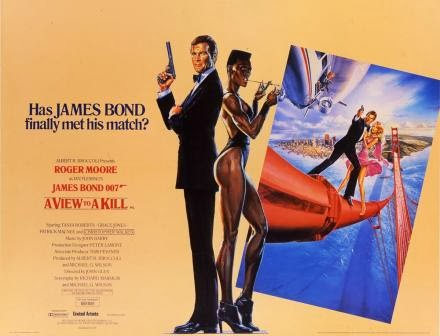
A View to a Kill (1985)

We’ve really had just about enough of Roger Moore around these parts.  From boring to offensively bad, Roger Moore’s tenure as James Bond has really disappointed after the initial promise he showed in Live and Let Die and The Man with the Golden Gun. After seven films and twelve years, A View to a Kill marks Moore’s last outing as 007, and it’s mixed feelings all around.  The film itself isn’t bad, but one gets the feeling that Moore has wasted too much time getting here.

After uncovering something to do with a computer chip, James Bond (Moore) seeks out the chip’s manufacturer, cyber-wunderkind Max Zorin (Christopher Walken).  Bond poses as an equestrian, then a journalist, to uncover the truth about Zorin’s mad scheme.  Along the way Bond is aided by fellow agent Godfrey Tibbett (Patrick Macnee) and heiress Stacey Sutton (Tanya Roberts) and foiled by Zorin’s Amazonian bodyguard May Day (Grace Jones).

A View to a Kill has a poor reputation among the Bond canon, though I don’t think the film is irredeemable.  I’m a fan of films where Bond has to put clues together to uncover a case, and this film plays that up quite well with a number of seemingly disparate plot threads – computer circuitry, illegal horse breeding, Nazi eugenics – that all come together with a satisfying cohesion.  It’s especially fun to see Moore puzzle through the matter with Macnee, the original John Steed, by his side; the two do a neat kind of “Grumpy Old Men” routine that riffs nicely on the shared espionage background between the two.

Having said that, Moore is really just too old to keep doing this sort of thing.  It’s clever when the film attempts to confront it, but once Macnee leaves the plot we’re asked to forget Moore’s age and regard him once more as the spry agent Bond ought to be.  But it’s a brutally unsuccessful move, made all the more apparent by how clearly youthful both Roberts and Jones are.  When Moore’s Bond beds both, it’s like catching a lusty grandfather in bed with a cheerleader; it feels both wrong and uncomfortable.  The other type of physical scenes also flounder due to his age, especially the ones involving complex stunts like another ski jump.  (You were right, Spy Who Loved Me:  nobody does it better.)

Fortunately, the film has an amazing antagonist in Christopher Walken.  Let that sink in:  Christopher Walken is a Bond villain, and it’s everything you’d expect from that sentence.  Walken is at his mid-80s nuttiest here, emphasizing all the wrong syllables and cocking his head at peculiar angles to give his character a fully off-kilter vibe.  Though the film relies on a clue-based structure, there’s no question that Walken, with his albino afro and shifty-eyed glances – is the villain, which allows him to surrender entirely to the character’s hammy quirks.  Best of all, Walken funnels that goofiness into full-blown psychosis; where some Bond villains have trouble toeing that line, Walken makes Zorin both engaging and terrifying, even without that curious subplot where (spoilers?) he’s revealed to be a Nazi test tube baby.

Perhaps even more than Walken’s performance, what helps A View to a Kill is its uncanny and unmistakable resemblance to the franchise’s finest hour – Goldfinger.  The basic plot outline is the same:  mad billionaire with lethal sidekick cooks up scheme to destroy resource and increase his own wealth.  While A View to a Kill never makes the connection explicit, with nary a reference in sight, reappropriating the successful formula carries with it a tried-and-true aspect that isn’t very surprising.  That is, it already worked in Goldfinger, so A View to a Kill doesn’t see a need to reinvent the wheel.  It’s ironic that we saw the same thing happen with Never Say Never Again, which rebranded Thunderball, though View to a Kill takes the remake angle a step further and at least does more than merely change the scenery.

And honestly, after all the missteps we’ve seen in the Roger Moore era, it’s subconsciously refreshing to be reminded of Goldfinger, arguably Connery’s and the franchise’s gold standard.  We’ve been through so much with Moore that I almost forgive the sin of uncreativity because it means we’re moving on to something new and different.  Plus, tell me the idea of Goldfinger starring Christopher Walken isn’t tempting.

A View to a Kill is rated PG.  There are several scenes of implied nudity (bare shoulders and backs), and in one scene a man machine-guns a crowd while another character is killed by an explosive.

Roger Moore may be out, but James Bond and The Cinema King will return in a review of The Living Daylights (1987) on April 7, 2014!