Showing posts with label Jack Nicholson. Show all posts

Monday, May 10, 2021

Bat-May: Batman (1989)

I have so many fond memories of this movie that I scarcely know where to begin an objective review of Tim Burton’s Batman (affectionately dubbed Batman ’89 by a generation hoping – nay, longing – to distance it from an earlier era’s Batman ’66). I can’t recall with precision the first time I saw the film, but I can say with confidence that it was the very first DVD I owned, a gift from my father when the home video format was in its nascence. But when I first built my Personal Canon in 2016, it was a natural inclusion; I’ve loved this film for years, and it occurs to me that its peculiar bizarre nuttiness has really permeated my identity as a moviegoer.

Batman redefines the Dark Knight more than two decades after the go-go groovy incarnation embodied by Adam West and his Swinging Sixties interpretation. Here, Bruce Wayne (Michael Keaton) is a brooding specter of unrelenting justice, a mystery to his city and to Vicki Vale (Kim Basinger), who’s come to town to photograph Bruce’s vigilante alter ego, The Batman. While busting up criminal activity at Axis Chemicals, Batman inadvertently creates his greatest nemesis when Jack Napier emerges from a vat of acid as The Joker (Jack Nicholson), a self-described homicidal artist with murderous plans for Gotham City.


Batman is a film that is so iconic because of how quickly it dominated the cultural landscape. Much has been said and written about the cultural saturation of the film, how it changed the superhero genre and action films more broadly, how it reimagined how a blockbuster could perform at the box office. Nicholson’s Joker is both inextricable from the actor’s persona and yet wholly of a piece with the villain’s own flexible characterization; meanwhile, Keaton is to this day still proudly declaring, “I’m Batman.” While the comics had been taking Batman grim ’n’ gritty since the early 1970s (peaking in 1986 with Frank Miller’s The Dark Knight Returns), Batman has the titanic reputation of being the movie that set the superhero genre down the straight and dour path.


This is not to say, however, that Batman isn’t a whole lot of fun. In my reviews of Batman: The Animated Series (and even The Killing Joke), I’ve consistently noticed how Mark Hamill’s Joker sets me giggling on a dime, but I’d forgotten that Nicholson’s Joker has the exact same effect. Nicholson’s strength comes from imbuing casual lines like “You’ll never believe what happened to me today” with deadpan sarcasm and repressed theatrical fire, to say nothing of how well that unique Joker look has aged, even on Blu-Ray. His wheezing laugh, too, so quintessential to any successful Joker, is a hoot, especially when it transforms into a fearless manic cackle, often looped over the following scenes, giving the sense that this movie is well and truly The Joker’s. Keaton’s great, too, a perhaps unexpected choice; in fact, he’s so good that we’ve all forgotten that there’s an extended sequence of Bruce Wayne in blue jeans, which feels more out-of-character than having Joker (spoilers) revealed to be the murderer of Thomas and Martha Wayne. But Nicholson doesn’t lean on his reputation; he earns top billing on the poster with a riveting performance that’s so markedly different from Heath Ledger’s Oscar-winning turn two decades later.


The older I get, and even as the world begins to retreat from the notion that superhero comics are (or at least ought to be) strictly for kids, I give a lot of thought to why these characters have become a kind of religion for me. Why do I cling to these four-color figures? In the case of this film, I think part of the appeal was that Batman was, for me, one of the first grown-up movies I’d ever seen – or at least it was one of the first that felt grown-up. It was a movie that didn’t talk down to me, didn’t try to pretty up the world. It painted a picture of life as a horrific carnival, Gotham City as a funhouse reflection of what civilization ought to be. It felt larger than life, but simultaneously it seemed entirely within reach, more gothic than the bright colors of a comic book page and yet divorced enough from reality that I could access it without fear. And it was a movie that didn’t really look like anything else I’d seen; it was almost certainly my first Tim Burton film, and the way it manages to make the dated feel timeless gave the film a very specific stylized identity I couldn’t find elsewhere on the video shelf. (His next film, Edward Scissorhands, feels very much a period piece, an homage to 1950s Anytown, USA.)


Of course, any discussion of Batman has to acknowledge the exquisitely baroque score by Danny Elfman, which has become the gold-standard anthem for multiple generations of Bat-fans. (No matter what you thought of the theatrical cut of Justice League, you had to love hearing that theme once more. It just felt right, scoring Ben Affleck astride the Bat-Signal.) The Animated Series owes so much to Elfman, as does this film overall. I’ll even venture to say that Elfman’s score is a character in itself, serving the same inextricable role here that John Williams’s work does for Star Wars; put another way, this film doesn’t work without Elfman’s ostentatious gusto over the scenes. That Bat-theme, the playful Joker melodies – heck, even the zany zeitgeist of including Prince in a few key scenes – there’s a reason these tracks are seared into our brains (and it’s not just the Lego Batman games, which aired them on an obsessive loop). Elfman is doing career – and genre – defining work with Batman.


If you haven’t seen Batman in a while, it’s high time for another look. On this latest rewatch, I was quite surprised by Alfred’s subplot. If at all, Alfred’s role lives on in cultural memory for the moment when he escorts Vicki Vale into the Batcave, blowing Bruce Wayne’s secret identity. But it’s a moment that the film earns by continually seeding Alfred’s desire for Bruce to move on and find safety in an end to his nightly crusade – all of which, if it seems faintly familiar, seems to anticipate Michael Caine’s “I won’t bury you” plot from The Dark Knight Rises. Michael Gough is quiet and unflappably avuncular as Alfred, a pitch-perfect counterpart to the high mania of the film’s dueling leads, but his deep compassion is so key to the character often brushed off as Batman’s butler. 


I was also struck by the mystery atmosphere that pervades the film, which feels quite fresh nearly thirty years later. We’re so used to superhero films that walk us through the origin story as a matter of course. But here, Batman’s backstory is presented as something of a mystery; it’s The Joker who gets the straightforward origin, lending further credence to the notion that the film is as much (if not more) his as Batman’s. Of course, it’s hard to imagine any filmgoer who doesn’t know who Batman is and how he came to be (I’ve only met one such person in my life), but the film introduces the familiar story beats in an innovative story structure that doles it out slowly, with gravity. When we finally get to the shooting of the Waynes, it’s nightmarish and ethereal, a hazy encounter with trauma, and it’s presented as the final cue to understanding Bruce Wayne’s psyche.


On that count, I’m not sure that the film succeeds – nor, I think, does it want or need to do so. Burton is content to leave Bruce Wayne as a somewhat enigmatic freak, locked in a chicken-and-egg struggle with Jack Napier. Who created whom? Were it not for the film’s ironclad concrete conclusion, one might almost imagine Burton’s universe operating under the conditions suggested by Heath Ledger’s Joker in his final sequence: “I think you and I are destined to do this forever.” With the news that Michael Keaton will be reprising his role in the Ezra Miller Flash film, at least half of that statement ended up applying. As for me, it’s one of my favorite movies of all time, so I’ll be returning to it forever.


Batman is rated PG-13. Directed by Tim Burton. Written by Sam Hamm and Warren Skaaren. Based on the DC Comics. Starring Jack Nicholson, Michael Keaton, Kim Basinger, Robert Wuhl, Pat Hingle, Billy Dee Williams, Michael Gough, and Jack Palance.

For more Bat-May action, the good folks at Collected Editions posted my review of Batman: The Movies, the comic book adaptation of the Batman Quadrilogy. Give them a click - no one reviews comics like Collected Editions!

Monday, October 29, 2012

Monday at the Movies - October 29, 2012

Welcome to Week Thirty-Nine of “Monday at the Movies.”  With Halloween coming up this week, here are a few movies that suit the season.

Arsenic and Old Lace (1944) – Directed by Frank Capra (of It’s a Wonderful Life fame), Arsenic and Old Lace is to Halloween what Die Hard is to Christmas – set on the night in question but with little to do with the actual holiday.  Instead, the film flies off on its own fantastic plot, in which the holiday decorations are only incidental.  Here, newlywed Mortimer Brewster (Cary Grant) finds his honeymoon plans deterred when he learns his aunts have a dead body in the window seat; throw in his homicidal brother Jonathan (Raymond Massey, disguised as Boris Karloff), another brother who thinks he’s Teddy Roosevelt, and a drunken Doctor Einstein (personal favorite Peter Lorre), and it’s madcap mania as only the Forties could provide.  Though the plot sounds grim, Arsenic and Old Lace is fantastically funny and is easily one of my favorite movies of all time.  Grant is at his slapstick best, chewing the scenery and pacing frenetically without being “too cool for the room.”  Massey is menacing within the boundaries of a comedy film, and Lorre is as always a scene-stealer of the highest order.  In fact, as with any great film, the supporting cast here is exceptionally strong, with no one performance falling below the bar of excellence set by the film.  The standout scene here is the one in which Jonathan and his aunts haggle over which has killed more people:  Aunts Abby and Martha agree that they’ve killed twelve people, while Jonathan insists he has thirteen kills to his name.  In any other movie, it’d be a dark and dismal moment, but in Arsenic and Old Lace it’s unbelievably hysterical, one in two-hour-long line of memorable scenes.  Now if someone could get on that remake with Robert Downey, Jr. I’ve been planning.

The Shining (1980) – Out of the fog and into the smog, The Shining is a more traditional choice for All Hallow’s Eve.  It’s Stanley Kubrick’s spookiest flick, loosely adapted from the Stephen King novel of the same name.  Whether you think the movie is about Native American genocide or how Kubrick faked the moon landing or if it’s just a story about a guy who goes nuts with his family in the mountains, The Shining is damned creepy.  Jack Nicholson stars as Jack Torrance, new caretaker of the Overlook Hotel during the off-season; slowly but inexorably, Jack is driven mad by the winter weather, the badgering of his wife Wendy (Shelley Duvall), and the interference of potentially supernatural elements.  I first saw the film when I was too young to appreciate it, mistaking the film’s slow-burn approach to horror for sluggish, dry monotony.  As usually works for me, watching it with a crowd changed my perspective on the film, allowing me to savor the unsettling elements of the film and even appreciate the significant changes Kubrick made to the source material.  Nicholson’s performance is classic id, whose insane and wild-eyed mugging for the camera immortalized the “Here’s Johnny!” refrain.  Child actor Danny Lloyd, too, is a fine foil for Nicholson; his contemplative psychic ability is a pitch-perfect counterpoint to Nicholson’s agitated energy without ever allowing the audience to relax. It may not be the best Stephen King movie, but it’s one of Kubrick’s more enjoyable films.

That does it for this week’s edition of “Monday at the Movies.” We’ll see you here next week!

Tuesday, May 27, 2008

The Departed (2006)

To those who know me at least peripherally, it shouldn't come as a surprise that I chose Martin Scorsese's 2006 Oscar-winner (finally) The Departed to be the inagural review. After all, it de-throned The Empire Strikes Back on my list of the best movies of all time. The Departed is, simply put, the best movie ever made. And I will fight to the death on that one. It's that good.

It used to be that Martin Scorsese was the precocious salutatorian of the Academy Awards; his achievments in film (Goodfellas stands out the most) were commended but received little more than a pat on the back and a "Keep up the good work" while movies like Dances with Wolves (ugh) took home the gold. Heck, The Three 6 Mafia won an Oscar before Marty.

The Departed changed all that and deservedly so. It goes without saying that this is Scorsese's magnum opus, it having been already established that this is the best movie ever made. I seldom level the label of "perfect" on a movie, but if ever oh ever a perfect movie there was, The Departed is one because... well, it has everything. One of my favorite quotes about cinema comes from Jean-Luc Godard: "All you need for a movie is a gun and a girl." Well, maybe that's true and maybe it isn't, but The Departed has all that and more.

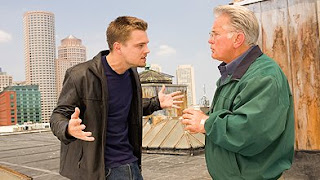
I hate to tell too much of the plot, since The Departed surprised me at every turn in a way movies normally don't - but should. The basic premise here is a mob story, with Jack Nicholson heading up the Boston Mafia as Frank Costello. Costello's mob has an informant in the Boston State Police - Matt Damon's delightfully scummy Colin Sullivan. Yet what almost no one in the film knows is that the cops have a man inside the Mafia - Billy Costigan, as portrayed by Leonardo DiCaprio, in the role that convinced me he had more depth than the waters into which he sank in Titanic. A tangled web of betrayal ensues, and if you see any of the last half-hour coming, James Randi has a prize for psychics like you.


Though the movie is based on the 2002 Hong Kong crime thriller Mou Gaan Dou (or Infernal Affairs), The Departed is so decidedly American that it seems a disservice to Scorsese and screenwriter William Monahan to call this a remake. Re-imagining might be a better word for it, since there's so much more flavor here. Scorsese's flair for directing and coaxing stellar performances from his players (did anyone know Kangaroo Jack alum Anthony Anderson could act?), editor Thelma Schoonmaker's intuitive method of editing the visuals, and a killer soundtrack are things that the original from Hong Kong was missing, things that guide your enjoyment of the movie without you even realizing it.

The old joke about Martin Scorsese is that all his movies have to include "Gimme Shelter" by The Rolling Stones. But I dare you to watch The Departed and listen to "Gimme Shelter" the same way again. If Tarantino changed the way we listen to non-diegetic music, he was plagiarizing from Scorsese. The music here is almost a character in itself; The Dropkick Murphys track "I'm Shipping Up to Boston" has achieved the public recognition that Pulp Fiction gave to Dick Dale's "Misirlou." The nifty thing about the soundtrack here is that you can notice it as an entity in and of itself, or you can let the movie wash over you like a tidal wave of cinematic perfection.

This is a perfect movie to watch with someone who's never seen it before, because the surprises in the movie are at least on a par with the shower scene in one of my favorite Hitchcock films, Psycho. Not that a main character gets killed in the first half, but there are quite a few moments that will challenge your conventions of how a movie should behave. Take for example the first twenty minutes. Just when you think the film's done a cold open and omitted opening credits, The Dropkick Murphys kick on, cue title card, and you know you're in for a whole lot of awesome. And it doesn't let up - from the omni-profane Alec Baldwin as the scene-stealing Captain Ellerby sparring with equally fascinating Sgt. Dignam (Oscar nominee Mark Wahlberg) to the freeze-frame that closes the film - this is 151 minutes of cinematic perfection.

Act accordingly.