Showing posts with label Frank Miller. Show all posts

Monday, August 25, 2014

Sin City: A Dame to Kill For (2014)

Eh.

Oh, you wanted a full review?  Okay, here goes:

When Oliver Twist asked, “Please, sir, I want some more,” he didn’t have to wait nine years for a second pot of food.  As I recall, he didn’t get any at all, so maybe we should be grateful that we even have Sin City: A Dame to Kill For, a pre/sequel to 2005’s Sin City.  “Gratitude” isn’t, however, the word I would use to describe Robert Rodriguez’s second adaptation of Frank Miller’s hardboiled comics; the proper word is somewhere between “bored” and “disappointed.”

As before, four interlocking narratives give us another look at Basin City, where the tough guys are tough and the women are all prostitutes of one kind or another.  Dwight McCarthy (Josh Brolin) is pulled back into a spiderweb woven by his femme fatale ex Ava Lord (Eva Green), while lucky gambler Johnny (Joseph Gordon-Levitt) finds himself across the poker table from the evil Senator Roark (Powers Boothe).  However, Nancy Callahan (Jessica Alba) also has her sights on Roark, while Marv (Mickey Rourke) lumbers around punching things.

Here’s the thing about this film:  you’ve already seen it.  Aside from the numerous films that have taken cues from the first Sin City, particularly vis-à-vis spot color and neo-hardboiled ethos, there is very little in the sequel that wasn’t already in the first film.  To name a few (veiled spoilers follow):  a cop’s suicide, shooting a woman mid-kiss, and Marv breaking into fortified compounds – which actually happens a couple of times in this movie alone.

The points deducted for originality really sting because Sin City was, on its initial arrival, heralded for its innovative approach to adapting comics to the screen.  Nine years later, though, Rodriguez has changed nothing, and the result feels quite stale, almost dated beyond the way that film noir usually harks back to a previous era.  This, for my money, is among the worst sins a film can commit.  For those that own Sin City on DVD, it’ll be cheaper to go back to the original.

If you’re playing the home game and can remember Machete Kills, you’ll recall that Rodriguez is now oh-for-two on sequels, and I’m wondering if the director has lost his edge (or if, a decade later, I’ve perceptibly matured as a moviegoer).  As in Machete Kills, Dame is overfull of very good actors, Gordon-Levitt and Boothe among them.  Post-Deadwood, I’m especially glad to see Powers Boothe get an expanded role here, since his particular brand of scenery-chewing is always a delight.  But where Rodriguez seems to be phoning it in lately, the cast too aren’t at their best.  Alba is trying, you can tell, and so is Brolin; even Green, seemingly inspired casting as the vamping Ava Lord, seems to be overplaying the part – I suspect, though, based on her performance in Dark Shadows that that’s deliberate (Ava Lord is essentially Angelique Bouchard sans clothing), but I might be giving her the benefit of the doubt.  One wonders if all that green-screen filming is getting to them, because the visuals appear to be doing most of the heavy lifting.

For all the disappointment that A Dame to Kill For engenders, it’s never patently bad, which is almost worse.  Making a genuinely bad film is in some respects more of an achievement because it elicits a reaction; an uninspired outing like this one can be reviewed with an unenthusiastic shrug.  I wanted to be swept away by this one like I was with the first, but instead it seems like a relic.  The gender politics are horridly outdated despite the film’s attempt to “empower” its female characters, and the Day-Glo blood sprays are no longer visceral enough.  Instead, the whole film plods out blandly, the cinematic equivalent of Josh Brolin gritting his teeth for two hours.  When he says “Don’t let the monster out,” we’re shouting back, “Please let the monster out and do something creative!”

Instead, the film pulls its punches and plays it safe.  If you enjoyed the first film but wanted more of the same without that feeling of freshness, you’ll have a great time here, but I suspect that this sequel will not be well remembered, if indeed it is remembered at all.

Sin City: A Dame to Kill For is rated R for “strong brutal stylized violence throughout, sexual content, nudity, and brief drug use.”  Stylized is the key word with the violence, because a lot of the time it looks like someone pouring out white paint; a few severed limbs and heads are seen, and usually the blood there is more red.  The middle segment of the film features all of the nudity, a man’s bottom and a frequently topless woman with her lower regions obscured in shadow; other scenes show strippers and prostitutes who keep their skimpy clothes on.  Surprisingly, the language is pretty tidy, with only one F-bomb in the batch.

Monday, February 4, 2013

Monday at the Movies - February 4, 2013

Welcome to this week’s edition of “Monday at the Movies.”  I have quite a few reviews backed up in the queue, but I wanted to bump up a few more recent releases in the interest of topicality and relevance.  Also because I’m dying to talk about these two.

Batman: The Dark Knight Returns, Part 2 (2013) – After a mostly successful first half, the conclusion to this animated adaptation of Frank Miller’s iconic “last” Batman story is effective, engaging, and highly entertaining.  Though the decision to break the film into two parts seems motivated only by sales and creates an odd break where you have to change discs midstream, the filmmakers have taken advantage of this extended format and given us full versions of the two major confrontations that conclude the book:  Batman’s last match with The Joker, and his face-off with Superman.  My thoughts about the voice cast remain unchanged:  as Batman, Weller is solid (but no Conroy), and Ariel Winter is a good choice for the spunky Carrie Kelley.  The two new cast members, though, are even better; Michael Emerson is a genuinely disturbing Joker whose affection for the Dark Knight never wavers from how creepy it’s meant to be, while Mark Valley’s Superman is the perfect aging Boy Scout, unwitting lapdog for “The Man.”  The word I can use to best describe this film is “unflinching” because it more than earns its PG-13 rating; consistent with Miller’s gritty original, Part 2 is relentlessly violent, especially when depicting Joker’s last murderous rampage.  It’s an accurate treatment of the source material, but the senseless violence may turn off some viewers; I suspect, though, that’s the point, since it helps us understand the difficult decision Batman has to make when he tells Joker, “No more.”  While I’d like to see other superheroes get this kind of treatment, Part 2 confirms that the DC’s animated studio knows what it’s doing.

The Hunger Games (2012) – First of all, thank heavens for Suzanne Collins for giving us a sophisticated and emotionally compelling franchise to dethrone Twilight.  And thank heavens for Gary Ross, too, whose adaptation of The Hunger Games is smart and surprisingly artistic without compromising what works about the book – namely, the survivalist bent of the story and its biting political satire.  Jennifer Lawrence is the epitome of “rising star” as Katniss Everdeen, who’s thrust into a televised death match meant to supply a repressed populace with bread and circuses from the Capitol of dystopic Panem.  The decision to eliminate the book’s first-person narration is a wise one, cinematically speaking, but as a result the film may come off as a little flat and emotionless for those who haven’t read the book (or maybe it doesn’t?).  Wisely, though, the film expands beyond Katniss’s singular perspective, allowing us to see more clearly the state of life in the Capitol:  decadence a la Lady Gaga (including Stanley Tucci as the Capitol’s delightfully flamboyant version of Larry King), political maneuvering orchestrated by Donald Sutherland’s restrained but smarmy President Snow, and an infectious performative posturing that begins to corrupt our protagonists (which should pay off in sequels, if I’m remembering the books correctly).  Ross brings an artistic touch to the film, which indulges the sentimentality of one contestant’s death in a haunting POV shot, while prizing orchestral score over chaotic battle sounds to emphasize the dehumanization of the Games.  It’s a shame that he’s not returning for the sequels, but a fantastic cast (let’s not forget Woody Harrelson as the begrudging inebriated mentor Haymitch) led by Lawrence at the top of her game suggest that the odds are ever in this franchise's favor – at least, more so than Twilight.

That does it for this week’s edition of “Monday at the Movies.” Don’t forget that the Double-Oh-Seventh of the month is coming up on Thursday (hint, hint), and after that we’ll see you here next week!

Monday, October 8, 2012

Monday at the Movies - October 8, 2012

Welcome to Week Thirty-Seven of “Monday at the Movies.”  Our Quentin Tarantino coverage is on hold this week for two animated films that are well worth your time.

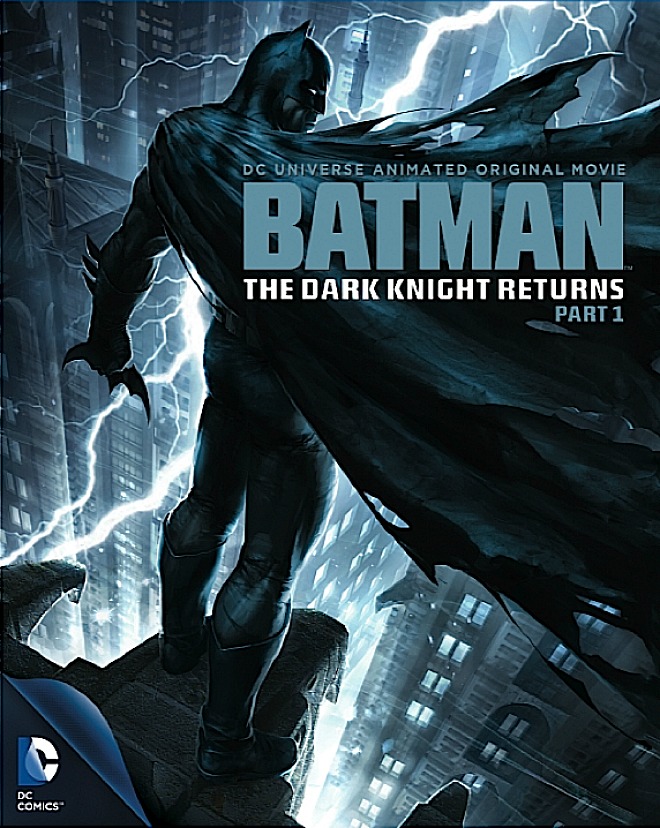
Batman: The Dark Knight Returns, Part 1 (2012) – The DC Universe Animated Original Movies have been quite good as of late, particularly in adapting classic stories.  Here the team takes on Frank Miller’s uber-iconic Batman story from 1986 (and one of the inspirations for The Dark Knight Rises), and it’s perhaps one of the studio’s best efforts.  Where Batman: Year One, also a Miller comic, was an adaptation too tethered to its own source material, The Dark Knight Returns takes what works in the comics and strips away what won’t work in the cinematic medium.  Gone are the overdrawn and slightly dated monologues; instead, we’re left to focus on the story of retiree Bruce Wayne retaking his city from Two-Face and a gang of mutant thugs.  The film is full of action with none of the dragging bits that pulled down Year One.  Though I’m a diehard Kevin Conroy fan, his absence may be noticed but not mourned, as Peter Weller (alias Robocop and the guy who trained Jack Bauer) turns in a suitably gritty but tongue-in-cheek performance as the eponymous Dark Knight.  This Batman, though, might be funnier than the title promises, but it’s all in good fun; the satire Miller may have been attempting in the comic comes through perfectly in here, as when the milquetoast mayor meets his match or when Batman drawls taunt after taunt at armed but outgunned goons.  Finally the filmmakers wisely chose not to cram everything into the 70-minute DCUA format, allowing the film its space to breathe and create an atmosphere (especially through the newscaster segments) without merely translating only the fan-favorite moments.  Though I’m still peeved about this business of splitting movies in half, I can’t say I’m not excited for Part 2 – and Michael Emerson’s turn as The Joker.

Phineas & Ferb The Movie: Across the 2nd Dimension (2011) – Phineas & Ferb might be the best cartoon on the air right now, exuberantly fun for kids and delightfully earnest and nuanced for the over-12 crowd.  Count me in the latter, among the viewers enamored with P&F’s absurdist non sequiturs and insider references.  Fortunately, their first film, Across the 2nd Dimension, retains in long form all the traits that make the television show a real treat.  Genius step-brothers Phineas and Ferb accidentally help the blundering evil scientist Dr. Doofenshmirtz open a portal to another dimension, much to the chagrin of their pet platypus Perry, who’s also a secret agent and the evil Doctor’s nemesis.  In this alternate dimension, there’s a more evil version of Doofenshmirtz who’s conquered the earth, while the alternate dimension Candace – Phineas & Ferb’s sister – is leading the resistance.  It’s less complicated than it sounds; young viewers won’t stumble over the plot at all, but more sophisticated filmgoers will find much to appreciate.  The story is surprisingly strong, grappling with heavy issues of loyalty, faith, friendship, and revolution... all with a series of memorable musical numbers.  My favorite part of any episode of Phineas & Ferb is always the wealth of allusions; the show has previously dealt homages to Memento, the James Bond franchise, and the Lord of the Rings series.  The film continues this majestic tradition, including impromptu nods to Indiana Jones, Star Wars, and Georgia O’Keefe.  (The ending also has an odd relationship with the climax of The Avengers, though I’m not sure what to do with that just yet.)  This all comes, though, in a tight package that does not insult the intelligence of the viewer nor sacrifice emotional payoff (see the big kiss at the end of the film).

That does it for this week’s edition of “Monday at the Movies.” We’ll see you here next week!

Monday, June 18, 2012

Monday at the Movies - June 18, 2012


Welcome to Week Twenty-Three of “Monday at the Movies,” a grab bag of movies I hadn’t reviewed yet. 

The Mummy (1999) – As with last week’s entries, The Mummy was a movie very dear to me as a child, and I think I’m sensing a pattern here.  Like the Indiana Jones movies, The Mummy is a period adventure piece mixing action, humor, the supernatural, and 1930s clothing.  In fact, the film could very easily be read as an Indy flick starring Brendan Fraser as a mercenary hired to lead Rachel Weisz to a hidden Egyptian city where an ancient evil mummy (Arnold Vosloo) is about to be resurrected.  The film is fast-paced, very exciting, and entertaining at every turn.  As with The Rocketeer, there’s something to enjoy in each scene, with director Stephen Sommers effectively never wasting a scene; when the plot isn’t advancing, the characters are interacting in fun ways.  While the chemistry between Fraser and Weisz isn’t entirely tangible – a kind of throwback, perhaps, to the early horror trope of the protagonists falling in love – John Hannah’s role as Weisz’s besotted treasure-seeking brother remains one of my favorite supporting roles in recent movies.  The screenplay, though, is surprisingly strong, flirting with the monster movie trope while giving it a modern sense of humor and weaving in a compelling take on the plagues of Egypt (making this film the unlikely love-child of Indiana Jones and Cecil B. DeMille’s The Ten Commandments).  The procedural format of a chain of victims and the accompanying plagues helps the film continue to advance and gather a sense of purpose while our characters band together to fight the mummy.  More than a decade later, The Mummy is still terrifically fun.

Sin City (2005, Extended Cut) – With recent news indicating that the sequel is finally on, Sin City has been on my rewatch list for a while.  The story and the content aren’t for everyone, to be sure; the film is violent and extremely dark, its depiction of women problematic at best, and the dialogue corny in places due to Miller’s hardboiled sensibility.  But what holds the attention more is the unique visual look, which has spawned a bevy of impersonators (I contend that Zack Snyder wouldn’t have a career without Rodriguez’s inspiration, particularly on Watchmen).  The version under review today is the “Recut, Extended, Unrated” version where director Robert Rodriguez added in ten minutes of direct “translation” of Frank Miller’s comics source material but divides the interweaving narratives into their own short films (about forty minutes each).  The only story that suffers from being divided is “The Customer is Always Right,” which stars Josh Hartnett as a hitman-for-hire; the clip’s link to the end of another segment makes its ending stand not-quite-alone.  Mickey Rourke leads “The Hard Goodbye,” in which he plays the hulk Marv on a quest for revenge.  In “The Big Fat Kill,” Clive Owen aims to protect the women of Old Town from the mob.  And, in what would be my favorite segment were Jessica Alba a stronger actress, Bruce Willis seeks out Alba after learning that her former attacker “That Yellow Bastard” is eager for a second attempt.  All three leads are fantastic, delivering the noirish narration with appropriate gravel and world-weariness (it says something that the voiceover isn’t distracting), while the supporting cast (too many A-listers to name) rounds out the film into an enjoyable experience which benefits from directorial expansion.

TRON: Legacy (2010) – TRON: Legacy is one of several rare breeds:  a sequel better than the original, a film that gets better each time I watch it, a film where the soundtrack is a character in its own right... you get the idea.  I have mixed feelings about the original – it hasn’t aged well, the story is a little thin, and not very much happens in between plot points – but I recognize its innovative nature and applaud the sequel for pushing the industry in the same ways as the original.  The look of the film is striking, resulting in another rare film where it looks just as good with the sound turned off; do that at your own peril, however, because you’ll be missing out on Daft Punk’s soundtrack, which was one of the best of 2010.  But the story is intriguing as well, kind of a Matrix done right what with its use of a “digital frontier” and what separates user from program; here, Jeff Bridges (in full Dude mode) reprises his role as Kevin Flynn, discoverer of “The Grid,” as well as portraying the evil program CLU (via CGI rejuvenation).  Garrett Hedlund is Bridges’s son Sam who enters The Grid looking for his father, while Olivia Wilde is charming as a naïve program hungry to learn about the real world.  The characters are more compelling than reviewers gave them credit, especially the elder Bridges, whose paternal compassion is a perfect companion for Father’s Day yesterday (always reminds me of my father, at least).  I’m admittedly a Disney shill, but the more I watch TRON: Legacy (or listen to the soundtrack), I always find something new to like.

Be sure to tune in Wednesday for The Cinema King’s review of The Best Exotic Marigold Hotel.  For now, though, that does it for this week’s edition of “Monday at the Movies.” We’ll see you here next week!