Showing posts with label Orlando Bloom. Show all posts

Wednesday, August 18, 2010

Pirates of the Caribbean: At World's End (2007)

Welcome to Wednesday 2, the final day of Depp Week. It's been an amazing journey, a real tour de force through the recent work of one of the greatest living actors, and I'm happy to have shared the journey with you.

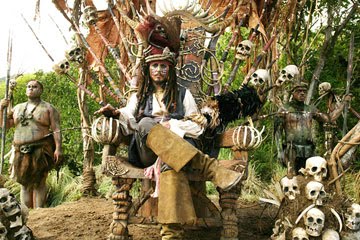
But, in the words of many a pirate, you may not survive to pass this way again, and these be the last friendly words you hear. Meaning: The following review unavoidably contains spoilers for Dead Man's Chest, as At World's End picks up right after the cliffhanger ending that preceded it. (Oh, hell; the picture kind of gives away one surprise.) So, for those uninitiated who haven't seen Dead Man's Chest but want to know more qualitatively about At World's End, let me say this for it: At World's End is my favorite of the Pirates trilogy, a restoration of the thematic balance that made The Curse of the Black Pearl so appealing which also maintains the "go bigger" attitude of Dead Man's Chest. It's also just plain fun, escapism which the increasingly heavy Hollywood offerings so desperately need to bust up the monotony.

With Captain Jack Sparrow (Johnny Depp) trapped in Davy Jones's locker after his encounter with the kraken, his former nemesis Captain Barbossa (Geoffrey Rush) - himself back from the dead - mounts a rescue effort with Will Turner (Orlando Bloom) and Elizabeth Swann (Keira Knightley). As if rescuing Jack from the land of the dead weren't hard enough, the pirate world must contend with the ever-tightening grip of Lord Cutler Beckett (Tom Hollander) and the East India Trading Company, which now controls the heart of Davy Jones (Bill Nighy).

Now this is my favorite of the Pirates films, but it's also unique because it's tonally very different from the first two films; perhaps, then, that's my main gravitation to it. Johnny Depp doesn't appear for more than half an hour into the film, allowing the movie to build up steam and firmly establish the necessity of his character to return. In some ways, this feels like a response to the critical backlash against Dead Man's Chest, as many characters run around in this film invoking the necessity of getting things back to the way they were. This film is darker - it opens with a small boy ascending the steps to the scaffold, and several very important characters are killed, brutally, on-screen - and consequently it feels more like the first than the second film, which you'll recall I critiqued for being too funny. Here the tone is one of urgent action punctuated by moments of levity (as when the crew sails over a waterfall and transports the audience, albeit briefly, to the Disneyland attraction that spawned the franchise), a return to form and a more fulfilling moviegoing experience. There are no scenes of audacious slapstick, but there are plenty of moments of entertaining comedy to keep you smiling throughout.

And where Dead Man's Chest did more of the same as far as performances go, At World's End dials it up for almost every main character. Now Jack Sparrow has a form of split-personality disorder, with "multiple Jacks" on his shoulders and in his hair, and Depp does a marvelous job at imbuing life into all the different Jacks we see on screen (at least twenty). Will has a renewed sense of purpose, and Bloom shoulders the responsibility with a grim but resigned countenance the whole way through. With a rousing speech on the nature of freedom, Elizabeth finally makes her decision between citizen and pirate, and it's a turn that feels completely natural in Knightley's hands. And it's a delight to see Rush again, who nuances his character's malicious nature by adding in a note of reformation and making it more palatable to root for the character who had previously been the villain. And Nighy continues to impress, even underneath all that CGI, by conveying through his words the anguish Davy Jones feels as a consequence of his betrayals at the hands of his lover and Cutler Beckett. Chow Yun-Fat joins the cast as Sao Feng, pirate lord of Singapore; though his character is done in broad strokes that might offend the PC crowd, Yun-Fat does an immersive job with the character, and there's a sense that all pirates are in effect stereotypes, somewhat legitimizing the Fu Manchu-esque nature of the character. And it'd be remiss of me if I didn't note that Keith Richards puts in an appearance as code-keeper Captain Teague, who shares a vitally important scene with Jack Sparrow.

The standout feature in At World's End, though, is an extended battle sequence which runs approximately forty minutes long and features the Black Pearl fighting the Flying Dutchman in the midst of a maelstrom. For most of the film, we're told that the pirates will have to face a last stand against Beckett's armada, and the subsequent battle that ensues more than lives up to the expectations raised by the rest of the film. Director Gore Verbinski (who, sadly, won't be returning for On Stranger Tides) does a masterful job of coordinating the action and keeping the action moving - even tossing an impromptu wedding into the mix. Hans Zimmer, too, is at his finest here, crafting an instrumental suite that runs for pretty much the whole length of the battle and integrates all the important themes (Jack's, Davy Jones's, Barbossa's, the love theme) from the trilogy in an expertly and elaborately written piece that you'll be humming for days. It's the kind of action sequence you can appreciate even out of context; a forty-minute combat sequence never hurt anyone, especially when it's as well-executed as this one is.

And the film brings to a satisfying conclusion the plotlines begun in the first film while still leaving open the possibility for a fourth film. The ending is remarkable in that it's sort of cliffhanger-ish, but at the same time it's the only way for these characters to end up; Will and Elizabeth are still together, despite a few obstacles, and Jack and Barbossa are still deadlocked in combat over the ownership of the Black Pearl and future treasure on the horizon. It's an immensely satisfying ending, one that validates the almost nine hours it takes to watch this epic sprawling trilogy unfold. Even taken on its own, though, At World's End is positively divine, an abundantly enjoyable flourish of a film.
Pirates of the Caribbean: At World's End is, like its predecessors, rated PG-13 "for intense sequences of action/adventure violence and some frightening images." In terms of content, there's not much different from the previous two installments, although the tone is much darker, and there's a pervading sense of danger that the more whimsical first two films lacked.

Well, folks, that's the end of Depp Week. It's been a marvelous journey, and I'm very curious to hear your thoughts on the whole affair. Would you be interested in seeing another themed week on The Cinema King (perhaps one that isn't gloriously gushing of its star)?

Tuesday, August 17, 2010

Pirates of the Caribbean: Dead Man's Chest (2006)

Welcome back to the only week with two Tuesdays in it - Depp Week. Right now we're going to set sail into the penultimate entry on the docket, the second installment of director Gore Verbinski's Pirates of the Caribbean trilogy.

Dead Man's Chest picks up a little bit after The Curse of the Black Pearl, with the wedding of Will Turner (Orlando Bloom) and Elizabeth Swann (Keira Knightley) disrupted by the arrival of the East India Trading Company's villainous representative Lord Cutler Beckett (Tom Hollander). Beckett detains Will and Elizabeth for assisting pirate Captain Jack Sparrow in the last film but later separately dispatches them to retrieve Jack's compass. But Captain Jack Sparrow (Johnny Depp) has bigger problems; the tentacled Davy Jones (Bill Nighy) holds a claim to Captain Jack's soul, owed to Davy Jones for 13 years as captain of the Black Pearl. With the land controlled by the EITC and the seas manned by Davy Jones, Jack Sparrow faces mounting challenges and learns, like Neil Gaiman's Sandman, that he must change (meaning confront his problems) or die.

I think that Dead Man's Chest is the most polarizing of the Pirates films; moviegoers are divided almost exclusively between those who love it and those who hate it. But there's room for a more honest appraisal, one (which I'll offer here) that gives credit to the film's strengths but acknowledges the fact that Dead Man's Chest is not perfect - at least, not in the sense that The Curse of the Black Pearl was.

Let's start with the bad news first. The bad news is that, as far as middle entries in trilogies go, Dead Man's Chest is no Empire Strikes Back. (Which is, I concede, a bit like criticizing water for not being cranberry juice.) Perhaps the worst thing that I can say about Dead Man's Chest is that it doesn't stand on its own very well. As a sequel, one can hardly criticize it for not restating a lot of the plot elements that were developed in the first movie - the relationship between Will and Elizabeth, the character of Jack Sparrow, the role of Weatherby Swann (Jonathan Pryce) in all this - but as a second of three, it ought to end without moviegoers feeling obligated to attend the third film in the franchise. In that respect, then, Dead Man's Chest is more Matrix Reloaded than Empire Strikes Back in the sense that the two former movies end on a cliffhanger which leaves nothing resolved. (To be fair, Empire ends on a cliffhanger, too, but it's one that goes for emotional tethers rather than plot twists.) Here, Dead Man's Chest ends with a major character deceased, another character back from the dead, major emotional connections seemingly irreparably severed, and a bevy of new characters thrown at us with no ultimate resolution on their storylines - such that one feels a bit like an empty keg of rum at the end of the picture, adrift in a sea of plotlines that, we're promised, the third movie will resolve. (It does, fortunately.)

My other major grievance with Dead Man's Chest is that it is, at its most basic, simply a turned-up-to-11 version of The Curse of the Black Pearl. With the exception of Elizabeth (and perhaps wooden-eyed Ragetti, who evinces concern for his newly-mortal soul), no returning character (or new one, for that matter) gets much depth added; Jack is still his same capricious self, Will is still that charming novice swashbuckler, and that dog still has the keys in his mouth. Even the new villains aren't very nuanced, with a mirthless one-dimensional evil separating them from Geoffrey Rush's evil-but-still-fun Barbossa. (Note that this critique of the unsubtle villains is distinct from the praise, which I'll be offering below, of Hollander and Nighy. Stay tuned.) Of course, evil villains are all well and good - in fact, they're essential - but they're contrasted with the turned-up-to-11 tone of whimsy that the picture sets up; nothing truly bad, it suggests, can happen to the characters as long as they keep us laughing. Consequently, when something truly bad does happen, it feels almost like a betrayal, a violation of some code somewhere. Then again, the first film did teach us that codes are "more like guidelines, anyway."

In sum, Dead Man's Chest doesn't engage in any emotional advancement of any character, but returning screenplayists Ted Elliott and Terry Rossio do a solid job of advancing the trilogy on a plot level, expanding the franchise's mythology and introducing a whole host of new characters - and doing so in a clear manner. As with the former film, there are complaints from the moviegoing public about a confusing aura around the film. But how the film could confound anyone is beyond me. Lunkheaded comic relief Pintel and Ragetti fill in for Navymen Murtogg and Mullroy as far as summarizing important action to each other and to the audience, and Naomie Harris joins the cast as Tia Dalma, a voodoo practitioner whose only purpose in this film, it seems, is to provide exposition on Davy Jones and the plight of Jack Sparrow. (Fortunately, she's given more to do in the final installment of the trilogy.) Again, there are many competing agendas here, but if you don't go out for a popcorn refill you should be fine. The script also does an outstanding job at building on what the first film introduces; throwaway elements like Jack's compass and his brief line "And then they made me their chief" from the first film get new meaning, making for a more comprehensive filmgoing experience. Most notably, though, Bootstrap Bill makes an appearance, portrayed by Stellan Skarsgard; if you noticed the plot hole of how the first film claimed that Bootstrap, cursed by the Aztec gold, could have drowned, the film addresses that.

And director Gore Verbinski does a firstrate job of topping a lot of the action sequences in the first film by kicking it up to 11 with swordfights on top of a spinning water wheel, a monstrous kraken attack, and a delightful re-introduction to Captain Jack Sparrow. Verbinski again keeps that sense of moving forward with sweeping shots of sailing ships and (doubtless) a little help from Hans Zimmer, who pens what might be his best film score to date in terms of listenability outside of the context of the film.

Continuing the train of good news about Dead Man's Chest, all the performers are still doing very good work. Even if they're not called on to do much more, they're still doing a good job at what they'd previously done: Depp is audaciously immersive as ever, replete with a slightly improved accent (something closer to a drunken Brit than previously), Bloom is still his charming roguish self, and Knightley is still doing a deft job at straddling that line between pirate and proper citizen (and she's probably the prettiest here of the three). Of the new cast members, all of them step into their roles like a good pair of slacks. Harris is almost unrecognizable as the grungy obeah priestess, with her blackened teeth and Jamaican dialect creating a vividly believable new character. On the side of evil, Bill Nighy is utterly engrossing as Davy Jones, lending a Scottish accent and a series of facial and verbal tics that are so human that you'll probably forget that the character is almost entirely created with CGI effects (honestly, the effects are that good). And Tom Hollander is perhaps the best villain of the series, because he's so joylessly evil that he's instantly detestable; his overconfident and avaricious qualities are brilliantly portrayed by the diminutive Hollander, who evokes Napoleon and all the worst qualities of British imperialism.

I've given what might be a mixed review of Dead Man's Chest, but I want to close with the note that this film contains my absolutely favorite shot of the entire trilogy. It's a small scene, maybe one that won't even be noticed by many audience members, but it's a pivotal one - one that is perfectly directed by Gore Verbinski and one that Jack Davenport (playing ex-Commodore Norrington) pulls off with aplomb. It's a silent scene, with only Hans Zimmer's rousing score to fill our ears, but it uses visual language like a fluent speaker uses French; with shots of only a rowboat, a swordfight, and a few finely detailed expressions from Davenport. It's a scene that says nothing and yet says everything we need to know about what's going through Norrington's head at that particular moment. It's so aesthetically effective that it, too, gives me chills.

If you've made it all the way through this review, first of all congratulations. Second, I hope the disenchantment of the earlier paragraphs has worn off. Really, this is an enjoyable movie for those of us who enjoyed the first. But my disappointment registers only because from a sequel I often expect so much more. I enjoyed this because I enjoyed the first movie, but I wish that I could have enjoyed it regardless of the first; I suppose in the end I was looking for more than more of the same. But perhaps that's just a case of my expectations being too high, in which case this is an issue I'll have to self-examine. But if you liked the first film, certainly the second is just as good (but not better).
Pirates of the Caribbean: Dead Man's Chest is - like its predecessor - rated PG-13, this time for "intense sequences of adventure violence, including frightening images." As with the first, standard pirate swashbuckling occurs. Here, though, some creatures may be more frightening than previously; Davy Jones's crew are all monstrous amalgamations of men and sea creatures, and his kraken is genuinely fearsome with tentacles and sharp fangs. Watch out for an early sequence at an island prison, which is surprisingly gruesome as ravenous birds attack caged prisoners.

Keep a weathered eye on the horizon, mates, because Wednesday we'll close out Depp Week with a look at my favorite of the Pirates films - At World's End.

Monday, August 16, 2010

Pirates of the Caribbean: The Curse of the Black Pearl (2003)

Thanks for staying with us, loyal readers. And a good, good morning to you in the wee small ones of this bright and sunshiney Monday morning. Depp Week (or rather, Depp Half-Week II) begins right now, with a look at Pirates of the Caribbean: The Curse of the Black Pearl, the film that jetted Johnny Depp to super-stardom and netted him an Oscar nomination, while simultaneously getting an entire generation of moviegoers to start asking, "Why is the rum gone?"

Depp stars as Captain Jack Sparrow, an off-kilter pirate with no ship, no crew, and no treasure. What he has are a keen wit, a poor sense of balance, a compass that doesn't point north, and improvisational skills that ought to earn him a lifetime spot on Whose Line Is It Anyway?. Captain Jack finds his way to Port Royal in search of a ship, where he's promptly locked up for piracy. Meanwhile, Captain Barbossa (Geoffrey Rush) and his undead crew of cursed pirates-turned-zombies come to Port Royal in search of blacksmith Will Turner (Orlando Bloom) - but end up abducting the governor's daughter, Elizabeth Swann (Keira Knightley), instead. Will, smitten with Elizabeth, strikes a deal to free Captain Jack in exchange for his help, but what Will doesn't know is that Captain Jack Sparrow only ever has his own best interests at heart

Developing a movie based on a low-velocity flume ride should have been an impossible feat; after all, The Country Bears and The Haunted Mansion all sank like stones when Disney unleashed them in theaters around the same time as Pirates. But what Pirates has that those movies didn't is a trifecta of what I believe are the three key components to any truly great motion picture: a charismatic and fantastically gifted cast, a solid and well-crafted screenplay, and a governing mood that combines the utmost sincerity with delightful notes of whimsy that prevent the movie from getting bogged down in its own gravitas (sorry, Quantum of Solace).

The obvious headliner here - the reason for Pirates being reviewed at this specific moment in time - is Johnny Depp, who gives a performance of a lifetime. And not just his lifetime, though Jack Sparrow certainly makes that grade; Depp's turn here is one of the greatest performances I've seen committed to film in my lifetime, right up there with Ledger's Joker and RDJ's Iron Man (perhaps it bears investigation that I've selected two comic book roles). It's immersive like diving into a swimming pool, yet so spot-on that it fits like a glove. Of Depp's role here I can only speak in superlatives, each of them deserved; there's an earnestness that goes with Jack Sparrow that goes a long way toward allowing the audience to forget "it's only a movie." Jack feels real because, in the hands of Johnny Depp, he is real. Every gesture (and there are many, from wild gesticulation to nuanced missteps), every inflection, every unfocused glance contribute to a portrait of a character larger than life and yet so unmistakably human.

Depp is backed by a wonderfully able supporting cast, the greatest of whom is Geoffrey Rush. Where Jack Sparrow is so finely crafted, Barbossa is all broad strokes, harkening back to the Errol Flynn pirate pictures where there was no question about who the bad guys were. But Rush manages to pull off the portrayal without ever feeling like he's resorting to cheap pirate stereotypes; even when he does employ those old standbys - as when he snarls the trademark pirate "Arrgh!" for no apparent reason - it feels less like a shortcut and moer like a facet of his character, who clearly enjoys theatricality. Our two romantic leads - Bloom and Knightley - do a fine job of drawing a line down the middle of the film between pirate and civilian, and their chemistry is palpable; that is, romantically, we get it between these two. (It doesn't hurt that Knightley is probably at her most attractive here, and it's no wonder that I had a major crush on her when the film first debuted in theaters.)

Of course, any talented actor will run around aimlessly without a taut script to guide him or her, and fortunately Pirates is one of the best written action films in recent memory. Credit Ted Elliott and Terry Rossio for penning a screenplay that triumphantly inverts a lot of the old pirate movie tropes - the mutiny occurs off-screen, and these pirates are returning treasure rather than taking it - while still seeming to adhere to the ideal platonic form of a pirate movie. In much the same way as the film is divided between pirate and citizen, the script is divided between action and comedy, such that I've invoked the Pirates name when talking about films that similarly split their time between comedy and action. The script is funny when it needs to be and exudes a sense of breathless urgency, such that we genuinely believe that there is a threat to the safety of the film world. In addition to being endlessly quotable, the film is also very clever with its dialogue, such that I actually got chills when a character in the film justified the audience's attachment to the pirate Jack Sparrow by saying, "Perhaps on the rare occasion pursuing the right course demands an act of piracy, piracy itself becomes can be the right course?" In addition, Elliott and Rossio do a first-rate job of keeping the disparate plot elements from becoming muddled in a tangle of plot soup. We have at least four competing agendas (five, if you count Commodore Norrington) at any given time in the film, but it's apparent who's fighting for what and - even more tricky - who's double-crossing whom. There are those who bemoan the film's confusing nature, but I feel those concerns are misguided and stem from something short of a full attention span. (For more on how clever the script is, take a look at LiveReal's take on the film.)

But the best script in the world can be tragically mismanaged, and so a hearty helping of kudos ought to go to director Gore Verbinski for making a film that's endlessly (re)watchable, which remains entertaining and nearly immortal as the film approaches the 10-year mark. If the script is a juggling act, Verbinski is the juggler who deftly keeps all the requisite plates spinning, to the perpetual amusement and amazement of the moviegoing public. What's even more remarkable is that Verbinski knows the perfect balance between action and comedy, even within the same scene - as when Jack and Barbossa duel with swords and with wordplay simultaneously. Though scenes like these are side-splitting, they're also intensely and precisely coordinated to attain that perfect edge-of-seat ratio. Doubtless this position of the audience on the precipice of their chairs (recliners, folding chairs, it doesn't matter) requires at least some small credit be given to the rousing score composed by Klaus Badelt, known disciple of Hans Zimmer (whose influence is very acutely felt); here's another Depp flick whose tune you'll be humming long after the credits roll. (Speaking of which, be sure to stick around for an after-credits treat, which actually has some bearing on the second film of the trilogy.)

I guess what I'm trying to say is that I love this movie. It's got an audaciously charismatic performance by Depp, but it's also a solid movie in and of itself. If nothing else, if you ahven't seen this movie, consider it part of a "Great Books" curriculum in which the objective is to become fluent in popular culture. If this country should ever be subject to a full-scale pirate attack, you'll at least know what to tell them so they don't kill you. (Hint: It's not parsley. Not palu-li-la-la-lulu, either.)

Pirates of the Caribbean: The Curse of the Black Pearl is, rare for a Disney flick, rated PG-13, here "for action/adventure violence." There's some typical swashbuckling swordfighting afoot, a few zombie pirates that may prove unsettling for younger viewers, and an unusual fascination with eunuchs that arises periodically throughout the trilogy.