Showing posts with label Robert DeNiro. Show all posts

Tuesday, October 15, 2019

Joker (2019)

I wasn’t going to review Joker. As you can probably tell from the infrequent updates here, I’ve been taking a little hiatus from movie reviews to recharge, focusing on other creative projects while waiting for the right film to spark up my reviewing energies again. But I can’t get Joker out of my head – nor, it seems, are media outlets interested in letting this movie just get away. On the one hand, you’ve got ardent comics fans who are beating the drum and hard for this movie; on the other, you’ve got the media at large trying distressingly to will into existence a mass shooting in this film’s name. Then again, the movie seems to anticipate and decry the media’s bloodthirsty and misguided reaction… all of which makes me wonder how certain I am that as movies go Joker is, well, just fine.

Joker is part Batman prequel, part Taxi Driver remake, leavened with The King of Comedy and flame-broiled by an incendiary performance courtesy of Joaquin Phoenix. Phoenix stars as Arthur Fleck, a sad clown-for-hire with a bevy of psychological problems and a handful of pills whose prescriptions are about to run out. He’s the caregiver for his addled mother (Frances Conroy); he’s carrying a torch for Sophie (Zazie Beetz) down the hall; and he never misses a late-night episode of Murray Franklin (Robert De Niro). But Gotham City circa the 1980s is a pressure cooker of decadence and madness, and it’s about to boil over.

But is it? And is he? Or did he…? One of the central tenets of The Joker is that he’s an inscrutable cipher, a man without an identity or an origin. “If I’m going to have a past,” Joker says in Moore & Bolland’s Killing Joke, “I prefer it to be multiple choice!” (Bolland gets a “special thanks” credit, and if Moore didn’t hate movie adaptations he probably would have, too.) Without giving away too much of the game in Joker, director Todd Phillips is very careful to intimate (and at one point outright declare) that Arthur Fleck is an unreliable narrator. For any of my grievances about the film, I have to give Phillips a strong pat on the back for circumventing the certainty that would have run this film counter to The Joker’s innate unknowability; indeed, the one moment where Phillips baldly explains that a thing we saw happen did, in fact, not happen is one of the film’s major missteps, assuming the audience is not clever enough to understand that what Arthur sees isn’t always what’s real.

Joker has been surrounded and very nearly drowned in a morass of “hot takes” and cultural extrapolations that wonder if the film is “bad for society” or “dangerous.” And the truth of the matter is, Joker is nowhere near dynamic enough to merit such extensive commentary. It is, in a word, fine, elevated by Phoenix’s bravura performance as the man who would be clown prince. Phoenix is stratospheric as Arthur Fleck, manic depressive and skeletal with a painful persistent laugh that nags at him like a hiccup. Wholly void of mirth, Arthur’s laugh is, like its owner, a shell of humanity, an empty imitation of glee. He’s trying to fit in, trying to find joy, but the world beats him down again and again. It is in this sense that Joker is a kind of four-color Taxi Driver, and if you’ve seen the preceding film you’ve seen much of what makes this Joker tick. (Perhaps I would have loved Joker if I didn’t already love Scorsese.)

The comparison to Taxi Driver explains and simultaneously deflates the hogwash claim that the movie is sympathetic to the kind of lunacy the media has feared this film will inspire because – and this is key – presentation is not sanction. Or, as Mark Kermode so eloquently puts it, “He’s not sympathetic; he’s pitiful.” It would take a very special and deliberate misreading of the film to find unchallenged sympathy for The Joker in this film. Again, Phillips is quite deliberate about deflating Arthur’s own notions about himself, about unbalancing the audience just when it thinks it understands him. In that sense it’s a surprisingly smart and nuanced film, coming from the director of the hilarious but hardly erudite Hangover, whose sequels were the very definition of diminishing returns. 

In another sense, though, the film is brutally one-note, single-minded in its relentless bleak worldview. Its gags (if one can call them that) are telegraphed loud and clear, with all the subtlety of an oncoming train. This brutal directness works to the film’s advantage in a climactic third-act sequence, which works like a perfectly tense setpiece, though the film doesn’t quite build to the scene in a unified manner. Throughout the film, everything is terrible, no one is trustworthy, and hope – so key to what I love about comics and the superhero genre – is nowhere to be found. Batman, too, is just out of reach, though the sidelong glances Phillips throws his way are among the more interesting pivots from conventional mythology, interesting precisely (though perhaps only) because they are pivots. In a genre that is constantly imperiled by sameness, persistently in danger of being “note-d” to death by bonebrained studio heads, I’ll always be a champion of the peculiar, of the different, of the unique, though I find I can’t quite muster up the enthusiasm for Joker in the same way that I did and continue to do for Batman v Superman. Where the latter is positively bursting with ideas, doomed like Icarus never to see its full potential met, Joker contains only about one or two – intriguing ideas, no doubt, but hardly enough to merit the vociferous condemnation of those who haven’t even seen the film.

Ultimately, I think Joker ends up as a cipher, a bit like its titular character. It means what you bring to it, and it doesn’t quite challenge any of those notions – except, I maintain, that we are meant to sympathize with Arthur Fleck. In true noir fashion, every scene is told from Arthur’s perspective, so even in those moments where you might feel sympathy, you must recognize that it’s because the story has been filtered through a teller who is (perhaps willfully) unstable. If you want to read this as an “eat the rich” Occupy fable or a prayer for mental health care or an argument on one or the other side of the gun debate, Joker gives you a coil of rope but doesn’t commit enough to hang you with it. Put another way, Joker is only ever really dedicated to showcasing Joaquin Phoenix’s idiosyncratic madman, and in that regard it’s the only place where the film unapologetically succeeds. 

Anyone who has a passing familiarity with my review style and my tastes in pop culture should know that I would love nothing more than to love this movie. I should probably see it again to make sure I’m confident in my take on the movie, but I’m not in a particular rush to see it again. It was fine.

Joker is rated R for “strong bloody violence, disturbing behavior, language and brief sexual images.” Directed by Todd Phillips. Written by Todd Phillips and Scott Silver. Based on the DC Comics. Starring Joaquin Phoenix, Robert De Niro, Zazie Beetz, Frances Conroy, and Brett Cullen.

Monday, April 17, 2017

Dirty Grandpa (2016)

Oh, the things I do for you people. As I looked for a movie to review this weekend, I found this gem “on demand,” which is a cruel joke for implying that anyone might ask for, let alone demand, the execrable piece of work. At the risk of sounding like someone’s grandfather, I should have known better. Everyone in this movie should have known better. But perhaps I should have actually acted like someone’s grandfather and just gone to bed early because Dirty Grandpa is utterly unbearable.

Robert De Niro stars as the eponymous grandpa, who cons his rising lawyer grandson (Zac Efron) into driving him to Florida for spring break, to grieve the loss of his wife in the arms of as many college girls as he can (including Zoey Deutch, doing her best Isla Fisher, and Aubrey Plaza, trying her hardest – and occasionally succeeding – to sell an R-rated April Ludgate).

You know I’m reticent to offer any kind of spoilers, but if I tell you any more of the plot you’ll see the film’s dénouement coming down the street in a cab. If I mention that Zac Efron’s character is a highstrung lawyer with an impending marriage to a real harpy of a bride, it won’t take Robert McKee to predict that he’ll find a more freespirited girl before the credits roll. If I acknowledge the drug dealer (Jason Mantzoukas, who I can honestly say has never made me laugh in anything) who has an overly chummy relationship with the police, you’ll probably assume that’s important in the third act. If I tee up any of the film’s ostensible jokes, however, you’ll probably come up with a funnier punchline than screenwriter John Phillips manages. If nothing else, you’d likely never come up with two versions of the same Terminator joke within five minutes, which Phillips accomplishes with all the grace of a first draft.

One thing about Dirty Grandpa is undeniable – Robert De Niro, an Academy Award winner and recipient of the Presidential Medal of Freedom, agreed to make this film and speak this dialogue, which is a free association mélange of smut, homophobia, and casual racism. The film’s vomitous vulgarity is married to a male gaze so leery that even Mr. Magoo can make it out. About an hour in, the film tries to moralize about the ills of homophobia while inquiring whether it’s acceptable for De Niro to use the N-word, but rather than feel at all self-aware, the film comes off as essentially mean-spirited in addition to its crude search for the absolute bottom of the barrel.

Had I seen that Dirty Grandpa was directed by Dan Mazer, I might not have watched it at all, for Mazer is a case study in the law of diminishing returns. Mazer had a hand in the hilarious Borat, the chuckle-worthy Brüno, and the unwatchable The Dictator. Now this. Perhaps Mazer would be better suited to a sitcom, because one feels that much of Dirty Grandpa is staged in such a way that Mazer is pointing to the joke and pausing, waiting for a laugh from the audience. The truth is that he’d be better off anticipating the arrival of Godot, because we certainly won’t be providing our own laugh track. Dirty Grandpa is Mazer’s second directorial feature, and we can only hope it’s his last.

At one point, Danny Glover appears for a “surprise” cameo as De Niro’s army buddy Stinky (and some jokes write themselves). “It’s all over for me,” Glover laments, to which I have to say, out of the mouths of degenerate septuagenarians, eh? Or as Efron’s character succinctly notes fairly early on, “I want to throw up.”

Dirty Grandpa is rated R for “crude sexual content throughout, graphic nudity, and for language and drug use.” Directed by Dan Mazer. Written by John Phillips. Starring Robert De Niro, Zac Efron, Zoey Deutch, and Aubrey Plaza.

Monday, December 28, 2015

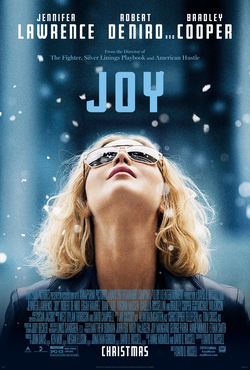
Joy (2015)

Joy rounds out a kind of thematic trilogy for director David O. Russell, but it’s a trilogy unified more by a stable company of performers – chief among them Jennifer Lawrence, Bradley Cooper, and Robert De Niro, with a few other bit players recurring in the mix. Of these, preceded by Silver Linings Playbook and American Hustle, Joy is perhaps the least successful of the lot – not by dint of being an abject failure but by never quite reaching the heights of the other two. Lawrence, however, turns in what might be her best performance yet.

Jennifer Lawrence stars as Joy Mangano, the QVC maven who made her millions with the Miracle Mop, a self-wringing cleaning device borne out of her own frustrations as a single mother living with both her father (Robert De Niro) and her ex-husband (Edgar Ramirez) in the basement. Bradley Cooper has a small supporting role as Neil Walker, the QVC exec who puts Joy’s product into the market.

Joy isn’t going to go down as Russell’s strongest film – I really do think Silver Linings Playbook holds that title – but I do think Lawrence has done her best work as a member of the Russell company, and I would put very real money on her seeing a third Best Actress nomination at the top of next year. As the eponymous Joy, Lawrence is riveting, from her beleaguered moments in the home to her natural charisma before the QVC camera. The film tasks Joy with representing the struggles faced by all women, and Lawrence is more than capable of bearing that weight.

That universality is one of the peculiarities of the film because I can’t help feeling that it would have been more successful had it adhered more strictly to the unique aspects of Joy’s story rather than an attempt to make her “every woman.” For one, I think the QVC sequences are among the best in the film, and I would have preferred this to be more than a small subplot. Russell has an eye for the innate strangeness of the QVC network, and a fuller treatment of that material (including the wonderfully strange cameo of Melissa Rivers as her mother Joan) would have been truly engaging – to say nothing of the chemistry that Lawrence and Cooper clearly have. Honestly, that’s the movie I thought we were getting, but sadly it’s unlikely we’ll see a Joy 2 that fleshes out that relationship in greater depth.

The movie keeps its eye tightly focused on Joy, often to the detriment of the other performers. It’s not that De Niro or Cooper are any less captivating than they usually are – De Niro is scene-stealing, particularly in an early tantrum about his ex-wife’s similarities with a gas leak – it’s more that there is just less of them to captivate. On reflection, it seems the largest supporting role belongs to Isabella Rossellini as Trudy, Joy’s principal investor and commercial mentor of sorts whose idiosyncratic approach to vetting entrepreneurs lends the film one of its greatest moments of empowerment. These moments provide glimpses of the A+ work that Joy might have aspired to be, had it taken off its Lawrence-shaped blinders.

Rotten Tomatoes has the self-congratulatory pun that the film “only sporadically sparks bursts of the titular emotion.” This joke misses the point of the film, because if you wanted a movie about joy you’ll have to check out Pixar’s summer offering Inside Out. This is instead a film about Joy, whose story is told reasonably well here, though the audience rightfully detects that Russell is capable of a fuller film than this. It’s perfectly serviceable, but transcendence belongs to the earlier films in this unofficial trilogy.

Joy is rated PG-13 for “brief strong language.” As might be expected, De Niro gets one F-bomb.

Monday, November 18, 2013

Last Vegas (2013)

We’ve come to regard The Hangover as a kind of golden standard which at least perfected the “weekend gone wrong” genre (if not kickstarting it).  And Last Vegas, with its all-star cast of Hollywood’s golden-year’d actors, has been marketed as a kind of Hangover for the over-50 crowd (or, unintentionally, 20-somethings like me).  But where Last Vegas sputters in places The Hangover soared, the film ultimately entertains on the sheer ethos of its A-list, A-game stars.

Last Vegas finds Michael Douglas on the eve of his marriage to his early-30s trophy girlfriend.  After convincing the reluctant Robert De Niro to join in spite of his “unresolved issues” with Douglas, Kevin Kline and Morgan Freeman fly to Las Vegas for the big reunion and the bachelor party for their perennially single friend.  Hijinks, of course, ensue.

Where The Hangover was innovative in the unexpected relentlessness of its rolling-in-the-aisles laughs, Last Vegas is the victim of its own marketing campaign, which tragically blew some of the best gags in the film (the rotating bed and Morgan Freeman’s window escape, to allude to a few).  And having seen the trailer more than once (the consequence of being a too-frequent moviegoer), these truly funny moments didn’t elicit much more than a weak chuckle – less than they deserved, but all I could muster.  There are a few genuine laughs (i.e., the conceit that a misogynistic “bro” mistakes the four friends for mobsters), but the best, to rework the old Browning poem, has already been.

Last Vegas never really surpasses the brilliant idea of “let’s get all our talented old people in one movie” (see also Red, The Best Exotic Marigold Hotel).  And not every movie needs to surpass convention, so if I dial back my standards of grandeur Last Vegas ends up being a pretty successful film.  The “Flatbush Four” are all reliably gifted performers and play to their strengths – Douglas the charismatic bachelor, De Niro the crochety East Coaster, Freeman the polysyllabic golden-throat, and Kline the goofy sidekick.  We know their work well enough to know what to expect, though a nice surprise comes from De Niro’s more heartfelt moments; from an actor who sometimes seems to phone it in, it’s nice to see a performance that (while not Oscar-worthy) still plucks a heartstring or two.  In fact, any one of these actors is worth the price of admission, and the combination of four can’t help but succeed, even in a bad movie (which, fortunately, Last Vegas isn’t).

The other nice surprise about the film – which, decently, the trailers didn’t spoil – is Mary Steenburgen’s lounge singer Diana, a keen counterpart to the testosterone-heavy cast.  (Sidebar:  I just realized she’s for this film what Heather Graham was for The Hangover.)  She won’t be passing any Bechdel tests any time soon, and I can’t say I was a fan of the predictable “older woman course-corrects girl-crazy bachelor” plotline, but at least the film keeps us guessing on which bachelor she’ll land.  Diana is a different brand of character than the competitive machismo fleshing out the rest of the cast, often calling out characters on their self-deceptions; it’s a clever storytelling technique which allows the film to be smarter than a less rigorous draft of the screenplay would have been.

Ultimately, Last Vegas didn’t knock me out like I wanted it to, but 90 minutes in the company of four of Hollywood’s finest is, to quote one of my professors from my first semester of graduate school, “as good a choice as any.”

Last Vegas is rated PG-13 “for sexual content and language.”  There’s a seduction scene in which nudity is implied, though we see nothing more than bare shoulders; there are a few unenthusiastic and brief innuendos, as well as (according to IMDb) one F-bomb and a few weaker profanities.  Quite tame, particularly compared to The Hangover.

Monday, March 11, 2013

Silver Linings Playbook (2012)

Academy Award winner Silver Linings Playbook makes this year’s list of “movies I got to because of the Oscars,” and it demonstrates a few important lessons to be learned going into 2013:  the romantic comedy as a genre isn’t as dead as I thought, Jennifer Lawrence is one of the most versatile actresses around, and Robert De Niro can still act his way through a movie without phoning it in.

Bradley Cooper stars as bipolar Pat, recently released from a psychiatric hospital after a messy separation with his wife.  While trying to reconnect with her in spite of a restraining order, Pat meets troubled widow Tiffany (Jennifer Lawrence), and the two strike up an unlikely friendship as they attempt to help each other through their problems.  Tiffany promises to help Pat reunite with his wife if Pat helps her win a dancing competition – and, incidentally, help his Eagles fan father (De Niro) win a bet in the process.

After The Fighter, this seems like a step away from what I’d come to expect from David O. Russell; the romantic comedy genre is a bit far from the heady biopic which finally won Christian Bale that Oscar.  But thank heavens that a fresher voice like Russell’s comes to a genre which has been otherwise formulaic, uninspiring, and often predictably pathetic, matching improbability with impotent self-importance.  The romantic comedy is a genre I’d long since written off, the clichés riddling it like so many bullets at the St. Valentine’s Day Massacre; give me Hepburn and Tracy any day of the week.  But Russell does something different here, creating something that still plays by the boy-meets-girl rules of the genre but without toadying to them.

While we’re on the subject of romantic comedies, thank goodness also that Russell didn’t cast someone like Katherine Heigl here.  Instead he’s gone with Lawrence, who is past shaping up to be one of the best actresses of her generation – she’s already there.  Lawrence is in that rare position of someone who does great genre work (see also X-Men: First Class and The Hunger Games) while knocking it out of the park with heavier stuff like this and Winter’s Bone (though the latter wasn’t really my bag).  Indeed, Silver Linings Playbook is not a perfect movie; the film stumbles between whether Pat’s devotion to his wife is endearing or delusional.  As such, the movie really takes off once Tiffany enters the picture; Lawrence imbues this potentially confusing character with an honest and unapologetic realism.  Where we’re not sure what to make of Pat, Tiffany isn’t transparent so much as she’s accessible and relatable; Lawrence is such a deft craftswoman that the character’s steely exterior doesn’t obscure the truth of her character.

The other cast members are quite good; Cooper is solid as ever, and Chris Tucker pops in to help you forget about the lackluster Rush Hour trilogy with an engaging supporting role as Pat’s confidant.  But the real surprise in the cast is that De Niro, after a long stint of roles alternating between uninspiring (Limitless and all those Fockers) and scenery-gobbling (Stardust and Machete), reminds us why he’s a great actor.  As Pat’s father, who’s sifting through his own issues while stepping on eggshells around his son, De Niro enters the pantheon of “movie dads you wouldn’t object to having.”  He never quite acts out of his own ethos, since you’ll always be thinking of him as De Niro first and Dad second, but he’s able to handle the extremes of his character with aplomb.  When he begins to weep over his son’s condition, it’s difficult not to be moved with him, but when he makes a key decision about betting on the dance competition he’s back to the same stammering repetition that elicited so many grins in Goodfellas.

All told, I’m still a bit surprised that Silver Linings Playbook got as much Oscar love as it did.  It’s not that the film is bad by any stretch of the imagination; no, once it gets going it’s quite enjoyable.  But it seems so far removed from the stalwart significance of the rest of the crop, like Argo, Django Unchained, and Zero Dark Thirty.  But perhaps if the film restores our confidence in the romantic comedy genre it also reminds us that sometimes the Oscars get it right; there’s enough good work being done here that I would have been complaining – especially had Jennifer Lawrence not taken home that trophy.

Silver Linings Playbook is rated R “for language and some sexual content/nudity.”  The F-word is used liberally (IMDB says 70+ times), and Pat is prone to erratic violent outbursts.  We see a woman nude from behind in a brief blurry flashback, while Tiffany and others speak about her promiscuous past.

Tuesday, December 18, 2012

Top 10 Christmas Season Movies - #8-7

This week, in anticipation of the Christmas season, we at The Cinema King would like to bring you more than just your usual share of recommendations.  So we present to you:  this week’s Top 10 list.  More specifically “The Top 10 Christmas Season Movies.”  Rather than fill the list with “obvious” choices of Christmas-y movies, there are a few “alternative” choices on the list – the overarching determining criterion is whether or not this is a movie that I will watch beginning to end, especially during (but not limited to) the Christmas season.

#8 – Edward Scissorhands (1990) 
Tim Burton’s fourth film is a solid choice for Christmas and a bit of a gimme for this list, but it’s one that doesn’t insist upon itself as a holiday film because of the absence of snow.  Ever the imaginative one, Burton sets the film in snowless suburbia, letting the spirit of the story take center stage.  And what a sweet story it is, a contemporary fairy tale with that Burton edge; Johnny Depp is iconic as the titular silent protagonist, nonthreatening despite his bladed fingers.  His romance with Winona Ryder covers the sentimental requirement, and Burton’s trademark sly sarcasm toward the cookie-cutter neighborhood makes this a year-round treat.  But lest you forget why Edward Scissorhands makes this list, keep your eyes peeled for the ubiquitous Christmas lights and reindeer decorations, and the fabulist explication for why it snows during the frame story is as touching as they come.

#7 – Goodfellas (1990) 
I’ve already lavished praise on this film, one of Martin Scorsese’s gangster epics and quite possibly one of the greatest films of all time.  It’s sharp, it’s witty, it’s thrilling, and it’s downright entertaining, cementing Robert De Niro’s reputation and forging one for Ray Liotta and Joe Pesci.  But what’s it doing on a Christmas list?  It’s not exactly a festive film, what with the strong bloody violence and general criminality.  After the film’s major “Lufthansa heist” segment, in which the mobsters successfully pull off the score of their lifetime, they celebrate with – what else? – an office Christmas party, all set to The Ronettes’ “Frosty the Snowman.”  Though the décor is festive, the demeanor of Jimmy Conway (De Niro) is anything but; in fact, he’s downright Grinchy as he demands that his goons take back the mink coats and Cadillacs they’ve bought with their share of the loot.  You could even argue that this Christmas scene is the pivotal turning point of the film, for when the soundtrack shifts to Cream’s “Sunshine of Your Love,” you know that scowl on Jimmy’s face bodes ill for his little elves.

Come back tomorrow for #6-5!

Monday, December 3, 2012

Monday at the Movies - December 3, 2012

Welcome to Week Forty-Three of “Monday at the Movies.”  This week, in anticipation of Django Unchained we’re finishing up the last two Quentin Tarantino movies that haven’t been reviewed on the site; as we did with our Christopher Nolan retrospective, links are provided to the reviews of the other films, in order of release.

Reservoir Dogs (1992)

Pulp Fiction (1994)

Jackie Brown (1997) – I’ve long considered this my least favorite Quentin Tarantino movie, in part because it’s the least flashy in his oeuvre.  But as I get older I’m looking at the film differently, and I think it’s actually one of his better films because of its aesthetic restraint.  Adapted from an Elmore Leonard novel (the only entry in Tarantino’s filmography not based on an original screenplay), Jackie Brown stars Pam Grier as the eponymous stewardess who schemes with bail bondsman Max Cherry (Robert Forster) and the ATF to take down kingpin Ordell Robbie (Samuel L. Jackson).  The three leads are all in fine form – Grier is believable as the kick-ass protagonist, Forster plays romantic but subdued, and Jackson is pitch-perfect as the villain – but the highlight here is how well Tarantino makes his homage to the blaxploitation genre without being consumed by it.  Tarantino has had a difficult relationship with homage, with some “loving references” feeling a lot like plagiarism (the burial of The Bride in Kill Bill, Vol. 2, for example), but here he seems tapped into the feeling of a blaxploitation movie (and even, with Grier and Sid Haig, some of the familiar faces) without sacrificing watchability for self-indulgence.  The film is smart and spirited, witty without being too wild.  The smaller parts from the ensemble cast – which includes Robert DeNiro, Bridget Fonda, and Michael Keaton – make this movie feel quite full, but it’s a fullness that gives the film depth and relevance.  Rather than exist just as an homage, Jackie Brown is one of Tarantino’s more accomplished films, perhaps out of place in an otherwise exhaustively exuberant catalogue, but at the same time perhaps the most mature (in sensibility, not in rating) of his films.

Kill Bill, Vol. 1 (2003)

Kill Bill, Vol. 2 (2004)

Death Proof (2007) – Tarantino recently noted that he wants Death Proof to be regarded as his worst film, which prompted me to revisit it.  Originally part of the double-feature experiment Grindhouse with Robert Rodriguez’s Planet Terror, Death Proof stars Kurt Russell as Stuntman Mike, a serial murderer who victimizes two groups of women with his invincible stunt car.  The first group (including Sydney Poitier and Vanessa Ferlito) succumbs to Mike’s car and the objectifying male gaze of the camera; this is Tarantino at his most exploitive, and it seems that the lusty way he films these women is less an homage to the genre of female revenge film and more a personal fetish given celluloid life.  Though Russell is better and more badass in this first half, the problematic treatment of women borders on deplorable.  The second half attempts to redeem these sins, with another group of women (including Rosario Dawson, stuntwoman Zoë Bell as herself, and Tracie Thoms, who’s like a cross between Wanda Sykes and Samuel L. Jackson) taking on the task of revenge.  This group is more fun, in part because we spend more time with them and know them better, but that attention leaves Russell by the wayside, giving the film a very uneven feeling.  Tarantino’s dialogue is punchy, but everyone talks like everyone else.  The result is a film that on the surface is peppy and poppy in the “grindhouse” tradition, but if you look deeper the film is fraught with problems – of representation, of balance, of identity.  I enjoyed the film enthusiastically as a high schooler, but age has somewhat cooled me on this movie; if it ends up being the worst Tarantino film, I can live with that.

Inglourious Basterds (2009)

Be sure to check back later this month for a full review of Django Unchained, but for now that does it for this week’s edition of “Monday at the Movies.”  Between finals week and The Dark Knight Rises on DVD tomorrow, I’m gonna be pretty busy, but next Monday we’ll have a look at a few movies that wrestle with sanity (opportune timing for those of us going crazy for finals).

Monday, April 30, 2012

Monday at the Movies - April 30, 2012

Welcome to Week Eighteen of “Monday at the Movies.” Just when you thought we were out, we’re pulled back in to the world of The Godfather!

The Godfather: Part II (1974) – There are those who say the sequel is better than the 1972 original. I don’t know about all that (I’m incredibly fond of the first Godfather), but Part II is every bit as good as the film that preceded it. Simultaneously a prequel and a sequel, Part II juxtaposes the rise of immigrant Vito Corleone (Robert De Niro) with the tenure of his son Michael (Al Pacino) as he contends with moves for legitimacy in the Vegas casino industry, an assassination attempt facilitated by a betrayal from within, a Congressional inquisition, and a smiling enemy (Lee Strasberg as Hyman Roth) attempting to slide a knife in his back. For my money, the Vito chapters are stronger, although I appreciate the Michael scenes more each time I see the film for two reasons: one, I enjoy the difficult plot the more I understand it and recognize the subtlety; and two, Al Pacino’s performance here is likely his all-time career best. (Take, for example, the exchange between him and his wife when Kay tells him she’s taking the children.) As before, the supporting cast excels: Robert Duvall’s work as Tom Hagen reminds me how empty that part of Part III felt, De Niro and Bruno Kirby are spot-on as Vito and Clemenza without feeling slavishly bound to the original actors, and John Cazale absolutely steals the movie as the malleable brother Fredo. In fact, Pacino and Cazale have what I maintain is the best scene of the film, a boathouse confessional which should have netted an Oscar for both; theirs is the relationship which anchors the film, for which I find myself, as I get older, returning to the film more than for the Vito plotline, which is amusing and entertaining, a lighter counterpart to the heavy burden with which Michael finds himself saddled by the film’s end. The first film needed no sequel, but the second proved how much more could be added to the saga; having only seen the third installment once, I’ll be curious to see if it transcends this film’s sense of completion.

Stay tuned for the final Godfather review. But for now, that does it for this week’s edition of “Monday at the Movies.” We’ll see you here next week!

Saturday, September 4, 2010

Machete (2010)

Attention Alexandre Aja and the rest of the crew who owe penance (or at least a partial refund) for Piranha 3D: Robert Rodriguez's Machete is how you do a B-movie.

Straight from the Grindhouse trailer, Danny Trejo leads one of the most eclectic casts in Hollywood history as federale-turned-day-laborer Machete Cortez, who immigrates illegally to the United States after his family is murdered by Mexican drug lord Torrez (Steven Seagal). Once stateside, Machete is hired by Michael Booth (Jeff Fahey) to kill border reformer Senator John McLaughlin (Robert DeNiro). Double-crossed, Machete allies himself with immigration officer Sartana (Jessica Alba), taco vendor Luz (Michelle Rodriguez), and his brother/priest Padre (Cheech Marin) to avenge himself on the men who betrayed him. The ensemble cast also includes wild child April (Lindsay Lohan), bounty hunter Osiris (Tom Savini), and minuteman vigilante Von Jackson (Don Johnson).

Like all of Rodriguez's best work, Machete is brutally violent and equally brutally fun, ignoring the laws of physics in favor of scenes that are so breathtakingly cool that you'll find it tough to swallow your popcorn for all the raucous guffawing you'll be issuing. Rodriguez finally turns the leading man reins over to Danny Trejo, who proves himself adroit at being more than meancing window dressing on the sidelines of films like Once Upon a Time in Mexico. Having cut his teeth in Rodriguez films, Trejo is a perfect fit for the off-the-wall sensibility that governs the film, delivering lines like "Machete don't text" with a deadpan humor that belies a recognition of the film's own campy nature. It's here that (and I'll try not to do this too frequently in the course of this review) Machete succeeds where Piranha 3D failed - by carrying itself off without mugging vigorously for camp appeal, Machete is a true homage to B-movies precisely because it keeps its tongue - and not its entire mouth - in cheek.

With Trejo as the star of the film, second billing really ought to go to the trademark Rodriguez style of relentlessly accelerated action, which comes out here in full force. There are moments when a plot about illegal immigration and a heavyhanded political statement (heavyhanded only because it's never given time to develop beyond a rapid boil), but these are mere placeholders to allow for a little downtime between high octane action pieces like Machete's escape from a hospital using only a bonesaw and an enemy's intestines. With characteristically improbable violence - such as one character, stabbed through the gut, delivering a nihilist monologue - surrounding delightfully hammy dialogue ("God has mercy; I don't"), Machete is a winner for knowing that delicate balance between entertainment value and legitimate dramatic style.

Machete is also remarkable in that it manages to assemble the strangest cast of actors and actresses - and make them all fit together like jigsaw pieces in a movie that shouldn't work but does. There's no question that some of these people can act - Robert DeNiro and Don Johnson have more than proven themselves, and Jeff Fahey is always a hoot (between this, Planet Terror, and his turn on Lost) - but Rodriguez finds a place for Jessica Alba and Lindsay Lohan, who are, shall we say, significantly less talented. The strangest thing is that Steven Seagal even manages to fit into the movie, despite being entirely one-note and bogged down with personal baggage and a history of parody as long as my grocery list. This is less a credit to the cast than it is to Rodriguez, although I must give a hearty handshake to the cast for not appearing too cool for the room; we know DeNiro is practically slumming to do a movie directed by the mind that brought us The Adventures of Sharkboy and Lavagirl, but at least he's a good sport about it and steps into the spirit of things (which is to say, larger than life in very broad strokes) fairly quickly.

Notice that I've not made claims to the film being a "great" film. That's because it's not. Nor does it pretend to be. What Machete professes to be is exactly what you'll find underneath the wrapper - another of Rodriguez's "Mexploitation" films, made on the cheap but with an earnestness that excuses the meager budget and dazzles the eye with a cast who's interested in having as much fun on this playground of a picture. If you're willing to leave your disbelief at home (merely suspending it probably won't do), Machete will be as much fun as you're looking for. If nothing else, it's far and away the B-movie of the year. (Nice try, Piranha 3D.)
Machete is rated a hard "R for strong bloody violence throughout, language, some sexual content and nudity." Blood flies everywhere and everywhen, with knife fights and a few spats of gunfire dominating the action of the movie. F-bombs pepper the dialogue like a tangy mole sauce, and Machete (spoiler warning?) lands in bed with pretty much every woman in the film, resulting in some toplessness and rear nudity in three scenes.

Tuesday, July 6, 2010

Raging Bull (1980)

Move Raging Bull off of the "I can't believe I've never seen this" list and onto the "great American classics" list.

Martin Scorsese's "rebirth" picture, made at a tumultuous time in the film icon's life, is a biopic about boxer Jake La Motta (Robert DeNiro) on his way to a title challenge. Raging Bull follows Jake from his first fights to his later years of ignominy as a nightclub performer, but the film spends less time in the ring and more time examining the ways in which Jake's paranoia ends up dismantling his relationships with his brother Joey (Joe Pesci) and his gorgeous second wife Vickie (Cathy Moriarty).

Raging Bull is many things at once - a feat that many films reviewed on this blog have tried and failed - but the most significant thing that it is not what a first-time audience expects. I had assumed I was in for standard biopic fare, a rise and fall story on a par with pretty much everything else Scorsese has done (and done well); imagine my surprise when boxing scenes take up very little of the film's runtime and lets the focus linger on Jake's private life - a move that makes an interesting statement about what makes a life significant. It is our relationships, Scorsese suggests, that define us, and consequently it is our own nature that determines how our relationships are to progress.

Raging Bull is dominated by absolutely gorgeous and breathtaking cinematography on Scorsese's part. While every Scorsese picture reviewed herein on this blog has earned high marks for aesthetics, the decision to film Raging Bull in black-and-white almost makes (as distinct from "breaks") the movie. The subconscious associations with nostalgia, the past, and moral absolutism - as well as the accompanying paranoia that befalls La Motta - create an ironically vibrant atmosphere amid the grayscale visuals on the screen.

This is due also in large part to DeNiro's stellar central performance. I think DeNiro - like Al Pacino, who's often connoted with him - has a tendency to phone in performances; there's nothing particularly stellar about his work in Meet the Parents or Jackie Brown, but he's earned a certain "DeNiro credit" for past services rendered. So if you're wondering why DeNiro is considered a top actor, look no further than Raging Bull, in which DeNiro plays a range of emotions and personality traits within one very complex yet fully plausible figure. All this is to say nothing of the sheer physical tranformation exhibited on the screen; no fat suits here - the extra pounds DeNiro carries as an older, doughier Jake La Motta are the genuine article. Featured co-lead Pesci (here in one of his earliest roles) does a solid job as the film's second banana, evoking lifelike chemistry with DeNiro and demonstrating his ability to be restrained rather than consistently over-the-top (as in Goodfellas and Casino). Moriarty kind of floats through this one, never misstepping but merely existing for the purpose of coming between Jake and Joey; she's pretty, which is all the script asks of her, but she doesn't have enough of a presence to ever take the spotlight away from DeNiro and Pesci - which is, of course, a good thing.

Like Casino, Raging Bull isn't exactly the kind of movie about which I can immediately gush after seeing it. In fact, the movie is unsettling in a lot of places: La Motta's fall from fame is heartbreaking, and his brief stint in prison is so violently uncomfortable that it's difficult not to look away (the latter being a perfect example of Scorsese's gift at knowing when not to cut a scene). It's also not straightforward (also a good thing), deftly avoiding cliches that in 1980 hadn't even been invented yet and thereby remaining freshly original. Though it's not a comfortable film, it's a viciously well-made one, representing the apex of the creative partnership betwixt Scorsese and DeNiro - two American filmmakers doing some of their finest work.

Raging Bull wouldn't be a Scorsese movie if it weren't rated R, this time ffor some very strong brutal violence - most of it set in the boxing ring - as well as about 100 F-bombs and occasional moderate sexual dialogue. One of Scorsese's tamer movies, but it's got its moments.

Thursday, June 24, 2010

Casino (1995)

The Martin Scorsese showcase continues here at The Cinema King with 1995's Casino, Marty's second and final collaboration with writer Nicholas Pileggi, his third and final with Joe Pesci, and his eighth and (to date) final with Robert DeNiro.

In many ways, the idea of this film being a "final" film is brutally apparent, as the film is another rise-and-fall story - albeit heavy on the "fall." When the film begins, Sam "Ace" Rothstein (DeNiro) has it all: a foolproof way to beat the odds whenever he bets, a kingdom in the form of the Tangiers Hotel and Casino, and a beautiful wife Ginger (Sharon Stone). His childhood friend Nicky Santoro (Pesci) doesn't have quite as much, but he comes to Las Vegas in order to take what he doesn't have. Ginger, meanwhile, has her jewelry, her former pimp (James Woods), and her problems with substance abuse. These three, against which is set the ultimate fall of Las Vegas from the Mafia's hands into the hands of corporate American tourism, have everything to lose, and their own personal ambitions make sure of it.

I've always thought of this film as the unofficial sequel to Goodfellas, both because of the DeNiro/Pesci/Scorsese reunion and because of blatant thematic similarities that make these two almost impossible to watch or review separately. Viewed almost back-to-back, I'm prepared to say that Goodfellas is the better of the two, but only in the same way that The Beatles are better than The Rolling Stones; that is, though both have undeniably epic qualities to them, there's something a little more polished about the former that makes the coarser qualities of the latter more difficult to appreciate. While Goodfellas is a 10 in my book, Casino hits closer to a 7 or an 8, for reasons to be discussed below. [Be warned that I'm going to begin discussing the film's main themes, which in turn involves some reveal of the film's ending. Though it pains me to do this for any who haven't seen the film, a) you already know my take on Casino, and b) Scorsese movies are always best discussed like Shakespearean tragedies instead of conventional Hollywood films - with full view of the ending, which is less about surprise and more about revelation.]

The atmosphere of finality pervades the entire film, so much so that its ending is entirely gloomy and perhaps unsettling for many viewers. Where Goodfellas ended on a sadly poignant note, marking one man's fall and the very personal toll it took upon him, Casino represents the end of an era - and not just in a metafictional kind of way, though this being Scorsese's final Italian Mafia picture counts, too. Casino is all about the ways that personal vice destroy lives, which are in turn interconnected with other lives. Sam, Nicky, and Ginger represent a precarious pyramid perched atop an even larger pyramid, and the actions of one could topple the whole thing like a house of cards. Nowhere is this more apparent than in a key scene in which one mob underling's grumbles in his family's deli end up on an FBI wiretap, which subsequently leads to increased federal scrutiny, which then leads to the fall of the mob's control of Las Vegas. Yet within this issue is the microcosm of Sam Rothstein and his own personal trials - very few of which he passes in the long run.

Not to mention that almost everyone ends up dead at the film's conclusion. Where prison and ignominy awaited the Goodfellas, almost all the characters in Casino who don't go to prison wind up buried in a hole in the desert - a denouement composed in montages of operatic brutality which reflect none of the lighthearted sensibilities that governed Goodfellas. Perhaps, then, my comparative favoring of Goodfellas over Casino stems from the degree to which the respective endings leave me feeling fuzzy; there is very little joy in Casino, which plays out much more like an epic tragedy than a personal narrative about individual consequences.

The performances aren't quite as good as in Goodfellas, due in part to the conspicuous absence of the uber-talented but perenially underused Ray Liotta. DeNiro isn't as strong here as previously, though he's a few steps above phoning it in; his portrayal of Rothstein is believable but not layered enough to be abundantly interesting. His character is one-note and a little predictable, making the film overall less enjoyable. Pesci, though, steps his game up a notch; where Tommy DeVito was unpredictable in terms of his violence in Goodfellas to the point of being surprising each time he lashed out, Nicky Santoro is a con man of the first order, never telling anyone but the audience what he thinks and what his angle is. Scenes where he tries to play Sam and Ginger against each other mark high points in his deception, and his cognizance of his own culpability in their collective fall is sterling - not to mention the fact that he's angrier here than ever. Don Rickles and James Woods turn in small parts, with Rickles revealing he's actually a talented dramatic actor while Woods is perfectly sleazy and entirely loathsome. And major props to Ms. Stone for making Ginger out to be a wholly repulsive character; she's a few levels above merely irritating because her acting allows us to understand her character (though we certainly shouldn't agree with her).

The camerawork by Scorsese is as stylized and stunning as before, with quirky camera angles, inventive use of freeze-frame (although one moment freezes almost too long, to the point where I actually got up and walked over to my DVD player to check for scratches), and helpful employment of multiple narrators to enrich moments on screen; though DeNiro and Pesci provide the bulk of narration, the most useful voiceover comes from Frank Vincent as Frankie Marino, who complements his own performance by letting us know why he's lying to his boss and informing us about the kinds of emotions that are being concealed by a suspiciously stony exterior. If I had a complaint about the direction of the film, it's that Casino is three hours long. The story sprawls (but never stalls), making itself into an epic (there's that word again) that feels complete. Consequently, though I'm griping about length, I'm not sure what I'd cut; Scorsese has kept everything essential in the film, and so all I'm left to grumble about is an abbreviated attention span. Good work, Scorsese, but I as a viewer will take the heat for the film's runtime.

This is starting to sound like a bad review, but it's really not. Casino has less to immediately enjoy and more to savor in the long run. With the end in sight, multiple viewings help the perspective and the focus become clearer. What's more, I think this movie lends itself more to thoughtfulness than to appreciation. Where it's easier for me to gush about the things in Goodfellas that I love, Casino makes me pause and reflect a bit more. In the moment, there aren't as many gut-busters - though there's no shortage of moments where you'll say, "Rock on, Scorsese" - and so I encourage you to go thoughtfully to Casino, ready to think before you can fully enjoy the filmic bouquet.

Though not quite as magical as Goodfellas and perhaps a bit too long for some viewers, Casino is nevertheless a fine outing for Scorsese and a more than adequate swan song for many of his collaborators.
No surprise, Casino is rated R "for strong brutal violence, pervasive strong language, drug use and some sexuality." This one is even more violent than Goodfellas, with incredibly violent and gruesome moments littered with more than 400 F-bombs (and a few C-bombs tossed in for good measure), as well as substantive abuse of drugs, alcohol, and chain-smoking. and several characters are depicted having sex though brief rear nudity is shown once out of focus.

Tuesday, June 22, 2010

Goodfellas (1990)

Every once in a while, I like to cleanse my palate by watching a really good movie, a tried-and-true classic, a flick that deserves to be on a "greatest movies of all time" list (a category so rare I don't have a tag for it, but I probably should). This time around, the entry is Martin Scorsese's Goodfellas.

The true story of the rise and fall of American mobster Henry Hill (Ray Liotta), Goodfellas is a biopic that borders on the epic. It begins with the simple declaration, "As far back as I can remember, I always wanted to be a gangster." Soon Hill's dream comes true: he finds himself a mobster in league with the legendary Jimmy Conway (Robert DeNiro) and the unbalanced heavy Tommy DeVito (Joe Pesci, in the role that rightfully earned him an Oscar). Life is glamorous, and times are good for Henry Hill - his suitable-for-a-romantic-comedy courtship with Karen (Lorraine Bracco) even results in an initially happy marriage. But soon the walls start closing in - financial and domestic pressure make him take bigger and bigger risks, Tommy's encounter with an old rival (Frank Vincent) culminates in disaster, and members of a significant heist start getting sloppy - and Henry begins to crack under the pressure of the crumbling Mafia institution.

The plot may seem formulaic by now, twenty years on, but that's because Goodfellas set the standard for what a gangster biopic needed to be in much the same way that The Godfather (another Greatest Movie) had defined what a Mafia epic looked like. As such, the only word I can think of to describe Goodfellas is "definitive." (Well, that's actually not true. I can think of many more superlative adjectives, so stay tuned.) Everything about this movie - the performances, the script, the direction, the soundtrack - just clicks, and the two-plus hours simply fly by. As with all of Scorsese's great movies, there's not a scene here that's wasted, not one moment where you think, "I could go to the bathroom here and not miss a thing." Though not every scene is of critical importance to the film's plot, there's something to enjoy in each moment; if the plot isn't at the forefront, it's a knockout performance or dynamite direction to hold your attention.

In praise of the performances, I can only say good things. Each actor/actress, big role or small walk-on (keep your eyes peeled for an early Sam Jackson), is incredible in his/her part. The three leads - DeNiro, Liotta, and Pesci - are all at the top of their respective games here. While I loved him in The Godfather, Part II, here DeNiro is at his best: mildly subdued but with a simmering don't-cross-me attitude that conveys menace with each insincere smile. Liotta, of course, is the undisputed star (despite what movie marketing might suggest), and he's explosively exciting; even his narration (a cinematic technique I often find heavyhanded and lazy) is entertaining in a way that propels the movie forward while often providing an ironic counterpoint to the events on-screen (as when he narrates about the respect and happiness his new career brings, while showing us his unique way of destroying a parking lot filled with cars). And if DeNiro and Liotta are "simmering" and "explosive," Pesci is downright nuclear, a full-on H-bomb on two legs; though small on stature, Pesci is big on energy and absolutely lethal if provoked. Each of his scenes is unforgettable, the very definition of a supporting character who almost steals the show. That much of the film's dialogue was improvised is an even greater testament to the skill of the actors at play.

But I've long contended that Scorsese is the real star of his movies, because all his films have an undeniable stamp of Scorsese-ness that's compelling in a way that isn't showy (I'm looking at you, Tony Scott). With Goodfellas in particular, I found myself sitting up straighter - even though I've seen this movie dozens of times - and saying to myself and to the fellow viewers who straggled in after being seduced by the film's siren-like magnetic allure, "Man, Scorsese is directing the daylights out of this picture." Goodfellas features one of my all-time favorite scenes of any movie ever: a three-minute take (with no cuts or tricks) in which Liotta and Bracco stroll through a nightclub's side entrance, mingling with gangsters and the kitchen staff before getting a front table at a Henny Youngman show. It's a mesmerizing scene, made all the more breathtaking once you realize midway through that all you see has been coordinated in one Steadicam shot. And the movie is littered with moments like this that prove what a stellar director Scorsese truly is and how brutally mistreated he was by an Academy that honored the snoozefest Dances with Wolves and its "director" Kevin Costner.

But if you're not up for all that aesthetic mumbo-jumbo -- if you're just looking to have a good time with a movie -- Goodfellas is a perfect choice, because it's a lot of fun. Even many viewings and several years down the road, the film is nuanced enough that there's still something to excavate, digest, and enjoy. The film has a strong sense of humor, balancing dramatic gravitas with comedic levity, the perfect hybrid of which comes in Pesci's iconic "How am I funny?" scene; here Pesci grills Liotta about a glib remark of "You're funny" and quickly takes a bawdy laugh fest from zero to "ruh-roh" with speed that'll give you whiplash. The scene rebounds and oscillates several more times before its end, which solidifies it as one of the most audacious examples of cinematic synecdoche, perfectly summing up the movie's attitude about its characters and about itself. But what separates this from any other mob movie is the moral compass which governs Goodfellas and its director Martin Scorsese; violence has consequences (guilt being the worst of all), and no one lives "happily ever after" in a world of all take and no give. So while we can laugh at absurdly violent moments like Henry Hill walking brusquely across a street to bludgeon a would-be rapist, the repeated violence and the recognition that this is part of a cycle makes the laughter uncomfortable, opening our eyes to the idea that this isn't all fun and games.

But it is still exuberantly fun. There's something funny in almost every scene - a discreet look, a clever delivery, an editing cut that punctuates with (often dark) irony - and if you're not enjoying yourself on a visceral (much less intellectual) level, the fault lies not in the film but in yourself.

Often readers disagree with my take on the movies I review here (most recently, Eternal Sunshine of the Spotless Mind sparked a bit of online and offline debate), but on this subject there can be no debate. Goodfellas is a fantastic film, one of the greatest ever made.
Goodfellas is rated R, undoubtedly for its nearly 300 uses of the F-word, grisly graphic violence, implied sexual (mis)conduct, and general not-appropriate-for-the-kiddies quality.

Sunday, June 29, 2008

My Idols.

I suppose in a lot of ways I'm just trying to do what these guys are doing.