Showing posts with label Tobey Maguire. Show all posts

Monday, December 26, 2022

Babylon (2022)

I became a fan of Damien Chazelle almost overnight. I rented Whiplash, one of the only films ever to leave me physically shaking, shortly before seeing La La Land in theaters (twice) and breaking down in full sobs. First Man was an odd follow-up, a spaceman biopic after a big Hollywood musical, but Babylon feels a bit more a return to form. Again (and still), Chazelle is looking at what makes successful people tick, what pushes them to succeed beyond their comfort zones, and what price fame exacts on their souls. 

Babylon is bigger and it is more boisterous, a three-hour version of Hail, Caesar! by way of Quentin Tarantino, which begins with a pachyderm’s diarrhea and concludes with a long montage that serves as – unsurprisingly, given his past work – Chazelle’s big love letter to the movies. For my money, it’s a grand success until that finale, which overinflates the point made by La La Land in a movie that is already perilously extravagant.


Babylon is a sprawling film epic in the tradition of, say, Once Upon a Time in Hollywood, featuring a bevy of characters bumping into each other on the way up the showbiz ladder: aspirant and ingenue Nellie LaRoy (Margot Robbie), whose dreams of stardom occlude the perils along her way; silent star Jack Conrad (Brad Pitt), who speaks bad Italian while proposing marriage to a different woman every other scene; accidental stagehand Manny Torres (Diego Calva); jazz trumpeter Sidney Palmer (Jovan Adepo); and gossip columnist Elinor St. John (Jean Smart), who sees all and writes even more.


I knew just from the runtime that the decadence of Babylon was going to be the point, that its sheer exorbitance would likely be a comment in itself. La La Land was a tight two hours, but it seems that three-hour runtimes are becoming the way of the future; James Cameron needed the full three to give us the next Avatar film, while Wakanda Forever landed only twenty minutes shy. After the aforementioned elephant sequence, Chazelle stages an exorbitant party sequence that would make Baz Luhrmann blush with envy. It’s The Great Gatsby times a million, and how our protagonists react to and inhabit it will set the course for the next two hours and change.


Chazelle is a confident filmmaker, and the vast majority of the film is leisurely world-building, episodic sequences that explore the consequences of Hollywood’s meteoric rise. In some such episodes, our protagonists are asked to make moral sacrifices in exchange for fortune and glory; in others, they voluntarily sacrifice their dignity or their physical well-being for a shot at the big time. To sustain this episodic structure, a storyteller must be supremely confident and adept in ferrying the audience along, and Chazelle is certainly that, but he’s helped ably by a terrific cast.


As Nellie LaRoy, Robbie is electrifying. I’m not sure if her performance is sufficiently different from, say, her Harley Quinn to land her an Oscar, though the idea is being bandied about; she’s certainly manic and magnetic, like a dark Judy Holliday. Her chemistry with Diego Calva’s Manny is supposed to be star-crossed, but I sense that only Manny feels that way, and that’s precisely the point. This is a far cry from Mia and Sebastian of La La Land, perhaps because Babylon is largely more cynical. Meanwhile, Pitt’s terrific, as he always is, though one may be wondering why Jean Smart was given a role as toothless as Elinor until the third act, when Smart – in her role as scribe, prophet, and gatekeeper – gets an incisive monologue that could very well crop up in an awards season sizzle reel. Indeed, Elinor’s big speech makes a better summation of the film than Chazelle’s ending proper, which leads me to my conflicted feelings about the film’s ending.


I was deliberately not looking at my watch throughout the film but felt it must surely be on its way toward denouement when Chazelle began to stage his final episode before the film’s coda. Nothing I had seen so far prepared me for a terrifying performance from Tobey Maguire as mobster James McKay. In the film’s final act, Chazelle ratchets up the tension until the film descends into its own version of Dante’s Inferno – itself a perfect inversion of Babylon’s opener – with the ghastly Maguire as Virgil, our sunken-eyed guide into the underbelly of Los Angeles. From there, the film wraps up by telling us who will and won’t change, just in time for an epilogue that puts a button on the story. 


It’s almost as though Chazelle is in a rush to conclude the movie in time for his final sequence, which feels less like a satisfying and integrated climax and more like the final moments of Walt Disney World’s The Great Movie Ride. Without spoiling, Chazelle’s grand point had always been clear, and the extended conclusion feels like a less successful version of La La Land’s ending – which worked precisely because it was rooted in the characters. Here, though, Chazelle is making a broader point about the filmmaking industry, and when he acknowledges, for example, Singin’ in the Rain, he tips his hand, gilding the lily and unfortunately suggesting that Babylon has just been an R-rated remake of the 1952 classic.


Babylon isn’t Singin’ in the Rain, but nor is it La La Land, which I maintain is still Chazelle’s best. If there’s an issue with Babylon, it isn’t that it lacks restraint or focus – its madcap meandering is precisely the point – but if it’s a shaggy dog story, the punchline needs to be a little more substantive and personal than where Chazelle leaves it. I still don’t know if La La Land ends on a happy, sad, or wistful note, but Babylon closes with one foot firmly in treacle, which is a sentiment the movie never fully earns. If the film had ended ten minutes earlier, this might have been a different review, but Babylon trips over its own feet right at the finish line – but what a race up until that point.
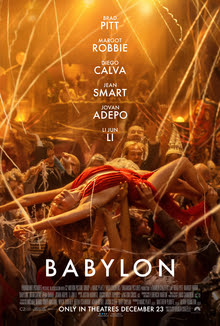


Babylon
 is rated R for “strong and crude sexual content, graphic nudity, bloody violence, drug use, and pervasive language.” Written and directed by Damien Chazelle. Starring Brad Pitt, Margot Robbie, Diego Calva, Jean Smart, Jovan Adepo, Li Jun Li, Eric Roberts, Jeff Garlin, and Tobey Maguire.

Tuesday, May 17, 2022

Take Two Tuesday: Spider-Man: No Way Home (2021) ... or, look out, here comes (another) Spider-Man

I haven’t done a lot of “Take Two Tuesdays,” but when I started back in May 2014, I set my sights on
The Amazing Spider-Man 2 and found that I liked it better than I thought. How appropriate, then, that I’m revisiting the “Take Two” premise with another Spider-Man film.

I’ve seen Spider-Man: No Way Home twice now on home video. With a 93% score on Rotten Tomatoes, nearly $2 billion in worldwide box office, and legions of fans declaring that it’s the best Marvel movie ever, Spider-Man: No Way Home isn’t actually very good. It’s entertaining enough, with flashes of brilliance, but it’s over-reliant on nostalgia with a story that doesn’t hang together. And were it not for the pure unadulterated charisma of its leading performers, No Way Home would be an unabashed flop. 


You’re going to need to have seen the film for me to talk about why it doesn’t work, so spoilers follow for No Way Home (and, really, every Spider-Man film that came before it). I compared No Way Home to Avengers: Endgame, in that “No Way Home finds itself as the unlikely apogee of the eight Spider-Man films that preceded it.” And I’ve thought about this idea a lot over the last five months, mulling the difference between Endgame (which was built as a climax) and No Way Home (which is merely masquerading as one). I think No Way Home tries very hard to be the next Endgame, especially if you’ve seen every Spider-Man movie in the last twenty years.

Tuesday, May 14, 2013

The Great Gatsby (2013)

Whenever a movie includes a superlative in its title, it always sets up the inevitable puns for reviewers (both casual and formal) to shout, and after a while it gets rather tedious.  But when it comes to the subject of Baz Luhrmann’s adaptation of F. Scott Fitzgerald’s The Great Gatsby, to you, sir, I say, “Not so great, old sport.”

A relatively close adaptation of Fitzgerald’s novel, The Great Gatsby follows Nick Carraway (Tobey Maguire) as he recounts his life as a bond salesman in the New York of the Roaring Twenties.  After procuring an invitation to the most lavish party in town – which just happens to be right next door – Nick meets the owner of the house, the ever-optimistic Jay Gatsby (Leonardo DiCaprio).  As Nick and Gatsby become friends, Gatsby makes an unusual request – he wants to meet with Nick’s married cousin Daisy Buchanan (Carey Mulligan).

The great American novel, a story of enduring love, required reading for high schoolers the world over – all accurate descriptors for The Great Gatsby.  And it’s not that Luhrmann’s adaptation is absolute rubbish.  It’s just far from great, much less than such a work of literature deserves.  Luhrmann’s Gatsby is not without its virtues, but its weak points outshine the good ones such that I suspect that even Luhrmann devotees might be disappointed.

First, the good news.  DiCaprio and Mulligan are exemplary as Gatsby and Daisy, first-rate approximations of the characters they embody.  It’s difficult to imagine an actor whose own star power better personifies that of Jay Gatsby, the never-say-die millionaire whose optimism is matched only by his opulence.  (Sidebar:  when is DiCaprio getting that Oscar?  He consistently turns in solid work, and while I don’t think he’ll land one here I do think he’s long overdue.)  And Mulligan is solid as the emotionally vapid Daisy, languid in all the right places but without rendering Gatsby’s affection inexplicable.  We too might love Daisy if we’d known her that long ago.  Finally, there’s Maguire, who does exactly what the novel asked of Nick – he observes, he mediates, he explicates.

And therein lies the problem.  The film is too faithful an adaptation in this regard, situating Nick as the main character through whom the entire movie is filtered.  But that technique doesn’t work for a film, because we don’t need a character to explain what we’re meant to see; we can just see it.  Worse, there are moments where Nick narrates what he sees while the camera focuses only on him; in a cinematic medium, this is the equivalent of someone telling you about their summer vacation.  Because Luhrmann is known for such a highly stylized approach to visuals, it’s quite a surprise that he does this so frequently; we know he knows better, but why won’t he let us see what’s going on?  (This is all to say nothing of the odd framing device placed over the film that seems to conflate Nick with Fitzgerald, to varying degrees of confusion.)

As for the visuals, Luhrmann does a decent job with the big parties, lavish set pieces that show off the decadence of the Jazz Age.  It’s classic Luhrmann, velvet vomit to excess and glittery garland as far as the eye can see (and it looks grand in 3D, to boot).  I had initial apprehensions about the use of contemporary music, but I didn’t mind it in the feature film itself; the effect seems to be simulate the shocking avant-garde nature of the music that must have been played at Gatsby’s parties, and it seems comparable to Deadwood’s use of modern profanity in lieu of historically accurate vulgarities. 

But all told, I came away more than just a bit disappointed, surprised at how restrained the movie was in some points (especially for a director like Luhrmann), pleasantly satisfied with the performances, but more-than-mildly irritated with the decision to foreground such a passive observer like Nick.  Build me a movie not around his tepid narration but around the dynamic between Gatsby and Daisy, and I’ll be ready to call that Gatsby “great.”

The Great Gatsby is rated PG-13 for “for some violent images, sexual content, smoking, partying and brief language.”  So you know someone gets hit by a car, and someone else gets shot, and Daisy and Jay are seen in bed canoodling, while Tom has a mistress.  Then there’s all that party stuff that... well, I wouldn’t go so far as to say it’s not appropriate.  But it is weird that they rate movies for “partying.”

Tuesday, July 10, 2012

Tuesday at the Movies - July 10, 2012

A day late but not a dollar short (since we’re still free of charge), welcome to Week Twenty-Five of “Monday at the Movies,” in which I pregame for The Amazing Spider-Man with Emma Stone and the latter two Sam Raimi Spider-Man films.  (I reviewed Spider-Man [2002] back in May 2008.)

Easy A (2010) – There are some movie stars who can carry a film solely on charisma.  Perhaps the newest face in this crowd (which includes such personalities as Denzel Washington, Judi Dench, and Samuel L. Jackson) is Emma Stone who, while making her big debut in Superbad, garnered international attention for Easy A, a take-off on Hawthorne’s Scarlet Letter in which Olive Penderghast (Stone) becomes the talk of her high school after a rumor about her romantic escapades takes on a life of its own.  I’m a sucker for literary updates (most of the time, at least, but I make no apologies for digging Twelfth Night by way of She’s the Man), and here the story works because it doesn’t use Hawthorne as a crutch but rather winks at the relationship and self- references itself in a clever way; a similar relationship with the John Hughes canon is fostered, as well, and the comparison is a successful one.  But as for charisma, Stone is insanely charming, extraordinarily gorgeous, and unceasingly hilarious as Olive; if the script is campy, it’s on her shoulders that the film succeeds.  Credit, too, should go to the supporting cast, which includes Stanley Tucci as Olive’s scene-stealing father, Thomas Haden Church as her favorite and most sympathetic teacher, and Amanda Bynes as the school’s antagonistic “Jesus freak,” an inverse Penny Pingleton.  Though the film relies on Olive’s webcam as a narrative guide, it’s a bad gimmick that works because of Stone’s aforementioned charm.  While Easy A may not yet be a classic like 10 Things I Hate About You, it deserves to stand in those ranks.

Spider-Man 2 (2004) – Under the capable direction of Sam Raimi, Tobey Maguire’s second outing as Peter Parker stood for a long time as arguably the best comic book film (up until, y’know, The Dark Knight), and it’s still exceptionally strong almost a decade later.  Here we see the classic “second film” plotline of the hero questioning his place in society, finding trouble navigating the disjunct between secret identity and public persona, even – channeling the famous comic plotline – quitting the hero game for a time.  This thread is especially strong, ably guided by a strong screenplay which makes the webslinger’s struggle seem plausible but never forced.  Alfred Molina’s role as Doctor Octopus in particular contributes to the film’s success, layering the villain with a complicated mixture of pathos and psychosis.  Spider-Man 2 makes the smartest choice of all, which is to play itself almost completely straight, save for J.K. Simmons’s spot-on performance as J. Jonah Jameson (note to the rebooters – bring him back at all costs).  And if Spider-Man 2 is indeed a perfect superhero film, it’s because it avoids the temptation of the sequel to replicate and overfill, instead moving the series in a new direction and allowing its plotlines to breathe.  Reflecting on this film makes me think about the very nature of good reviews; it’s difficult to reach my standard 250 words because the film is exceptional.  In the words of Stan Lee, ’nuff said?

Spider-Man 3 (2007) – Take a breather.  Spider-Man 3 is not as bad as we remember.  The film is flawed, to be sure, but it’s not irredeemable; had it not been preceded by Spider-Man 2, things may have seemed different, but the film certainly suffers by comparison to its antecedent.  For the first hour, the film is strong, among the best of Raimi’s trilogy; consumed by revenge, Spider-Man hunts The Sandman while under the influence of a malicious alien symbiote which feeds on his vengeance and budding narcissism.  But the film escapes Raimi’s control near the beginning of the second act; the film is overfull, with Bryce Dallas Howard miscast as Gwen Stacy, who literally has nothing to do in this movie and whose absence would have no effect on the finished product.  What’s more, we have three villains (Sandman, Venom and New Goblin) who never get fully developed beyond shallow and poorly scripted motivations.  Worse, the film badly fumbles the symbiote plotline, opting for slapstick and easy laughs instead of focusing on the internal perversion and darkening of Spider-Man.  How much better might the film have been if we got a truly frightening Symbiote Spider-Man rather than the Emo Peter Parker we found tousling his hair and thrusting his pelvis?  What’s good about the previous films still holds – J.K. Simmons still aces his part, Thomas Haden Church as Sandman is another great villain – but Spider-Man 3 has a strong first act but spirals out of control like the Goblin’s glider.

That does it for this week’s edition of “Monday at the Movies.” We’ll see you here next week!

Wednesday, May 28, 2008

Spider-Man (2002)

A great many people will credit Bryan Singer's 2000 film X-Men with saving the superhero genre from the ignominy of Schumacher. To be certain, the X-Men franchise proved that comic book movies could be taken seriously. Yet I was always slightly more partial to Sam Raimi's Spider-Man. Maybe that's unfair, because I own both movies and rewatch them every so often.

Perhaps what makes Spider-Man the stronger of the two is its direct handling of "the origin story." Raimi walks us through the ins and outs of Peter Parker (Tobey Maguire, who seems like he was birthed by Stan Lee's original comic book), so that by the time he's bitten by the radioactive spider we feel intimately acquainted with the human side of the character.

And while Ian McKellan is a brilliant Magneto, nothing beats the almost inhuman split personality that Willem Dafoe delivers as Norman Osborne, alias The Green Goblin. Alternating between a desperate businessman and a maniacal fiend, Dafoe is at his peak here. His ability to deliver on multiple emotions in the same scene - as in the mirror scene here - should come as no surprise; Dafoe played Detective Kimball in the 2000 cult classic American Psycho, where he acted his part in three different ways (1 - positive of a character's guilt, 2 - positive of his innocence, and 3 - uncertain either way), edited together to allow the viewer not to get a grasp on his character.

The dialogue here is a little hammy, but one has to remember that it's based on a Stan Lee comic book. As Lee's famous creation The Thing might say, 'nuff said. What the dialogue does exceptionally well, though, is capture the first-person narration that comic books provide more readily than movies. Maguire's narration isn't awkward (as Kevin Costner's is in Dances with Wolves) or stilted (Sin City, though narrated poetically, left something to be desired with the inflection of its narrators).

And as a piece of art, the movie just looks good. The red and blue costume of our Friendly Neighborhood Web-Slinger stands out in stark contrast to the Green Goblin's... well, green suit. Sunlight on New York never looked so beautiful. And Kirsten Dunst, who's otherwise dull, glows in this movie. Maybe it's the red hair.

One can't critically review Spider-Man without at least touching on J.K. Simmons's spot-on performance as grizzly newspaperman J. Jonah Jameson. If Maguire was born of the pages of Marvel Comics, Simmons was the inspiration, because he couldn't be more flawless. Scene-stealing has never seen the likes of a performance like this and indeed probably never will. (Though I should give "props" to Cillian Murphy's scintillating turn as Dr. Crane / The Scarecrow in Christopher Nolan's 2005 Batman Begins, which may be the best comic book movie ever... until its sequel dethrones it)

Speaking of great comic book movies, Spider-Man 2 is generally considered to be among the best, if not THE best. Then came Spider-Man 3, the universally deplored threequel that gave us the travesty that is a disco-dancing Emo Parker. Try to forget that. The first film was a powerhouse. But "With great power comes great responsibility."