Showing posts with label fairy tale. Show all posts

Monday, April 10, 2017

Beauty and the Beast (2017)

It’s a tale as old as time, and it’s certainly one we’ve seen before. But for the first time in Disney’s ongoing project of remaking its animated classics into live-action big budget fairy tales (with or without a healthy dose of revisionism), Beauty and the Beast both makes the case for another retelling of the story and manages to be a compelling and potent riff on the original.

If you’re like me, you probably have vast swathes of the 1991 animated film committed to (or seared into) memory, and you’ll likely be singing along in your head to the musical numbers, which get a few bonus verses here and there but are otherwise largely unchanged. So too is the plot translated fairly directly to live-action: bookish villager Belle (Emma Watson) finds herself imprisoned in the castle of the Beast (Dan Stevens), a prince turned monstrous by a curse, in order to save her doddering father Maurice (Kevin Kline). While local ape-man Gaston (Luke Evans) pines for her, to the consternation of his compatriot LeFou (Josh Gad), the castle’s lusty candlestick Lumiere (Ewan McGregor), fussy clock Cogsworth (Ian McKellen), and maternal teapot Mrs. Potts (Emma Thompson) conspire to bring beauty and the beast together to lift the spell.

In the case of Disney’s continued remake renaissance, I wouldn’t say there’s been a complete win. Maleficent was at once too distant from its source material while simultaneously pulling its punches on that difference. Meanwhile, Cinderella and The Jungle Book were visually stunning but ultimately more of the same as far as the originals were concerned. With Beauty and the Beast, however, I recall thinking several times during the film, “Oh, so that’s why they remade this!” Between its new characters and its patched-up plot holes, elucidated backstories and added lyrics, this Beauty and the Beast is a lot like a new brand of your favorite flavor of ice cream. There’s a lot that’s recognizable and reminds you what you love about it, but there are added nuances that gives this incarnation a life all its own. (It’s like the time I discovered they made cookie dough ice cream out of monster cookies and M&Ms.)

Perhaps the greatest strength of the film is its cast, which is positively bang-on from the word “go.” Watson and Stevens are well cast as the star-crossed lovers, in a romantic plotline that doesn’t feel obligatory and includes a few very well-crafted turns of character that give believability to the courtship plot. (That one such moment revolves around a library is perhaps preaching to this bibliophile’s choir, but I’d fall in love with a beast too if he had a library of his own to make Alexandria blush.) That McGregor, McKellen, and Thompson are note-perfect is right up there with “Water Wet” in terms of headlines, nor should one be surprised by the frankly stunning special effects work. What’s genuinely surprising is that Evans and Gad create something really quite special in Gaston and LeFou. Though it’s by no means sympathy for the devil, the script gives Gaston a refreshing amount of psychological depth, and Gad plays LeFou with an understated tenderness that gives LeFou a few legitimate reasons to hang around a specimen as deplorable as Gaston.

Indeed, what Beauty and the Beast does quite well is clarify a few of the nagging details and polish up the bits that work in order to present a fresh version of the story to an audience who is a little older, a little wiser, and a bit more sophisticated. This is hardly an “adult” version of the story, but it does feel a bit more grown-up, more willing to go to places the original didn’t – the question of Belle’s mother, for one, and the aforementioned update to Gaston: neither of which changes the characters or the plot but brings them into sharper focus.

Perhaps most importantly for this moviegoer, Beauty and the Beast never forgets to embrace with exuberance the playful weirdness of a film that includes a talking wardrobe, a barking footstool, and a boisterously romantic candlestick who turns a dinner invitation into something out of Busby Berkeley. It is the kind of film that touches the heart in the right places but isn’t embarrassed to leave you with a big dumb grin on your face as a talking clockface excretes gears in alarm. It’s a film that has more emotional range than we have any right to expect from a remake of an animated fairy tale.

But it’s also a film that, as the song goes, may have something there that wasn’t there before. I’m reticent to call it a brain or a heart or something so reductive, nor do I want to chalk it up to je ne sais quoi, though one character actually does. But unlike some of Disney’s more recent live-action updates, it has an unflappable demand to exist and ends up a worthy successor to the original.

Beauty and the Beast is rated PG for “some action violence, peril, and frightening images.” Directed by Bill Condon. Written by Stephen Chbosky and Evan Spiliotopoulos. Starring Emma Watson, Dan Stevens, Luke Evans, Josh Gad, Kevin Kline, Ewan McGregor, Ian McKellen, and Emma Thompson.

Monday, March 16, 2015

Cinderella (2015)

With Maleficent (mercifully) behind us and a live-action Beauty and the Beast yet to come, we’re in the midst of a live-action reinvention over at the House of Mouse.  While I do have some reservation regarding the overall necessity of the move, I do think that Cinderella acquits itself better than Maleficent thanks to its narrative fidelity and its frankly stunning production value.

In what is essentially a remake of the 1950 animated Disney film, Lily James stars as Cinderella, left after her father’s passing in the care of her evil stepmother Lady Tremaine (Cate Blanchett).  After a chance encounter with her Prince Charming (Richard Madden), Cinderella makes every effort to go to the ball, with a little magical assist from her Fairy Godmother (Helena Bonham Carter).

The most striking thing about Cinderella is, surprisingly, the clothing.  I cannot recall ever being as impressed with costume design as I was with Sandy Powell’s work on this film.  (Fun fact:  she’s also the costume designer for my all-time favorite film, The Departed.)  Perhaps some credit is due to the cinematography, but the colors in the film really pop in a way that dominates my overall impression of the film – Cinderella looks spectacular.  The dresses of Lady Tremaine and her daughters very plainly communicate their interior ugliness, doing so with a flair that Powell has described as nineteenth century by way of the 1940s.  Cinderella’s dresses, too, are incredibly vibrant, matching well the Prince’s royal finery.

The film overall has a very polished look which I credit to the very pristine direction of Kenneth Branagh, who does fairy tales with the same elegance he brings to Shakespeare and superheroes.  There are a few nods to both – from Hamlet, both Derek Jacobi and fencing, and from Thor, Stellan Skarsgard – but more importantly, Branagh brings his trademark earnestness to Cinderella.  It’s honestly a little jarring to go from the delightfully revisionist Into the Woods, in which Cinderella’s indecisiveness clashed with Prince Charming’s insincerity, to a film which wholly believes in the happily-ever-after genre tropes.

Despite the well-crafted nature of the film and the strong performances all around, there is still the lingering question of whether there is a need for another treatment of Cinderella which doesn’t really distinguish itself too strongly from the versions that preceded it.  This is, of course, the question asked of every remake at one time or another, and my chief complaint about Maleficent was, you’ll recall, that its contributions to the revisionist project were so uneven that the best scene was the one that took the fewest liberties, so clearly there’s a threshold of acceptable innovation/transgression.  Cinderella succeeds, I think, on the grounds that it steers a very straight course through the familiar elements of the plot in an even and engaging way, but as content as I felt during the end credits there was still the sensation that I hadn’t actually seen anything new.

Now, to be fair, Cinderella goes 180-degrees from Into the Woods by making the Prince more, not less, compelling; where Sondheim’s Prince “was raised to be charming, not sincere,” Cinderella gives us a prince bristling at his royal obligations, more interested in marrying for love than for obligation (subtext that I don’t recall being quite so present in the animated film).  It also recognizes that Cate Blanchett is phenomenally gifted, so Lady Tremaine’s wickedness is played up as well as explored near the end of the film as she monologues about her motivations.

Ultimately, then, I’m in an unusual place with Cinderella.  The creative team responsible have created something that amounts to a very good cover band version of a classic with a few neat solos in the middle there, but there’s a curmudgeonly bit of me that wants to cling to the original because the new isn’t different enough.  Then again, I think of all the children in the theater with me that afternoon, and I realize that for them this film likely is the definitive Cinderella, and I don’t think that’s such a bad thing.  Maybe the better metaphor is that of translation, the act of going from one language (animation) to another (live-action), and it is on those grounds that Branagh’s Cinderella succeeds.

Cinderella is rated PG for “mild thematic elements.”  I suppose that’s due to the passing of Cinderella’s parents and the verbal abuse she endures at the hands of her wicked stepmother, but this is very nearly G-rated material.

Bonus review!  Cinderella is preceded by a seven-minute short, Frozen Fever – a sequel to (you guessed it), Disney’s wildly profitable Frozen from two Christmases ago.  The short finds Elsa (Idina Menzel) prepping the kingdom for the birthday of her sister Anna (Kristen Bell).  Only two things stand in the way – the snowman Olaf (Josh Gad) is trying to eat the cake, and Elsa has a head cold.  The cynic in me thinks that Frozen Fever is a long advertisement for plush toys of the snow-babies created whenever Elsa sneezes, but aren’t they cute?  By nature of being so short, Frozen Fever isn’t long on substance, but it does continue the film’s emphasis on the sisters’ relationship over a romantic one between Anna and Kristoff in a way that is more refreshing than treacle.  The main song “Making Today a Perfect Day” is about as catchy as “For the First Time in Forever” from the main film, though it won’t, I predict, have the staying power of “Let It Go” (either in eternity or in your head).  All told, I’m a bigger fan of Disney’s original shorts like Paperman and Feast, though Frozen Fever is as pleasant as the “Toy Story Toons” we’d been getting for a while there, a fun pit stop with some familiar faces.

Monday, January 19, 2015

Into the Woods (2014)

I had so desperately wanted to begin this review with the fabulous line given to Little Red Riding Hood:  “Nice is different than good.”  Unfortunately for the sake of the pun, Into the Woods is both nice and good, a fine close to what has been another good year for Disney and perhaps the more sober alternative to the relentless cheeriness of the nation’s current Frozen mania.

The film’s opener sets the stage best:  “Once upon a time in a far-off kingdom there lay a small village at the edge of the woods, and in this village lived a young maiden (Anna Kendrick as Cinderella), a carefree young lad (Daniel Huttlestone as the bean-stalked Jack), and a childless baker (James Corden) with his wife (Emily Blunt).”  The curse of a witch (Meryl Streep) sets these characters into a quest through the woods, where they cross paths with Little Red Riding Hood (Lilla Crawford), a pair of narcissistic princes (Chris Pine and Billy Magnussen), and a Big Bad Wolf (Johnny Depp).

As someone unfamiliar with the stage play – and deliberately so, in order to take the film on its own terms – I can’t help but see Into the Woods as another fabulous step forward for Disney in its current phase of self-reflexive reinvention.  Those who don’t know the play might be surprised, as I was, by the film’s clever fake-out climax which delivers the “happily ever after” about forty minutes too early and then dissects just how untenable that ending would have been – warts, discontents, and unfinished business.  It’s smart stuff, the kind of revisionist fairy tale that we’re seeing played out in stuff like the Fables comics and, more closely to Into the Woods, the true-love fallacies of Frozen and Brave.

As for the lyrical elephant in the room, Stephen Sondheim’s trademark syncopated style of “talk singing” isn’t for everyone, and even folks who liked Tim Burton’s Sweeney Todd adaptation from a few years back will find Into the Woods somewhat less melodic, governed more by motifs than catchy tunes.  For me, I liked the music enough to go out in search of the soundtrack, if only for the tour de force “Prologue,” a fifteen-minute introduction to all the characters and major plots that also gives us the whimsical eponymous chorus “Into the woods / It’s time to go...”

I like the music, but I’m sure it’s because the performers are all quite charismatic.  I can’t think of many actresses who could sell a line like “I caught him in the autumn in my garden one night!” – but, as the oft-quoted line from Modern Family goes, “Meryl Streep could play Batman and be the right choice.”  Streep, who did Mamma Mia! with more class than anyone expected, lends the Witch an equal dose of class, and she does wonders with the maternal scenes with Rapunzel as well as absolutely killing it in the witchier bits.  I honestly don’t have a bad word about any of the aforementioned cast, although I’ll throw in the two-cents that I really could have used more Johnny Depp.  Touted as a centerpiece of the ensemble cast, Depp only appears for about five minutes – which are captivating, don’t get me wrong, with his vaguely pedophilic Wolf devouring scenery and children in one fell gulp.

I think the reason I fell so fast in love with Into the Woods, aside from the equally captive audience sharing the theater with me, is that the characters are very well-crafted and – tragically, a rarity these days – eminently likeable.  Everyone, from the Baker and his wife to Red Riding Hood, has a story arc, compelling motivations, and at least one ingenious turn of phrase (either by smart rhyme or admirable manipulation of rhythm).  When things don’t go well for them, the audience feels it; when the characters triumph, we feel it even more.  This is a musical adaptation that remembers those of us who don’t already love the story, so director Rob Marshall works extra hard to get all of us swept away by the once-upon-a-times.

And while I’m on the subject of the captive audience, Into the Woods is an effortless crowd pleaser, even amid a somewhat gloomy ending.  There’s something for everyone in here, plenty of year-end spectacle and spectacular performances:  “It Takes Two” is a catchy and slyly romantic duet, where “Agony” is the musical number that’ll elicit the most laughs as the Princes compare male-privilege sorrows.  Into the Woods manages to be self-reflexive without being overtly cynical – “Careful the tale you tell” seems to be the moral of this story, and it’s evident that the filmmakers have been very careful indeed.  What more can I say?  I had an infectiously good time, escapism layered with enough narrative criticality not to feel like a brain-drain.  I’d happily go back into the woods once more.

Into the Woods is rated PG for “thematic elements, fantasy action and peril, and some suggestive material.”  There’s fairy-tale discussion of curses and creatures, though the film darkens considerably in the second half when a giantess walks the earth and several characters die in emotionally-charged sequences.  The Wolf is played as a metaphor for sexual awakening with pedophilic overtones, while the Prince’s philandering ways lead to serious questions about seduction and fidelity.  All told, though, this is no less appropriate than most of, say, Disney’s late-90s offerings.

Thursday, June 19, 2014

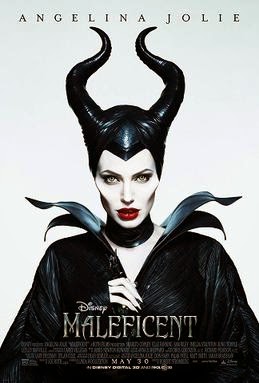
Maleficent (2014)

I won’t bury the lead on this one:  Maleficent is not an unwatchable film, but it is colossally disappointing.

And I won’t do the usual plot summary bit here because the plot of the film is essentially a “sympathy for the devil” take on Disney’s 1959 animated Sleeping Beauty, starring Angelina Jolie as the eponymous fairy queen who’s betrayed by the kingdom of men before she curses the young princess Aurora (Elle Fanning).  While this sounds like a prime opportunity to reinvent the story, promising us the version of the fairy tale we hadn’t heard before, Maleficent very much amounts to a pulled punch.

I’ll start with the good news, and it’s probably something you’ve already heard because nearly every film critic agrees:  Jolie is perfectly cast as Maleficent; she does a phenomenal job delighting in her own wickedness, she walks with the grace of a fairy queen, and her delivery captures flawlessly the intonations Eleanor Audley brought to the original.  And there’s a curious moment near the middle of the film where Maleficent restages the curse scene from the original Sleeping Beauty animated film.  I say curious because it is unequivocally one of the best moments in the entire film, and it leads me to wonder why Disney bothered with all the trappings of a retelling and didn’t just opt for a straight remake. 

I hate to be cynical, but frankly this film is aimed at the grungy Hot Topic crowd, who are probably going to love it.  Maleficent is part of Disney’s recent push to reinvent classic films, as with Tim Burton’s Alice in Wonderland and the upcoming Kenneth Branagh Cinderella (March 2015), but it’s not as successful as Wonderland was because it never commits to a core idea – or rather, it commits to too many.  Angelina Jolie is so good that her character deserves a better vehicle, one more certain of what it wanted to do with the character.  Either Disney should have given us the true between-the-scenes take on what Maleficent was up to, or it should have given us a truly sympathetic portrait of Maleficent the misunderstood.  Instead, the film tries to give us both, and the result is a film that never fully invests to itself.

It’s a cop-out to boot – either you want us to sympathize with the character or you don’t (or, if you’re Breaking Bad, spend six years exploring that gray area).  The film’s conclusion that Maleficent was both a hero and a villain is, truthfully, an evasion.  You do see the hand of uncredited rewriter Paul Dini here; he famously brought pathos to the backstories of many Batman villains in the early 1990s animated series, though the fact that only Linda Woolverton gets screenwriting credit suggests why Disney’s Maleficent can’t do in 97 minutes what Batman’s “Heart of Ice” did in 20.  (I’m referring, of course, to the definitive rebranding of Mr. Freeze as a tragic villain out to avenge his cryo-frozen wife.)

Honestly, I’m not sure if the bigger problem with the film is a studio that wants to have its fairy cake and eat it too, or if first-time director Robert Stromberg is juggling too much at once.  The film does have a very appealing look, and the shots are very interesting.  The special effects look good, especially the climactic dragon battle.  Interestingly, the film also participates in Disney’s recent trend of rejecting “love at first sight” and backing away from “love conquers all.”  With Frozen and Brave, Maleficent makes three films where the studio offers a self-reflexive critique of its early, easier boy-meets-girl narratives.  The difference is, however, that by now we’ve already seen this new spin, and the film doesn’t really break any new ground on that front.

Maybe I’m just being excessively vitriolic because I haven’t written a truly bad review in a while, and the bile’s built up.  I will say that I’m not sorry to have seen it.  I’m a fantastic Disney shill and will watch just about anything the studio puts out, and although it may not sound like it I truly do not begrudge Maleficent the ninety-plus minutes I spent watching it.  It’s fine for what it is, but it’s impossible to watch the movie and not see snippets of a much grander, more ambitious project.  But, as the film states explicitly, ambition is supposed to be bad, and so the result is a somewhat neutered update on a fairy tale which, this very update proves, didn’t need updating in the first place – at least, not the kind of halfhearted updating we’ve been given.

Maleficent is rated PG for “sequences of fantasy action and violence, including frightening images.”  The scene after Maleficent’s wings are taken is disturbing – many are reading it as a rape metaphor – and some blood is seen on her back.  As for frightening images, there’s nothing scarier than what a conventional Disney film offers; there is some swordfighting, and iron is seen to burn fairies in a few scenes.

Monday, June 25, 2012

Brave (2012)

I make no apologies for being a Pixar shill.  Their movies all do exactly what I want a film to do – transport me to a new world, move me in many emotional directions, and leave me with a memorable and complete story (arguably their strongest suit). 

And so it seems insufficient merely to say that Brave, Pixar’s latest offering, is a success.  We (that is, the royal we) assumed this much going in; therefore, it only remains to be seen how much of a success Brave manages to be.

Pixar dips into the princess business with Brave, a Scottish fairy tale about the tomboyish Merida (voiced by Kelly MacDonald) and her resistance to the idea of an arranged marriage.  Rather than obey her mother (Emma Thompson) and father (Billy Connolly), Merida wants to “ride through the glen, firing arrows into the sunset.”  But after a witch’s potion doesn’t quite change her fate the way she envisioned, Merida is left with only two days to make things right and mend her relationship with her mother.

The first thing you’ll notice about Brave, even without seeing it in 3D (which I didn’t, since my love affair with the extra dimension is waning), is how incredible the visual effects are.  The landscapes look natural, misting water might trick you into believing you’re not watching an animated film, and the abundance of detailed curly red hair can only be described as “Pixar showing off.”  With the clan of DunBroch, Pixar takes one more step toward indistinguishable perfection.

The other great Pixar talent on showcase here is their ability to create emotive, expressive nonhuman characters.  We know that they’re gifted at human faces (or even semi-human, as in the case of the Toy Story films), but the bear characters in Brave especially manage to communicate human feelings and motivations; better, none of the bears are indistinguishable, as each has a unique body language that allows us to know precisely – even if it’s a detail as fine as eye color – which bear is which.

The best example of nonverbal filmmaking, though, comes from the scene-stealing triplets Hamish, Harris, and Hubert.  These three never speak, but through their faces and their body language we know from scene one what these three rascals are like.  They’re crowd-pleasers, instant favorites, and a perfect example of what Pixar does better than any other animation studio – tact.  If this were a Dreamworks film, for example, we’d see a franchise around these three, running the joke into the ground.  (As it is, I’m kept awake at nights by the haunting specter of the “Afro Circus” song.)  But directors Mark Andrews and Brenda Chapman wisely keep the boys in check (at least, as in check as three little hellions can be kept).  But if the film merits a rewatch, it’s at least to keep an eye on these three.

As always, the voice cast matches well, although the small setting doesn’t allow for many trademark Pixar cameos (but John Ratzenberger is in there).  MacDonald is spunky and sassy without shortchanging the emotional moments when her character pivots, Thompson is stern but frustrated with her daughter, and Connolly seems to be channeling Brian Cox as the patriarch, reining in his madcap stand-up inflection for a (slightly) more dignified king.

It’s not Toy Story 3 by any stretch of the imagination – I maintain that that is Pixar’s crowning achievement, if only because I still cry just thinking about it – but Brave is another solid entry in the Pixar catalog, fun for the whole family and delightfully entertaining even for those of us who ought to be too old for this sort of thing.

PS – make certain you stick around after the credits.  No, Nick Fury doesn’t recruit Merida to join The Avengers (they already have an archer, after all), but the stinger scene does tie up a loose end.
Brave is rated PG “for some scary action and rude humor.”  There’s an evil monster bear running around, growling and mauling.  In addition, there are a surprising number of nude rear ends (all played for laughs) in this one, as well as a booger joke.  I think the latter two are a first for Pixar.

Tuesday, June 23, 2009

The Brothers Grimm (2005)

The Brothers Grimm is almost Kaufman-esque, in a way, as a story about stories. By extension, then, I suppose it's the Pirates of the Caribbean of Charlie Kaufman stories - it doesn't take itself too seriously. But at the same time, it's a Terry Gilliam flick, which means The Brothers Grimm is superlatively visually stimulating, but coherence is not to be expected.

Fortunately, The Brothers Grimm is to date the most accessible Gilliam movie (excepting the brilliant Monty Python and the Holy Grail) I've seen.

These ain't your momma's Grimm Brothers, that's for sure. As portrayed by Matt Damon and Heath Ledger, Will and Jake - not Wilhelm and Jakob - are the 19th century equivalent of Ghostbusters, liberating French-occupied Germany from all manner of witches and demons. We quickly learn that the Grimm enterprise is a sham, as Will & Jake are staging superstitious happenings in order to reap the profits for "defeating" the apparitions. Their fraud is unearthed by the villainous French General Delatombe (Jonathan Pryce) and his Italian torturer Cavaldi (Peter Stormare, best known as the killer from Fargo, Karl Hungus/Uli Kunkel from The Big Lebowski, and rogue electrician Slippery Pete from "Seinfeld"), who force the brothers Grimm to solve the mystery of the missing girls of Marbaden, a forest town filled with every fairy tale denizen you can imagine.

Coherent? Certainly. Spectacular? Not quite. Fun? If you're into this sort of thing.

The fun in the film comes from two places: the cast and the script. The cast isn't quite impeccable, since they never manage to steal the show from the vivacious visuals Gilliam provides, but they all do a nice job of creating memorable if cartoonish characters. Damon and Ledger (both of whom can do no wrong in my book, though I would have liked to see the original choice for Will - Johnny Depp) are the stars, and they've got a real chemistry as brothers that suggests a long history between the two. Ladies man Will often clashes with bookish Jake, and both Damon and Ledger do a solid job of instantly creating a plausible characterization and sticking to it throughout. Ledger's accent, though, is a touch distracting, an interesting combination of Sean Connery and The Joker circa The Dark Knight. Pryce and Stormare are far grosser caricatures, underspeaking a typically British xenophobia of all things continental; Pryce is a knockout as always, and Stormare brings his conventional slimy foreigner aura to his role. Lena Headey (the queen from 300) is negligible as guide/love interest, but Monica Bellucci - as the eerie Mirror Queen - carries well the seductive cruelty of her witchy character.

The script, tangled though it is in places (and admittedly muddy in others) is fun because it's filled to the brim with references, homages, and nods of the head toward the more commonly known career of the Grimm brothers and the fairy tale canon on the whole. Keep your eyes peeled for Snow White, Cinderella, Little Red Riding Hood, Hansel & Gretel, and even The Gingerbread Man (look out, cookie from Shrek). Of course, knowing the identity of the little girl wearing a red hood in the forest isn't essential, but it helps make the later joke - in which Jake jots down in his journal "Little Red Riding Cape" - more entertaining.

I admitted the film is muddy, and it's classic Gilliam mud. After knocking out essential exposition within twenty minutes, the film dispenses with most claims to a plot and instead focuses on the Grimm dynamic and the eye-popping spectacle sequences (like moving trees, cobwebbed horses, and mud with a face). Consequently, the movie gets a little difficult to follow, especially when the narrative jumps quickly from scene to scene with little but imagination to fill in the gaps. What saves The Brothers Grimm from being another Gilliam headscratcher is its existence in a fantasy world where normal rules don't apply. I often ask of a Gilliam film, "How could this happen? What exactly is happening?" Here, the film makes up its own rules as it goes along, answering the question by saying, "X happens because that's the way fairy tales work."

The Brothers Grimm might not leave viewers happily ever after, but you'll at least turn the page with a smile on your face.
The Brothers Grimm is inscribed with a rating of "PG-13 for violence, frightening sequences and brief suggestive material." Violence and terror come on the whole from spooky creatures and foreboding forest environs, which some younger viewers might find more eerie than entertaining. As for suggestive material, Will is implied numerous times to be quite the ladies' man, but this is subtle and not prevalent.