Showing posts with label Damien Chazelle. Show all posts

Monday, December 26, 2022

Babylon (2022)

I became a fan of Damien Chazelle almost overnight. I rented Whiplash, one of the only films ever to leave me physically shaking, shortly before seeing La La Land in theaters (twice) and breaking down in full sobs. First Man was an odd follow-up, a spaceman biopic after a big Hollywood musical, but Babylon feels a bit more a return to form. Again (and still), Chazelle is looking at what makes successful people tick, what pushes them to succeed beyond their comfort zones, and what price fame exacts on their souls. 

Babylon is bigger and it is more boisterous, a three-hour version of Hail, Caesar! by way of Quentin Tarantino, which begins with a pachyderm’s diarrhea and concludes with a long montage that serves as – unsurprisingly, given his past work – Chazelle’s big love letter to the movies. For my money, it’s a grand success until that finale, which overinflates the point made by La La Land in a movie that is already perilously extravagant.


Babylon is a sprawling film epic in the tradition of, say, Once Upon a Time in Hollywood, featuring a bevy of characters bumping into each other on the way up the showbiz ladder: aspirant and ingenue Nellie LaRoy (Margot Robbie), whose dreams of stardom occlude the perils along her way; silent star Jack Conrad (Brad Pitt), who speaks bad Italian while proposing marriage to a different woman every other scene; accidental stagehand Manny Torres (Diego Calva); jazz trumpeter Sidney Palmer (Jovan Adepo); and gossip columnist Elinor St. John (Jean Smart), who sees all and writes even more.


I knew just from the runtime that the decadence of Babylon was going to be the point, that its sheer exorbitance would likely be a comment in itself. La La Land was a tight two hours, but it seems that three-hour runtimes are becoming the way of the future; James Cameron needed the full three to give us the next Avatar film, while Wakanda Forever landed only twenty minutes shy. After the aforementioned elephant sequence, Chazelle stages an exorbitant party sequence that would make Baz Luhrmann blush with envy. It’s The Great Gatsby times a million, and how our protagonists react to and inhabit it will set the course for the next two hours and change.


Chazelle is a confident filmmaker, and the vast majority of the film is leisurely world-building, episodic sequences that explore the consequences of Hollywood’s meteoric rise. In some such episodes, our protagonists are asked to make moral sacrifices in exchange for fortune and glory; in others, they voluntarily sacrifice their dignity or their physical well-being for a shot at the big time. To sustain this episodic structure, a storyteller must be supremely confident and adept in ferrying the audience along, and Chazelle is certainly that, but he’s helped ably by a terrific cast.


As Nellie LaRoy, Robbie is electrifying. I’m not sure if her performance is sufficiently different from, say, her Harley Quinn to land her an Oscar, though the idea is being bandied about; she’s certainly manic and magnetic, like a dark Judy Holliday. Her chemistry with Diego Calva’s Manny is supposed to be star-crossed, but I sense that only Manny feels that way, and that’s precisely the point. This is a far cry from Mia and Sebastian of La La Land, perhaps because Babylon is largely more cynical. Meanwhile, Pitt’s terrific, as he always is, though one may be wondering why Jean Smart was given a role as toothless as Elinor until the third act, when Smart – in her role as scribe, prophet, and gatekeeper – gets an incisive monologue that could very well crop up in an awards season sizzle reel. Indeed, Elinor’s big speech makes a better summation of the film than Chazelle’s ending proper, which leads me to my conflicted feelings about the film’s ending.


I was deliberately not looking at my watch throughout the film but felt it must surely be on its way toward denouement when Chazelle began to stage his final episode before the film’s coda. Nothing I had seen so far prepared me for a terrifying performance from Tobey Maguire as mobster James McKay. In the film’s final act, Chazelle ratchets up the tension until the film descends into its own version of Dante’s Inferno – itself a perfect inversion of Babylon’s opener – with the ghastly Maguire as Virgil, our sunken-eyed guide into the underbelly of Los Angeles. From there, the film wraps up by telling us who will and won’t change, just in time for an epilogue that puts a button on the story. 


It’s almost as though Chazelle is in a rush to conclude the movie in time for his final sequence, which feels less like a satisfying and integrated climax and more like the final moments of Walt Disney World’s The Great Movie Ride. Without spoiling, Chazelle’s grand point had always been clear, and the extended conclusion feels like a less successful version of La La Land’s ending – which worked precisely because it was rooted in the characters. Here, though, Chazelle is making a broader point about the filmmaking industry, and when he acknowledges, for example, Singin’ in the Rain, he tips his hand, gilding the lily and unfortunately suggesting that Babylon has just been an R-rated remake of the 1952 classic.


Babylon isn’t Singin’ in the Rain, but nor is it La La Land, which I maintain is still Chazelle’s best. If there’s an issue with Babylon, it isn’t that it lacks restraint or focus – its madcap meandering is precisely the point – but if it’s a shaggy dog story, the punchline needs to be a little more substantive and personal than where Chazelle leaves it. I still don’t know if La La Land ends on a happy, sad, or wistful note, but Babylon closes with one foot firmly in treacle, which is a sentiment the movie never fully earns. If the film had ended ten minutes earlier, this might have been a different review, but Babylon trips over its own feet right at the finish line – but what a race up until that point.
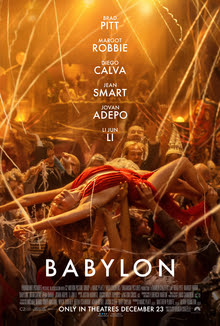


Babylon
 is rated R for “strong and crude sexual content, graphic nudity, bloody violence, drug use, and pervasive language.” Written and directed by Damien Chazelle. Starring Brad Pitt, Margot Robbie, Diego Calva, Jean Smart, Jovan Adepo, Li Jun Li, Eric Roberts, Jeff Garlin, and Tobey Maguire.

Monday, October 15, 2018

First Man (2018)

At the risk of opening myself up to relitigating 2016, it was the year Damien Chazelle demanded I take him seriously with La La Land, a beautiful film which I perhaps overhastily dubbed “best of 2016” (though then-runner-up Batman v Superman: Dawn of Justice has only risen in my estimations). He had physically rattled me with Whiplash, one of the only movies to leave me visibly shaking, but La La Land was something else entirely, revelatory and emotional, resonant and instant Personal Canon material. With First Man, a movie at once quite different and yet of a piece with his oeuvre, Damien Chazelle three-peats and earns himself a spot on my “worth a look” list.

Ryan Gosling stars as Neil Armstrong, the aforementioned “first man” on the moon in this biopic that begins with his application to NASA and culminates (spoilers?) with his walk on the moon. Claire Foy co-stars as his wife Janet, the emotional center of the film amid her husband’s obdurate refusal to acknowledge that his missions are increasingly dangerous.

As a true story, First Man is quite different from Whiplash and La La Land, and though it continues Chazelle’s exploration of the sacrifices necessary to achieve greatness, it puts the audience in the interesting position of knowing that Neil Armstrong does indeed succeed; we didn’t know if Andrew, Mia, or Sebastian would achieve their goals, which added a tension to those stories (and a heartbreak if the costs ever outweighed the results). With First Man, we know where this is going, which lets Chazelle and screenwriter Josh Singer flip the script and examine the emotional toll of this achievement and the grave uncertainty that leads up to it. Here Foy is particularly riveting, playing opposite a veritable cipher in the form of Gosling; where Gosling bottles up every emotion he has, Foy proves unable – or more likely, unwilling – to curb those feelings when they are killing her. Gosling, meanwhile, plays the portrait of restraint, single-minded focus with a twitchy flinch at the prospect of facing his fears. 

Also returning from La La Land is Justin Hurwitz on score duties, and I have to say it does show. There’s something about the way Hurwitz organizes a melody and a musical refrain that recalls the sweeping score of 2016’s top musical. New to Hurwitz’s repertoire is the theremin, underappreciated and right at home in a science-fiction movie (this being, of course, nonfiction); invoking the score from The Day the Earth Stood Still is never a bad idea, and hearing the theremin build up to the moon landing sequence proves highly effective. 

Equally (and perhaps more) successful is the way the film drops out most of the audio during the moon landing. There’s been much ballyhoo about “needing” to see the film in IMAX, and I’ll certainly agree that it’s a standout feature when the aspect ratio opens up and the film goes dead silent – I’ve never seen a theater audience that respectful of silence. Emphasizing that the only things on the moon with Neil are what he brings up with him, the score focuses on a swirling martial beat, John Barry by way of Hans Zimmer (or is it the other way around?), before ceding to the majesty of the lunar surface. It’s a breathtaking sequence, worth the price of admission even in spite of the fact that we know he’s going to stick the landing – Hurwitz and Chazelle give a real powerhouse of a moment.

The film ends on a much quieter note – I won’t spoil it, because the film does go beyond the moon landing just a bit. The silent closing sequence is tremendously powerful, even after the bombastic scope of the moon; it’s a potent scene between two performers who should earn Oscar nominations on those facial expressions alone. Whiplash left me shaken, and La La Land left me sobbing; First Man is somewhere closer to the latter end of the spectrum, but softer, less painful by far. It’s a poetic conclusion to a movie with a surprising emotional core, but then Chazelle has hit me with more than his fair share of sentimental sucker punches. Three in a row, at least, guarantees I’ll be in attendance for whatever he tries next.

First Man is rated PG-13 for “some thematic content involving peril, and brief strong language.” Directed by Damien Chazelle. Written by Josh Singer. Based on the book by James R. Hansen. Starring Ryan Gosling, Claire Foy, Corey Stoll, Jason Clarke, Kyle Chandler, and Ciaran Hinds.

Monday, January 2, 2017

La La Land (2016)

In one of the most famous passages from his Confessions, Saint Augustine realizes he has been moved to tears by the suicide of Dido in Virgil’s Aeneid. In hindsight, Augustine recognizes that the true tragedy was not the death of the Carthaginian queen but Augustine’s blindness to his own reality as a sinner – that is, he had no tears for the reality of his soul but rather had wasted them on the dimension of the imaginary.

I couldn’t help but think of Dido while I watched La La Land, Damien Chazelle’s eagerly-awaited follow-up to the masterful Whiplash, because it does feel like Chazelle is directly rebutting Augustine on this count. Yes, La La Land seems to declare, it is right and proper for us to weep for that which is not real, that which we cannot help but imagine in the language of film, for reality can often be dispiriting, unexpected, or filled with fear of the future.

Ryan Gosling and Emma Stone star as Sebastian and Mia, a jazz pianist and an aspiring actress whose paths continue to cross in Los Angeles until finally, inevitably, they surrender to temptation and fall in love. Amid the continual anxiety that they won’t make it in Hollywood, Sebastian and Mia inspire each other to pursue their dreams, even when they seem difficult and unattainable.

Aside from a few shots of single spotlights on jazz musicians, it’s difficult to tell that La La Land, wistful and nostalgic, comes from the same writer/director as the intensely furious Whiplash. Instead, La La Land feels like the postmodern thematic sequel to 2011’s The Artist, which reveled in the tropes of the silent film while reminding audiences of the acute sense of loss that came with the passing of an era. In the same way, La La Land embraces the aesthetic of the musicals of the 1950s (though in color, there are also affinities with the Fred-and-Gingers of the 1930s), lamenting the way that reality all so often fails to live up to the romanticized spectacle of a big Hollywood musical. Reality can be sweet, La La Land posits, but it’s got nothing on the polish and image surfaces made on a movie studio backlot.

And whether that makes the film’s final statement one of tragedy or beauty is, I think, in the eye of the beholder. If you have a romantic eye, thank God we have the movies; if yours is a cynical vision, how ignoble that we supplant reality with the image. But Chazelle is content to leave the rose-colored glasses of Hollywood in place as a filter, amplifying the emotions of the story by blowing them up into something extravagant, with a clever sense of humor that I hope isn’t lost on moviegoers. Mia and Sebastian’s first date takes them, naturally, to the movies, to see Rebel Without a Cause, but when things go awry they visit the Griffith Observatory, where parts of Rebel were set.

There, if we hadn’t been paying attention, Chazelle reveals his end game. What begins as a typical cute date turns into the fantastic (emphasis on fantasy) as they dance in the observatory and join the stars in a beautifully-shot midair waltz. It’s breathtaking in its unreality; there’s no doubt that this isn’t really happening – this isn’t Superman, after all; you won’t believe a man can fly – but isn’t it beautiful to imagine it so?

It’s really difficult to talk about this without discussing the ending of the film – and don’t worry, I won’t, because the third act has maybe the best gut-punch in recent memory, at least as far back as the last time my whole theater collectively gasped, at Frozen – so let’s shift gears and talk about the music. For those who, like me, still tremor a bit when thinking about the climax of Whiplash, there’s none of that in La La Land, thank heavens, but as far as the singing goes, I’ve seen a fair bit of critique laid at Gosling and Stone’s feet. While I do concede that they’re not the strongest singers on the screen these days, I do wonder if some of that is the point – Mia and Sebastian, as much as they want to be, are not stars just yet; Gosling’s piano playing, though, has rightly earned its share of accolades, and I do have to say that Emma Stone’s final number, “Audition” (as heard in many of the trailers), is as affective as Anne Hathaway’s “I Dreamed a Dream,” which in 2013 I described as a “heart-breaking . . . despairing ode that would drive even the stone-hearted Pharaoh to tears and will likely garner her an Oscar nod.” I have similar words to say about “Audition,” which pins all our hopes on Mia’s ability to connect with her auditioners, even as we quickly lose track of them and fall into the story Mia weaves.

La La Land is not Whiplash, although J.K. Simmons appears in both (here, he cameos as a club owner who’s a stickler for seasonal set-lists). Instead, it’s an elegy for a bygone film genre, a glimpse of a relationship which imagines itself in loftier terms, positing the question of whether “la la land” – suggesting Los Angeles, “la la” singing, and “la la” head in the clouds – is such a bad place to be. Under Chazelle’s watch, it’s anything but.

La La Land is rated PG-13 for “some language.” Written and directed by Damien Chazelle. Music by Justin Hurwitz. Starring Ryan Gosling and Emma Stone.

Monday, October 19, 2015

Monday at the Movies - October 19, 2015

Welcome to another installment of “Monday at the Movies.”

Whiplash (2014) – Look, do you need me to be one more voice in the litany of praise for JK Simmons’s tour de force role as a jazz band instructor who pushes his students to the brink of madness? If so, consider yourself adequately informed; Whiplash features a can’t-miss performance from the man you may only know as the newspaper editor from Spider-Man. Equal parts mesmerizing and terrifying, Simmons’s Terence Fletcher is the stuff nightmares are made of; think the Sgt. Hartman of jazz. In fact, at a brisk 100-some minutes, Whiplash might be the most intense film about jazz ever made, leaving me physically shaken in a way that I honestly can’t recall another film doing. I kid you not; I had lingering jitters for at least fifteen minutes after putting the DVD back in its case. I single out in particular an extended drum solo, which sounds far less compelling on paper than in its execution, to which I credit the frenetic editing and Damien Chazelle’s tight directorial work. The unsung hero of the film is Miles Teller, who plays the drumming prodigy protagonist, who appears noir-style in every scene of the film and who does such a credible job of bringing Andrew Neimann to life that you’ll forget all about Fant4stic (as should we all). And without spoiling too much, I’ll say that Whiplash ends in a place of open-endedness, not on a question of fact but one of meaning, one that is guaranteed to provoke discussion and stick with you for at least a solid weekend. Chazelle has created a think-piece disguised as a jazz film with all the ambience of a David Fincher thriller, and if nothing else you’ll appreciate JK Simmons in a whole new light.

That does it for this week’s edition of “Monday at the Movies.” We’ll see you here next week!