Showing posts with label Michael Caine. Show all posts

Monday, November 17, 2014

Interstellar (2014)

It’s been a good month for science – we landed on a comet, Big Hero 6 brought scientific imagination to the Disney crowd, and the Internet was able to withstand the gravitational pull of Kim Kardashian’s bottom.  But leave it to Christopher Nolan to outdo all of the above by treating us to what a true filmmaker can do with his own material and his own vision.

Matthew McConaughey stars as Cooper, a top pilot turned farmer in the midst of a total collapse of the earth’s ecosystem.  Without giving away too much of the plot, Cooper is torn between his loyalty to his daughter Murph (Mackenzie Foy) and the initiative spearheaded by Professor Brand (Michael Caine) and his daughter Amelia (Anne Hathaway), which promises hope for humanity among the stars.

Interstellar is, to be quite blunt about it, Inception meets 2001: A Space Odyssey, combining Kubrick’s science-fictional aesthetics with Nolan’s knack for tight and highly personal storytelling.  Where 2001 lacked humanity amid god-babies and monoliths, and where Inception delved deep into an individual’s dreamspace, Interstellar opens the scope considerably, beyond galaxies, while never forgetting the heart of the story is Cooper’s love for his family.  This, I think, will be the crux of Nolan’s oeuvre – high concept anchored by a deeply personal love story (especially, more recently, the love of a father for his children).

It’s been six years since Christopher Nolan’s last wholly original film – with 2012’s The Dark Knight Rises in between, concluding his take on the mythic DC Comics character – and as much as I loved his Batman films I couldn’t be more excited that Nolan is doing his own work again.  By way of disclaimer, I do feel a bit like a devout churchgoer when I attend a Nolan film, seated quietly as the lights dim and expecting to receive some enlightenment or at least feel the touch of the divine.  Nolan hasn’t disappointed me yet, and I appreciate his emphasis on the cerebral.  Nolan is, for my money, one of only a handful of “directors to watch,” whose output has been consistently strong and who deliver a stable brand of films.

Interstellar is through and through a Christopher Nolan product, which is to say that it continues to develop his major themes, continues to push the envelope in terms of practical effects, and does so in a very smart way that resists the puzzle-box style of Inception while preserving that film’s investment in dense scientific concepts.  That is to say, Interstellar isn’t a rigorous intellectual workout like Inception, but it isn’t any less clever for being more temporally straightforward; Nolan is still interested in the relative experience of time, but it’s grounded more in Einstein than in Freud.  It is the high science-fiction followup to Inception that I wanted from Transcendence, but Wally Pfister – Nolan’s frequent cinematographer – gave us more an impression of than a exercise in Nolan’s brainy auteurism.  Interstellar doesn’t just look like a Nolan film (as Transcendence did); it thinks like one, and it even feels more deeply than Nolan films usually do.

The heart of the film – and indeed, it has one – comes from McConaughey’s love for his daughter, and The New Yorker couldn’t have been more right when they dubbed this stage of his career “The McConaissance.”  There’s a moment in the film where I thought to myself, “This is the same guy from How to Lose a Guy in 10 Days?”  I wouldn’t be averse to seeing McConaughey join the troupe of Nolan staples, as Michael Caine has (and, to a lesser extent, Hathaway).  Nobody in the film is bad – Jessica Chastain continues to be reliably compelling in everything from Zero Dark Thirty to Mama, and John Lithgow does crotchety-old-man quite well.  McConaughey, though, is the emotional center of the film, perhaps a step in the evolution of a filmmaker who’s been accused of being a sort of cinematic Tin Man.

Interstellar is Nolan at his biggest and most expansive, his longest film to date but also his most emotional, leading to a few misty-eyed moments.  I don’t think it’s his best – Inception is still a masterpiece, and The Dark Knight is just consummate filmmaking – and it is a little bit long, though I struggle to see what could have been cut from a movie as tightly crafted as this one.  What it undeniably is, though, is another strong creation from a big-budget auteur with an unmistakable vision and a profound understanding of the value of cinematic spectacle.  Your eyes may mist, but they’ll be wide in astonishment.

Interstellar is rated PG-13 for “some intense perilous action and brief strong language.”  Like most Nolan movies, Interstellar is entirely bloodless; there are a few explosions, fistfights, and tidal waves, including one very successful jump moment.  Two F-bombs are heard, and there is a pervading sense of just how dangerous space travel is.

Thursday, June 13, 2013

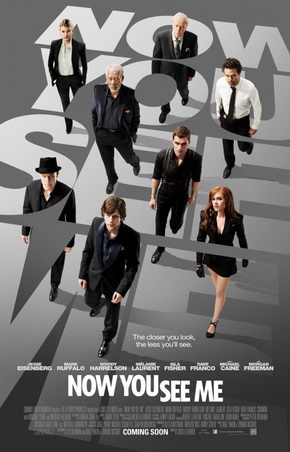
Now You See Me (2013)

The movies are a magical experience, and movies about magic can double up the fun by drawing attention to the innocuous deception of a theatrical illusion.  Unfortunately, Now You See Me spends so much time swaggering that it never really enchants. Now You See Me is ostensibly the story of four semi-professional magicians (Jesse Eisenberg, Woody Harrelson, Isla Fisher, and Dave Franco) who pull off a series of elaborate magic tricks as The Four Horsemen.  But when their illusions begin to look like theft by way of social justice, FBI agent Dylan Rhodes (Mark Ruffalo) and professional debunker Thaddeus Bradley (Morgan Freeman) begin to realize the magicians are, of course, not what they seem.

The key to any successful slight of hand is that the audience has to be so distracted by the flair that they miss the real trick.  Take Christopher Nolan’s The Prestige, a clever (perhaps brilliant) case study of competitive magicians; you’ll be so fascinated by the rivalry between Christian Bale and Hugh Jackman that you’ll miss the clues dropped by the filmmakers.  It’s possibly unfair but entirely unexpected that I’d make this comparison, but Now You See Me doesn’t let the audience play along.  Instead, we’re practically kidnapped, tied down by a film that continually insists on its own brilliance, reminding us at every turn that they’re smarter than we are.

Sure, I can be smarter than you if I don’t tell you what’s going on.  Then, the film gloats by showing you what really happened, though these scenarios are couched in so many maybes and perhapses that it’s never wholly clear what’s going on.  And when your focal character is an investigator, it’s a bit empty to have him never really understand anything.  Ruffalo’s solid as the not-smartest man in the room, and his charisma is enough to hold your attention, but it seems like a less successful riff on his character from The Brothers Bloom, which is saying something.

As for the rest of the cast, you’re looking at the disappointment of the summer.  The four leads have all done good work in the past, but the screenplay is incredibly thin, failing to distinguish any of the four characters beyond physical appearance.  You could rotate the actors in the cast, and it really wouldn’t matter; the characters are so boilerplate and so frustratingly identical that you’ll struggle to connect with them.  Perhaps the film’s worst offense?  Morgan Freeman and Michael Caine never share the frame; their scenes together crackle like a master class in acting, but we never get to see them side-by-side, which gives it a phoned-in feel.

Having said that, there’s a bit of fun to be had in some of the film’s stagier moments.  When The Four Horseman are performing, it’s an opportunity to chew some scenery, and the four leads do well there.  You might even want to see a full show by them at some point, since they convey a sense of infectious enthusiasm for their work.  And, naturally, once you’re told you’re about to be tricked, it’s engaging to watch and try to figure out where the trick is.

As Michael Caine said in The Prestige, “You want to be fooled.”  It’s a good thing, too, since Now You See Me never gives you an opportunity to figure out how the trick is done.  Nor is the ultimate explanation a fulfilling payoff; a last-minute twist is so clichéd that you’ll have already dismissed it as “too obvious.”  Now You See Me is superficial and a bit irksome, continually reminding you of its own cleverness without ever earning the moniker of “smart.”  Sad news for a strong cast, but the real trick is on the audience.

Or, in other words, now I saw it, now you don’t.

Now You See Me is rated PG-13 for “language, some action, and sexual content.”  There’s an F-bomb, playful banter, and some shouting; action consists of a car chase, a few explosions, and some shouting.  And there’s an aborted make-out scene thrown in to earn the “13.”

Friday, August 31, 2012

The Dark Knight Rises - EPIC Review

Enough time has passed, I believe, that a more extensive and more specific look may be taken at Christopher Nolan’s The Dark Knight Rises.  In the tradition of 2008’s “Epic Review” of The Dark Knight, I’ll be discussing more in depth what I enjoyed about the film, which will inevitably entail spoilers of both general plotlines and specific dialogue which I’ll invoke.  The goal is, I hope, to provide a more detailed assessment of the film beyond my earlier review which gushed over the technical aspects of the film but could only allude to the story and its effect on me.  For safety’s sake, the bulk of the review can be found after the jump; those reading this review from anywhere other than the front page will be advised that spoilers begin below the first image in this review.

I cannot stress this enough:  if you have not seen The Dark Knight Rises yet, do not read any further.  The success of the film depends wholly on allowing it to develop at its own pace; any spoilers therein would detract from the overall experience.

Friday, July 20, 2012

The Dark Knight Rises (2012) -- Spoiler Free

I mused yesterday about whether or not Christopher Nolan could create a successful and fully realized trilogy – something no superhero director, for one reason or another, has been able to do.  After attending a midnight showing of The Dark Knight Rises, the verdict is in.

He has.

In many ways, I would have been able to write the bulk of this review without ever having seen the film.  I was expecting to gush.  I was anticipating that feeling of being blown away.  I had few (if any) doubts in the back of my mind.  And ordinarily a film which fulfills expectations might ultimately be a disappointment.  But when expectations are this high, merely meeting them is worth the price of admission.

And The Dark Knight Rises, impossible as it may seem, even exceeds expectations.  One might even say it “rises” to the challenge.

I’ll forego the usual plot summary in deference to the cloud of secrecy and spoiler embargoes necessitated by our digital age (even our late night talk shows were thought to be dangerous).  Suffice it to say that The Dark Knight Rises joins Gotham eight years after the death of Harvey Dent, eight years after Batman entered a self-imposed exile, and just as new foes are rising to threaten the very foundations of Gotham City and its new era of peace.

Of the performances, I can only quote the words of Stan Lee – “Excelsior!”  Bale bears the bulk of the film – no surprise here, since he’s playing the eponymous Knight; as has been the case with the past two films in “The Dark Knight Trilogy,” the focus is as much (if not more so) on Bruce Wayne as on Batman.  His character evolves without ever feeling forced to do so, his quest both understandable and relatable, and his return to the Batsuit a welcome and applause-worthy moment.

Bale’s backed by a cast that doesn’t disappoint.  The old favorites – Michael Caine as Alfred, Morgan Freeman as Lucius Fox, and Gary Oldman as Jim Gordon – continue to turn in solid performances.  Bonus credit to Caine, who manages to do create (particularly in two specific scenes) a real and accessible version of the trusty butler that hasn’t been reached in the character’s seventy-year history.  More than just the snarky chauffeur or stolid voice of reason, Caine’s Alfred is a friend first, as much a father as Thomas Wayne was, and we feel his agony when he sees what Bruce has allowed himself to become.

As for the new faces, they’re welcome additions to the cast.  I see now why we needed so many new faces, and I’m glad especially that Joseph Gordon-Levitt was among them.  His John Blake is easily the most interesting new protagonist (more on the villains later), embodying many of the film’s – and trilogy’s – main themes without ever feeling shoehorned into an already full film.  I’ve said it once and I’ll say it again:  JGL is bound for stardom (if he’s not there already), and The Dark Knight Rises is another fantastic line on the résumé.

But after Heath Ledger’s unforgettable turn as The Joker, can the film’s villains surpass the decade’s most iconic force of evil?  Honestly, probably not, but Tom Hardy’s Bane and Anne Hathaway’s Selina Kyle (note that the name “Catwoman” is surprisingly never invoked) aren’t trying to outdo their predecessor.  Rather, they create entirely new – and gratefully fresh – versions of significant members of the Batman mythos.  More surprising than Hardy’s Bane is what Anne Hathaway manages to do with Selina; it’s a performance I didn’t quite know she had in her, managing to distinguish herself from the Catwomen before her with breathy intonations and evident internal conflict.  Bane, however, is head-to-toe conviction; though he’s given the unenviable task of emoting with much of his face obscured, Hardy manages to convey through his body language the smug self-satisfaction and confident physical dexterity for which his character is known.  (A fuller take on his voice remains to be seen; though it has been lampooned ad infinitum, I suspect my theater’s audio system wasn’t equipped for the booming bass of the film, and so I’ll have more thoughts on that later.)

But what’s most remarkable about The Dark Knight Rises is not the able work delivered by qualified thespians.  The greatest compliment I can pay the film is to repeat what I’ve already said time and time again – Christopher Nolan is a master storyteller who wastes not a frame of film in delivering his definitive statement on the character and what he means.  As before, The Dark Knight Rises is filled with moments that tie together and layer new meaning on important scenes; conversely, perhaps the worst thing I can say about the film is that it doesn’t stand on its own as well as The Dark Knight did.  Indeed, The Dark Knight Rises is very closely related to Batman Begins, revisiting moments and referencing plot beats in a way that echoes without plagiarizing.  But as the final installment in the trilogy (and not just a sequel, as The Dark Knight was initially envisioned), Nolan rewards his viewers just as Lucius Fox was rewarded in The Dark Knight for his faith in Batman’s mission.

If Batman Begins could be distilled to a meditation on overcoming fear, and if The Dark Knight can be said to be a film about defeating the forces of chaos and conquering fear which has escalated into weaponized terror, The Dark Knight Rises is about precisely that – about rising, about overcoming once more.  But here Nolan makes explicit what’s been suggested all along:  the greatest heroism in the world is born through hope, both the hope that an individual can make a difference and that that difference will be a positive one.  And though I’m much more attached to films which engage me on a cerebral level – which this film does, unequivocally – The Dark Knight Rises also makes me feel, deep inside of me, that there is always hope.  It’s a film that made me shed a few tears for a variety of reasons – finality, sorrow, ecstasy, unrestrained jubilation – and it’s a credit to Christopher Nolan that I do not begrudge him a single salty drop.  He has earned it.
The Dark Knight Rises is rated PG-13 “for intense sequences of violence and action, some sensuality and language.”  Violence and all-out action sequences are prevalent as before but are almost entirely bloodless, though Bane’s methods and physicality are more brutal than we’ve seen in the trilogy thus far.  There is one clearly implied sexual encounter, with no more than bare shoulders, while another character is implied to be a prostitute; Selina is extremely sultry and uses that to her advantage, without transgressing beyond an astonishingly tight suit.  Language is mostly tame and is probably PG-quality taken on its own.

Rest assured, loyal readers, I haven’t said my last words on The Dark Knight Rises.  I saw The Dark Knight eight times in theaters, and I am certain repeat viewings of this film will come in the days to follow.  And once the statute of limitations on spoilers has been lifted, I’ll give more in-depth comments on specific moments in the film and the thematic importance of the trilogy as a whole.  Stay tuned, loyal readers – we return on Monday with our regularly-scheduled “Monday at the Movies” post!

Tuesday, July 17, 2012

Armrest Review - Batman Begins, Part Two

Welcome to the first edition of “Armrest Reviews,” a new series in which I, The Cinema King, will partner up with a fellow filmgoer to review films as we watch them.  That’s right, we’ll be writing our unexpurgated observations as we watch the film, meaning you could theoretically read the review while watching the movie and “watch along” with us.

A further welcome back for the second part of our Armrest Review of Batman Begins, the first entry in Christopher Nolan's "Dark Knight Trilogy."  As before, I’m joined by The Popcorn Prince, who’s been watching movies for almost as long as I have.  He’s a big Batman fan, so I’m pleased to have him by my side for the next installment of this series.

Monday, July 16, 2012

Monday at the Movies - July 16, 2012

Welcome to Week Twenty-Six of “Monday at the Movies.” With The Dark Knight Rises only five days away, we’re kicking off a week of exciting content focused around Christopher Nolan, the man behind this generation’s definitive interpretation of the Batman mythos.  Throughout the week we’ll be looking at the trilogy, but today let’s take a few minutes to revisit the body of work which preceded “The Dark Knight Trilogy.”

On the docket for this installment of “Monday at the Movies,” we have reviews of the three Christopher Nolan films not yet covered on this site; we also have links to coverage of films we’ve already reviewed so you can see our assessment of each film in context.  Happy reading!

 Following (1998) – I was in disbelief that I’d never seen Christopher Nolan’s first film, recognizing that it was high time I patch that hole in my cinematic CV.  Following introduces many of the classic Nolan characteristics – nonlinear smart writing which plays with the audience’s expectation and understanding, obsessed characters who dress stylishly, moral ambiguity – and uses them without the disappointing incapacity of an underdeveloped filmmaker.  Bill (Jeremy Theobald) is an aspiring writer who begins following pedestrians for inspiration, but the game is turned when he follows Cobb (Alex Haw, of no relation to Dom Cobb from Inception), a burglar who enlists Bill’s help in a few break-ins.  In classic Nolan fashion, the film functions much like a puzzle box, with at least three distinct timeframes narrated simultaneously and disorienting the viewer.  The film begins somewhat slowly, with Theobald’s narration a bit less than inspiring (though still leagues better than Kevin Costner’s in Dances with Wolves), but once Cobb enters the picture things become vastly more interesting, in part because Haw is both charismatic and enigmatic and because many of the twists in Nolan’s screenplay revolve around Cobb’s real motivations.  The film is, unfortunately, very short (69 minutes, including credits), and I can’t help feeling that the film would have been stronger with 20 more minutes; while the structure is similar to that of Memento, the final twist ending has none of the weight of Memento’s, mostly because the film answers all our questions.  The ending may be neater than we’ve come to expect, but Following is one of the strongest first films I’ve ever seen, sharp and slender.

Memento (2000)
 
Insomnia (2002) – Christopher Nolan’s only remake and only directorial outing for which he didn’t also write the screenplay, Insomnia is also the least Nolan-esque Nolan film, but if it’s the least successful film on today’s list it’s still far and away better than a lot of what Hollywood has to offer.  But let’s be clear – Insomnia is not a bad movie; it’s a taut psychological thriller grounded in strong performances.  But I’m having trouble seeing it as a Christopher Nolan film.  There are no Nolan regulars here – Al Pacino stars as Detective Will Dormer, a homicide expert investigating an Alaskan murder with the help of Hilary Swank, while the killer (Robin Williams in classic creepy form) taunts him from afar.  The film, like every Nolan film, is about obsession, both the killer’s obsession with his victim and Dormer’s obsession with closing the case; the Alaskan setting, however, becomes the focus of the film as it begins to weigh on Dormer’s psyche, impairing his ability to sleep and ultimately function as a human being.  Rather than utilize a structure which forces the audience into a character’s shoes, Insomnia opts to represent as starkly as possible Dormer’s deteriorating consciousness; it’s a fine distinction, to be sure, but it proves how deft a filmmaker Nolan really is.  It’s comparably easier to confuse an audience while a character is confused, but it’s a bit more difficult to craft a film in such a way that we feel Dormer’s insomnia without staying up for five nights in a row.  And Nolan does what few have been able to do in the last decade – elicit a solid performance from Pacino.

Batman Begins (2005)

The Prestige (2006) – Before Inception, this was the film that made me think the hardest, and it’s guaranteed to leave you scratching your noodle.  Hugh Jackman and Christian Bale play rival magicians bound up in a cycle of revenge and one-upsmanship with the women in their lives (Piper Perabo, Rebecca Hall, and Scarlett Johansson) and their mutual assistant (the ever-avuncular Michael Caine) caught in the middle.  With The Prestige, Nolan returns to interwoven chronologies in a story that warns you in advance to be on guard for a twist – “the prestige,” the moment in a magic act when the magician performs the unexpected.  But what the film doesn’t tell you (and it won’t be spoiling anything to do so) is that there are multiple prestiges in the film, at least one for each of the three acts of the film with several right at the end.  It’s ingenious storytelling, regardless of what you think of the story itself; while some complained that the twists were “unfair” or “unintelligible,” Nolan continually reinvents the film to prevent us the filmgoers from ever getting too far ahead of the protagonists.  In this way, Nolan proves himself a master of “movie magic” (whatever that is), expertly controlling what we see and don’t see, leaving us to puzzle out not “who” and “why” like most thrillers but instead forcing us to wonder “how” – how the magician does his trick, how the story will end, and how two hours can whiz by so quickly.

The Dark Knight (2008)

Inception (2010)

That does it for this week’s edition of “Monday at the Movies.” We’ll see you here next week for more brief reviews, but don’t forget to stick around for tomorrow’s debut installment of an exciting new series – “Armrest Reviews” – in which we’ll reassess Batman Begins on the eve of the trilogy’s final installment.  Stay tuned!

Monday, July 19, 2010

Inception (2010)

Before I launch into my review of Inception, let me just say that this is a fantastic film, downright dynamite and an absolute must-see. I'm just giddy about it. And now, the review proper:

Christopher Nolan's Inception is one of the most anticipated movies to hit Hollywood in a long time - probably the first of that anticipatory magnitude since Nolan's last and perhaps greatest venture, 2008's The Dark Knight - for a few very good reasons. First, it's Christopher Nolan's next film, and everyone's dying to see if he can continue his winning streak after making a comic book movie that's in the runnings for "instant classic." Secondly, Inception's marketing campaign is tantalizingly vague, unrevealing in an expertly intriguing way. Finally and most significantly, it's one of the only movies this year to be wholly and unequivocally original; it's not a sequel, a prequel, a remake, a reboot, an adaptation, a rip-off, or a retread. Inception is wildly imaginative, delectably innovative, and enthusiastically entertaining - unquestionably one of the best films of the year and a strong contender for the year's top honor.

Those in the know (namely, those who have seen it) are extremely reticent to talk about Inception on a plot level, desperately afraid that the uninitiated will have the movie spoiled for them. But what's delightful about Inception is that it's practically unspoilable; the major joys of the film come not from what happens, but how and why it happens. Still, if the following plot summary is in any way lacking, it's because I'm holding back; after all, being there is half the fun.

Inception introduces us to a radical new world, one in which dreams can be invaded, manipulated, and harvested. Leonardo DiCaprio stars as Cobb, a self-styled "extractor" who specializes in entering dreams and stealing important information from his marks - extraction. Already on the run from the law after mysteriously parting ways with his wife Mal (Marion Cotillard) who regularly appears in his dreams, Cobb is offered a chance to return home by pulling off a heretofore unheard of and presumably impossible task - inception, planting an idea rather than stealing one. And so, assuming inception can be done, Cobb assembles a team (which includes Joseph Gordon-Levitt and Ellen Page as researcher and dream architect, respectively) and sets to work.

Essentially, Inception is a heist film turned on its head; it's a heist film in which the object is to plant, not to steal, but thatn's not where the similarities end. Here we have the protagonist with a dark past, the characteristically complex team of misfits, the young novice (Page, who respectfully restrains her trademark snarkiness in deference to the film's concentration on verisimilitude), the mark (Cillian Murphy as a coolly cold corporate heir apparent), the shady yet wealthy backer (Nolan standard Ken "Fake Ra's" Watanabe, who adeptly handles the shift from suspicious to endearing), and the twist-upon-twist format that Nolan employed to widespread approval in his fabulous magician's duel The Prestige. Inception warrants comparison to The Prestige because both films relied upon warning the audience they were about to be tricked, but Inception takes it one step further by letting the audience in on the game; we're not on the sidelines but rather in the field with the team, figuring it out as we go along rather than letting our protagonists do it for us.

If I had to review Inception in only two words, I'd choose the phrase "mental calisthenics" because I can't remember the last time a movie made me keep my mind so concentrated to the point where I actually felt tired at the end of it all. Never mind those who say that the movie is "confusing" because what it actually is is engaging; Inception spells itself out for you, but it's up to you to follow along. The concept of "inception" is explained once and only once, so pay attention; this is a thoughtful movie but it's also a high-octane adventure picture with no time to backtrack or recap. Like the train that features into the film's climax, the course of Inception runs fast and unrelentingly forward.

There really aren't enough positive things I could say about Inception. It's a downright brilliant film, anchored by sharp and solid performances from all around. TheWrap.com recently argued that the coming generation doesn't have an A-list in the bunch, but DiCaprio and JGL are obvious contenders for the next breed of A-listers. Riffing on his role in Shutter Island, in which he also had difficulties separating reality from imagined delusion, DiCaprio takes center stage here and holds the audience's attention, proving that he's at his best when he's playing a character with a few cards hidden - both from his fellow characters and from the audience. JGL is much more straightforward, doing a great job as a serious actor after proving he's got solid comedic chops in (500) Days of Summer. And working with very little character description, Cotillard is a vision (often literally) as Mal, maintaining a perfect balance between the mystery surrounding her character and the sense of importance underlying her many appearances. I've already spoken well of Page, Murphy, and Watanabe, but let's not overlook a small but vital role from Michael Caine as Cobb's mentor and tether to the world Cobb has had to leave behind.

The script is smart, the performances sterling, but the visuals are downright eye-popping. Nolan boasted of filming in six different countries (up from three in The Dark Knight), and it shows - scenery is strikingly gorgeous, ranging from Tokyo bullet-trains to the nighttime cityscape of Paris to the snowy mountains of... well, someone's dream. The standout visual piece, though, is a hotel in which conventional rules of gravity no longer apply (to explain why would be to betray one of the film's better surprises); while the scene has Kubrickian undertones with a rotating corridor straight out of 2001: A Space Odyssey, Nolan ups the ante by staging a fight scene in zero gravity - and it's one of the most breathtaking fights in recent cinematic history, outdoing the "bullet time" of The Matrix and the quick-cut style of the Bourne trilogy. Nolan's style is one that continually leaves his audience breathless because Inception insists on outdoing itself - visually and creatively.

If you haven't already figured it out, I'm nothing short of gaga about Inception. Before this review turns into abject gushing, let me close by noting once more that Inception is undebatably a top movie of 2010, a must-see for a myriad of reasons, and a sheer delight to behold. As if I weren't already stoked about Nolan's third Batman movie.

Inception is rated PG-13 "for sequences of violence and action throughout." Overall, it's pretty tame, with more emphasis on thrills than gore, although blood appears sporadically but never explicitly.

Tuesday, June 8, 2010

Sleuth (1972)

I've noticed that my reviews boil down to evaluations of a film on two key spectra: the ranking of good/flawed/bad as applied to the people in front of the camera and the people behind it. With a film like the original Sleuth - in which only three characters ever appear on camera (Jolly Jack, pictured at left with Michael Caine, doesn't count) - makes both qualities infinitely more integral to a film's success.

It is almost impossible to discuss Sleuth without spoiling at least something about the film, and so I frontload this review with the overarching opinion before going into greater details. (Consequently, then, this review may be more brief than my readers are accustomed.) When all is told, Sleuth is worth the watch, even if it comes at the expense of a puzzling and slow-moving first third. If you're interested in watching two fantastic actors - Laurence Olivier and Michael Caine - go head to head, Sleuth is as good a choice as any.

With that out of the way, let's begin. Olivier plays Andrew Wyke, a wealthy member of the aristocracy who prides himself on his razor-sharp intellect, which he hones by writing mystery novels and solving puzzles in which the pieces are colorless. Caine plays Milo Tindle, a hairdresser who's having an affair with Wyke's wife Marguerite. Wyke invites Milo to his home, revealing he's conscious of the affair but suggesting that he's amenable to a resolution in which he is relieved of the burden of marriage to Marguerite. What follows, though, is a cat-and-mouse game with layers beyond the surface and hidden agendas just out of sight.

The most remarkable trait of this film is Anthony Shaffer's script, which he adapted from his own stage play, and what's remarkable about it is the fact that there are only two characters in the whole thing. And what's remarkable about that is the fact that the film only drags a little at the beginning; the exposition takes a little while to get off the ground, but once it does Shaffer's script becomes an intense confrontation within which a myriad of conflicts play themselves out - class tensions, generational gaps, immigrant-vs.-native, cuckold vs. lover.

The two performances are also quite strong. Olivier is entirely plausible as the arrogant and overconfident genius, while Caine is solid and abundantly entertaining as the novice here, who has to learn the rules of the game as he plays. Watching the two of them spar is as intense as a fencing match; the animosity is palpable, like Gable and Laughton in Mutiny on the Bounty, and the interplay is sufficiently jarring so that it's never quite clear who is on top in this duel of wits.

The only shortcoming of the film is that it's not quite surprising. At least, that was my experience, as a lifetime devotee of The Twilight Zone, Night Gallery, and other suspense/twist ending flicks. There's a fairly surprising twist about an hour into the movie, but the rest of it plays out in fairly unsurprising terms. That's not to say that Sleuth is predictable to a fault; it's just that I was able to piece it together fairly quickly and see where it was going (and I'm not bragging). This detracted a bit from my enjoyment of the movie, though other moviegoers may not have the same problem. It's fun, though, to watch it play out since these two actors are doing fine work. For example, when Wyke discovers he's under the scrutiny of Police Inspector Doppler, the twist here is fairly obvious, but the performances are in top form.Sleuth is rated PG, as it contains a few droppings (no pun intended) of the S-bomb, as well as mild violence and psychologically intense confrontations.

Wednesday, July 30, 2008

The Dark Knight (2008) - EPIC Review

I suppose that by way of apology I should explain pour quoi this review was so long in coming. I know that after my first viewing - which was (be jealous) truly an IMAX experience - I was so overwhelmed that not only could I not speak for five minutes on the car ride home but I also knew on some level that any initial reaction to this movie would have been no more than one could get from a teenybopper seeing The Jonas Brothers for the first time.

So I had to see it again. Within 24 hours. And then again. And again. And guess what? I'm going back. Because it's the movie we need and the movie we deserve. <-- That's a reference to the movie. If you haven't seen it, it might not be a good idea to read this review since I'll both be liberal in referencing dialogue and discussing plot points (although I won't be revealing any on the scale of "Rosebud is the sled" I will be exploring issues with which even casual Batman fans should be familiar), and I'll be featuring a proliferation of images that (again) won't give too much away but might be better left unseen by the uninitiated. Just go and see the movie, then check back with me, since you'll get more out of this review. Back? Where do we begin? Three years ago a little director called Christopher Nolan made a little movie called Batman Begins which, if we're being honest, made only comparatively little splashes at the box office. But then again, it's not about the money. It's about sending a message. And the message was that comic book movies could be serious works of cinematic literacy without compromising the source material.

The Dark Knight is no exception to this rule and unquestionably is the golden standard by which all other comic book movies - and indeed perhaps all other movies, period - will be weighed. (I can feel nothing but pity for future directors of comic book movies who are destined to fall short of this cinematic perfection.) Picking up where the first movie left off, The Dark Knight finds its eponymous hero (Christian Bale, back in the role for which he was born) facing escalation in the form of amped up enemies and do-gooder Bat-doppelgangers -- and a new nemesis, the self-professed "agent of chaos" known only as The Joker (the divine Heath Ledger, who's receiving all the accolades he deserves for this, his final and most magnificent role). All the old cast are back for this one, save Katie Holmes who's replaced by the less irritating Maggie Gyllenhaal. And we have a few new faces, too - of course, Ledger as the "dog chasing cars" man supposedly without a plan, Eric Roberts as mobster Sal Maroni, and Aaron Eckhart as Gotham's white knight Harvey Dent, the straitlaced D.A. with a touch of destiny about him.
Why so serious? For some comic relief, we have (Sir) Michael Caine and Morgan Freeman back as butler Alfred and CEO Lucius, respectively, but a great deal of the laughs - uncomfortable ones though they may be - come from Ledger's Joker, upon whom I cannot heap enough praise without sounding like either a sheep critic who feels obliged to respect the actor in light of his ultra-untimely passing or a giggly fanboy (the latter of which is probably closer to the truth) marveling at this, the truest interpretation of Batman's greatest nemesis. Though his first scene on-screen - a heist brilliantly planned by The Joker - won't get a lot of chuckles, his second appearance most certainly will. The Joker holds the mob financially hostage, unveils his master plan for correcting Gotham, and executes - and I do mean executes - the strangest, most audacious magic trick since Nolan's 2006 magical mystery tour The Prestige. Should we laugh at something like that? It's difficult not to. He does that, makes us question our ethics and morals for laughing at the more gruesome moments of life. It makes one think, that's all.

Making us think is one of Nolan's specialties here. This is so much more than just a seminal entry in the world of comic book adaptations - which, make no mistake, it is. The Bat-gauntlet has been thrown down. But The Dark Knight is, among many things, a mature rumination on the very nature of heroism, of deceit, of good and evil and the mutual necessity one has for the other. The very concept of heroism is up for grabs here, as well-intentioned civilians doll up like the Bat and take on crime themselves. "What gives you the right?" one asks Batman. Hockey pads or not, one has to admit that it does take a certain brand of madness to dress as a Fledermaus and dive from rooftops. And "madness, as you know, is like gravity. All it takes is a little push."

Where the first film devoted a great deal of contemplation to mulling the power and pains of fear, here the main issue at stake is duality - the mirror relationship between good and evil - with a liberal dose of secrecy thrown in for good measure. The clearest example of duality is of course the nature of the battle between Gotham's Dark Knight and its anarchic harbinger of lawlessness, The Joker. "I don't want to kill you!" the Joker cackles at one point. "What would I do without you? You... you complete me." Earlier, in a home video of sorts, Joker grins as he decries Batman's need for secrecy and suggests "This is how craaaaaazy Batman's made Gotham."

Surely this is cause for contemplation; Batman's first villains in this series were mere mortals (not so mere, though, should Nolan choose to play up Ra's al-Ghul's immortality in later installments) with fear toxins and utopian aspirations. Gotham before Batman had never seen a man so without rules as The Joker, a man willing to allow himself to be killed for a punchline.
And no discussion of duality could be complete without Harvey Dent. Just as Scarecrow was the perfect way to explore fear, the district attorney - the white knight - is Nolan's masterstroke in the discussion of doublethink. "I believe in Harvey Dent," the oft-repeated aphorism goes. To believe in Harvey Dent, though, is to believe in a world that doesn't need Batman, a world where crime can be stopped in the courts. The Joker, of course, begs to differ and endeavors to "turn [Dent's] little plan on itself." Failing to corrupt The Dark Knight (even finding him "too much fun"), Joker turns to the white one. Because all it takes is a little push to win the battle for Gotham's soul. Aaron Eckhart's performance as Harvey Dent is sadly lost in the shuffle of praise for the movie - and undeservedly so. As Dent, Eckhart has the unenviable task of playing an optimist in a world without hope, a task made all the more impossible once everything is taken from him - even his Robert Redford good looks. In a way then, Harvey is a mirror of Batman as well; where Batman lost everything and chose good, Harvey seeks revenge and sense in a world gone mad - decency in an indecent time, as Dent cries at the film's second climax.

Oh, yeah. There are two climaxes to the movie. You read that right. The screenplay by the Nolans is a marvelous examination of the Batman mythos, drawing on all of the best Caped Crusader chronicles to create what is the most complete, most honest, most magnificent Batman story ever told. (And this from a reviewer who loves Jeph Loeb's The Long Halloween!) This two climax bit is part of the magic of the movie (and also a nod to the rise of Two-Face?); just as one major threat is defeated, Batman is reminded that the battle for Gotham's soul has yet to be won. This final act of the film is haunting - pure poetry. The chills that ran up my arms couldn't have been from the air conditioning in the theater, because I felt the hair on my arm stand up at all four screenings - in different venues, no less. As The Joker hangs upside down and taunts Batman with his notion that "I think you and I are destined to do this... forever" the camera slowly does a 180 and turns so that The Joker appears to be right-side up... but he isn't. The world, Nolan tells us in a brilliant use of visual language, has been turned topsy turvy, on its head just as the "SLaughter is the best medicine" semi earlier in the film.
For me to delve any further into scholarly analysis would be to give short shrift to my duties as a reviewer (although if I haven't by now convinced you of the film's marvelous nature, you might need a quick reminder - Rotten Tomatoes ranks it 94% fresh, but only because 6% of critics are afraid to join the crowd). Every actor brings an A-game or better to the table, so we might as well go right down the line. Christian Bale actually plays three parts here: gravelly Batman, "fake" playboy Bruce Wayne, and the real Wayne who legitimately wants to do right but understands the necessity of his facades. As butler and confidante Alfred, Michael Caine is pitch-perfect, providing the perfect amount of levity while also bringing gravitas by keeping the secret that could crush his employer's spirit. You'll never believe Gary Oldman is British, since he plays such a spot-on Chicago-style cop as Lt. Gordon. I've already lauded Aaron Eckhart's turn as Harvey Dent; the biggest compliments I can give Maggie Gyllenhaal is that she's not Katie Holmes and that she made me forget that I really don't like her - especially in a scene where she finally gives Harvey "an answer." And of course Morgan Freeman, who's rapidly becoming one of my favorites, is unindictable, saying more with an enigmatic smile than, oh, let's say Keanu Reeves can do with a whole movie. Heck, even Eric Roberts comes close to inciting curiosity that he wasn't in one of the Godfather movies.

Then there's Heath Ledger, who's in a caliber all his own. Where each other actor is physically recognizable (well, except for Eckhart in the second half), Ledger completely immerses himself in the role and disappears behind that David Lynch voice and a face only Baby Jane Hudson could love. If you thought Johnny Depp's turn as Captain Jack Sparrow was a physical transformation, wait until you see this. Ledger blows Jack Nicholson (as much fun as he was) out of the water with a dark and gruesome anarchist who delights in chaos and physical abuse. Moviegoers aren't screaming "Oscar!" for no reason, and it's got nothing to do with the tragic passing of Ledger back in January. It's got everything to do with the highest echelon of acting that I've ever seen.

There are some who say that the editing befuddles, but these must be the same nitwits that cried foul at the "confusing" plot of the second and third Pirates of the Caribbean movies. The only confusing thing about this movie is how it can be so irreproachable and still be made by humans. It's as layered as an Alan Moore plot, with little nuggets to reward repeat viewings - like the year imprinted on Harvey's silver dollar or the ballerina grace with which the opening bank robbery is choreographed. The script is endlessly quotable without being showy, by far surpassing 300 for "Most catchphrases in a single bound." A great deal of that is delivery, because when you get down to it there's nothing truly remarkable about the line "Here's my card."

The soundtrack, too, is everything a movie score should be - gentle in spots (courtesy of James Newton Howard) and aggressive in others (characteristically Hans Zimmer's work), all without screaming "Listen to me!" From the chaotically frenzied Joker theme ("Why So Serious?" on the soundtrack) to the majestic Batman action theme ("Like A Dog Chasing Cars" and "I'm Not A Hero" as best highlights), the score swoops like a - "Like a submarine, Mr. Wayne. A submarine." And the special effects - well, they're virtually nonexistent. You see, Nolan is an advocate of hyper-realism in his filmmaking, so almost none of what you see is CGI. Yes, Nolan really blew up the Brachs candy factory (which stands in for a somewhat more targetable facade). Yes, Nolan really flipped a semi on its head. Yes, Nolan really filmed a car chase scene on Wacker in Chicago. I'm pretty sure he didn't really crash a helicopter into a skyscraper, but it looks damn cool anyway.

I'm this close to announcing a new king in the land of cinema. No, I'm not abdicating my throne as The Cinema King. I'm mere centimeters (or one more screening, preferably IMAX) from placing The Departed at #2 on the list of Greatest Movies of All Time. Because here's another perfect movie. It's unquestionably the best movie of 2008, and I see no competition in sight.

Tuesday, July 22, 2008

Batman Begins (2005)

It's perhaps difficult to appreciate now, three years after Batman began, what director Christopher Nolan did for the comic book movie genre. For land's sakes, folks, Bryan Singer's Superman - the all-American Boy Scout ambassador of good will - was considerably more angsty in response to the smash hit called Christian Bale as Bruce Wayne, alias Batman. With a new take on the quintessential origin story, a few plausible revamps to the old rogues gallery, and a solid cast, Christopher Nolan redeemed the Batman franchise from the Schumacher debacle.

And all that with nary a Batnipple in sight.

How does every Batman origin story need to start? In the alley behind the theater where Thomas and Martha Wayne were gunned down by oft-faceless hood Joe Chill (not The Joker, Tim Burton, but nice try), right? WRONG. In typical Nolan fashion, Batman Begins toys with the audience's expectation of chronology that origin flicks like Spider-Man and Superman led us to anticipate. As Bruce Wayne (Christian Bale, one of the best living actors) receives his training from Ra's al Ghul (Ken Watanabe) and the League of Shadows - especially personal mentor Henri Ducard (the perma-divine Liam Neeson), his backstory is fleshed out. By the time he returns to Gotham to clean up the city and (in the words of Jeph Loeb, arguably one of the greatest Batman writers of all time) make good on his "promise on the grave of my parents to rid this city of the evil that took their lives." Among the evildoers are Scarecrow (Cillian Murphy, immaculately exuding creepiness through his eerie eyeglasses) and mob boss Carmine Falcone (Tom Wilkinson) - but there is good in Gotham. Detective Jim Gordon (Gary Oldman) and legal beagle Rachel Dawes (a bland Katie Holmes, the only strained link in a pitch-perfect chain), as well as Wayne associates Lucius Fox (the ever-eloquent Morgan Freeman, who just gets better at playing himself as time goes on) and butler Alfred (Michael Caine, whose moments of levity are well-appreciated), are on hand to assist in the neverending battle.

If it smacks of an ensemble cast, it's not. The focus, make no mistake, is on Bale's Dark Knight. With a cavalcade of great actors (only two of whom, I might add, hail from the continent which birthed Batman in the first place), it might be easy for any one of them to get lost in the shuffle, but thankfully each holds his own. You'll pardon the sexist language, but Holmes is out of her league here - then again, I can't think of an appropriate modern actress who wouldn't be (I say appropriate because Judi Dench would rock but might be more believable as Alfred's love interest). What helps the cast along is a whizbang screenplay by Nolan & David S. Goyer which not only sets the groundwork for a franchise but stands alone on its own merits, not the least of which is its clever use of repetition to further plot points and recall earlier hints and foreshadowings.

So the cast is mostly impeccable, the screenplay tight as a pimped-out ride. Of the direction I have only positive things to say. Nolan is a master both at intense action scenes such as a Batmobile chase scene and at moments of "arranging matches" drama as when Falcone explains the law of Gotham to Bruce. Relying on CGI to the point of nihilsm, Nolan gives his hyper-realistic take on Batman that extra layer of authenticity by showing us reality on the screen. Chicago never looked so corrupt - nor worth saving. Additionally, a score composed by Hans Zimmer and James Newton Howard deftly bounces between peaks and troughs of action. Though it's not as "listenable" as some of Zimmer's other soundtracks (such as the uber-catchy scores for the Pirates of the Caribbean franchise), the score here doesn't call attention to itself but rather supplements the visuals in a way that is almost subconscious.

It's an intelligent movie. The heroes are walking that fine line between good and evil, bending society's conventions and occasionally the laws to achieve real justice. The movie, in a theme that would be more fully fleshed out in its sequel, also asks where the line is and whether Batman is crossing it. The threat of escalation, too, lingers over the whole shebang, further questioning the label of "hero." And the villains are even less civil than previously; Scarecrow, for example, is less than reluctant to target innocent women and children so long as they fear him. Where Spider-Man 3 hit heavy the metaphor of "villain [Venom and the black suit] as revenge," Batman Begins is an elegant contemplation of fear and power, even if the bullet-train climax is less than wholly realistic.

And for a movie that drew applause not precisely at the end of the movie but rather 30 seconds prior to conclusion with the mere turning over of a playing card within an evidence bag, Batman Begins is a movie that needed no sequel. Certainly I won't grumble over The Dark Knight or even deem it unnecessary. But Batman Begins is more than able to survive and thrive in independence, with a complete ending that we might believe could occur in the real world.

Of course, then came a little film known as The Dark Knight, which shattered expectations - and box office records.

Mr. Nolan, I never got a chance to thank you for Batman Begins...

"And you'll never have to ."