Showing posts with label Brad Pitt. Show all posts

Monday, December 26, 2022

Babylon (2022)

I became a fan of Damien Chazelle almost overnight. I rented Whiplash, one of the only films ever to leave me physically shaking, shortly before seeing La La Land in theaters (twice) and breaking down in full sobs. First Man was an odd follow-up, a spaceman biopic after a big Hollywood musical, but Babylon feels a bit more a return to form. Again (and still), Chazelle is looking at what makes successful people tick, what pushes them to succeed beyond their comfort zones, and what price fame exacts on their souls. 

Babylon is bigger and it is more boisterous, a three-hour version of Hail, Caesar! by way of Quentin Tarantino, which begins with a pachyderm’s diarrhea and concludes with a long montage that serves as – unsurprisingly, given his past work – Chazelle’s big love letter to the movies. For my money, it’s a grand success until that finale, which overinflates the point made by La La Land in a movie that is already perilously extravagant.


Babylon is a sprawling film epic in the tradition of, say, Once Upon a Time in Hollywood, featuring a bevy of characters bumping into each other on the way up the showbiz ladder: aspirant and ingenue Nellie LaRoy (Margot Robbie), whose dreams of stardom occlude the perils along her way; silent star Jack Conrad (Brad Pitt), who speaks bad Italian while proposing marriage to a different woman every other scene; accidental stagehand Manny Torres (Diego Calva); jazz trumpeter Sidney Palmer (Jovan Adepo); and gossip columnist Elinor St. John (Jean Smart), who sees all and writes even more.


I knew just from the runtime that the decadence of Babylon was going to be the point, that its sheer exorbitance would likely be a comment in itself. La La Land was a tight two hours, but it seems that three-hour runtimes are becoming the way of the future; James Cameron needed the full three to give us the next Avatar film, while Wakanda Forever landed only twenty minutes shy. After the aforementioned elephant sequence, Chazelle stages an exorbitant party sequence that would make Baz Luhrmann blush with envy. It’s The Great Gatsby times a million, and how our protagonists react to and inhabit it will set the course for the next two hours and change.


Chazelle is a confident filmmaker, and the vast majority of the film is leisurely world-building, episodic sequences that explore the consequences of Hollywood’s meteoric rise. In some such episodes, our protagonists are asked to make moral sacrifices in exchange for fortune and glory; in others, they voluntarily sacrifice their dignity or their physical well-being for a shot at the big time. To sustain this episodic structure, a storyteller must be supremely confident and adept in ferrying the audience along, and Chazelle is certainly that, but he’s helped ably by a terrific cast.


As Nellie LaRoy, Robbie is electrifying. I’m not sure if her performance is sufficiently different from, say, her Harley Quinn to land her an Oscar, though the idea is being bandied about; she’s certainly manic and magnetic, like a dark Judy Holliday. Her chemistry with Diego Calva’s Manny is supposed to be star-crossed, but I sense that only Manny feels that way, and that’s precisely the point. This is a far cry from Mia and Sebastian of La La Land, perhaps because Babylon is largely more cynical. Meanwhile, Pitt’s terrific, as he always is, though one may be wondering why Jean Smart was given a role as toothless as Elinor until the third act, when Smart – in her role as scribe, prophet, and gatekeeper – gets an incisive monologue that could very well crop up in an awards season sizzle reel. Indeed, Elinor’s big speech makes a better summation of the film than Chazelle’s ending proper, which leads me to my conflicted feelings about the film’s ending.


I was deliberately not looking at my watch throughout the film but felt it must surely be on its way toward denouement when Chazelle began to stage his final episode before the film’s coda. Nothing I had seen so far prepared me for a terrifying performance from Tobey Maguire as mobster James McKay. In the film’s final act, Chazelle ratchets up the tension until the film descends into its own version of Dante’s Inferno – itself a perfect inversion of Babylon’s opener – with the ghastly Maguire as Virgil, our sunken-eyed guide into the underbelly of Los Angeles. From there, the film wraps up by telling us who will and won’t change, just in time for an epilogue that puts a button on the story. 


It’s almost as though Chazelle is in a rush to conclude the movie in time for his final sequence, which feels less like a satisfying and integrated climax and more like the final moments of Walt Disney World’s The Great Movie Ride. Without spoiling, Chazelle’s grand point had always been clear, and the extended conclusion feels like a less successful version of La La Land’s ending – which worked precisely because it was rooted in the characters. Here, though, Chazelle is making a broader point about the filmmaking industry, and when he acknowledges, for example, Singin’ in the Rain, he tips his hand, gilding the lily and unfortunately suggesting that Babylon has just been an R-rated remake of the 1952 classic.


Babylon isn’t Singin’ in the Rain, but nor is it La La Land, which I maintain is still Chazelle’s best. If there’s an issue with Babylon, it isn’t that it lacks restraint or focus – its madcap meandering is precisely the point – but if it’s a shaggy dog story, the punchline needs to be a little more substantive and personal than where Chazelle leaves it. I still don’t know if La La Land ends on a happy, sad, or wistful note, but Babylon closes with one foot firmly in treacle, which is a sentiment the movie never fully earns. If the film had ended ten minutes earlier, this might have been a different review, but Babylon trips over its own feet right at the finish line – but what a race up until that point.
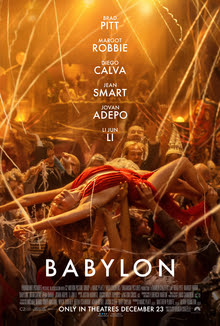


Babylon
 is rated R for “strong and crude sexual content, graphic nudity, bloody violence, drug use, and pervasive language.” Written and directed by Damien Chazelle. Starring Brad Pitt, Margot Robbie, Diego Calva, Jean Smart, Jovan Adepo, Li Jun Li, Eric Roberts, Jeff Garlin, and Tobey Maguire.

Thursday, July 11, 2013

World War Z (2013)

Did anyone expect a zombie movie from the director who brought you Stranger Than Fiction (one of the best metafictional films) and Quantum of Solace (one of the less inspiring Bond films in recent memory)?  Maybe I expected a talkier film from Marc Forster, especially because of the epistolary format of the eponymous Max Brooks novel, but what I got was something more engaging – an entertaining blockbuster-lite with some thrilling zombie set pieces.

Brad Pitt stars as Gerry Lane, average joe with classified UN experience which comes in handy when teeming hordes of the undead take over Philadelphia – and, Gerry learns, most of the world.  In exchange for his family’s safety, Gerry agrees to escort a leading physician in search of a cure, a harrowing search which will take Gerry around the world and face to face with speedy, deadly zombies.

Devotees of the Brooks book will likely find fault with the fact that the film streamlines the book’s narrative, eliminating most of the political commentary and torqueing the story toward a more action-based plot.  (In fact, I suspect you could change the name of the film and those folks might like it better.)  While I miss the governmental satire Brooks brought to the genre, portraying political leaders as bumbling naysayers until it’s too late, I found the book a bit repetitive, duplication which the film eliminates by focusing on Gerry Lane and not his interviewees.

This change allows Forster to focus more on in-the-moment experiences of the zombie apocalypse rather than reflect nostalgically on the experience.  While the latter has its advantages in a literary form, it’s hard to imagine that being a compelling film (perhaps as a mockumentarian experiment?).  Instead, Forster drops us in on the day of the zombie disaster, literally in the middle of a traffic jam with only pancakes to prepare us.  Granted, this comes at the expense of character development; we don’t know much about what makes Gerry or anyone else in the film tick beyond basic survival.  Conversely, the film mercifully avoids padding out the cast with stock survivor characters (see Shaun of the Dead for a gleeful vivisection of these tropes) by following Gerry.

It’s likely Pitt’s star power that elicits the audience’s sympathies more so than the strength of the script, but Forster makes up for the script’s shortcomings (with Brooks, five writers – too many cooks?) by prizing spectacle over protagonist.  By staging a series of progressively more intricate and more terrifying zombie confrontations (I counted seven), Forster creates a deeply personal involvement with the audience, who can’t help but hold their breath once it becomes apparent that zombies react to sound.  Simultaneously, the shifting setting creates a global feel for a genre that too often has been bogged down by the stale locked-room plot (cf. Mulberry Street done wrong, Dawn of the Dead done right).

Want zombies in the metropolis?  Sure, you’ve seen it before, but rarely with the terror-of-the-unseen rendered here.  Zombies on a plane?  (Where’s Sam Jackson when you need him?)  WWZ’s got those, too.  And if you liked those two, Forster outdoes himself with the film’s final big zombie scene, which collects all the bits the film introduces to the mythology and throws them together into a tense sequence requiring silence and sharp reflexes – almost like a video game level but without the passivity that often plagues such moments.  Here especially, Forster knows when to go for the jugular and when to pause for a moment of levity (thank God for Pepsi, that’s all I’ll say).

Taken holistically, World War Z isn’t the “complete package” that zombie aficionados might expect from the genre, but what WWZ lacks in innovation it atones for with execution.  With those house lights dimmed and nothing between moviegoers and the screen, the bumps in the dark create an effective cinematic experience that ends up being more fun than I expected.

World War Z is rated PG-13 “for intense frightening zombie sequences, violence and disturbing images.”  The zombies are pretty freaky – pale veiny skin with translucent eyes, snarls and gnashing teeth with dried flecks of blood.  The blood doesn’t flow as freely as elsewhere in the genre, but plenty of bodies are felled by biting, gunfire, and blunt force trauma; in an intense but brisk moment, a hand is amputated.

Monday, November 26, 2012

Monday at the Movies - November 26, 2012

Welcome to Week Forty-Two of “Monday at the Movies.”

Fight Club (1999) – I’ll say this for David Fincher’s Fight Club:  it holds up much better on a second viewing.  I came to it years ago under the auspices of anticipating the allegedly brilliant twist ending, but after predicting it fairly early on I found myself disappointed.  I won’t spoil the ending here, though I will say that the movie is much more successful when you know the reality-bending twist in advance, particularly since the self-congratulatory way in which it’s revealed may seem abrasive to viewers ahead of the game.  Edward Norton plays a pitch-perfect nameless sad sack (known only as “The Narrator”) who begins to find meaning in his life after the charismatic Tyler Durden (Brad Pitt) begins a franchise of “fight clubs” in which men can take out their anger and recapture their masculinity in a consumerist and depersonalizing world; Helena Bonham Carter costars as Marla Singer, an intensely damaged individual whose self-hatred leads her into the path of Tyler and The Narrator.  At its best, Fight Club is classic Fincher:  dimly-lit, intensely violent, and monomaniacal in its examination of deranged, deviant personalities.  Pitt’s performance in particular stands out as one of his best; Tyler is infectiously exuberant and sadistically nuanced, allowing Pitt to show off the full range of his talents and recalling his nutty turns in Twelve Monkeys and, to a lesser extent, Burn After Reading.  What the film leaves you with is a slightly unsettling commentary on modern society that asks you to sympathize with The Narrator before abandoning you as his plans go awry; Fincher wisely avoids moralizing by leaving the ending ambiguous, asking the audience what is to be made of Fight Club and Project Mayhem.  If nothing else, it’s astounding that this is the same director who did The Social Network!

Hable con ella (2002) – It’s been a year of firsts here at The Cinema King, reviewing silent films (The Italian) and James Bond films (Skyfall) for the first time.  Now your first foreign-language film, courtesy of Pedro Almodóvar.  Hable con ella (“Talk to Her”) is an unusual film, many things at once without leaving much room for the audience to get comfortable in one genre.  Through a series of interconnected events, caregiver Benigno (Javier Cámara) and travel writer Marco (Darío Grandinetti) become friends in the hospital where the comatose loves of their lives sleep.  Marco’s relationship with the bullfighter Lydia (Rosario Flores) becomes more tragic as flashbacks and surprise reveals detail the secret she was keeping from him before her injury, while Benigno’s one-sided friendship with ballerina Alicia (Leonor Watling) becomes more unsettling as we learn more about the extent of his devotion to her.  I’m not sure what to make of this movie; it accomplishes a great deal without leaving much closer for the audience, and it seems that Almodóvar’s film is essentially a treatment of misinterpreted romantic relationships.  To that end it’s a compelling one, helped by strong performances and a willingness to let the audience put some of the major pieces together.  Grandinetti’s turn as Marco is particularly compelling, his emotional vulnerability and forthright nature reminding this viewer of Gordon Pinsent’s moving turn in 2006’s Away From Her.  The film is troubling in places (some unintentional, as I found myself a bit perturbed that the women in the film are literally reduced to bodies), but I think that Almodóvar is after just that – a destabilizing of assumptions and the revelation that everyone has something to hide, be it an emotional trauma in the past or an aberrant secret in the present.

That does it for this week’s edition of “Monday at the Movies.”  We had “Fight” today – tune in on Wednesday for Flight!

Monday, September 6, 2010

Inglourious Basterds (2009)

It's not spoiling anything to reveal that Quentin Tarantino's most recent film, Inglourious Basterds [sic], closes with one character remarking to another, "I think this just might be my masterpiece." The film is punctuated with moments like this, when one character says to another (as Hitler to Goebbels, for another example), that the other has just achieved his crowning glory. While I'm not convinced that Inglourious Basterds is Tarantino's magnum opus (it's tough to top Pulp Fiction, for my money), it does represent a return to form after indulgent experiments like Kill Bill and Death Proof.

Inglourious Basterds is, per Tarantino's description, a spaghetti western with World War II imagery, with the story divided into five semi-standalone chapters, each revolving around one set of character interactions. The film follows, separately, a ragtag team of Jewish-American soldiers scalping Nazis on the orders of their quirky Lieutenant Aldo Raine (Brad Pitt, channelling Foghorn Leghorn); Jewish fugitive Shosanna Dreyfus (Mélanie Laurent), who plans to use her movie theater to kill Nazis during the premiere of war hero Fredrick Zoller's (Daniel Brühl) biopic; British Lieutenant Archie Hicox (Michael Fassbender), commissioned by Winston Churchill to aid German actress-turned-secret-agent Bridget von Hammersmark (Diane Kruger) in an attempt to blow up the Nazi premiere, ignorant of Shosanna's plot; and SS Colonel Hans Landa (Christoph Waltz, in a performance well-deserving of its Supporting Actor Oscar), the ranking Nazi official standing between Hitler himself and all these plots, which converge in a stellar finale that's as fun as it is fantastic.


I've voiced my discomfort with labeling Inglourious Basterds Tarantino's masterpiece, but if it's not Number One it's certainly Number Two (although I may change my tune once I rewatch Reservoir Dogs). The screenplay is one of Tarantino's best, in the "interconnected disconnect" tradition of Pulp Fiction and, to a lesser extent, Kill Bill, in which vignettes are tied together as part of a narrative thread but are easily (re)watchable outside the context of the film as a whole. The script is a taut exercise in dramatic tension, deceptively composed of long scenes of dialogue (often subtitled from German or French) but which bring to a simmer intense anxiety about if and when each character's deception will be revealed and cause events to boil over into a brutally gory yet classically Tarantino shoot-'em-up sequence (which, don't worry, happens more often than not).

Perhaps, then, we can ascribe a masterpiece to Tarantino, but with the caveat that it isn't his only one. If we're hellbent on labeling Inglourious Basterds the masterpiece, we can always excuse Pulp Fiction for being partially co-authored by Roger Avery. But Basterds is all Tarantino, showing a maturity level that heretofore has been absent (but, in retrospect, showed signs of nascency in Death Proof); rather than clutter his work with blatant homages and showy stylization, Tarantino wisely pulls back on both, creating a work that's more subtle than I think most of us knew Tarantino could produce. It's not for nothing the film nabbed a Best Picture nomination, you see. It stands as the perfect intersection of a first-rate screenplay and a more-than-capable cast.

The true star of the film is Tarantino's dialogue, which manages to transcend the drudgery of subtitles by leaping off the screen without calling attention to its own built-in flair (from what I've been told, the translation work isn't bad, either). But the members of the cast are all so good that it's difficult to find a star made of flesh and blood. Is it Pitt, who takes first billing bcause of his name recognition but whose star power is dwarfed by the comparatively small role he plays? Is it Laurent, a protagonist in the tradition of The Bride who does a solid job portraying all her character's fears and determination? Is it Waltz, who obviously dominated the public imagination about the film with a delightfully nuanced and delectably wicked performance as the Nazi with as many cards up his sleeve as held close to his chest? Or should we merely throw our hands up in uncertainty by saying it's an ensemble cast? Well, it is. But they're all so good that you won't notice, for example, that Pitt is absent for the first, third, and most of the fourth acts; actors like Fassbender and especially Waltz take control of their screen time such that you'll forget that it isn't entirely their movie.

It's a movie that isn't really about anything. It's about World War II, sure, but it's more the story of a group of very radical figures fighting it on different terms, on different fronts, and for different reasons. One of the most significant features for me is the way in which the film brilliantly cheats itself; it contains the single most creative way I've ever seen for dealing with a film in which the objective is to assassinate Hitler - even though we know Hitler was never assassinated (Bryan Singer did an equally solid but different job with Valkyrie, though it's nothing on the scale of audaciousness that Basterds brings to the table). Hint: the first major clue comes before the first scene of the film; pay attention.

Oh, what the heck. High tension, tight scripting, fantastic performances - maybe it is his masterpiece, after all.
Inglourious Basterds is, like every Quentin Tarantino movie, rated "R for strong graphic violence, language and brief sexuality." Obviously, the language and the violence are pretty extreme, with F-bombs and scalpings all over the place, as well as the sporadic bloody shoot-out. There's an implied sexual liasion between Goebbels and his translator, and Fredrick flirts heavily with Shosanna, but it's pretty tame compared to other Tarantino films in this regard.

Monday, June 29, 2009

Trailer Park: Inglourious Basterds (2009) [Trailer #2]


For starters, I'm reviewing the second trailer for this video, though I'll be taking for granted a slight familiarity with the first trailer (and that one's embedded at the bottom of this post).

We've been waiting since Kill Bill for the next Quentin Tarantino movie (okay, Grindhouse fans, Death Proof counts) and here it is. We've been hearing about Inglourious Basterds (back when it was spelled Inglorious Bastards) for some time now, and I was just about to relegate it into the dead pool where The Vega Brothers currently tends bar. Thankfully, Tarantino managed to get his script put together and filmed in time for the 2009 movie season.

This one looks like what every Tarantino fan loves - kitsch, violence, and hyperstylized dialogue. Furthermore, Brad Pitt devotees will probably have much to enjoy when it comes to his distinctive characterization of Lt. Aldo Ray (an interesting combination, one reviewer has noticed, of Cary Grant and Foghorn Leghorn), whose every movement is in step with a unique character - the kind for which Tarantino is best known.

Inglourious Basterds probably isn't landmark cinema, but it looks like it'll be a lot of fun. Plus, Mike Meyers is doing an accent again, and Hitler is wearing a cape. Like I said, a lot of fun.

Sunday, July 6, 2008

The Assassination of Jesse James by the Coward Robert Ford (2007)

Don't let the gregariously prejudiced (and spoiler-iffic) title throw you. Don't let the total lack of publicity throw you. Don't even let the name of Affleck on the poster throw you. Director Andrew Dominik's sophomore showpiece is a masterpiece of high tension, nuanced characters, and one of the best screenplays of '07.

I knew very little about the history between Jesse James and Robert Ford - I was even, before hearing of this film, unable to name James's assassin. So in a lot of respects, the movie was a learning experience for me, a student of history. So I shirked my concern for spoilers upon reading the title but did not research further, letting the movie unfold history for me.

I suppose there isn't much in the way of plot synopsis, since the title seems to do all that for me. Casey Affleck (who looks more like a cross between Hugh Grant and Zac Efron circa Hairspray than his own dispiriting brother Ben, whose apple fell far from Casey's acting tree) does a sound job of portraying the hero-worshipping titular "coward" who slowly turns from utter idolatry to jaded enervation, while Brad Pitt is electrifyingly eerie as the waning bandit with a touch of destiny surrounding him. The other performances are negligible (in that they're by no means as dynamic as Affleck and Pitt) but by no means disposable; each fits perfectly within the era, especially Garret Dillahunt's role as the nervous Ed Miller.

The screenplay is a risky one, asking the thespians to tackle lines like "You're just like any other tyro who's prinked himself up for an escapade." The last time I heard dialogue that expertly crafted was on the short-lived David Milch drama Deadwood (sadly cancelled by the boneheads at HBO); ditto for the delivery, which flows like those liquid goodies in Canaan. Dominik has done a bang-up job adapting the eponymous novel into a first-rate screenplay, arguably the second-best of the year (after, of course, P.T. Anderson's There Will Be Blood, also an adaptation).

At two hours and forty minutes, the runtime of the film might intimidate a few. And for good reason - a few spots in the film drag, littered with loving long shots of desolate scenery that belong more in No Country for Old Men than they do in between the tense peaks of this film. Believe me, it gets tense, especially in a scene where Jesse James visits Ed Miller, who's heard that Jesse is wiping out the old gang, one by one. Recall the sensation you got from The Descent as you waited for the bang that you knew was coming, and amp it up when you see the absolutely spooky Pitt, who ominously leaves on his heavy black coat when he enters Miller's home.

Speaking of bangs, there's of course the big one near the end of the film. Not knowing the circumstances of Jesse James's demise, the whole of the movie felt like an intense build-up to what I expected would be a cataclysmic showdown, O.K. Corral style. But Dominik stages the much anticipated execution (and it is that, in clear gory detail) quietly, without fanfare or nobility. Instead, pure poetry plays out before us, with an air of tragedy to rival John Coffey's last walk in The Green Mile. Then Dominik does something risky - he continues the film for about twenty more minutes after James's death, reminding us that this is as much the tragedy of "the coward" Robert Ford (who, like Pancho's betrayer Lefty from the old Willie Nelson songbook, descends into ignominy faster than Amy Winehouse) as it is of Jesse James.

I'm going to have to re-evaluate my Top Ten of '07 List.