Showing posts with label Jeffrey Wright. Show all posts

Tuesday, March 15, 2022

The Batman (2022)

I like Batman. I think you know I like Batman. In fact, I spent a month last year telling you just how much I like Batman. And so it should probably come as no surprise that I really liked The Batman, helmed by Matt Reeves and starring Robert Pattinson as the broodiest Dark Knight yet. The Batman is overwhelmingly confident, hypnotic at three hours long and entirely refreshing compared to what Batman has been before. 

Two years into his war on crime, Bruce Wayne (Robert Pattinson) has turned the mantle of the Batman into a figure of fear, of dark vengeance in a city nevertheless still overwhelmed by crime. When the mayor is murdered, The Riddler (Paul Dano) announces his intention to do what Batman never could and rid the city of its lawless infestation. As Batman races to expose a criminal conspiracy, he finds unlikely leads in the form of a slinky cat burglar (Zoë Kravitz), a mobster lieutenant (Colin Farrell), and his own trusty butler (Andy Serkis).


If we learned one lesson from Zack Snyder’s Justice League, it’s that we really should not be arbitrarily cutting comic book movies to a length that fits a studio’s idea of how many screenings per day a theater can accommodate. If a story needs to be four hours long, let it be. If you need three hours to tell a dark detective story introducing three classic Batman villains – by your leave, Mr. Reeves. Especially after proving himself on making two of the best Planet of the Apes movies, with the patently impossible task of making CGI apes endearing and sympathetic, Reeves is a filmmaker who’s never anything less than totally in command. Take his Gotham – at once fully realized and blossoming anew like a pressed flower, revealing itself to an audience as a layered artifact of decay and corruption. Crumbling and desiccated, Reeves’s Gotham sprawls, and while this fanboy will always lament that we never got a franchise out of Ben Affleck’s Batman (then again, never say never), this Gotham is fascinating enough to warrant the myriad spinoffs we’ve already been promised.


When it comes to the Dark Knight himself, Robert Pattinson acquits himself well. I had expected him to be playing up the billionaire playboy, not unlike his suave spy turn in Tenet, but this Batman distinguishes himself by leaning hard into the psychological damage that comes with being an obsessive loner vigilante. While I usually like my Batman a little more healed, this younger Bat is certainly a valid interpretation, and Pattinson plays it to the hilt. He’s visibly uncomfortable and morose every time he’s Bruce Wayne, and he’s only standing taller when he’s in the cape and cowl. It’s a fascinating and grim performance, even as we start to see signs that this bat is coming out of his cave.


I always say that the problem with modern comic book movies is almost never the casting, and The Batman boasts another well-rounded slate of performers. Zoë Kravitz has a unique take on the character of Catwoman, such that I forgot that this was the same character that Anne Hathaway and Michelle Pfeiffer had played before her. (The less said of Halle Berry’s outing, the better.) As Selina Kyle, Kravitz is knowingly seductive, yet there’s a fantastic character beat that will come as no surprise to fans of the comics, giving Kravitz something truly emotional with which to grapple. Meanwhile, Colin Farrell is literally unrecognizable as The Penguin, such that one almost wonders why they paid for an actor of his caliber; then again, maybe that’s the point – if The Penguin is going to have presence, you need a performer with presence. And then there’s The Riddler, and Paul Dano is spooky and deranged as a criminal mastermind who’s equal parts Zodiac Killer, Jigsaw from the Saw films, and Moriarty all rolled into one. We don’t see Dano for much of the film, ensconced as he is in military surplus and a full-face mask, but there are moments when he channels his There Will Be Blood antagonist in unhinged monologues, to great effect.


For the “human” parts – the ones that don’t get colorful aliases – these performances are appropriately more subdued, less flashy. Jeffrey Wright is great fun as Jim Gordon, exasperated and sarcastic. Without being showy about it, Wright builds a deep camaraderie with Pattinson’s Batman, respectful of his mission but willing to poke fun at his methods. After being told not to use his gun, for example, Wright rolls his eyes and tells Batman, “That’s your thing, man.” On the other hand, Andy Serkis as Alfred is a bit of a headscratcher. Compared to some of Serkis’s more recent high-profile franchise roles, there isn’t much for him to do as Alfred, though his clear frustration with his young charge’s calling is a bridge further than Michael Caine’s interpretation. Still, one feels that the material does not quite give Serkis room to soar, and it is in this casting more than any other that I felt I’d have rather been seeing, say, Jeremy Irons.


At three hours long, The Batman is an experience, and while it’s the longest Batman film by a mile (or eleven minutes, depending how you measure), it never feels excessive or bloated. There is a third-act turn that does feel a bit like it belongs to a different movie, but it cues up the fulfillment of a number of thematic and character threads in a way that’s immensely satisfying in the way that only comic book spectacle can be. The Batman also goes for broke in a way that many superhero franchise films don’t, and if they’re cuing up the comic book plot that I think they’re invoking (no spoilers), we’re in for a wild ride. If this is the only Batman movie Reeves, Pattinson, and company deliver, they’ve done well to skip the origin and dive right into the heart of Gotham. But I cannot believe we have seen the last of this Batman, and I certainly hope not, too.


The Batman is rated PG-13 for “strong violent and disturbing content, drug content, strong language, and some suggestive material.” Directed by Matt Reeves. Written by Matt Reeves and Peter Craig. Based on the DC Comics. Starring Robert Pattinson, Zoë Kravitz, Paul Dano, Jeffrey Wright, John Turturro, Andy Serkis, and Colin Farrell.

Monday, October 11, 2021

No Time to Die (2021)

It’s hard to believe it’s been twenty months since I set foot in a movie theater. It’s perhaps harder to accept that it wasn’t a superhero movie that brought me back to the box office – though two, Black Widow and Shang-Chi, have been released since my last outing with Birds of Prey in February 2020. I hadn’t missed a Marvel movie until this year, yet nor had I missed a James Bond vehicle starring Daniel Craig. Fifteen years and five films after Casino Royale, I had to see this supposed swan song in all its IMAX glory.

It isn’t Craig’s best – that honor still and forever goes to Skyfall, as perfect a Bond movie as you can get – but No Time to Die is a fitting conclusion to this iteration of the character, thematically consistent and perhaps the most Fleming-esque of the Craig era.


Five years after defeating the forces of Spectre, James Bond (Daniel Craig) is called back into the fight after Lyutsifer Safin (Rami Malek) kidnaps a defecting scientist (David Dencik) and his powerful bioweapon. The chase for Safin finds Bond crossing paths with his old friend Felix Leiter (Jeffrey Wright), a new 00-agent (Lashana Lynch), and his old love Madeleine Swann (Léa Seydoux) before the trail leads back, as it always does, to Ernst Stavro Blofeld (Christoph Waltz).


As much as the Craig-era Bond films have struggled to fit all its disparate parts into one unified narrative – we all remember how Spectre tried unsuccessfully to weave its antecedents together – the films have been at their best when considering the psychological toll that Bond’s life is taking on the man. Casino Royale intimated that Bond’s callous womanizing stemmed from a deep personal trauma, while Skyfall showed us that happened when Bond’s closest relationship (with Judi Dench’s M) got too close. No Time to Die picks up on the unlikely ending of Spectre, in which Bond ostensibly rode off into the sunset with Madeleine Swann, but it wisely reminds us that Bond has been down this road before, in more films than just Casino Royale. There are numerous nods, for example, to (and this may be a very light spoiler) On Her Majesty’s Secret Service, which for many is the gold standard for Bond. (Appropriately enough, it was #007 when I ranked the films in 2014.)


But No Time to Die is conscious of its place as a finale of sorts, and so we get reunions with Felix Leiter from Casino Royale and Quantum of Solace, and with the Blofeld of Spectre; there’s even a wink-nod at Skyfall with a portrait of Judi Dench and a well-timed cameo from her porcelain bulldog. These references tie Craig’s tenure together more authentically than Spectre’s stubborn insistence that it was all connected, but the true payoff is in Craig’s Bond getting a better understanding of himself. He’s cognizant of his own flaws, sensitive to his blind spots, and determined all the same to save the world as only he can. When one character asks him if he knows the worst thing about himself, he quips, “My timing?” He’s become self-aware and, in the process, self-realized. Having taken Bond from his roots to his ultimate self, it’s only fair that Craig calls it a day and leaves the character for the next – and, perhaps not insignificantly, seventh – incarnation.


No Time to Die is, then, a kind of grand tour through the Craig era, but it has its eye on a more distant past, going back to Connery’s 1962 debut and to the Ian Fleming novels of that era. Safin is not, as the rumor mill had hoped, secretly Doctor No in disguise, though his island lair may as well be the good doctor’s; with its hazmat-suited servants, nuclear generators, and vaulted ceilings, one half-expects Joseph Wiseman to saunter out in his Nehru jacket. Meanwhile, the lair’s retractable bay doors are straight out of the film version of You Only Live Twice, while the denouement and a certain Jack London epigraph are airlifted from the novel of the same name. The 1967 film, scripted by Roald Dahl, was somewhat less than faithful to Fleming’s 1964 original, which saw Bond stalking Blofeld in a poison garden; here, it’s Safin who becomes the lethal horticulturalist, while Bond has no Tracy to avenge but comes bearing equally personal motivations. Indeed, I came out of No Time to Die – as I often do when a new Bond film arrives – finding myself lunging for the Ian Fleming novels on my bookshelf. 


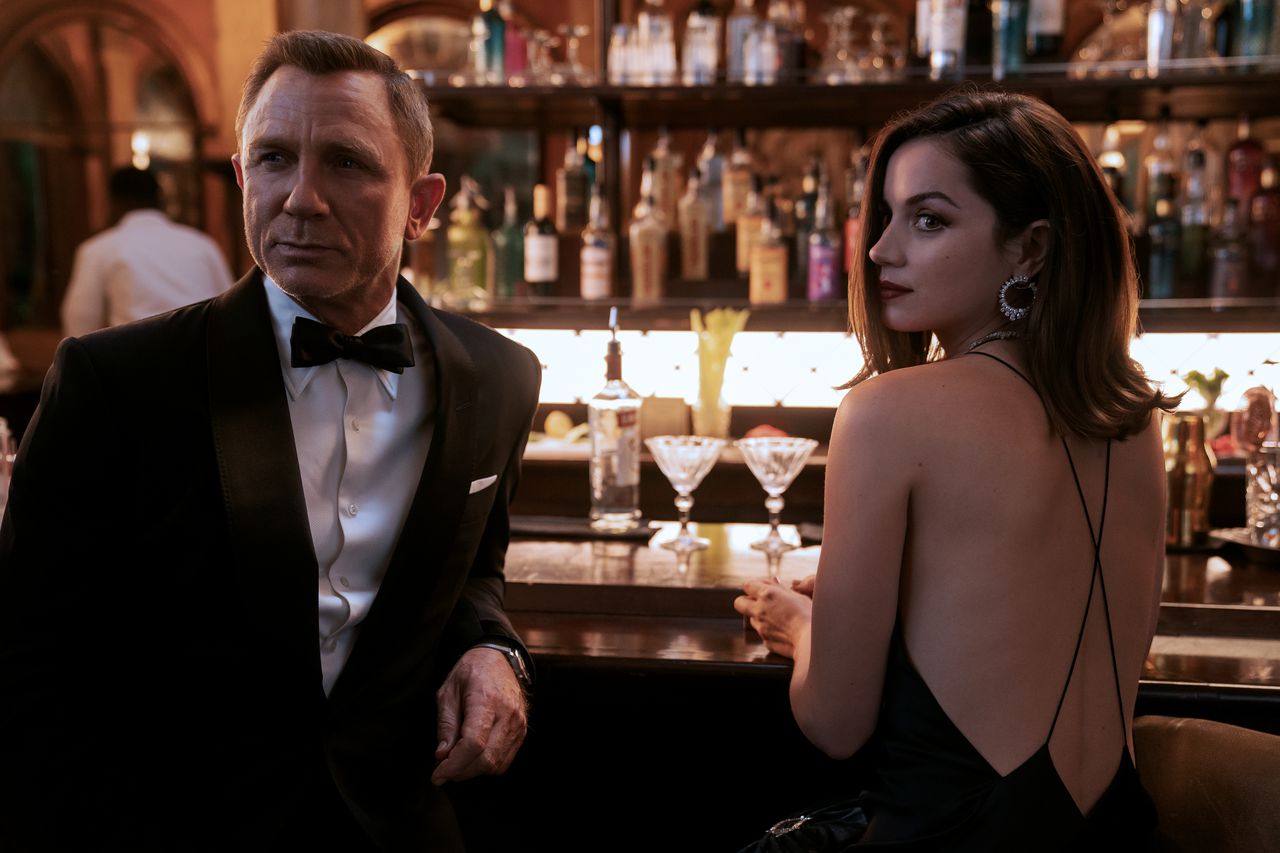
One wonders what Fleming would have made of this latest Bond film. Once you get past the big-budget trappings and the unfathomable gadgetry, I imagine Fleming would find something very familiar in Daniel Craig’s interpretation, globetrotting yet guarded, equal parts damaged and damaging. There’s so much in this film that works, thanks to the distinctive persona Craig has crafted for Bond. Once you have a character as solid as this one, the rest is a breeze, especially by the time the film makes its way to Cuba for an unforgettable sequence costarring the inimitable and infectiously fun Ana de Armas, late of Knives Out with Craig. Where she was timid and prone to fits of nausea as domestic worker Marta Cabrera, de Armas is a far cry from Knives Out here as Paloma, who winkingly exaggerates her naïveté while nervously downing a vodka martini. It’s almost criminal that she has only the one sequence, though one wonders if she too might recur down the road.

The unlikely star of the film – though perhaps not so unlikely, if you’ve been reading my blog for a while – is Hans Zimmer. After a forgettable title track by Billie Eilish, Zimmer runs away with the film, giving us a rousing score that had me stomping my feet with excitement. When he’s not winking at previous soundtracks, Zimmer is remixing and reinventing Monty Norman’s Bond theme with fearless aplomb. Thomas Newman did a fine job with Skyfall (though he revisited his own footsteps too closely with Spectre), yet throughout No Time to Die Zimmer makes a compelling case for the next Bond maestro. If Inception was a kind of proto-Bond for director Christopher Nolan, its Zimmer score was only the beginning; his love theme here is reminiscent of Inception’s showstopper “Time,” while his 007 action beats would be equally at home in Nolan’s ski lodge setpiece. David Arnold’s score for Casino Royale famously winked in the direction of Bond as we know him, and Zimmer takes us over the finish line with dexterity. 


It was a gamble to try to tell one story across five films, rather than tell more standalone stories about the world’s greatest spy. Before his untimely passing at 56, Fleming came to that concept late in his novel series, with his final three books forming a kind of “Blofeld trilogy.” No Time to Die is, finally, the successful culmination of that ambition, and it gives a suitable arc to these versions of Fleming’s characters. Whether it’s an ending or a transition may be for the casting directors to decide; let’s hope, however, that the MI6 crew – Ralph Fiennes, Ben Whishaw, and Naomie Harris – opt to stick around for that sense of internal continuity. Yet if you find yourself wondering, as the credits roll, what comes next – stick around. There’s no postcredits sequence, but there is one final guitar riff and the words “James Bond Will Return.” So too will I; after twenty months, it was fun to go to the theater once again and tell the coronavirus that now was no time to die.


No Time to Die is rated PG-13 for “sequences of violence and action, some disturbing images, brief strong language, and some suggestive material.” Directed by Cary Joji Fukunaga. Written by Neal Purvis, Robert Wade, Cary Joji Fukunaga, and Phoebe Waller-Bridge. Starring Daniel Craig, Rami Malek, Léa Seydoux, Lashana Lynch, Ben Whishaw, Naomie Harris, Jeffrey Wright, Christoph Waltz, and Ralph Fiennes.