Monday, October 24, 2022
Black Adam (2022)
Monday, August 9, 2021
The Suicide Squad (2021)
Superhero movies are like ice cream. I like ice cream. I like most kinds of ice cream. I have favorite flavors, but there are also certain flavors or toppings of ice cream on which I’m not terribly keen. I don’t like chocolate in my ice cream, for example, and too much of it ruins dessert.
I think James Gunn is chocolate ice cream. I enjoyed Guardians of the Galaxy well enough but found Vol. 2 to be overly laden with Gunn’s trademark gross-out schoolboy humor, a fascination with bodily functions and jeering insults. Vol. 2still had the Marvel heart, but The Suicide Squad has boasted that it is Gunn’s unvarnished foray into the DC (Extended) Universe. If this is Gunn undisguised, it is crude, and it is cruel, and it is certainly not my favorite flavor of ice cream.
In The Suicide Squad (not to be mistaken with its predecessor, Suicide Squad), Amanda Waller (Viola Davis) has assembled another crew of miscreants to undertake a top-secret mission with clandestine ill intent. She sends the assassin Bloodsport (Idris Elba), the fanatical Peacemaker (John Cena), the depressive Polka-Dot Man (David Dastmalchian), young Ratcatcher 2 (Daniela Melchior) and King Shark (voiced by Sylvester Stallone) into the island nation of Corto Maltese to find mad scientist The Thinker (Peter Capaldi) before his Project Starfish is exposed. Meanwhile, Harley Quinn (Margot Robbie) and Squad leader Rick Flag (Joel Kinnaman) are stranded on Corto Maltese, with Harley doing her Harley thing while Flag tries to get control of the increasingly manic situation.
From its opening scenes, The Suicide Squad is aiming for a fun and zany tone, but instead it lands somewhere just south of virulently misanthropic. If audiences complained that Zack Snyder’s comic book movies boasted too high a body count, wait until they get a load of The Suicide Squad, in which human life does not matter while the film regards each death as a punchline, an opportunity to convince the audience that Gunn’s sick, bloody nihilism is something to be cheered. As a comic book fan, I was over the moon at the cast list, scraping the bottom of the barrel for characters like Mongal and Savant, The Thinker and King Shark (never mind that the latter two had already been on the CW show The Flash). After all, Gunn had successfully introduced audiences to Z-list Marvel characters like Groot and Yondu, and we fell in love with them.
Not so here. At every turn, each time a character debuts, someone else on screen verbally assaults them, calling them names and mocking them. Only Idris Elba’s Bloodsport is spared this unpleasant introduction, likely because it would beggar believability to think that anyone might get the drop on Idris Elba. There is nothing redemptive like the “We are Groot” moment and nothing heartfelt like Yondu’s remark, “He wasn’t your daddy”; the only thing that comes close is the clear and predictable relationship that forms between Bloodsport and his proxy daughter Ratcatcher 2, who is herself carrying her father’s complicated and tragic mantle.
When the film is not actively ridiculing its protagonists or treating them like mere cannon fodder, The Suicide Squadcontinues that Gunn tradition of kneecapping its emotional moments with lowest-common-denominator humor; worse yet, just when the characters get a moment in the sun, they’re often exterminated in brutal, abrupt fashion – and these moments are, again, so predictable, lacking only the subtlety of a bright neon sign to announce a character’s imminent mortality. It is hard to imagine any of these faces becoming breakout characters because the film doesn’t often seem to care if they live or die. In a sense, Gunn might seem to have the most in common with Amanda Waller, who sees her Squad draftees as expendable grist for her own manipulative mill, yet Gunn appears to have some degree of loathing for Waller too, especially given how the film treats her in its third act.
But I didn’t hate The Suicide Squad. There is so much in the movie that works. Elba is a gem, and Daniela Melchior is the closest thing the film has to a real protagonist, even wading her way with aplomb through a film school student monologue about her origin story. King Shark is the closest to the film’s Groot, though Gunn makes the curious decision to write the character, the comic book son of a sea god, like a brain-damaged toddler deserving of his colleagues’ derision. Capaldi is perfectly cast as The Thinker, even though the film never gives him an opportunity to flex his augmented brain. And of course, Margot Robbie continues to be a light in the darkness as Harley Quinn, a spot-on interpretation of an unapologetic if errant feminist. It’s only too bad that the film never quite knows whether it wants to be a true Suicide Squad movie or another Harley Quinn movie (in the vein of the delightful and underappreciated Birds of Prey).
But as much as I wanted to like the film, and as much good material as there is somewhere in The Suicide Squad, there is a core ugliness at the center of the film, an underlying contempt for its source material and its characters. There should be zaniness and joy, especially with a cast of misfits like this. The Suicide Squad was an opportunity to tell the schoolyard bullies that they were wrong, that Polka-Dot Man isn’t proof positive that comics are inherently stupid. “This is dumb,” the film says, “and you’re an idiot for liking this.” There is nothing redemptive about The Suicide Squad, nothing but condescending spite and scorn until an emotional climax that is never really earned.
And yes, I am aware of the delicious grim dark irony of complaining that a movie like The Suicide Squad is mean-spirited. If you put a crew of supervillains on a helicopter together, they probably wouldn’t get along; they’d cuss and sneer and betray each other. But as much of a mess as David Ayer’s Suicide Squad was, studio interference or no, there was always a sense that Ayer liked these characters and wanted us to like them too. Gunn’s Suicide Squad is like a serving of ice cream at the Abuse Café, and it is not for everyone.
The Suicide Squad is rated R for “strong violence and gore, language throughout, some sexual references, drug use, and brief graphic nudity.” Written and directed by James Gunn. Based on the DC Comics. Starring Margot Robbie, Idris Elba, John Cena, Joel Kinnaman, Sylvester Stallone, David Dastmalchian, Daniela Melchior, Peter Capaldi, and Viola Davis.
Monday, January 9, 2017
Suicide Squad [Extended Cut] (2016)
2016 was a curious year for superhero films and their
afterlives. Marvel and DC released two each, but only DC took its home video
releases as opportunities for longer versions of its film slate. Batman v Superman: Dawn of Justice got
an Ultimate Edition, half an hour longer and a little clearer in its execution.
Suicide Squad, meanwhile, found
itself the heir of an “Extended Cut,” gaining only ten minutes in the offing.In a way, the nomenclature says it all. Suicide Squad isn’t a movie that was intended to be seen in a longer version like BvS, cut down by studio heads balking at three hours of Bat-sturm und Super-drang. Instead, director David Ayer presents an “extended cut,” more of the same that doesn’t shed much new light on the film, doesn’t clarify it in any meaningful way, but does provide more opportunity for the film to showcase its greatest strength – quirky personalities, well-casted, bouncing off of other strange rangers of whom I do hope we see much, much more.
Comparing an extended version naturally requires me to throw up a SPOILER WARNING, although it’s not exclusively the sort of spoiler that gives away the ending. (I do, however, discuss the film’s final scene at the end of this paragraph.) This is just an “extended” take on the story we’ve already seen, and it’s not substantially different from the film we got back in August. But discussing the differences naturally involves spoiling what they are, and the first (and perhaps most recognizable) difference is probably the film’s most appealing. We have a whole new flashback in which Dr. Harleen Quinzel (Margot Robbie, still the film’s shining star) chases down The Joker (Jared Leto) and demands that he make her his clown queen. It’s a smart move that adds agency to Dr. Quinzel’s fall into the identity of Harley Quinn, and it helps distance the film from the abusive relationship from the source material. Subsequently, it sheds more light on Harley’s dive into the vat of acids at Axis Chemicals; we have more context, and we know she’s chosen to go down this path. (Remember, in the theatrical cut, we move from Joker’s electroshock treatment right to Axis.) Harley’s less of a victim here, even if she’s still a dangerous psychopath, and it makes the film’s final frames – in which The Joker rescues Harley from prison – a little more palatable, a little more – dare I say it? – darkly romantic.
In the wake of Suicide Squad, a lot of buzz was devoted to Jared Leto’s Joker, and in this version he’s changed not at all. Even his modified involvement in Harley’s origin remains of a piece with his characterization in this film; he’s exasperated by her desire to join his criminal empire, but he goes along with it, because... well, why not? But while news emerged that much of Leto’s performance had been cut from the film (reported both by Leto and by eagle-eyed trailer viewers who detected something missing), rumors swirled that we’d see it all back in the Extended Cut. Not so, true believers, and so Joker exists unchanged in the Extended Cut. I’m still of the philosophical opinion that this is #NotMyJoker though he serves this film as well as he’s expected to be.
Margot Robbie continues to benefit most from the Extended
Cut in two fun extended group scenes, which deepen the character dynamics while
giving the performers a chance to get more comfortable in their clown paint,
yakuza mysticism, and reptilian skin. It’s apparent why these scenes we’re cut
– they’re far from cinematic, with long takes of characters walking and talking
on their way to the next big special effects bonanza – but it’s a real loss for
those who wanted Suicide Squad to be
more of a character piece than it was. In one scene, Harley puts her
psychotherapist skills (emphasis on the “psycho”) to work in diagnosing Killer
Croc and Katana. The off-beat dynamic among these Gotham-centric characters in
particular makes me hope that we’ll see them all together again in Ayer’s
follow-up Gotham City Sirens (which
nominally ought to include Catwoman and Poison Ivy alongside Harley Quinn).In another scene, which ends up comprising an entire deleted subplot, we see that the Squad is plotting against Rick Flag (Joel Kinnaman), a plan later abandoned when they realize how dangerous Midway City has become. It’s this kind of fun scheming that restores a sense of danger to these characters, a kind of inevitable unpredictability that reminds us that “Task Force X” is actually kind of a bad idea, and it’s something only a royal badass like Amanda Waller (Viola Davis, in pure “hell hath no fury” mode) could pull off.
I don’t know that I’ve heard anyone compare Suicide Squad to Watchmen, the seminal mid-1980s comic that redefined (and/or reminded) what the medium could accomplish using its own bag of tricks. So allow me to be the first in saying that Suicide Squad’s extended cut reminds me a great deal of Watchmen – but Zack Snyder’s Watchmen and the way its visual tricks aped the comic’s scene transitions. It’s not a major change at all, and it might even be that I’m misremembering the theatrical version, but it did jump out at me in this cut. For example, Harley Quinn looks down a flight of stairs, reminding her of the long fall at Axis Chemicals, or she sees a motorcycle that takes her mind back to chasing The Joker. It’s a small touch, but it aligns the film a little closer with the Snyder aesthetic by way of a non-DCEU comic book film, a little insider information much appreciated for those of us in the know, and it makes the film just a little bit more of a comic-book.
There’s a very funny Photoshop going around in which the only difference between two Suicide Squad posters is that a wound on Harley Quinn’s forehead is only slightly longer – hence, an extended cut. And it’s quite an apt metaphor in this case: the Extended Cut features Harley Quinn front and center, but the differences are more or less otherwise cosmetic. A little deeper and a little bit more fun, the Suicide Squad Extended Cut is more of the same for fans but less substantial than the much-improved Batman v Superman Ultimate Edition.
Suicide Squad is still rated PG-13 for “sequences of violence and action throughout, disturbing behavior, suggestive content and language.” Written and directed by David Ayer. Starring Will Smith, Jared Leto, Margot Robbie, Joel Kinnaman, Viola Davis, and Cara Delavingne.
Tuesday, December 27, 2016
Fences (2016)
When I saw the trailer for Fences, I immediately thought three things – “I’ve got to read that
play,” “I’ve got to see that movie,” and “Denzel ought to win an Oscar just for
the trailer alone.” Now that I’ve seen Fences
in its entirety, all three were – if I may say so – sage proclamations: August
Wilson reminds us why he’s a compelling playwright, the film is worth the price of admission, and
it’s going to be a tight race this year as Denzel Washington gives Andrew Garfield a run for his money.Pulling directorial and performing duty, Denzel Washington stars as Troy Maxson, a Pittsburgh trash collector who missed his shot as a professional baseball player and who fills his Friday afternoons with gab, both self-effacing and self-aware. From the kitchen window overlooking their backyard, Troy’s wife Rose (Viola Davis) watches her larger-than-life husband and tries to make room for herself in the life they have built together.
I have a very short list of actors and directors who are guaranteed winners, always worth the price of admission even if the rest of the film isn’t very good. But Fences is very good, and it’s due almost universally to the powerful lead performances from Washington and Davis. I wouldn’t be surprised or disappointed to see both up for their fair share of awards come Oscar season, and if they take home the trophies, so much the better. It comes as no surprise that Denzel Washington is the very picture of commanding; he’s one of a select few actors who can swing the pendulum from exuberantly gregarious to crushingly emotional without feeling anything but natural, and Troy Maxson is a perfect vehicle for Denzel to show us what he can do. Prone to long monologues, Troy is the consummate stage lead, and a less capable performer could have easily mishandled the complexities with which his character forces us to wrestle. Instead, Denzel is a master craftsman, and his discreet directorial style reminds one of a filmed stage play.
On the subject of the filmed stage play, this is Denzel’s third directorial outing (following Antwone Fisher and The Great Debaters), and here’s the thing – it’s not all that cinematic. If you’re looking for a Denzel movie with visual flair, you might be better suited to something like John Q or American Gangster. It’s a slightly unusual moviegoing experience, watching something that feels very much like a Broadway drama on film, though it’s not unprecedented. For example, I’m a huge fan of the twin productions of Hamlet starring David Tennant and Benedict Cumberbatch, which currently only exist for a wide audience in a filmed-stage-play edition. For an audience primed for that – and for an audience who can’t go see the real thing in person (Denzel’s Fences was staged in 2010, while the Hamlets were overseas), it’s the next best thing. And if the only casualty of a filmed Denzel stage play is that it’s a little uncinematic, it’s a sacrifice I’m content to make, because the performances and the characters are so large and powerful that it escapes notice after a few minutes.
About halfway through the film, Rose tells Troy, “I’ve been standing here with you!” reminding him – and us – that this is her life, too, and in the same way Davis pivots the screen’s attention to her. In a film where Denzel Washington is playing such an unreserved character like Troy Maxson, it might be easy to fade into the backdrop, but Davis holds her own and gives a formidable performance, exuding emotion with a fierce glance of the eye or a despairing runny nose. So much of her performance is predicated on silences and pauses, and Davis (who was, in a word, definitive earlier this year in Suicide Squad) very nearly steals the show as the film pivots into its second half with a game-changing revelation about their marriage.
Theatrical in the stage sense of the word, Fences is nevertheless a must-see as 2016 wraps itself up and bends again toward award season. Featuring two lead performances from thespians at the pinnacle of their craft, and with an unexpected range of emotions on display, Fences is a tour de force that does every bit of justice imaginable to the August Wilson playtext.
Fences is rated PG-13 for “thematic elements, language and some suggestive references.” Directed by Denzel Washington. Screenplay by August Wilson from his stage play. Starring Denzel Washington, Viola Davis, Stephen Henderson, Jovan Adepo, Russell Hornsby, Mykelti Williamson, and Saniyya Sidney.
That’s going to bring a close to 2016, folks. Over the past twelve months, The Cinema King has brought you 40 movie reviews (with eight installments of “Monday at the Movies,” a series that began in 2012), seven Top 10 lists, one Grand Marvel Rewatch (with a baker's dozen installments), and one Personal Canon (consisting of 65 essential films). What does the future hold? 2017 will see the same great content coming your way, as well as a number of exciting new features. Starting in 2017, you’ll see one of the greatest television shows of all time recapped and reviewed, episode by episode, week by week. You’ll also see the debut of “Ten at a Time,” a series which treads methodically through particularly dense films ten minutes at a time; at that rate, the first such feature should take about four months to get through. You’ll see a number of other surprises coming your way, but we don’t want to pull back the curtain all at once... If you haven’t subscribed, make sure to put your email in the box at the top of the page to guarantee your weekly dose of movie magic. See you next year!
Monday, August 8, 2016
Suicide Squad (2016)
Suicide Squad is a
very difficult film for me to review, because I genuinely believe that casual
comics fans are going to encounter a somewhat different film than the one I saw
this weekend. We hear this description “for the fans” being bandied about,
usually when a comic book movie doesn’t perform well critically, but I think Suicide Squad is made more for the fans
who are already on board with these characters, and it’s with that base that
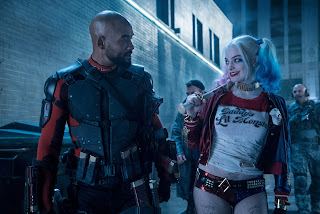
the film will be more successful.In the wake of the events of Batman v Superman: Dawn of Justice, Amanda Waller (Viola Davis) believes that a metahuman war is coming, so she convinces the US Government to create a black ops team of psychopathic criminals to do Waller’s dirty work. Headlined by hitman-for-hire Deadshot (Will Smith) and manic pixie clown girl Harley Quinn (Margot Robbie), Task Force X – dubbed a “suicide squad” in an on-the-nose moment from Deadshot – is dispatched to Midway City for a rescue mission when a magical threat menaces the entire globe. Meanwhile, Harley Quinn is being pursued by her “Mistah J,” the Joker (Jared Leto), who wants his girl back.
I usually pride myself on my ability to look at a thing objectively, to set aside my enthusiasm for the source material and see how a fresh eye would look at things. (I hear some of you scoffing already.) But for a diehard DC Comics devotee, Suicide Squad is a real challenge because it nails some of the comics material from the starting gate, though I’m not sure Johnny Popcorn will have the same enthusiasm for it.
Case in point: Amanda Waller. Viola Davis absolutely nails the role from the comic books. If Amanda Waller could step off the page and onto the screen, we’ve got Davis as living proof. For comics fans, you couldn’t do better. But for the casual film fan, the character is well-developed and compelling, but without the lens of comics accuracy the character is probably somewhat unremarkable (aside from a midcredits scene that intimates a surprise depth to Waller’s influence).
Ditto for The Joker. And I’ll say this for Suicide Squad – it is pretty bold for the film to include Batman (Ben Affleck) and the Joker in largely supporting roles, the former in what amounts to a cameo performance. I just want to point out that we’re living in a world where Captain Boomerang has more screentime in Suicide Squad than Batman. (And boy, is the film aware of how ludicrous Captain Boomerang is.) But back to the Joker – as with Waller, I’m fully aware that I’m bringing decades of investment in the character into the theater with me, and so I can rationalize this wildly divergent interpretation of the character as emblematic of the Joker’s “super sanity,” in which he constantly reinvents his own personality to cope with the madness of modern life. But even then, and I imagine the effect is compounded for viewers who don’t care about the Joker like I do, there’s something puzzling about why the Joker looks like something out of a gangster rap music video. Is he satirizing the gangs he seeks to replace? Or is this just our post-Ledger edgier Joker (cribbing Ledger’s voice, to boot)? Either way, there’s a “not my Joker” reflex from this fan, and I suspect a sort of bemused perplexity from others.
The good news is that the casting of the leads in the DC Extended Universe continues to be successful. Will Smith, despite my misgivings that he only ever plays Will Smith, does a fine job with Deadshot, giving the character sufficient nuance and a clear psychiatric profile. But far and away, Suicide Squad is Margot Robbie’s movie. For a relatively new character to the Batman mythos, Harley Quinn is one of its most beloved, and Robbie more than does the character justice. Granted, this is still early-days Harley, before she realizes just how abusive her relationship with the Joker really is, and I’m sure that future films will get to that part in due time. For now, though, Robbie revels in the harlequinade of madness, layering the character with shades of performance and insanity, leaving us to wonder just which is which. Above all, it’s clear that Robbie is having a blast with Harley Quinn, and that infectious enthusiasm transfers over to the audience’s side of things.
Suicide Squad is not Guardians of the Galaxy, though it seems to try very hard to be, nor is it quite Deadpool, which its detractors have accused it of aping. Fortunately, it’s also not Fant4stic, the dun standard for comic book movies. But it is, however, more than a little strangely crafted, from its opening montage to its Ghostbusters-esque climax. Almost aware of the fact that the general audience won’t know who Katana, Enchantress, and Killer Croc are, the film delivers this information in the bluntest exposition imaginable, replete with stylized on-screen rap sheet text. It’s aesthetically cringe-worthy and decidedly uncinematic, but in a way it’s understandable. The film’s use of the Suicide Squad against a mystical force who wants to destroy the earth for unknown reasons, using a big shining light in the sky to do it, is less sensible. The Squad is a pretty down-to-earth group with no discernible “super” skills, so they seem grossly outmatched and perhaps even in the wrong movie when juxtaposed with an otherworldly force. Put another way, it’s not the best narrative structure to allow the team to shine. If there’s to be a Suicide Squad 2, which box office receipts seem to indicate in the affirmative, I’d like to see the Squad stay closer to their home turf, against a villain that doesn’t require more expository mumbo-jumbo.
Suicide Squad is not a total disaster, a backhanded Trumpean compliment if ever there were one, but it’s not an unqualified success, either. It’s a strange film, off-putting in some ways but fantastically enjoyable in others, fun enough to get a thumbs-up from this reviewer but not quiet the triumph I wanted.
Suicide Squad is rated PG-13 for “sequences of violence and action throughout, disturbing behavior, suggestive content and language.” Written and directed by David Ayer. Starring Will Smith, Jared Leto, Margot Robbie, Joel Kinnaman, Viola Davis, and Cara Delavingne.
Monday, March 3, 2014
Monday at the Movies - March 3, 2014
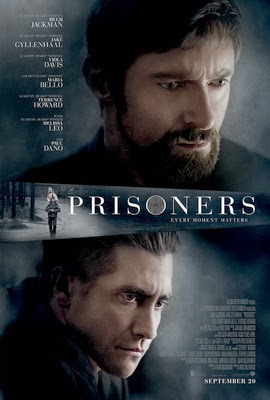
Prisoners (2013)
– I could fill this review with 250 adjectives – breathless, intense,
suffocating – but they all add up to one word.
Prisoners is fantastic, much
darker and more intricate than the torture porn promised by the film’s one-note
marketing. Hugh Jackman and Terrence
Howard star as fathers whose daughters disappear one Thanksgiving; displeased
with the methods of Detective Loki (Jake Gyllenhaal), Jackman takes hostage a
mentally challenged man (Paul Dano) who he believes abducted the girls. Prisoners,
though, is much more elaborate than that initial synopsis posits, weaving a
number of plot threads together in unexpected ways that are best experienced as
the film unfolds – especially because some of the most insignificant details
acquire astonishing relevance in the third act.
I’d never heard of director Denis Villeneuve before, but he’s certainly
on my watchlist now. There are moments
in Prisoners that recall the best
scenes in David Fincher’s Zodiac,
moments of intense claustrophobia that have little to do with the actual set
design and much more to do with the sense that the plot is rapidly closing in
on itself, that events are spiraling beyond the control of the
protagonists. (Jackman’s continual
reminders of how long the girls have been missing further add a real-world
tenseness to the proceedings.) Though
all in the cast do fantastic work, including Maria Bello and Viola Davis as the
beleaguered mothers, a special tip of the hat goes to Paul Dano, who really deserved
a Supporting Actor nod. As the disabled
Alex Jones, Dano masters the mental handicap without overplaying it and subtly
convinces us that something is quite wrong about Alex even if we don’t know exactly
what it is (and he keeps us guessing, too).
Disappointingly, Prisoners
seemed to fall off the radar once it debuted in theaters – a real shame, since
it’s one of the most gripping films I’ve seen in recent memory.That does it for this week’s edition of “Monday at the Movies.” We’ll see you here next week, and don’t forget that this Friday is the Double-Oh-Seventh of the month (and Roger Moore’s swan song as James Bond)!