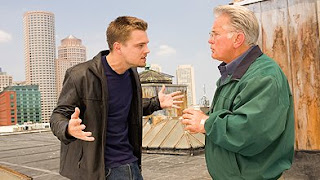
Showing posts with label Leonardo DiCaprio. Show all posts

Monday, January 18, 2016

The Revenant (2015)

2016 is shaping up to be the year of “Is it just me?” I’m closer to thirty now than I’ve ever been before, and I’m increasingly feeling out of touch with the critical community; I still love a good Marvel superhero flick, more inclined as I am to forgive/overlook their failings. Meanwhile, critical darlings are drifting past me in severely underwhelming fashion. I sniffed at Mad Max: Fury Road, which now has a Best Picture nomination to its name, and I couldn’t disagree more with those who said The Hateful Eight was the work of a mature Tarantino.

Now here I am at The Revenant, “Certified Fresh” by Rotten Tomatoes and lauded with Oscar nominations and Golden Globes victories aplenty. And again I’m asking the question that seems poised to be on my lips for the rest of the year – did we all see the same movie? For my money, The Revenant was more than a little boring, containing as it does a few viscerally composed memorable moments punctuated by long reels of punishment that border closer to cinematic sadism than awards bait.

Leonardo DiCaprio, in the role which will likely win him his first Oscar (about which, more later), stars as Hugh Glass, a frontiersman left for dead by his comrades (Tom Hardy and Will Poulter). Amid an unremitting landscape and every possible way to die in the wilderness, Glass stumbles, bleeds, and inches his way back to civilization – and his revenge.

I’m a bit of a newcomer when it comes to director Alejandro González Iñárritu, but I thought Birdman was a masterpiece, brilliantly anchored by Michael Keaton’s commanding lead performance with a delightful ensemble cast backing him up. And after The Revenant, I was reminded just how good Birdman was, because The Revenant lacks most of what made Birdman so compelling. Instead of a snappy script with snappier performances and a directorial eye that knows to keep the film moving, The Revenant has one strong performance that plays out its one-note fairly quickly, while the supporting cast is given short shrift in favor of long – and I mean gruelingly long – wide takes of landscape, the likes of which perhaps more properly belonged in an ode to 70mm like The Hateful Eight.

“Belabored” is the word I’d use most for The Revenant. DiCaprio is bludgeoned by the weight of survival, and he does an adequate job portraying a man at the limits of his capacity to survive, but more than two and a half hours it’s excruciating only to a point, at which moment the viewer becomes dulled to the horror of the wilderness, moving instead in the “Well, what else did you expect? Of course [insert tragedy here] was bound to happen at this rate.” Ditto for the unforgiving landscape, which at first seems horrifyingly blank but soon becomes commonplace, painful to the retinas more than to the soul.

And speaking of souls, I sense that The Revenant is going for spiritual commentary in its dreamlike editing, but there is not the thickness of narrative needed to support such intuited depth. The motivations of all the protagonists are, frankly, still somewhat baffling, and the political climate of the time isn’t adequately fleshed out. All the time that could have been devoted to these plots is instead exhausted on calamity and bloodshed and struggling, leading the audience to feel that the point was more about punishment than any narrative arc. One must recognize that there is something much deeper in Hardy’s character than the film permits him to display, and I’m sure I’m not alone in wanting to see more of Domhnall Gleeson’s Captain Henry, or perhaps that’s just a reflection of how much I liked his understated sneer of a villain in The Force Awakens.

There are things enjoyable in the film, predominantly the most violent bits in which the plot moves forward and the languorous quality of the film pays off. The bear scene, about which much ado has been made, is brutal in a technically sound way, and the final confrontation between DiCaprio and Hardy does justice to the relationship between the two characters. At the end of the day, The Revenant tries to overwhelm but ends up underwhelming. Though DiCaprio is good enough in the film, he’s not overpoweringly commanding, leading this reviewer to suspect that his Oscar win next month (which is all but assured – or so I predicted about Keaton in Birdman last year) will be more a lifetime achievement award than a recognition that this is as good as it got this year. The same happened to Denzel Washington for Training Day, which was good but not his career best (that honor goes to Malcolm X or John Q).

Or maybe I’m just out of the loop. But I can’t say that I’d put The Revenant on my Top 10 of 2015.

The Revenant is rated R for “strong frontier combat and violence including gory images, a sexual assault, language and brief nudity.” This thing is intense, as I’ve said, and Iñárritu is unapologetic in his depiction of blood. There’s a rape sequence in which nothing is shown, though in another scene a dead man is seen naked from a moderate distance.

Monday, September 15, 2014

Monday at the Movies - September 15, 2014

Welcome to another edition of “Monday at the Movies.”  Continuing our string of bizarre coincidences, tomorrow is screenwriter Justin Haythe’s birthday, he of the largely ill-conceived Lone Ranger reboot.

Revolutionary Road (2008) – If you want to remember the postwar era fondly, the door to Turner Classic Movies is that way.  Director Sam Mendes helms this adaptation of the eponymous novel by Richard Yates, and you’ll find it astounding to believe this is the same director behind both Skyfall and American Beauty.  Leonardo DiCaprio and Kate Winslet play Frank and April Wheeler, a couple for whom the sheen of marital bliss is quickly cracking; the two deliver reliably solid work, and the tension between the two is divinely palpable.  As unfaltering as these two performances are, they’re also relentlessly depressing.  They’re fantastic performers, and we enjoy them on-screen for it, but good Lord – it’s very trying to watch two of your most beloved thespians berate each other for two hours in a self-destructive, mutually abusive marriage.  The goal here is a warts-and-all exposé on the darker side of the late-40s American optimism, with a heavy dose of Peyton Place thrown in for those who still held the suburbs as idyllic.  On that count, Revolutionary Road is a bleak success, but feel good it ain’t.  To lighten the mood, though, Michael Shannon wanders into the frame every so often, and – as is usually the case with him – it’s as though he’s in an entirely different movie, one I can’t say I wouldn’t rather have watched.  His supporting role as the son of the Wheelers’ realtor neighbor (Kathy Bates) comes with equal parts mental derangement and frightening outburst, a fine and effective complement to the repressed Frank and April.  The real treat is in watching him act, with an occasional tic or bizarre vocal inflection making his the only real fun performance to be had in a film that is creatively successful but otherwise oppressing to watch.

That does it for this week’s edition of “Monday at the Movies.” We’ll see you here next week!

Monday, December 30, 2013

The Wolf of Wall Street (2013)

Any reader who isn’t a stranger around these parts knows that I’m an enormous Martin Scorsese fan, and I’m of the opinion that Leonardo DiCaprio is one of our finest actors.  So believe me when I say that The Wolf of Wall Street, the pair’s fifth collaboration in more than a decade, is undoubtedly their best work since 2006’s The Departed (and maybe even since Goodfellas – your mileage may vary).

DiCaprio stars as the titular Wolf, Jordan Belfort, who uses his Wall Street savvy to start up his own barely legal brokerage.  Amid the debauchery and depravity of the excesses at Stratton Oakmont, Belfort attracts the attention of the FBI while juggling the demands of his second wife Naomi (newcomer Margot Robbie) and his partner Donnie (Jonah Hill).

With Wolf of Wall Street, Scorsese returns to the true-crime biopic genre he perfected with Goodfellas and Casino; indeed, Wolf could be seen as the third in a thematic trilogy of rise-and-fall narratives ripped from the headlines, and it certainly deserves that place of prominence in Scorsese’s repertoire.  Wolf is compelling and engaging, a prime example of a filmmaker not content to rest on his laurels; instead, he reminds us just how good he can be.  And for a film that never feels like it’s three hours long, never elicits so much as a bathroom break or a glance at a watch, Wolf is one of the most engrossing films I’ve seen all year.

As far as engrossing goes, let’s hope that this is the year that finally nets DiCaprio his Best Actor trophy at the Oscars (though he’ll have some steep competition from Christian Bale in American Hustle).  DiCaprio’s been turning in consistent work for the better part of a decade, and it’s high-time the Academy stops treating him like a bridesmaid and recognizes the total immersion DiCaprio undergoes into this character.  Aside from the verisimilitude of DiCaprio’s impression of Belfort’s physicality and mannerisms, he proves himself deft with a range of behaviors, from slapstick humor to deadpan disgust, from swaggering braggadocio to a whole range of addictions.  Belfort is such a multilayered character, and the film offers DiCaprio so many different opportunities to flesh out facets of this fascinating figure.

Yet with so many tonal oscillations, The Wolf of Wall Street never feels confused or inconsistent.  While some reviewers are bemoaning the film’s indulgent excesses, I have to think that’s part of the point; Scorsese is so effective at recreating Belfort’s world that he manages to trick us into thinking he’s not on our side.  And just like in Goodfellas, we’d be remiss if we didn’t think there was at least something seductive about Belfort’s lifestyle.  Whether it’s the money, the sex, or the feeling of invincibility, we’re meant to understand in some way – and perhaps even empathize with – Belfort’s decisions.

And Wolf of Wall Street plays with so many of the great Scorsese themes that it deserves high marks as another fascinating iteration of a great director’s most significant statements – the perils of venality, the inevitability of self-destruction, the coincidental slip-up.  In fact, one might even lump Wolf of Wall Street in with the greatest of Greek tragedy – we have our protagonist cursed with a fatal flaw (as with most Scorsese characters, it’s ambition) that becomes the instrument of his own implosion.  But if that’s too highfalutin a comparison for you, just remember Henry Hill’s closing monologue from Goodfellas about how the road through your dreams ends in being a schnook, eating egg noodles with ketchup.

In an era where one-percenters are the popular scapegoat, it’s refreshing to see a film that addresses the issue without heavy-handed moralizing about the evils of capitalism.  Instead, Scorsese presents the subject on its own terms, with an invigorating honesty that asks the audience to draw its own inescapable conclusions.  It’s a master class in respect and rewards for the audience, anchored by one of the year’s best performances.

The Wolf of Wall Street is rated R “for sequences of strong sexual content, graphic nudity, drug use and language throughout, and for some violence.”  Man, is this movie wildly inappropriate.  We’ve got a bevy of naked men and women on parade (sometimes literally), more drug abuse than you know what to do with, an estimated 500 F-bombs, and a few mild fisticuffs.

Tuesday, May 14, 2013

The Great Gatsby (2013)

Whenever a movie includes a superlative in its title, it always sets up the inevitable puns for reviewers (both casual and formal) to shout, and after a while it gets rather tedious.  But when it comes to the subject of Baz Luhrmann’s adaptation of F. Scott Fitzgerald’s The Great Gatsby, to you, sir, I say, “Not so great, old sport.”

A relatively close adaptation of Fitzgerald’s novel, The Great Gatsby follows Nick Carraway (Tobey Maguire) as he recounts his life as a bond salesman in the New York of the Roaring Twenties.  After procuring an invitation to the most lavish party in town – which just happens to be right next door – Nick meets the owner of the house, the ever-optimistic Jay Gatsby (Leonardo DiCaprio).  As Nick and Gatsby become friends, Gatsby makes an unusual request – he wants to meet with Nick’s married cousin Daisy Buchanan (Carey Mulligan).

The great American novel, a story of enduring love, required reading for high schoolers the world over – all accurate descriptors for The Great Gatsby.  And it’s not that Luhrmann’s adaptation is absolute rubbish.  It’s just far from great, much less than such a work of literature deserves.  Luhrmann’s Gatsby is not without its virtues, but its weak points outshine the good ones such that I suspect that even Luhrmann devotees might be disappointed.

First, the good news.  DiCaprio and Mulligan are exemplary as Gatsby and Daisy, first-rate approximations of the characters they embody.  It’s difficult to imagine an actor whose own star power better personifies that of Jay Gatsby, the never-say-die millionaire whose optimism is matched only by his opulence.  (Sidebar:  when is DiCaprio getting that Oscar?  He consistently turns in solid work, and while I don’t think he’ll land one here I do think he’s long overdue.)  And Mulligan is solid as the emotionally vapid Daisy, languid in all the right places but without rendering Gatsby’s affection inexplicable.  We too might love Daisy if we’d known her that long ago.  Finally, there’s Maguire, who does exactly what the novel asked of Nick – he observes, he mediates, he explicates.

And therein lies the problem.  The film is too faithful an adaptation in this regard, situating Nick as the main character through whom the entire movie is filtered.  But that technique doesn’t work for a film, because we don’t need a character to explain what we’re meant to see; we can just see it.  Worse, there are moments where Nick narrates what he sees while the camera focuses only on him; in a cinematic medium, this is the equivalent of someone telling you about their summer vacation.  Because Luhrmann is known for such a highly stylized approach to visuals, it’s quite a surprise that he does this so frequently; we know he knows better, but why won’t he let us see what’s going on?  (This is all to say nothing of the odd framing device placed over the film that seems to conflate Nick with Fitzgerald, to varying degrees of confusion.)

As for the visuals, Luhrmann does a decent job with the big parties, lavish set pieces that show off the decadence of the Jazz Age.  It’s classic Luhrmann, velvet vomit to excess and glittery garland as far as the eye can see (and it looks grand in 3D, to boot).  I had initial apprehensions about the use of contemporary music, but I didn’t mind it in the feature film itself; the effect seems to be simulate the shocking avant-garde nature of the music that must have been played at Gatsby’s parties, and it seems comparable to Deadwood’s use of modern profanity in lieu of historically accurate vulgarities. 

But all told, I came away more than just a bit disappointed, surprised at how restrained the movie was in some points (especially for a director like Luhrmann), pleasantly satisfied with the performances, but more-than-mildly irritated with the decision to foreground such a passive observer like Nick.  Build me a movie not around his tepid narration but around the dynamic between Gatsby and Daisy, and I’ll be ready to call that Gatsby “great.”

The Great Gatsby is rated PG-13 for “for some violent images, sexual content, smoking, partying and brief language.”  So you know someone gets hit by a car, and someone else gets shot, and Daisy and Jay are seen in bed canoodling, while Tom has a mistress.  Then there’s all that party stuff that... well, I wouldn’t go so far as to say it’s not appropriate.  But it is weird that they rate movies for “partying.”

Wednesday, December 26, 2012

Django Unchained (2012)

It’s all been building to this:  I’ve spent the last few months revisiting the oeuvre of Quentin Tarantino here at The Cinema King, all in preparation for Django Unchained – Tarantino’s eighth directorial feature.  Django Unchained is, at worst, an odd film; at best, it’s another wickedly entertaining entry from one of this generation’s most vivid and unique filmmakers.

Django Unchained stars Jamie Foxx as the eponymous freeman, liberated from slavery in order to assist the theatrical bounty hunter Dr. King Schultz (Christoph Waltz) in tracking his prey.  Django and Schultz make a deal:  if Django helps Schultz track the nefarious Brittle Brothers, Schultz will help Django free his wife Broomhilda (Kerry Washington), a promise which leads the pair to the plantation of Calvin J. Candie (Leonardo DiCaprio).  At Candieland, Django and Schultz pretend they are shopping for slaves, though Candie’s house slave Stephen (Samuel L. Jackson, by way of Uncle Ben) suspects the pair are being less than honest.

In many ways, Django is a kind of departure for Tarantino.  For one, the film isn’t littered with blood and guts like some of his earlier works, though there’s still enough of the old ultra-violence (especially at the end) to interest even Alex DeLarge.  Moreover, the film is told in a straightforward linear fashion, without the temporal hijinks we’ve come to expect since Pulp Fiction and Kill Bill.  Finally, and possibly most surprisingly, Django is the first Tarantino film to deal with “serious” issues like slavery instead of stopping short at visceral themes like revenge (an overarching theme, though, of all Tarantino films).

All of this, however, is to say what the film doesn’t do.  What the film does do is provide a snappy and engaging romp through a dark chapter in American history, a kind of Gone With the Wind for our generation.  As with Inglourious Basterds, Tarantino explodes his setting, touring the entirety of the antebellum South (circa 1858) with Foxx and Waltz as our tour guides.  Django is a “spaghetti southern” in this regard, as we follow two eclectic protagonists on a deeply personal quest through a perilous landscape.

Of these two protagonists, Waltz is (perhaps unexpectedly) the far more compelling.  Foxx is serviceable as Django; his determination to save his wife is tangible, but his deeper personality is never really accessible (a subplot about his humanity ebbing while he impersonates a black slaver, for example, never really pans out).  As Schultz, though, Waltz steals the show with his garrulous and gregarious performance; much as he did as Hans Landa in Basterds, Waltz brings this character to explosive life, deftly handling Tarantino’s tricky dialogue and humanizing Schultz’s contempt for the institution of slavery in the way that I wanted to see done in Lincoln.  (In this respect, then, Django is more honest with its audience than Lincoln was – a sentence I never thought I’d write!)

The third trademark of a Tarantino film, aside from extreme violence and peppy prose, is a solid supporting cast.  And in this Django does not disappoint.  We’ve got the “unlikely choice” – Don Johnson as a slaveowner a la Colonel Sanders.  We’ve got the “big name” – DiCaprio, who drips detestability as the film’s ostensible antagonist.  Though his Southern accent seems a garish caricature, I suspect that’s the point; Tarantino villains are seldom subtle, and the broad strokes surrounding Calvin J. Candie make it all the easier for us to hate him.  Finally, there’s the “veteran collaborator” – Samuel L. Jackson as Stephen.  If Waltz steals the show from Foxx, Jackson steals it right back in the film’s third act, making Stephen a nuanced menace somewhere between Stepin Fetchit and Darth Vader.  The gross stereotyping in his early scenes may elicit laughs, but those laughs quickly give way to fear when we see the true cruel danger he poses.  Jackson handles both aspects well and doesn’t forget to chew the scenery along the way.

Indeed, Foxx aside, most of the players in the film seem to be having a great deal of fun with the picture, which helps the audience have fun, too.  Django is probably not the “important film” Tarantino hoped it would be by tackling such a weighty issue as slavery, but it does so in a mature way without preaching a sermon the audience already believes.  Instead, Tarantino tries to have some fun with the material, and the film he’s created steps far enough out of the boundaries of realism that the audience can have an uncomplicatedly good time.

Django Unchained is rated R “for strong graphic violence throughout, a vicious fight, language and some nudity.”  There are several cartoonishly bloody shootouts, a scene of two slaves being forced to fight to the death, F-bombs and N-words galore, and two fleeting glimpses of naked slaves being tortured.

Monday, July 19, 2010

Inception (2010)

Before I launch into my review of Inception, let me just say that this is a fantastic film, downright dynamite and an absolute must-see. I'm just giddy about it. And now, the review proper:

Christopher Nolan's Inception is one of the most anticipated movies to hit Hollywood in a long time - probably the first of that anticipatory magnitude since Nolan's last and perhaps greatest venture, 2008's The Dark Knight - for a few very good reasons. First, it's Christopher Nolan's next film, and everyone's dying to see if he can continue his winning streak after making a comic book movie that's in the runnings for "instant classic." Secondly, Inception's marketing campaign is tantalizingly vague, unrevealing in an expertly intriguing way. Finally and most significantly, it's one of the only movies this year to be wholly and unequivocally original; it's not a sequel, a prequel, a remake, a reboot, an adaptation, a rip-off, or a retread. Inception is wildly imaginative, delectably innovative, and enthusiastically entertaining - unquestionably one of the best films of the year and a strong contender for the year's top honor.

Those in the know (namely, those who have seen it) are extremely reticent to talk about Inception on a plot level, desperately afraid that the uninitiated will have the movie spoiled for them. But what's delightful about Inception is that it's practically unspoilable; the major joys of the film come not from what happens, but how and why it happens. Still, if the following plot summary is in any way lacking, it's because I'm holding back; after all, being there is half the fun.

Inception introduces us to a radical new world, one in which dreams can be invaded, manipulated, and harvested. Leonardo DiCaprio stars as Cobb, a self-styled "extractor" who specializes in entering dreams and stealing important information from his marks - extraction. Already on the run from the law after mysteriously parting ways with his wife Mal (Marion Cotillard) who regularly appears in his dreams, Cobb is offered a chance to return home by pulling off a heretofore unheard of and presumably impossible task - inception, planting an idea rather than stealing one. And so, assuming inception can be done, Cobb assembles a team (which includes Joseph Gordon-Levitt and Ellen Page as researcher and dream architect, respectively) and sets to work.

Essentially, Inception is a heist film turned on its head; it's a heist film in which the object is to plant, not to steal, but thatn's not where the similarities end. Here we have the protagonist with a dark past, the characteristically complex team of misfits, the young novice (Page, who respectfully restrains her trademark snarkiness in deference to the film's concentration on verisimilitude), the mark (Cillian Murphy as a coolly cold corporate heir apparent), the shady yet wealthy backer (Nolan standard Ken "Fake Ra's" Watanabe, who adeptly handles the shift from suspicious to endearing), and the twist-upon-twist format that Nolan employed to widespread approval in his fabulous magician's duel The Prestige. Inception warrants comparison to The Prestige because both films relied upon warning the audience they were about to be tricked, but Inception takes it one step further by letting the audience in on the game; we're not on the sidelines but rather in the field with the team, figuring it out as we go along rather than letting our protagonists do it for us.

If I had to review Inception in only two words, I'd choose the phrase "mental calisthenics" because I can't remember the last time a movie made me keep my mind so concentrated to the point where I actually felt tired at the end of it all. Never mind those who say that the movie is "confusing" because what it actually is is engaging; Inception spells itself out for you, but it's up to you to follow along. The concept of "inception" is explained once and only once, so pay attention; this is a thoughtful movie but it's also a high-octane adventure picture with no time to backtrack or recap. Like the train that features into the film's climax, the course of Inception runs fast and unrelentingly forward.

There really aren't enough positive things I could say about Inception. It's a downright brilliant film, anchored by sharp and solid performances from all around. TheWrap.com recently argued that the coming generation doesn't have an A-list in the bunch, but DiCaprio and JGL are obvious contenders for the next breed of A-listers. Riffing on his role in Shutter Island, in which he also had difficulties separating reality from imagined delusion, DiCaprio takes center stage here and holds the audience's attention, proving that he's at his best when he's playing a character with a few cards hidden - both from his fellow characters and from the audience. JGL is much more straightforward, doing a great job as a serious actor after proving he's got solid comedic chops in (500) Days of Summer. And working with very little character description, Cotillard is a vision (often literally) as Mal, maintaining a perfect balance between the mystery surrounding her character and the sense of importance underlying her many appearances. I've already spoken well of Page, Murphy, and Watanabe, but let's not overlook a small but vital role from Michael Caine as Cobb's mentor and tether to the world Cobb has had to leave behind.

The script is smart, the performances sterling, but the visuals are downright eye-popping. Nolan boasted of filming in six different countries (up from three in The Dark Knight), and it shows - scenery is strikingly gorgeous, ranging from Tokyo bullet-trains to the nighttime cityscape of Paris to the snowy mountains of... well, someone's dream. The standout visual piece, though, is a hotel in which conventional rules of gravity no longer apply (to explain why would be to betray one of the film's better surprises); while the scene has Kubrickian undertones with a rotating corridor straight out of 2001: A Space Odyssey, Nolan ups the ante by staging a fight scene in zero gravity - and it's one of the most breathtaking fights in recent cinematic history, outdoing the "bullet time" of The Matrix and the quick-cut style of the Bourne trilogy. Nolan's style is one that continually leaves his audience breathless because Inception insists on outdoing itself - visually and creatively.

If you haven't already figured it out, I'm nothing short of gaga about Inception. Before this review turns into abject gushing, let me close by noting once more that Inception is undebatably a top movie of 2010, a must-see for a myriad of reasons, and a sheer delight to behold. As if I weren't already stoked about Nolan's third Batman movie.

Inception is rated PG-13 "for sequences of violence and action throughout." Overall, it's pretty tame, with more emphasis on thrills than gore, although blood appears sporadically but never explicitly.

Monday, June 28, 2010

Gangs of New York (2002)

Martin Scorsese ushered in the '00s with the start of a beautiful friendship - with Leonardo DiCaprio, who's been called Marty's new DeNiro - and this epic look at the birth of modern New York City set, like Casino (albeit in positive terms) against personal rise-and-fall stories.

Sixteen years after the murder of his father (Liam Neeson), young Amsterdam Vallon (DiCaprio) returns to New York and his old neighborhood, the Five Points. After meeting up with old friends and new acquaintances - chief among them the pickpocket prostitute Jenny Everdeane (Cameron Diaz) - Amsterdam finds himself falling in with a gang led by his father's murderer, the man he's vowed to kill: the merciless Bill "The Butcher" Cutting (the ever-riveting Daniel Day-Lewis). Meanwhile, Boss Tweed (Jim Broadbent) is coming to power, the Civil War rages, and an impending draft notice might just ignite the powderkeg that is New York City.

As with every Martin Scorsese movie reviewed here thus far (with the possible exception of Shutter Island), Gangs of New York is a mesmerizing epic, with characters and events representing larger forces and ideals of national consequence. On one side, Amsterdam and his immigrants; on the other, Bill the Butcher and his nativists. Already, then, the conflict becomes something more than just two men in battle. There are other issues at stake - what it means to be an American, what the nature of honor is, and even an examination of the political process. All of these plates Scorsese keeps spinning without ever losing sight of the immediate Amsterdam/Bill conflict, and in that respect the film succeeds.

Scorsese is like Sidney Lumet in that he reliably casts actors who turn in star performances, even if it wasn't quite expected of them (prime example for Lumet: Vin Diesel in Find Me Guilty). Gangs of New York begins a series of (to date) four films Scorsese has made with DiCaprio, and it's here that we get glimmers of the actor that DiCaprio has since become. While his performance isn't completely polished - his Irish accent slips in places - it's a giant leap forward from Titanic and a good start on the road to The Departed. Diaz, of whom I've never been a big fan, is decent here, her accent slightly more consistent and a hair/makeup job that almost lets you forget that this is the same actress responsible for Charlie's Angels. Bit players get chances to shine; Broadbent is mirthfully corrupt as Boss Tweed, Liam Neeson is a show-stealer in the film's brutal opening reel, and as an Irish cop John C. Reilly proves that he is, like all good comedians, a fine dramatic actor too. The greatest performance, unsurprisingly, is Daniel Day-Lewis's villainous turn as Bill the Butcher, a baddie of the highest order and the kind of man who could keep company with Deadwood's Al Swearengen and No Country for Old Men's Anton Chigurh; that Day-Lewis lost the Oscar that year is a travesty, though the early inklings one gets of his Daniel Plainview in There Will Be Blood suggest that this is an actor who builds on what he does until the majority sit up and take notice.

At nearly three hours, this sprawling epic might not be for everyone. Unlike the Kill Bill series, which was a non-stop wham/bam "roaring rampage of revenge," Gangs of New York is more deliberate in its pacing. After a showstopping opening (successfully ignoring Rip Torn's advice from The Larry Sanders Show, "Never open with a showstopper"), Amsterdam encounters Bill almost immediately upon returning to New York, simmering and gathering information before he makes his play for vengeance - which promptly pans out completely unpredictably, leaving Amsterdam to slink back, lick his wounds, and restrategize. And so the film contains three action pieces - beginning, first climax, and second climax - with little "action" in between; instead, the focus is on character (story vs. plot, as Scorsese would put it) and scenery - downright gorgeous scenery, with Scorsese's trademark meticulous attention to detail and a high degree of historical accuracy as far as capturing a bygone era on film.

While it's not Scorsese's absolute finest work (that honor, in my humble opinion, belongs to The Departed), Gangs of New York is arguably among his more polished pieces. If nothing else, Daniel Day-Lewis proves himself a first-rate actor as the terrifying villain of the piece.

Gangs of New York, like nearly everything else Scorsese makes, is rated R, this time "for intense strong violence, sexuality/nudity and language." There aren't really words to describe how unflinchingly brutal the violence is in this movie, as it's probably the most intensely violent of Scorsese's movies. Prostitutes are topless in three separate scenes, and the characters make brief but vulgar sexual remarks. As for language, there are more racial slurs than F-bombs, though the main justification for the R rating, I'm sure, is the downright savage violence.

Thursday, March 4, 2010

Shutter Island (2010)

I’ve never actually gone crazy - at least, not clinically. But Martin Scorsese’s Shutter Island might be the closest I’ve come to a brush with insanity.

Scorsese’s 21st film - the latest in a long and impeccably significant history - isn’t a typical filmic descent into madness. It’s more like being thrown into the deep end of a freezing cold swimming pool, equally disorienting and inescapably gripping.

After a months-long delay in the theatrical release (a real tragedy for the film’s Oscar chances), audiences have seen the trailers for Shutter Island and so are already familiar with the basic premise: Mentally unhinged U.S. marshal Teddy Daniels (Leonardo DiCaprio) goes in search of an escaped convict/patient at an island-based mental institution off the coast of Boston. While searching Ashecliffe Hospital with his new partner Chuck Aule (Mark Ruffalo), Teddy finds himself combating a hurricane and a subversive institutional staff (led by Sir Ben Kingsley).

The real narrative, though, takes place within Teddy’s mind, as headaches and delusions begin to muddle his investigation. The line between reality and delirium becomes blurred, and it’s here that DiCaprio gets a chance to shine; indeed, this might be DiCaprio’s top performance, even besting his last outing with Scorsese in 2006’s The Departed.

Surrounded by an omnipresent cloud of smoke pluming from his pipe, Kingsley almost steals the show with his turn as the shady Dr. Cawley, continually dodging questions and requests for help in favor of his own personal agenda. And just wait until that agenda is revealed, because it’s one of the most alarming twists in recent American film history - which, I suppose, owes as much to the Dennis Lehane book on which the film is based as it does to Scorsese’s penchant for last-reel shockers.

But the true star here is Scorsese himself. No, he doesn’t appear on screen as he has in previous films (his taxicab confession is arguably the spookiest part of Taxi Driver), but what Scorsese does from behind the camera is masterful. From the opening moments of the film, Scorsese puts the viewer on edge, forcing us to orient ourselves first on a buoyant ferry and then en route to a high-security zone of an island so eerie we expect Matthew Fox to come running out of the treeline at any second.

Sorry, Lost fans: There’s no time-skipping or black smoke monsters on this island, but there is a pervading sense of imminent danger from the environment and its inhabitants, an unsettling air of mystery keeping the plot’s solution just out of reach. As Scorsese reveals Teddy’s past in a curious blend of flashback and hallucination, we get to see a master at work; Scorsese is like an expert puppeteer who knows exactly how to manipulate what he wants us to see.

A prime example of Scorsese’s skill as a filmmaker comes when Teddy and Chuck find their way into Ward C of Ashecliffe Hospital, the building in which the most dangerous patients are housed. At once claustrophobic and nerve-racking in an “I know the killer is just around the corner” kind of way, Scorsese’s direction puts the audience on edge until Teddy, relieved, escapes Ward C with his life and a fistful of questions - a literal fistful, in the case of a hospital document that becomes central to the film’s climax.

What filmgoers will be discussing most when the credits roll is exactly the film’s climax and its falling action, but to treat Shutter Island as if it were a puzzle film on the order of Christopher Nolan’s mind-bending Memento might be to do a disservice to the movie Scorsese has crafted. The psychological thriller isn’t exactly Scorsese’s trademark - he’s more at home with violent stories about the conflict between family and duty - but many other reviewers are already noting a serious debt to the canon of Alfred Hitchcock. As thrillers go, Shutter Island is certainly up there with Hitch’s Psycho and Rear Window.

Just try not to go crazy watching it.
Like every Scorsese movie, Shutter Island gets an "R for disturbing violent content, language and some nudity." There's some blood, as well as disturbing flashbacks with Holocaust overtones and a graphic suicide. A few F-bombs (also standard Scorsese fare) and a brief glimpse at naked prisoners pepper the flick.

Thursday, June 18, 2009

Trailer Park: Shutter Island (2009)

Finally, Martin Scorsese is coming back to the big screen. After 2006's The Departed (which still may or may not be my favorite movie of all time), Marty's bringing Dennis Lehane's novel to cinemas while carrying along some familiar faces - and that beloved Bawstuhn accent that's supplanted the Italian vernacular in Marty's catalog.

Of course I think this movie looks spectacular. Leo's finally becoming a real actor, Ben Kingsley is just so creepy as a doctor who I'm sure is hiding something, and the tension is high as a kite in this trailer.

Concerns? A) The trailer seems to be giving away a lot. B) It seems to be mismarketed as a horror movie, which I'm quite sure it isn't. Everything I've read about the film points to it being a mystery/thriller with a question about blurring the line between fact and fantasy, between reality and hallucination. Of course, how do you convey that in a trailer? How do you draw audiences in for a tight psychological thriller?

Simple: put Martin Scorsese's name on the trailer.

Shutter Island drops into theaters on October 2, 2009.

For more information about the film, take a peek at http://www.totalfilm.com/features/on-set-shutter-island, which focuses a lot on the look and feel that Scorsese is seeking for this film. Plus, some pretty pictures.

Tuesday, May 27, 2008

The Departed (2006)

To those who know me at least peripherally, it shouldn't come as a surprise that I chose Martin Scorsese's 2006 Oscar-winner (finally) The Departed to be the inagural review. After all, it de-throned The Empire Strikes Back on my list of the best movies of all time. The Departed is, simply put, the best movie ever made. And I will fight to the death on that one. It's that good.

It used to be that Martin Scorsese was the precocious salutatorian of the Academy Awards; his achievments in film (Goodfellas stands out the most) were commended but received little more than a pat on the back and a "Keep up the good work" while movies like Dances with Wolves (ugh) took home the gold. Heck, The Three 6 Mafia won an Oscar before Marty.

The Departed changed all that and deservedly so. It goes without saying that this is Scorsese's magnum opus, it having been already established that this is the best movie ever made. I seldom level the label of "perfect" on a movie, but if ever oh ever a perfect movie there was, The Departed is one because... well, it has everything. One of my favorite quotes about cinema comes from Jean-Luc Godard: "All you need for a movie is a gun and a girl." Well, maybe that's true and maybe it isn't, but The Departed has all that and more.

I hate to tell too much of the plot, since The Departed surprised me at every turn in a way movies normally don't - but should. The basic premise here is a mob story, with Jack Nicholson heading up the Boston Mafia as Frank Costello. Costello's mob has an informant in the Boston State Police - Matt Damon's delightfully scummy Colin Sullivan. Yet what almost no one in the film knows is that the cops have a man inside the Mafia - Billy Costigan, as portrayed by Leonardo DiCaprio, in the role that convinced me he had more depth than the waters into which he sank in Titanic. A tangled web of betrayal ensues, and if you see any of the last half-hour coming, James Randi has a prize for psychics like you.


Though the movie is based on the 2002 Hong Kong crime thriller Mou Gaan Dou (or Infernal Affairs), The Departed is so decidedly American that it seems a disservice to Scorsese and screenwriter William Monahan to call this a remake. Re-imagining might be a better word for it, since there's so much more flavor here. Scorsese's flair for directing and coaxing stellar performances from his players (did anyone know Kangaroo Jack alum Anthony Anderson could act?), editor Thelma Schoonmaker's intuitive method of editing the visuals, and a killer soundtrack are things that the original from Hong Kong was missing, things that guide your enjoyment of the movie without you even realizing it.

The old joke about Martin Scorsese is that all his movies have to include "Gimme Shelter" by The Rolling Stones. But I dare you to watch The Departed and listen to "Gimme Shelter" the same way again. If Tarantino changed the way we listen to non-diegetic music, he was plagiarizing from Scorsese. The music here is almost a character in itself; The Dropkick Murphys track "I'm Shipping Up to Boston" has achieved the public recognition that Pulp Fiction gave to Dick Dale's "Misirlou." The nifty thing about the soundtrack here is that you can notice it as an entity in and of itself, or you can let the movie wash over you like a tidal wave of cinematic perfection.

This is a perfect movie to watch with someone who's never seen it before, because the surprises in the movie are at least on a par with the shower scene in one of my favorite Hitchcock films, Psycho. Not that a main character gets killed in the first half, but there are quite a few moments that will challenge your conventions of how a movie should behave. Take for example the first twenty minutes. Just when you think the film's done a cold open and omitted opening credits, The Dropkick Murphys kick on, cue title card, and you know you're in for a whole lot of awesome. And it doesn't let up - from the omni-profane Alec Baldwin as the scene-stealing Captain Ellerby sparring with equally fascinating Sgt. Dignam (Oscar nominee Mark Wahlberg) to the freeze-frame that closes the film - this is 151 minutes of cinematic perfection.

Act accordingly.