Showing posts with label Mark Wahlberg. Show all posts

Monday, September 24, 2018

Monday at the Movies - September 24, 2018

Welcome to another installment of “Monday at the Movies.” This week, a film which gives lie to the old expression about how the sausage is made.

All the Money in the World (2017)– A year or so from its release, it is a shame that the most interesting – and distracting – thing about All the Money in the World remains the ballyhoo surrounding the replacement of Kevin Spacey with Christopher Plummer in the role of billionaire J. Paul Getty. It’s unfortunate because the film is otherwise quite fine, neither a triumphant masterpiece nor a mordant trainwreck, but in every scene with Plummer there’s a macabre curiosity about what Spacey, beneath mountains of Gumby makeup, had done with the part, whether we’ll ever see any of the footage that necessitated the speedy and expensive reshoots. Plummer is doing masterful work, as he always does, and I have no doubt that he gave a more engaging performance than Spacey, who was exceedingly distracting in the prosthetics-laden trailers. Michelle Williams, as the mother of the abducted Getty grandson, is equally compelling, heartbreaking in the frustration we share with her at the immovable object of Plummer’s Getty. Mark Wahlberg, however, is disruptively miscast as the CIA operative turned Getty advisor Fletcher Chace; Wahlberg plays Chace like a scrappy everyman, albeit without the sobered gravitas needed to believe that this man is dangerous and capable of anything. (One almost expects him to tell an OPEC sheik, apropos of Andy Samberg, “Say hi to your mother for me.”) But the suspense of the film, a true story, falls somewhat tepid with knowledge of how the facts turned out, and the continual reminder of the film’s tumultuous gestation gets in the way of two very solid performances. Then again, I would much rather director Ridley Scott make films like this instead of persist in reinscribing the Alien mythos to the point of murky exposition (after Prometheus, I’ve still not hauled myself in front of Alien: Covenant, and I consider the prospect leavened with dread.)

That does it for this week’s edition of “Monday at the Movies.” We’ll see you next week!

Monday, October 3, 2016

Deepwater Horizon (2016)

Hands up if you’ve seen a film where Mark Wahlberg plays a middle-class Average Joe who becomes an American hero after being thrust into extraordinary life-threatening circumstances. Hands up if it was based on a true story? Hands up if it was directed by Peter Berg? While statistically we’re only talking about one other movie – Lone Survivor – it sure feels like we’ve seen this one before.

Wahlberg stars as Mike Williams, an engineer aboard the doomed (and retrospectively ominously dubbed) oil rig Deepwater Horizon. Against the advice of supervisor “Mister Jimmy” (Kurt Russell), BP execs (led by a seedy John Malkovich) press on with the drilling operation, sparking catastrophe when the rig ignites.

Deepwater Horizon is competently told, frightening when it needs to be and rousingly admiring of its real-life heroes in the obligatory epilogue in which we see photos of the real-life casualties. That’s the thing about Deepwater Horizon, though; it’s entirely inoffensive because it plays very much by the numbers of how you’d expect this film to bear out. Deepwater Horizon never truly transcends the genre it inhabits.

As a piece of narrative fiction, Deepwater Horizon isn’t particularly thick. Its characters are largely indistinguishable, set apart largely by the fact that they’re played by different recognizable performers who lean heavily on their reputations or, in the case of Malkovich, an accent bordering on the ludicrous. These are largely seasoned veterans, quite comfortable in their cinematic personas. Wahlberg is in top “say hi to your mother for me” mode and looks suitably beleaguered by the harrowing disaster he endures. And Russell is finely stalwart as Mister Jimmy, commanding the respect of his employees in a way that never beggars credulity. But it’s not as though there are any surprises in this one as far as acting goes. Ditto for the story, which ends up being a vehicle for big explosions and opportunities for individual heroism (usually shot against a billowing American flag, which is astonishingly flame-retardant).

When it comes to the spectacle, though, Deepwater Horizon is sufficiently compelling and doesn’t disappoint. Indeed, it calls to mind an oceanic Alien, claustrophobic with no shortage of renegade scenery ready to pop out without a moment’s notice. As with character, the film is unfulfillingly thin on plot, but its special-effects sequences are engaging and amply terrifying, though I’m not sure they have the staying power that make the film strongly memorable.

Trailers before Deepwater Horizon reveal that Berg and Wahlberg are reuniting for Patriots Day, a film about the 2013 Boston Marathon bombings. Whether this is the final installment of a thematic trilogy or the shape of things to come, there isn’t much to suggest that another film won’t be anything but more of the same. This “same” is fine enough, but it’s doubtful that the third time’s going to flip the script. If you’ve enjoyed it before, you’ll like it again, but unlike the depths which its protagonists plumb Deepwater Horizon proves to be a little shallower than filmgoers might appreciate.

Deepwater Horizon is rated PG-13 for “prolonged intense disaster sequences and related disturbing images, and brief strong language.” Directed by Peter Berg. Written by Matthew Michael Carnahan and Matthew Sand. Based on a true story. Starring Mark Wahlberg, Kurt Russell, and John Malkovich.

Monday, January 5, 2015

The Gambler (2014)

Wherefore art thou, William Monahan?  Whither went the man who won an Oscar for the screenplay to my single favorite movie of all time, The Departed?  Well, it seems we know; he had a hand in the dismal Sin City: A Dame to Kill For, and now this.  The Gambler isn’t on par with the disappointing and ultimately unnecessary Sin City sequel, largely on the strength of the performances, but it is a tragically unengaging affair.

Mark Wahlberg stars as Jim Bennett, a literature professor and novelist with a gambling addiction and a laundry list of sharks (Michael K. Williams and John Goodman among them) to whom he owes money.  While he wrestles with his debts, he borrows money from his mother (Jessica Lange) and enters into a semi-illicit romance with one of his top students (Brie Larson).

As someone who has taught literature at the college level for some time now, I must begin by saying that the classroom scenes in The Gambler are halfhearted at best and, at worst, horribly ill-conceived.  They seem to serve only to introduce the character of Lamar so that he can be in place for the climax of the film, because top student Amy (more about whom, later) doesn’t contribute much.  It’s evident that Monahan hasn’t set foot in a classroom in a very long time, even setting aside the utter absurdity of placing Camus next to Shakespeare on a survey course syllabus.  Bennett’s class sessions, which oscillate between a packed lecture hall and a group of barely ten students, are longwinded, unfocused, with little to no actual literary content; instead, Bennett insufferably berates his students and himself until dismissing them early because one is sick of the other.

Maybe that’s the point, you suggest, to which I’m willing to listen – at which point, however, I respond that the very characterization of Jim Bennett is a colossal misstep.  Either he’s deliberately unlikeable, or Monahan’s script has failed the character.  I’m inclined to think the latter based on the film’s conclusion.  Without spoiling anything, the character pulls off an eleventh-hour personality change and becomes really quite clever – this after two hours of the gambling equivalent of Leaving Las Vegas.  I’m sorry, Gambler, you can’t be both an unflinching look at the woes of addiction and then go for the Hollywood ending.

Then there’s the whole problem with Larson’s character.  As near as I can tell, the sum purpose of her character is that Amy is someone with whom Mark Wahlberg’s character can have sex.  I’d forgive the script the intensely problematic aspect that Bennett has a relationship with a student if the script didn’t explicitly point out how inappropriate this is and then proceed to do nothing with that detail.  The worse crime is that the character is virtually devoid of personality and could be removed from the film entirely without any impact on the plot whatsoever.

None of this, incidentally, is the cast’s fault.  Wahlberg, Williams, and especially Goodman all turn in grand performances, and if the production starred rank amateurs I’d have walked out.  This holy trinity, however, does the best they can with the material, and my faith in them maybe even elevates the material.  There are a few really snappily-written monologues in the film, mostly leading up to scenes in which Bennett borrows money, monologues that make me long for the William Monahan with whom I fell in screenplay love.

If you’ll indulge the concluding pun, I think The Gambler is something of a gamble for moviegoers.  Either you’ll have the patience for the uneven screenplay or you won’t, but the game is rigged in favor of an unearned Hollywood ending amid a host of master showmen brandishing their hands.

The Gambler is rated R for “language throughout, and for some sexuality/nudity.”  The language is as salty as the popcorn, rife with the F-word, and a brief scene in a strip club shows topless women.  Wahlberg gets roughed up a bit by the folks to whom he owes money.

Thursday, July 17, 2014

Transformers: Age of Extinction (2014)

The kindest thing I can say about Michael Bay’s Transformers: Age of Extinction is that it reminded me very much of the fireworks show I saw on the Fourth of July this year.  In both cases, I attended out of a mix of curiosity, a mild sense of obligation, and a persistent feeling in the back of my mind that I was going to be disappointed.  And in both cases, I got exactly what I expected.

For that reason, I feel less inclined to berate Transformers: Age of Extinction than my readers might be expecting.  I knew precisely what to expect, and my expectations were pretty low, allowing me to take the fourth Transformers film for what it really is:  the cinematic equivalent of a fireworks show, all bombast and no bravura.  So I won’t even do the usual plot summary, because the plot can be summarized almost exclusively by naming actors and shouting onomatopoeias in all capital letters.

Fortunately, some very talented actors – Mark Wahlberg, Kelsey Grammer, and Stanley Tucci among them – are cashing what ought to have been very easy paychecks, and they’re more than capable of engaging an audience just on ethos alone.  They’re reliable and stable performers, and to be perfectly honest they, together with the budget, are what separate this film from a straight-to-DVD release.  It’s not particularly innovative, remaining in a very real sense indistinguishable from the three films that preceded it.  All one should expect from a Transformers film at this point is a series of very big, very loud, and slightly dumb explosions – which this Transformers delivers, and how.

At two hours and forty-five minutes, however, it’s absurdly long, baggy and bloated.  The words “There are too many robots” should not be an issue with a Transformers film, and yet there are far too many characters who come and go for reasons that can only be described as “plot.”  There are at least five factions of Transformers in the film, most of which are devoid of personality (and the ones with characterizations are viciously broad caricatures, like the samurai Transformer voiced by Ken Watanabe and the gun-toting Transformer voiced by John Goodman).  Only some of them are visually interesting – especially the dinosaur Transformers – but there’s little need for them in a film that very much resembles its main characters – lifeless, bulky, and clunky.

Sidebar:  one of my biggest cinematic pet peeves is when a film doesn’t properly introduce characters, such that I forget or never learn character names.  I think I can name about three Transformers in a cast of dozens.

Characterization aside, Transformers: Age of Extinction is a brutally tone-deaf feature, likely hard of hearing as a result of the amplified volume from the first three films.  The film barely has two settings – loud and very loud – and the pacing is astonishingly uneven while still managing to remain perfectly predictable.  There seem to be two distinct plots going on here – the American government’s pursuit of the Autobots and one corporation’s attempt to make their own Transformers – and either one of them would have made a decent enough film.  But since they’re thrown together into a film that is far more interested in explosions than in ideas, they’re reduced to what Mark Kermode has called “the loudest common denominator.”  Now, I realize that asking for ideas in a Transformers movie is like asking for a soufflé in a McDonalds, but I don’t think it’s too much to ask for the barest pretense of an idea.

What’s more, the film manages to be staggering insensitive, throwing around racial stereotypes to make the cast of Deadwood blush (for example, every Asian character is a master of some form of martial arts).  More patently offensive, Transformers boasts a neverending slew of quintessentially leery camera angles from Bay in which young women in tight/short clothing bend over things in slow-motion while the camera practically salivates over their lithe bodies.  It’s an eyeroll of the highest order to begin with, because Bay seems to be one of the only filmmakers outside of pornography not to realize that it’s the 21st century and we’re all trying to be a bit more enlightened than that, but what makes it worse is that the film attempts to lecture us about sexualizing young women while doing exactly that.  There’s a loathsome moment where Wahlberg asks his daughter to dress more conservatively, which almost sounds like Bay reprimanding himself, but the camera is actually poised behind actress Nicola Peltz while apparently attempting to film directly up the leg of her shorts.

Aside from the perverse leering, aside from the casual racism, aside from the problems of pacing and length, and aside from the thin characterizations, every once in a while Transformers: Age of Extinction does manage to be a little bit of fun.  There are a few decent eyeball kicks, and Stanley Tucci is a real treat as always (it’s just too bad the film doesn’t actually know what to do with him).  But it is ultimately as mindless and as ephemeral as a fireworks show, but a good deal louder and very nearly unbearably longer.

Transformers: Age of Extinction is rated PG-13 for “intense sequences of sci-fi violence and action, language and brief innuendo.”  There are more robots punching robots and exploding than you could possibly imagine, and the film is replete with sexual objectification of female characters in tight clothing and accompanying light misogyny (“She looks hot”).  There’s one particularly well-timed F-bomb from Tucci and several other profanities of the scatological variety.

Monday, January 13, 2014

Lone Survivor (2014)

The box office receipts from this weekend indicate that Lone Survivor is a highly lucrative film, and it’s been compared to Saving Private Ryan.  While I’m not sure it’s as important a film as Spielberg’s take on World War II, it’s a compelling film that renders a true story in riveting detail, even if some of the storytelling itself is a little thin.

Mark Wahlberg stars as Marcus Luttrell, part of a four-man team (comprised also of Taylor Kitsch, Emile Hirsch, and Ben Foster) in pursuit of a terrorist in Afghanistan.  On the outskirts of an Afghani village, the mission goes horribly awry, putting the lives of the Navy SEALs in danger.

I’ll begin by saying that writer/director Peter Berg obviously has an immense respect for the work of servicemen like the ones portrayed in the film, and it’s refreshing to see a film this reverential; his last terrorism-themed movie, 2007’s The Kingdom, had a note of moral equivalency that still doesn’t taste right, but Lone Survivor just exudes a sense of unflinching admiration that might even turn off some cynical viewers.  But, as Phil Coulson says, “People might just need a little old-fashioned.”

Berg’s evident respect for the subject material and for Luttrell, who cameos as a SEAL in a few scenes, means that the combat sequences of the film are realistic and harrowing, highly effective at allowing the audience to feel some of the palpable terror that must come of being in such a situation – ambushed and outnumbered, staring down death.  Consequently, Lone Survivor is one of the more gripping films, and had the ending not been “spoiled” (see the title of the film and Luttrell’s presence on the PR circuits) it might have as suspenseful as Gravity because of how expertly directed both films were.

But Berg’s deft hand at the shootout scenes isn’t limited to just the one note.  Berg also knows when to punctuate the film with moments of levity, opportune placement of lines to elicit a smile or relieve the tension.  (Standout moments include a well-timed duck and a villager’s two-word summary of his opinion of the Taliban.)

What the film doesn’t manage to do very well is characterization.  On one level, portraying the SEALs as everymen allows the audience to put themselves in the soldiers’ shoes, heightening the anxiety of the situation as the danger escalates.  But on the other hand, the film feels a bit distanced when we don’t know much about the men or their personalities (it doesn’t help that some of them look very similar).  It’s not that the performances are bad – Wahlberg manages to suppress his Boston tough-guy persona enough to play up the real-life heroics of war – but the screenplay’s greater strengths lie in the violent action sequences and not in breathing much life into the characters themselves.

I wonder, though, if that’s not intentional.  Berg’s project here is clearly to valorize the real-life men who died during Operation Red Wings, so much so that he ends the film with an extended “in memoriam” montage that plays on the most basic heartstrings in the audience.  (Mine applauded at the end.)  There’s ultimately something missing from the film as a whole, but what we’re presented with is compelling enough and smartly put-together that it almost deserves better than a ghettoized mid-January release.

Lone Survivor is rated R “for strong bloody war violence and pervasive language.”  The violence is really quite brutal and often unpleasant to watch, frequently unrelenting after the first twenty minutes.  F-bombs pervade, as one would expect in a combat zone.

Monday, August 5, 2013

2 Guns (2013)

It’s hard to say just which of the many guns – both literal and colloquial – are referenced in the title of 2 Guns, but there should be no doubt that Denzel Washington accounts for at least one of them (and if only one, then at least a double-barreled one).  Indeed, without Denzel, I can safely say that 2 Guns would lose a lot of its fun and thereby expose its own flaws.

Posing as small-time crooks with big league connections, DEA Agent Bobby “Beans” Trench (Denzel Washington) and NCIS Agent Michael Stigman (Mark Wahlberg) pull off a surprisingly solid bank robbery and boost $40 million more than they were expecting.  But the two quickly learn that not only have they double-crossed each other by working for rival federal agencies but that they’ve also been double-crossed themselves by their own superiors.  Worse yet, the drug lord they thought they were robbing (Edward James Olmos) and the money’s true owner (Bill Paxton) are both gunning for our heroes.

I’ll say something I almost never say for a movie that I ultimately liked:  2 Guns is a little more complicated than it needs to be.  I know, I know; I’m almost always the guy who wants films to be more complex (cf. Pacific Rim).  But during the film there were moments where the intricate plot meanderings left me behind for a breath, even though the end results were a bit predictable.  Spoiler free translation:  I knew that certain characters would do things, but I wasn’t quite clear on why.  (It’s mostly a question of sequence, of when exactly in the past a few third-act revelations of past misdeeds actually occurred.  Again, without spoiling anything, when did people decide to do certain things?)

But the barest skeleton of the plot – double agents double-crossed – is enough on which to hang an otherwise engaging film, and 2 Guns is at its best when it shows Trench and Stigman putting their plans into action, in scenes that are as fun as they are explosive.  Director Baltasar Kormákur wisely keeps a sense of humor about the proceedings, allowing the elevated absurdity to come to life amid a series of incredibly charismatic performances.

As the villains of the piece, Olmos and Paxton are scenery-noshers in the highest degree, doing “comic book baddie” (yes, adapted from a graphic novel!) without the negative connotations of the term.  Olmos’s is the stronger of the two, in part because I’m already biased (loved him since Stand and Deliver) and also because I would have preferred something a little less showy than Paxton’s tough Texan turned up to eleven.  Peeking in as the handlers, Paula Patton and James Marsden do well enough, though the script doesn’t ask much from them; Marsden does, however, step far enough out of his squeaky-clean stereotype (literalized in both Hairspray and Enchanted) to impress.

But the film really and truly succeeds, even conceals some of its shortcomings that are visible more in retrospect than in the moment, by virtue of the exceptionally disarming performances of Wahlberg and especially Washington.  Wahlberg is still playing a strong mostly-wise guy (a la The Other Guys, minus the comedic broad strokes), though his greatest strength is in keeping pace with Washington, who’s made a career out of stealing movies through sheer power of ethos.  Washington remains fresh, fun, and fascinating, bringing new life to another version of the quintessential Denzel Washington character (that quick-talking guaranteeing charmer straddling the line of the law).

Look, I tried to write a review of this film but really all I wanted to do was write a love letter to Denzel Washington.  So I’ll close by saying that Denzel is, here as always, far and away worth the price of admission, elevating what might have been a C-grade film into at least a high B solely by his presence – which, unlike most actors with so-called “presence,” actually counts for a whole lot.

2 Guns is rated R for “violence throughout, language and brief nudity.”  There’s a lot of bloody gunplay and a generous amount of profanity which includes a good helping of F-bombs.  Additionally, we briefly see a topless woman early in the film (between this and Flight, is that a new rider in Denzel’s contract?).

Don’t change that dial, loyal readers, because Wednesday is the Double-Oh-Seventh of the month... and you all know what that means by now!

Sunday, August 8, 2010

The Other Guys (2010)

Let's have a few more laughs and one more cop film before Depp Week kicks off. Here's the movie that dethroned Inception from its perch at the top of the box office. And while I'm certainly not going to suggest The Other Guys is the stronger film, it's got a lot of laughs, and it's a solid choice for a trip to the theater if you've already seen Inception (sorry, Cats and Dogs 2).

Writer/director Adam McKay continues his series of collaborations with Will Ferrell (a series which began with Anchorman and continued into fellow funny flicks Talladega Nights and Step Brothers, the latter two introducing John C. Reilly to the mix) here, with Ferrell as desk cop Allen Gamble. After the spots for "top cop" are made vacant at the precinct (thanks to clever surprising cameos by Samuel L. Jackson and Dwayne "The Rock" Johnson), Gamble and his partner Terry Hoitz (Mark Wahlberg) find themselves in the running to fill the open celebrity shoes - much to the consternation of their stressed captain (Michael Keaton). Gamble and Hoitz find their big case when a scaffolding permit violation leads them to Gordon Gekko-esque David Ershon (Steve Coogan) and an investment scheme that's skimming money from... well, somebody.

It's been MUFMW [(Mostly) Unintentional Food Metaphor Weekend] here at The Cinema King, and so I'll keep it going by saying that The Other Guys is, like many of Adam McKay's other films, a root beer float: two things at once, both tasty and cohabiting without overpowering each other. We have the root beer of a comedy film here but the ice cream heart of a cop film. And if I can stretch the metaphor a little further, the comedy part (the root beer) runs out first; about halfway through, The Other Guys becomes more of a straightforward police movie (ice cream) without losing sight of the comedy roots that make the first half of the film a gutbuster. That's not to say that the second half is less funny; it's just more cop conscious. Perhaps the best example of this divide is Sam Jackson's presence in the early scenes of the film, providing some of the deepest laughs ("Did someone call 9-1-Holy s**t?") but exiting quickly, leaving the film to be something a little more earnestly police-centric.

Fortunately, all the performers are well-equipped to handle the switch. Though Ferrell is obviously more comfortable with the funny stuff, moments when Gamble grows serious are reminiscent of his stellar turn in Stranger Than Fiction, proving that he's a little better than Michael Cera at switching off the "goofy" setting. Wahlberg, conversely, is more at home as the cop, but he wisely draws on his role as Sgt. Dignam in Scorsese's The Departed (which, if you haven't seen it, is pretty much the greatest movie ever made) to create a compelling police character with a prominent funny bone. Though Coogan is finely restrained (a far cry from Tropic Thunder and Tristram Shandy), the master of comedic timing in the film is Michael Keaton, who's already earned high marks from me for his role as Ken in Toy Story 3; Keaton is fantastic as the exasperated Captain Gene, juggling punchlines about a bisexual DJ son at NYU and a side job as a manager at Bed Bath & Beyond without ever feeling forced. I'm not saying this is an entirely compelling character, but Keaton's delivery certainly prevents the character from feeling like a mere receptacle for outrageous subplot after outlandish character trait. (One final note - is it a rule that Eva Mendes can only appear in cop movies? She's plenty funny as Gamble's "plain" wife, but it's a little jarring that I've only tagged her name in posts about cop movies.)

I want to go back briefly and reexamine the root beer float claim. No, I'm not going to strain the metaphor any more (though you'll probably see the phrase come up several times more on this blog), but I do want to talk a little bit about how movies can be two things at once - and do that well; failure to do so is, after all, one of the most frequently recurring complaints on this blog. I claimed that Anchorman, Talladega Nights, and Step Brothers all do this; Anchorman begins as a slapstick frat pack flick but becomes a commentary on the battle of the sexes, Talladega Nights changes gears between egotistical satire and satire on the cult of celebrity, and Step Brothers lampoons conventional sibling rivalries before metamorphosing (or, as the phrase goes, taking the shape of a unicorn) into a thoughtful meditation on growing up. For some, this can be jarring, but I think McKay's screenplays do a decent job of handling the left-hand turns that I've come to expect - and appreciate - from his work. Kudos, then, Mr. McKay, for doing what I've often said might be impossible. Now if you can get Megan Fox to actually act, then we're in business.

Until then, just keep making funny movies; I'll be in the front row until my sides split.
The Other Guys is rated PG-13 "for crude and sexual content, language, violence and some drug material." I thought it was all pretty tame; there are a few lines between Ferrell and Mendes that push the envelope, and a few sexual jokes crop up, but the most omnipresent objectionable content is the coat of cocaine that envelops Ferrell's red Prius.

Tuesday, May 27, 2008

The Departed (2006)

To those who know me at least peripherally, it shouldn't come as a surprise that I chose Martin Scorsese's 2006 Oscar-winner (finally) The Departed to be the inagural review. After all, it de-throned The Empire Strikes Back on my list of the best movies of all time. The Departed is, simply put, the best movie ever made. And I will fight to the death on that one. It's that good.

It used to be that Martin Scorsese was the precocious salutatorian of the Academy Awards; his achievments in film (Goodfellas stands out the most) were commended but received little more than a pat on the back and a "Keep up the good work" while movies like Dances with Wolves (ugh) took home the gold. Heck, The Three 6 Mafia won an Oscar before Marty.

The Departed changed all that and deservedly so. It goes without saying that this is Scorsese's magnum opus, it having been already established that this is the best movie ever made. I seldom level the label of "perfect" on a movie, but if ever oh ever a perfect movie there was, The Departed is one because... well, it has everything. One of my favorite quotes about cinema comes from Jean-Luc Godard: "All you need for a movie is a gun and a girl." Well, maybe that's true and maybe it isn't, but The Departed has all that and more.

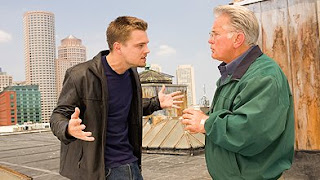
I hate to tell too much of the plot, since The Departed surprised me at every turn in a way movies normally don't - but should. The basic premise here is a mob story, with Jack Nicholson heading up the Boston Mafia as Frank Costello. Costello's mob has an informant in the Boston State Police - Matt Damon's delightfully scummy Colin Sullivan. Yet what almost no one in the film knows is that the cops have a man inside the Mafia - Billy Costigan, as portrayed by Leonardo DiCaprio, in the role that convinced me he had more depth than the waters into which he sank in Titanic. A tangled web of betrayal ensues, and if you see any of the last half-hour coming, James Randi has a prize for psychics like you.


Though the movie is based on the 2002 Hong Kong crime thriller Mou Gaan Dou (or Infernal Affairs), The Departed is so decidedly American that it seems a disservice to Scorsese and screenwriter William Monahan to call this a remake. Re-imagining might be a better word for it, since there's so much more flavor here. Scorsese's flair for directing and coaxing stellar performances from his players (did anyone know Kangaroo Jack alum Anthony Anderson could act?), editor Thelma Schoonmaker's intuitive method of editing the visuals, and a killer soundtrack are things that the original from Hong Kong was missing, things that guide your enjoyment of the movie without you even realizing it.

The old joke about Martin Scorsese is that all his movies have to include "Gimme Shelter" by The Rolling Stones. But I dare you to watch The Departed and listen to "Gimme Shelter" the same way again. If Tarantino changed the way we listen to non-diegetic music, he was plagiarizing from Scorsese. The music here is almost a character in itself; The Dropkick Murphys track "I'm Shipping Up to Boston" has achieved the public recognition that Pulp Fiction gave to Dick Dale's "Misirlou." The nifty thing about the soundtrack here is that you can notice it as an entity in and of itself, or you can let the movie wash over you like a tidal wave of cinematic perfection.

This is a perfect movie to watch with someone who's never seen it before, because the surprises in the movie are at least on a par with the shower scene in one of my favorite Hitchcock films, Psycho. Not that a main character gets killed in the first half, but there are quite a few moments that will challenge your conventions of how a movie should behave. Take for example the first twenty minutes. Just when you think the film's done a cold open and omitted opening credits, The Dropkick Murphys kick on, cue title card, and you know you're in for a whole lot of awesome. And it doesn't let up - from the omni-profane Alec Baldwin as the scene-stealing Captain Ellerby sparring with equally fascinating Sgt. Dignam (Oscar nominee Mark Wahlberg) to the freeze-frame that closes the film - this is 151 minutes of cinematic perfection.

Act accordingly.