Showing posts with label animated films. Show all posts

Monday, June 5, 2023

Spider-Man: Across the Spider-Verse (2023)

Five years and one Oscar later, Into the Spider-Verse just happens to be my favorite Spider-Man film. Apologies to Spider-Man 2 and Far From Home, which are the best that live-action Spidey has to offer, but Into the Spider-Verse is such a diamond absolute of a movie, so entertaining in an effortless way that belies its complex juggling act. It was a joy to queue it up the night before seeing its sequel, Across the Spider-Verse, which might have been a bad idea: Across is fantastic, but its predecessor was perfect. 

Sixteen months after becoming his world’s Spider-Man, Miles Morales (Shameik Moore) is still juggling his responsibilities to his school, his family, and his city. But a surprise visit from his not-so-secret crush Gwen “Spider-Woman” Stacy (Hailee Steinfeld) forces Miles to reckon with his place in the Spider-Verse, an interconnected multiversal web of superheroes under attack from the villainous Spot (Jason Schwartzman). Miles finds himself teaming with old friends like recent dad Peter B. Parker (Jake Johnson) and new allies like Spider-Man India (Karan Soni) and Spider-Punk (Daniel Kaluuya) – all led by the humorless Miguel O’Hara (Oscar Isaac), who understands Miles’s great responsibility better than anyone.


Across the Spider-Verse goes big. It’s purportedly the longest animated film in American cinematic history, and it’s packed to the gills with more spider-people than most comic books can accommodate. Across begins with an extended sequence set on Earth-65, home of Spider-Gwen, and it’s such an engaging bit of table-setting that one fairly wishes the whole movie had been Gwen’s; the scene looks like something out of a Robbi Rodriguez comic, and the film might very well have been Gwen’s wholesale had the second act kept her front and center. (Fear not, true believers, Sony has already promised Gwen will be leading a spin-off film and, we can reasonably assume, next year’s Beyond the Spider-Verse.)


Indeed, my second-biggest gripe with Across – albeit far from a dealbreaker – is that the film struggles to be a two-hander between Gwen and Miles. It reminds one of middle chapters like The Empire Strikes Back and Infinity War, both of which interposed their antagonists as protagonists while splitting up the good guys on parallel narrative tracks. The first and third acts of Across belong to Gwen, but the middle act is solidly Miles, still plucky and earnest with his tongue firmly in his cheek. In the first film, he managed to turn the theory of relativity into a cheesy pick-up line, and here he’s fully inherited the uniquely Spider-Man brand of goofball sarcasm. Across never quite balances them the way that Empire so gracefully did – we lose Gwen’s plot when we see her through Miles’s eyes – but if Gwen is this film’s Leia, Miles is still squarely its Luke. 


Like Luke Skywalker, Miles enters into a much bigger world in Across, serving also as the audience’s gateway into the larger realm of the Spider-Verse. These sequences on the densely-populated Earth-928 are going to be ripe for a home video audience to freeze-frame and analyze, loaded with cameos and references from the last sixty years of Spider-Man content. But amid all these homages and single-frame appearances, the creative team have not forgotten to anchor it all to compelling story arcs for the primary characters – their longing to belong, their fears of commitment, and their rebellious wonderings whether they’re able to write their own stories. This, after all, is what made Into the Spider-Verse such a roaring success – that we managed to meet no fewer than five new Spiders and parallel versions of villains like Doctor Octopus, all in under two hours without shortchanging any of them.


The makers of Across have more time to play, but paradoxically it seems they didn’t have enough time, because the film speeds along for two hours and twenty minutes before slamming on the brakes. To be fair, ending a story with “to be continued” is one of the oldest and noblest traditions in comic book history, and it does solidify the film in conversation with Empire Strikes Back and Infinity War. Yet while I’m a little rankled that the film stops rather than ends, I think my principal complaint is actually the fact that I don’t have more of this film already being injected directly into my eyeballs. The principal story arcs have mostly concluded, and the characters have made choices that show how far they’ve grown, but there is still something shamelessly corporate about mandating my attendance at Beyond the Spider-Verse by withholding the end of the story until March 2024. (Don’t worry, guys, I was already planning on it!)


I never check my watch during a movie, and so I had thought the third act was just ramping up when Across flashed those three cliffhanger words across our screen. And so, if that’s actually the beginning of a brand-new first act, I’m legitimately excited to see what happens next. I’m equally thrilled to see how the creators deepen the world one more time; the introductions of Spider-Man India and Spider-Punk are so compelling that we forget that we haven’t seen Spider-Man Noir, Spider-Ham, or Peni Parker this time around. Which other spiders are waiting for us just beyond Beyond? If the third installment in the trilogy is as breakneck and beautiful as the second, we might have to rethink whether we let other franchises get away with the cliffhanger ending.


Spider-Man: Across the Spider-Verse is rated PG for “sequences of animated action violence, some language, and thematic elements.” Directed by Joaquim Dos Santos, Kemp Powers, and Justin K. Thompson. Written by Phil Lord, Christopher Miller, and David Callaham. Based on the Marvel Comics. Starring Shameik Moore, Hailee Steinfeld, Bryan Tyree Henry, Luna Lauren Vélez, Jake Johnson, Jason Schwartzman, Karan Soni, Daniel Kaluuya, and Oscar Isaac.

Monday, April 17, 2023

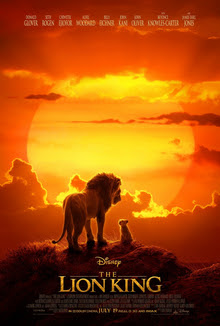
The Lion King (2019)

Most movies would be improved, I think, by imagining that you are watching them with Jeff Goldblum. And as I was watching The Lion King, Jon Favreau’s 2019 remake of the 1994 animated classic, I had the acute feeling that Goldblum’s Dr. Ian Malcolm (from Jurassic Park) was sitting next to me. I could almost hear him say, “Your animators were so preoccupied with whether they could, they didn’t stop to think if they should.”
 
By the time the end credits rolled on The Lion King, I found myself asking the same question I ask of nearly all of Disney’s live-action remakes: “Why?” Why does this film exist? Why was the remake almost identical to the original? And why was I surprised that, yet again, Disney pulled the wool over my eyes in convincing me that I hadn’t already seen this story?
 
From its opening frames, The Lion King is an exercise in déjà vu. The sun rises on an African plain, and the same Zulu opening vocals from Lebo M. ring out. If it’s not precisely shot-for-shot, it’s close enough, as Mufasa (James Earl Jones) and Sarabi (Alfre Woodard) present their son Simba (JD McCrary, then Donald Glover) to the kingdom he will one day rule. All of this has happened before, and the “Circle of Life” might as well be the creative bankruptcy that leads to a rinse-and-repeat mode of content creation.
 
To be fair, that sequence is the very model of ‘iconic’; it was, after all, packaged as a teaser trailer for the 1994 film, and it’s an absolute banger of an opener. Don’t fix what isn’t broken, they say, so I’ll give director Jon Favreau a pass on the first five minutes. When you’re a cover band, you play the hits, no matter how many times you’ve heard “Hey Jude” or “Free Bird” in your life. As the film unfolded, I thought we were heading into fairly interesting territory. This 2019 version begins to deepen the psychological profile for its villain Scar (Chiwetel Ejiofor) and his cackle of hyenas, who rebel against Mufasa for largely different reasons this time around. An explanation for his eponymous scar, and a few line changes to his solo number “Be Prepared,” feel like early forays into giving us a reason to run through the paces once more.
 
Perhaps ironically poignant, the first time that I noticed a major content change was in a sequence that revolves around, of all things, a dung beetle and his bespoke fecal boulder. Every creature in the savannah plays some small part in accidentally delivering to Rafiki (John Kani) a snarl of Simba’s mane, proving to the mandrill shaman that the lion king is still alive. It’s a fascinating rebuttal to Timon (Billy Eichner) and Pumbaa (Seth Rogen), who had just prior rebuked the idea of a “circle of life,” and it’s a slightly more credible way for Rafiki to learn of Simba’s exile. But in the end, it is an extended sequence about ossified manure, perhaps more suited to Planet Earth than a Disney feature.
 
In fact, the whole thing comes off as more of a thought experiment than a movie proper. What if, The Lion King asks, we could remove all abstraction from the original and render it as lifelike as possible so that we become not spectators but voyeurs in the animal kingdom, watching a wildlife documentary? Why include a bird who can smile or roll his eyes when we can give audiences a Zazu (John Oliver) whose physical features are limited by how an actual hornbill can move? Indeed, why make the film in such a way that the only expressions on the characters’ faces are provided by the Kuleshov effect? 
 
The answer, it seems, is behind the scenes. As far back as his Jungle Book, Jon Favreau has been experimenting with what technology can allow him to do, and the making-of featurettes for both movies show Favreau exploring his imaginary world through the use of VR technology. (A similar technical invention allows Favreau to shoot much of The Mandalorian in an immense soundstage called “The Volume,” so perhaps all’s fair in love and Star Wars.) If Favreau’s directorial outings are more about pushing the envelope of special effects, reskinning classic films just to see if he can, then The Lion King is a roaring success. But one can’t even call this a live-action adaptation – it is, rather, just differently animated, an identical remake only slightly less inessential than Gus Van Sant’s Psycho.
 
It’s not that The Lion King is badly made. The effects are good, even to the point that one might assume these were actual animals filmed on genuine African landscapes, and some of the voice casts are decent upgrades; Ejiofor in particular is a more Shakespearean Scar, while Eichner and Rogen are the surprise best-in-show (excluding, naturally, James Earl Jones’s return as Mufasa). Despite being slightly longer than the original, all of it feels overly familiar. “I know, I know,” I found myself thinking, “You’ve told me this one already.” There is a long gap between 1994’s Lion King and the Hamletthat inspired it; the difference between 1994 and 2019’s Lion Kings, however, is merely one of overlaying an Instagram filter.
 

The Lion King
 is rated PG for “sequences of violence and peril, and some thematic elements.” Directed by Jon Favreau. Written by Jeff Nathanson. Starring Donald Glover, Seth Rogen, Chiwetel Ejiofor, Alfre Woodard, Billy Eichner, John Kani, John Oliver, Beyoncé Knowles-Carter, and James Earl Jones.

Monday, February 27, 2023

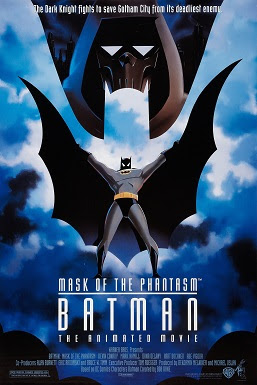
Batman: Mask of the Phantasm (1993)

“I need it to be different now. I know I made a promise, but I didn’t see this coming. I didn’t count on being happy.”
 
When I reviewed Batman: Mask of the Phantasm back in 2012, I said that it was “impossible” to compare it to The Dark Knight, finding Phantasm to be “quintessential.” Four years later, in my first expansion of my Personal Canon, Mask of the Phantasm made the cut – and yet I had said it was “imperfect... the resolution doesn’t quite hold up after repeat viewings.”
 
Reader, I was wrong. This review could have been so many things – an edition of “Take Two Tuesdays,” a continuation of my 2017-2019 reviews of Batman: The Animated Series, or part of my heretofore undeclared attempt to review every movie on the Personal Canon. Even before rereading my original review, I wanted to revisit Mask of the Phantasm because it deserved so much more than just 250 words in that “Monday at the Movies” format – especially on the occasion of its 30th anniversary this year. Whatever I was thinking in 2012, Phantasm has never truly let me down.
 
The Batman (Kevin Conroy) is a wanted man, wrongly accused of the murders of some of Gotham’s most notorious mobsters. Batman is hot on the trail of the real killer, The Phantasm (Stacy Keach), when an old flame returns to town – Andrea Beaumont (Dana Delany), whose past relationship with Bruce Wayne is explored in heartbreaking flashbacks, even as the plot marches inexorably toward a final confrontation with The Joker (Mark Hamill).
 
I always forget that Phantasm is as brief as it is. In the neighborhood of 75 minutes, it’s hard to find a film that hits all the bases like this one does: suspense, romance, comedy, heartbreak. Between dynamite action sequences and deeply human character work, Mask of the Phantasm includes no fewer than three origin stories across two timelines, telling an indelible and original story about Batman. It’s a tale that has cast its own shadow over Batman in the past thirty years, with fans constantly asking, “When will the Phantasm show up?” (The Phantasm appeared in Batman Beyond comics circa 2015 and in 2020’s Batman/Catwoman; over on film, we got a name-only tease in Batman v Superman, while the Phantasm is frequently name-checked in wishlists for the inevitable sequel to The Batman.)
 
Yet the reason I’ve never quite sounded the call for more Phantasm stories is because this one is perfect. The comics did a semi-sequel to the film in Batman & Robin Adventures, in an issue that could only be called “Shadow of the Phantasm.” While it’s a fun romp, it’s not indispensable, and it essentially leaves the characters in the same place where the film did: separated, exiled, and presumed dead. I’m being cagey about spoilers, even though the film is thirty years old and the action figure infamously unmasked the Phantasm just in time to disappoint kids on Christmas. My spoiler-phobia is largely due to my quasi-religious devotion to stories and the art of storytelling, but it’s also because the mystery isn’t entirely the point; if you know how tragedies work, you’ll plot this one out in short order.
 
Because the key to Phantasm isn’t that it’s a mystery; it’s a film noir about brooding avengers and the dark shadowy antiheroes who love them. It’s a tragedy about what happens when people let their pasts define them, but it’s also about the inescapability of the past, of chickens coming home to roost when it’s least convenient. Indeed, the past looms as large as the heavy tombstone on which the WAYNE family name is inscribed, and the real pain of the film is Bruce Wayne’s inability to escape that destiny he pledged for himself. “The way I see it,” Andrea snipes in one incisive moment, “the only one in this room controlled by his parents is you.”
 
Phantasm is somewhat unique for a Batman origin story in that we never see the murder of the Waynes, that random act of devastating violence that set Bruce Wayne on a course of dark vengeance. Instead, the film takes their loss as a given and sets the real origin story as a choice – Bruce Wayne chooses his vow over his own selfhood, and when he dons the cape and cowl for the first time, it’s not a moment of triumph. Alfred intones, “My God!” and recoils. The music swells, but even that refrain is sobered and pained. From that moment on, Bruce Wayne is the performance, a careless playboy charade who has to hide himself away from others lest they see through his façade.
 
The Phantasm, too, is a performance, reciting the ominous refrain, “Your angel of death awaits,” like some grim prophecy that explains everything. Outfitted with a theatrical costume and an insistence on dramatic violence, the Phantasm is wrestling with demons that have nothing to do with framing Batman for murder. Meanwhile, the mobsters – most notably Sal Valestra, voiced by Abe Vigoda – are stuck in their roles, playing out cheap imitations of The Godfather while their past catches up to them. The casting of Vigoda is inspired, mired in the genre’s past while playing on the arrested timelessness of Vigoda’s permanent old age.
 
Paradoxically, only The Joker is perfectly liberated. If you didn’t know he was in the movie, his first appearance reads like something out of a nightmare; the film takes a hard pivot and bends around his manic gravity. At first, the mobsters try to recruit Joker to protect them from Batman, but the incorrigible Joker can’t help but take over the plot for his own purposes, bumping off as many gangsters as The Phantasm does. He even seems to grasp the cruel irony of the film’s finale, laughing with gleeful abandon as he, Batman, and The Phantasm stare down certain death. Indeed, throughout Joker plays the Shakespearean fool, commenting on the coincidences of the plot, calling out red herrings about Phantasm’s identity, and cracking wise with a sense of humor best suited to the gallows of Gotham.
 
I haven’t said anything about the voice cast because the scripting is so impressive, but suffice it to say that Kevin Conroy remains the definitive Batman, giving us no fewer than three takes on the character (costumed vigilante, fresh-faced bachelor, and jaded philanthropist). He can plumb the depths of grief or crack a wry one-liner, and he’s the voice I’ll always hear in my head for any comic book. Ditto for Mark Hamill, whose Joker is so good that you forget he was ever a farmboy from Tatooine. Hamill has a knack for uncomfortable punchlines like “That’s what I want to see, a nice big smile.” Then there’s Dana Delany, who has to be the emotional heart of the story while keeping her own feelings clenched beneath a cool exterior. She can keep pace with both Bruce Wayne and Batman, and using nothing but her voice, she convinces us that she’s Bruce’s true star-crossed lover.
 
Ultimately, the reason people want more Phantasm isn’t because there’s more to say. It’s because this film is so good, so perfect, that 75 minutes feels criminally brief. We want to hear Conroy and Hamill riffing on each other until the end of time. We want to chase happiness just like Bruce Wayne does, and we want to revel in the bittersweet fatefulness that finds Bruce pursuing a darker calling. Or maybe we just want to live in that glorious art deco Gotham, painted on black with red skies, with a breathtaking Shirley Walker score to make sense of it all. (I know I do.) It’s an agonizingly human story, heightened by the presence of elaborate costumes and a certain Clown Prince, and as in the best films no one wants to see it end.
 
I don’t know what I meant in 2012 by “doesn’t quite hold up,” because Phantasm is a movie that has held up – and it has held me up when I’ve felt down about storytelling, disappointed by my favorite genre, or just grim about life itself. It’s almost like a calculated distillation of a superhero narrative, sweeping from start to finish, from origin story to never-ending battle. It’s not a movie that necessarily makes one feel good about humanity, but it does make one feel good about being alive. What life is worth living if you don’t have Conroy and Hamill narrating it?
 

Batman: Mask of the Phantasm
 is rated PG for “animated violence.” Directed by Eric Radomski and Bruce Timm. Written by Alan Burnett, Paul Dini, Martin Pasko, and Michael Reaves. Based on the DC Comics. Starring Kevin Conroy, Dana Delaney, Hart Bochner, Stacy Keach, Abe Vigoda, Efrem Zimbalist Jr., and Mark Hamill.

Tuesday, October 19, 2021

Monster March II: Frankenweenie (2012)

Frankenweenie is not quite the movie I was expecting. Certainly I got more than my fair share of Tim Burton hijinks, all angular bodies and the subtle terrors of the suburbs. What I wasn’t expecting was how much of a faithful and loving adaptation Frankenweenie would prove to be of the original James Whale Frankenstein – and what a fitting inclusion for Monster March II. (Remakes and mash-ups and sequels, oh my.)

Young Victor Frankenstein (Charlie Tahan) loses his beloved dog Sparky (Frank Welker) in an unfortunate accident, but the words of his eccentric science teacher (Martin Landau) inspire Victor to undertake his own experiment. Sparky lives! Yet as Victor struggles to keep his science project secret, his classmates begin to realize that his experiment has the potential to change their town.


From the beginning of Frankenweenie, it seems that Tim Burton has set out to make a film about his own childhood. The story begins with Victor screening his latest short film for his parents. Like Burton, Victor clearly has an appreciation for low-budget horror with all its gimmicks and movie magic, even equipping his parents with 3-D glasses for the living room premiere. It’s the sort of peculiar precise detail that suggests Burton actually lived this moment. Already the film was defying my expectations, and I do wish Burton had spent more time on this hobby of Victor’s; I’m not sure how it would fit into the Frankenstein allegory he’s telling, but it’s certainly unique and clearly a passion for Burton.


As Victor attempts to discover a world beyond his love for his dog, the film veers into a riff on Edward Scissorhands, which was itself a kind of Franken-fable (with Johnny Depp as a kinder, gentler creature who nonetheless became feared for his unnatural appearance). Here Burton’s obsession with the simulacrum of the suburbs is on full display; though the streets and houses all look normal, the people that occupy them are anything but – especially the children, who are cartoonish and borderline monstrous, even before their fierce competitive spirit drives them to burglarize his attic laboratory. Kids can be real creeps, Burton says here, and having had a childhood myself I would have to agree.


Yet if the film starts out in the vein of Edward Scissorhands, it well and truly reminds us by the end of the story that it’s from the same odd mind that brought us The Nightmare Before Christmas. Victor’s relationship with the reanimated Sparky is both bizarre and sweet, a comfortable niche for Burton, but the creature horror of the film’s third act puts one in mind of the vampire bat toy that Jack Skellington’s minions set loose on Christmas Eve. As the children of New Holland reanimate their pets, only some of whom have joined the choir invisible, one can almost hear Burton gleefully rubbing his hands together from behind the camera as he intones, “I will show you fear in a handful of sea monkeys!” 


Frankenweenie is plenty enjoyable, even when it feels a bit like a Tim Burton cover band, but it’s of particular interest this month for being a spot-on adaptation of the Frankenstein legend, especially as remediated through the lens of horror films like the Karloff classic. (Indeed, one neighborhood boy, voiced by Martin Short, may as well be Karloff.) Colin Clive’s ecstatic “It’s alive!” is replaced by Victor’s more jubilant “I did it!” And of course, no modern Frankenstein would be complete without Elsa Lanchester’s iconic hairdo from Bride of Frankenstein, though it would be criminal to spoil who gets to wear it. (Perhaps surprisingly, it’s not the neighbor girl Elsa Van Helsing, voiced by Winona Ryder.) This is a madcap Frankenstein, a mishmosh of all the iconography Burton loved as a child, run through his instantly recognizable stop-motion filter. It is perhaps exactly the movie you’d anticipate coming from Burton, but by the same token it’s never quite the movie you expect. After two hundred years, this old story still has a little spark to it.


Frankenweenie is rated PG for “thematic elements, scary images, and action.” Directed by Tim Burton. Written by John August and Tim Burton. Starring Charlie Tahan, Martin Short, Catherine O’Hara, Martin Landau, Winona Ryder, and Frank Welker.

Thursday, October 7, 2021

Monster March II: The Batman vs. Dracula (2005)

Leave it to The Cinema King to find a way to work Batman into a month of monster movies. But for so very many reasons, how could we not review The Batman vs. Dracula? It’s got everything I love, with a perfect tie-in for October and an even more perfect excuse for me to check out one of the last corners of Gotham City I haven’t yet visited.


When The Penguin (Tom Kenny) and The Joker (Kevin Michael Richardson) break out of Arkham Asylum, their quest for loot leads The Penguin into a desolate Gotham crypt, where he accidentally reawakens the long-dead Count Dracula (Peter Stormare). But there’s only room for one bat-man in Gotham, as Bruce Wayne (Rino Romano) learns when he meets his latest supernatural foe.


It may surprise you to learn that I’ve never seen an episode of The Batman (2004-2008), the animated series to which The Batman vs. Dracula belongs. It was made just when I was phasing out of comics and ended just before I jumped back in, and I’ve never quite gotten used to the character designs, which look like inexpensive Saturday morning cartoons compared to Batman: The Animated Series (which, you’ll recall, is much more my jam). It ran for five years and sixty-five episodes, which is a significant investment of time for a project I’m not sure cuts the mustard for me.


After watching The Batman vs. Dracula, I’m still not sure if it’s “my” Gotham, per se, but I’m a little more intrigued after having dipped my toe. Still, The Batman vs. Dracula isn’t a new classic in the Gotham canon, a la Mask of the Phantasm or even Batman: Under the Red Hood. It’s perfectly serviceable but a little more shallow than some of my favorite Batman stories. It does exactly what it says on the tin – Batman does indeed fight Dracula – but it does so without the sophistication that might come of pitting two children of the night against each other. Indeed, the script feels very much like what might happen if you gave action figures of Batman and Dracula to a child: simple and straightforward, with a certain charm in its innocuous lack of depth.


Even before we meet Dracula, for example, when Bruce Wayne announces that he’s working on a device that will process solar energy, he may as well call it the deus ex machina, since we know it’s going to come up in the third act. Penguin, meanwhile, is relegated to the Renfield role without really doing much of anything else in the film; it’s perhaps just as well, since this Penguin seems to have the mentality of a twelve-year-old, with a scatological sense of humor to match. The Batman’s Joker is an interesting ragdoll of a man, with a husky voice and a colossal mop of green hair; while this isn’t the Joker I’d have written, it’s an intriguing and perfectly valid take on the villain, and Richardson captures that manic energy that makes the Clown Prince so compelling.


Then there’s our titular antagonist, and it’s hard to imagine better casting than Peter Stormare as Count Dracula. Stormare’s voice isn’t always recognizable – which is a shame, given how distinctive his line-readings can be (cf., The Big Lebowski, Seinfeld’s “The Frogger”) – but he’s clearly relishing the role, turning every line into a deep-throated snarl. The character is undercooked, only a surface-level interpretation of Stoker’s original, though perhaps anything would pale in comparison to Lugosi or Oldman. Stormare might have fared better in a longer theatrical release; as it is, direct-to-video animation doesn’t give this Dracula ample room to spread his wings. 


I’ve said almost nothing about Rino Romano’s Batman, but then again I grew up with Kevin Conroy, and there are very few who can hold a candle to his Dark Knight. Romano (no relation, apparently, to Andrea Romano, who assembled the voice cast that included Conroy) is evidently playing a younger Batman, and the script seems to lean into his inexperience. He assumes, for one, that Joker’s death in the opening sequence is permanent, but then again, the city later assumes Batman has gone rogue based on the word of only one less-than-credible witness. Perhaps this is overall a younger Gotham than I realized? Then again, Romano’s Batman simply isn’t as vocally distinctive as some of his Bat-counterparts, though I may feel differently after watching more of the cartoon.


All told, The Batman vs. Dracula is not a great Batman movie, nor is it a great Dracula movie. I can’t imagine it being of much interest to anyone beyond the most ardent aficionados of either franchise. It’s serviceable and inoffensive, and it is transparently a product of its time, a particular era of Saturday morning cartoon that is hard to describe if you didn’t live through it. Its soundtrack, full of wailing electric guitars, makes it feel as much like an episode of Buffy the Vampire Slayer as anything else, and at least for this reviewer that’s not a tremendous compliment. 


The Batman vs. Dracula is not rated. Directed by Michael Goguen. Written by Duane Capizzi. Starring Rino Romano, Peter Stormare, Tara Strong, Tom Kenny, Kevin Michael Richardson, and Alastair Duncan.

Monday, February 4, 2019

Monday at the Movies - February 4, 2019

Welcome to another installment of “Monday at the Movies.” This week, a two-parter, and long-time readers of the blog will know that I always think this sort of thing shouldn’t happen. For the record, this ought to be one movie, but if it’s going to be two, it’s probably best not to space them out too far; an hour’s intermission did the trick for me.

The Death of Superman (2018) – Famously killed off because the writers wanted to delay his wedding to Lois Lane, Superman perished in the comics in 1992, and The Death of Superman has persisted with surprising vigor for a story that goosed sales and was ultimately reversed within a year. DC’s animated stable trotted out this story in 2007 with mixed success, but this time the animators give scripting duties to noted comics scribe Peter J. Tomasi, who does a much better job adapting the comics slugfest into a narrative with real heart as Superman (Jerry O’Connell) wrestles with divulging his identity to Lois Lane (Rebecca Romijn), even as the beast called Doomsday begins to tear its way toward Metropolis for their fateful showdown. The film’s highlight is obviously the brawl promised by its title, and the action choreography is quite successful. The first half of the film is a little talky, though it hits all the right character beats and sows interesting seeds for the sequel. In a sense, The Death of Superman succeeds where The Killing Joke failed by devising an opening act that feeds into the emotional heart of the story rather than wasting time and defaming its characters. Here the emotional center is relocated onto Lois and Clark’s relationship, which gets added weight as the inevitable, eponymous death approaches. It’s hard to imagine this film working as well for someone who isn’t already a big fan of Superman, but Tomasi does a very good job at capturing the spirit and the scope of those early 1990s Superman comics, with a deep bench of supporting characters (remember Bibbo?) and a very of-its-moment approach to the Lois and Clark dynamic. But it’s sweet (with an adorable reference to the “You’ve got me? Who’s got you?” from Superman) and touching, even if it feels a bit overlong at times.

Reign of the Supermen (2019) – As the second half of the story, Reign of the Supermen is a lot more frenetic, with a good deal more plotting and easily half a dozen characters to explore. Where Death kept the focus tight, feeling protracted when it wouldn’t expand, Reign feels overfull, with barely any downtime. I knew the film was off to breakneck speed when its earliest scenes swiftly bring together the four Supermen in a clash of wills and fists, something the comics eased into over the course of about six months of storytelling. Surprisingly, though, Reign adheres to the comics story with remarkable allegiance; granted, major changes are made (Mongul doesn’t appear, but you can probably guess which hulking alien dictator replaces him), but screenwriters Tim Sheridan and Jim Krieg follow the broad strokes with the devotion of someone who’s read the book a hundred times. They also draw in a wide net from comics continuity at large, bringing in the 2003 retcon that Superboy has a helping of Lex Luthor’s DNA holding his clone body together. In Superman’s absence, the voice cast steps up their game; Rainn Wilson acquits himself better here as Lex Luthor than he did in Death, where he sounded too much like Dwight Schrute. Among the four Supermen, Cameron Monaghan is the standout as the brash Superboy, but Cress Williams is a fine Steel, and Patrick Fabian channels all his Better Call Saul superiority as the Cyborg Superman. Reign also does well to draw on the internal continuity of these DC animated films, linking its storyline as far back as Justice League: War and setting up a few future developments in a tantalizing post-credits sequence (Death had four, but Reign makes its singular stinger count). As much as DC’s live-action films have buckled under the weight of studio interference, it’s refreshing to see a Justice League film that isn’t pulled in a dozen different directions; indeed, you’ll be surprised how large the League looms in Reign, but it’s all in service of a pretty strong Superman story.

That does it for this week’s edition of “Monday at the Movies.” See you next week!

Monday, January 7, 2019

Spider-Man: Into the Spider-Verse (2018)

We like to say that “the geeks have won.” It’s a victory that’s been called more often than Barbara Stanwyck’s bedside telephone in Sorry, Wrong Number, but each time it feels like geekdom has achieved the unthinkable – be it the smash debut of The Avengers or introducing comics-accurate oddballs like King Shark and Professor Pyg on primetime. In 2018, the geeks won by having a banner year, with three animated superhero films alongside major showings by their live-action counterparts. However you slice it, we can have a productive argument about whether the cartoon with a Spider-Pig was actually the best one – a true win for the geeks.

Spider-Man: Into the Spider-Verse (finally) introduces Miles Morales (Shameik Moore) to the big screen as Brooklyn’s new friendly neighborhood Spider-Man after a spider bite puts him in a league with his universe’s Peter Parker (Chris Pine). I say “his” universe, for Brooklyn becomes host to a coterie of spider-people after The Kingpin (Liev Schreiber) tears a hole in the fabric of space-time with a particle accelerator experiment. Joining Miles are a shlubbier Spidey (Jake Johnson), Spider-Woman (Hailee Steinfeld), the black-and-white Spider-Man Noir (Nicolas Cage), and Peter Porker, the Spectacular Spider-Ham (John Mulaney) – all in search of a way home.

I’ve said in the past that Batman is the greatest fictional character because of his chameleonic ability to accommodate whatever his audience needs – he can be the paragon of camp, the apex gargoyle, a space-age dark knight, or a kid-friendly crusader. When I say that, however, I’m usually not thinking of Spider-Man, for whose comparable metamorphoses Spider-Verse makes a compelling argument. Spider-Verse posits a veritable spider-prism (kids next door, rocker chicks, tough-guy gangsters, wise-cracking pigs, and more), each of whom accesses the central truth of Spider-Man – that with great power, there must also come great responsibility. You can’t run away, you can’t turn your back; your family and your friendly neighborhood are counting on you. For all his myriad forms, it’s hard to imagine Batman in a film like this one, teamwork having never been his strong suit. (Singular dislocation suits Batman better than prismatic conjunction; cf. Batman Ninja, Batman Beyond, etc.)

It’s equally hard to imagine that Spider-Verse works as well as it does. Its irreverent approach to storytelling, layering origin stories in a gag that never loses its comedic punch, helps the viewer navigate fifty years of convoluted chronology with deft precision. (Its comics counterpart, 2014’s Spider-Verse crossover, is comparably impenetrable.) Make no mistake, though; for all its spider-people, Spider-Verse is well and truly Miles’s film, a full origin story for the newest Spider-Man (who debuted in 2011). Here Miles is quite a character, engaging and relatable because of his eminent humanity; he’s shy but gifted, funny and earnest. What’s more, there comes a moment in the film where you’d almost rather he not become Spider-Man because of how well we like Miles and the unique story being told with him; it almost seems a shame to put him in a costume and give him a fairly recognizable super-action narrative. But the exceedingly clever script finds a way to weave that hero’s journey into the story already in progress (including a few, ahem, touching callbacks).

Of course, so much of the film’s success owes to its lanky animation style, delicately exaggerated in the best Tex Avery tradition. The slightly jerky movements and modest design tweaks help divorce Spider-Verse from strict representation and move it into a realm where it feels like anything can happen, where any abstract incursion fits right in (cf. Spider-Ham). Animation naturally unfetters a filmmaker’s aspirations in the way that a comic book page renders all things possible beyond constraints of budget. That’s not to say that Spider-Verse is cheap (its budget has been reported at $90 million), but it’s hard to imagine a live-action film capturing all the peculiar quirks of this world, to say nothing of its technicolor climax or the characters that almost need to belong to an animated world (again, Spider-Ham, but also the monochromatic Spider-Man Noir). I knew I was in for a visual treat even from the trailers, but nothing can really prepare a moviegoer for the first appearance of the massive Kingpin – whose sheer mass cannot be understated. Even this, though, is essential character work; Kingpin’s colossal bulk distorts gravity around him, in the way that his particle accelerator tampers with the laws of physics in order to pull in the objects of his plot (no spoilers, but the script is smart to make Kingpin three-dimensional, giving him a full and possibly legitimate reason for risking the fate of the universe).

As dark as the film can be, wading into heavy subplots about betrayal, disappointment, and loss, Spider-Verse is exuberantly, boundlessly fun. I can’t, for example, point at someone or touch their shoulder without thinking of particular jokes in the film and guffawing my webs off. But the film also tickles my specific devotion to superheroes for its relentless optimism. Yes, the situation is dire, with cataclysmic consequences, but here’s a kid from Brooklyn who stands at the center of this massive web with the power to save everyone, and all he needs to do is figure himself out. What’s more, he has a loving family and a network of friends to help him through difficult times; no matter how isolated he feels, Miles Morales is never alone. Reducing him to “the black Spider-Man” doesn’t do justice to the depth of this character or the ways he advances and perpetuates the legend of Spider-Man without the guilt or baggage of Peter Parker.

I’m not ready to wade into the battlefields of “who did it better?” just yet. (As I get older, I’m losing patience with these pithy ‘hot takes’ that end more conversations than they start.) The geeks have well and truly won when we can have Black Panther and Spider-Verse, when we get a long-overdue Incredibles 2 alongside them and Avengers: Infinity War, to say nothing of Aquaman, Venom, Deadpool 2, and Ant-Man and the Wasp. (Phew!) It’s an embarrassment of riches, not unlike the spider-cornucopia presented in Spider-Verse, with something for everyone and everything adding up to a romping good time. Best of all, Spider-Verse got me to dust off my Marvel Unlimited subscription and queue up a slate of spider-comics to read. That’s how the geeks win.

Spider-Man: Into the Spider-Verse is rated PG for “frenetic sequences of animated action violence, thematic elements, and mild language.” Directed by Bob Persichetti, Peter Ramsey, and Rodney Rothman. Written by Phil Lord and Rodney Rothman. Based on the Marvel Comics by Stan Lee, Steve Ditko, Brian Michael Bendis, Sara Pichelli, and Dan Slott. Starring Shameik Moore, Jake Johnson, Hailee Steinfeld, Mahershala Ali, John Mulaney, Nicolas Cage, Kathryn Hahn, Liev Schreiber, and Chris Pine.

Monday, July 30, 2018

Monday at the Movies - July 30, 2018

Welcome to another installment of “Monday at the Movies.” This week, a mismatched pair with clowns in common.

Batman Ninja (2018) – Of late, DC have been killing it on their animated offerings, and Batman Ninja is perhaps the weirdest of their successes. The premise is precariously unstable, relocating Batman and his greatest foes to feudal Japan, and yet the film’s creators stick the landing by embracing that manic wildness and careening between set pieces that alternate mad action with eccentric animation choices. I can’t overstate how bonkers Batman Ninja is, with concepts like Gorilla Grodd’s time machine, Robin’s unacknowledged adoption of a monkey sidekick, and a clan of ninja dedicated to the prophecy of the Bat; that’s even before Bane shows up as a sumo wrestler while the other villains build castles that turn into mechanized warriors. In the middle of all this madness is Batman (Roger Craig Smith), who delivers with an impossibly straight face lines like, “Our weapons will be everything that exists.” His level deadpan is matched by Tony Hale’s madcap Joker, who outdoes Buster Bluth’s mood swings by a mile. Watching Batman Ninja, I could not help but think of Mad Max: Fury Road, which I took to task for a similar meandering plotlessness and overemphasis on action sequences dialed up to eleven. Was the difference, then, only that Batman Ninja wore a Batsuit to appease my biases as a comic book shill? Perhaps, but a key distinction is that no two scenes in Batman Ninja are alike; compare Batman’s duel with Joker to the meditative storybook quality of the sequence in which Jason Todd finds an apparently reformed Joker and Harley Quinn (Tara Strong). Fury Road was a two-hour car chase; Batman Ninja is eighty-five unpredictable minutes in which a change in tone, pace, and energy is usually only a few minutes away.

It (2017) – Stephen King adaptations have a hit-or-miss reputation, usually skewing more successfully toward his less supernatural stories (cf. The Shawshank Redemption, The Green Mile). I read It at an impressionable age, perhaps around fourteen or so, and vividly recall it as one of the most terrifying novels I’ve ever read. (Thomas Harris’s Red Dragon is up there, too.) I’ve not seen the original miniseries, starring Tim Curry, but I found director Andy Muschetti’s adaptation wholly successful, unsettling in all the right places and bloody terrifying in the rest. Muschetti has the unenviable task of directing a cast of children, which includes Jaeden Lieberher, Sophia Lillis, and Finn Wolfhard. Unlike many child performers, however, the cast of It are remarkably gifted, lacking that trying-too-hard aura that might have plagued another production. The kids all have striking eccentricities that give their performers something to embrace; Lieberher, for one, is adept at giving his Bill Denbrough a stutter, while Jack Dylan Grazer balances comic relief with crippling panic as the hypochondriac Eddie Kaspbrak. Of course, no one comes to It without wanting to talk about Pennywise the Clown, and on this count Bill Skarsgård is really frightening. Jump scares aside, Skarsgård’s Pennywise is this perpetually hungry, partly childlike specter of menace whose savage teeth and yellow eyes belie a physicality that could snap at any moment. From clips, I sense that Tim Curry’s original Pennywise casts something of a long shadow, and Skarsgård has mostly stepped out of that shadow; though the voice feels similar in places, Skarsgård substitutes Curry’s guttural rasp for pitch variances that recall Heath Ledger’s Joker. I admit that I am always skeptical when a novel is broken into parts for multiple films, but It strikes a good chord by consolidating the novel’s “past” segments into one story that doesn’t require you to come back for more. I am, however, more intrigued by It: Chapter Two having seen what a knockout horror film It ended up being.

That does it for this week’s edition of “Monday at the Movies.” We’ll see you next week!

Monday, March 5, 2018

Monday at the Movies - March 5, 2018

Welcome to another installment of “Monday at the Movies.” And since it’s Monday, it must be time to review something from the animated realm.

Scooby-Doo! & Batman: The Brave and the Bold (2018) – This film ended up being, to quote a popular Star Wars meme, “a surprise, to be sure, but a welcome one.” The Scooby Gang, alias Mystery Incorporated, comes to Gotham City, where they find themselves invited by Batman (Diedrich Bader) to join the Mystery Analysts of Gotham, a clubhouse of super sleuths (including Black Canary, Detective Chimp, Martian Manhunter, Plastic Man, The Question, and the aspirant Aquaman) who find themselves wrapped up in one of Batman’s earliest – and only unsolved – cases, which just so happens to involve a ghost. I was a big fan of Batman: The Brave and the Bold, a first-rate animated series that embraced everything in Batman’s long history, from the nutty and the zany to the grim and the gritty; I’ve also been a monthly reader of Scooby-Doo Team-Up!, the comic that pairs the Scooby Gang with guest stars from the DC publishing wheelhouse. This film, then, seemed like a natural extension of two things I already like, and so I’m pleased to report it’s great fun. It strikes a balance between the pseudo-supernatural sleuthing of the Scooby-Doo universe and the high concept superheroics that put Batman next to a talking chimp to solve crimes, managing quite well to strike a balance between two distinct brands. This is a crossover done right, with plenty of fan service and a decent story in its own right. Moreover, the film actually includes a well-crafted mystery (with at least one “red” herring), with sufficient clues for the audience to piece together. I’d happily watch more installments of the Mystery Analysts, particularly if they give us an opportunity to revisit Diedrich Bader’s Batman, a collegial and dead(pan) serious Bat who captures that surrogate father quality of Batman comics from the 1950s and who can render immortal a line like “The hammer of justice is unisex.” (Points also to Jeffrey Combs, who returns as the definitive Question, and John DiMaggio, whose Aquaman is as delightfully ‘outrageous!’ as ever.)

That does it for this week’s edition of “Monday at the Movies.” We’ll see you next week!

Monday, November 27, 2017

Coco (2017)

Over the last seven years, more than half of Pixar’s output has taken the form of sequels to their preexisting properties (disclosure: I’ve still not seen Finding Dory or Cars 3), and of their original fare only Inside Out has distinguished itself as belonging to that higher stratosphere of storytelling for which Pixar became known long ago. No slight to Brave or The Good Dinosaur, but I’ll claim Inside Out as standing quite apart from those fine but familiar endeavors. Coco is, however, a return to form for Pixar, taking us to a new world with a fresh narrative that ends up touching a few heart (and guitar) strings.

Against the wishes of his family, who believe that music has cursed their family, young Miguel (Anthony Gonzalez) has a secret shrine in his attic where he practices guitar and idolizes the world’s greatest musician, Ernesto de la Cruz (Benjamin Bratt). Miguel wants to play in a talent show on Día de los muertos, but a series of mishaps drops him into the land of the dead, where he’ll need the help of the nearly-forgotten Hector (Gael García Bernal) to reach Ernesto de la Cruz and rejoin his living family.

Director Lee Unkrich has been tied up with Coco since Toy Story 3 (2010), which was arguably Pixar’s finest film in the last ten years, so it’s a welcome relief to see finally what’s taken so long. On that count, Unkrich does not disappoint; Coco is the kind of film that reminds you what truly exceptional animated material looks like when it’s married to equally compelling storytelling. Yes, it’s a version of that same Pixar plot in which a character travels through a new place in order to return home while learning something about himself in the process, but the film feels so remarkably fresh that I didn’t notice this plot similarity until I went back to my review of The Good Dinosaur to remind myself why that film hadn’t worked as well.

One of Pixar’s remarkable strengths has always been its ability to create a world, and it’s that dexterity at world-building that has made Pixar sequels so appetizing to the general public – who wouldn’t want to rejoin The Incredibles or see what else is in the Toy Story toy box? As good as those sequels have been (or are expected to be), though, revisiting a world comes at the expense of building another one. Pixar’s always been quite deft at giving us a sideways glance at our own world, seeing what’s just out of sight and asking us to reimagine – to re-envision (emphasis on vision) – how we view our toys, our feelings, our fish. Here, surprisingly soberly, Coco takes us into the afterlife, through the particular lens of Mexican culture. In so doing, the film does a remarkable job at introducing this tradition to an audience who may not know an ofrenda from an alebrije. Coco is never directly didactic, but it strikes me as a fine primer on what another culture does on October 31.

Visually, Coco is a real delight. My screening of Coco was preceded by a little vignette about how many people participated in the film and how intricate their work was, so perhaps I was readied to appreciate the many details within the film’s animation. Individual illuminated buildings, the peculiar way each skeleton walks, the delicate ornamentation on each skull – to say nothing of the trademark Pixar bouncy ball and Pizza Planet truck – all are brought to startling life with what can only be described as “Pixar showing off” (as in the best it does). Like the famous pencil adjustment scene in The Incredibles, there’s no story relevance to Miguel having only one dimple when he smiles, but it’s a moment when Pixar can flex its animation muscles and play magician with a peek behind the digital curtain and a wink at its own prowess.

At the heart of the film is a smooth, effortless narrative which feels unique and takes the audience to surprising places, both geographically and emotionally. The film’s emphasis on music, so pivotal to Miguel’s self-discovery, also feels like a revelation from Pixar; though composer Michael Giacchino (who himself makes a small cameo) always serves as a worthwhile hand on deck, Coco approaches becoming a musical in a way that most Pixar fare has not, echoing WALL·E’s use of Hello, Dolly! as Miguel makes his way closer to his idol. If you don’t leave the theater humming at least one of the tracks from the film, consult an audiologist, because the songs are so inextricable from the core narrative, so vitally integrated, that the film might not succeed without them.

Coco does succeed, though, and it’s a blessing to have films like this in the world. Without the benefit or burden of extended universes, with a runtime healthily shy of two hours, and with a style that identifies it as uniquely itself, Coco is a fine reminder of what Lee Unkrich and Pixar can accomplish when they do what they do best. And hey, if there’s a Coco 2 in the distant future, I’m all for it; they will have earned it.

Coco is rated PG for “thematic elements.” Directed by Lee Unkrich and Adrian Molina. Written by Lee Unkrich, Adrian Molina, Jason Katz, and Matthew Aldrich. Starring Anthony Gonzalez, Gael García Bernal, Alanna Ubach, and Benjamin Bratt.

Bonus review! Coco is preceded by Olaf’s Frozen Adventure, in which magical snowman Olaf (Josh Gad) travels throughout Arendelle in search of a holiday tradition for Elsa and Anna (Idina Menzel and Kristen Bell). At twenty-one minutes, it’s evident that the short began life as a television holiday special in the vein of Toy Story of Terror! and Toy Story That Time Forgot, and perhaps the short would have fared better there than before a feature film, where it seems to overstay its welcome (conditioned as we are to expect an original short in the neighborhood of eight minutes). Audiences in Mexico have notably revolted, such that the short has been largely pulled from theaters there, and I do have to say that the short isn’t that bad. It’s possessing of the same charm extended from Frozen, though its songs are not quite as memorable and its story holds a little fat around the edges. But I certainly felt impatient around halfway through, so its length and placement would seem to have worked against the short. Frozen fans will love it, but the general audience might not be ready for a "short" of this magnitude.

Monday, October 30, 2017

Monday at the Movies - October 30, 2017

Welcome to another installment of “Monday at the Movies.” We seem to do a lot of animated superhero movies in this series, and today is no exception, with a double-feature starring two very different Caped Crusaders.

Batman and Harley Quinn (2017) – As you well know, I’m in the midst of a grand Batman: The Animated Series rewatch, which is rather opportune timing for this film, which has been regarded as Bruce Timm’s extension of and return to the definitive interpretation of Batman. I’m a little surprised to see this one getting a lukewarm reception, because I had a pretty good time with it. It’s no Mask of the Phantasm, to be sure, but it’s a fun 70-minute romp through a playfully immature adventure which sees Harley Quinn (Melissa Rauch) team up with Batman (Kevin Conroy) and Nightwing (Loren Lester) to stop Poison Ivy and the Floronic Man from turning the world’s populace into plant people. On story details, Timm is delightfully irreverent, recognizing that the value of the film is not in a mythic plot but in the giddy good fun of its absurdities, like a self-aware appearance by Swamp Thing or the bdum-tsch finale which leaves ’em laughing just like Harley would want. I’ll never say no to more Conroy & Lester (though I’ll not bother scratching my head over the continuity), and Rauch is suitably squawky in her debut as Harley. There’s been some consternation over the more risqué moments of the film, to which I say it’s a far cry from the egregious prologue to The Killing Joke, played off in a way that’s more “Oh, you” than “Oh, no!” Between Killing Joke and Gods and Monsters, Bruce Timm seems to be easing his way back into the DC Animated waters, to which I say, welcome home.

Batman vs. Two-Face (2017) – This pseudo-sequel to Return of the Caped Crusaders will probably be overshadowed by the passing of Adam West in June 2017, though it’s quite good and prefigures a new animated franchise that will likely not come to pass. (Suggestion, though: ask Jeff Goldblum to take a stab at the role!) Batman vs. Two-Face introduces Harvey Dent to the world of Batman ’66 (he never appeared on the show), portrayed by William Shatner, who is surprisingly strong as Two-Face even if he’s stereotypically Shatnerian as the milquetoast district attorney. I was a little surprised to see the film take on an original story rather than adapt Harlan Ellison’s famously unused script for a Two-Face episode (though you can read a comic book adaptation), and I was more surprised at how quickly the episode moves through Two-Face’s origin, reform, and relapse, even if the resolution to the film’s big mystery is fairly predictable. This film is a little less light-hearted than its predecessor, which reveled in the campy delights of the West/Ward television show, though there are still wonderful gags to behold (like a fun exchange between Julie Newmar’s Catwoman and an attorney voiced by Lee Meriwether). I think I was expecting Batman vs. Two-Face to bring the bifurcated baddie into the groovy go-go world of Batman ’66, but I think the opposite happened; the villain, voiced by a top star who could have played the role at the time, ends up overshadowing his environment – perhaps because Shatner chows down on the cartoon scenery – and gives us instead a Two-Face movie with Adam West’s Batman in it.

That does it for this week’s edition of “Monday at the Movies.” We’ll see you next week!

Monday, February 27, 2017

Monday at the Movies - February 27, 2017

Welcome to 2017’s first installment of “Monday at the Movies.” Today, The Cinema King catches up on DC’s animated movies.

Batman: Return of the Caped Crusaders (2016) – After fifty years, Adam West and Burt Ward reteam with Julie Newmar to bring the ethos of Batman back to life in an animated film that captures perfectly the spirit of 1966. Return of the Caped Crusaders is one sustained self-aware giggle as the audience revels in every alliteration, pow-biff-bam, and straightfaced platitude that West & Co. deliver with the same wry camp from the 1966 television show. This installment finds less attention paid to the Joker/Riddler/Penguin/Catwoman team-up and more focus on a Batman descending into darkness, replete with metafictional nods to grimmer ’n’ grittier interpretations of the character. Yet despite the character’s fall from grace over the course of the plot, this film never feels out of place with the culture of the classic television show; it’s all done with a wink to the camera, an embrace of the audience, and most importantly an abiding love for the character of Batman. The filmmakers have even captured the frequently nonsensical attitude of Batman ’66, with headscratching science, overly complicated plots, and plot resolutions that practically have speed lines coming off of their rapid conclusions. There are also great one-off gags that one could imagine the show featuring, such as a temporarily unemployed Alfred Pennyworth resorting to rifling through dumpsters, replete with a rickety shopping cart. Overall, it’s just a real treat to hear West & Ward back in the voiceover equivalent of ill-fitting spandex, and it’s evident that the filmmakers are having just as much fun as the moviegoing public. The best compliment one can pay the delightful Return of the Caped Crusaders is that it’s so much of a piece with Batman ’66 that you shouldn’t be surprised if you see more of Adam West around these parts...

Justice League Dark (2017) – Meanwhile, over in DC’s more self-serious animation department, Justice League Dark follows on the new Justice League animated films with a look at DC’s magical underbelly, complete with a “darker” R-rating that doesn’t actually manifest itself as it did in The Killing Joke. I think this might be my favorite of the new wave of DC animated films that began with Justice League: War, in part because this actually feels like something new rather than a different paint job on more of the same. Not that the new Justice League or Batman cartoons have been bad, per se, but they’ve been a little forgettable. (I haven’t rewatched any, for the record.) Justice League Dark feels more – pardon the pun – magical because most of these characters heretofore haven’t gotten their day in the sun. Magicians Zatanna (Camilla Luddington, late of the Tomb Raider games) and John Constantine (Matt Ryan, late of NBC’s Constantine and CW’s Arrow) join Batman (Jason O’Mara, still growling his way through the role) and the spectral trapeze artist Deadman (Nicholas Turturro, who plays Deadman as a wise-cracking Jersey boy) to thwart a magical threat of global, demonic proportions. The film descends into a generic urban fight scene by the middle of its third act, but the character work up to that point ends up holding the audience’s attention, even as deep cuts like Etrigan the Demon and Swamp Thing show up (always a treat for this viewer!). Justice League Dark is, well, darker than its counterparts, but the grim humor that emerges makes these characters more than likeable and leads me to want more of this sort of thing.

That does it for this week’s edition of “Monday at the Movies.” We’ll see you next week!

Monday, February 13, 2017

The Lego Batman Movie (2017)

I was pleasantly surprised – I think we all were – by The Lego Movie, which ended up being more heartfelt and entertaining than it had any right to be. Its ostensible spin-off, The Lego Batman Movie, is quite fun, albeit in another direction; rather than critique what in 2014 I called “Hollywood’s remake-happy philosophy,” The Lego Batman Movie lasers its vision on Batman for a loving farce of all that the character can be, has been, and ought to be.

Will Arnett returns to voice The Dark Knight, darker than ever with a new theme song and a smashing set of gadgets, vehicles, and outfits. He’s a Batman that has it all, except for a family, and at the insistence of his trusty butler Alfred (Ralph Fiennes, delightfully droll), Batman takes under his wing the young orphan Dick Grayson (Michael Cera). While Batman learns to work with new police commissioner Barbara Gordon (Rosario Dawson), The Joker (Zach Galifianakis) plots his latest scheme, smarting from Batman’s declaration that Joker is not his greatest enemy.

With The Lego Movie, there was a sense that anything was possible and everything was awesome. For The Lego Batman Movie, everything is still awesome (though that earworm won’t wend its way to your brain in the movie proper), though there’s less a sense that anything can happen and more a focused attempt to bring every aspect of Batman to bear on this adaptation. I’d venture to say every corner of the Bat-mythos is spotlighted here, from the 1940s serials to Batman v Superman, from Crazy Quilt to The Mutant Leader.

For this reason, I’d hazard a guess that I loved this movie more than more filmgoers because it engages with my favorite aspect of my favorite fictional character – this idea that Batman is a conceptually rich figure with a myriad of possibilities built into his very nature. It’s difficult to imagine Captain America in space, or Superman in a mafia noir, or Iron Man in a detective story, or Green Lantern in World War II. Yet Batman works in all these settings, and so I reveled in the idea that The Lego Batman Movie embraces everything that’s ever been done with the character as equally valid (even if, as Alfred says, 1966 was “that weird one”).

There’s something of a farce at play, but it’s one done in earnest and without a trace of malice. Batman is the same grim-n-gritty caricature from The Lego Movie, snarling and petulant, but it’s giddy fun to watch him serenely chow down on lobster thermidor in his Bat-dinghy. Batman’s aversion to teamwork gets turned up to eleven here, providing the framework for a fairly boilerplate “learn to get along” plot that works largely because it’s dressed up in a cape and Bat-ears. In spite of gently spoofing the Bat, there’s something very accurate about the film’s portrayal; Joker’s obsession with Batman rings quite true with the comics, which have leaned toward interpreting his hate as repressed love, while Batman’s “master builder” status (inherited from The Lego Movie) feels of a piece with his apparent canonical ability to create any gadget.

If I have a critique about the film, it’s that its marketing was a little misleading in the sense that the trailers and posters promised a coterie of Bat-villains running the gamut from The Riddler to Egghead. Yes, these characters all do appear, as does the entirety of the Justice League, but I can’t help feeling that they’re somewhat underused, particularly considering the all-star voice cast behind them (Channing Tatum returns as Superman, while Conan O’Brien debuts as Riddler). Only The Joker gets any considerable amount of screen-time – appropriate, naturally – though the reduction of the other villains to near-cameo status feels a bit like someone wafting cake beneath your nose, only to deliver pie. (Fortunately, though, it’s not Joker’s preferred “cyanide pie in the face.”)

The Lego Batman Movie is delirious in its satire and throws everything into the mix for a playful romp through the Bat-mythos. I’ve seen a lot of critics take Lego Batman as an opportunity to turn up their nose at Batman v Superman, as if two competing interpretations of Batman can’t coexist. Rather, I think Lego Batman makes quite the opposite argument – that Batman can wear any suit he likes (with apologies to Henry Ford, even if it’s not black; even if it has rabbit ears, Bat-nipples, or a tutu). Batman goes through cultural evolutions all the time – about every four years, by Alfred’s math – and so Lego Batman ought to be something that cultivates our appreciation for the character’s infinite possibilities, not something that we use to tear down the past. Heck, it’s a Lego movie. Let’s build something.

The Lego Batman Movie is rated PG for “rude humor and some action.” Directed by Chris McKay. Written by Seth Grahame-Smith, Chris McKenna, Erik Sommers, Jared Stern, and John Wittington. Starring Will Arnett, Zach Galifianakis, Michael Cera, Rosario Dawson, and Ralph Fiennes.