Showing posts with label Mark Hamill. Show all posts

Monday, February 27, 2023

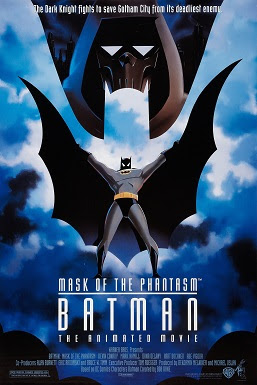
Batman: Mask of the Phantasm (1993)

“I need it to be different now. I know I made a promise, but I didn’t see this coming. I didn’t count on being happy.”
 
When I reviewed Batman: Mask of the Phantasm back in 2012, I said that it was “impossible” to compare it to The Dark Knight, finding Phantasm to be “quintessential.” Four years later, in my first expansion of my Personal Canon, Mask of the Phantasm made the cut – and yet I had said it was “imperfect... the resolution doesn’t quite hold up after repeat viewings.”
 
Reader, I was wrong. This review could have been so many things – an edition of “Take Two Tuesdays,” a continuation of my 2017-2019 reviews of Batman: The Animated Series, or part of my heretofore undeclared attempt to review every movie on the Personal Canon. Even before rereading my original review, I wanted to revisit Mask of the Phantasm because it deserved so much more than just 250 words in that “Monday at the Movies” format – especially on the occasion of its 30th anniversary this year. Whatever I was thinking in 2012, Phantasm has never truly let me down.
 
The Batman (Kevin Conroy) is a wanted man, wrongly accused of the murders of some of Gotham’s most notorious mobsters. Batman is hot on the trail of the real killer, The Phantasm (Stacy Keach), when an old flame returns to town – Andrea Beaumont (Dana Delany), whose past relationship with Bruce Wayne is explored in heartbreaking flashbacks, even as the plot marches inexorably toward a final confrontation with The Joker (Mark Hamill).
 
I always forget that Phantasm is as brief as it is. In the neighborhood of 75 minutes, it’s hard to find a film that hits all the bases like this one does: suspense, romance, comedy, heartbreak. Between dynamite action sequences and deeply human character work, Mask of the Phantasm includes no fewer than three origin stories across two timelines, telling an indelible and original story about Batman. It’s a tale that has cast its own shadow over Batman in the past thirty years, with fans constantly asking, “When will the Phantasm show up?” (The Phantasm appeared in Batman Beyond comics circa 2015 and in 2020’s Batman/Catwoman; over on film, we got a name-only tease in Batman v Superman, while the Phantasm is frequently name-checked in wishlists for the inevitable sequel to The Batman.)
 
Yet the reason I’ve never quite sounded the call for more Phantasm stories is because this one is perfect. The comics did a semi-sequel to the film in Batman & Robin Adventures, in an issue that could only be called “Shadow of the Phantasm.” While it’s a fun romp, it’s not indispensable, and it essentially leaves the characters in the same place where the film did: separated, exiled, and presumed dead. I’m being cagey about spoilers, even though the film is thirty years old and the action figure infamously unmasked the Phantasm just in time to disappoint kids on Christmas. My spoiler-phobia is largely due to my quasi-religious devotion to stories and the art of storytelling, but it’s also because the mystery isn’t entirely the point; if you know how tragedies work, you’ll plot this one out in short order.
 
Because the key to Phantasm isn’t that it’s a mystery; it’s a film noir about brooding avengers and the dark shadowy antiheroes who love them. It’s a tragedy about what happens when people let their pasts define them, but it’s also about the inescapability of the past, of chickens coming home to roost when it’s least convenient. Indeed, the past looms as large as the heavy tombstone on which the WAYNE family name is inscribed, and the real pain of the film is Bruce Wayne’s inability to escape that destiny he pledged for himself. “The way I see it,” Andrea snipes in one incisive moment, “the only one in this room controlled by his parents is you.”
 
Phantasm is somewhat unique for a Batman origin story in that we never see the murder of the Waynes, that random act of devastating violence that set Bruce Wayne on a course of dark vengeance. Instead, the film takes their loss as a given and sets the real origin story as a choice – Bruce Wayne chooses his vow over his own selfhood, and when he dons the cape and cowl for the first time, it’s not a moment of triumph. Alfred intones, “My God!” and recoils. The music swells, but even that refrain is sobered and pained. From that moment on, Bruce Wayne is the performance, a careless playboy charade who has to hide himself away from others lest they see through his façade.
 
The Phantasm, too, is a performance, reciting the ominous refrain, “Your angel of death awaits,” like some grim prophecy that explains everything. Outfitted with a theatrical costume and an insistence on dramatic violence, the Phantasm is wrestling with demons that have nothing to do with framing Batman for murder. Meanwhile, the mobsters – most notably Sal Valestra, voiced by Abe Vigoda – are stuck in their roles, playing out cheap imitations of The Godfather while their past catches up to them. The casting of Vigoda is inspired, mired in the genre’s past while playing on the arrested timelessness of Vigoda’s permanent old age.
 
Paradoxically, only The Joker is perfectly liberated. If you didn’t know he was in the movie, his first appearance reads like something out of a nightmare; the film takes a hard pivot and bends around his manic gravity. At first, the mobsters try to recruit Joker to protect them from Batman, but the incorrigible Joker can’t help but take over the plot for his own purposes, bumping off as many gangsters as The Phantasm does. He even seems to grasp the cruel irony of the film’s finale, laughing with gleeful abandon as he, Batman, and The Phantasm stare down certain death. Indeed, throughout Joker plays the Shakespearean fool, commenting on the coincidences of the plot, calling out red herrings about Phantasm’s identity, and cracking wise with a sense of humor best suited to the gallows of Gotham.
 
I haven’t said anything about the voice cast because the scripting is so impressive, but suffice it to say that Kevin Conroy remains the definitive Batman, giving us no fewer than three takes on the character (costumed vigilante, fresh-faced bachelor, and jaded philanthropist). He can plumb the depths of grief or crack a wry one-liner, and he’s the voice I’ll always hear in my head for any comic book. Ditto for Mark Hamill, whose Joker is so good that you forget he was ever a farmboy from Tatooine. Hamill has a knack for uncomfortable punchlines like “That’s what I want to see, a nice big smile.” Then there’s Dana Delany, who has to be the emotional heart of the story while keeping her own feelings clenched beneath a cool exterior. She can keep pace with both Bruce Wayne and Batman, and using nothing but her voice, she convinces us that she’s Bruce’s true star-crossed lover.
 
Ultimately, the reason people want more Phantasm isn’t because there’s more to say. It’s because this film is so good, so perfect, that 75 minutes feels criminally brief. We want to hear Conroy and Hamill riffing on each other until the end of time. We want to chase happiness just like Bruce Wayne does, and we want to revel in the bittersweet fatefulness that finds Bruce pursuing a darker calling. Or maybe we just want to live in that glorious art deco Gotham, painted on black with red skies, with a breathtaking Shirley Walker score to make sense of it all. (I know I do.) It’s an agonizingly human story, heightened by the presence of elaborate costumes and a certain Clown Prince, and as in the best films no one wants to see it end.
 
I don’t know what I meant in 2012 by “doesn’t quite hold up,” because Phantasm is a movie that has held up – and it has held me up when I’ve felt down about storytelling, disappointed by my favorite genre, or just grim about life itself. It’s almost like a calculated distillation of a superhero narrative, sweeping from start to finish, from origin story to never-ending battle. It’s not a movie that necessarily makes one feel good about humanity, but it does make one feel good about being alive. What life is worth living if you don’t have Conroy and Hamill narrating it?
 

Batman: Mask of the Phantasm
 is rated PG for “animated violence.” Directed by Eric Radomski and Bruce Timm. Written by Alan Burnett, Paul Dini, Martin Pasko, and Michael Reaves. Based on the DC Comics. Starring Kevin Conroy, Dana Delaney, Hart Bochner, Stacy Keach, Abe Vigoda, Efrem Zimbalist Jr., and Mark Hamill.

Monday, December 23, 2019

Star Wars: The Rise of Skywalker (2019)

When The Last Jedi came out two years ago, I observed of its theme (but for whatever reason did not say so in my review) that it seemed to be the story of “looking for hope in Alderaan places.” The film had been a tale of failures, of misplaced hope and crushing defeats, but it also ended up reaffirming that the Resistance’s true hope lay in the princess of Alderaan and her brother in exile, and the legacy they were building for the next generation. In the follow-up, The Rise of Skywalker, that legacy comes to bear in unexpected ways, crowd-pleasing and recontextualizing for an emotionally successful finale to this Sequel Trilogy and the Skywalker Saga writ large.

(As ever, there won’t be spoilers here; even the major reveal, divulged in the film’s opening crawl, is a sacred mystery in this review.)

After narrowly escaping The Last Jedi with their lives, agents of the Resistance are on the run from the First Order, gathering what few allies they can find in a galaxy that’s given up. While Kylo Ren (Adam Driver) marshals the forces of the First Order, Rey, Finn, and Poe (Daisy Ridley, John Boyega, and Oscar Isaac) head into the unknown in search of a way to prevent the complete obliteration of the Resistance, meeting new friends and old while Rey decides, once and for all, what her destiny will be.

So much exhausting ink is being spilled about whether or not The Rise of Skywalker “betrays” The Last Jedi by walking back or diminishing certain aspects of the film, whether or not this film “ruins” Star Wars or if returning director J.J. Abrams hates predecessor Rian Johnson. All of this is to say that no one hates Star Wars more than Star Wars fans, especially that vexing vocal minority monopolizing internet chatter. In the case of The Rise of Skywalker, I found myself strongly reminded of Return of the Jedi, itself a capper to a trilogy and an ostensible end to a story. Both films play it a little safer than their edgier forebearers, but both make up for that decrease in originality by dialing up the emotional resonance. Where Return of the Jedi reunited its heroic trinity for one last mission, Rise of Skywalker gives us Rey, Finn, and Poe properly together for the first time, having kept them apart for much of the preceding two films. It’s a real joy to see these three side by side, and their interactions carry the weight of all the adventures we didn’t get to see between films.

Critics have lamented the way the film is perhaps overfilled with setpieces, characters, and side quests, to which I have to say, I hope they enjoyed their first Star Wars film – because this is a franchise that has always been overfull of bits, fodder for imagination and tie-in media alike. True, Rise of Skywalker begins with its foot on the gas and never quite lets up, but as the third film in a trilogy there’s not a lot of time for much else, especially when the stakes are as dire as they are here. In fact, however, there’s a beat near the end of the second act where the plot does slow down, and it’s one of the most emotionally resonant corners of the film.

I was disappointed to find my audience so quiet during the film because there are a number of moments where you want to pump your fists and cheer. (The biggest laugh seemed to be who gets the line, “I’ve got a bad feeling about this.”) Perhaps audiences have been down this road so many times since 2015 – where, recall, the Milennium Falcon’s appearance got a big cheer – but suffice it to say I was charmed and cheered by more than a few sequences, including, and this is not a spoiler, a silent cameo from the Maestro himself, John Williams. Speaking of Williams, it’s his grand finale, too, and there are only so many ways to praise a man with more than 50 Academy Award nominations; he’s got an impressive body of work on which to draw, and he does so in ways that are breathtaking. I sense, however, that J.J. Abrams is still less comfortable with an orchestral score than Rian Johnson was, so I’m eager to see the film again after getting more familiar with the score (which remains, incidentally, my favorite component of any Star Wars material, period).

In the way that Return of the Jedi was an ending that gestured at a beginning, Rise of Skywalker is the final act in a nine-piece story, with plenty of space for what happens next, but it’s also acutely aware that there are things it needs to resolve. Leavened with the usual amount of space nonsense – which I love – the film cobbles macguffins together to get us to a sequence that orbits around Chekhov’s gun while wrapping up one of the Sequel Trilogy’s most potent emotional questions, and my only complaint is that it does so in a way that makes me want a whole movie or two of just thatcomponent. But taken as part three of three (and I feel I must be terribly vague here) the impossibility of continuation is perhaps for the best, as it needs first to resolve an entire arc, not establish a new one. That’s what the toys are for, folks.

As with nearly any film, there are moments I would have done differently. I’d have liked to see a few returning faces have a few more scenes, but there isn’t really anything to trim to make room for that. (In a post-Endgame world, though, I’d have been up for a three-hour space opera!) But in a world where toxic fandom demands that a piece of art conform to every single expectation, where the villains of the story are the ones who insist on rewriting history to accede to their vision for the galaxy, I find it’s much healthier to review the film we actually got instead of the one I might have made. And the Rise of Skywalker before us is pretty swell.

Star Wars: Episode IX – The Rise of Skywalker is rated PG-13 for “sci-fi violence and action.” Directed by J.J. Abrams. Written by Chris Terrio, J.J. Abrams, Derek Connolly, and Colin Trevorrow. Starring Carrie Fisher, Mark Hamill, Adam Driver, Daisy Ridley, John Boyega, Oscar Isaac, and Anthony Daniels. (And a few more!)

Monday, April 9, 2018

The Last Jedi (2017) [Score-Only]

Anyone who has known me long enough has heard me say some version of the following: so much of what works in Star Wars is due to the music of John Williams. I said over and over when I reviewed the prequels four years ago that if anything in those films works, it’s because John Williams crafted scores that, quite frankly, the films neither deserved nor lived up to. I even claimed, “Put the dialogue on mute, and the score alone could carry the plot better than the acting.”

With the home video release of The Last Jedi, I finally have the opportunity to put my money where my mouth is, because the digital copy of the film includes a score-only version – that’s the visuals, the John Williams score, and nothing else; no sound effects, no dialogue, not even subtitles to walk you through the film. It’s just you and the maestro. I won’t say that it’s the definitive version of the film, and I won’t say that the score-only version will necessarily work for everyone; my sense is that it might work better with a few listens to the score under your belt, because it’ll be easier to notice how the score is playing off the visuals when you have a sense of where the score is going. But I will say that it’s a special treat to watch The Last Jedi with Williams alone in your ears, particularly for those who haven’t been impressed with the Sequel Trilogy’s score work thus far. John Williams is still doing grand work, if only we had ears to hear it.

(I’m going to loosen the spoiler reins a bit, and by dint of talking about the score I can’t help but spoil a few things, particularly character interactions. I’ll keep it to a minimum, but please do watch The Last Jedi; it rises in my estimations each time I see it.)

Monday, December 18, 2017

Star Wars: The Last Jedi (2017)

No one, it seems, hates Star Wars as much as Star Wars fans. To be fair, we’ve been wronged by the franchise we profess to love – the much-maligned Prequel Trilogies are cumbersome and inelegant, and the less said about the “Holiday Special” the better – but I think by and large the fanbase has been spoiled by a profusion of content and thus has developed a very narrow view of what Star Wars ought to be. The Last Jedi, the eighth episode in a franchise that now also includes “Anthology Films,” flies in the face of that narrow vision of Star Wars and does something truly unique with the franchise while remaining (to borrow a phrase from its composer, John Williams) quintessentially Star Wars-ian.

(As ever, you can trust me to give you the spoiler-free treatment. Believe me when I tell you that the plot summary below is only half of the first act, but if you haven’t seen it and want to go in totally unspoiled, skip down to the last paragraph, and don’t listen to the soundtrack, because Williams is not shy about quoting identifiable cues.)

The Force having awakened in the previous film, The Last Jedi picks up moments later, as Rey (Daisy Ridley) encounters Luke Skywalker (Mark Hamill) in his self-imposed, grimly pessimistic exile. While Rey implores Luke to rejoin the galaxy and teach her the ways of the Force, Leia Organa (Carrie Fisher) leads the Resistance in evacuating their D’Qar base; Poe Dameron (Oscar Isaac) butts heads with Vice Admiral Holdo (Laura Dern); and defector Finn (John Boyega) joins up with mechanic Rose Tico (Kelly Marie Tran) to seek out a way to keep the First Order off their tail. And speaking of the film’s villains, Kylo Ren (Adam Driver) is dispatched by the Supreme Leader Snoke (Andy Serkis) to snuff out the Resistance, the Jedi Order, and his own demons.

The Last Jedi covers a lot of ground, and it’s been rightly compared to The Empire Strikes Back for its divergent plot structure. Where The Force Awakens was relentlessly linear and unilaterally focused on a tight narrative, The Last Jedi sprawls out on this galactic tapestry and gives us no shortage of plots to follow. Like in Empire, the plots splinter off and converge in unexpected ways, and the audience is never quite sure what’s going to happen. I’ve seen a lot of outlets that report the film doesn’t “play it safe” and “takes risks” with the franchise – there is a moment, about halfway through the film, at which point I realized I had no idea what was going to happen because something I’d taken for granted had changed completely. After that, I found myself trying to keep up with the film as it heroically outpaced my expectations. As we galloped into the third act, I found myself quite literally gasping for air; I’d forgotten to breathe, and it took an unexpected shock to jar me back to life.

There’s not a bad performance in the bunch, and to say more might encroach on the territory of spoilers. Daisy Ridley gives a fantastically driven performance as a woman who is finally running toward her destiny, while Adam Driver is magnetic as he wrestles with the legacies he’s being forced to inherit. Far and away, the film belongs to Mark Hamill, who’s given a meaty character arc once Rey holds out that lightsaber on the island of Ahch-To, but Carrie Fisher gives a hell of a swan song as General Leia, who looms over the film like the regal war hero we know her to be. Then there’s the trio of new faces, of whom Kelly Marie Tran is the most engaging and likely a new fan favorite as she presents a giddy new look at what it means to be a hero of the Resistance from the vantage point of the mechanic Rose Tico; Laura Dern and Benicio del Toro turn in compelling performances, too, and all three of them are examples of what Star Wars has done best – introduce us to slices of a character’s life and invite us to study further into that galaxy far, far away. For The Last Jedi is, like all of the Star Wars universe, a story about the personal stakes of good and evil, about a series of individual choices that add up to galactic mythology because every life is precious, every moment sacred, every interaction blessed by significance because each life exists in its own expanded universe of stories. (Rose has her own tie-in book; Holdo appears in an earlier novel about Leia; and del Toro’s DJ has his own comic book coming soon – crass consumerism it may be, but sign me up for the lot of it.)

By way of critique, I’ll say that there are a few moments in the movie that don’t quite feel like Star Wars to me – new abilities we see on display, new technologies, even incidental characters who feel as if they’ve been imported from another franchise. Where some have taken this with resentment, #NotMyStarWars, I’m in the camp where those plot devices feel like fresh angles on a franchise that had already recapped its greatest hits with The Force Awakens and, to an extent, Rogue One. The tone of the film does, however, occasionally flirt with the line between deflating comedy and moments of high drama; where Guardians of the Galaxy, Vol. 2 tripped headlong over its own shoes into a pratfall in its best effort to prevent us from engaging with an emotion beyond laughter, The Last Jedi uses these moments to show us that a person is never only one thing. Someone mired in the deepest depression can find an opportunity for levity; life-or-death stakes end up blinking when they stare us down and we shrug our shoulders as if to say, “Do your worst.”

Surprisingly, I didn’t cry at this one. I still get a little choked up at the reunion of Han and Leia in The Force Awakens – kudos to John Williams, who did nonpareil work there and who continues to live up to his own legend. (Thank goodness, by the way, the “Canto Bight” theme is on the soundtrack!) I did, however, feel a swell of admiration at a film that managed to defy my expectations and yet make a perfect amount of sense. There may have been a few things I would have done ever so slightly differently, but of what movie isn’t that true? At film’s end, I felt thrilled, breathless, captivated. Though it’s the longest entry in the franchise, I could have easily done another hour. We’ve got two years until the as-yet-untitled Episode IX, but director Rian Johnson has given us a lot to pore over, and I can’t wait to see it again. Moreover, my excitement for the future of the franchise is stratospheric, because this all could have gone horribly wrong. The galaxy is in good hands, and there’s room for hope.

The Last Jedi is rated PG-13 for “sequences of sci-fi action and violence.” Written and directed by Rian Johnson. Starring Mark Hamill, Carrie Fisher, Adam Driver, Daisy Ridley, John Boyega, Oscar Isaac, Andy Serkis, Domhnall Gleeson, Anthony Daniels, Gwendoline Christie, Kelly Marie Tran, Laura Dern, and Benicio del Toro.

Thursday, August 4, 2016

Batman: The Killing Joke (2016)

It’s safe to say that Alan Moore and Dave Gibbons turned in a work that is both seminal and controversial when they created The Killing Joke back in 1988. It’s a work that has sparked heated debate about its content, its treatment of Barbara Gordon, and its recently challenged ambiguous ending (which I’ll admit eluded even me at first). And I’m extremely satisfied with the forty-five minute animated adaptation DC Comics released this week, for reasons I’ll enumerate.

But for reasons I cannot begin to understand, the adaptation is preceded by the cartoon equivalent of a steaming dump taken to profane the very concept of the character of Barbara Gordon. Spoilers are going to follow on this one, folks, but the long and short of it is that you can skip the first twenty-eight minutes of the film and regale yourself with everything you wanted from a Killing Joke adaptation, or you can watch the whole thing and sit in a stunned stupor as you wonder how so many people thought this was a good opening act.

The Killing Joke is the quintessential Batman v. Joker tale, in which the Clown Prince of Crime (Mark Hamill) attempts to prove a point to his Dark Knight foe (Kevin Conroy) that madness is the only sane reaction to the tyranny of the world’s “random uncontrollability.” This existential dilemma plays out on the bodies of retired Batgirl Barbara Gordon (Tara Strong) and her father Commissioner Gordon (Ray Wise), victims of Joker’s obsession with the Batman.

It’s the ultimate Joker story, proving just how terrifying the grinning jester can be by exposing us to the very blackness at the core of his soul. It features some of the darkest humor ever uttered from those crimson lips, brutally uncomfortable in a way that is precisely the point. It’s a story about how deep the Joker’s obsession with Batman runs, even as the reader begins to see just how close these two diverging paths really are. Is Batman, too, mad? Is this a path that necessarily ends in death? Though Alan Moore has largely dismissed Killing Joke, there are some really good ideas in there.

There are also some really abhorrent things in there, some things with which every comics fan must wrestle, particularly the text’s treatment of Barbara Gordon. And I’m honestly not sure where I end up on this debate – is the text simply presenting the Joker’s horrors in all their appalling brutality, or is there something approaching at best ignorant representation and at worst virulent misogyny in the book’s violence? The book undeniably deprives Barbara of much of her agency and even some of her humanity in reducing her to a pawn in the conflict between Batman and Joker, but fortunately so much good work was done in the comics about how Barbara healed and became something even greater in the form of Oracle, the information broker of the DC Universe and arguably one of its smartest tech-savvy heroes. This, I contend, is the crux of the superhero genre – it’s a core narrative about how we make ourselves into our greatest ideals, how we build ourselves into the best possible versions of ourselves. That’s why Batman is the greatest superhero: he’s us, as we wish to be, at the cost we fear paying. He’s not superhuman, but he is a super human.

When producer Bruce Timm and writer/adapter Brian Azzarello announced some time back that they were adding a Batgirl-centric prologue to the film, in part to pad out the runtime and in part to give Barbara a more leading role, I was intrigued. I’ve always regretted that Barbara is merely a victim in The Killing Joke, so it was good to hear that the film’s creators were attuned to that sensitive element of the book. Now for a little thought experiment: in one sentence, give me a reason to care about Batgirl. If you don’t know much about Batgirl, you can try it with any character you admire – just one reason to care about them. Write it down.

Did you write down, “She’s able to have sex with Batman”? No? Oh, well, that’s the best thing Azzarello came up with. Look, I admire the man’s work tremendously, and I’ve met him in person and found him to be wise and affable. But how in the world did the man who gave us Doctor 13: Architecture and Morality decide that the best way to get audiences invested in Batgirl was to hook her up with Batman in a creepy, sleazy rooftop one-night-stand that reduces both of them to petulant children the morning after? In what alternate universe is that either palatable or acceptable? It’s leery and exploitive in a way that participates in, not decries, the Joker’s violence of the same kind. And I wish to heavens I were exaggerating when I say that the prologue is capped off by a scene of Barbara jogging as – and I swear on all that’s holy, I’m not stretching the truth – the camera lingers over her jiggling behind and chest, never ascending past her shoulders. I try to keep the language PG on this blog, but I have all manner of vituperative commentary just under my bitten tongue.

After that, about which I could decry so, so much more (like the fact that the prologue is ultimately, from a cinematic point of view, entirely unnecessary, as it’s never so much as acknowledged again), the film takes a complete 180-turn into a rendition of the graphic novella that leans hard into accuracy, embellishing just a little bit in ways that are really quite engaging. This Killing Joke does more with the carnival freaks, an intriguing visual here made into a coterie of Joker’s maddest henchmen, and it sets one of Joker’s monologues in a room that’s quite literally topsy-turvy, amping up the madness in a way that the comic only used words to accomplish.

In a very real sense, this is the Killing Joke for which we waited. The animation is a compelling if visibly low-budget approximation of Brian Bolland’s highly precise penciling, and the voice cast is Conroy and Hamill at their level best. The first time we hear Joker’s laugh, I burst into an irresistible smile and snicker. “That’s my Joker,” I thought, “and here’s my Killing Joke.” But that first half-hour I can guarantee I will never watch again. It angers me just to think about it. A friend of mine once said, “I know Batman better than I know most real people I know,” and I feel that way about Batgirl too. I care about this character in a way that I think no one watching only this film possibly could. She’s plucky, brave, and brainy as all get-out, and she deserves so much better. The original Killing Joke comic did violence to her, and it’s abhorrent to see that the violence continues. In the comics, Barbara healed and became Oracle, but here the credits roll and nobody seems terribly bothered by any of it. (Do stay through the credits, though.)

As I wrap up this review, I’ve got a stack of new comic books waiting for my eyes, but I’m so eager to go back and enjoy the forty-five minutes of Killing Joke proper once more. It’s on those grounds, then, that I can recommend The Killing Joke: it’s a gourmet steak dinner preceded by the crudest crudité imaginable. If I were a principled man, I’d boycott DC Animated Films from here on out. But next up, it’s Justice League Dark. And I can’t say no to an animated Swamp Thing. I just can’t. And that’s no joke.

Batman: The Killing Joke is rated R for “some bloody images and disturbing content.” This isn’t one for the kiddies; Barbara’s injuries are pretty graphic, and the shots of her pained body are framed in a way that obscures the most explicit details but leaves the imagination to run rampant. Then there’s the offensive hypersexualization of the character, the aforementioned jogging shot and a beat in which Barbara removes her mask and costume, wearing a bra, before the Hitchcockian pan away. The film is relentlessly dreary, bleak in the way it needed to be to do the book justice, and it spares no blood. Weirdly, though, the language is self-censored, as when a mobster says “What the eff?” If you’re going to go for the R rating, why stop short on that point?

Monday, December 21, 2015

Star Wars: The Force Awakens (2015)

First of all, if you haven’t seen The Force Awakens just yet, read on without fear of being spoiled (although really, what else did you have to do this weekend?). I’m very sensitive to the fact that this is a film with a heavy curtain of secrecy around it. The spoilers are out there if you really want them, but I’d advise anyone to go into The Force Awakens with a clean palate because this is a film that works best when it washes over you and introduces itself to you on its own terms. It’s a remarkable achievement, breathing new life into a franchise that needed it, setting a fantastic tone for the forthcoming Disney era.

Again, no spoilers here, so I’ll refrain from the usual plot synopsis, only to say that the film’s opening title crawl is immensely captivating stuff, clicking into place a lot of the rumors and official releases such that you have an instant sense of the state of that galaxy far, far away these thirty years after Return of the Jedi. In addition to the familiar faces of Han Solo (Harrison Ford), Luke Skywalker (Mark Hamill), and Leia Organa (Carrie Fisher) – listed in the order they’re credited on the film – The Force Awakens introduces us to a new trio: stormtrooper Finn (John Boyega), scavenger Rey (Daisy Ridley), and hotshot Poe Dameron (Oscar Isaac). And menacing the galaxy is one more black-clad acolyte of the dark side, Kylo Ren (Adam Driver), and the First Order’s plan to unseat the Republic.

I found myself thinking immediately of the words of Obi-Wan Kenobi from Return of the Jedi: “You cannot escape your destiny.” And while I’m on record as being one of those moviegoers who ordinarily detests the deus ex machina of destiny, it’s undeniably woven into the fabric of the Star Wars universe, and director JJ Abrams does some very intriguing work with it. Throughout The Force Awakens, we have characters who are either running from their destiny or sprinting headlong toward it, and all of them end up pretty much exactly where they are meant to be – from the stormtroopers in the opening scene to the folks present in the final shot of the film (and what a gorgeous, sweeping final shot it is). Heck, even Greg Grunberg, a childhood friend of Abrams, fulfills his destiny by appearing here as an X-wing pilot.

JJ Abrams had the unenviable task of being the only person to direct a Star Wars film without George Lucas's hand on his shoulder (including, of course, The Clone Wars and that horrible thing I watched last Friday). While I’ve never been a full Abrams disciple, there’s no question that he more than lives up to the legacy of the original trilogy. (As for the prequels, they’re largely set aside, save for one passing reference.) As a director, Abrams keeps the pace of the film at an even clip, sprinkling in enough humor to make this possibly the funniest Star Wars film in the saga without compromising the film’s overall tone. More apparent is the film’s reverential and referential attitude toward the original trilogy; nearly every sequence in the film has some callback to a previous moment, giving lie to George Lucas’s oft-quoted refrain about the poetry of the saga. But what’s remarkable here is that the aggregate effect isn’t one of plagiarism; there’s a deference, to be sure, to what came before, but it advances the saga forward and cues up more than enough for Episodes VIII and IX to continue to explore.

Bizarrely, and actually gratefully, I’m more interested in the new characters than in the returning faces. Yes, there’s a wonderful reintroduction moment for every returning character (even the ones you weren’t expecting to be applause-worthy), but the Finn-Rey-Poe trio could easily be the new Luke-Leia-Han for this generation, and not necessarily in that order. This is great news for the franchise as a whole, because it shows that Star Wars is capable of sustaining itself beyond the inevitable first flash of nostalgia that The Force Awakens was always destined (there’s that word again) to invoke. And say what you want about the prequels, but they always pointed to A New Hope, never sufficiently building their own world (save for those long and tedious political conversations). The Force Awakens propels the narrative forward, to say nothing of the introduction of an equally compelling trio (or quartet, depending on how you do the math) of antagonists. Let’s just say this – Kylo Ren is everything we wanted from Hayden Christensen’s Anakin Skywalker.

I’ll have to see the film again to give a more detailed assessment – I know there are folks chomping at the bit to talk about some of the more spoileriffic details – and I’d like to revisit the film with more of the John Williams score under my belt. I was just too overwhelmed by the film to drink it all in at once. And that’s such a good thing. I felt myself smiling like a child again once those blue words “A long time ago...” appeared on the screen, felt my jaw fall as the title crawl clued me into the story. I smiled, I laughed, I gasped, and I very nearly cried in a few moments, and not only out of sadness when the film went for the emotional tug. My eyes were misty because I felt, finally, I’d come home. Chills up my arms, chokes in my throat (not the kind induced by the dark side, mind you), and a permanent grin across my face: these were the feelings The Force Awakens conjured up in me. Like some magical incantation, cast out across the void of decades, Star Wars is back.

Star Wars: The Force Awakens is rated PG-13 for “sci-fi action violence.” This film is slightly bloodier than previous Star Wars films, but the level of violence and action is about the same.

Monday, February 16, 2015

Kingsman: The Secret Service (2015)

I’m really quite surprised that the marketing for Kingsman: The Secret Service didn’t make more of the fact that its central antagonist is named Richmond Valentine, a tycoon with a sinister plot set to culminate on the self-styled “Valentine’s Day.”  It is, I suspect, infinitely more preferable than the other film opening this weekend, 50 Shades of Grey; though vastly more violent and surprisingly more chaste, Kingsman ends up being at once a highly palatable deconstruction and a heroically rousing genuine article.

Repaying the debt he owes the boy’s father, secret agent Harry Hart (Colin Firth) springs local hoodlum Eggsy Unwin (Taron Egerton) from lockup and recruits him to be a member of Kingsman, an elite espionage unit in the heart of Britain.  While Eggsy trains to earn a seat at the table, Hart (codename: Galahad) tracks the malicious misdeeds of Richmond Valentine (Samuel L. Jackson), a blue-chip billionaire with dastardly designs on the planet’s future.

As with Kick-Ass, the previous collaboration between director Matthew Vaughn and comics writer Mark Millar, Kingsman: The Secret Service bears a curious relationship with the eponymous comic book by Millar and Dave Gibbons.  The film is very loosely based on the comic, in  the way that I think all of Millar’s work ought to be; Vaughn has taken the broadest strokes from the source material and done his own riff unfettered by fidelity.  Millar’s work always has a darkly cynical edge to it, refusing to pander to the reader’s expectations and instead shocking him with truly grotesque violence and profanity.  As before, Vaughn’s adaptation is more earnest, more interested in deconstructing and rebuilding a film genre than in disparaging convention.

A point-by-point comparison would be somewhat facile (EW’s done a “top five” if you’re interested – beware spoilers in the comments), but case in point – the book unfolds the mystery of who’s been abducting science-fiction icons.  Sidebar for a fun fact: the book opens with the abduction of Mark Hamill; the film opens with the kidnapping of a climate change scientist played by Hamill.  The film, however, tells us fairly early on that Valentine is the villain, and where the book derided Valentine for being a simpering nerd, Sam Jackson’s antagonist is steeped in deliberate camp because he’s a self-conscious throwback to the James Bond villains of old.

As someone who spent the last two years tearing through the James Bond film franchise, seeing Kingsman’s loving critique of the gentleman spy brought a warmth to my heart, one that overrode my occasional frustration with the film’s more excessive laddish humor (cranked up more than in any of Vaughn’s other work, alas).  The film gives us a very suave Bond-esque figure, promptly dispenses with him, and then gives us something even better in the form of Harry Hart, the role that Colin Firth seems to have been waiting to play.  His entire performance exudes a sense of, “Look, I’ve won the Oscar for playing royalty, thanks very much.  But what I’d really like to do is be James Bond.”  He came close with Tinker Tailor Soldier Spy (with his costar Mark Strong turning up here as Merlin, the Kingsman agency’s tech guru).  But Kingsman is Firth’s moment to shine, and boy, is he dapper as ever.  Jackson brings plenty of charisma as the villain, though honestly he’s just playing himself with a lisp (“Do I look like I give a ----?” could be either Valentine’s quip or Jackson’s response to a dull interview); Firth, on the other hand, is all class, the kind of man that every male moviegoer ought to want to be.

Throughout it all, though, Vaughn never fails to keep it fun, never sacrificing entertainment value for self-consciousness.  In part, this is because the characters are themselves reveling in the act of nostalgia, fondly recalling the quirks and clichés of James Bond and his similarly initialed comrades (Jason Bourne, Jack Bauer, et al).  But the greater strength is that Vaughn doesn’t lean too heavily on genre, instead giving us resplendently engaging action sequences for which the allusions to monologuing villains and underground lairs are mere (but in the latter case, literal) set decoration.

As I’ve said before, the film does overstep itself every once in a while; there are a few references to real-life figures, the Westboro Baptist Church and Barack Obama among them (though Vaughn is nonsensically backpedaling on the latter), where the satirical eye becomes downright mean.  The “Pomp and Circumstance” sequence, however – which some reviewers have, tsk tsk, spoiled in their write-ups – is perhaps the most lewdly absurd of these tonal digressions, and in these moments it seems Vaughn allows the reins to slip.  Millar’s pointed disdain works amid the overall attitude of his work, but in the film adaptations, Vaughn is at his best when he’s working in a sandbox populated by wry witticisms and gentle self-reflexivity.

At two points in the film, one character cites a spy genre chestnut, only to be met with the response, “This isn’t that kind of movie.”  Honestly, I’m very much okay with that.  This is the kind of film I felt was promised at the end of Skyfall.  The moment when Bond enters the new M’s office – only it’s the same office from Dr. No – felt like an emphatic “And we’re back, only better.”  Kingsman is that next step, celebrating the best of the genre while moving in a decidedly modern direction.  Don’t get me wrong, I’m very much excited for Spectre (the next Bond film), but a Kingsman 2 would get my ticket dollar just the same.

Kingsman: The Secret Service is rated R for “sequences of strong violence, language and some sexual content.”  The violence is comprised of several very bloody fight sequences, some providing very unflinching detail with some creative methods of killing; gunshots, knives, slicing metallic limbs, and hand-to-hand combat is all included.  The F-word abounds, in excess of 100 times, and one reference to an unusual sexual act is delivered for comedic effect.

Sunday, May 4, 2014

Return of the Jedi (1983)

At the end of the Star Wars trilogy, it’s virtually impossible to top The Empire Strikes Back, which truly is a perfect movie.  But fortunately Return of the Jedi isn’t a fumble – think Godfather III without Sofia Coppola.  It’s a fitting conclusion to the Original Trilogy, though a few beats feel repeated from Star Wars.

The Empire has begun constructing a second Death Star, but before the Rebels can launch their attack Luke Skywalker (Mark Hamill) and Princess Leia (Carrie Fisher) must rescue their carbonite-frozen friend Han Solo (Harrison Ford) from the slimy clutches of the vile gangster Jabba the Hutt.  After that memorable first act, Luke must contend with the revelations about his father while all his Jedi training tells him he must face Darth Vader (voiced by James Earl Jones) one last time while his friends launch an assault on the Death Star’s shield generator on the forest moon of Endor.

I have a very vivid memory of the first time I watched Return of the Jedi – I was eating bubble gum ice cream (we had gone to Baskin Robbins between the Jabba and Endor scenes), and the lush greenery of the Endor sequence impressed me, since I had only seen Empire Strikes Back on a black and white television.  Now, I’m not that old, but I have a harder time looking objectively at Return of the Jedi than at the prequels, partially because of this childhood remembrance; I don’t have a problem, for example, with the cuddly teddy bear Ewoks (though I think that using Wookiees might have been more interesting), and the first act in Jabba’s palace is really more of an extended precredits sequence in the James Bond tradition.

But it all adds up to something really quite entertaining, even if it steps on the toes of Star Wars a bit with a retread of the Death Star trench run climax.  After the sturm und drang of Empire Strikes Back, Jedi feels refreshing without the whiplash of an abrupt course correction.  The Jabba sequence, more prologue than plot, really only serves to get Han Solo back into the story, but director Richard Marquand keeps it interesting by populating the scene with fascinating visuals and a fantastically confident performance by Hamill.

Hamill’s turn as Luke Skywalker, now a full-fledged Jedi Knight, makes me very excited for the as yet unnamed Episode VII, because by the time Jedi rolls around the core group of performers are obviously very comfortable in their roles; if Star Wars felt a little bumpy for the fresh-faced nature of the cast, the big three are their characters in this installment.  The Han/Leia relationship comes to fruition here, and Ford & Fisher play it very well, very naturally, with a nice reprise of the “I love you”/“I know” exchange. 

The stakes are upped by the appearance, finally, of Emperor Palpatine, portrayed with fine villainy by Ian McDiarmid.  For a role that’s mostly sedentary, McDiarmid exudes menace with every snarled vowel and malicious glint in his eye.  Furthermore, the Force-lightning trick works better here than in Attack of the Clones, because it’s the only weapon the decrepit Palpatine has beyond his words; it’s a fantastic surprise that the wizened old geezer can actually do real damage.  This new villain perhaps mitigates the overly adorable nature of the Ewoks, who manage to dismantle an Imperial garrison with sticks and stones; with Palpatine commanding the fleet from the air, the Empire continues to feel like a true threat.

But in spite of the compounded darkness in the film, Return of the Jedi is probably the most feel-good of the franchise.  Star Wars tastes good going down too, but the original film carries more of a sense of astonishment at innovation than comfort at the company of old friends.  Return of the Jedi feels like the band getting back together, with all the laughs and nostalgia that a fine epilogue should have.  For a series that begins as ill-advisedly as The Phantom Menace did, Return of the Jedi brings us back to where we ought to be – a definitive science-fiction epic for the ages.

Return of the Jedi is rated PG for “sci-fi action violence.”  More of the same from the last outings, really – lightsaber duels, a mechanized hand is severed, explosions and blaster fire, and one skimpy metal bikini.

Thanks for joining us today for “Star Wars Day”!  We’ll be back tomorrow with a review of The Amazing Spider-Man 2, and then again on Wednesday for the Double-Oh-Seventh of the month!

The Empire Strikes Back (1980)

If Star Wars is a perfect movie, it may seem hard to believe that The Empire Strikes Back is a more perfect movie.  The Empire Strikes Back follows religiously in its predecessor’s footsteps, though it turns the excellence up to eleven with a darker yet more human story that takes its characters to their most emotional moments.

Three years after the destruction of the Death Star, the Rebel Alliance’s hidden base on the ice world of Hoth is discovered by the Empire, and the Rebels flee after a spectacular battle in the snow.  Luke Skywalker (Mark Hamill) journeys to Dagobah to continue his training as a Jedi under the tutelage of the diminutive Yoda (Frank Oz), while Han Solo (Harrison Ford) and Princess Leia (Carrie Fisher) fight their mutual attraction and the pursuing Empire.  All three become pawns in a larger game controlled by Darth Vader (David Prowse & James Earl Jones), who wants revenge for the Empire and holds a dark secret about what really happened to Luke’s father...

The Empire Strikes Back amps up everything that Star Wars did correctly but augments the gee-whiz science-fiction angle with a more grounded sense of characterization.  The characters in Star Wars seem a lot like archetypes, which isn’t bad for a high mythic narrative, but The Empire Strikes Back really plays up the personalities of Luke, Leia, and Han (and, to a degree, Darth Vader).  It’s really the result of stronger writing; I’ve chastised George Lucas all along for creating relatively flat characters (cf. the Plinkett rule), but Leigh Brackett and Lawrence Kasdan’s screenplay feels much more three-dimensional and even more engaging.

Subsequently, the core cast members all rise to the occasion.  The will-they/won’t-they courtship between Leia and Han is positively electrifying, and Fisher & Ford nail the dynamic with a healthy dose of wry banter and lingering glances.  Even before we fully learn that the two are in a Benedict/Beatrice standoff, the chemistry between them tingles, and you’ll be pulling for them to end up together long before Han delivers his iconic last line (ad-libbed, to boot!).  As for Hamill, he’s given the unenviable task of acting opposite a puppet for much of his screen time, but his work onscreen is so compelling that you might forget Yoda is a glorified Muppet.  (One senses that Yoda’s introduction is what Lucas wanted out of Jar Jar Binks, but as per usual Empire offers a masterclass in how to do a movie right.)

I’m going to go out on a limb here and suggest that The Empire Strikes Back is one of the principal forerunners of our current grim-n-gritty approach to genre narrative.  Without Empire’s focus on the darker side of conflict, both internal and external, I doubt we’d have The Dark Knight and its ilk.  I don’t want to take away from Christopher Nolan’s accomplishment – he really did kickstart the movement in comic book films – but there’s much in Empire that feels comparable to the Nolan level of respect for the source material.  Director Irvin Kershner regards the Star Wars franchise incredibly reverently, telling a story with tremendous sincerity that aims not just to entertain but to follow a strand of very human logic and emotion that just happens to have dueling lightsabers, asteroid fields, and little green gurus.

As in Revenge of the Sith, the third act of Empire is frankly astonishing.  (The key difference being, of course, that the rest of Empire is unproblematically dynamite, as well.)  Underlined all the while by a tour de force score by John Williams, which works beautifully even through the headphones of an iPod, all the film’s plotlines come to a boil on Cloud City, with Han and Leia trapped in Vader’s web.  Emotions are running high – love, betrayal, fear, resolve, Vader’s menace.  As Luke comes to the rescue, it’s impossible not to get caught up in the good-vs.-evil plot, even though we know the forces of good are horribly outnumbered.  The revelation of Vader’s master plan and his darkest secret are exceptionally memorable, very well-crafted by all hands on the creative deck.  It’s a moment that sweeps you up, 34 years later, making you feel as excited as the first time you heard the words, “No, I am your father.”  And even having the prequels tell you that already, even after it’s been homage’d very nearly to death, Jones’s delivery is still powerful enough to send a chill through you.

The film ends in a very grim place, though as the credits roll there’s a breathtaking feeling of having been taken on a whirlwind journey through a galaxy of exciting possibilities, guided by an able pilot in the form of – no, not Han Solo, not even George Lucas – director Irvin Kershner and his able copilots Brackett and Kasdan.  The Empire Strikes Back was long my favorite movie of all time (up until, at least, I finally saw Casablanca), and it’s still Top Ten material for me, standing solidly in the ranks of the perfect movies.

If nothing else, it’s fine context for the strangest thing that Lando Calrissian (Billy Dee Williams) has ever done.

The Empire Strikes Back is rated PG for “sci-fi action/violence.”  A few lightsaber duels transpire, and two result in dismemberment.  Darth Vader force-chokes a few minions to death, and a character is frozen in carbonite amid fears that he might not survive.  Other laser blasts and explosions occur, as do a few kisses.

We’ll be back in two hours for the final installment of this review series, a look at Return of the Jedi!

Star Wars (1977)

Even if you strip away all the bells and whistles of the myriad “Special Edition” rereleases, at the core of Star Wars (now known also as Episode IV – A New Hope) is what I’m ready to label a “perfect movie,” a deft example of genre-(re)defining science fiction that never hits a sour note as it tells a relatively simple story with graceful aplomb.

Luke Skywalker (Mark Hamill) is a farmboy with dreams of space travel when the Rebellion against the malevolent Empire arrives on his doorstep in the form of two droids – R2-D2 and C-3PO – carrying data that could spell the end of the Empire’s latest technological terror, the Death Star.  Luke and his new mentor Ben Kenobi (Alec Guinness) charter the Millennium Falcon, captained by roguish Han Solo (Harrison Ford) and his Wookiee copilot Chewbacca, though their flight is derailed by an effort to rescue Princess Leia (Carrie Fisher) from the very embodiment of evil, Darth Vader (movements by David Prowse, voice by James Earl Jones).

After all the disappointment we’ve endured over the last few hours’ worth of reviews, it’s amazingly easy to fall back in love with the franchise from the very opening shot of two starships in combat – which brilliantly tells us everything we need to know without a single word of dialogue:  an enormous Star Destroyer bearing down on the miniscule and outgunned fleeing Rebel ship.

I do want to judge the Original Trilogy on its own merits and not quite in comparison to its prequel successors, but Star Wars does such a deft job of storytelling that it’s a wonder this is the same George Lucas who would later inflict Jar Jar Binks and ultimately meaningless political posturing upon us.  Star Wars is elegant in its simplicity – there are good guys and there are bad guys, and any special effects in the film are entirely at the service of the plot (rather than the other way around).

In fact, even before Lucas went in and revised the films with all his computer trickery (some of which is actually an improvement, especially the scene between Jabba and Han, which was absent from the initial theatrical release), Star Wars has aged spectacularly well.  Though I’ve seen the movie umpteen times by now, this most recent rewatch still captured all the movie magic for me, and it’s probably the most fun I’ve had with a movie since Captain America: The Winter Soldier.  There’s action, adventure, humor, romance (even if it’s uncomfortable knowing that Luke and Leia are related), a remarkably tight screenplay, and a slew of first-rate performances – the constellation required for a perfect movie.  And let’s not forget the John Williams score, the (mostly) unsung hero of the series, which swoops and soars when it needs to but pulls out the heavy brass lines when villainy is afoot.

If the film feels in any way familiar, remember that Star Wars distilled preexisting myth narratives and simultaneously reinvented them; it’s impossible to imagine a film in the mythic realm that hasn’t been influenced by this classic tale.  Even without the prequels, the introduction of Darth Vader, gliding over the bodies of fallen Rebel soldiers, is instantly iconic, and Jones’s vocal performance is genuinely chilling.  The rest of the cast, too, are doing pitch-perfect character work – Hamill naïve but determined, Ford charismatic yet cocky, Fisher resolute and courageous, and Sir Alec Guinness as the scene-stealer among them all, wise and pragmatic.  Each of these roles is legendary, but the addition of all of them together in a tightly-plotted and intensely focused screenplay results in... well, how many ways can I say “perfect movie”?

Science fiction at an undeniable apex, Star Wars proves a worthy inauguration to a long-lasting franchise, even nearly forty years after the fact.  Take it on its own or as the first/fourth chapter in a longer narrative; Star Wars is a perfect film.

Star Wars is rated PG for “sci-fi violence and brief mild language.”  A few folks get blasted by laser fire and explosions (both in person and in spaceships); one is choked to death, and another is briefly choked by The Force.  A planet and a space station explode, killing all aboard.  The expletives are of the “damn” and “hell” variety.

We’ll be back in two hours with (Star Wars: Episode V –) The Empire Strikes Back!