Showing posts with label Martin Scorsese. Show all posts

Monday, January 16, 2017

Silence (2016)

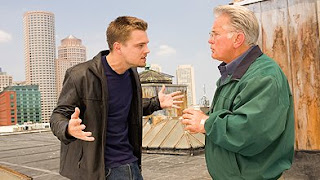
In thirteen years, I’ve not missed a single Scorsese theatrical release. In fact, most of them I’ve attended more than once. (The only other director who’s earned that degree of loyalty, you may be unsurprised to learn, is Christopher Nolan, who I’ve followed for twelve.) You should know – if you don’t already – that Martin Scorsese directed my all-time favorite film, The Departed, that I’ve never really been disappointed by him, and that I consider him easily one of the greatest and most reliable living film directors. Perhaps, then, I’m a little biased, but I contend that his latest, Silence, is an accomplished feat, a moody and mature contemplation of many of the themes that have dogged Scorsese throughout his oeuvre.

Based on the Shusaku Endo novel, Silence finds Jesuit missionaries Rodrigues and Garrpe (Andrew Garfield and Adam Driver) journeying to seventeenth-century Japan to investigate reports that their predecessor and mentor Ferreira (Liam Neeson) has turned apostate and renounced the church. In the course of their investigation, they find a community of Kakure Kirishitan (“hidden Christians”) persecuted by a local inquisitor and his interpreter (Issei Ogata and Tadanobu Asano), testing their faith and demanding more of them than they may be prepared to give.

Two of Scorsese’s dominant themes have been the struggles of faith and the tensions of duty; in Goodfellas, Henry Hill labored under his obligations to his criminal friends, while Scorsese acquired some notoriety for the inquisitive The Last Temptation of Christ. And in The Departed, a film rife with Catholic guilt and misplaced paternalism, the blurred line between cops and criminals becomes too much for both protagonist Billy Costigan and antagonist Colin Sullivan. In Silence, our protagonists have their faiths tested in more severe ways, facing torture and death in a way that’s almost biblical. Silence has long been a passion project of Scorsese’s, and I mean that in several ways, as the Jesuit priests face their own Christ-like trials, compared alternately to Gethsemane and to the crucifixion.

At two hours and forty minutes, Silence will likely test moviegoers as well; Scorsese movies have always been something of an endurance test (his last, The Wolf of Wall Street, topped three hours), but usually they’re padded out with flashy editing, nonstop dialogue, and at least one Rolling Stones track. With Silence, none of those is on display; indeed, this is one of Scorsese’s least stylized, most subdued works – and it’s also among his most mature and most contemplative. At 74 years old, Scorsese has a clear and unapologetic reverence for the source material and the thematic content of Silence, and as Rodrigues undergoes his trials, we can sense something of Scorsese’s own wrestling with his faith amid the apparent silence of God.

As Scorsese seems to extract himself from the equation, directing in a subtle manner with only a few trademark quirks on display, Andrew Garfield is proving to have quite a year for himself. (And, strikingly enough, between this and Hacksaw Ridge, he’s not had much luck going to Japan.) His performance of Rodrigues as religiously challenged, horrorstruck by the conflict between his religious obligation and his sense of duty to the faithful, is sophisticated in a way that makes me worry he’ll split the Best Actor vote for himself with Hacksaw Ridge. The film’s Japanese cast – particularly Ogata, who’s been rightly compared to Christoph Waltz from Inglourious Basterds – more than hold their own opposite their western counterparts, and in some ways with the harder job as their roles are largely silent. And Neeson, as ever, is brokenheartedly stoic as the alleged apostate, whose appearance in the third act layers the narrative with pathos of a surprisingly tragic dimension.

As a fan of the 1966 novel, I had wondered how the film would capture the multiplicity of narrators in the book, but I needn’t have worried. Scorsese pulls it off beautifully, opting for meditation over exposition. But where the novel ended somewhat optimistically, redemptive in a way that reaffirmed the reader’s faith, Scorsese continues the story for a few more minutes, allowing the audience to ask whether Silence is actually a tragedy, the despair of a man who wonders whether God has been silent all along. Or do we too hear the voice of God in the silences of Silence?

Silence is rated R for “some disturbing violent content.” Directed by Martin Scorsese. Screenplay by Jay Cocks and Martin Scorsese. Based on the novel by Shusaku Endo. Starring Andrew Garfield, Adam Driver, Tadanobu Asano, Issei Ogata, Yôsuke Kubozuka, Ciarán Hinds, and Liam Neeson.

Monday, December 30, 2013

The Wolf of Wall Street (2013)

Any reader who isn’t a stranger around these parts knows that I’m an enormous Martin Scorsese fan, and I’m of the opinion that Leonardo DiCaprio is one of our finest actors.  So believe me when I say that The Wolf of Wall Street, the pair’s fifth collaboration in more than a decade, is undoubtedly their best work since 2006’s The Departed (and maybe even since Goodfellas – your mileage may vary).

DiCaprio stars as the titular Wolf, Jordan Belfort, who uses his Wall Street savvy to start up his own barely legal brokerage.  Amid the debauchery and depravity of the excesses at Stratton Oakmont, Belfort attracts the attention of the FBI while juggling the demands of his second wife Naomi (newcomer Margot Robbie) and his partner Donnie (Jonah Hill).

With Wolf of Wall Street, Scorsese returns to the true-crime biopic genre he perfected with Goodfellas and Casino; indeed, Wolf could be seen as the third in a thematic trilogy of rise-and-fall narratives ripped from the headlines, and it certainly deserves that place of prominence in Scorsese’s repertoire.  Wolf is compelling and engaging, a prime example of a filmmaker not content to rest on his laurels; instead, he reminds us just how good he can be.  And for a film that never feels like it’s three hours long, never elicits so much as a bathroom break or a glance at a watch, Wolf is one of the most engrossing films I’ve seen all year.

As far as engrossing goes, let’s hope that this is the year that finally nets DiCaprio his Best Actor trophy at the Oscars (though he’ll have some steep competition from Christian Bale in American Hustle).  DiCaprio’s been turning in consistent work for the better part of a decade, and it’s high-time the Academy stops treating him like a bridesmaid and recognizes the total immersion DiCaprio undergoes into this character.  Aside from the verisimilitude of DiCaprio’s impression of Belfort’s physicality and mannerisms, he proves himself deft with a range of behaviors, from slapstick humor to deadpan disgust, from swaggering braggadocio to a whole range of addictions.  Belfort is such a multilayered character, and the film offers DiCaprio so many different opportunities to flesh out facets of this fascinating figure.

Yet with so many tonal oscillations, The Wolf of Wall Street never feels confused or inconsistent.  While some reviewers are bemoaning the film’s indulgent excesses, I have to think that’s part of the point; Scorsese is so effective at recreating Belfort’s world that he manages to trick us into thinking he’s not on our side.  And just like in Goodfellas, we’d be remiss if we didn’t think there was at least something seductive about Belfort’s lifestyle.  Whether it’s the money, the sex, or the feeling of invincibility, we’re meant to understand in some way – and perhaps even empathize with – Belfort’s decisions.

And Wolf of Wall Street plays with so many of the great Scorsese themes that it deserves high marks as another fascinating iteration of a great director’s most significant statements – the perils of venality, the inevitability of self-destruction, the coincidental slip-up.  In fact, one might even lump Wolf of Wall Street in with the greatest of Greek tragedy – we have our protagonist cursed with a fatal flaw (as with most Scorsese characters, it’s ambition) that becomes the instrument of his own implosion.  But if that’s too highfalutin a comparison for you, just remember Henry Hill’s closing monologue from Goodfellas about how the road through your dreams ends in being a schnook, eating egg noodles with ketchup.

In an era where one-percenters are the popular scapegoat, it’s refreshing to see a film that addresses the issue without heavy-handed moralizing about the evils of capitalism.  Instead, Scorsese presents the subject on its own terms, with an invigorating honesty that asks the audience to draw its own inescapable conclusions.  It’s a master class in respect and rewards for the audience, anchored by one of the year’s best performances.

The Wolf of Wall Street is rated R “for sequences of strong sexual content, graphic nudity, drug use and language throughout, and for some violence.”  Man, is this movie wildly inappropriate.  We’ve got a bevy of naked men and women on parade (sometimes literally), more drug abuse than you know what to do with, an estimated 500 F-bombs, and a few mild fisticuffs.

Tuesday, December 18, 2012

Top 10 Christmas Season Movies - #8-7

This week, in anticipation of the Christmas season, we at The Cinema King would like to bring you more than just your usual share of recommendations.  So we present to you:  this week’s Top 10 list.  More specifically “The Top 10 Christmas Season Movies.”  Rather than fill the list with “obvious” choices of Christmas-y movies, there are a few “alternative” choices on the list – the overarching determining criterion is whether or not this is a movie that I will watch beginning to end, especially during (but not limited to) the Christmas season.

#8 – Edward Scissorhands (1990) 
Tim Burton’s fourth film is a solid choice for Christmas and a bit of a gimme for this list, but it’s one that doesn’t insist upon itself as a holiday film because of the absence of snow.  Ever the imaginative one, Burton sets the film in snowless suburbia, letting the spirit of the story take center stage.  And what a sweet story it is, a contemporary fairy tale with that Burton edge; Johnny Depp is iconic as the titular silent protagonist, nonthreatening despite his bladed fingers.  His romance with Winona Ryder covers the sentimental requirement, and Burton’s trademark sly sarcasm toward the cookie-cutter neighborhood makes this a year-round treat.  But lest you forget why Edward Scissorhands makes this list, keep your eyes peeled for the ubiquitous Christmas lights and reindeer decorations, and the fabulist explication for why it snows during the frame story is as touching as they come.

#7 – Goodfellas (1990) 
I’ve already lavished praise on this film, one of Martin Scorsese’s gangster epics and quite possibly one of the greatest films of all time.  It’s sharp, it’s witty, it’s thrilling, and it’s downright entertaining, cementing Robert De Niro’s reputation and forging one for Ray Liotta and Joe Pesci.  But what’s it doing on a Christmas list?  It’s not exactly a festive film, what with the strong bloody violence and general criminality.  After the film’s major “Lufthansa heist” segment, in which the mobsters successfully pull off the score of their lifetime, they celebrate with – what else? – an office Christmas party, all set to The Ronettes’ “Frosty the Snowman.”  Though the décor is festive, the demeanor of Jimmy Conway (De Niro) is anything but; in fact, he’s downright Grinchy as he demands that his goons take back the mink coats and Cadillacs they’ve bought with their share of the loot.  You could even argue that this Christmas scene is the pivotal turning point of the film, for when the soundtrack shifts to Cream’s “Sunshine of Your Love,” you know that scowl on Jimmy’s face bodes ill for his little elves.

Come back tomorrow for #6-5!

Monday, February 27, 2012

Monday at the Movies - February 27, 2012

Welcome to Week Nine of “Monday at the Movies.” Last night was Oscar night, and I realized I only saw one out of the nine nominated Best Picture films, but there seemed to be a few other films that cropped up in the acting categories. I’ve already reviewed The Girl with the Dragon Tattoo, Rango, and Tinker Tailor Soldier Spy, so here are two more Oscar-nominated films from the past year.

Bridesmaids (2011) – Touted as “The Hangover for ladies,” Bridesmaids is something more than that because, rather than repeat a line of gags (as funny as those are in The Hangover), the film goes for an actual story anchored by a series of absurdly escalating vignettes around wedding planning. Because it was billed as “for ladies,” I was surprised by how much bathroom humor was present (saying something, I think, about gender politics in 2011) – not that I don’t find that kind of humor extremely funny, as when bad Brazilian food induces Maya Rudolph to defecate in the middle of the street (beneath the folds of a wedding dress, for those who have delicate constitutions). Melissa McCarthy snagged a Best Supporting Actress nomination for her outgoing and outrageous performance as raunchy bridesmaid Megan, although I’m not sure that anyone expected the nomination; it’s certainly strong acting, but nothing about it screamed “Oscar!” for me. In part, that’s because the ensemble cast in the movie is also strong – Jon Hamm as a sleazy beau, Rose Byrne as the one-upping aspirant to the “maid of honor” title, and the sweet and clean-cut Ellie Kemper who doesn’t quite get enough screen time. It’s ultimately not as rewatchable as The Hangover, but it’s not two hours that I regret spending in the first place.

Hugo (2011) – I’ve made no bones about the fact that I’m a huge Martin Scorsese fan, and the promise of his first 3-D movie was enough for me to give the entire visual gimmick a second try. Here’s another case of a film being billed as something it isn’t – I was told this was Scorsese’s “children’s film” made for all-ages as distinct from his other, more violent work. But the film is actually Scorsese’s love song to the work of early cinema pioneers like Georges Méliès, whose Voyage to the Moon plays a pivotal role in the film. Young orphan Hugo (Asa Butterfield) lives in a train station with his late father’s few belongings, including a mysterious key-operated automaton. The key comes into his life around the neck of Isabelle (Chloe “Hit Girl” Moretz), leading Hugo into a brave new world populated by cinematic dreams and hope for a magical future. I don’t want to spoil many of the little delightful surprises tucked into this deceptively complex film, but beyond the remarkable ensemble cast (including Sacha Baron Cohen as the sneaky station security, Michael Stuhlbarg as film historian René Tabard, and Sir Ben Kingsley as a train station toymaker) there’s a particularly strong soundtrack offered by Howard Shore, catchy and whimsical without losing sight (or sound?) of the powerful emotions the film elicits. As a meta-reflection on the magic of the movies, Hugo doesn’t disappoint and will leave audiences wistfully and blissfully satisfied.

That does it for this week’s edition of “Monday at the Movies.” We’ll see you here next week!

Tuesday, July 6, 2010

Raging Bull (1980)

Move Raging Bull off of the "I can't believe I've never seen this" list and onto the "great American classics" list.

Martin Scorsese's "rebirth" picture, made at a tumultuous time in the film icon's life, is a biopic about boxer Jake La Motta (Robert DeNiro) on his way to a title challenge. Raging Bull follows Jake from his first fights to his later years of ignominy as a nightclub performer, but the film spends less time in the ring and more time examining the ways in which Jake's paranoia ends up dismantling his relationships with his brother Joey (Joe Pesci) and his gorgeous second wife Vickie (Cathy Moriarty).

Raging Bull is many things at once - a feat that many films reviewed on this blog have tried and failed - but the most significant thing that it is not what a first-time audience expects. I had assumed I was in for standard biopic fare, a rise and fall story on a par with pretty much everything else Scorsese has done (and done well); imagine my surprise when boxing scenes take up very little of the film's runtime and lets the focus linger on Jake's private life - a move that makes an interesting statement about what makes a life significant. It is our relationships, Scorsese suggests, that define us, and consequently it is our own nature that determines how our relationships are to progress.

Raging Bull is dominated by absolutely gorgeous and breathtaking cinematography on Scorsese's part. While every Scorsese picture reviewed herein on this blog has earned high marks for aesthetics, the decision to film Raging Bull in black-and-white almost makes (as distinct from "breaks") the movie. The subconscious associations with nostalgia, the past, and moral absolutism - as well as the accompanying paranoia that befalls La Motta - create an ironically vibrant atmosphere amid the grayscale visuals on the screen.

This is due also in large part to DeNiro's stellar central performance. I think DeNiro - like Al Pacino, who's often connoted with him - has a tendency to phone in performances; there's nothing particularly stellar about his work in Meet the Parents or Jackie Brown, but he's earned a certain "DeNiro credit" for past services rendered. So if you're wondering why DeNiro is considered a top actor, look no further than Raging Bull, in which DeNiro plays a range of emotions and personality traits within one very complex yet fully plausible figure. All this is to say nothing of the sheer physical tranformation exhibited on the screen; no fat suits here - the extra pounds DeNiro carries as an older, doughier Jake La Motta are the genuine article. Featured co-lead Pesci (here in one of his earliest roles) does a solid job as the film's second banana, evoking lifelike chemistry with DeNiro and demonstrating his ability to be restrained rather than consistently over-the-top (as in Goodfellas and Casino). Moriarty kind of floats through this one, never misstepping but merely existing for the purpose of coming between Jake and Joey; she's pretty, which is all the script asks of her, but she doesn't have enough of a presence to ever take the spotlight away from DeNiro and Pesci - which is, of course, a good thing.

Like Casino, Raging Bull isn't exactly the kind of movie about which I can immediately gush after seeing it. In fact, the movie is unsettling in a lot of places: La Motta's fall from fame is heartbreaking, and his brief stint in prison is so violently uncomfortable that it's difficult not to look away (the latter being a perfect example of Scorsese's gift at knowing when not to cut a scene). It's also not straightforward (also a good thing), deftly avoiding cliches that in 1980 hadn't even been invented yet and thereby remaining freshly original. Though it's not a comfortable film, it's a viciously well-made one, representing the apex of the creative partnership betwixt Scorsese and DeNiro - two American filmmakers doing some of their finest work.

Raging Bull wouldn't be a Scorsese movie if it weren't rated R, this time ffor some very strong brutal violence - most of it set in the boxing ring - as well as about 100 F-bombs and occasional moderate sexual dialogue. One of Scorsese's tamer movies, but it's got its moments.

Monday, June 28, 2010

Gangs of New York (2002)

Martin Scorsese ushered in the '00s with the start of a beautiful friendship - with Leonardo DiCaprio, who's been called Marty's new DeNiro - and this epic look at the birth of modern New York City set, like Casino (albeit in positive terms) against personal rise-and-fall stories.

Sixteen years after the murder of his father (Liam Neeson), young Amsterdam Vallon (DiCaprio) returns to New York and his old neighborhood, the Five Points. After meeting up with old friends and new acquaintances - chief among them the pickpocket prostitute Jenny Everdeane (Cameron Diaz) - Amsterdam finds himself falling in with a gang led by his father's murderer, the man he's vowed to kill: the merciless Bill "The Butcher" Cutting (the ever-riveting Daniel Day-Lewis). Meanwhile, Boss Tweed (Jim Broadbent) is coming to power, the Civil War rages, and an impending draft notice might just ignite the powderkeg that is New York City.

As with every Martin Scorsese movie reviewed here thus far (with the possible exception of Shutter Island), Gangs of New York is a mesmerizing epic, with characters and events representing larger forces and ideals of national consequence. On one side, Amsterdam and his immigrants; on the other, Bill the Butcher and his nativists. Already, then, the conflict becomes something more than just two men in battle. There are other issues at stake - what it means to be an American, what the nature of honor is, and even an examination of the political process. All of these plates Scorsese keeps spinning without ever losing sight of the immediate Amsterdam/Bill conflict, and in that respect the film succeeds.

Scorsese is like Sidney Lumet in that he reliably casts actors who turn in star performances, even if it wasn't quite expected of them (prime example for Lumet: Vin Diesel in Find Me Guilty). Gangs of New York begins a series of (to date) four films Scorsese has made with DiCaprio, and it's here that we get glimmers of the actor that DiCaprio has since become. While his performance isn't completely polished - his Irish accent slips in places - it's a giant leap forward from Titanic and a good start on the road to The Departed. Diaz, of whom I've never been a big fan, is decent here, her accent slightly more consistent and a hair/makeup job that almost lets you forget that this is the same actress responsible for Charlie's Angels. Bit players get chances to shine; Broadbent is mirthfully corrupt as Boss Tweed, Liam Neeson is a show-stealer in the film's brutal opening reel, and as an Irish cop John C. Reilly proves that he is, like all good comedians, a fine dramatic actor too. The greatest performance, unsurprisingly, is Daniel Day-Lewis's villainous turn as Bill the Butcher, a baddie of the highest order and the kind of man who could keep company with Deadwood's Al Swearengen and No Country for Old Men's Anton Chigurh; that Day-Lewis lost the Oscar that year is a travesty, though the early inklings one gets of his Daniel Plainview in There Will Be Blood suggest that this is an actor who builds on what he does until the majority sit up and take notice.

At nearly three hours, this sprawling epic might not be for everyone. Unlike the Kill Bill series, which was a non-stop wham/bam "roaring rampage of revenge," Gangs of New York is more deliberate in its pacing. After a showstopping opening (successfully ignoring Rip Torn's advice from The Larry Sanders Show, "Never open with a showstopper"), Amsterdam encounters Bill almost immediately upon returning to New York, simmering and gathering information before he makes his play for vengeance - which promptly pans out completely unpredictably, leaving Amsterdam to slink back, lick his wounds, and restrategize. And so the film contains three action pieces - beginning, first climax, and second climax - with little "action" in between; instead, the focus is on character (story vs. plot, as Scorsese would put it) and scenery - downright gorgeous scenery, with Scorsese's trademark meticulous attention to detail and a high degree of historical accuracy as far as capturing a bygone era on film.

While it's not Scorsese's absolute finest work (that honor, in my humble opinion, belongs to The Departed), Gangs of New York is arguably among his more polished pieces. If nothing else, Daniel Day-Lewis proves himself a first-rate actor as the terrifying villain of the piece.

Gangs of New York, like nearly everything else Scorsese makes, is rated R, this time "for intense strong violence, sexuality/nudity and language." There aren't really words to describe how unflinchingly brutal the violence is in this movie, as it's probably the most intensely violent of Scorsese's movies. Prostitutes are topless in three separate scenes, and the characters make brief but vulgar sexual remarks. As for language, there are more racial slurs than F-bombs, though the main justification for the R rating, I'm sure, is the downright savage violence.

Thursday, June 24, 2010

Casino (1995)

The Martin Scorsese showcase continues here at The Cinema King with 1995's Casino, Marty's second and final collaboration with writer Nicholas Pileggi, his third and final with Joe Pesci, and his eighth and (to date) final with Robert DeNiro.

In many ways, the idea of this film being a "final" film is brutally apparent, as the film is another rise-and-fall story - albeit heavy on the "fall." When the film begins, Sam "Ace" Rothstein (DeNiro) has it all: a foolproof way to beat the odds whenever he bets, a kingdom in the form of the Tangiers Hotel and Casino, and a beautiful wife Ginger (Sharon Stone). His childhood friend Nicky Santoro (Pesci) doesn't have quite as much, but he comes to Las Vegas in order to take what he doesn't have. Ginger, meanwhile, has her jewelry, her former pimp (James Woods), and her problems with substance abuse. These three, against which is set the ultimate fall of Las Vegas from the Mafia's hands into the hands of corporate American tourism, have everything to lose, and their own personal ambitions make sure of it.

I've always thought of this film as the unofficial sequel to Goodfellas, both because of the DeNiro/Pesci/Scorsese reunion and because of blatant thematic similarities that make these two almost impossible to watch or review separately. Viewed almost back-to-back, I'm prepared to say that Goodfellas is the better of the two, but only in the same way that The Beatles are better than The Rolling Stones; that is, though both have undeniably epic qualities to them, there's something a little more polished about the former that makes the coarser qualities of the latter more difficult to appreciate. While Goodfellas is a 10 in my book, Casino hits closer to a 7 or an 8, for reasons to be discussed below. [Be warned that I'm going to begin discussing the film's main themes, which in turn involves some reveal of the film's ending. Though it pains me to do this for any who haven't seen the film, a) you already know my take on Casino, and b) Scorsese movies are always best discussed like Shakespearean tragedies instead of conventional Hollywood films - with full view of the ending, which is less about surprise and more about revelation.]

The atmosphere of finality pervades the entire film, so much so that its ending is entirely gloomy and perhaps unsettling for many viewers. Where Goodfellas ended on a sadly poignant note, marking one man's fall and the very personal toll it took upon him, Casino represents the end of an era - and not just in a metafictional kind of way, though this being Scorsese's final Italian Mafia picture counts, too. Casino is all about the ways that personal vice destroy lives, which are in turn interconnected with other lives. Sam, Nicky, and Ginger represent a precarious pyramid perched atop an even larger pyramid, and the actions of one could topple the whole thing like a house of cards. Nowhere is this more apparent than in a key scene in which one mob underling's grumbles in his family's deli end up on an FBI wiretap, which subsequently leads to increased federal scrutiny, which then leads to the fall of the mob's control of Las Vegas. Yet within this issue is the microcosm of Sam Rothstein and his own personal trials - very few of which he passes in the long run.

Not to mention that almost everyone ends up dead at the film's conclusion. Where prison and ignominy awaited the Goodfellas, almost all the characters in Casino who don't go to prison wind up buried in a hole in the desert - a denouement composed in montages of operatic brutality which reflect none of the lighthearted sensibilities that governed Goodfellas. Perhaps, then, my comparative favoring of Goodfellas over Casino stems from the degree to which the respective endings leave me feeling fuzzy; there is very little joy in Casino, which plays out much more like an epic tragedy than a personal narrative about individual consequences.

The performances aren't quite as good as in Goodfellas, due in part to the conspicuous absence of the uber-talented but perenially underused Ray Liotta. DeNiro isn't as strong here as previously, though he's a few steps above phoning it in; his portrayal of Rothstein is believable but not layered enough to be abundantly interesting. His character is one-note and a little predictable, making the film overall less enjoyable. Pesci, though, steps his game up a notch; where Tommy DeVito was unpredictable in terms of his violence in Goodfellas to the point of being surprising each time he lashed out, Nicky Santoro is a con man of the first order, never telling anyone but the audience what he thinks and what his angle is. Scenes where he tries to play Sam and Ginger against each other mark high points in his deception, and his cognizance of his own culpability in their collective fall is sterling - not to mention the fact that he's angrier here than ever. Don Rickles and James Woods turn in small parts, with Rickles revealing he's actually a talented dramatic actor while Woods is perfectly sleazy and entirely loathsome. And major props to Ms. Stone for making Ginger out to be a wholly repulsive character; she's a few levels above merely irritating because her acting allows us to understand her character (though we certainly shouldn't agree with her).

The camerawork by Scorsese is as stylized and stunning as before, with quirky camera angles, inventive use of freeze-frame (although one moment freezes almost too long, to the point where I actually got up and walked over to my DVD player to check for scratches), and helpful employment of multiple narrators to enrich moments on screen; though DeNiro and Pesci provide the bulk of narration, the most useful voiceover comes from Frank Vincent as Frankie Marino, who complements his own performance by letting us know why he's lying to his boss and informing us about the kinds of emotions that are being concealed by a suspiciously stony exterior. If I had a complaint about the direction of the film, it's that Casino is three hours long. The story sprawls (but never stalls), making itself into an epic (there's that word again) that feels complete. Consequently, though I'm griping about length, I'm not sure what I'd cut; Scorsese has kept everything essential in the film, and so all I'm left to grumble about is an abbreviated attention span. Good work, Scorsese, but I as a viewer will take the heat for the film's runtime.

This is starting to sound like a bad review, but it's really not. Casino has less to immediately enjoy and more to savor in the long run. With the end in sight, multiple viewings help the perspective and the focus become clearer. What's more, I think this movie lends itself more to thoughtfulness than to appreciation. Where it's easier for me to gush about the things in Goodfellas that I love, Casino makes me pause and reflect a bit more. In the moment, there aren't as many gut-busters - though there's no shortage of moments where you'll say, "Rock on, Scorsese" - and so I encourage you to go thoughtfully to Casino, ready to think before you can fully enjoy the filmic bouquet.

Though not quite as magical as Goodfellas and perhaps a bit too long for some viewers, Casino is nevertheless a fine outing for Scorsese and a more than adequate swan song for many of his collaborators.
No surprise, Casino is rated R "for strong brutal violence, pervasive strong language, drug use and some sexuality." This one is even more violent than Goodfellas, with incredibly violent and gruesome moments littered with more than 400 F-bombs (and a few C-bombs tossed in for good measure), as well as substantive abuse of drugs, alcohol, and chain-smoking. and several characters are depicted having sex though brief rear nudity is shown once out of focus.

Tuesday, June 22, 2010

Goodfellas (1990)

Every once in a while, I like to cleanse my palate by watching a really good movie, a tried-and-true classic, a flick that deserves to be on a "greatest movies of all time" list (a category so rare I don't have a tag for it, but I probably should). This time around, the entry is Martin Scorsese's Goodfellas.

The true story of the rise and fall of American mobster Henry Hill (Ray Liotta), Goodfellas is a biopic that borders on the epic. It begins with the simple declaration, "As far back as I can remember, I always wanted to be a gangster." Soon Hill's dream comes true: he finds himself a mobster in league with the legendary Jimmy Conway (Robert DeNiro) and the unbalanced heavy Tommy DeVito (Joe Pesci, in the role that rightfully earned him an Oscar). Life is glamorous, and times are good for Henry Hill - his suitable-for-a-romantic-comedy courtship with Karen (Lorraine Bracco) even results in an initially happy marriage. But soon the walls start closing in - financial and domestic pressure make him take bigger and bigger risks, Tommy's encounter with an old rival (Frank Vincent) culminates in disaster, and members of a significant heist start getting sloppy - and Henry begins to crack under the pressure of the crumbling Mafia institution.

The plot may seem formulaic by now, twenty years on, but that's because Goodfellas set the standard for what a gangster biopic needed to be in much the same way that The Godfather (another Greatest Movie) had defined what a Mafia epic looked like. As such, the only word I can think of to describe Goodfellas is "definitive." (Well, that's actually not true. I can think of many more superlative adjectives, so stay tuned.) Everything about this movie - the performances, the script, the direction, the soundtrack - just clicks, and the two-plus hours simply fly by. As with all of Scorsese's great movies, there's not a scene here that's wasted, not one moment where you think, "I could go to the bathroom here and not miss a thing." Though not every scene is of critical importance to the film's plot, there's something to enjoy in each moment; if the plot isn't at the forefront, it's a knockout performance or dynamite direction to hold your attention.

In praise of the performances, I can only say good things. Each actor/actress, big role or small walk-on (keep your eyes peeled for an early Sam Jackson), is incredible in his/her part. The three leads - DeNiro, Liotta, and Pesci - are all at the top of their respective games here. While I loved him in The Godfather, Part II, here DeNiro is at his best: mildly subdued but with a simmering don't-cross-me attitude that conveys menace with each insincere smile. Liotta, of course, is the undisputed star (despite what movie marketing might suggest), and he's explosively exciting; even his narration (a cinematic technique I often find heavyhanded and lazy) is entertaining in a way that propels the movie forward while often providing an ironic counterpoint to the events on-screen (as when he narrates about the respect and happiness his new career brings, while showing us his unique way of destroying a parking lot filled with cars). And if DeNiro and Liotta are "simmering" and "explosive," Pesci is downright nuclear, a full-on H-bomb on two legs; though small on stature, Pesci is big on energy and absolutely lethal if provoked. Each of his scenes is unforgettable, the very definition of a supporting character who almost steals the show. That much of the film's dialogue was improvised is an even greater testament to the skill of the actors at play.

But I've long contended that Scorsese is the real star of his movies, because all his films have an undeniable stamp of Scorsese-ness that's compelling in a way that isn't showy (I'm looking at you, Tony Scott). With Goodfellas in particular, I found myself sitting up straighter - even though I've seen this movie dozens of times - and saying to myself and to the fellow viewers who straggled in after being seduced by the film's siren-like magnetic allure, "Man, Scorsese is directing the daylights out of this picture." Goodfellas features one of my all-time favorite scenes of any movie ever: a three-minute take (with no cuts or tricks) in which Liotta and Bracco stroll through a nightclub's side entrance, mingling with gangsters and the kitchen staff before getting a front table at a Henny Youngman show. It's a mesmerizing scene, made all the more breathtaking once you realize midway through that all you see has been coordinated in one Steadicam shot. And the movie is littered with moments like this that prove what a stellar director Scorsese truly is and how brutally mistreated he was by an Academy that honored the snoozefest Dances with Wolves and its "director" Kevin Costner.

But if you're not up for all that aesthetic mumbo-jumbo -- if you're just looking to have a good time with a movie -- Goodfellas is a perfect choice, because it's a lot of fun. Even many viewings and several years down the road, the film is nuanced enough that there's still something to excavate, digest, and enjoy. The film has a strong sense of humor, balancing dramatic gravitas with comedic levity, the perfect hybrid of which comes in Pesci's iconic "How am I funny?" scene; here Pesci grills Liotta about a glib remark of "You're funny" and quickly takes a bawdy laugh fest from zero to "ruh-roh" with speed that'll give you whiplash. The scene rebounds and oscillates several more times before its end, which solidifies it as one of the most audacious examples of cinematic synecdoche, perfectly summing up the movie's attitude about its characters and about itself. But what separates this from any other mob movie is the moral compass which governs Goodfellas and its director Martin Scorsese; violence has consequences (guilt being the worst of all), and no one lives "happily ever after" in a world of all take and no give. So while we can laugh at absurdly violent moments like Henry Hill walking brusquely across a street to bludgeon a would-be rapist, the repeated violence and the recognition that this is part of a cycle makes the laughter uncomfortable, opening our eyes to the idea that this isn't all fun and games.

But it is still exuberantly fun. There's something funny in almost every scene - a discreet look, a clever delivery, an editing cut that punctuates with (often dark) irony - and if you're not enjoying yourself on a visceral (much less intellectual) level, the fault lies not in the film but in yourself.

Often readers disagree with my take on the movies I review here (most recently, Eternal Sunshine of the Spotless Mind sparked a bit of online and offline debate), but on this subject there can be no debate. Goodfellas is a fantastic film, one of the greatest ever made.
Goodfellas is rated R, undoubtedly for its nearly 300 uses of the F-word, grisly graphic violence, implied sexual (mis)conduct, and general not-appropriate-for-the-kiddies quality.

Thursday, March 4, 2010

Shutter Island (2010)

I’ve never actually gone crazy - at least, not clinically. But Martin Scorsese’s Shutter Island might be the closest I’ve come to a brush with insanity.

Scorsese’s 21st film - the latest in a long and impeccably significant history - isn’t a typical filmic descent into madness. It’s more like being thrown into the deep end of a freezing cold swimming pool, equally disorienting and inescapably gripping.

After a months-long delay in the theatrical release (a real tragedy for the film’s Oscar chances), audiences have seen the trailers for Shutter Island and so are already familiar with the basic premise: Mentally unhinged U.S. marshal Teddy Daniels (Leonardo DiCaprio) goes in search of an escaped convict/patient at an island-based mental institution off the coast of Boston. While searching Ashecliffe Hospital with his new partner Chuck Aule (Mark Ruffalo), Teddy finds himself combating a hurricane and a subversive institutional staff (led by Sir Ben Kingsley).

The real narrative, though, takes place within Teddy’s mind, as headaches and delusions begin to muddle his investigation. The line between reality and delirium becomes blurred, and it’s here that DiCaprio gets a chance to shine; indeed, this might be DiCaprio’s top performance, even besting his last outing with Scorsese in 2006’s The Departed.

Surrounded by an omnipresent cloud of smoke pluming from his pipe, Kingsley almost steals the show with his turn as the shady Dr. Cawley, continually dodging questions and requests for help in favor of his own personal agenda. And just wait until that agenda is revealed, because it’s one of the most alarming twists in recent American film history - which, I suppose, owes as much to the Dennis Lehane book on which the film is based as it does to Scorsese’s penchant for last-reel shockers.

But the true star here is Scorsese himself. No, he doesn’t appear on screen as he has in previous films (his taxicab confession is arguably the spookiest part of Taxi Driver), but what Scorsese does from behind the camera is masterful. From the opening moments of the film, Scorsese puts the viewer on edge, forcing us to orient ourselves first on a buoyant ferry and then en route to a high-security zone of an island so eerie we expect Matthew Fox to come running out of the treeline at any second.

Sorry, Lost fans: There’s no time-skipping or black smoke monsters on this island, but there is a pervading sense of imminent danger from the environment and its inhabitants, an unsettling air of mystery keeping the plot’s solution just out of reach. As Scorsese reveals Teddy’s past in a curious blend of flashback and hallucination, we get to see a master at work; Scorsese is like an expert puppeteer who knows exactly how to manipulate what he wants us to see.

A prime example of Scorsese’s skill as a filmmaker comes when Teddy and Chuck find their way into Ward C of Ashecliffe Hospital, the building in which the most dangerous patients are housed. At once claustrophobic and nerve-racking in an “I know the killer is just around the corner” kind of way, Scorsese’s direction puts the audience on edge until Teddy, relieved, escapes Ward C with his life and a fistful of questions - a literal fistful, in the case of a hospital document that becomes central to the film’s climax.

What filmgoers will be discussing most when the credits roll is exactly the film’s climax and its falling action, but to treat Shutter Island as if it were a puzzle film on the order of Christopher Nolan’s mind-bending Memento might be to do a disservice to the movie Scorsese has crafted. The psychological thriller isn’t exactly Scorsese’s trademark - he’s more at home with violent stories about the conflict between family and duty - but many other reviewers are already noting a serious debt to the canon of Alfred Hitchcock. As thrillers go, Shutter Island is certainly up there with Hitch’s Psycho and Rear Window.

Just try not to go crazy watching it.
Like every Scorsese movie, Shutter Island gets an "R for disturbing violent content, language and some nudity." There's some blood, as well as disturbing flashbacks with Holocaust overtones and a graphic suicide. A few F-bombs (also standard Scorsese fare) and a brief glimpse at naked prisoners pepper the flick.

Thursday, June 18, 2009

Trailer Park: Shutter Island (2009)

Finally, Martin Scorsese is coming back to the big screen. After 2006's The Departed (which still may or may not be my favorite movie of all time), Marty's bringing Dennis Lehane's novel to cinemas while carrying along some familiar faces - and that beloved Bawstuhn accent that's supplanted the Italian vernacular in Marty's catalog.

Of course I think this movie looks spectacular. Leo's finally becoming a real actor, Ben Kingsley is just so creepy as a doctor who I'm sure is hiding something, and the tension is high as a kite in this trailer.

Concerns? A) The trailer seems to be giving away a lot. B) It seems to be mismarketed as a horror movie, which I'm quite sure it isn't. Everything I've read about the film points to it being a mystery/thriller with a question about blurring the line between fact and fantasy, between reality and hallucination. Of course, how do you convey that in a trailer? How do you draw audiences in for a tight psychological thriller?

Simple: put Martin Scorsese's name on the trailer.

Shutter Island drops into theaters on October 2, 2009.

For more information about the film, take a peek at http://www.totalfilm.com/features/on-set-shutter-island, which focuses a lot on the look and feel that Scorsese is seeking for this film. Plus, some pretty pictures.

Tuesday, May 27, 2008

The Departed (2006)

To those who know me at least peripherally, it shouldn't come as a surprise that I chose Martin Scorsese's 2006 Oscar-winner (finally) The Departed to be the inagural review. After all, it de-throned The Empire Strikes Back on my list of the best movies of all time. The Departed is, simply put, the best movie ever made. And I will fight to the death on that one. It's that good.

It used to be that Martin Scorsese was the precocious salutatorian of the Academy Awards; his achievments in film (Goodfellas stands out the most) were commended but received little more than a pat on the back and a "Keep up the good work" while movies like Dances with Wolves (ugh) took home the gold. Heck, The Three 6 Mafia won an Oscar before Marty.

The Departed changed all that and deservedly so. It goes without saying that this is Scorsese's magnum opus, it having been already established that this is the best movie ever made. I seldom level the label of "perfect" on a movie, but if ever oh ever a perfect movie there was, The Departed is one because... well, it has everything. One of my favorite quotes about cinema comes from Jean-Luc Godard: "All you need for a movie is a gun and a girl." Well, maybe that's true and maybe it isn't, but The Departed has all that and more.

I hate to tell too much of the plot, since The Departed surprised me at every turn in a way movies normally don't - but should. The basic premise here is a mob story, with Jack Nicholson heading up the Boston Mafia as Frank Costello. Costello's mob has an informant in the Boston State Police - Matt Damon's delightfully scummy Colin Sullivan. Yet what almost no one in the film knows is that the cops have a man inside the Mafia - Billy Costigan, as portrayed by Leonardo DiCaprio, in the role that convinced me he had more depth than the waters into which he sank in Titanic. A tangled web of betrayal ensues, and if you see any of the last half-hour coming, James Randi has a prize for psychics like you.


Though the movie is based on the 2002 Hong Kong crime thriller Mou Gaan Dou (or Infernal Affairs), The Departed is so decidedly American that it seems a disservice to Scorsese and screenwriter William Monahan to call this a remake. Re-imagining might be a better word for it, since there's so much more flavor here. Scorsese's flair for directing and coaxing stellar performances from his players (did anyone know Kangaroo Jack alum Anthony Anderson could act?), editor Thelma Schoonmaker's intuitive method of editing the visuals, and a killer soundtrack are things that the original from Hong Kong was missing, things that guide your enjoyment of the movie without you even realizing it.

The old joke about Martin Scorsese is that all his movies have to include "Gimme Shelter" by The Rolling Stones. But I dare you to watch The Departed and listen to "Gimme Shelter" the same way again. If Tarantino changed the way we listen to non-diegetic music, he was plagiarizing from Scorsese. The music here is almost a character in itself; The Dropkick Murphys track "I'm Shipping Up to Boston" has achieved the public recognition that Pulp Fiction gave to Dick Dale's "Misirlou." The nifty thing about the soundtrack here is that you can notice it as an entity in and of itself, or you can let the movie wash over you like a tidal wave of cinematic perfection.

This is a perfect movie to watch with someone who's never seen it before, because the surprises in the movie are at least on a par with the shower scene in one of my favorite Hitchcock films, Psycho. Not that a main character gets killed in the first half, but there are quite a few moments that will challenge your conventions of how a movie should behave. Take for example the first twenty minutes. Just when you think the film's done a cold open and omitted opening credits, The Dropkick Murphys kick on, cue title card, and you know you're in for a whole lot of awesome. And it doesn't let up - from the omni-profane Alec Baldwin as the scene-stealing Captain Ellerby sparring with equally fascinating Sgt. Dignam (Oscar nominee Mark Wahlberg) to the freeze-frame that closes the film - this is 151 minutes of cinematic perfection.

Act accordingly.