Showing posts with label Christopher Walken. Show all posts

Monday, April 25, 2016

The Jungle Book (2016)

Why Disney is remaking their animated features as live-action films is, quite honestly, beyond me. Last year I had a “Why does this exist?” reaction to Kenneth Branagh’s Cinderella, finding that it didn’t distinguish itself enough from the original. Now it’s Jon Favreau’s turn to adapt an animated film, The Jungle Book, and I have to say that the end result is much more successful for the tightrope act it performs between fidelity and innovation, to say nothing of the frankly fabulous special effects.

The Jungle Book introduces Neel Sethi as man-cub Mowgli, banished from his adopted wolf pack after his life is threatened by tiger Shere Khan (Idris Elba). With panther Bagheera (Ben Kingsley) at his side, Mowgli travels through the jungle in search of man’s village, encountering a menacing snake (Scarlett Johansson), gigantopithecus King Louie (Christopher Walken), and omnivorous bear Baloo (Bill Murray).

One of the real delights of Cinderella was getting to see Cate Blanchett chew the scenery as the wicked stepmother Lady Tremaine, and it’s as if Favreau decided to turn up the volume to eleven by selecting an all-star voice cast for his remake. The voiceover work is arguably the most compelling aspect of this Jungle Book; Elba is perfectly menacing as the mean-spirited tiger, and there’s something uncanny about recasting Kaa’s slithery speech for Johansson’s husky notes. And as much as I’ll always love Louis Prima and Phil Harris, in their respective roles Walken is sublime and Murray is freshly definitive.

Wisely, and strikingly, the film preserves many of the original songs from the 1967 cartoon, in a way that feels organic to the film. “The Bare Necessities” comes on the heels of Bill Murray’s recent Netflix Christmas special, which allowed the comic actor to flex his crooning muscles, and Murray’s natural charisma comes through clearly, even behind the CGI fur of Baloo. And let’s just say that there will be few moments of pure cinematic ecstasy this year to rival Walken’s recitation of “Ooby-doo, I wanna be like you-oo-oo.”

King Louie himself is a real treat, reimagined from a hepcat orangutan into a colossal ape straight out of Conrad’s Heart of Darkness (like Kipling, wrestling with the legacy of imperialism in India). Behind the computer effects we can discern some of Walken’s own distinctive tics, facial gestures and hand movements as well as his non-pareil intonations. And here’s where Jungle Book really mesmerizes me – like Kaa’s hypnotic eyes, I’m captivated by the fact that all the animals are animated by computers, not by motion capture or animating only the mouths. This is really remarkable stuff that the Disney animators have managed to cook up, and the fact that it never looks phony is perhaps justification enough for updating the 1967 animated film into live action.

Quietly, Favreau has become one to watch, demonstrating an incredible versatility between this, Iron Man, and Chef (and, though it wasn’t as well received, Cowboys & Aliens). Jungle Book proves my hypothesis that Chef was good for Favreau in the sense that it gave him time to find his own voice again after working on blockbuster corporate products for several years in a row. There is something of the same personal vision from Chef balanced by the unabashed wonder that ought to belong to a Disney picture.

News spread like man’s red flower that Jungle Book 2 had already been greenlit. I can only imagine where the narrative will go – unlike the original film, this Jungle Book doesn’t end with a coquettish water girl at man’s village – but more like this will be a welcome addition to the Disney canon.

The Jungle Book is rated PG for “some sequences of scary action and peril.” There are growly animals that chase and menace our protagonists, and scenes in which fire ravages the jungle might intimidate younger viewers.

Heads up, True Believers – we’ll continue to Make Yours Marvel this Wednesday with another installment in “The Grand Marvel Rewatch,” so check back then for 2015’s Ant-Man. Or subscribe above, and receive those missives right in your inbox. Nuff said!

Friday, March 7, 2014

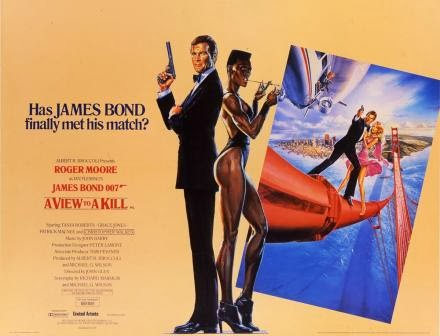
A View to a Kill (1985)

We’ve really had just about enough of Roger Moore around these parts.  From boring to offensively bad, Roger Moore’s tenure as James Bond has really disappointed after the initial promise he showed in Live and Let Die and The Man with the Golden Gun. After seven films and twelve years, A View to a Kill marks Moore’s last outing as 007, and it’s mixed feelings all around.  The film itself isn’t bad, but one gets the feeling that Moore has wasted too much time getting here.

After uncovering something to do with a computer chip, James Bond (Moore) seeks out the chip’s manufacturer, cyber-wunderkind Max Zorin (Christopher Walken).  Bond poses as an equestrian, then a journalist, to uncover the truth about Zorin’s mad scheme.  Along the way Bond is aided by fellow agent Godfrey Tibbett (Patrick Macnee) and heiress Stacey Sutton (Tanya Roberts) and foiled by Zorin’s Amazonian bodyguard May Day (Grace Jones).

A View to a Kill has a poor reputation among the Bond canon, though I don’t think the film is irredeemable.  I’m a fan of films where Bond has to put clues together to uncover a case, and this film plays that up quite well with a number of seemingly disparate plot threads – computer circuitry, illegal horse breeding, Nazi eugenics – that all come together with a satisfying cohesion.  It’s especially fun to see Moore puzzle through the matter with Macnee, the original John Steed, by his side; the two do a neat kind of “Grumpy Old Men” routine that riffs nicely on the shared espionage background between the two.

Having said that, Moore is really just too old to keep doing this sort of thing.  It’s clever when the film attempts to confront it, but once Macnee leaves the plot we’re asked to forget Moore’s age and regard him once more as the spry agent Bond ought to be.  But it’s a brutally unsuccessful move, made all the more apparent by how clearly youthful both Roberts and Jones are.  When Moore’s Bond beds both, it’s like catching a lusty grandfather in bed with a cheerleader; it feels both wrong and uncomfortable.  The other type of physical scenes also flounder due to his age, especially the ones involving complex stunts like another ski jump.  (You were right, Spy Who Loved Me:  nobody does it better.)

Fortunately, the film has an amazing antagonist in Christopher Walken.  Let that sink in:  Christopher Walken is a Bond villain, and it’s everything you’d expect from that sentence.  Walken is at his mid-80s nuttiest here, emphasizing all the wrong syllables and cocking his head at peculiar angles to give his character a fully off-kilter vibe.  Though the film relies on a clue-based structure, there’s no question that Walken, with his albino afro and shifty-eyed glances – is the villain, which allows him to surrender entirely to the character’s hammy quirks.  Best of all, Walken funnels that goofiness into full-blown psychosis; where some Bond villains have trouble toeing that line, Walken makes Zorin both engaging and terrifying, even without that curious subplot where (spoilers?) he’s revealed to be a Nazi test tube baby.

Perhaps even more than Walken’s performance, what helps A View to a Kill is its uncanny and unmistakable resemblance to the franchise’s finest hour – Goldfinger.  The basic plot outline is the same:  mad billionaire with lethal sidekick cooks up scheme to destroy resource and increase his own wealth.  While A View to a Kill never makes the connection explicit, with nary a reference in sight, reappropriating the successful formula carries with it a tried-and-true aspect that isn’t very surprising.  That is, it already worked in Goldfinger, so A View to a Kill doesn’t see a need to reinvent the wheel.  It’s ironic that we saw the same thing happen with Never Say Never Again, which rebranded Thunderball, though View to a Kill takes the remake angle a step further and at least does more than merely change the scenery.

And honestly, after all the missteps we’ve seen in the Roger Moore era, it’s subconsciously refreshing to be reminded of Goldfinger, arguably Connery’s and the franchise’s gold standard.  We’ve been through so much with Moore that I almost forgive the sin of uncreativity because it means we’re moving on to something new and different.  Plus, tell me the idea of Goldfinger starring Christopher Walken isn’t tempting.

A View to a Kill is rated PG.  There are several scenes of implied nudity (bare shoulders and backs), and in one scene a man machine-guns a crowd while another character is killed by an explosive.

Roger Moore may be out, but James Bond and The Cinema King will return in a review of The Living Daylights (1987) on April 7, 2014!

Monday, January 6, 2014

Monday at the Movies - January 6, 2014

Welcome to the first edition of “Monday at the Movies” in 2014.  We’re going into our third year with this feature; can you believe it?

Seven Psychopaths (2012) – In Bruges was a delightful surprise, marketed as a gangster comedy but actually a contemplative take on guilt with a stellar script.  With Seven Psychopaths, Martin McDonagh is at it again with another thoughtful film, though its slow burn might not appeal to everyone.  Colin Farrell stars as a screenwriter suffering from a creative block, while Sam Rockwell and Christopher Walken play dognappers who cross gangster Woody Harrelson by abducting his Shih Tzu.  The marketing bills this movie as a wacky slapstick action comedy, but the result is something much more sincere, a metafictional take on stories and endings.  But along the way, McDonagh doesn’t forget to let his cast have fun; Walken proves himself the king of the stammered non sequitur with many hilarious lines and outbursts, while no one does increasingly unhinged like Sam Rockwell.  I’m inclined to label the movie “smart” because of the way it’s structured, calling back to previous scenes and letting the audience figure certain plot details out without spoonfeeding them, but then there’s a legitimate problem with the film’s female characters.  There aren’t many of them, and all of them either take their clothes off or get killed (or both); the film seems aware of this when Farrell’s character is chastised for the poor quality of the female characters in his screenplay – another moment of clever metafictional play – but I’m not sure that self-awareness lets one off the hook, and indeed it might even exacerbate a problem by calling attention to it without attempting to rectify it.  But compelling if problematic, Seven Psychopaths manages to entertain, which in the final analysis is really all I ask of a film.

Happy New Year!  That does it for this week’s edition of “Monday at the Movies.”  Don’t forget to come back tomorrow for the Double-Oh-Seventh of the month (and boy is it a doozy)!

Monday, February 13, 2012

Monday at the Movies - February 13, 2012

Welcome to Week Seven of “Monday at the Movies.” Only one movie this week, and right in time for Valentine’s Day, to boot!

Wedding Crashers (2005) – I’d forgotten how funny this movie is, partly because I can see retrospectively how much influence this had on the buddy comedy genre in the past seven years. The premise is simple: Owen Wilson and Vince Vaughn play divorce mediators who crash weddings in order to score notches on their bedposts, but their plans go askew after they’re invited to the weekend home of Treasury Secretary Christopher Walken, who very nearly steals the movie altogether. But it’s Vaughn who holds court over the entire film; although Wilson is ostensibly the romantic lead in a love triangle with Rachel McAdams and a cusp-of-fame Bradley Cooper, Vaughn nails every line, eliciting guffaw after belly laugh with memorable lines like “You lock it up!” and “You and I both know I’m a phenomenal dancer.” And unlike most comedies, there are very few parts that drag, with each bit character having a specific trait that lends itself to laughs, like the nutty old grandmother or the uncredited surprise cameo of Chaz Reinhold (which I won’t spoil for the three people in the world who haven’t seen the movie yet). Seven years out, though, it’s impossible not to notice the legacy the film has left – the rapid-fire overlapping dialogue (our generation’s His Girl Friday?), the appearance of a star who’s funny just to look at (Walken), the supporting role chaired by a future leading man (Cooper), the cameo from a comedy superstar (Chaz)... the list goes on. Wedding Crashers is one party you’ll want to be invited to – and then crash – again and again.

That does it for this week’s edition of “Monday at the Movies.” We’ll see you here next week!

Tuesday, July 1, 2008

Hairspray (2007)

At the risk of sounding horribly dull and cliched, remakes are a tricky subject. A lot of people don't like talking about them. To be fair, we've had two great remakes - John Huston's 1941 film noir masterpiece The Maltese Falcon (a remake of two previous adaptations of Dashiell Hammett's eponymous novel) and Scorsese's 2006 Oscar-winning epic The Departed (a remake of Hong Kong mob story Infernal Affairs).

But for every good remake, we get thirty like Gus Van Sant's Psycho or The Ladykillers (from the Coen Bros. slump of the early 2000s) or - God forgive me for even invoking this film's name - Steve Martin's The Pink Panther. And lest we forget, Nic Cage's version of The Wicker Man, unintentionally hysterical with lines like "Step away from the bike!" and "HOW'D IT GET BURNED?!", was a remake of a British suspense/horror film with Christopher Lee (automatically superior by default).

So you can understand why I typically roll my eyes when word of a remake whispers around IMDb - case in point, the pointless Keanu Reeves starring in a pointless remake of The Day The Earth Stood Still. I get even more skeptical when a film purports itself to be a remake of an obscure 80s movie from a midnight movie director with a strong cult following and no possible way of being family friendly.

Then a movie called Hairspray comes along and completely reinvents my concept of what a remake should be. Though technically a second-degree remake (being a filmed version of the Broadway musical based on John Waters's original 1988 film), Adam Shankman's Hairspray is, in my opinion, the third best film of 2007 (landing behind There Will Be Blood and Sweeney Todd: The Demon Barber of Fleet Street).

And, as it turns out, the difference between second and third place is one dud song; where Sweeney had no songs worth fast-forwarding, Hairspray sadly has one right in the middle of the movie. So, since it's a musical and since I fear becoming formulaic, I'll walk through the plot synopsis song by song. "Good Morning Baltimore," a peppy number about the power of dreams and the need to follow them (lest, as Cherry Darling informed us in Planet Terror, "dreams become the thing you talk about instead of the thing you do"), introduces us to pleasantly plump Tracy Turnblad, played to bubbly perfection by newcomer Nikki Blonsky (who seems thus far to have been a one trick pony). Then it's time to meet "The Nicest Kids in Town," the twenty dancers on the Corny Collins Show, a TV dance program hosted by exaggeratedly swanky yet slightly exasperated host Corny Collins (James Marsden). Among the Kids are lead dancer Amber (Brittany Snow, who takes the catty blonde cliche and plays it to the hilt) and top heartthrob Link (Zac Efron, finally getting a chance to spread his wings away from the Mouse).
When Corny announces that Nicest Kid Brenda is taking a leave for "Just nine months," Tracy sees her chance and auditions for the show. But she comes up against Amber's stage-mom matriarch Velma (a delightfully wicked Michelle Pfeiffer), "Miss Baltimore Crabs," who's determined to keep anyone who's different off the show (sensing the message yet?). Later, Tracy's sent to detention, a paradise of dancing and diversity where the races mix and groove - and where Tracy finally meets Link and falls in love. "I Can Hear the Bells" - can you? Finally the "Ladies Choice" gets a song all to himself, giving Efron the opportunity for his vocals to shine and giving Tracy the opportunity to have her dance moves seen.

To the delight of best friend Penny (Amanda Bynes, who [it seems] can actually act!) and Tracy's parents Wilbur (Christopher Walken, a caricature of himself but a lovable one) Edna (John Travolta, who with a Baltimore accent and a LOT of makeup actually passes as slightly feminine), Tracy snags a spot on the Corny Collins Show, to the predicted chagrin of Velma and Amber who both loathe "The New Girl in Town." They also hate Negro Day, Corny's monthly episode featuring African-American dancers and crooners led by Motormouth Maybelle (Queen Latifah) and her son Seaweed (Elijah Kelley, whose talent and resemblance to Sammy Davis Jr. ought to land him a spot in a biopic).

Tracy has hit the big time, even scoring a spokesgirl spot for Mr. Pinky (a marvelous cameo from Jerry Stiller, who played Wilbur in the original movie) during "Welcome to the 60s," in which Edna gets her makeover. In terms of pure fun, it's tough to beat "Run and Tell That," Seaweed's ode to being different. Even Maybelle's "Big, Blonde, and Beautiful" is sweet as chocolate cake, which Maybelle and Edna ingest in mass quantities to make the Coneheads blush. A reprise of "BB&B" features Velma attempting (hysterically fruitlessly) to seduce Wilbur, while Edna gets dolled up for her man, who she catches in an apparently compromising position with Velma. The two women collide, and Edna forces Wilbur to move out.
Wilbur atones with Edna in a catchy duet of romance, "You're Timeless to Me," which couples dated references to the Sixties with slightly insulting professions of love ("You're like a fatal disease, babe / But there's no cure / So let this fever rage"). Then comes the aforementioned dud, "I Know Where I've Been," Maybelle's message of racial integration no matter the price, layered over a march on the racist practices of Velma's station WYZT.

But the best number comes after the protest march, when Tracy is imprisoned in Penny's basement awaiting a trip to "the big house," when Penny is similarly tethered to her bed via jump rope, while Link waits for Tracy to come home, and while Seaweed aims "to rescue the fair maiden" Penny - it's "Without Love," by far the standout song in terms of vocals, lyrics, even direction a la Shankman. The rest would be criminal for me to describe in any detail (even Corny's last number, "Hairspray," is a barrel of fun), but suffice it to say that Tracy succeeds in teaching the whole world that - no matter what repression society places - "You Can't Stop The Beat."

I didn't say much about the perfect casting choices made in this movie, because the real star of the film is the music, including a few new numbers by the songwriting team of Wittman & Shaiman, such as the end credits tune "Come So Far (Got So Far to Go)" which will make you sit through the entire credit sequence, something I hardly ever do. But the cast is perfect, too; from Bynes to Walken, from Snow to Marsden, it's impossible to find someone who isn't spot-on for their specific role. Even Paul Dooley, in a small role as Ultra-Clutch Hairspray's exec, simmers with frustration at "that chubby communist" Tracy. The film is also addicting; it's one of those works that whenever it's on cable I can't resist turning it on just to see where they're at - and then stay until the end.

The dialogue (and occasionally lyrics) is hilarious, allowing the anti-racism medicine to go down with more than a spoonful of sugar. A great deal of the laughs come from the impeccable delivery of campy lines such as "Plastic little spastic" or "I am now a checkerboard chick!" (both delivered by Bynes, a real comedic talent whose roles here and in She's the Man tell me she needs the right vehicle to shine) The problem with Waters's original is the deliberate pandering to an audience seeking camp; as Edna, Divine seemed awkwardly masculine while trying to hard, and the original ending featured a roach bomb in one character's beehive do. This new interpretation of the story is effortless, intentionally yet subtly cheesy without calling attention to itself.

If I had a complaint, it's that two of the stage production's songs, "Mama, I'm a Big Girl Now" and "Cooties," have been cut - the former a foot-stomping temper tantrum shared by Amber, Penny, and Tracy at their overbearing mothers, and the latter serving as Amber's "talent portion" at the Miss Teenage Hairspray Spectactular. Maybe I'm just a Brittany Snow fan (and I have been since her turn as white supremacist Ariel on Nip/Tuck) who wanted to see more of her in the movie, but it seems these two songs might have made up for "I Know Where I've Been" (which really could have been cut). Sure, it'd give the film an almost 2.5 hour runtime, but I'm asking more from Zack Snyder in his Watchmen adaptation. Come on, Shankman; it's not too late to film these scenes and put them in a director's cut! (Versions of the songs appear in the end credits, but they're somehow not as charming without accompanying visuals.)

At one point, Link tells Edna that he was "just at home, practicing my new twist on the twist." All too often, "new twists" don't go over so well; Catwoman, anyone? Thank heavens this movie does so well at polishing a somewhat slipshod original production into a Top Five movie.