Showing posts with label Bradley Cooper. Show all posts

Monday, May 8, 2023

Guardians of the Galaxy, Vol. 3

It wasn’t until very late in the film – midway through the first post-credits scene, in fact – that Guardians of the Galaxy, Vol. 3 finally clicked for me. It is not spoiling very much to mention that a band of characters sits around and listens to Redbone’s “Come and Get Your Love,” mutually agreeing that it is one of the greatest songs in history. It’s an unapologetic lure on the fishing line of nostalgia, made all the more hollow by the fact that many of the aforementioned characters we’ve only just met. (Certainly none of them had been there for Peter Quill’s opening dance number in the first Guardians film.)

While this post-credits scene ostensibly points toward a future for the franchise (including, it pains me to say, one particular inflection that reminded me all too much of the dismal Thor: Love and Thunder), it is also trying desperately to serve as an evocative coda to a trilogy that hasn’t held together as well as its finale would like to pretend. Writer/director James Gunn is juggling too much, straining like Tobey Maguire’s Spider-Man to hold it all together, and while the film is competently told and engaging enough, it is overlong and baggy, and it serves more as a love letter to itself than anything else. 


Vol. 3 finds Rocket Raccoon (Bradley Cooper) wounded in a battle with Adam Warlock (Will Poulter), leading to the revelation, finally, of the horrific circumstances that created Rocket. Peter Quill, the Star-Lord (Chris Pratt), and his ersatz band of Guardians team up with the Ravager Gamora (Zoe Saldaña) to break into the vaults of the High Evolutionary (Chukwudi Iwuji) in search of Rocket’s salvation.


If I’m daydreaming or almost falling asleep, there’s something very wrong with the movie. And while I should have been trying harder to separate the movie from off-screen drama, vast swaths of this bloated movie failed to hold my attention. (It wasn’t, however, as dire as Black Widow, the only Marvel movie where I’m not convinced I didn’t nod off.) And so it was that I found myself wondering how many moviegoers had seen last November’s Guardians of the Galaxy Holiday Special, which already introduced the concept of the Guardians defending Knowhere alongside the revelation that Peter Quill and Mantis (Pom Klementieff) were half-siblings. I wondered if we were still in trilogy territory, and then I remembered that the Guardians trilogy had a significant detour through Infinity War and Avengers: Endgame, which looms quite large over Vol. 3. 


Here, Gunn has to accommodate the time-travel shenanigans that killed off Gamora but restored her from a decade-old past, and Gunn never quite figures out how to fit Gamora back into the franchise. Moreover, the film takes time to air Gunn’s own grievances about the way “his” characters were handled by the Russo Brothers in the third and fourth Avengers films (a complaint no one else shares); in one of my least favorite superhero movie tropes, Star-Lord has a long monologue about the unfortunate and nonsensical circumstances that have led to his current state of affairs. It’s a scene that is meant to play for laughs, but the joke is on the source material and on the fans for taking any of this seriously; in short, it’s another iteration of Gunn’s “comics are for bozos” mentality, and of his bizarre insistence that only he understands these characters. (See also his recent claims that Star-Lord would never have lost his temper in the fight against Thanos.)


Indeed, throughout the film, Gunn is trying to play the hits, his hits, as in the Redbone sequence, but all of it feels simply like thumbing through a scrapbook – which the end credits actually bear out, showing still photos to remind us of the foregoing entries in the franchise. But each echo misses what made the originals special. The first Guardians film was a breath of fresh air in a genre that was beginning to take itself too seriously, and it was a welcome treat to see on-screen interpretations of characters that even comics fans thought too ludicrous for primetime. Even the second film, which hasn’t aged well in my estimations, overly reliant on emotional insincerity and crude humor, still had that Marvel heart when it came to the idea of family. Never mind the iconic soundtrack of the films, mashing up unlikely oldies with shots of spaceships and laser blasts; here, however, none of the songs is really very memorable, and the gag about swapping a Walkman for a Zune seems to have yielded only a paucity of good tunes. (Even the Guardians fanfare gets short shrift in this one.) Here, however, Vol. 3 is an ending that doesn’t have the heart to end, striking a false chord in the final twenty minutes, which consist of (as Neil Gaiman would put it) people standing around saying good-bye to each other.


In the middle of it all, though, is a very compelling performance by Chukwudi Iwuji as one of Marvel’s better villains of late. His High Evolutionary is a far cry from the cosmic source material, but Iwuji’s version is fantastic, entirely unsympathetic and intrinsically evil without needing to twirl a mustache. As great as he is, though, there’s a beat where Star-Lord cuts short his supervillain soliloquy with snarky remarks about why villain monologues don’t work and whether the High Evolutionary’s mother loved him enough. Iwuji barrels on, almost as if he’s sick of these jokes too, and one almost wishes that this spine of the film had been its own Rocket Raccoon feature – inspired by, or perhaps plagiarized from, Grant Morrison and Frank Quitely’s We3 comics about animal experimentation. (Floor the Rabbit is, at least, plundered wholesale from We3’s Pirate.) In fact, Iwuji’s performance is so engaging that one wonders if he shouldn’t replace the beleaguered Jonathan Majors and retroactively enroll the High Evolutionary as one more ageless Kang.


Look, I’m no fan of James Gunn, but I went into this thing with an open mind. I did, after all, love the first one! Vol. 3 is not, thank God, the nightmarish brand of misanthropy we saw in The Suicide Squad – a film that I’m still convinced would like nothing more than to shove me into a locker – and it’s at least effective on an emotionally manipulative level. The action scenes aren’t anything special, and the script is working overtime to resolve too many concurrent plots. But it lacks sufficient grounds for me to be able to say it’s a bad movie; it’s just not as good as it ought to be, nor as good as it hopes, striking an indelicate balance between ridiculing its characters for having emotions and then expecting us to play along when those same emotions are played sincerely.


Vol. 3 is, in short, attempting to eat its cake and have it too, but it’s a cake with a hollow center that tries to convince us that it’s a better, earlier cake. Worse, this particular cake smacks of self-congratulation, yet at the end of the day, I’ve eaten 32 slices (plus whatever the television shows are in this analogy), and I’ve come too far to quit just yet. 


Guardians of the Galaxy, Vol. 3
 is rated PG-13 for “intense sequences of violence and action, strong language, suggestive/drug references and thematic elements.” Written and directed by James Gunn. Based on the Marvel Comics. Starring Chris Pratt, Zoe Saldaña, Dave Bautista, Karen Gillan, Pom Klementieff, Vin Diesel, Bradley Cooper, Chukwudi Iwuji, and Will Poulter.

Tuesday, February 1, 2022

Licorice Pizza (2021)

After a titanic and prestige showing in 2007’s There Will Be Blood, Paul Thomas Anderson has somewhat returned to form – his particular brand of oddball character pieces driven by episodic plot happenings that seem to follow dream logic more than strict realism. In this way, Anderson has become one of the directors in whose brain I’d most like to rent a room, curl up with a blanket, and snuggle in for a few hours. His latest, Licorice Pizza, is precisely one such cozy dream, a meandering fantasia of late-70s Los Angeles that comfortably finds its groove, if not its purpose.

Child actor and high school entrepreneur Gary Valentine (Cooper Hoffman) falls head over heels with Alana Kane (Alana Haim), a photographer’s assistant nearly twice his age. While Gary tries to convince Alana that the age gap doesn’t matter, he embroils her in his myriad schemes, which include selling waterbeds, opening a “pinball palace,” and jump-starting Alana’s own budding Hollywood career. Her showbiz path takes her into the orbit of a gin-soaked legend (Sean Penn) and his director (Tom Waits), mayoral candidate Joel Wachs (Benny Safdie), and blustery film producer Jon Peters (Bradley Cooper).


The plot of Licorice Pizza, such as it is, meanders between the twin itinerant protagonists and their respective trials to find meaning and purpose. While Gary Valentine moves from hustle to hustle, Alana works fame like the gig economy, first modeling then auditioning before moving into politics. This episodic structure makes Licorice Pizza feel a bit plotless, but in the compelling and oddly comforting vibe of other recent Anderson films like The Master and Inherent Vice. Perhaps, if Alana and Gary are not the protagonists of the film, Los Angeles is; not unlike the underrated Shane Black film The Nice Guys, LA is here a place of mystery, but it’s an ineffable, unknowable mystery rather than a mystery to be solved.


Licorice Pizza is not quite a bildungsroman, insofar as its protagonists don’t seem to have changed all that much by the end of the story. But it’s a film more about a journey than a destination; it’s a love story where the love is peculiar, unlikely, and largely unilateral. At 15, Gary is in love with Alana, who finds his romantic fixation amusing but never reciprocates his frequent professions of love, recognizing them for the immature infatuations they are. This is not a story of predators and prey, but rather one of arrested development; despite being 25, Alana is the youngest and least mature of her sisters, with little in the way of career or romantic prospects until she finds both, such as they are, in Gary. It’s to the credit of the performers that this dynamic never feels creepy. Instead, it’s understandable, human, and perhaps even a little sweet, despite being completely impossible and inherently ridiculous.


Indeed, Anderson invents a world without imposing a moral judgment on it, leaving it to the audience to discern that, yes, some of these people are outlandish and absurd. John Michael Higgins, for example, plays a restaurateur fetishizing Japanese culture to the point where the joke is on him, not his Japanese bride(s). Anderson trusts we can figure it out, that the humor is in Higgins’s failure to recognize the irony of his inability to speak Japanese. The others in the film are all in a sense using Alana, projecting their own desires onto her. It’d be spoiling to say what any of those desires are, but never is the tableau clearer than when Bradley Cooper quite literally storms into the picture (leading a woman a few rows behind me to intone, in a momentous whisper, “This is the best part”). As real-life producer and Streisand beau Jon Peters, Cooper is sound and fury signifying only self-aggrandizement, building himself up by threatening the life of a mattress delivery boy while making the world’s most shameless pass at his driver. It’s not hard to imagine that this Peters is the same producer who would famously demand a giant spider in Kevin Smith’s aborted Superman screenplay.


There are moments of genuine pathos in Licorice Pizza, as when Alana learns why her mayoral candidate boss has asked her to dinner, that show Anderson is truly in command of a narrative that seems otherwise wandering. While I’m still not sure anyone can recount the plot of Inherent Vice (thanks in no small part to the deliberate illogic of its author, Thomas Pynchon), Anderson takes the same shambolic narrative anarchy but finds his own kind of odd purpose in it. What Licorice Pizza is “saying” is anyone’s guess, but we can feel what it’s doing, even if we can’t rationalize it. Anderson takes the framework of a Hollywood love story, builds his own chassis around it, and guides the plane in for a landing on a runway that looks like “happily ever after” but might not actually be.


Licorice Pizza is rated R for “language, sexual material and some drug use.” Written and directed by Paul Thomas Anderson. Starring Alana Haim, Cooper Hoffman, Sean Penn, Tom Waits, Bradley Cooper, and Benny Safdie.

Monday, December 17, 2018

The Mule (2018)

At 88 years old, it’s a wonder anyone is calling Clint Eastwood a lazy filmmaker. Despite his notoriety for eschewing multiple takes, Eastwood remains a workhorse, turning out two films this year when his contemporaries are browsing leaflets for retirement homes. The Mule is classic late Eastwood, brisk and deliberate without any pretense of political correctness; one can almost hear Eastwood from behind the camera, growling that any young whippersnappers in hearing range ought to take a look and see how it’s done.

Clint Eastwood stars as workaholic horticulturalist Earl Stone, who’s lost his family after years of throwing himself into his work. Short on cash, Earl finds himself a mule for a drug cartel, shuttling contraband across state lines in his dilapidated pick-up truck. The film is complemented by parallel narratives involving a trio of DEA agents (Bradley Cooper, Michael Peña, and Laurence Fishburne) and the cartel’s decadent leader (Andy Garcia). 

There is something quite methodical about Eastwood’s directing here, an unshowy pacing that doesn’t descend into cliché; there’s little cat-and-mouse in the DEA subplot, for example. It’s a little like Heat if the classic showdown were set in a waffle house – we get there when we get there, with a minimum of glamour. Indeed, if memory serves, the only firearms discharged are on Garcia’s skeet-shooting range. Eastwood is more interested in a character sketch than an octogenarian Sicario, and his cantankerous Earl is very much of a piece with The Mule’s spiritual predecessor Gran Torino.

Gran Torino shares screenwriter Nick Schenk with The Mule, and it shows. Though Earl Stone isn’t as extreme in his prejudice as Walt Kowalski was, Eastwood is unafraid to show him as a sympathetic throwback, someone surprised to meet a lesbian biker gang but more interested in helping repair their engines than in talking down to them. Walt might have thrown a few slurs their way, but Earl greets them cheerily. It seems Earl is more perplexed by texting and the internet than by issues of difference, scratching his head at a generation raised by search engines instead of fathers. As cantankerous yet genial, Eastwood shines, a commanding if doddering heart to the film.

As good as Eastwood is and as well-developed as his character is, I couldn’t help but wish the rest of the movie were as thoroughly fleshed-out. We don’t know very much, for example, about the DEA agents on Earl’s trail. There’s a gesture toward a parallel with Earl about putting work before family, but much of that rings shallow when it’s told but not shown. A throwaway line about Peña’s five children, for one, never materializes into something meaningful because the movie is almost wholly disinterested in anyone else’s interiority. Similarly, the cartel plotline doesn’t land as forcefully as it could because, as even the film’s characters readily admit, it’s hard to tell one drug lord from the next. The only criminal with a semblance of a personality is Garcia as Laton, though I wonder how much of that comes from the page and how much comes from Garcia’s own magnetic, underrated capabilities. 

The Mule is a wholly unique flick, resembling others only tangentially. It’s itinerant in scope and methodical in temperament, quirksome and curious. It can’t be a big-budget blank check, but it’s certainly a creative blank check in that the premise is something so curiously specific that it takes the clout of Clint Eastwood to assemble it in this particular fashion. It’s also a healthy indicator that Eastwood in all his peculiar specificity shows no signs of slowing down, which is for this reviewer a very good thing.

The Mule is rated R for “language throughout and brief sexuality/nudity.” Directed by Clint Eastwood. Written by Nick Schenk. Based on a true story. Starring Clint Eastwood, Bradley Cooper, Taissa Farmiga, Michael Peña, Alison Eastwood, Andy Garcia, Laurence Fishburne, and Dianne Wiest.

Tuesday, May 9, 2017

Guardians of the Galaxy, Vol. 2 (2017)

It’s a bit weird to reflect on the idea that, three years ago, there had been speculation that Guardians of the Galaxy, starring a talking raccoon and a walking tree, might be Marvel’s first box office bomb. In 2017, though, we are Groot; put another way, it’s Star-Lord’s galaxy, and we all just go to the movies in it. As for Vol. 2, it’s a real delight, often more of the same but in a way that feels like qualitatively more.

Having saved the galaxy once before, the Guardians have inflated their prices and their egos to match. In disparate plotlines that coalesce in surprising ways, Star-Lord (Chris Pratt) meets the omnipotent Ego (Kurt Russell), his long-lost father; Gamora (Zoe Saldana) takes up anew her feud with wicked sister Nebula (Karen Gillan); and Rocket and Baby Groot (voices of Bradley Cooper and Vin Diesel, respectively) find themselves caught up in a war between Yondu (Michael Rooker) and his mutinous band of Ravagers. And then there’s Drax (Dave Bautista), the metaphor-less marauder, who’s happy just to slice and dice as needed.

I’ve got a soft critique of the film, though it’s more a bit of a backhanded compliment, and it’s that the film is wearingly funny. And I don’t mean that Vol. 2 ever becomes unfunny, but around the second act I had this surprising and acute desire for the jokes to take a breather and get back to the character work that made the first film such a rousing success. Indeed, a more cynical moviegoer might lament that the film is undercut by the overabundance of jokes, gags, and giggles, and I certainly feel the balance tipped in favor of humor this go-around.

That is not to say, however, that there isn’t really compelling character work being done, although surprisingly it’s the supporting characters that really get developed over the core five. Ego has a pretty engaging story arc, and writer/director James Gunn was right to make the film less about the mystery of Star-Lord’s paternity and more about what he does with that knowledge. If you’d told me that Yondu was going to be the most interesting member of the cast this go-around, I’d have thought it had something to do with the size of his red fin, but Gunn and Rooker did the pleasantly unexpected and gave Yondu a plot arc that goes over the course of the film and also clarifies a few bits about his role as Star-Lord’s erstwhile stepfather.

It’s the main cast that doesn’t quite make the leap from A to B as they did in the first, discovering their capacity for working together and finding a kind of family. Star-Lord grows, sure, but how could he not, where Gamora’s arc mainly consists in convincing other characters of things; Rocket and Groot are the same lovable violent pair, a kind of Rocketcrantz and Grootenstern for the cosmos. It is – and this should come as no surprise – Groot who steals the film wholesale, from his opening performance of ELO’s “Mister Blue Sky” to the perpetual challenges he faces in expressing himself. These characters are, however, fun enough that it’s still a treat to spend two hours with this particular “bunch of a-holes.”

Gunn continues not to play ball with the Marvel Cinematic Universe, eschewing the usual batch of cameo appearances (though Stan Lee appears, naturally, in what might be a kind of game-changer). There’s nary an Infinity Stone in sight, yet as we dash apace toward Infinity War, there’s something refreshing about that; as much as I love the shared universe, there would have been something inorganic about seeing Iron Man or even Thor wander in. Lest we forget, though, Gunn maintains and exacerbates the central rule of Marvel Studios with not one but five post-credits sequences, which suggest that the shared universe will bend toward the cosmic, if only because there’s more nodded toward than can possibly be encompassed in a Vol. 3. And while I can’t say I’ve ever been a big fan of “Cosmic Marvel” – The Silver Surfer is about as far as I go, and Marvel Studios doesn’t own him (yet) – if Gunn is guiding the Guardians, I’m on board.

Guardians of the Galaxy, Vol. 2 is rated PG-13 for “sequences of sci-fi action and violence, language, and brief suggestive content.” Written and directed by James Gunn. Based on the Marvel Comics by Dan Abnett and Andy Lanning. Starring Chris Pratt, Zoe Saldana, Dave Bautista, Vin Diesel, Bradley Cooper, Michael Rooker, Karen Gillan, Pom Klementieff, and Kurt Russell.

Monday, December 28, 2015

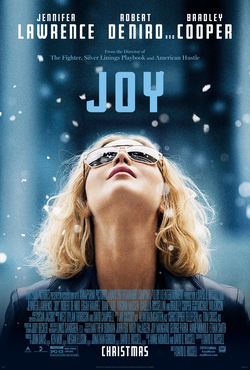
Joy (2015)

Joy rounds out a kind of thematic trilogy for director David O. Russell, but it’s a trilogy unified more by a stable company of performers – chief among them Jennifer Lawrence, Bradley Cooper, and Robert De Niro, with a few other bit players recurring in the mix. Of these, preceded by Silver Linings Playbook and American Hustle, Joy is perhaps the least successful of the lot – not by dint of being an abject failure but by never quite reaching the heights of the other two. Lawrence, however, turns in what might be her best performance yet.

Jennifer Lawrence stars as Joy Mangano, the QVC maven who made her millions with the Miracle Mop, a self-wringing cleaning device borne out of her own frustrations as a single mother living with both her father (Robert De Niro) and her ex-husband (Edgar Ramirez) in the basement. Bradley Cooper has a small supporting role as Neil Walker, the QVC exec who puts Joy’s product into the market.

Joy isn’t going to go down as Russell’s strongest film – I really do think Silver Linings Playbook holds that title – but I do think Lawrence has done her best work as a member of the Russell company, and I would put very real money on her seeing a third Best Actress nomination at the top of next year. As the eponymous Joy, Lawrence is riveting, from her beleaguered moments in the home to her natural charisma before the QVC camera. The film tasks Joy with representing the struggles faced by all women, and Lawrence is more than capable of bearing that weight.

That universality is one of the peculiarities of the film because I can’t help feeling that it would have been more successful had it adhered more strictly to the unique aspects of Joy’s story rather than an attempt to make her “every woman.” For one, I think the QVC sequences are among the best in the film, and I would have preferred this to be more than a small subplot. Russell has an eye for the innate strangeness of the QVC network, and a fuller treatment of that material (including the wonderfully strange cameo of Melissa Rivers as her mother Joan) would have been truly engaging – to say nothing of the chemistry that Lawrence and Cooper clearly have. Honestly, that’s the movie I thought we were getting, but sadly it’s unlikely we’ll see a Joy 2 that fleshes out that relationship in greater depth.

The movie keeps its eye tightly focused on Joy, often to the detriment of the other performers. It’s not that De Niro or Cooper are any less captivating than they usually are – De Niro is scene-stealing, particularly in an early tantrum about his ex-wife’s similarities with a gas leak – it’s more that there is just less of them to captivate. On reflection, it seems the largest supporting role belongs to Isabella Rossellini as Trudy, Joy’s principal investor and commercial mentor of sorts whose idiosyncratic approach to vetting entrepreneurs lends the film one of its greatest moments of empowerment. These moments provide glimpses of the A+ work that Joy might have aspired to be, had it taken off its Lawrence-shaped blinders.

Rotten Tomatoes has the self-congratulatory pun that the film “only sporadically sparks bursts of the titular emotion.” This joke misses the point of the film, because if you wanted a movie about joy you’ll have to check out Pixar’s summer offering Inside Out. This is instead a film about Joy, whose story is told reasonably well here, though the audience rightfully detects that Russell is capable of a fuller film than this. It’s perfectly serviceable, but transcendence belongs to the earlier films in this unofficial trilogy.

Joy is rated PG-13 for “brief strong language.” As might be expected, De Niro gets one F-bomb.

Monday, March 23, 2015

American Sniper (2014)

I’m not sure why it was that American Sniper was quietly snubbed at the Oscars; despite several nominations, the film made barely a splash, and it seemed people were more interested in the (admittedly amateurish) fake baby than the frankly stellar performance by Bradley Cooper.  While I’m not saying he deserved the award more than Eddie Redmayne (or, for that matter, Michael Keaton), Cooper’s work here deserves another look, especially since the film seems to have been pigeonholed by what potential viewers likely assumed were the politics of the film.

Cooper stars as Chris Kyle in this biopic of the Navy Seal sniper who is credited with the greatest number of kills as a marksman during his service in Iraq.  Sienna Miller costars as his wife Taya, who finds it difficult to keep her family together while her husband is on and off the battlefield.

I think one reason American Sniper made little more than a ripple is because audiences expected (and some critics reported – wrongly, I might add) that the film was only a rah-rah patriotic exercise with little attention to the consequences of a military career.  To which I would say, the movie you’re probably thinking of is Lone Survivor, not this one.  Clint Eastwood has been largely brushed off by many for his conservative politics and/or his abrasive curmudgeonly attitude, but American Sniper never feels like a commercial for the military in the way that Peter Berg’s earlier film toed that same line.

No, this is something much closer to The Hurt Locker, that brilliant Oscar winner from a few years back in which Kathryn Bigelow gave us both a thriller of a war film and a very sober examination of the human psyche under such conditions.  American Sniper is comparable (though a little longer) in that it devotes about as much time to Kyle’s military experiences as to the pained moments where he’s unable to let go of the battlefield and readjust to civilian life.  What American Sniper adds to the narrative of The Hurt Locker is the sense that the country had, ultimately, failed Kyle by not helping him reassimilate.  It’s a smart humanizing move that Eastwood makes, particularly as it anticipates the claim (made by those who haven’t seen the movie) that the film essentially celebrates a murderer – Eastwood rejects that out of hand by showing the dire situation overseas, the pain through which Kyle was wrung, and his true heroism at film’s end (spoilers?) when he attains a kind of healing.

Cooper is frankly astonishing as Kyle, and in any other year I would have been rooting for him to win.  Let’s not forget that Cooper got his big break on Alias, ABC’s spy drama by way of Keri Russell’s Felicity; to see him here and in Silver Linings Playbook, doing amazing work with comedy and drama, is a career to be celebrated.  I wouldn’t go so far as to call this a disappearance into a role, but it is unequivocally a commendable transformation, particularly in his ability to emote beyond his physicality, refusing to let his bulk do the acting for him.  Eastwood is a star director of the action sequences, but it’s Cooper’s quieter moments that truly define the film and almost overshadow the film as a whole.

On the note of performances, I’d actually written off Sienna Miller about the time she did GI Joe – pretty face, Jude Law’s ex, never memorable in the one or two things I’d seen of hers before.  After American Sniper, though, I’d put her in the “one to watch” category, provided that she gets a good director.  I’m sure Eastwood is a stern hand at the till when it comes to directing, but kudos to Miller for stepping up her game and bringing in a very moving turn as the other side of this very human struggle to recover.

I don’t think American Sniper got the attention it deserved, for a number of reasons.  All of those reasons, however, are largely immaterial, more a discredit to the closed minds of the prospective audience than to the film itself.  What you have here are three very talented creative forces coming together for a film that is, if not outright moving, very intelligent about its subject matter in a way that I hope puts Eastwood back on the map as a director and keeps Cooper in the spotlight where he can do more first-rate work.

American Sniper is rated R for “strong and disturbing war violence, and language throughout including some sexual references.” Many of the combat scenes are very intense and bloody, in addition to being suspenseful and loud. The film is rather unflinching in the brutality and the immediacy of violent combat.  F-bombs proliferate, as does the typical kind of chauvinistic dialogue you’d expect in aggressive male camaraderie.

Monday, August 4, 2014

Guardians of the Galaxy (2014)

By now, we’re all familiar with the Marvel formula and its somewhat unique brand of adapting comic book properties into blockbuster fun.  Guardians of the Galaxy reads almost like a challenge to themselves – can the Marvel method work on characters the mainstream audience has almost certainly never heard of?  It worked at the beginning with Iron Man, and as we approach the second Avengers film, Guardians proves that Marvel is unstoppable, taking everything that worked about their earth-bound adventures and applying that to space.

Intergalactic outlaw Peter Quill (Chris Pratt) wants to live up to his self-applied moniker of Star-Lord, but what he gets instead is a bounty on his head, pursued by Rocket Raccoon (Bradley Cooper) and Groot (Vin Diesel), a machine-gun-toting raccoon and his talking tree partner.  After the trio is arrested, they align themselves with fellow inmates Gamora (Zoe Saldana) and Drax (Dave Bautista) to escape prison before preventing a mad warlord (Lee Pace, as Ronan the Accuser) from destroying the galaxy.

Has anyone called Harrison Ford to congratulate him on the buckets of money that Guardians has made thus far?  I ask this because Guardians feels like the love child of Star Wars and Indiana Jones, very heavily inflected by the cavalier confidence of Ford’s characterization of Han Solo and Indiana Jones.  It’s especially evident during the opening credits sequence, in which Peter Quill steals a precious artifact from a temple, only to incur the wrath of its protectors.  (The film’s conclusion, with one scene set in the Nova Corps vault, seems to echo Raiders as well.)  Indeed, from the start, there is question of who Peter’s father is, and I wonder – now that Disney owns Lucasfilm as well – if Han Solo might be up for paternity.

That aside, on its own merits, Guardians is enthusiastically engaging, taking the “band of misfits” conceit and injecting it into the space opera genre in a way that seems effortless.  Comics devotees will be amazed at the breadth of concepts introduced to the Marvel Cinematic Universe – the Celestials, the Nova Corps, the Kree – and for those who don’t know what those words mean, fear not, because Guardians delivers them with a deft expositional hand.  In short, Guardians works better than one might suspect because it immerses you in the fantastical world(s), explains quickly and capably what you need to know, and leaves you to wonder in slack-jawed awe at the rest. 

What Guardians does best, though, is characterization, especially through humor.  The movie is uproariously funny, even in places you might not expect.  All of it serves to give us characters that are astonishingly well-crafted, a double blessing for those of us who know next to nothing about them.  But where most of the characters’ personalities emerge through humor, as when we discover that Drax is incapable of understanding metaphor, director and co-writer James Gunn is careful to balance these gags with genuine moments where we sympathize with the characters.  Take for example the moment when a drunken Rocket Raccoon declares how he really feels about being the only one of his kind; it’s a surprisingly moving moment in the middle of a film where you wouldn’t expect it.  As fun as Thor: The Dark World was, I don’t remember feeling touched by it.

As much as the film links up to the broader Marvel Cinematic Universe, with its talk of Thanos (played well in a cameo by Josh Brolin, who is perfect in the part) and the Infinity Stones, I’m glad to hear that there’s already a sequel in the works, helmed once more by Gunn.  I’m glad, because here is a film that does many unexpected and wonderful things, a film which establishes its own identity without relying on anything more than the “Marvel” brand name.  The rumored appearance by Robert Downey Jr. does not occur, nor should it, because Guardians deserves to be its own thing before it lines up with The Avengers (as it inevitably will).  As fun as it would be to see Iron Man walk on screen, it might take the audience out of the mesmeric spectacle Gunn & Co. have crafted.  Come for the CGI walking talking foliage; stay for the heart and wit of a fresh direction and voice in the Marvel Cinematic Universe.

Guardians of the Galaxy is rated PG-13 for “intense sequences of sci-fi violence and action, and for some language.”  Honestly, the action in it is roughly equivalent to most of the Star Wars films, with laser guns and explosions more than visceral gore; some bodies are pierced or thrown around, but even in one shot where a body is seriously maimed, it’s more limbs akimbo than bloody geysers.  There are a few defecatory profanities, one middle finger, and the occasional insult; overall, the grit is tempered by the wit.

We’re at ten Marvel Cinematic Universe movies, which sounds suspiciously like something ripe for organizing in ascending order of approval... could something like that be in your future?  Check back with us at the “Top” of next week to find out, and don’t forget that Thursday is the Double-Oh-Seventh of the month!

Monday, December 23, 2013

American Hustle (2013)

Last year David O. Russell snuck in at the tail end of the calendar with Silver Linings Playbook, a romantic comedy that reinstilled my belief in the genre; two years earlier, he’d caught my eye with The Fighter.  And with American Hustle, Russell takes the things that worked best in those movies – namely the remarkable acting talent on display – and mashes them together for a thoroughly enjoyable Oscar contender.

Based loosely on a true story – “Some of this actually happened,” an opening title card boasts – American Hustle gives us con artist Irving Rosenfeld (Christian Bale in another total body transformation) and his lover/partner Sydney “Edith” Prosser (Amy Adams) as they are forced into a federal corruption investigation led by FBI Agent Richie DiMaso (Bradley Cooper).  As the investigation bears unexpected fruit with Camden Mayor Carmine Polito (Jeremy Renner) in the crosshairs, Irving’s reckless wife Rosalyn (Jennifer Lawrence) puts her husband in jeopardy while trying to keep her marriage safe.

I almost don’t need to say much about the cast; they’re all exceptionally solid choices, the best performers from Russell’s two previous films under one roof.  As the lead (and hopefully a Best Actor candidate), Bale is almost unrecognizable were it not for his remarkable talent, and Adams demonstrates herself a perfect foil for him, continuing to break out of that “too cute for words” mode into which she might have been typecast after Enchanted.  Renner and Cooper are reliably compelling, and Lawrence continues to hold onto that “most talented young actress” title with a powerhouse performance as the spirited Rosalyn.  All handle the naturalistic dialogue very well, with improvisational quirks and touches that give the film a lived-in feel.  We come to know these people very well, thanks to the life given by the cast.

Even better than these five thrown into the same pot – plus all the supporting roles, including Louis CK as Cooper’s boss and a delightful uncredited cameo by a real legend – is the sum of the parts.  American Hustle is at once blissfully engaging and wildly unpredictable.  I don’t want to say it’s something we’ve never seen before; indeed, for many reasons it feels very much like an update on Scorsese’s Goodfellas.  But American Hustle manages to feel quite fresh, playing fast and loose with the historical facts (happily for those who know the story and those who don’t) in order to create an elaborately twisty narrative that takes its characters in surprising and entertaining directions.

All the while, Russell keeps us guessing by refusing to spoonfeed us character motivation, even with the presence of voiceover narration.  Rather than spell out plot beats and character traits, the voiceover instead fills us in on the personalities of the characters and, more importantly, the moments when we know they’re lying to themselves.  The narrative of the film is highly concerned with questions of honesty and deception, and Russell wisely plays about in it without handing us easy moral judgments.  The number of double- and triple-crosses are quite successful on an aesthetic level and satisfying on an interpretive one because we’re never expecting them.  Of course, in a movie about deception, we’ll have characters deceiving each other, but Russell manages to avoid the clichéd “gotcha” beats and instead continually sucker-punches the audience with another new twist introduced with graceful subtlety (as when we learn a key character actually can speak Arabic or when Rosalyn lets slip once or twice).

American Hustle is a movie that will leave its audience reeling, first from the sheer volume of thespianic talent on display and then from the intricate and enthralling plot structure which Russell uses to say insightful things about the problem of honesty and self-deceit.  The original title of the film was American Bulls—t, a title which would have been deliciously ironic – there’s no worse comparison to make with this film than a comparison to excrement.  American Hustle is the exact opposite – delightfully fun, solid gold.

American Hustle is rated R “for pervasive language, some sexual content and brief violence.”  The characters use the F-word quite a lot, a few adulterous affairs occur on-screen (with maybe a possible flicker of female nudity in one), and there’s a death-by-gunshot and a few minor fistfights.  Aside from the language, this one is really close to a PG-13.

Monday, May 27, 2013

The Hangover Part III

When director Todd Phillips unleashed The Hangover, he really let the dogs out in one of the funniest movies of the last five years.  The sequel wasn’t an entire dud, keeping enough of what worked while choosing to recycle most of the plot of the first movie without much vigor.  For Part III, we’re promised an end to the trilogy, an end that’s more Godfather III than Dark Knight Rises.

There’s no wedding, no bachelor party, not even a morning-after hangover – just an intervention for man-child Alan (Zach Galifianakis) after an unfortunate incident involving a giraffe.  En route to rehab, Phil (Bradley Cooper), Stu (Ed Helms), and Alan are abducted by mad mafioso Marshall (John Goodman), who’s got a beef with Leslie Chow (Ken Jeong).  Tasked with finding Chow, the Wolfpack goes on the hunt.

The Hangover Part III is not a terrible movie by any stretch of the imagination, but it’s far from the resounding success of the first film.  Mercifully, Phillips doesn’t retread over the what-just-happened plot of the first two, and it’s to his credit that he attempts something new.  But in his verve for a creative closer, he left a handful of laughs somewhere along the trail, and Part III just isn’t as funny as its predecessors.  There are a few great moments, mostly due to some stellar line readings, and a moment or two of physical comedy, but overall Part III doesn’t hit the high bar on humor.  It’s not that it’s subtler; it’s just more restrained and perhaps even a bit more contemplative as the franchise winds down. 

The good news is that everyone still turns in consistently good work.  Galifianakis, the undisputed breakout star of the first film, is suitably kooky and not suited for the real world, an awkward bundle of issues that should have been worked out in kindergarten.  Cooper and Helms are still able straight men, though Helms gets more to do with his deft dry heaves, hilarious as ever.  And newcomers Goodman and Melissa McCarthy (as a pawn shop proprietor and amour pour Alan) fit in perfectly, exuberantly over the top with their collaborators; it’s a shame that they’re practically cameos, since their reliably solid work comprises much of the real treats the film has to offer.

Then we get to the bad news.  Aside from missing the consistent roaring-in-the-aisles laughter of the first film, The Hangover Part III makes the unpardonable mistake of giving us way too damn much Leslie Chow.  I don’t know who decided Ken Jeong has ever been funny, but I wasn’t invited to that meeting and indeed would have voted against it.  Chow was unquestionably the worst bit about the first Hangover, but there his presence was minimized; his expanded role in Part II was one of that film’s worst excesses.  Here, it’s worse; it’s everywhere.  It’s uninspired, hammy, amateurishly caricatured, and a little bit offensive – but the worst problem about Mr. Chow is that he’s just not funny.  And in a comedy movie, that’s a deadly sin.

But if Part III is like The Godfather Part III, Chow is unquestionably the Sofia Coppola of the flick.  But like Godfather III, Hangover III is as good a note as any to end the trilogy – not overstaying its welcome, conscious of its own finality, and without the need to suggest further installments.  The Hangover franchise has, I believe, fully run its course, and it’s better to end on a passable note than by overstaying its welcome. 

The Hangover Part III is rated R for “pervasive language including sexual references, some violence and drug content, and brief graphic nudity.”  The dialogue is pretty crude, unapologetically talking about orifices and objects of entry; there are a few firearm casualties and several discussions of drugging people.  As for the nudity, it’s prosthetic and restricted to the mid-credits scene (which maybe you don’t want to miss).

Monday, March 11, 2013

Silver Linings Playbook (2012)

Academy Award winner Silver Linings Playbook makes this year’s list of “movies I got to because of the Oscars,” and it demonstrates a few important lessons to be learned going into 2013:  the romantic comedy as a genre isn’t as dead as I thought, Jennifer Lawrence is one of the most versatile actresses around, and Robert De Niro can still act his way through a movie without phoning it in.

Bradley Cooper stars as bipolar Pat, recently released from a psychiatric hospital after a messy separation with his wife.  While trying to reconnect with her in spite of a restraining order, Pat meets troubled widow Tiffany (Jennifer Lawrence), and the two strike up an unlikely friendship as they attempt to help each other through their problems.  Tiffany promises to help Pat reunite with his wife if Pat helps her win a dancing competition – and, incidentally, help his Eagles fan father (De Niro) win a bet in the process.

After The Fighter, this seems like a step away from what I’d come to expect from David O. Russell; the romantic comedy genre is a bit far from the heady biopic which finally won Christian Bale that Oscar.  But thank heavens that a fresher voice like Russell’s comes to a genre which has been otherwise formulaic, uninspiring, and often predictably pathetic, matching improbability with impotent self-importance.  The romantic comedy is a genre I’d long since written off, the clichés riddling it like so many bullets at the St. Valentine’s Day Massacre; give me Hepburn and Tracy any day of the week.  But Russell does something different here, creating something that still plays by the boy-meets-girl rules of the genre but without toadying to them.

While we’re on the subject of romantic comedies, thank goodness also that Russell didn’t cast someone like Katherine Heigl here.  Instead he’s gone with Lawrence, who is past shaping up to be one of the best actresses of her generation – she’s already there.  Lawrence is in that rare position of someone who does great genre work (see also X-Men: First Class and The Hunger Games) while knocking it out of the park with heavier stuff like this and Winter’s Bone (though the latter wasn’t really my bag).  Indeed, Silver Linings Playbook is not a perfect movie; the film stumbles between whether Pat’s devotion to his wife is endearing or delusional.  As such, the movie really takes off once Tiffany enters the picture; Lawrence imbues this potentially confusing character with an honest and unapologetic realism.  Where we’re not sure what to make of Pat, Tiffany isn’t transparent so much as she’s accessible and relatable; Lawrence is such a deft craftswoman that the character’s steely exterior doesn’t obscure the truth of her character.

The other cast members are quite good; Cooper is solid as ever, and Chris Tucker pops in to help you forget about the lackluster Rush Hour trilogy with an engaging supporting role as Pat’s confidant.  But the real surprise in the cast is that De Niro, after a long stint of roles alternating between uninspiring (Limitless and all those Fockers) and scenery-gobbling (Stardust and Machete), reminds us why he’s a great actor.  As Pat’s father, who’s sifting through his own issues while stepping on eggshells around his son, De Niro enters the pantheon of “movie dads you wouldn’t object to having.”  He never quite acts out of his own ethos, since you’ll always be thinking of him as De Niro first and Dad second, but he’s able to handle the extremes of his character with aplomb.  When he begins to weep over his son’s condition, it’s difficult not to be moved with him, but when he makes a key decision about betting on the dance competition he’s back to the same stammering repetition that elicited so many grins in Goodfellas.

All told, I’m still a bit surprised that Silver Linings Playbook got as much Oscar love as it did.  It’s not that the film is bad by any stretch of the imagination; no, once it gets going it’s quite enjoyable.  But it seems so far removed from the stalwart significance of the rest of the crop, like Argo, Django Unchained, and Zero Dark Thirty.  But perhaps if the film restores our confidence in the romantic comedy genre it also reminds us that sometimes the Oscars get it right; there’s enough good work being done here that I would have been complaining – especially had Jennifer Lawrence not taken home that trophy.

Silver Linings Playbook is rated R “for language and some sexual content/nudity.”  The F-word is used liberally (IMDB says 70+ times), and Pat is prone to erratic violent outbursts.  We see a woman nude from behind in a brief blurry flashback, while Tiffany and others speak about her promiscuous past.

Monday, February 13, 2012

Monday at the Movies - February 13, 2012

Welcome to Week Seven of “Monday at the Movies.” Only one movie this week, and right in time for Valentine’s Day, to boot!

Wedding Crashers (2005) – I’d forgotten how funny this movie is, partly because I can see retrospectively how much influence this had on the buddy comedy genre in the past seven years. The premise is simple: Owen Wilson and Vince Vaughn play divorce mediators who crash weddings in order to score notches on their bedposts, but their plans go askew after they’re invited to the weekend home of Treasury Secretary Christopher Walken, who very nearly steals the movie altogether. But it’s Vaughn who holds court over the entire film; although Wilson is ostensibly the romantic lead in a love triangle with Rachel McAdams and a cusp-of-fame Bradley Cooper, Vaughn nails every line, eliciting guffaw after belly laugh with memorable lines like “You lock it up!” and “You and I both know I’m a phenomenal dancer.” And unlike most comedies, there are very few parts that drag, with each bit character having a specific trait that lends itself to laughs, like the nutty old grandmother or the uncredited surprise cameo of Chaz Reinhold (which I won’t spoil for the three people in the world who haven’t seen the movie yet). Seven years out, though, it’s impossible not to notice the legacy the film has left – the rapid-fire overlapping dialogue (our generation’s His Girl Friday?), the appearance of a star who’s funny just to look at (Walken), the supporting role chaired by a future leading man (Cooper), the cameo from a comedy superstar (Chaz)... the list goes on. Wedding Crashers is one party you’ll want to be invited to – and then crash – again and again.

That does it for this week’s edition of “Monday at the Movies.” We’ll see you here next week!

Monday, June 14, 2010

The A-Team (2010)

Even though I have never watched a single episode of the television show on which it's based, I knew I wanted to see The A-Team once I saw the trailer, in which Bradley Cooper fires the machine gun turret on a tank as it plummets in midair. And the good news is that the movie is filled with moments like that, unapologetically and gleefully screaming "Summer popcorn movie!"

Liam Neeson stars as Hannibal Smith, leader of an alpha unit - or A-team - that's regarded as the best covert ops team in the armed forces. Cooper plays Face, the beauty to Hannibal's brains, every bit the ladies' man; Quinton Jackson plays B.A., the warrior/pacifist role made popular by (or which popularized, if you want to go chicken-v.-egg) Mr. T; and Sharlto Copley, late of District 9, plays the borderline-cuckoo pilot Murdock. After a mission in Iraq goes awry and with the aid of the CIA's secretive Mr. Lynch (Patrick Wilson), the A-team turns fugitive in an attempt to recover a stolen MacGuffin while creatively evading recapture at the hands of Face's former flame Charisa Sosa (Jessica Biel).

In terms of action, director Joe Carnahan gets points for imagination with his management of some of the most inventive action sequences on screen in recent years. In truth, the action is the real star of the movie: character development is negligible (though it exists, in small doses) and plot twists are present (though you'll probably see most of them coming), but it's the visuals that will make your eyes pop. If you've ever wanted to see a flying tank or a man parachute into a moving helicopter, this is the summer picture for you.

As for the acting, it fits well into the "action film" stock tropes, but the fact that the cast is made up of very talented people brings this film in above the level of "cliche." Though he's not quite as good as in Taken (review coming soon) or Love Actually, Neeson is endearing as always, showing off his sense of humor and ennabling us to have as much fun as he is; Cooper too is just as fun, having made a satisfying transformation from the slightly irritating Will Tippin on Alias to the genial star of gutbusters like The Hangover. Jackson and Copley are supporting characters in the classic tradition, not overbearing but still entertaining; my one gripe (aside from the broad strokes with which B.A. is painted, which I imagine is faithful to the spirit of the show) is that Copley's thick South African dialect slips through in a few moments, distracting from his otherwise jolly turn. And Wilson and Biel are just fine in their roles; Wilson is the stronger of the two, stepping solidly out of the schleppy shoes he normally fills for this slick and cagey part, while Biel's acting chops are overshadowed by how pretty she is (which is really the only requirement given to female co-leads in an action movie - attractiveness).

So if there's a word that encapsulates my take on The A-Team, it's "fun." It may not be credible or particularly layered, but The A-Team is a lot of fun. And that, first and foremost, is all I ask of a movie - that it be entertaining, that I feel satisfied on a gut level if not on a creative level. Fortunately, what this movie lacks in narrative imagination, it makes up for in how far it pushes the envelope of originality. There are numerous moments in the film that caused me to think to myself, "I've never seen that before," and that alone is worth the price of admission. If the action sequences were more conventional, in the vein of Michael Bay explosion-centric CGI-fests, perhaps this would only be a so-so movie. But what might have been an average action vehicle has a backbone which makes it stand up straight and be better than it ought to have been. This, in a way, is what The Losers should have been.

The A-Team isn't one of the greatest films of all time - nor does it pretend to be. What it is- and what it is successfully - is a bona fide popcorn flick that doesn't shortchange the audience on pure
visceral entertainment.

Like all good summer popcorn blockbusters, The A-Team is rated PG-13, this time "for intense sequences of action and violence throughout, language and smoking." Basically, stuff blows up, people get shot, mild profanity (no F-bombs) gets issued, and Liam Neeson smokes a cigar.

Tuesday, May 11, 2010

New York, I Love You (2009)

It seems that the older I get, the shorter my attention span becomes. Maybe I'm just a jaded filmgoer, maybe today's flicks have run out of pizzazz, or maybe I'm being overdramatic about the whole getting-bored-quickly thing.

At any rate, the beauty of an anthology film is that you only have to invest about ten minutes in any given story. New York, I Love You represents the second in what is apparently a franchise devoted to vignettes about love in important world cities. I was initially only aware of the first "Cities of Love" film, Paris je t'aime (which really ought to be reviewed herein), a film near and dear to the romantic in me.

Before I go any further, I should preface this review by noting that by definition an anthology of any kind is naturally going to be hit or miss. Even Paris je t'aime has a few duds in the bunch. But unfortunately New York, I Love You is primarily a batch of misses with only a few hits. In honor of the anthology format, I'm going to shake things up and review each short separately and then think globally, with the caveat that New York is much more fluid, with its untitled segments intersecting and mingling much more than in Paris.

Director Jiang Wen has the first segment, which stars Hayden Christensen as a thief who picks Andy Garcia's pocket. After being smitten by passer-by Rachel Bilson, Christensen finds out that his quick con on Garcia isn't as easy as it looks. This vignette starts off as a cliche, and the fact that Christensen can't really act doesn't help. But when Garcia and Christensen share the screen, there's something better afoot, with each trying to one-up the other in a game of wills.

Mira Nair directs a more romantic tale about two salespeople (Natalie Portman and Irrfan Khan) married to other people but who fall in love with each other regardless. This segment is unfulfilling, carried by solid acting but lacking any dramatic resolution beyond a clever use of visual language which suggests that these two will always love each other.

Shunji Iwai gets one of the most romantic parts of the film when he brings musician Orlando Bloom together with receptionist Christina Ricci by using Dostoevsky. Props on that one and on creating an ending to their story which feels neither forced nor hackneyed.

Yvan Attal directs two segments, both of which are marked by narrative twists and compelling dialogue which conceals something important beneath the surface. Both are set outside restaurants with their characters on smoke breaks; in the first of these, Ethan Hawke propositions Maggie Q about the inevitability of their romance based on one chance encounter, while in the second Robin Wright Penn plays a jilted wife looking for a change when she meets Chris Cooper and propositions him. The parallel is less pronounced than it seems.

Brett Ratner's segment is my absolute favorite in the film and really the only portion I'd consider rewatching at least once. After breaking up with Blake Lively, Anton Yelchin (one of my new favorites after Charlie Bartlett) agrees to take pharmacist James Caan's daughter to the prom. There's one catch - the daughter (Olivia Thirlby) is in a wheelchair. Don't be fooled; whimsy ensues, and Yelchin's big wish comes true. This one has a fabulous twist; if you only watch one segment, watch this one.

After appearing in a few interstitials, Bradley Cooper co-stars with Drea de Matteo in Allen Hughes's narrator-heavy story about a regrettable one-night stand. This segment flops because it doesn't quite go anywhere, and the ending is abrupt and inconsistent with all but the title of the film.

In the most puzzling segment in the film, Shekhar Kapur directs Anthony Minghella's screenplay about an opera singer (Julie Christie) who returns to a hotel in New York and has separate encounters with two bellhops (John Hurt and Shia LeBeouf). If anyone can make heads or tails of this segment, please let me know what you've decided, as I can't wrap my head around it.

Natalie Portman steps behind the camera to direct a segment about a father's (Carlos Acosta) day in the park with his daughter (Taylor Geare). This segment is cute and fluffy but ultimately forgettable. Portman does a fine job writing and directing it, to the extent that I'd be curious what she can do with longer material.

Fatih Akin directs an empty segment about a painter (Ugur Yucel) who falls for Chinese herbalist Shu Qi and then dies. Burt Young peeks his head in as Yucel's landlord. Huh? That's about all this segment amounts to.

Joshua Marston writes/directs the final full segment, in which Eli Wallach and Cloris Leachman celebrate their 63rd anniversary. The dialogue in this segment is well-played and flows at a leisurely pace, but if you're looking for a conventional narrative you won't find it here. This segment feels very personal and personable, and it's a comfortable way to close the film.

Throughout, Randy Balsmeyer gives transition scenes which feature various characters entering taxicabs together; Emilie Ohana plays a videographer whose role in the film seems only to be to unite the characters. One interstitial in particular, though, is memorable, with Eva Amurri and Justin Bartha quarreling about how they never vacation together.

The DVD includes two deleted vignettes, one of them directed by Scarlett Johannson and starring Kevin Bacon as a New Yorker with a bad case of wanderlust. These deleted scenes, though, have rightfully been omitted, as they are entirely lifeless and protracted. Perhaps Ms. Johannson should stay in front of the camera looking pretty, which she's very good at doing if Iron Man 2 is any indication.

Taken separately, there is a fair amount to like about New York, I Love You, but taken together as a 103 minute film there is a lot of disappointment. The choice to more deliberately blend vignettes - Drea de Matteo visits James Caan's pharmacy, and Chris Cooper meets Maggie Q at a dry cleaner's - makes the film difficult to follow in points; it is often unclear where one story ends and another begins. This trademark of the first film is evident only in the film's most successful segments - Iwai's and especially Ratner's. On the whole, though, Ratner's segment is the only standout feature in an otherwise disappointing follow-up to Paris je t'aime.
New York, I Love You is rated "R for language and sexual content." This being a movie about New York, F-bombs pepper the dialogue; this being a movie about love, sex comes up in conversation and is depicted twice without any nudity to speak of.

Tuesday, June 9, 2009

The Hangover (2009)

The Hangover isn't a terribly bright comedy, but it's laugh-out-loud in a "my cheeks hurt" kind of way, something I haven't really had since Nick and Norah's Infinite Playlist.


With their best bud Doug (Justin Bartha, Riley from the National Treasure flicks [also known as the last watchable Nic Cage movies]) getting married, Phil, Stu, and Alan (Bradley Cooper, Ed "Andy Bernard" Helms, and Zach Galifianakis) decide to host the bachelor party to end all celebrations of singlehood. It's the party they never want to forget, but the next morning it becomes clear that this was the party that they can't remember: furniture is smoldering, there's a tiger in the bathtub, a baby wails in a closet, and Doug is missing. What follows is a quest to find their friend - and their memories.


Part of the magic of the film is the almost impossibly complicated shenanigans the hungover experience, and so it'd be ruining the fun if I told you any of what they discover they got into over the course of the night/morning. So, let a few generalizations suffice:

I wasn't prepared to laugh as much as I did at this movie. Perhaps the phenomenon I'm ready to call "Nick and Norah syndrome" is at fault here - it is, of course, easier to laugh at a film when watching it with multiple people. (The same thing happened with Anchorman for me, as well, a film I thought was stupid until I watched it with other people -- and fell in love.) But I was constantly laughing, smiling, or slapping my forehead during the entire movie. Like I said, my cheeks hurt; I clearly enjoyed myself.


Smart comedy? Certainly not - though none of the official Frat Pack members show up in this movie, this one might as well belong in the canon. (In fact, between this and Wedding Crashers, Bradley Cooper might as well be an honorary Frat Packer.) The Hangover is riddled with the kind of humor I've come to expect: people under the influence losing their inhibitions, profuse amounts of randomized vomiting, people ramming their heads into car doors and other objects, as well as pretty prose peppered with profanities. That, a baby in sunglasses, and the funniest photos-over-credits montage I've seen in a long while (replete with Wayne Newton cameo).


The cast is magical in their roles, especially frontmen Cooper, Helms, and Galafianakis. Heather Graham is charming but relatively one-dimensional as the Vegas wife of the gents, and there's a delightful near-cameo from Jeffrey Tambor (George Sr. of Arrested Development fame) as Doug's future father-in-law. Even Mike Tyson does a decent job of eliciting a few chuckles in his self-parodic supporting role, singing and slugging with the best of them - though the star song in this one belongs to Helms, who delivers an impromptu "What Do Tigers Dream Of?" reminiscent of his crooning moments on The Office.


A guy comedy that ought to appeal to chicks as well (the packed house I was in was made up of about half and half, all of whom seemed to be having a good time), The Hangover is more than enough fun for moviegoers looking for loads of laughs.

Deservedly so, The Hangover is rated "R for pervasive language, sexual content including nudity, and some drug material." No dearth of profane and sexualized dialogue, though nudity is fairly fleeting and played for laughs. Like all black-out nights, drugs were involved, and there's some confusion over what drugs exactly were (ab)used.