Showing posts with label Woody Harrelson. Show all posts

Monday, January 24, 2022

Venom: Let There Be Carnage (2021)

When Venom came out in 2018, I remember the world freaking out. Was it good? Could a bad movie make that much money? With its late-90s vibe and gleefully cheesy mentality, was Venom the future of superhero movies? I vividly remember insisting, “Venom is fine.” It certainly wasn’t worth the consternation into which so many comics fans lathered themselves. (Then again, nothing usually is.)

On the other hand, its sequel, Venom: Let There Be Carnage, is not fine. It’s dire. It’s nearly unwatchable. Its only saving grace is that it’s only ninety minutes long, and you will want to run to the nearest comic book to cleanse your palate.


Possessed by the man-eating alien symbiote Venom, Eddie Brock (Tom Hardy) has found himself the only reporter to whom serial killer Cletus Kasady (Woody Harrelson) will make his confessions. Kasady’s time on death row is short-lived, though, once he too becomes infected with a symbiote that transforms him into the murderous Carnage. While Carnage scampers off to free his equally homicidal lover Shriek (Naomie Harris), Eddie must mend his fractured relationship with Venom before San Francisco burns.


Somehow, at 97 minutes, Let There Be Carnage still feels like it’s too long. The plot meanders and dithers until Kasady becomes Carnage, as though we need ample exposition to make us believe that Woody Harrelson is playing a crazy person. Between his manic eyes and the insane red wig he was sporting in the previous film’s mid-credits scene (a bonkers creative decision that is, alas, ignored in this film), I don’t think we need to wait more than thirty minutes before Kasady transforms into Carnage, especially when the film is already this brief. The showdown between these two characters, which ought to be a hallmark feature of the film, is limited to the climactic third-act setpiece. Compare to the comics, which made Carnage the star of a 14-issue crossover series, “Maximum Carnage.” For a villain this iconic, with a performer as significant as Harrelson, it seems almost a waste not to use him more.


The film is, like its twin protagonist and antagonist, bifurcated between identities. On the one hand, it is a superhero sequel in which the stakes are raised with a high-profile villain from the comics. On the other hand, Let There Be Carnage may as well be a CGI remake of The Odd Couple, in which Tom Hardy is forced to share an apartment with his own gooey anthropomorphized voice. You might charitably view this as a satirical riff on the standard sequel, in which the superhero wrestles with his chosen path and contemplates abandoning the heroic path (cf., Spider-Man 2). But it’s hard to be charitable to a movie in which Tom Hardy is keeping live chickens in his apartment to stop himself from cannibalizing muggers and hobos. At every turn, there are glimmers of a less deranged film, but time after time Venom takes the manic path. If you’re a filmgoer who likes the volume at eleven, though, perhaps Let There Be Carnage is the Venom for you.


Throughout Let There Be Carnage, one thing is abundantly clear – everyone who made the film was clearly having a ball, serving up plate after plate of ham. Indeed, some of this fun must have come from the fact that, yes, the studio let them make a movie so unhinged, so eccentric. It’s the sort of blank check creative recklessness that comes with recouping eight times your budget, but the first film was already abundantly nutty; Let There Be Carnage is like giving cotton candy to a caffeinated toddler at a theme park’s last call. And I’m sure there are moviegoers for whom this is the perfect flavor of superhero movie, madcap and ludicrous. To them I say, God bless. I look at this film, having forgotten what I actually liked about the first Venom, and I realize that Let There Be Carnage is simply not on my wavelength. It is difficult even to recognize it as residing on the same planet as I do. 


Venom: Let There Be Carnage is rated PG-13 for “intense sequences of violence and action, some strong language, disturbing material and suggestive references.” Directed by Andy Serkis. Written by Tom Hardy and Kelly Marcel. Starring Tom Hardy, Michelle Williams, Naomie Harris, Reid Scott, Stephen Graham, and Woody Harrelson.

Monday, May 28, 2018

Solo: A Star Wars Story (2018)

It’s always a strange place to be, writing a review after learning that the movie hasn’t resonated with audiences in a big way. Solo: A Star Wars Story proves that you can in fact recast an iconic figure like Harrison Ford with a high degree of success, but it would seem also to prove that audiences aren’t terribly interested in that. I do wonder in what universe an $80-some million opener isn’t a smash (sounds like a lot of dough to me!), but I do feel a twinge of sorrow at the notion that the narrative of Solo might end up being not one of a scrappy against-all-odds winner but one of a misfired also-ran.

Alden Ehrenreich stars as Han Solo, desperate to escape the harsh streets of Corellia with his partner (in every sense of the word) Qi’ra (Emilia Clarke). This being a prequel to Star Wars, you know at some point he’s bound to encounter the mammoth Wookiee Chewbacca (Joonas Suotamo) and the roguish gambler Lando Calrissian (Donald Glover), though getting there is half the fun – the other half being Han’s introduction to smuggling, courtesy of heist man Tobias Beckett (Woody Harrelson) and gangster Dryden Vos (Paul Bettany).

Prequels can be tricky territory – heaven knows George Lucas learned that one the hard way – but Solo manages to navigate that terrain as deftly as its titular flyboy might, finding an appealing balance between fan service and genuine surprise. In the case of the former, there is a certain thrill to be had when we sense that Chewbacca is just around the corner or that Han’s about to see the Millennium Falcon for the first time; on the other hand, Solo manages to hold a few tricks up its sleeve, narrative about-faces that feel about as surprising as Vader’s “I am your father” must have seemed in 1980. Despite Beckett’s insistence that “people are predictable,” there are at least two or three genuine shocks in Solo that ought to excite anyone with a modicum of investment in the storytelling of the Star Wars universe, which bodes well for a prequel that may as well spin-off its own spin-offs.

Perhaps the greatest surprise of all is that Solo actually hangs together as a film. We’ve all heard the troubled production history of the film, with director Ron Howard replacing original filmmakers Phil Lord and Chris Miller at as close to the eleventh hour as humanly possible. And having just seen a case of how aft agley these things can gang with last year’s Justice League, where the seams on the reshoots were as transparent as Wonder Woman’s invisible jet, Solo feels like a singular film with a singular vision, a consistent way of looking at the seedy underbelly of Star Wars. Whether we get another Solo movie is almost less important to me than whether Ron Howard gets another shot at the sandbox, with all the Western pioneer grit that gives Star Wars that lived-in feeling. Put another way, it’s a short putt from here to Tatooine in a way that never feels as reiterative as Jakku did, instead feeling much more of a piece with the danger and the dust that made Luke Skywalker so wistful for anything but.

As far as the cast goes, I’ll wager that anything I say here, you’ve probably already heard elsewhere – for one, Ehrenreich acquits himself quite well once you get past the fact that he’s not Harrison Ford. He’snot, true, but neither was Roger Moore entirely Sean Connery as James Bond, though no one raised such a fuss on general principle. We’ve seen recasting before, and Ehrenreich does find the core of Han Solo – clever, hapless, and a sucker for a good cause – to the point where even the most stubborn among us should find him an acceptable substitute for the otherwise unavailable late-70s Ford. Clarke is a welcome new kind of protagonist in a galaxy populated by princesses and queens, while Glover does a masterful riff on Billy Dee Williams as the smoothest operator in the galaxy. Harrelson and Bettany, meanwhile, are just fantastic, with the latter especially giving a performance that just exudes casual menace with every gleeful bite of the scenery. 

If the original Star Wars was The Hidden Fortress by way of Alphaville, I think there’s a conversation to be had about which visual languages Solo reappropriates. I don’t want to say too much by way of spoilers, so I’ll just note that the film begins as a Star Wars-ian riff on the outdoor sections of Blade Runner (with what appears to be a Blade Runner take on a Star Wars crawl) before moving into a heist film courtesy of Indiana Jones and the Temple of Doom, detouring through the light tunnel sequences from 2001: A Space Odyssey (as scored not by Strauss but by the greatest hits of John Williams), before ultimately cycling back around to the interiors of Blade Runner. Spoiler-phobes can rest easy while the rest of us try to draw points of connection, which I raise not to accuse Howard of any sort of plagiarism – indeed, this may just be my own filmic apophenia – but to note with some curiosity how he may have taken a trick from George Lucas’s own playbook and made a Star Wars film out of a cinematic bricolage.

Ultimately, I think Solo will end up being something of a litmus test for Star Wars fans, telling us more about the moviegoer than the movie itself. For the xenophobes boycotting the film until producer Kathleen Kennedy is fired for the crime of daring to include just a whiff of diversity (both cultural and narrative in The Last Jedi), Solo is a staging ground for protest. For those of us living on planet earth, however, Solo is either a lackluster cash-grab or a fine diversion through a side street in Star Wars. It’s not a game-changer for the saga (though it may contain one, in the very last place you may be expecting it), but I’m of the opinion that these Anthology films – subtitled A Star Wars Story, as Rogue One was – need only be engaging standalones that just so happen to take place in that galaxy far, far away. While we wait for Episode IX to reveal the final fate (for now, at least) of the Skywalker bloodline, Solo is the kind of side-trip that reminds us why we fell in love with Star Wars in the first place.

Solo: A Star Wars Story is rated PG-13 for “sequences of sci-fi action/violence.” Directed by Ron Howard. Written by Jonathan Kasdan and Lawrence Kasdan. Starring Alden Ehrenreich, Woody Harrelson, Emilia Clarke, Donald Glover, Phoebe Waller-Bridge, Joonas Suotamo, and Paul Bettany.

Monday, July 17, 2017

War for the Planet of the Apes (2017)

In War of the Planet of the Apes, the special effects are so good that even the characters themselves have to comment on them. “Look at your eyes,” Woody Harrelson’s Colonel says from behind polished sunglasses to the ape leader Caesar; “Almost human.” Where most films go for either exceptional storytelling or digital animation of the first order, War for the Planet of the Apes manages to juggle both.

Caesar (Serkis) and his ape clan are recovering from the attack of the humans in Dawn of the Planet of the Apes when The Colonel (Harrelson) arrives with his sights on killing Caesar to save the planet from the apes. Filled with bloodlust at the sneak attack, Caesar sends his apes away and pursues The Colonel in search of vengeance.

As the third film (whether it’s the last in the franchise seems to be a subject of some debate, though franchises never really die these days), War does seem to be the best of the bunch in terms of narrative craft and technical dexterity. The storytelling in the first half of the film recalls Wall-E, with long nonverbal sequences that nevertheless advance the story and the characterization. Of course, this is to say nothing of the success of the computer animation itself, which brings the apes to life in a way that is frankly astonishing. While there might be some cognitive dissonance in knowing that these are rendered by computer, there are disproportionately more moments where that edifice fades altogether, and the simian characters are as human as the ones played by live actors. One must acknowledge, however, the human performers like Harrelson, who do equally pivotal work in performing opposite characters that are not actually there, going a long way to selling the conceit to the audience.

Where the first two films had gone for an epic scope, showing the state of the world degenerating toward the dystopia glimpsed in the 1968 original film, War does well to restrict itself to a singularly personal narrative. Early in the film, Caesar strikes off on his own, allowing the film to breathe without the burden of cross-cutting between plotlines. And while some filmgoers might find these scenes unpleasantly protracted, there’s a certain delight in seeing the film play out at its own pace, particularly as it toys with themes left dangling from the last film. Indeed, I greatly appreciated the way this film wrestles with the violent resolution to the Koba plotline, which rightly continues to haunt Caesar. It’s that sort of attention to detail that makes this film seem more thoughtful; I recall, for example, thinking that Dawn had very little connective tissue to Rise of the Planet of the Apes, but this one feels properly of a piece with its predecessors, revisiting both Koba from Dawn and the simian flu from Rise.

Gratefully, however, this film diverges from its predecessors by dint of its utopian vision. Rather than continue to amble toward the dystopia of the Charlton Heston original, War instead imagines a happier ending for the shifting paradigm of men and apes. The Colonel’s fear, that men will become cattle on a planet of apes, was seen in 1968, with Heston’s ability to speak alarming his ape captors, but these apes are different; the particularly affective scenes between orangutan Maurice (named for Maurice Evans, he of Dr. Zaius fame) and the mute human girl Nova (get it?) go a long way to imagining a better world, particularly when contrasted with the internecine and self-perpetuating violence the humans enact on the apes and on themselves.

If there is a fourth film, fair enough, though it’ll take a bit of thread-pulling to get us closer to the 1968 Planet of the Apes. If this is the last, however, it’s a fitting conclusion to the trilogy, framing Caesar as part Noah, part Moses, surviving a great flood and leading his people closer to a promised land. And if we get a spin-off, can it please be the story of Bad Ape, the scene-stealing simian?

War for the Planet of the Apes is rated PG-13 for “sequences of sci-fi violence and action, thematic elements, and some disturbing images.” Directed by Matt Reeves. Written by Mark Bomback and Matt Reeves. Starring Andy Serkis, Woody Harrelson, Steve Zahn, Karin Konoval, Amiah Miller, and Terry Notary.

Monday, January 6, 2014

Monday at the Movies - January 6, 2014

Welcome to the first edition of “Monday at the Movies” in 2014.  We’re going into our third year with this feature; can you believe it?

Seven Psychopaths (2012) – In Bruges was a delightful surprise, marketed as a gangster comedy but actually a contemplative take on guilt with a stellar script.  With Seven Psychopaths, Martin McDonagh is at it again with another thoughtful film, though its slow burn might not appeal to everyone.  Colin Farrell stars as a screenwriter suffering from a creative block, while Sam Rockwell and Christopher Walken play dognappers who cross gangster Woody Harrelson by abducting his Shih Tzu.  The marketing bills this movie as a wacky slapstick action comedy, but the result is something much more sincere, a metafictional take on stories and endings.  But along the way, McDonagh doesn’t forget to let his cast have fun; Walken proves himself the king of the stammered non sequitur with many hilarious lines and outbursts, while no one does increasingly unhinged like Sam Rockwell.  I’m inclined to label the movie “smart” because of the way it’s structured, calling back to previous scenes and letting the audience figure certain plot details out without spoonfeeding them, but then there’s a legitimate problem with the film’s female characters.  There aren’t many of them, and all of them either take their clothes off or get killed (or both); the film seems aware of this when Farrell’s character is chastised for the poor quality of the female characters in his screenplay – another moment of clever metafictional play – but I’m not sure that self-awareness lets one off the hook, and indeed it might even exacerbate a problem by calling attention to it without attempting to rectify it.  But compelling if problematic, Seven Psychopaths manages to entertain, which in the final analysis is really all I ask of a film.

Happy New Year!  That does it for this week’s edition of “Monday at the Movies.”  Don’t forget to come back tomorrow for the Double-Oh-Seventh of the month (and boy is it a doozy)!

Thursday, June 13, 2013

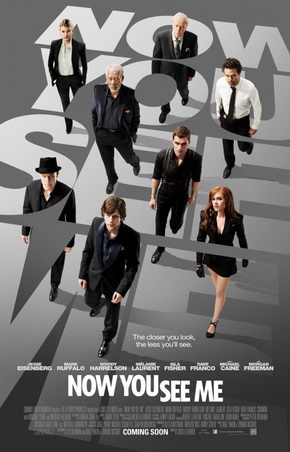
Now You See Me (2013)

The movies are a magical experience, and movies about magic can double up the fun by drawing attention to the innocuous deception of a theatrical illusion.  Unfortunately, Now You See Me spends so much time swaggering that it never really enchants. Now You See Me is ostensibly the story of four semi-professional magicians (Jesse Eisenberg, Woody Harrelson, Isla Fisher, and Dave Franco) who pull off a series of elaborate magic tricks as The Four Horsemen.  But when their illusions begin to look like theft by way of social justice, FBI agent Dylan Rhodes (Mark Ruffalo) and professional debunker Thaddeus Bradley (Morgan Freeman) begin to realize the magicians are, of course, not what they seem.

The key to any successful slight of hand is that the audience has to be so distracted by the flair that they miss the real trick.  Take Christopher Nolan’s The Prestige, a clever (perhaps brilliant) case study of competitive magicians; you’ll be so fascinated by the rivalry between Christian Bale and Hugh Jackman that you’ll miss the clues dropped by the filmmakers.  It’s possibly unfair but entirely unexpected that I’d make this comparison, but Now You See Me doesn’t let the audience play along.  Instead, we’re practically kidnapped, tied down by a film that continually insists on its own brilliance, reminding us at every turn that they’re smarter than we are.

Sure, I can be smarter than you if I don’t tell you what’s going on.  Then, the film gloats by showing you what really happened, though these scenarios are couched in so many maybes and perhapses that it’s never wholly clear what’s going on.  And when your focal character is an investigator, it’s a bit empty to have him never really understand anything.  Ruffalo’s solid as the not-smartest man in the room, and his charisma is enough to hold your attention, but it seems like a less successful riff on his character from The Brothers Bloom, which is saying something.

As for the rest of the cast, you’re looking at the disappointment of the summer.  The four leads have all done good work in the past, but the screenplay is incredibly thin, failing to distinguish any of the four characters beyond physical appearance.  You could rotate the actors in the cast, and it really wouldn’t matter; the characters are so boilerplate and so frustratingly identical that you’ll struggle to connect with them.  Perhaps the film’s worst offense?  Morgan Freeman and Michael Caine never share the frame; their scenes together crackle like a master class in acting, but we never get to see them side-by-side, which gives it a phoned-in feel.

Having said that, there’s a bit of fun to be had in some of the film’s stagier moments.  When The Four Horseman are performing, it’s an opportunity to chew some scenery, and the four leads do well there.  You might even want to see a full show by them at some point, since they convey a sense of infectious enthusiasm for their work.  And, naturally, once you’re told you’re about to be tricked, it’s engaging to watch and try to figure out where the trick is.

As Michael Caine said in The Prestige, “You want to be fooled.”  It’s a good thing, too, since Now You See Me never gives you an opportunity to figure out how the trick is done.  Nor is the ultimate explanation a fulfilling payoff; a last-minute twist is so clichéd that you’ll have already dismissed it as “too obvious.”  Now You See Me is superficial and a bit irksome, continually reminding you of its own cleverness without ever earning the moniker of “smart.”  Sad news for a strong cast, but the real trick is on the audience.

Or, in other words, now I saw it, now you don’t.

Now You See Me is rated PG-13 for “language, some action, and sexual content.”  There’s an F-bomb, playful banter, and some shouting; action consists of a car chase, a few explosions, and some shouting.  And there’s an aborted make-out scene thrown in to earn the “13.”

Monday, February 4, 2013

Monday at the Movies - February 4, 2013

Welcome to this week’s edition of “Monday at the Movies.”  I have quite a few reviews backed up in the queue, but I wanted to bump up a few more recent releases in the interest of topicality and relevance.  Also because I’m dying to talk about these two.

Batman: The Dark Knight Returns, Part 2 (2013) – After a mostly successful first half, the conclusion to this animated adaptation of Frank Miller’s iconic “last” Batman story is effective, engaging, and highly entertaining.  Though the decision to break the film into two parts seems motivated only by sales and creates an odd break where you have to change discs midstream, the filmmakers have taken advantage of this extended format and given us full versions of the two major confrontations that conclude the book:  Batman’s last match with The Joker, and his face-off with Superman.  My thoughts about the voice cast remain unchanged:  as Batman, Weller is solid (but no Conroy), and Ariel Winter is a good choice for the spunky Carrie Kelley.  The two new cast members, though, are even better; Michael Emerson is a genuinely disturbing Joker whose affection for the Dark Knight never wavers from how creepy it’s meant to be, while Mark Valley’s Superman is the perfect aging Boy Scout, unwitting lapdog for “The Man.”  The word I can use to best describe this film is “unflinching” because it more than earns its PG-13 rating; consistent with Miller’s gritty original, Part 2 is relentlessly violent, especially when depicting Joker’s last murderous rampage.  It’s an accurate treatment of the source material, but the senseless violence may turn off some viewers; I suspect, though, that’s the point, since it helps us understand the difficult decision Batman has to make when he tells Joker, “No more.”  While I’d like to see other superheroes get this kind of treatment, Part 2 confirms that the DC’s animated studio knows what it’s doing.

The Hunger Games (2012) – First of all, thank heavens for Suzanne Collins for giving us a sophisticated and emotionally compelling franchise to dethrone Twilight.  And thank heavens for Gary Ross, too, whose adaptation of The Hunger Games is smart and surprisingly artistic without compromising what works about the book – namely, the survivalist bent of the story and its biting political satire.  Jennifer Lawrence is the epitome of “rising star” as Katniss Everdeen, who’s thrust into a televised death match meant to supply a repressed populace with bread and circuses from the Capitol of dystopic Panem.  The decision to eliminate the book’s first-person narration is a wise one, cinematically speaking, but as a result the film may come off as a little flat and emotionless for those who haven’t read the book (or maybe it doesn’t?).  Wisely, though, the film expands beyond Katniss’s singular perspective, allowing us to see more clearly the state of life in the Capitol:  decadence a la Lady Gaga (including Stanley Tucci as the Capitol’s delightfully flamboyant version of Larry King), political maneuvering orchestrated by Donald Sutherland’s restrained but smarmy President Snow, and an infectious performative posturing that begins to corrupt our protagonists (which should pay off in sequels, if I’m remembering the books correctly).  Ross brings an artistic touch to the film, which indulges the sentimentality of one contestant’s death in a haunting POV shot, while prizing orchestral score over chaotic battle sounds to emphasize the dehumanization of the Games.  It’s a shame that he’s not returning for the sequels, but a fantastic cast (let’s not forget Woody Harrelson as the begrudging inebriated mentor Haymitch) led by Lawrence at the top of her game suggest that the odds are ever in this franchise's favor – at least, more so than Twilight.

That does it for this week’s edition of “Monday at the Movies.” Don’t forget that the Double-Oh-Seventh of the month is coming up on Thursday (hint, hint), and after that we’ll see you here next week!

Thursday, March 4, 2010

Zombieland (2009)

After Jennifer's Body (and after the last few posts retroactively updated the blog with reviews I'd written a while back), I needed a fresh movie to restore my faith in the cinema. It was with reservation that I slid Zombieland into my DVD player, but within moments my trepidation was assuaged.

You see, I love a zombie movie that doesn't take itself seriously - Shaun of the Dead is on my as-yet-unpublished "Best of the 2000s" list - and if the undead tongue is firmly in the decaying cheek, I'm right there. Zombieland is another entry in a long line of zombie movies with a sense of humor, and it's one of the better ones.

In an America populated primarily by zombies and where identities are subordinated to destinations (our protagonist is named Columbus, because that's where he's going), survival of the fittest is the order of the day, and the prize for those who make it is the promise of the last Twinkie on earth. Narrator Columbus (Jesse Eisenberg, who seems to be the B-list Michael Cera) meets up with Tallahassee (a fabulous Woody Harrelson), who's all about one-upsmanship and making zombie-killing an art while searching for that last Twinkie. The unlikely duo match wits several times with con artist sisters Wichita (Emma Stone) and Little Rock (Abigail Breslin) before a delightful showdown at the most bitingly contagious theme park this side of Disney World.

While I'm not a big fan of Eisenberg - Adventureland (also set, curiously, at an amusement park) left me cold and I'd much rather watch Michael Cera do the same act - Harrelson rarely lets me down, and his turn as Tallahassee is iconic for all the right reason, setting a new standard for infectiously fun zombie-killers in the same way that Zac Efron redefined teeny-bopper musicals. Stone is cute in a quirky kind of way, and she's entirely believable as a sneaky survivalist. Breslin's cute, too, like a less pretentious and more talented Dakota Fanning with more appeal to a broader audience. So the cast is a lot of fun.

(Note: I think the statute of limitations on spoilers has expired, but just in case... skip this paragraph if you don't want a pleasant mid-flick surprise spoiled.) The most fun, though, comes from an entirely unpredictable and extremely kitschy cameo appearance by Bill Murray, playing himself as one of the last remaining non-infected humans. Murray plays himself, but he does it with as much dry wit as in his most acclaimed roles (Groundhog Day and Ghostbusters, which gets a name check here). There's nothing un-funny about his five or so minutes in the middle of the movie, and the rest of the film almost feels like a letdown once he exits the stage.

The second half of the film has a different feel after the dynamically rip-roaring opening hour, but it's still a lot of fun. It's hard to believe that, in the forty or so years since George Romero made zombies cool, there are still creative ways to kill the undead (again). But how about garden shears? A car door? A piano? Zombieland has all that and more, especially the unforgettable "Double Tap" rule that must be seen to be fully appreciated.

The film is gratuitously violent, but its excessive nature is not purposeless, because the film is so ludiccrously over the top that the blood-and-guts effects have to be similarly beyond the pale. So while some fans might object to the slow-mo shot of a zombie vomiting blood over the opening credits, those of us who are in on the joke know that Zombieland is intentionally dialing the genre up to eleven. Watching Tallahassee do his thing - giggling maniacally and taunting the zombies as he goes - should be proof enough that the filmmakers are having as much fun as they'd like us to have.

It's a biting good time.

Zombieland is, no surprise, rated "R for horror violence/gore and language." The gore certainly isn't for the squeamish, but the language wouldn't make Joe Pesci blush.