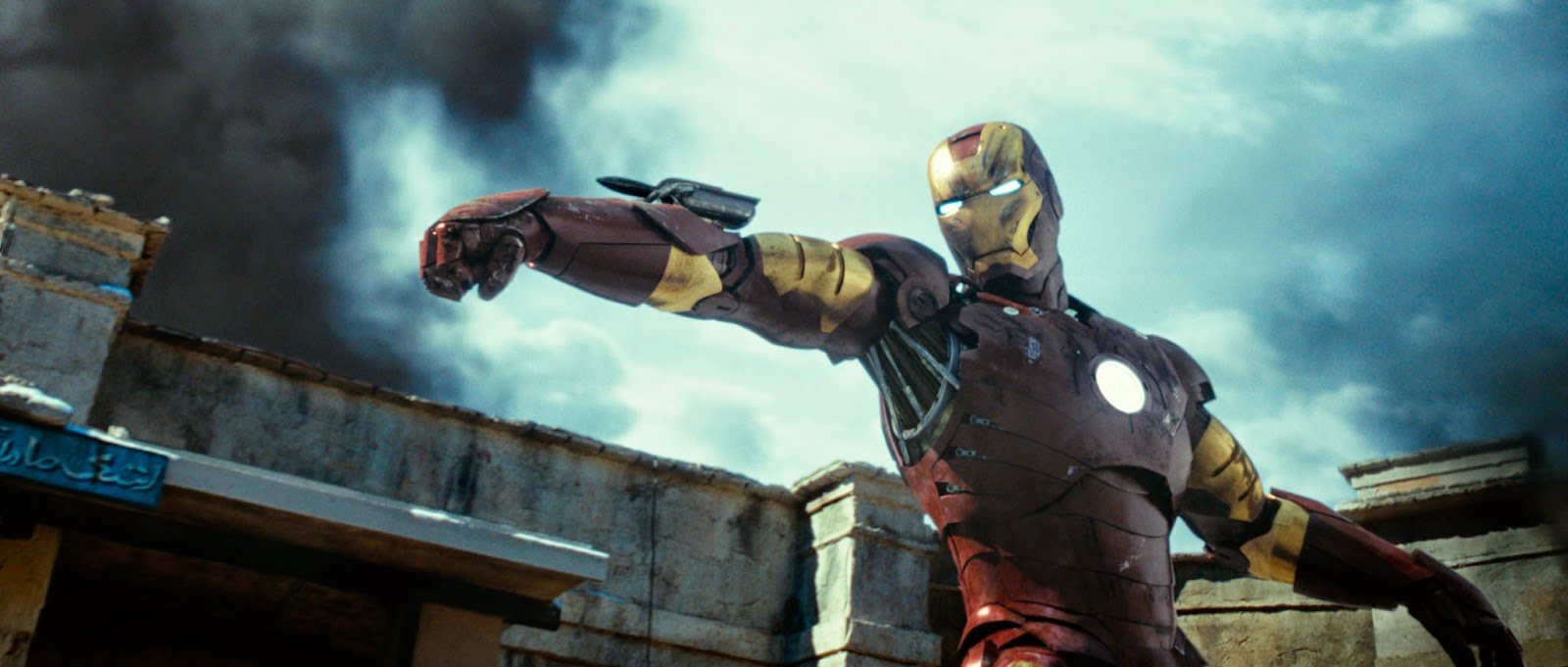
Showing posts with label Robert Downey Jr. Show all posts

Monday, July 24, 2023

Oppenheimer (2023)

Last week was the fifteenth anniversary of The Dark Knight. It was a seismic and seminal moment in blockbuster cinema, a sort of coming-of-age for me as a filmgoer and for superhero cinema writ large. It was the movie that made comic book movies a billion-dollar business, and after a decade and a half it hasn’t lost a step. But it also made Christopher Nolan a household name – no mean feat for a director to become ostensibly the auteur star of his own show.
 
Oppenheimer is Nolan’s sixth film since The Dark Knight, which is (for better or worse) the North Star for his entire career. I think you’d be hard-pressed to say that The Dark Knight isn’t still his best film, a perfect diamond absolute of a film, but Oppenheimer is in a way his most ambitious since, precisely because it’s Nolan without his characteristic science-fictional flair, his high concept effects wizardry. It’s still got all his stylistic quirks and puzzle-box structure, but for a director who has been criticized for being impersonal and unemotional, Oppenheimer is a riveting three-hour character study of one of history’s greatest enigmas.
 
Cillian Murphy stars as J. Robert Oppenheimer, the father of American quantum physics and director of the Manhattan Project, which yielded the world’s first atomic bomb at Los Alamos, New Mexico. Nolan’s intricate approach to the biopic catches three distinct moments in Oppenheimer’s life – his path to Los Alamos, his 1954 security clearance investigation, and a 1959 Senate confirmation hearing for Lewis Strauss (Robert Downey, Jr.), an American bureaucrat who frequently butted heads with Oppenheimer.
 
Nolan has cited Oppenheimer as “the most important person who ever lived,” which – coming from one of the most important directors who ever lived – is high praise and certainly fair justification for the man who created Inception to turn his camera toward one particular scientific genius. Nolan has become one of those directors whose decisions (and films) may seem initially inscrutable, but like any good magician (cf. The Prestige) Nolan has a way of hiding his endgame in plain sight, only revealing his purpose at the moment when it best suits him. There are many moments in Oppenheimer that take one’s breath away – the Trinity bomb test certainly is orchestrated that way – but the film’s final exchange of dialogue recontextualizes the film by delivering Nolan’s ultimate thesis.
 
Nolan is both academic and prestidigitarian, technician and artisan, but what’s somewhat surprising about Oppenheimer is the example it sets of Nolan as a friend – of humanity, sure, but of his entire cast of players. Cillian Murphy has been a veteran of Nolan’s company since 2005’s Batman Begins, but his turn as Oppenheimer is a gift any performer would be envious to receive: three hours of, more or less, a one-man show about a living cipher, a man who embodied contradictions and challenged binaries, insisting all the while on neutrality and unreadability. Even his greatest triumph, the creation of the bomb, cannot be rendered in anything but code, as when he tells his wife over the telephone, “Bring the sheets in.”
 
As his wife, one of the two unwieldy women in his life, Emily Blunt is another performer treated by Nolan with kindness and grace. While the film is nominally her husband’s, Kitty Oppenheimer is given her own moments to shine, her own room to be her complicated self, petty yet resilient, sturdy and yet agreeing with her husband that they are “awful selfish people.” Blunt can do plenty with a steely look, particularly in two impactful sequences late in the film, but she can equally channel that quiet nerve into an explosion of emotion. Meanwhile, Florence Pugh is heartbreaking as Oppenheimer’s mistress Jean Tatlock, unable to articulate her own desires or her needs from a man who is himself less than forthcoming. Pugh is arguably one of our preeminent scene stealers; case in point, she was the only ray of sunshine in the paint-by-numbers Black Widow, though her work in fare like Midsommar proves she’s equally gifted as a lead performer.
 
And speaking of Marvel performers, Robert Downey Jr. is already being fitted for a Best Supporting Oscar for his monochromatic antagonist Lewis Strauss. For those of us who are used to Downey as the flawed-yet-saintly Tony Stark, his turn as Strauss is a reminder of how versatile he can be. Strauss is instantly dislikeable, vindictive and self-righteous, and Downey creates an all-time classic screen villain. I can’t recall ever seeing a Downey character as loathsome as this one, but I certainly hope it’s not the last time he plays the heel, because it’s equally apparent that he is having a ball interpreting Strauss’s version of the story.
 
I did not join with so many of my fellow moviegoers in partaking of the “Barbenheimer” double feature. Truth be told, I was enervated after three hours of Oppenheimer. Not that the film was overlong and stupefying – quite the opposite. The cast is chock full of characters, some of whom are played by quite famous faces in surprisingly small roles, but each of them adds something quite special and unique to the stew. (Shout-out to Gary Oldman in one scene as Harry S. Truman.) But in telling a story out of sequence, as Nolan is wont to do, he takes the audience on a scenic tour through one man’s life, which as it turns out might well be the fulcrum point of human history. But Nolan’s method of delivery is not unlike an atomic bomb itself – a bright flash of light, followed by a roaring shockwave of impact. If you let out a breath as the credits rolled, as I did, it would have been one of recognition, of understanding. And before you draw air again, you’ll have to reckon with a sobering proposition that followed Oppenheimer all his life. And that, dear readers, is the most amazing magic trick of all – that Nolan created a biopic with a surprise ending, an interpretive twist that shouldn’t be spoiled.
 

Oppenheimer
 is rated R for “some sexuality, nudity, and language.” Written and directed by Christopher Nolan. Based on the book American Prometheus by Kai Bird and Martin J. Sherwin. Starring Cillian Murphy, Emily Blunt, Matt Damon, Robert Downey Jr., Florence Pugh, and Kenneth Branagh.

Monday, April 30, 2018

Avengers: Infinity War (2018)

Avengers, assemble – Avengers: Infinity War brings together ten years and eighteen movies’ worth of stories to pit Earth’s Mightiest Heroes against the strength of Thanos (Josh Brolin) as he gathers the six Infinity Stones in order to impose his will on the universe. From Wakanda to Scotland, from New York to the moons of Jupiter, the Marvel Universe has never seen a threat quite like this one, and so it will take the gathered forces of the Avengers, the Guardians of the Galaxy, and more to repel Thanos and his forces to save all of existence.

I don’t know if it’s possible to give a full review of Avengers: Infinity War without spoiling at least something (I’ll certainly try), but I do want to take a moment to applaud the “spoiler culture” of 2018, which has done a fairly remarkable job of not ruining the film. It’s a critic’s burden that a film this big carries with it the necessity of preserving at all costs the sanctity of narrative surprise; then again, I do have a sense that my main audience here will have already seen the film at least twice. Mum is, however, the word here; I can’t, for example, talk about my only major critique of the film because it’s a mammoth spoiler. Reserving a fuller take for later, I’ll say only that I think the absolute ending of the film doesn’t quite accomplish what it sets out to do, both for reasons that are extratextual and because the film doesn’t quite position the last character we see on screen as the film’s protagonist in a way that would make that figure’s journey the center of the film. (It does, however, stick the emotional landing, in an extraordinary way.)

What Avengers: Infinity War manages to accomplish very deftly – and very quickly, I’d say, within the first ten minutes – is establish the stakes of the film with remarkable precision and weight. For a film that assembles eighteen other films and umpteen million cast members, this is a film that feels amazing well-balanced, and it rises to the gravity of the occasion by presenting a story where it truly feels that anything can happen: not just that X favorite character will meet up with unlikely ally Y, but that any important character could die before this is all said and done, that this story will matter more than we might have been led to expect. At one point, Thor says something like, “It feels like it’s going to stick this time.” Despite all the fakeouts, both within this film and within the Marvel Cinematic Universe at large, Infinity War achieves what I call the “Indiana Jones in peril” moment, where – despite knowing that Indiana Jones won’t actually die – we gasp in shock as his car fritters near the edge of a canyon; only in Infinity War, that car might veer off the road and take a hero or two out with it.

As a film that is more a collision of stories than a singular narrative – Iron Man’s addiction to his technology, Captain America as a man out of time, Black Panther opening his kingdom to the world, etc. – the film very nearly buckles under the sheer weight of what it’s called upon to do. And yet the only characters who don’t get a fair shake are the ones who don’t appear at all; everyone else is placed in subplots that use them to their full range, bouncing them against unlikely but pitch-perfect foils. I wasn’t left wanting more of any one character; I was just left wanting more, period. In this way, Infinity War is almost a new ur-blockbuster, mashing together a decade’s worth of blockbusters to create a super-film that was, as early as Sunday morning, already the biggest opening of all time.

Infinity War is such a roaring success because it understands both its core audience and the audience who may not have caught all the preceding films. We don’t necessarily need to have seen Guardians of the Galaxy, Vol. 2, for example – though Star-Lord fills us in, just in case – because the film is much more invested in its characters than in their continuity. That’s the reason that each character’s arrival (and in at least one particularly electric case, a re-arrival) is such a crowdpleasing moment; regardless of where we left Captain America in Civil War, we’re just so glad to see him again because the Marvel folks have put the “care” back in “character.” From major players like Rocket Raccoon and Spider-Man to supporting cast like Wong and Okoye, Infinity War remembers why we love these characters and wisely keeps them to their strengths while nudging them out of their comfort zones. To review the performances in the film would require a scorecard – and maybe that’s a feature for another time, once the spoiler-warning reins have loosened – but suffice it to say that no one phones it in, treating each scene like just one more installment in their own films. Part of the electricity of the film, then, is the unforeseen chemistry between characters who might otherwise be poles apart (though, once more, it’d be terribly rotten to give all that away just yet), and on this count the filmmakers have continued to do the largely admirable work of the Marvel Cinematic Universe.

Aside from the popular appeal this film is likely to have, the ultimate “good time” popcorn flick, it represents the apotheosis of the very idea of the franchise – we now know that the largest film franchise can spawn the largest film of all time (dethroning The Force Awakens, which is really saying something in terms of hype), but what next? Avengers 4 seems poised to remind us one last time why we started down this journey back in 2008 and why we kept coming back for more, but it seems equally likely that it’ll set up the next ten years. If you don’t believe me, turn to the Marvel Zombie in your life after you see the post-credits sequence. The fullness of the universe is a major theme of this film, but the film is equally a reminder of the fullness of the Marvel Universe – and not just the Cinematic one. There’s always more, as the “_________ will return” credit acknowledges, and so too will the audience – return, that is, for the as-yet-untitled Avengers 4, for the two films (Ant-Man and the Wasp this year, and Captain Marvel the next) in the interim, for another viewing of Infinity War, and for whatever your personal favorite Marvel movie has been (for me, it’s still the masterful Winter Soldier). The Infinity Stones have been with us since the dawn of creation, and the success of Infinity War seems to promise that Marvel will be with us until the end of it.

Avengers: Infinity War is rated PG-13 for “intense sequences of sci-fi violence and action throughout, language and some crude references.” Directed by Anthony and Joe Russo. Written by Christopher Markus and Stephen McFeely. Based on the Marvel Comics by Stan Lee, Jack Kirby, and Jim Starlin. Starring Robert Downey Jr., Chris Hemsworth, Mark Ruffalo, Chris Evans, Scarlett Johansson, Benedict Cumberbatch, Don Cheadle, Tom Holland, Chadwick Boseman, Paul Bettany, Elizabeth Olsen, Anthony Mackie, Sebastian Stan, Danai Gurira, Letitia Wright, Dave Bautista, Karen Gillen, Pom Klementieff, Zoe Saldana, with Josh Brolin, Bradley Cooper, Vin Diesel, and Chris Pratt.

Monday, July 10, 2017

Spider-Man: Homecoming (2017)

“Spider-Man, Spider-Man,” the old song goes, “does whatever a spider can,” and lately it’s seemed that what a spider can do better than anyone is fumble and reboot himself twice in five years (yes, Andrew Garfield’s web-slinging debut was as recent as 2012). And while I eventually came around to liking The Amazing Spider-Man 2, it was still something of a mess, and what Spider-Man really needed was not his own immediate shared universe but rather a strong solo film, and on that front Spider-Man: Homecoming finally does what the franchise(s) hadn’t done since 2004.

Tom Holland reprises his role from Captain America: Civil War as Peter Parker, the friendly neighborhood Spider-Man who’s eager to get back into the Avengers fray but whose mentorship deal with Tony Stark (Robert Downey Jr.) is proving to be something less than attentive. Desperate to prove himself to Iron Man, Spider-Man follows a trail of advanced weaponry used and sold by The Vulture (Michael Keaton). Amid all this, Peter has to find time to compete in academic decathlons with his friend Ned (Jacob Batalon) and ask senior girl Liz (Laura Harrier) to the homecoming dance.

At the risk of sounding like a corporate shill – I’ve yet to receive that check from Marvel – one thing about Spider-Man: Homecoming that works exceptionally well is its existence in the shared universe. I’m not sure how well the movie scans for someone who hasn’t seen Civil War, and indeed the movie assumes (perhaps rightly) that everyone on the planet did see it, but it feels right to put Spider-Man into a world that is already so dense, with surprising connections to existing film events and to comics elements that hadn’t yet made their way to film. And then there is the indomitable force of Robert Downey Jr. himself, who has become synonymous with the Marvel brand and whose presence feels like a benediction over the film. And no, this isn’t Iron Man 4, much as the trailers might have led us to believe. It’s a proper Spider-Man film, with a tight focus on Spidey, his world, and how it all fits seamlessly into the Marvel Cinematic Universe.

As Spider-Man, Holland continues to make the role his own. Sans the Maguire self-consciousness and the Garfield angst, Holland plays Peter Parker as a gawky kid penned in by an awkward high school existence, with the Spidey suit representing an outlet for all his irrepressible charm and desire to make a positive impact on the world. Most importantly, there’s no artifice in the distinction between Peter and Spider-Man; their goals are the same, their personality only differing by degrees. Most excitingly, Holland seems enthused by the role, so perhaps we’ll end the spiral of reboots and stick with him for a while.

As foolproof as the Marvel formula seems to be, their villains have been admittedly inconsistent. For every multilayered Loki, there’s a one-note Malekith or an aptly-named Abomination (and let’s be honest, unless you’re a superfan, you don’t even remember in which movies those characters appeared). Director Jon Watts does well to keep the scope of The Vulture’s plans local and intimate, with no aspirations to take over or destroy the world. Wisely, this insular approach allows the film to develop what Vulture’s real motivations are, and Michael Keaton (Batman to Birdman to bird-man) renders him with very relatable goals and evident humanity beneath his role as antagonist. Even without the added frisson of seeing Keaton in a comic book film once more, his performance is a real treat, never fully hammy but likewise never unaware of just how much fun he can have with a meaty role like this. Spider-Man has never faced The Vulture on-screen before, but better still, he’s never faced a villain like this one before. If his ilk is what we can expect from the Sony/Marvel détente, I’m eager to see what’s next.

There is just so much about Homecoming that is delightful, full of surprises and so many small careful touches like the deliciously amateurish student news segments or the way the film works in so many villains and Iron Man without feeling overfull. Unlike the Garfield films, which often operated under the assumption that the most interesting thing about Spider-Man was everything else around him, Spider-Man: Homecoming doesn’t rush to any big moments or overload itself with Easter eggs (there are enough of them to go around, though). Homecoming takes a core idea – Spider-Man wants to be something more than he is – and builds outward from there, keeping the subtitle as an omnipresent reminder that our protagonist is a high school sophomore on the cusp of immense life changes. The news that the Sony/Marvel partnership is considering their Spider-Man in terms of a five-film arc (of which this is the second) augurs well for characterization, which has been so important for our Marvel heroes. Spider-Man is not Iron Man, nor is he Captain America, and this film remembers that.

Put another way, the Homecoming sequel in 2019 (Spider-Man: Winter Formal?) cannot come soon enough. To those who had written off Spidey or gotten bored of him, Homecoming is a proper return to form for the wall-crawler, with a can’t-miss performance by Michael Keaton.

Spider-Man: Homecoming is rated PG-13 for “sci-fi action violence, some language, and brief suggestive comments.” Directed by Jon Watts. Written by Jonathan Goldstein, John Francis Daley, Jon Watts, Christopher Ford, Chris McKenna, and Erik Sommers. Based on the Marvel Comics by Stan Lee and Steve Ditko. Starring Tom Holland, Michael Keaton, Marisa Tomei, Zendaya, Jacob Batalon, Laura Harrier, Jon Favreau, and Robert Downey Jr.

Monday, May 9, 2016

Captain America: Civil War (2016)

It’s been a wild ride here at The Cinema King, getting amped up for Captain America: Civil War by engaging ourselves in a Grand Marvel Rewatch of the twelve-picture Marvel Cinematic Universe. Marvel’s latest (and longest) film, Captain America: Civil War is also its biggest in terms of stakes, cast, and moral complexity, and it’s a dazzling super-triumph.

After years of operating unchecked amid several major global events, The Avengers find their powers under scrutiny by a United Nations resolution that seeks to oversee their operations. Tony Stark (Robert Downey Jr.), feeling guilt over his complicity in the creation of Ultron, signs on almost immediately, but Captain America (Chris Evans) has grave reservations about signing away his liberty. The rest of their teammates are forced to choose sides in the conflict when Cap’s childhood friend Bucky Barnes (Sebastian Stan) comes out of hiding, further splitting the team as regards Bucky’s responsibility for his actions as the Winter Soldier.

Civil War manages to be both sweepingly epic and deeply personal, with far-reaching consequences stemming out of what is essentially a clash of personalities, a philosophical difference of opinion about the nature of individual power. And what’s really striking – shout-out here to directors Anthony & Joe Russo and screenwriters Christopher Markus & Stephen McFeely, because they deserve it – is that the film never sacrifices one for the other. We get wonderful character beats and big-scale action sequences. One minute we’re in the kitchen with Scarlet Witch (Elizabeth Olsen) and Vision (Paul Bettany) as hosts of an adorable impromptu cooking show, and the next we’re in Leipzig for the airport sequence which is even more awesome than the trailers let on. (Honestly, the airport scene might be Marvel’s best action sequence to date, worth the price of a DVD, and eerily reminiscent of Whedon’s two 360-degree shots of the Avengers collaborating.)

And yet, for as much as the film valorizes character development, delivering some of the least opaque motivations for superhero characters yet, I really must quibble with the title of this film. Captain America: Civil War is not quite a Captain America movie – at least, not in the way that Captain America: The Winter Soldier was. In some part, this is due to the inclusion of RDJ as Iron Man, because Downey steals the screen whenever he shows up, but it’s also because the script is uncannily fair to both sides of this conflict. Both Stark and Cap have lines that might convince a fair-minded viewer to change their own opinion, and the film has neither a cop-out “villain orchestrated it all” twist nor any out-of-character beats like the comics source material (in which Tony Stark put Daredevil in a space prison). Civil War is balanced, and it may be difficult to digest for that reason, and kudos to the filmmakers for never cheapening the weighty debate.

Indeed, a better title would have been, simply, Marvel’s Civil War, for the film is unmistakably a waypoint for the franchise as a whole. There are beats in here that pay off all the way back to 2008, bringing everyone from Ant-Man to Thunderbolt Ross into the fray, and Civil War introduces Spider-Man (Tom Holland) and Black Panther (Chadwick Boseman) to the MCU in ways that make me incredibly excited for their standalone films. Holland in particular is the new definitive Peter Parker, capturing the webslinger’s inability to keep quiet without letting us forget that he’s perhaps too young for this. Civil War feels very much like a slice of a universe, but while Cap is undeniably a star it’s difficult to say he’s the star.

Ultimately, this is not actually a bad thing. It’s at worst a misnomer, but I’d rather have a film with a handful of fantastic characters than a film that limits its focus unnecessarily. I think we can all agree, for example, that The Force Awakens didn’t necessarily need more Luke Skywalker, especially if it cost us a few scenes with Poe Dameron. Whether it’s Captain America 3, Iron Man 4, or Avengers 2½, Civil War is too exciting, too much fun, and too engaging to write off on a technicality. It leaves you wanting more, a sage move for a ballooning franchise like this one. It sends you out of the theater debating over which scene was the coolest, to be sure, but it also sends you away with a moral question that’ll take up most of the car ride home.

Captain America: Civil War is rated PG-13 for “extended sequences of violence, action and mayhem.” There’s a lot of running/jumping/shooting/punching sequences, several extended; a few explosions and scatological profanities; and a few shots of bloody people. More of the same, really, from Marvel.

Wednesday, March 23, 2016

The Grand Marvel Rewatch: Iron Man 3

Face front, true believers! Welcome to the next astonishing addition to “The Grand Marvel Rewatch,” designed to get us all sufficiently amped up for Captain America: Civil War, which comes out May 6, 2016. Each Wednesday, The Cinema King casts his eye back upon the twelve films in the Marvel Cinematic Universe and offers five salient observations about the caliber of the films and the way they might play into Marvel’s latest installment in America’s favorite franchise.

Today’s fantastic feature film takes us to 2013 for Iron Man 3, kicking off Phase Two of the MCU with an old favorite and some new PTSD.
  1. Where is everybody? In a comic book world, it’s so easy to have characters meet up for an issue or two – you just check with your editor to make sure the character isn’t dead and then draw them in. Cinematically, with budgets and contracts, that’s tougher, so you get a case like Iron Man 3 where the intervention of SHIELD might have been helpful. I understand that the point is that Tony is a loner, and he’s pretty detached from the world for most of the film, but the fact that this issue never pops up in the film feels a bit like a gaping hole.
  2. Speaking of wormholes... The sense of absent Avengers (Bruce Banner’s post-credits cameo aside) is compounded by the fact that the film very self-consciously lives in the shadow of The Avengers and the Battle of New York. This I very much appreciate – someone as grounded and self-centered as Tony Stark would necessarily be very shaken by a near-death experience battling aliens through a giant wormhole in the sky above New York City. And I can’t help but feel that all the questions Tony fields about New York are some meta-commentary from director Shane Black, who very self-consciously enters into a narrative six films in the making and feels the pressure of everyone asking how he’s going to tie it all together.
  3. Manda-wrong. It’s been long enough that we can talk about the big Mandarin reveal, right? Namely that Ben Kingsley’s Mandarin is actually a patsy, a persona put on by addict actor Trevor Slattery in service to Aldrich Killian’s master plan. To add insult to injury, the plot twist is accompanied by a few fart jokes. Look, I totally understand why Iron Man 3 goes this way, but I would have much rather seen Iron Man go head-to-head with a terrifying and surprisingly not-racist interpretation of the Mandarin. Instead, the main villain is another well-dressed white guy. (“All Hail the King,” a short on the Thor: The Dark World DVD, suggests that there’s a real Mandarin out there, as well, but the Kingsley interpretation promised so much more than we got.)
  4. He is Iron Man. I very much enjoyed the film, and it’s because Shane Black makes a film that is very consistent with the tone of the previous films and the MCU as a whole. That’s predicated largely on the performance of Robert Downey Jr., who treats Tony Stark like a comfortable suit. The film’s closing line, “I am Iron Man,” harkens back to the first film, tells us something about the character’s growth beyond reliance on the metal suits, and tells us that this whole franchise succeeds because of the attitude struck by RDJ back in 2008.
  5. Music to my ears. Longtime readers of the blog know I’m a big fan of musical scores; when done right, like in the Star Wars series, the score becomes a character unto itself (or, in the case of Tomorrowland, does more work than the film itself). For all the connective tissue between the films, musically they’ve been somewhat piecemeal. Iron Man 3 is the fourth film starring Tony Stark, with four different composers along the way. Finally, though, Brian Tyler’s Iron Man theme seems to have stuck (due in no small part to Tyler’s work scoring Age of Ultron). Will we hear it in Civil War as well? I’m keeping my fingers crossed.
There’s so much more to be said about Iron Man 3, so be sure to check out my original review. Join me in the Grand Marvel Rewatch over the coming weeks, and hit the comments to share your thoughts about the MCU. And don’t forget to tune in next Wednesday for the next installment, in which we take a closer look at 2013’s Thor: The Dark World. Excelsior!

Wednesday, February 24, 2016

The Grand Marvel Rewatch: Iron Man 2

Face front, true believers! Welcome to the next astonishing addition to “The Grand Marvel Rewatch,” designed to get us all sufficiently amped up for Captain America: Civil War, which comes out May 6, 2016. Each Wednesday, The Cinema King casts his eye back upon the twelve films in the Marvel Cinematic Universe and offers five salient observations about the caliber of the films and the way they might play into Marvel’s latest installment in America’s favorite franchise.

Today’s fantastic feature film takes us to 2010 for Iron Man 2, our first sequel and the only MCU film to feature prominently a cockatoo.
  1. Better than its reputation. Iron Man 2 is usually ranked among the MCU’s lowest points (it has the third lowest ranking on Rotten Tomatoes, ahead of The Incredible Hulk and Thor: The Dark World), but there’s still plenty of fun to be had here. As before, Robert Downey, Jr., is the big attraction here, beginning with a giggle-inducing opener in which Tony Stark makes an appropriately dramatic entrance, extols his own virtues, and in a wonderful bit of metacommentary applauds himself and says, “Oh, it’s good to be back!” With RDJ on-screen it certainly is. 
  2. On the other hand, however... There is a chunk of Iron Man 2 that is astonishingly boring. You’ll remember this as the moment right near the end of Act Two, when both Tony and Whiplash (Mickey Rourke) are engaged in some high-tech shenanigans in their own montages. Maybe it’s just that I’ve seen these movies a thousand times by now, but there’s a feeling of treading water while there’s so much other interesting stuff going on in the movie. The film recovers in time for the climax, but I had the distinct feeling of not missing much if I had to get up for more popcorn. (You bet your arc reactor I was noshing.) 
  3. The cast explodes as the universe expands. It might be to the detriment of the main plot, but Iron Man 2, but the Marvel Cinematic Universe takes an enormous leap forward with a closer look at SHIELD, a peek into the past of Tony’s father Howard, and the introduction of Black Widow (Scarlett Johansson). While these are all fascinating additions in hindsight, deployed to much greater effect later in the MCU, here these beats feel a little like intrusions, corporate presences without narrative arcs. The MCU has more successfully navigated that line between franchised product and standalone entertainment than Iron Man 2 might lead one to believe.
  4. New Rhodey. I like Terrence Howard as much as the next man, but it’s really hard to imagine anyone other than Don Cheadle as War Machine. The film hangs a delightful lampshade on the casting change with Rhodey’s opening line, “Look, it’s me. I’m here. Deal with it.” But it ends up not being a big deal because Cheadle has fantastic charisma with RDJ, brings the critically palpable enthusiasm for the role, and fits into the suit in a way that is difficult to define. I’m keeping my fingers crossed that Rhodes pops up in Captain Marvel (assuming he makes it out of Civil War alive), based on the relationship he has with Carol Danvers in the comics.
  5. Continuity detritus. It’s hard to say how much of this stuff is planned out in advance and how much is improvised, but there’s a surprising amount of retrospective continuity that ends up making Iron Man 2 more enjoyable almost by accident. Agent Coulson’s (Clark Gregg) discovery of the Captain America shield prototype makes wonderful sense, given the fanboy devotion we discover in The Avengers. Then there’s Senator Stern (Garry Shandling), whose dogged pursuit of the Iron Man technology squares nicely with the character development we get during his cameo in Captain America: The Winter Soldier. At the same time, however, there’s a question to be answered about Howard Stark – what turns him from the carefree playboy (Dominic Cooper) of Agent Carter into the sobered Disneyesque futurist (John Slattery) we meet in this film? It’s all connected... and tracing out those connections is half the fun.
There’s so much more to be said about Iron Man 2, so be sure to check out my original review. Join me in the Grand Marvel Rewatch over the coming weeks, and hit the comments to share your thoughts about the MCU. And don’t forget to tune in next Wednesday for the next installment, in which we take a closer look at 2011’s Thor. Excelsior!

Wednesday, February 10, 2016

The Grand Marvel Rewatch: Iron Man

Face front, true believers! Welcome to the first in a limited series of ongoing posts entitled “The Grand Marvel Rewatch,” designed to get us all sufficiently amped up for Captain America: Civil War, which comes out May 6, 2016. Each Wednesday, The Cinema King casts his eye back upon the twelve films in the Marvel Cinematic Universe and offers five salient observations about the caliber of the films and the way they might play into Marvel’s latest installment in America’s favorite franchise.

First up, let’s throw it back all the way to 2008 – eight years ago! – for Iron Man, the place it all began.

  1. This movie holds up. I’m not one to only watch these movies once, so I’ve probably seen Iron Man the most of all twelve – and not just by virtue of it being the oldest. But even though I find myself doing most of the dialogue right along with the film, it doesn’t feel stale. Indeed, it feels as if it’d work just as well if it came out today. It sets a wonderful bar for the MCU, builds a world almost immediately, and initiates a delightful brand of humor that never transgresses into Batman and Robin territory. 
  2. Robert Downey, Jr., is perfectly cast. Look, Iron Man doesn’t work without RDJ, and it’s safe to say that the entire MCU is built on the shoulders of this film. So it’s a good thing that RDJ is pitch-perfect as the swaggeringly confident Stark; the improvisational quality of the film gives it a fast pace that requires a gifted performer to keep up, and RDJ manages to navigate the fast-talking attitude along the character’s evolution into a comparatively more responsible hero. And it’s not a coincidence that the Tony Stark who appears in post-2008 Marvel Comics is essentially a printed version of RDJ – that’s character redefinition, the likes of which we hadn’t seen since “Heart of Ice.”
  3. The chemistry with Gwyneth Paltrow is underrated. It’s easy to forget that there’s anyone else in this film besides RDJ, but I want to give a special shout-out to Gwyneth Paltrow’s turn as Pepper Potts, Tony Stark’s doting assistant, walking conscience, and life support system. It’s somewhat criminal that Pepper won’t be in Civil War (at least, so far as we know), because it’s hard to imagine Tony having a crisis of conscience without Pepper’s presence. Aside from Paltrow’s wonderful presence as the counterpoint to RDJ’s frenetic energy, the romantic tension between the two doesn’t feel compulsory; instead, you feel from the opening that these two genuinely care for each other, and their endpoint – somewhere between playful banter and tender affection – feels earned by the film.
  4. That world-building, son. Iron Man does this wonderful thing where it’s perfectly fine as a standalone film. Director Jon Favreau quickly builds a universe for the characters to inhabit, and if we never had an MCU to follow we certainly wouldn’t have known this was a prelude to a much larger franchise. There’s that opening sequence in the back of the Humvee (or, as Tony calls it, “the Funvee”), memorable for its deft introduction of tone while also establishing the climax of the first act. But at the same time, Iron Man lays all kinds of seeds for the MCU to come, and we can go all the way to the very end of the film and its iconic post-credits sequence (you are now free to imagine Samuel L. Jackson turning up at the end of any movie saying, “You think you’re the only [insert profession here] in the world?”). 
  5. Phil! You know, I’d almost forgotten that Iron Man marks the debut of Agent Phil Coulson, ostensibly the most important original character imported into the comics since Harley Quinn appeared in Batman: The Animated Series. Clark Gregg just kills it with a strikingly nuanced performance (or maybe those are retrospective lenses I’m wearing) that suggests at first a timid pencil pusher before revealing himself to be something of a badass. Again, Coulson’s a great example of how the film carves out its own turf without feeling like it’s in deference to a larger narrative. Coulson would go on to headline his own show, Agents of S.H.I.E.L.D., but we always remember him as the guy who never got to debrief Tony Stark because (headcanon alert) he was too busy becoming Pepper’s bestie and stealing all our hearts in the process.
There’s so much more to be said about Iron Man, so be sure to check out my original review. Join me in the Grand Marvel Rewatch over the coming weeks, and hit the comments to share your thoughts about the MCU. And don’t forget to tune in next Wednesday for the next installment, in which we take a closer look at 2008’s The Incredible Hulk. Excelsior!

Monday, May 4, 2015

Avengers: Age of Ultron (2015)

The world is a darker place in the wake of the news that Joss Whedon won’t be helming the two-part Avengers: Infinity War (due out in 2018 and 2019). To wit, Avengers: Age of Ultron is a darker, moodier installment in the Marvel Cinematic Universe than its predecessor. But if this truly is Whedon’s swan song in the world of The Avengers, it’s a damned good note on which to end, better than the original and a close contender for the MCU’s finest hour.

After a knockout opening sequence that doesn’t waste any time getting to the action, all your favorite Avengers have assembled. When Tony Stark (Robert Downey Jr.) and Bruce Banner (Mark Ruffalo) develop an artificial intelligence project that goes awry, the other Avengers – Captain America (Chris Evans), Black Widow (Scarlett Johansson), Thor (Chris Hemsworth), and Hawkeye (Jeremy Renner) – face the threat of annihilation when the AI builds itself a body and becomes Ultron (James Spader). Along the way, the Avengers are threatened by superpowered twins (Elizabeth Olsen and Aaron Taylor-Johnson) left in the wake of the fall of Hydra.

It seems clunky to type with all those parentheticals, but the Joss Whedon trademark has always been gracefulness when it comes to large ensemble casts. As in the first film, there is an organicity to the assembling of these Avengers, but where The Avengers spent the better part of its first half in assembly-mode (a really lovely first half, actually, perhaps stronger than the action-heavy climax), Age of Ultron throws the group into a cauldron already boiling with tension and camaraderie. The script is well-crafted as ever, with distinct arcs for its characters (which ought to be the norm but, sadly, isn’t) and a tight narrative focus that finds a way to expand the universe without dithering and losing focus.

I don’t want to say more about expanding the universe for fear of spoiling the film, so on the occasion of May the Fourth – Star Wars Day – I’d like to comment on Age of Ultron being ostensibly the franchise’s “Empire Strikes Back” moment, the middle and darkest entry in a trilogy. The mood in Age of Ultron is considerably grimmer than in The Avengers, though it’s by no means unbearable; in fact, what’s surprising about the film is just how much humor it includes among all the foreboding. The Avengers was funny, but Age of Ultron seems to have imported the raucous tempo of Guardians of the Galaxy’s punchlines. “Keep ’em laughing” seems to be the word of the day here, to the point where I began to wonder, amid all the franchise’s one-liners and character resurrections (Nick Fury, Phil Coulson, Pepper Potts, Bucky Barnes, et al), whether Age of Ultron would actually pull the emotional trigger and give us something truly tragic. Suffice it to say, Age of Ultron does go there, and in a way that works better than it actually ought to.

I could lather up the performers, as I usually do, but you’ve seen it all before. The cast continues to do that at which they are best while also successfully navigating through their respective character evolutions. Ruffalo, for one, is still doing the exposed-nerve timidity, but the romantic wrinkles given to his character equally compelling and don’t feel the least bit out of Bruce Banner’s rhythm. Renner gets the closest thing to the film’s center stage (an apology, perhaps, for spending much of The Avengers under Loki’s mind-control) with a development so surprisingly unanticipated that a pin drop would have deafened the audience on opening night.

The true surprises are in the incoming cast, who distinguish themselves quite nicely while also integrating into the ensemble without that feeling of intrusion. Spader in particular stands out as one of the MCU’s better villains, very well-developed and extremely menacing in a creepy sort of way – in other words, exactly the kind of character you’d expect from James Spader. The twins, Scarlet Witch and Quicksilver, work very well in the context of the film, and they’re the sort of people you’d like to see more of in future films.

One final note must be made of the way that Age of Ultron very consciously engages with the superhero film genre overall. We all have this sense that the bubble is going to burst at some point (with four superhero movies coming out in July 2018 – one a week!), but Age of Ultron never feels overfull or weary. Instead, there’s an interesting way that the film comments on the trend of superhero movies toward ungrounded violence, by which I don’t mean the odd tendency of Marvel films to end with airborne combat and explosions galore. No, there seems to be a very clear commentary on Man of Steel’s ignorance (willful or otherwise) of civilian casualties. At many points in Age of Ultron, The Avengers take great pains to guarantee the safety of the innocent, at the point of risking their own lives to save the citizenry. While I’m one of the few who maintains that Man of Steel’s carnage will actually be a motivating factor for Superman in the sequels, Age of Ultron tackles the issue head-on to demonstrate that the sanctity of life ought to be the hero’s first prerogative.

Is Age of Ultron a bid for a kinder, gentler superhero film? I’m not sure that’s the message, but it is certainly a bid for a more thoughtful one. And while I’m not ready to say it’s dethroned The Winter Soldier at the top of my MCU power rankings, I will say that Whedon had made an indelible stamp on the superhero genre, and the future would do well to take its cues from him – particularly the well-crafted yet innovative juggling act of Age of Ultron.

Avengers: Age of Ultron is rated PG-13 for “intense sequences of sci-fi action, violence and destruction, and for some suggestive comments.” The action scenes are standard superhero fare, with all the punching, explosions, and gunfire you’d expect. Most of it is bloodless, as you’d expect from fights with robots, but some of the more personal action beats include blood. The film also includes the standard amount of innuendo and a few scenes of flirting.

By the way, today is May the Fourth – Star Wars Day! – so flashback to 2014 and take a look at my reviews of the Star Wars saga!

Monday, August 18, 2014

Top 10 Marvel Cinematic Universe Films - #4-3

With Guardians of the Galaxy, the Marvel Cinematic Universe enters the double-digits club.  The job of a Top 10 list in this case is especially difficult because I knew precisely which would be #1 and which would be #10, but the rest I don’t have much complaint about.  The Marvel brand has been very reliable, so assigning ranks becomes a somewhat arbitrary game of quibbling and comparing.  That said, I feel fairly confident in assessing “The Top 10 Marvel Cinematic Universe Films!”

4.  Guardians of the Galaxy (2014)
“Guardians proves that Marvel is unstoppable, taking everything that worked about their earth-bound adventures and applying that to space.” 
It’s the Cinderella success story of this summer blockbuster season, and for good reason.  Guardians, like Iron Man 3 before it, demonstrates Marvel’s unique ability to blend distinctive directorial voice with the studio’s unique house style.  More importantly, though, Guardians is an accomplishment for presenting a veritable cast of unknown characters to an audience for the very first time and succeeding wildly.  Granted, it’s tough to resist the lure of a talking, gun-toting raccoon, but how many filmgoers (diehards aside) knew a Groot from a Gamora?  They sure do now; box office numbers rightly made this one a winner.  Under the capable hand of James Gunn, C-list characters get the A-list treatment – compelling narrative arcs, infectiously fun personalities, and an impressive sense of scope without overwhelming the audience.  To boot, it’s impossible to undersell just how fun the film is, leaving me with a wide grin in the face of such improbabilities as an opening credits sequence scored to Redbone’s “Come and Get Your Love.”  More of this, please.

3.  Iron Man (2008)
“This is a phenomenal picture, at once an accomplishment on celluloid and an exhilarating breeze of a picture - in total, the perfect summer blockbuster.” 
Iron Man earns its place on the countdown for many reasons, but one of the big ones is innovation.  This is the fun uncle of the modern comic book superhero film, and without it you wouldn’t have something as zany, original, and enjoyable as the aforementioned Guardians.  Iron Man presents an astoundingly deft origin story for Tony Stark, brought quite literally to life by Robert Downey, Jr.  A two-hour montage of RDJ’s in-character riffing and improvisation would have been just fine, but director Jon Favreau also gives us an immensely engaging character arc, from weaponer to weapon, from war-monger to penitent man.  It follows the classic format established by the Christopher Reeve Superman – origin, adventures, character development, big showdown – but in bringing the genre back to its heretofore finest hour, Iron Man reinvents the wheel but makes it lightyears better by creating a breezy and seemingly effortless expert work.  It’s no wonder that the mere post-credits mention of “The Avengers Initiative” had audiences salivating – the promise of more to come never tasted sweeter than at the end of Iron Man.

True believers know what's left on the list, but come back on Wednesday for the final two, in an order that may surprise you...!

Friday, August 15, 2014

Top 10 Marvel Cinematic Universe Films - #6-5

With Guardians of the Galaxy, the Marvel Cinematic Universe enters the double-digits club.  The job of a Top 10 list in this case is especially difficult because I knew precisely which would be #1 and which would be #10, but the rest I don’t have much complaint about.  The Marvel brand has been very reliable, so assigning ranks becomes a somewhat arbitrary game of quibbling and comparing.  That said, I feel fairly confident in assessing “The Top 10 Marvel Cinematic Universe Films!”

6 (tie).  Thor (2011)
“Branagh brings his background in Shakespeare to bear in Thor, which blends perfectly the high theology and overwhelming pride of Asgard and the Norse deities with the restrained and comic scenes on planet Earth.” 
Released the same year as Captain America, Thor is a fantastic example of how effortlessly Marvel can render the incredible, thanks largely to Kenneth Branagh’s directorial hand, which deftly juggles gods and mortals in a film that never feels unbalanced.  The sweeping Shakespearean quality of Asgard is so impressively crafted that we could spend a whole movie there, but the fish-out-of-water plotline which finds Thor exiled to earth is correspondingly mesmerizing, heavier on the humor but no less aware of the mythic quality of the narrative.  As noted earlier in the countdown, Tom Hiddleston delivers a star-making performance as the trickster Loki, but Chris Hemsworth is no slouch as the swaggeringly confident God of Thunder.  It edges out Captain America only ever so slightly, solely by virtue of remaining self-contained, but the entertainment value between the two movies is almost indistinguishable; filmgoers will have an equally fantastic time with either. 

As we enter the Top Five, not to disparage the preceding five films too much, we’re headed into a higher caliber of film.  The earlier five films are fun enough, diverting enough, but the five films to follow are truly remarkable – not just as Marvel films, not even just as superhero films, but as films in their own right.  It’s especially true of the #1 choice on this list, but we’ll get there in due time... on with the show!

5.  Iron Man 3 (2013)
“It evolves the character of Tony Stark in a number of intriguing ways, and the promise that “Tony Stark will return” (shades of James Bond?) was never more fascinating.”
Tony Stark famously remarked in the second film in the trilogy, “Oh, it’s good to be back!”  But it’s not until the third film that the Iron Man franchise really lives up to its inaugural installment.  RDJ is joined by writer-director Shane Black, who had collaborated with him on the downright fabulous sleuth/caper flick Kiss Kiss Bang Bang, and the result is everything that worked about KKBB with a heavy dose of everything that works about a Marvel movie.  The Christmas setting is inspired, and I particularly love the way the story takes Tony Stark to rock bottom, builds him back up, only to reveal that (no spoilers) the only reason he was able to become Iron Man in the first place was because he has always been Iron Man.  If this is RDJ’s final solo outing as Tony Stark, it’s a fitting farewell, but here’s hoping (Avengers aside) we haven’t seen the last of this iteration of Iron Man.

Come back on Monday, true believers, as the countdown continues into the Final Four!

Monday, August 11, 2014

Top 10 Marvel Cinematic Universe Films - #10-9

With Guardians of the Galaxy, the Marvel Cinematic Universe enters the double-digits club.  The job of a Top 10 list in this case is especially difficult because I knew precisely which would be #1 and which would be #10, but the rest I don’t have much complaint about.  The Marvel brand has been very reliable, so assigning ranks becomes a somewhat arbitrary game of quibbling and comparing.  That said, I feel fairly confident in assessing “The Top 10 Marvel Cinematic Universe Films!”

10.  The Incredible Hulk (2008)
“All that said, there's something... off about this movie. I'm not sure what it is.”
It’s only the second entry in the Marvel Cinematic Universe, so perhaps we can excuse The Incredible Hulk for not finding its feet very well.  It’s not a bad film by most stretches of the imagination, but it isn’t very engaging; the supporting cast is rather unmemorable (though I wouldn’t mind seeing William Hurt’s Thunderbolt Ross show up somewhere else in the MCU), but the biggest disappointment is Edward Norton’s turn as Bruce Banner, a tepid and wiry character who pales in comparison to Mark Ruffalo’s more intriguing portrayal.  There’s a disjunct between Norton and his gamma-sized alter ego, one that makes Hulk and Banner feel more like separate characters.  Perhaps it’s the story, focused around eliminating the Hulk persona – but only insofar as he’s not needed for an obligatory action sequences.  The special effects are gee-whiz, a step up from the Ang Lee film five years earlier, but even with an RDJ cameo this Hulk is not quite incredible.

9.  Iron Man 2 (2010)
“The film thrives because of Downey's personality; he's impeccably cast here in a character who's larger than life.” 
Loyal readers may be surprised by how low on the countdown Iron Man 2 lands, and in spite of how much I’m enamored of Robert Downey Jr. I put Iron Man 2 just above Incredible Hulk mostly on the grounds of narrative unity.  As engaging as RDJ is as Tony Stark, as fun as the movie can be, it feels very much like a friend with an ulterior motive.  As much as I admit to being a Marvel shill, there’s a degree to which I resent how much of Iron Man 2 is devoted to teasing The Avengers.  I love Samuel L. Jackson as much as the next guy, but I can’t help but wonder if an Iron Man 2 sans tie-ins might have been as strong as the first; the glimpses we get of that film – in which Tony Stark wrestles with his legacy while facing a competitor – is fantastically fun, but it feels put on hold whenever the S.H.I.E.L.D. crew stroll in.

Come back Wednesday for the next installment of this sure-to-be-controversial Top 10 list!

Monday, June 23, 2014

Chef (2014)

As much as I love a good big-budget popcorn summer movie, I have the sense that a lot of smaller films are lost amid the explosion-heavy hype surrounding the tentpole franchises and blockbuster features.  Case in point – Chef flew very low under the radar, but those who find it are in for a treat.

Chef Carl Casper (Jon Favreau) faces a midlife crisis after a social media meltdown against a mean-spirited food critic (Oliver Platt).  On the advice of his ex-wife (Sofia Vergara), Casper seeks true happiness by opening a food truck with his son and his sous chef (John Leguizamo) and embarking on a road trip.

That is, essentially, opening shot to closing shot, a complete synopsis of the film, but it doesn’t seem like a spoiler, and not just because the trailers have given away as much.  Chef feels very much like a film that proceeds along a clear path from the beginning, without a need to try to surprise the audience or pull one over on it.  Instead, Favreau – who also wrote and directed – clearly wants to make a very straightforward film with a very simple message.

For me, knowing that Favreau is wearing every creative hat in the film, it seems like a very authorially guided project, Favreau’s own statement about himself.  What’s interesting to me is the way that Chef reads like a treatise on why Favreau isn’t directing Iron Man movies anymore; like Favreau, Casper attained fame quickly for his indie work before settling into a critically derided routine with “the man,” embodied here by an overbearing Dustin Hoffman who demands sameness from Casper’s menu.  Instead of staying with the lovely Scarlett Johansson (in Chef, a maître d’ seduced by Casper’s prowess in the kitchen), Casper/Favreau breaks off and does his own smaller thing, finding greater success and fulfillment than ever before.

Whether or not Chef is a manifesto on why Favreau has left big-budget Hollywood (for now), Chef is exceptionally entertaining, feel-good in the least derisive sense of the word.  I can honestly say that I had an embarrassingly wide smile on my face for much of the film, even between the punchlines.  That’s because Chef plays like a passion project, which makes the food truck plotline feel very metaphorical – one senses that Chef is Favreau’s food truck.  In fact, it doesn’t seem accidental that the man who sells Casper the truck is played by Robert Downey Jr., in one of the film’s funniest scenes; without the RDJ-sponsored success of Iron Man, we might not have a Chef.

This is all very beneath the surface, and I don’t think the moviegoing public at large are meant to focus on the metaphorical content the way I have.  But it does emphasize the degree to which Favreau’s heart is in the film, an emotional investment that carries over to the audience, who can’t help but fall in love with Casper, whether he’s playing sad sack or genuinely content.  While Favreau has that everyman charisma that one would need for this role, he surrounds himself with a fantastically talented supporting cast of scene stealers who all possess a deft comedic timing that sells lines like “You’re trending, bro.”

Chef is a classic story told very well, without the burden of overwhelming ambition or franchised expectations.  It’s both narratively and literally a back-to-basics piece for Favreau, a kind of (appropriately enough) palate cleanser for him and for the audience.  With an emphasis on simplicity and substance, Chef is a sweet dish wholly recommended for anyone seeking a bit of lighthearted fun at the box office this summer.

Chef is rated R for “language, including some suggestive references.”  There are a surprising number of F-bombs (at least, surprising based on the trailer), though it feels organic for the characters.  There are verbal fisticuffs and an occasional crude remark about romantic partnerships.

Monday, May 6, 2013

Iron Man 3 (2013)

It’s a brave new world, folks.  We’re post-Avengers and entering solidly into what’s been called “Phase 2” of the Marvel Cinematic Universe.  And with a new director at the helm of the centerpiece franchise, how does Iron Man fare against cinema’s greatest enemy – the dreaded threequel?

Come on, it’s Robert Downey, Jr.  Of course it’s fantastic.

Iron Man 3 picks up after The Avengers, with a PTSD Tony Stark (RDJ) tinkering with his metal men in lieu of sleeping.  The suits are all quite fantastic, but Pepper Potts (Gwyneth Paltrow) is worried, especially after a few close encounters with empty suits.  Speaking of empty suits, blast from the past Aldrich Killian (Guy Pearce) arrives at Stark Enterprises with an offer that’s too dangerous to be good – hacking into the human brain to augment natural genetics.  And when Tony Stark calls out top terrorist The Mandarin (Ben Kingsley), the Invincible Iron Man finds himself vulnerable and pondering the viability of his very existence.

It’s heavy stuff, vaguely reminiscent of the rock-bottom approach of The Dark Knight Rises.  But make no mistake – RDJ and new writer/director Shane Black maintain all the fun that ought to be the governing spirit of an Iron Man film.  Even the panic attack sequences aren’t deadly serious, deflated by RDJ’s speedy comedic delivery and the script’s wise refusal to submit to cliché; case in point, Tony Stark’s second-act encounter with a young child who helps him out.  It’s an initial eye-roll, but our incredulity is assuaged once we realize that Stark refuses to “learn a lesson” from the kid and indeed willfully disregards the boy’s guilt-trip backstory in favor of a sandwich.

It’s a credit to Black that the film doesn’t feel tonally different from its two Jon Favreau-helmed predecessors.  In fact, Iron Man 3 is equally consistent with the last Black/RDJ team-up, 2005’s brilliant Kiss Kiss Bang Bang.  It’s not just the Christmas setting or the narration (which pays off beautifully in the incredible post-credits sequence), but it’s a consistency of tone, of snappy dialogue, of confident fun that runs through both films.

I can’t emphasize enough how much of this is thanks to another fabulous central performance by RDJ; in fact, most of the other roles are essentially cameos, though no one drops the ball in their smaller parts.  (It’s a shame, though, that we don’t get more Pepper, since her scene in The Avengers was among the best.)  Our two big villains here, Pearce and Kingsley, are right at home in the trappings of a comic book film, though comics fans may wrinkle their nose at liberties taken with each character (Pearce’s role is bigger than Killian’s ever was, while the Mandarin’s presence is reduced).  As Killian, Pearce is reminiscent of Sam Rockwell’s turn as Justin Hammer in Iron Man 2, but without the schlock and quirkiness; Aldrich Killian is deadly menacing, a near-perfect match for Tony Stark (though I still think Jeff Bridges as Obadiah Stane was the best nemesis).  As for Kingsley, his Mandarin isn’t your granddaddy’s Oriental wizard; updated for the film as the new face of terrorism, Kingsley brings in his trademark any-ethnicity-goes approach and drawls out threats that downright drip doom.

And as War Machine/Iron Patriot, Don Cheadle gets more action sequences than last time, both in and out of the suit.  The case of Iron Patriot raises a key point about the film; where The Dark Knight Rises spent so much time working toward the symbolic significance of the costume, Iron Man 3 revisits the first film’s closing line – “I am Iron Man” – in search of some greater truth about its protagonists.  It almost seems like an effective metaphor for changing creative teams:  you can paint the suit any color you like, you can strap on any number of accoutrements, and you can even blow up as much of the trappings as you like.  Because what really matters is the person inside the suit.  You need to get the character right for any of the rest of it to work.

And in that respect, Iron Man 3 succeeds.  It evolves the character of Tony Stark in a number of intriguing ways, and the promise that “Tony Stark will return” (shades of James Bond?) was never more fascinating.  See you in Avengers 2, Tony.

Iron Man 3 is rated PG-13 “for sequences of intense sci-fi action and violence throughout, and brief suggestive content.”  There’s a modest amount of blood in scenes that involve iron-suited fisticuffs, as well as an unsettling heat signature around most of the enemies in the movie; as for suggestive content, Tony Stark meets women, some of them in bikinis.  You can imagine how that conversation goes.

Don’t forget tomorrow is the Double-Oh-Seventh of the month, and you know what that means...

Monday, December 17, 2012

Top 10 Christmas Season Movies - #10-9

This week, in anticipation of the Christmas season, we at The Cinema King would like to bring you more than just your usual share of recommendations.  So we present to you:  this week’s Top 10 list.  More specifically “The Top 10 Christmas Season Movies.”  Rather than fill the list with “obvious” choices of Christmas-y movies, there are a few “alternative” choices on the list – the overarching determining criterion is whether or not this is a movie that I will watch beginning to end, especially during (but not limited to) the Christmas season.

#10 – Love Actually (2003)
While I confess I’ve only seen this movie once, about five years ago, I can safely say that not a Christmas goes by that I don’t think about Love Actually.  It’s probably because of the sweet-as-sugar finale in which Liam Neeson’s son gets to perform “All I Want for Christmas Is You” onstage with the lady of his affections.  But the holiday spirit is in the air throughout this movie, which has one of the best ensemble British casts this side of The Best Exotic Marigold Hotel.  You’ve got Alan Rickman unsuccessfully navigating office politics vis-à-vis Christmas gifts, a snowy evening in which Andrew Lincoln uses cue cards to profess his love for Keira Knightley, and Rowan Atkinson as the walking embodiment of the Christmas spirit.  Then of course there’s Bill Nighy, whose turn as an aging pop star gives some of the best laughs of the film, especially as he tries to shoehorn Christmas into The Troggs’ “Love Is All Around” before attending Elton John’s holiday party.  It’s a year-round affair for how romantic it is, but it’s especially Christmas-worthy.

 #9 – Kiss Kiss Bang Bang (2005)
You can’t go wrong with Robert Downey, Jr., especially if he’s dodging snowfall and self-absorbed supermodels with reindeer antler headbands in a hardboiled detective film that allows him the freedom to run wild at his most antic.  This is a fantastic if underappreciated movie that pairs RDJ with Val Kilmer, who plays an irrepressible private investigator named Gay Perry.  The script and direction by Shane Black are both smart, and holiday film fans are in for a treat when they see how irreverent it is, quite unlike any other Christmas film.  For example, the film begins with RDJ acquiring Christmas gifts for his son – the catch is, he’s shoplifting them.  You won’t see that on TCM this year.  The clearest indicator of the film’s Christmas setting, though, is the Santa Claus costume worn by Harmony Lane (played by Michelle Monaghan) in several key scenes, including one where a seduction attempt goes awry when RDJ deduces a key clue.  I highly recommend Kiss Kiss Bang Bang, even if there’s no mistletoe over your television.

Come back tomorrow for #8-7!

Monday, May 7, 2012

The Avengers (2012)

If you had any question about when the summer movie season begins, seeing most of your favorite summer movie icons assembled in one film should assuage your confusion.

We’ve been waiting since 2008 for The Avengers to assemble, and under the direction (and script) of fan favorite Joss Whedon, they’ve done just that.  Iron Man (Robert Downey, Jr.), The Hulk (Mark Ruffalo), Thor (Chris Hemsworth), Captain America (Chris Evans), Nick Fury (Samuel L. Jackson), Black Widow (Scarlett Johansson), and Hawkeye (Jeremy Renner) – the gang’s all here.  (Even Clark Gregg, who manages to make Agent Coulson even more likeable, as he has with each successive appearance of this great character.)

And when The Avengers assemble... it’s amazing.

Taking little threads from each of the existing Marvel Cinematic Universe films, The Avengers finds the team gathering for the first time after Thor’s brother Loki (Tom Hiddleston) steals a weapon of unimaginable power from S.H.I.E.L.D. headquarters.

That’s it.  That’s the premise.  But without spoiling any of the film’s delightful surprises, it’s a deceptively simple plot which allows plenty of room for character interactions.  So while the story won’t surprise anyone, the relationships will; we’ve been fantasizing about a time when Iron Man and Thor would meet Captain America, and here we get to put them all in the same room and see what’s shaking.

Joss Whedon’s greatest strength here is in balancing an enormous cast of characters, something he does far better here than he ever did on the abbreviated Firefly.  Pulling double duty on scripting and directing, Whedon never loses focus on any of the heroes – even the unpowered Black Widow and Hawkeye, who highlight how out of their league they are in a key emotional scene.  Rather, each gets a moment to shine, a line or action that’ll elicit applause or hooted cheers from an audience which is already glad to be there.

Even better, these are the same characters we’ve already met in other films – excepting, of course, Ruffalo’s Hulk, a vast improvement over lackluster predecessors.  By “same,” I mean that Whedon has kept their voices intact; Iron Man still possesses the same narcissistic wit, Thor seems to have walked straight off a Shakespearean stage, and Captain America hasn’t lost any of his 1940s flair despite being more than 70 years out of his time (better yet, we’re not asked to laugh at him for it).

What makes The Avengers a hit is that it’s a successful whole built on successful parts.  Marvel has made a string of delightful films in the lead-up to The Avengers, and if even one of those had fallen flat, this whole enterprise would have been fruitless.  If Thor had floundered or if Iron Man had missed the mark, we’d be stuck with a dud in a team of winners.  Instead, what we have is grade-A comic book movie.

And I say “comic book movie” with no derision in my voice.  Where The Dark Knight took comics and applied filmic realism to spectacular effect, The Avengers translates perfectly to film the experience of reading a comic book.  Flashy colors, exorbitant explosions, clever angles, and costumes that ought to look out of place but don’t (I’m looking at you, Loki) – these are what we’d expect on the newsstands, not in a post-Nolan world.  But it works here.

It works because the movie is so infectiously fun that it quickly sweeps the audience into its world and recruits us into the superteam.  The Avengers isn’t a team of demigods like the Justice League (an updated Greek pantheon in Grant Morrison’s 1997-2000 comics run), it’s a cluster of (mostly) human characters with human foibles.  Tony Stark’s attempts to provoke Bruce Banner into changing into the Hulk isn’t something you’d ever see Batman doing to Superman, but here it’s perfectly in line with what a group of misfits do when they’re assembled in a tight space.

It’s also extremely entertaining to watch.  Whedon singles out each character’s defining traits and pits them against each other; take Downey’s playful lack of sincerity and Ruffalo’s tortured repression, and you’ve got sparks.  Blast Nick Fury’s dedication to the task against Thor’s sense of cosmic perspective, and you’ll be chuckling right alongside Thor. 

Honestly, I can’t sell short just how fun this movie is.  See it with a full house, if you can.  But see it.  It’s the kind of film that makes my cheeks numb from smiling all the time.  Well, not all the time.  There’s a moment – true believers will know it – when the film hits a surprisingly heartfelt beat, but it sweetens, not sours, the film.  I’m already eagerly awaiting the DVD – and a second showing before that.
The Avengers is rated PG-13 for “intense sequences of sci-fi violence and action throughout, and a mild drug reference.”  It’s more of the same comic book violence we’ve come to expect from Marvel’s stable, often not bloody (with one notable exception) but dominated by explosions.  I think the aforementioned drug reference is Tony Stark’s continued abuse of alcohol, which would have been a disappointing omission.
 
Welcome back to the summer of full reviews, true believers – we’ll see you next week!