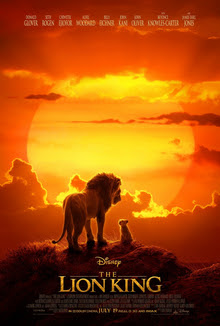
The Lion King is rated PG for “sequences of violence and peril, and some thematic elements.” Directed by Jon Favreau. Written by Jeff Nathanson. Starring Donald Glover, Seth Rogen, Chiwetel Ejiofor, Alfre Woodard, Billy Eichner, John Kani, John Oliver, Beyoncé Knowles-Carter, and James Earl Jones.
Monday, April 17, 2023
The Lion King (2019)
The Lion King is rated PG for “sequences of violence and peril, and some thematic elements.” Directed by Jon Favreau. Written by Jeff Nathanson. Starring Donald Glover, Seth Rogen, Chiwetel Ejiofor, Alfre Woodard, Billy Eichner, John Kani, John Oliver, Beyoncé Knowles-Carter, and James Earl Jones.
Tuesday, October 12, 2021
Monster March II: The Mummy (1999)
If you’re having a sense of déjà vu, don’t be alarmed. We did review the Universal Mummy films back in March, and we even reviewed this remake in 2012. But for an entry on the Personal Canon itself, it deserves more than 270 words. The Mummy is one of my all-time favorite movies. Here’s why.
Thousands of years after the high priest Imhotep (Arnold Vosloo) was condemned to an eternity of suffering, librarian Evelyn Carnahan (Rachel Weisz) and her treasure-seeking brother Jonathan (John Hannah) hire adventurer Rick O’Connell (Brendan Fraser) to lead them to the fabled lost city of Hamunaptra. Beneath the sands of Hamunaptra, though, the mummified Imhotep sleeps, and this band of explorers will soon learn that what awaits them is something other than buried treasure – and infinitely worse than death.
I’ve long made the joke that The Mummy may as well be called Indiana Jones and the Curse of Hamunaptra. With a similar pace, setting, atmosphere, and attitude, The Mummy needs only a few cosmetic tweaks to sneak its way into the Indiana Jones franchise for good. Brendan Fraser is heroically fun as our cocky swashbuckling protagonist, a kind of early “fortune and glory” iteration of the good Dr. Jones. He’s got the self-aware sarcasm down pat, yet he can flip to sincerity with a well-timed smolder. In short, Fraser is the key to the movie allowing us to have fun – he’s very clearly enjoying himself, too. Like Fraser, the movie is a master of its own tone, zany and madcap at one turn, cavalier and daring at the next, without losing any of its own integrity. The movie might poke fun at itself, but it never makes a fool of its audience.
Fraser is the perfect model for what’s going on with The Mummy because the film overall is never boring. If it’s not being funny, it’s ably building tension or hosting a rollicking action sequence, helped in no small part by Jerry Goldsmith’s rousing score. As the old meme goes, Jerry Goldsmith didn’t have to go so hard, but he did that – he did that for all of us. Goldsmith’s orchestral work soars, dabbles in the romantic, and plays around in the Arabesque; it works perfectly in the film, and it’s a darned good listen outside of the cinema, too. Longtime readers of the blog know that a good score is often my favorite thing about a movie, and you can get away with a lot if the music is doing its work right. Goldsmith is trying to do an uncomplicated arrangement a la Old Hollywood, but his use of motifs and swirling patterns mean this score isn’t one to ignore. (And yes, I was listening to the score as I wrote this review. How could you tell?)
Among the rest of the cast, everyone is doing their level best to make this world believable, and they do succeed. Weisz and Hannah are divinely cast as bickering siblings – somewhat broadly caricatured, it’s true, but their devotion to the clichés make these characters feel real. Arnold Vosloo, meanwhile, has a real presence as Imhotep, and though he doesn’t say much he’s expressively sinister in the scenes when he has all his skin; when he’s in ‘monster mode,’ Imhotep is creepy and ghastly to behold, which is all the better when the movie needs that quick jolt of terror that only a decaying corpse can deliver.
Then there’s the smaller supporting roles, a veritable who’s-who of late-90s character actors. Oded Fehr (who, incidentally, played a terrorist on Sleeper Cell while Vosloo played one on 24) is tons of fun as the dead-serious protector of Hamunaptra, while Kevin J. O’Connor is equally a blast in the role of servile weasel Beni, handily a top goon in the annals of monster movies. And don’t sleep on Erick Avari, indisputably the fin-de-siècle king of “Hey, it’s that guy!”, in the thankless role of fez-wearing museum curator Dr. Bey (not to be confused with Fehr’s Ardeth Bay); in mummy movies, there’s always a guy with a fez, and there’s always a shady museum curator, so Avari is the pristine cherry on top of a perfect sundae.
One of the things I’ve always loved about The Mummy isn’t quite apparent in the film itself, though it’s equally impossible to ignore. In 1999, The Mummy comes at the tail end of a decade of period pulp films, which is precisely my favorite flavor of cinematic ice cream. I’m thinking of films like Dick Tracy, The Rocketeer, The Shadow, and The Phantom – all of which I loved as a child and still do as an adult. We can enroll Tim Burton’s 1989 Batman in this pattern, and indeed we might even consider it the progenitor of a host of imitations to follow. At the climax of the decade, The Mummy is arguably the most successful of these period pulps, though I’ll always have an elemental soft spot for The Rocketeer. I’m a sucker for this kind of heightened reality, placed into a distinct historical past, without postmodern cynicism or deliberate genre subversion. Take a story and a time period, and revel in it; that’s what The Mummy does best of all.
The Mummy is rated PG-13 for “pervasive adventure violence and some partial nudity.” Directed by Stephen Sommers. Written by Stephen Sommers, Lloyd Fonvielle, and Kevin Jarre. Starring Brendan Fraser, Rachel Weisz, John Hannah, Arnold Vosloo, Oded Fehr, and Kevin J. O’Connor.
Monday, February 11, 2019
Cold Pursuit (2019)
With variable returns beginning from Taken, the indisputably finest of the genre, Liam Neeson has become Hollywood’s go-to for grizzled revenge thrillers. While Cold Pursuit has been marketed as the next high-concept riff on an old classic – Liam Neeson kills people with a snowplow, the posters promise – the end result is something closer to Fargo than Taken, more dark comedy than dark night of the soul, though Neeson seems not to know it.Neeson stars as Nels Coxman, snowplow driver and citizen of the year in Kehoe, Colorado. When his son turns up dead of a heroin overdose, Nels senses a darker truth and sets out for revenge on the drug dealers who killed his boy, working his way to the Viking (Tom Bateman) at the top of the distribution ladder.
In my journey toward avoiding trailers altogether (I’ve worked my way up to ignoring the “final trailers,” often riddled with spoilers), I admit I never saw a promo for Cold Pursuit and only knew of its existence because of early posters that showed Liam Neeson dragging a body past a snowplow. “I’m in,” I said confidently, but now that I’ve come out of the theater, I’m not exactly sure what I had gotten into in the first place. Cold Pursuit is an odd movie with a meticulously tuned sense of what is funny, what is conventional, and what constitutes finality. “What the hell was that movie?” I asked when the credits rolled, and I genuinely don’t know what to make of it. I enjoyed it, certainly, and got a fair dose of thrills from Neeson’s ability to turn mundane vengeance into Shakespearean violence. But at the same time I felt myself being recalibrated over the course of the movie, aghast at an early gag about morgue equipment but gradually realizing that the whole film finds humor in offbeat interruptions, as in a gag of magnifying returns where the names of the deceased appear as title cards.
The film continues a surprising number of subplots, many of which overwhelm Neeson’s by the end of the film, and it’s in these side stories that the film stretches its dark comedic wings. When the film’s focus is on Nels Coxman and his drive for revenge, it’s a mostly straight action thriller; Liam finds a baddie, interrogates him with varying degrees of roughness, and executes him with brutal precision. Elsewhere in the film, though, mobsters struggle with fantasy football drafts, quarrel over who’s on body disposal duty, and take to the ski slopes because they were “born to fly.” One senses that Neeson was starring in one film – and perhaps the finest joke of all is that he is deadly serious in ways the rest of the film steadfastly refuses to be, that Neeson persisted in Taken form when the film called for Fargo.
Cold Pursuit is director Hans Petter Moland’s American debut, remaking his Norwegian film, and perhaps the Scandinavian sensibility that gave us The Girl with the Dragon Tattoo (famously marketed as the “feel-bad Christmas movie” for American audiences) is to blame for this mad experiment in tonal shifts. It’s certainly not conventional American fare and can catch a moviegoer off-guard if they, like yours truly, enter a theater unaware. And yet, as a moviegoer increasingly aware of his own idiosyncratic sensibilities, there is something undeniably appealing about a director throwing caution to the wind and making a film that only he could have made. One could imagine a version of this film from the Taken crowd that would have been exactly what I expected, for better or for worse. So in that sense, Cold Pursuit earns my respect for giving me something I didn’t expect but ended up liking all the same.
Cold Pursuit is rated R for “strong violence, drug material, and some language including sexual references.” Directed by Hans Petter Moland. Written by Frank Baldwin. Based on the film Kraftidioten by Hans Petter Moland. Starring Liam Neeson, Laura Dern, Tom Bateman, Emmy Rossum, William Forsythe, Domenick Lombardozzi, John Doman, and Tom Jackson.
Monday, April 10, 2017
Beauty and the Beast (2017)
It’s a tale as old as time, and it’s certainly one we’ve
seen before. But for the first time in Disney’s ongoing project of remaking its
animated classics into live-action big budget fairy tales (with or without a
healthy dose of revisionism), Beauty and
the Beast both makes the case for another retelling of the story and
manages to be a compelling and potent riff on the original. If you’re like me, you probably have vast swathes of the 1991 animated film committed to (or seared into) memory, and you’ll likely be singing along in your head to the musical numbers, which get a few bonus verses here and there but are otherwise largely unchanged. So too is the plot translated fairly directly to live-action: bookish villager Belle (Emma Watson) finds herself imprisoned in the castle of the Beast (Dan Stevens), a prince turned monstrous by a curse, in order to save her doddering father Maurice (Kevin Kline). While local ape-man Gaston (Luke Evans) pines for her, to the consternation of his compatriot LeFou (Josh Gad), the castle’s lusty candlestick Lumiere (Ewan McGregor), fussy clock Cogsworth (Ian McKellen), and maternal teapot Mrs. Potts (Emma Thompson) conspire to bring beauty and the beast together to lift the spell.
In the case of Disney’s continued remake renaissance, I wouldn’t say there’s been a complete win. Maleficent was at once too distant from its source material while simultaneously pulling its punches on that difference. Meanwhile, Cinderella and The Jungle Book were visually stunning but ultimately more of the same as far as the originals were concerned. With Beauty and the Beast, however, I recall thinking several times during the film, “Oh, so that’s why they remade this!” Between its new characters and its patched-up plot holes, elucidated backstories and added lyrics, this Beauty and the Beast is a lot like a new brand of your favorite flavor of ice cream. There’s a lot that’s recognizable and reminds you what you love about it, but there are added nuances that gives this incarnation a life all its own. (It’s like the time I discovered they made cookie dough ice cream out of monster cookies and M&Ms.)
Perhaps the greatest strength of the film is its cast, which is positively bang-on from the word “go.” Watson and Stevens are well cast as the star-crossed lovers, in a romantic plotline that doesn’t feel obligatory and includes a few very well-crafted turns of character that give believability to the courtship plot. (That one such moment revolves around a library is perhaps preaching to this bibliophile’s choir, but I’d fall in love with a beast too if he had a library of his own to make Alexandria blush.) That McGregor, McKellen, and Thompson are note-perfect is right up there with “Water Wet” in terms of headlines, nor should one be surprised by the frankly stunning special effects work. What’s genuinely surprising is that Evans and Gad create something really quite special in Gaston and LeFou. Though it’s by no means sympathy for the devil, the script gives Gaston a refreshing amount of psychological depth, and Gad plays LeFou with an understated tenderness that gives LeFou a few legitimate reasons to hang around a specimen as deplorable as Gaston.
Indeed, what Beauty and the Beast does quite well is clarify a few of the nagging details and polish up the bits that work in order to present a fresh version of the story to an audience who is a little older, a little wiser, and a bit more sophisticated. This is hardly an “adult” version of the story, but it does feel a bit more grown-up, more willing to go to places the original didn’t – the question of Belle’s mother, for one, and the aforementioned update to Gaston: neither of which changes the characters or the plot but brings them into sharper focus.
Perhaps most importantly for this moviegoer, Beauty and the Beast never forgets to embrace with exuberance the playful weirdness of a film that includes a talking wardrobe, a barking footstool, and a boisterously romantic candlestick who turns a dinner invitation into something out of Busby Berkeley. It is the kind of film that touches the heart in the right places but isn’t embarrassed to leave you with a big dumb grin on your face as a talking clockface excretes gears in alarm. It’s a film that has more emotional range than we have any right to expect from a remake of an animated fairy tale.
But it’s also a film that, as the song goes, may have something there that wasn’t there before. I’m reticent to call it a brain or a heart or something so reductive, nor do I want to chalk it up to je ne sais quoi, though one character actually does. But unlike some of Disney’s more recent live-action updates, it has an unflappable demand to exist and ends up a worthy successor to the original.
Beauty and the Beast is rated PG for “some action violence, peril, and frightening images.” Directed by Bill Condon. Written by Stephen Chbosky and Evan Spiliotopoulos. Starring Emma Watson, Dan Stevens, Luke Evans, Josh Gad, Kevin Kline, Ewan McGregor, Ian McKellen, and Emma Thompson.
Monday, September 26, 2016
The Magnificent Seven (2016)
The very first thing that must be said about The Magnificent Seven is that any movie
directed by Antoine Fuqua that stars Denzel Washington is automatically worth a
look. Having said that, one can’t help but feel that The Magnificent Seven suffers a bit for being an ensemble piece
because we don’t get as much Denzel time as we deserve. That’s not to say that The Magnificent Seven is ever boring or
unwatchable, but it is underwhelming.In a remake of the eponymous 1960 western (which was itself a remake of Seven Samurai), Denzel Washington stars as Sam Chisolm, a bounty hunter recruited by Emma Cullen (Haley Bennett) to save her village from a mustache-twirling robber baron (Peter Sarsgaard) who wants the exclusive mining rights to the valley. Chisolm assembles a posse comprised of the self-proclaimed “world’s greatest lover” (Chris Pratt), a mountain man (Vincent D’Onofrio), a traumatized Confederate and his Chinese comrade (Ethan Hawke and Byung-hun Lee), a Mexican outlaw (Manuel Garcia-Rulfo), and a Comanche (Martin Sensmeier) on his own path.
Here’s a pretty good cast, and it’s really very evident that they’re all having a terrifically good time together. D’Onofrio is delightfully strange, as is his wont, and the rest of the cast seem to enjoy playing off that peculiarity. (Ten points to anyone who can identify that accent, incidentally.) Washington and Pratt are, essentially playing variations on the Yul Brynner and Steve McQueen, with an engaging chemistry between the two of them.
It is, however, a chemistry predicated on Pratt playing the clown and Denzel as the straight man, which is a tragic underutilization of the latter’s skill. It’s no surprise that Pratt is a success as a character that boils down to “Star Lord by way of John Wayne,” but it’s a wonder that Denzel loses to his costar so many opportunities for clever one-liners and sarcastic reactions. This isn’t to say that Denzel himself is a disappointment – in a sense playing both the leads of Django Unchained, Denzel is charismatic and heartbreaking, determined and haunted, and (we sense) withholding a part of himself from his exterior out of a sense of duty and propriety. But it is a bit of a letdown to come to expect a leading performance out of an actor who’s modest enough to embrace his role as 14% of an ensemble.
The Magnificent Seven is not, as its title promises, magnificent. It’s not a transcendent moviegoing experience, but then again in late September I don’t think it has to be. Because on the other hand, The Magnificent Seven is not a disappointment of heroic proportions. It’s fun and fluffy and diverting, and it doesn’t do anything egregiously wrong. It’s in that Baby Bear territory of “just right,” and perhaps it’s gluttonous of me to want the Papa Bear portion of a Denzel Washington western. Moreover, it’s different enough from its predecessors to justify its existence as a variation on a theme. At any rate, keep them coming, Denzel, because I’ll be in the front row every time.
The Magnificent Seven is rated PG-13. Directed by Antoine Fuqua. Written by Nic Pizzolatto and Richard Wenk. Starring Denzel Washington, Chris Pratt, Ethan Hawke, Vincent D'Onofrio, Byung-hun Lee, Manuel Garcia-Rulfo, Martin Sensmeier, Haley Bennett and Peter Sarsgaard.
Monday, July 18, 2016
Ghostbusters (2016)
Set the “controversy” aside, and take the movie on its own
terms. Ghostbusters is plenty of fun
and a pretty strong example of how to remake a movie with sufficient reverence
balanced by satisfactory innovation.Years ago, Erin Gilbert (Kristen Wiig) and Abby Yates (Melissa McCarthy) coauthored a book on the paranormal, but Erin has tried to distance herself with a legitimate career in academia. A haunted house in New York, however, brings the two back together, with Abby’s new partner Jillian Holtzmann (Kate McKinnon) and streetwise MTA employee Patty Tolan (Leslie Jones) rounding out the pack of paranormal investigators dubbed “Ghostbusters,” who become the last line of defense when New York is riddled with ghosts.
I was among the skeptics when a Ghostbusters remake was announced – having nothing to do with the gender switch, but based entirely on the fact that the original Ghostbusters movie is alchemically good, difficult to duplicate like lightning in a bottle. And remakes almost never live up to the original, let alone surpass it (aside from The Maltese Falcon and The Departed, that is). So I was a little trepidatious while in line for my ticket, but the trailers had looked funny enough, and I hadn’t been to the movie theater in nearly two months.
I’ll say that I went into this film expecting it to be something less than Personal Canon material, and I’ve found that the lower I temper my expectations the more I tend to enjoy a film. But I think Ghostbusters is genuinely entertaining even without the expectation threshold. It’s not, however, a classic like the first Ghostbusters – at least, not yet, perhaps – but it’s quite far from disgracing the legacy of the original. No, it’s a case study in how to do a remake right; it nods toward the original (including fun cameos from nearly all of the original cast, save Rick Moranis), moves in its own direction, and doesn’t forget to have fun along the way. What it’s not, and I think some of us were expecting it, is a legacy film, in which the ladies accept the mantle from the original team. As great as it would have been to see Dr. Venkman back on screen, it’s a smarter play to let the film run in its own direction.
Melissa McCarthy continues to be the queen of physical comedy, bounding about the screen while attached to a misfiring Ghostbusters backpack; she’s equally at home with quick delivery, like the moment she realizes that her proposed slogan for the Ghostbusters already belongs to another group. Kristen Wiig is perfect at playing it straight, hamming it up in overdrawn romantic gestures toward her new secretary (Chris Hemsworth, in a fun comedic turn), but it’s Kate McKinnon who steals the show as ostensibly this film’s Egon Spengler, the socially awkward genius. It’s the only role loosely borrowed from the original, but McKinnon does crazy eyes and lingering silences better than anyone. For Jones, the film never quite develops her “New York expert” character trait, but she gets to have just as much fun as the others and even ties in with one of the most fun cameos of the film.
Your childhood is safe. It’s only a movie. (It’s only a movie, the horror trailers would have us repeat.) It’s a very fun movie, the second coming of Slimer but far from the greatest film of the summer. It’s diverting and entertaining – and good heavens, is it loud! – but for an afternoon off, it’s good spectacle and hopefully the start of a new franchise where the fun keeps rolling even beyond the credits (after which, you’ve got to stay).
Ghostbusters is rated PG-13 for “supernatural action and some crude humor.” There are ghosts in here, and some of them barf green slime.
Monday, June 6, 2016
The Top 10 Movies Denzel Should Remake Next
Which brings me, of course, to the subject of today’s post: “The Top 10 Movies Denzel Should Remake Next.” Of course, no slights intended to the original performers or films, but it’s a fun exercise to imagine a world in which Denzel stars in every movie.
10. Star Wars: Episode I – The Phantom Menace, starring Denzel as Qui-Gon Jinn
To be fair, Liam Neeson wasn’t given much to work with in a role that’s really only memorable because Neeson played it. Denzel could bring a great quiet dignity to the role and develop a tender relationship with young Anakin Skywalker.
9. The Da Vinci Code, starring Denzel as Robert Langdon
Tom Hanks is perfectly serviceable as Langdon, but I think we can all agree it’s not a home-run performance. Denzel would lend palpable genius, innate credibility, and a better haircut to a role that’s roughly analogous to a contemporary Indiana Jones.
8. North by Northwest, starring Denzel as Roger Thornhill
For my money, the second-best Hitchcock film (after Psycho) needs no revision, since I get an elevated heart rate just thinking about the last time I saw it. But Denzel has carved out a career niche playing men against time, men driven on a mission inflicted upon them. Cary Grant was sufficiently harried, but imagine Denzel out of his element, running from an airplane through a cornfield.
7. Fahrenheit 451, starring Denzel as Guy Montag
I’m aware that there’s an HBO remake in the offing, likely to address some of the shortcomings of the Truffaut adaptation of Ray Bradbury’s novel, and while I haven’t seen any casting information I submit Denzel for the part of a man whose firm convictions are overturned as his worldview alters dynamically. Gone would be the glassy-eyed stare of Oskar Werner; let Denzel emote his way through this American classic.
6. Harvey, starring Denzel as Elwood P. Dowd
It’s a fairly kooky concept – presumed insanity in the form of an imaginary giant rabbit friend – but if anyone could make be believe in an invisible bunny, it’s Denzel.
5. Licence to Kill, starring Denzel as James Bond
I agonized over this one – I’d love to see Denzel as James Bond, even though he’s not British, and I think he’d be more believable as a seasoned Bond than a novice 007, so something like Casino Royale was out. But Denzel as an espionage veteran out for revenge, infiltrating cartels and destroying them from within using little more than his wits? Step aside, Idris Elba – make mine Denzel.
4. 12 Angry Men, starring Denzel as Juror #8
This perfect film has already been remade once, but something tells me Denzel could do more with the material than Jack Lemmon (who, let’s be fair, is a titan in his own right). If you need to cast a man who can change eleven recalcitrant minds by the force of his own convictions, what about that doesn’t demand Denzel?
3. Dirty Harry, starring Denzel as Harry Callahan
No one does grizzled like Clint Eastwood, but Denzel has had success in the past playing cops on the edge, law enforcement officers with their own unique codes of justice. I’d love to hear him do the “I know what you’re thinking” speech
2. Casablanca, starring Denzel as Rick Blaine
It’s horrifyingly inevitable that someone, somewhere will remake what is by most accounts one of the most perfect of the perfect films. So if it must be done, put it in the most capable hands and let Denzel lead. Lost love, garrulous barkeep, cynical yet soft-hearted – Rick is a complicated character, and Denzel has the chops to pull it off. Heck, Denzel could be a lock for any Humphrey Bogart vehicle – The Maltese Falcon, Key Largo, Sabrina, The Caine Mutiny...
1. Batman, starring Denzel as Batman
I don’t need to say more here, do I?
Sound off in the Comments – what would you like to see Denzel remake?
Monday, March 16, 2015
Cinderella (2015)
With Maleficent
(mercifully) behind us and a live-action Beauty
and the Beast yet to come, we’re in the midst of a live-action reinvention
over at the House of Mouse. While I do
have some reservation regarding the overall necessity of the move, I do think
that Cinderella acquits itself better
than Maleficent thanks to its
narrative fidelity and its frankly stunning production value.In what is essentially a remake of the 1950 animated Disney film, Lily James stars as Cinderella, left after her father’s passing in the care of her evil stepmother Lady Tremaine (Cate Blanchett). After a chance encounter with her Prince Charming (Richard Madden), Cinderella makes every effort to go to the ball, with a little magical assist from her Fairy Godmother (Helena Bonham Carter).
The most striking thing about Cinderella is, surprisingly, the clothing. I cannot recall ever being as impressed with costume design as I was with Sandy Powell’s work on this film. (Fun fact: she’s also the costume designer for my all-time favorite film, The Departed.) Perhaps some credit is due to the cinematography, but the colors in the film really pop in a way that dominates my overall impression of the film – Cinderella looks spectacular. The dresses of Lady Tremaine and her daughters very plainly communicate their interior ugliness, doing so with a flair that Powell has described as nineteenth century by way of the 1940s. Cinderella’s dresses, too, are incredibly vibrant, matching well the Prince’s royal finery.
The film overall has a very polished look which I credit to the very pristine direction of Kenneth Branagh, who does fairy tales with the same elegance he brings to Shakespeare and superheroes. There are a few nods to both – from Hamlet, both Derek Jacobi and fencing, and from Thor, Stellan Skarsgard – but more importantly, Branagh brings his trademark earnestness to Cinderella. It’s honestly a little jarring to go from the delightfully revisionist Into the Woods, in which Cinderella’s indecisiveness clashed with Prince Charming’s insincerity, to a film which wholly believes in the happily-ever-after genre tropes.
Despite the well-crafted nature of the film and the strong performances all around, there is still the lingering question of whether there is a need for another treatment of Cinderella which doesn’t really distinguish itself too strongly from the versions that preceded it. This is, of course, the question asked of every remake at one time or another, and my chief complaint about Maleficent was, you’ll recall, that its contributions to the revisionist project were so uneven that the best scene was the one that took the fewest liberties, so clearly there’s a threshold of acceptable innovation/transgression. Cinderella succeeds, I think, on the grounds that it steers a very straight course through the familiar elements of the plot in an even and engaging way, but as content as I felt during the end credits there was still the sensation that I hadn’t actually seen anything new.
Now, to be fair, Cinderella goes 180-degrees from Into the Woods by making the Prince more, not less, compelling; where Sondheim’s Prince “was raised to be charming, not sincere,” Cinderella gives us a prince bristling at his royal obligations, more interested in marrying for love than for obligation (subtext that I don’t recall being quite so present in the animated film). It also recognizes that Cate Blanchett is phenomenally gifted, so Lady Tremaine’s wickedness is played up as well as explored near the end of the film as she monologues about her motivations.
Ultimately, then, I’m in an unusual place with Cinderella. The creative team responsible have created something that amounts to a very good cover band version of a classic with a few neat solos in the middle there, but there’s a curmudgeonly bit of me that wants to cling to the original because the new isn’t different enough. Then again, I think of all the children in the theater with me that afternoon, and I realize that for them this film likely is the definitive Cinderella, and I don’t think that’s such a bad thing. Maybe the better metaphor is that of translation, the act of going from one language (animation) to another (live-action), and it is on those grounds that Branagh’s Cinderella succeeds.
Cinderella is rated PG for “mild thematic elements.” I suppose that’s due to the passing of Cinderella’s parents and the verbal abuse she endures at the hands of her wicked stepmother, but this is very nearly G-rated material.
Bonus review! Cinderella is preceded by a seven-minute short, Frozen Fever – a sequel to (you guessed it), Disney’s wildly profitable Frozen from two Christmases ago. The short finds Elsa (Idina Menzel) prepping the kingdom for the birthday of her sister Anna (Kristen Bell). Only two things stand in the way – the snowman Olaf (Josh Gad) is trying to eat the cake, and Elsa has a head cold. The cynic in me thinks that Frozen Fever is a long advertisement for plush toys of the snow-babies created whenever Elsa sneezes, but aren’t they cute? By nature of being so short, Frozen Fever isn’t long on substance, but it does continue the film’s emphasis on the sisters’ relationship over a romantic one between Anna and Kristoff in a way that is more refreshing than treacle. The main song “Making Today a Perfect Day” is about as catchy as “For the First Time in Forever” from the main film, though it won’t, I predict, have the staying power of “Let It Go” (either in eternity or in your head). All told, I’m a bigger fan of Disney’s original shorts like Paperman and Feast, though Frozen Fever is as pleasant as the “Toy Story Toons” we’d been getting for a while there, a fun pit stop with some familiar faces.
Monday, January 5, 2015
The Gambler (2014)
Wherefore art thou, William Monahan? Whither went the man who won an Oscar for the
screenplay to my single favorite movie of all time, The Departed? Well, it seems
we know; he had a hand in the dismal Sin City: A Dame to Kill For, and now this.
The Gambler isn’t on par with
the disappointing and ultimately unnecessary Sin City sequel, largely on the strength of the performances, but
it is a tragically unengaging affair.Mark Wahlberg stars as Jim Bennett, a literature professor and novelist with a gambling addiction and a laundry list of sharks (Michael K. Williams and John Goodman among them) to whom he owes money. While he wrestles with his debts, he borrows money from his mother (Jessica Lange) and enters into a semi-illicit romance with one of his top students (Brie Larson).
As someone who has taught literature at the college level for some time now, I must begin by saying that the classroom scenes in The Gambler are halfhearted at best and, at worst, horribly ill-conceived. They seem to serve only to introduce the character of Lamar so that he can be in place for the climax of the film, because top student Amy (more about whom, later) doesn’t contribute much. It’s evident that Monahan hasn’t set foot in a classroom in a very long time, even setting aside the utter absurdity of placing Camus next to Shakespeare on a survey course syllabus. Bennett’s class sessions, which oscillate between a packed lecture hall and a group of barely ten students, are longwinded, unfocused, with little to no actual literary content; instead, Bennett insufferably berates his students and himself until dismissing them early because one is sick of the other.
Maybe that’s the point, you suggest, to which I’m willing to listen – at which point, however, I respond that the very characterization of Jim Bennett is a colossal misstep. Either he’s deliberately unlikeable, or Monahan’s script has failed the character. I’m inclined to think the latter based on the film’s conclusion. Without spoiling anything, the character pulls off an eleventh-hour personality change and becomes really quite clever – this after two hours of the gambling equivalent of Leaving Las Vegas. I’m sorry, Gambler, you can’t be both an unflinching look at the woes of addiction and then go for the Hollywood ending.
Then there’s the whole problem with Larson’s character. As near as I can tell, the sum purpose of her character is that Amy is someone with whom Mark Wahlberg’s character can have sex. I’d forgive the script the intensely problematic aspect that Bennett has a relationship with a student if the script didn’t explicitly point out how inappropriate this is and then proceed to do nothing with that detail. The worse crime is that the character is virtually devoid of personality and could be removed from the film entirely without any impact on the plot whatsoever.
None of this, incidentally, is the cast’s fault. Wahlberg, Williams, and especially Goodman all turn in grand performances, and if the production starred rank amateurs I’d have walked out. This holy trinity, however, does the best they can with the material, and my faith in them maybe even elevates the material. There are a few really snappily-written monologues in the film, mostly leading up to scenes in which Bennett borrows money, monologues that make me long for the William Monahan with whom I fell in screenplay love.
If you’ll indulge the concluding pun, I think The Gambler is something of a gamble for moviegoers. Either you’ll have the patience for the uneven screenplay or you won’t, but the game is rigged in favor of an unearned Hollywood ending amid a host of master showmen brandishing their hands.
The Gambler is rated R for “language throughout, and for some sexuality/nudity.” The language is as salty as the popcorn, rife with the F-word, and a brief scene in a strip club shows topless women. Wahlberg gets roughed up a bit by the folks to whom he owes money.
Thursday, June 19, 2014
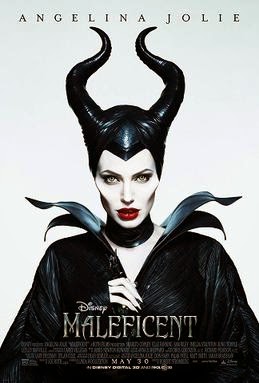
Maleficent (2014)
And I won’t do the usual plot summary bit here because the plot of the film is essentially a “sympathy for the devil” take on Disney’s 1959 animated Sleeping Beauty, starring Angelina Jolie as the eponymous fairy queen who’s betrayed by the kingdom of men before she curses the young princess Aurora (Elle Fanning). While this sounds like a prime opportunity to reinvent the story, promising us the version of the fairy tale we hadn’t heard before, Maleficent very much amounts to a pulled punch.
I’ll start with the good news, and it’s probably something you’ve already heard because nearly every film critic agrees: Jolie is perfectly cast as Maleficent; she does a phenomenal job delighting in her own wickedness, she walks with the grace of a fairy queen, and her delivery captures flawlessly the intonations Eleanor Audley brought to the original. And there’s a curious moment near the middle of the film where Maleficent restages the curse scene from the original Sleeping Beauty animated film. I say curious because it is unequivocally one of the best moments in the entire film, and it leads me to wonder why Disney bothered with all the trappings of a retelling and didn’t just opt for a straight remake.
I hate to be cynical, but frankly this film is aimed at the grungy Hot Topic crowd, who are probably going to love it. Maleficent is part of Disney’s recent push to reinvent classic films, as with Tim Burton’s Alice in Wonderland and the upcoming Kenneth Branagh Cinderella (March 2015), but it’s not as successful as Wonderland was because it never commits to a core idea – or rather, it commits to too many. Angelina Jolie is so good that her character deserves a better vehicle, one more certain of what it wanted to do with the character. Either Disney should have given us the true between-the-scenes take on what Maleficent was up to, or it should have given us a truly sympathetic portrait of Maleficent the misunderstood. Instead, the film tries to give us both, and the result is a film that never fully invests to itself.
It’s a cop-out to boot – either you want us to sympathize with the character or you don’t (or, if you’re Breaking Bad, spend six years exploring that gray area). The film’s conclusion that Maleficent was both a hero and a villain is, truthfully, an evasion. You do see the hand of uncredited rewriter Paul Dini here; he famously brought pathos to the backstories of many Batman villains in the early 1990s animated series, though the fact that only Linda Woolverton gets screenwriting credit suggests why Disney’s Maleficent can’t do in 97 minutes what Batman’s “Heart of Ice” did in 20. (I’m referring, of course, to the definitive rebranding of Mr. Freeze as a tragic villain out to avenge his cryo-frozen wife.)
Honestly, I’m not sure if the bigger problem with the film is a studio that wants to have its fairy cake and eat it too, or if first-time director Robert Stromberg is juggling too much at once. The film does have a very appealing look, and the shots are very interesting. The special effects look good, especially the climactic dragon battle. Interestingly, the film also participates in Disney’s recent trend of rejecting “love at first sight” and backing away from “love conquers all.” With Frozen and Brave, Maleficent makes three films where the studio offers a self-reflexive critique of its early, easier boy-meets-girl narratives. The difference is, however, that by now we’ve already seen this new spin, and the film doesn’t really break any new ground on that front.
Maybe I’m just being excessively vitriolic because I haven’t written a truly bad review in a while, and the bile’s built up. I will say that I’m not sorry to have seen it. I’m a fantastic Disney shill and will watch just about anything the studio puts out, and although it may not sound like it I truly do not begrudge Maleficent the ninety-plus minutes I spent watching it. It’s fine for what it is, but it’s impossible to watch the movie and not see snippets of a much grander, more ambitious project. But, as the film states explicitly, ambition is supposed to be bad, and so the result is a somewhat neutered update on a fairy tale which, this very update proves, didn’t need updating in the first place – at least, not the kind of halfhearted updating we’ve been given.
Maleficent is rated PG for “sequences of fantasy action and violence, including frightening images.” The scene after Maleficent’s wings are taken is disturbing – many are reading it as a rape metaphor – and some blood is seen on her back. As for frightening images, there’s nothing scarier than what a conventional Disney film offers; there is some swordfighting, and iron is seen to burn fairies in a few scenes.
Friday, February 7, 2014
Never Say Never Again (1983)
We’ve been doing this review series for fourteen months now,
and I always tease the next installment by saying that “James Bond will
return,” but it’s been a bit of a downward spiral these past few months as we
hit the doldrums of the Roger Moore era (or should we say reign of error?). Finally, with 1983’s Never Say Never Again, we can officially say: James Bond is back, baby. And with Sean Connery back at the helm, it’s
almost enough to overlook the film’s faults.Essentially a remake of Thunderball, Never Say Never Again finds Connery as an aging 007 pulled out of therapeutic retirement to counter SPECTRE’s latest plot for world domination. While investigating Domino Petachi (Kim Basinger), the sister of a dead Air Force pilot, Bond realizes that two missing warheads are in the possession of Domino’s domineering lover Maximillian Largo (Klaus Maria Brandauer).
It seems odd to remake an entry in the canon less than twenty years after Thunderball, but the success of Never Say Never Again is largely due to the work of two men – Sean Connery and director Irvin Kershner (who, of course, helmed The Empire Strikes Back). Kershner keeps the film moving, avoiding the dull bits with a good action sequence or attractive cinematography, and Connery slips back into the role with all the charisma we’d expect from a veteran thespian. The decision to foreground Connery’s return as a crucial plot element is an inspired one, and it’s woven quite seamlessly into the tapestry of Thunderball for a film that seems familiar yet cleverly updated.
The graying Bond plotline fits perfectly with the spa retreat portions of Thunderball, also giving Connery a solid action sequence after a frankly lackluster opening (the jungle infiltration here fails to live up to Thunderball’s jetpack funeral crash). And Connery’s roguish sense of humor plays well opposite a frustrated M; though the “upper management loathes Bond” plot doesn’t quite mesh with what we’ve seen from previous films, a more welcome change is the newer camaraderie with Q – whose previous frustration with 007 gives way to a warmer embrace when he realizes how much fun it is to have Bond/Connery back.
Indeed, Never Say Never Again is an extremely fun outing for Bond. It mercifully avoids the slapstick comedy of, say, Octopussy (released the same year), but Connery plays the role with a wry wink and a powerful penchant for opportune one-liners. Brandauer too, as a contemporary Peter Lorre type, plays his madman baddie with gleeful insanity (which he proudly admits when one character labels him as such). The big surprise here is Basinger’s Bond girl; while I’m not the world’s biggest fan of hers, she plays second fiddle to Connery without succumbing to the empty-headed bimbo stereotype, instead offering a Domino whose anger at her brother’s death is palpable. More importantly, Bond’s seduction of Domino is entirely plausible, even in spite of the wiry gray tint in Connery’s sideburns (okay, maybe even because of the gray).
It’s not a perfect Bond film – Goldfinger can rest easy in that regard. Because it’s a one-off in a sideways universe version of James Bond, we never get closure on Blofeld, who remains at large; it’s a shame, since Max von Sydow’s master criminal role is a treat and mixes menace with that classic British smug satisfaction. Perhaps the biggest crime, aside from a motorcycle in place of an Aston Martin, is that the score is wholly devoid of the classic Bond theme. For legal reasons, of course, it couldn’t have appeared, but in this regard Thunderball has the advantage; nothing beats a John Barry score.
If someone somewhere layers a Barry soundtrack over this film, though, we might be looking at a solid silver to stand beside Goldfinger. As it stands, though, Never Say Never Again is a pleasant detour away from the catastrophe of the mainstream franchise, and I’ll never say never ever to more Sean Connery.
Never Say Never Again is rated PG. Bond beds three different women, one of whom wears a translucent leotard. The typical amount of fistfights and gunfights transpire, though with a little more blood than in the mainstream series thus far; one person explodes.
James Bond and The Cinema King will return in a review of A View to a Kill (1985) on March 7, 2014!
Monday, April 1, 2013
Monday at the Movies - April 1, 2013
That does it for this week’s edition of “Monday at the Movies.” We’ll see you here next week!
Monday, February 18, 2013
Monday at the Movies - February 18, 2013
The Dictator (2012)
– Look, I’m a big fan of Sacha Baron Cohen, both his prankumentary style (which
he perfected in 2006’s Borat) and his
more traditional character work (with which he stole Les Misérables). On the
surface, The Dictator ought to be a
delightful blend of those two – a scripted comedy about a hapless Middle
Easterner with a ludicrous accent.
Instead, what you get is a confused and barely-funny satire of... well,
the film never quite focuses on one target long enough for a sustained take on
Arab dictatorship, college yuppie liberalism, or American democracy. Any one of these could be the subject for a
clever comedy, but the odd melding of the three leaves us uncertain who we’re
supposed to root for. Cohen plays
Admiral General Aladeen with his usual enthusiasm, but he’s pumping air into a
disappointingly lifeless script which is, for vast stretches, entirely without
laughs. Many of the gaffes are
predictable, elongated beyond their worth, or just plain unfunny, and even Cohen’s
trademark disappearance behind the character isn’t enough to engage the
audience. There are a few chuckles to be
had – cameos by John C. Reilly and a self-deprecating Megan Fox gesture toward
a palpable and intriguing direction for the film – but mostly the film seems
unsure what it wants to be and tries to be all those things at once, making for
a very disunified whole. The film is a
lot like Ben Kingsley’s role therein (yes, Sir Ben costars): you don’t quite know how so many talented
people got into such a mess, but you’re disappointed that they’re not doing
better work.
21 Jump Street (2012)
– Nothing about this movie screams success; in fact, nothing about the film
should work. A remake of an ’80s TV
show, 21 Jump Street stars Channing
Tatum and Jonah Hill as undercover cops in a high school where new illegal
drugs are being distributed. I
repeat: no part of that sentence has
really ever worked in a movie before.
Yet there’s something about 21
Jump Street that is surprising in a very good way: the movie is very funny, rather clever, and
just downright better than it ought to be.
Hill and Tatum have tangible chemistry as partners, best friends, and
pseudo-brothers; they play off each other like Simon Pegg and Nick Frost do in Shaun of the Dead (among others),
exploiting each other’s foibles while working together to accomplish their
goals. The film is incredibly
self-aware, with many characters acknowledging and poking fun at the fact that
Hill and Tatum look far too old to be high schoolers, but the film’s greater
strength is its funny script given life by a bevy of talented supporting cast
members. It’s almost enough just to
mention their names – Nick Offerman, Ellie Kemper, Rob Riggle – because their
work is reliable and solid. (Kudos also to
Ice Cube, who practically steals the show as a self-conscious walking
stereotype who shouts about Miranda rights and “Korean Jesus.”) And yes, that original 21 Jump cast member makes a fun
appearance, too. A surprisingly
entertaining entry from a team that’s never really delighted me before, 21 Jump Street deserves more than the casual
brush-off its premise usually elicits.That does it for this week’s edition of “Monday at the Movies.” We’ll see you here next week!
Monday, February 11, 2013
Monday at the Movies - February 11, 2013
Meet the Robinsons
(2007) – I know that I’m an unrepentant Disney shill, but when I say that Meet the Robinsons is essentially
Disney/Pixar’s version of Doctor Who,
I mean that in the best, most wibbly-wobbly way I can: Meet
the Robinsons combines Doctor Who’s
timey-wimey mechanics and sense of wonder with the classic Disney
sentimentalism and compelling storytelling, to great effect. Loosely adapted from William Joyce’s A Day with Wilbur Robinson (a favorite
of mine as a young boy), this film weaves a time-travel narrative while
layering on a rich subplot about finding your place in the world amid a cast of
kooky characters whose madcap personalities mean they share a house, a surname,
and little else. The Robinsons are
oddball supporting characters, each quirky without excess, though Adam West’s
turn as the spandex-clad pizza deliveryman uncle is a surprising treat. The real delight in Meet the Robinsons, though, is how surprisingly profound it is; a
Disney movie usually doesn’t include heavy meditations on the future
consequences of the present, nor has the “best friends” relationship been
explored in as much satisfying depth.
What’s more, the time travel element of the film allows for a few neat
third-act surprises that even caught me off-guard. Truly, the influence of John Lasseter looms
large over Meet the Robinsons,
because the film mixes high concept sci-fi designs with moving character arcs
that sucker-punch an earnest tear right into the corner of your eye. Come for the gee-whiz marveling at a great
big beautiful tomorrow, stay for the feelings.
The Three Stooges
(2012) – The words I’d like to use to describe this film are unsuitable for
general consumption, so I’ll simply begin with a three-letter word: Why?
Why make a movie that wears its unoriginality on its sleeve and pretends
to be an homage? Why steal three classic
characters and recycle them with lesser performers who are little more than
impersonators? (In fact, I don’t need to
tell you who’s in it, because it doesn’t matter.) Why shoehorn the Three Stooges into a
halfhearted and instantly recognizable “Save the Catholic Orphanage” knockoff
of The Blues Brothers? Why watch this mess of a movie when there are
dozens of funnier shorts starring the real Three Stooges? Why did I even sit through this whole thing,
when the episodic nature of the film makes it easy to stop partway through? The world may never know the answers to these
questions, because this is one of those “Abandon all hope” kinds of movies,
where there are only weak chuckles, at best, to be had. The film imitates the Stooges’ style with so
little invention that you’re left wondering what the whole point was –
especially when the film concludes with the film’s directors reminding you that
the stage violence, the real heart of a Stooges short, was all fake and should
not be replicated at home. It’s this
kind of lifeless balloon deflating that reminds us the Stooges need not be
redone; even the attempt at relevance by having Moe poke Snooki in the eyes
fails to garner a smile.
That does it for this week’s edition of “Monday at the Movies.” We’ll see you here next week!
Monday, April 9, 2012
Monday at the Movies - April 9, 2012
Repo! The Genetic Opera (2008) – I have a hesitant affection for the Saw franchise (mostly redeemed by Tobin Bell’s star-marking performance), so this Darren Lynn Bousman rock opera is something I’ve orbited but to which I’ve never committed. While I’m no foe of musicals, the cast seemed a mixed bag: Paul Sorvino and Anthony Head on the one hand, Paris Hilton on the other. All told, Repo! is an odd hybrid of Sweeney Todd and the Saw franchise, with a dollop of dystopia thrown in for set dressing. Make no mistake – this is an opera, with generational rises and falls punctuated by bombastic solos and Sondheim-esque talk-singing. Sorvino is Rotti Largo, the dying organ transplant baron in search of a new heir after his brood (including Hilton as the surgery addict Amber Sweet); he finds one in Shilo (Spy Kids alum Alexa Vega), the daughter of his top organ-collecting repo man (Anthony Head). Among the film’s greatest strengths is its highly stylized look, ready-made for the Hot Topic crowd, and its rich plot, whipping between multiple threads which all tie together at the opera-within-an-opera finale. Unfortunately, though, the runtime is a little brief, and each plot thread is introduced with an exposition-heavy montage which might have been better served with a more extended flashback or musical sequence. Additionally, the film will turn off many with its gruesome violence (blood flows, intestines spill, and a face even falls off) and its musical style (more rhythmic slam poetry than melodious harmony), but I found it an enjoyable enough 90-some minutes.
Tristram Shandy: A Cock and Bull Story (2006) – Steve Coogan and Rob Brydon (best known as “those guys in the Michael Caine impressions video”) star in this metafictional adaptation of Laurence Sterne’s famously sprawling proto-postmodern novel, at once a filming of the book and a mockumentary on the making of said filming. After finally reading Tristram Shandy, I went back to the film, and my suspicions were confirmed – the film has many more jokes for those in the know, but it’s at its best when Coogan and Brydon are turned loose upon each other in a battle of one-ups-manship and celebrity impersonations. We begin with a riveting conversation in the makeup chairs, move to a half-hour adaptation of the first few volumes of the novel, and conclude with a failed preview screening of the failed film. There’s about 45 minutes that are almost entirely negligible, dwelling on Coogan’s self-caricature and ruminating a bit too much on the unfilmability of the novel. As a result, it’s easy to get distracted once the film stops showing the straight adaptation segments, especially in the moments when Coogan and Brydon are kept apart. There are a few clever bits, as when Gillian Anderson is cast to play the Widow Wadman, but this is a plot that doesn’t get as much attention as it ought. I’ll say this, though; rewatching Tristram Shandy has reminded me how much I still need to see The Trip, in which Coogan and Brydon team up for a restaurant road trip.
12 Angry Men (1997) – Having glowingly reviewed the Sidney Lumet original last week, I was delighted to see that the remake is available on YouTube. I was even more delighted by the all-star cast – Jack Lemmon, George C. Scott, Ossie Davis, and James Gandolfini, among others. But almost immediately I realized this was a case of a remake which doesn’t do enough to distance itself from the original, nor does it remain slavishly loyal in apparent devotion. Instead, it’s an indistinct reflection of the original, right down to imitative line readings (especially from Tony Danza as Juror #7). While Lemmon does gravitas without even thinking about it, he’s a far cry from Henry Fonda, and even Scott doesn’t improve upon the performance of Lee J. Cobb. Indeed, the only performance which adds something to the film is Mykelti Williamson’s turn as Juror #10; here the white supremacist Ed Begley is replaced by a lapsed member of the Nation of Islam, spouting bigotry against the Hispanic defendant. This clever update, however, is overshadowed by the fact that the film frequently oversimplifies itself, telling instead of showing, as when Juror #3’s bias against the defendant is verbalized instead of implied (as in the original). While it’s in theory a good idea to put contemporary actors into an old classic, when they don’t turn in a new or interesting product, even Juror #12 – straight out of Mad Men – couldn’t sell it to an audience. Stick with the original; this one’s guilty of stagnation.That does it for this week’s edition of “Monday at the Movies.” We’ll see you here next week!